Feb. 14, 2020: The night sky is in danger. This has been true for years as urban landscapes became increasingly light-polluted. But now there’s a new threat, one you can’t escape by driving into the countryside. It’s the “mega-constellation.” Some companies are planning to launch tens of thousands of internet satellites into low-Earth orbit. The recent launch by Space X of just 240 Starlink satellites has already ruined many astronomical observations.
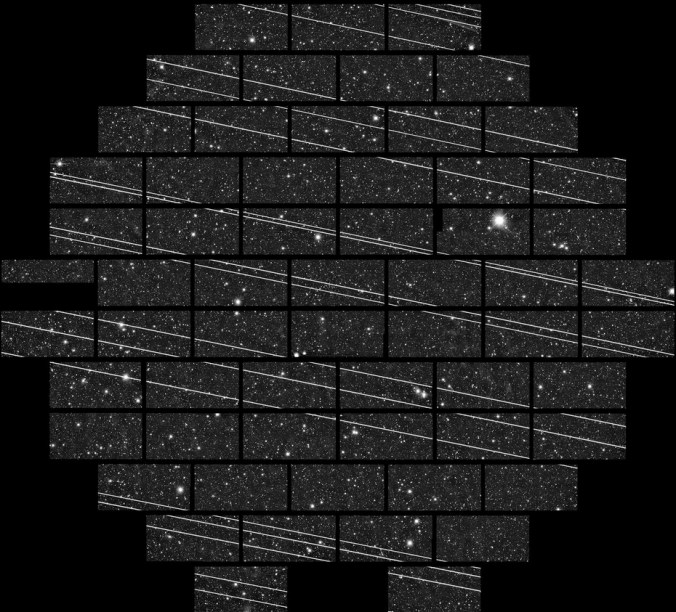
Above: Astronomers at the Cerro Tololo Inter-American Observatory were trying to photograph nearby galaxies when 19 Starlink satellites intervened. [Full Story]
1. The number of satellites above the horizon at any given time would be between ~1500 and a few thousand. Most will appear very close to the horizon, with only a relative few passing directly overhead.
2. When the sun is 18 degrees below the horizon–that is, when the night becomes dark–the number of illuminated satellites above the horizon would be around 1000. These numbers will decrease during the hours around midnight when many satellites fall into Earth’s shadow.
3. At the moment it is difficult to predict how many of the illuminated satellites will be visible to the naked eye because of uncertainties in their reflectivity. Probably, the vast majority will be too faint to see. This depends to some degree on experiments such as those being carried out by SpaceX to reduce the reflectivity of their satellites with different coatings.
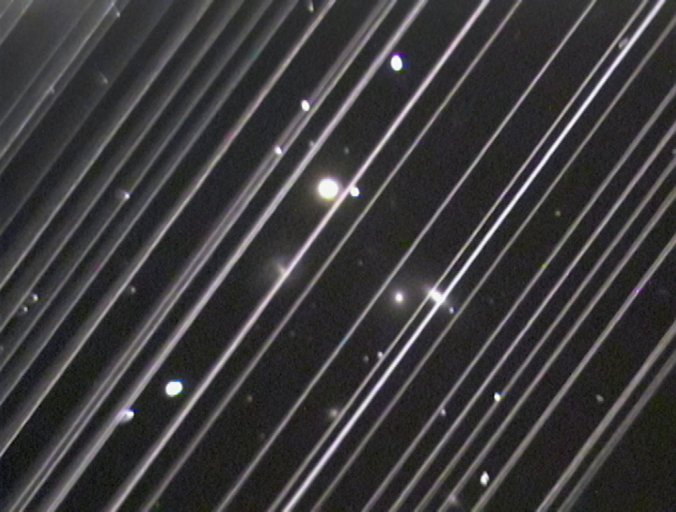
Above: Starlink satellites photobomb the NGC 5353/4 galaxy group at Lowell Observatory [more]
5. The Vera C. Rubin Observatory currently under construction in Chile will be particularly hard-hit. The innovative observatory will scan large swaths of the sky, looking for near-Earth asteroids, studying dark energy, and much more. According to the IAU, up to 30% of the 30-second images during twilight hours will be affected. In theory, the effects of the new satellites could be mitigated by accurately predicting their orbits and interrupting observations, when necessary, during their passage, but this is a burdensome procedure.
There are no international rules governing the brightness of orbiting manmade objects. Until now, they didn’t seem to be necessary. Mega-constellations, however, threaten “the uncontaminated view of the night sky from dark places, which should be considered a non-renounceable world human heritage,” says the press release. Therefore the IAU will present its findings at meetings of the UN Committee for Peaceful Uses of Outer Space, bringing the attention of this problem to world leaders.



 Spaceweather.com