The Great Québec Blackout

March 13, 2021: They call it “the day the sun brought darkness.” On March 13, 1989, a powerful coronal mass ejection (CME) hit Earth’s magnetic field. Ninety seconds later, the Hydro-Québec power grid failed. During the 9 hour blackout that followed, millions of Quebecois found themselves with no light or heat, wondering what was going on?

“It was the biggest geomagnetic storm of the Space Age,” says Dr. David Boteler, head of the Space Weather Group at Natural Resources Canada. “March 1989 has become the archetypal disturbance for understanding how solar activity can cause blackouts.”

Above: Sunspot 5395, source of the March 1989 solar storm. From “A 21st Century View of the March 1989 Magnetic Storm” by D. Boteler.

It seems hard to believe now, but in 1989 few people realized solar storms could bring down power grids. The warning bells had been ringing for more than a century, though. In Sept. 1859, a similar CME hit Earth’s magnetic field–the infamous “Carrington Event“–sparking a storm twice as strong as March 1989. Electrical currents surged through Victorian-era telegraph wires, in some cases causing sparks and setting telegraph offices on fire. These were the same kind of currents that would bring down Hydro-Québec.

“The March 1989 blackout was a wake-up call for our industry,” says Dr. Emanuel Bernabeu of PJM, a regional utility that coordinates the flow of electricity in 13 US states. “Now we take geomagnetically induced currents (GICs) very seriously.”

What are GICs? Freshman physics 101: When a magnetic field swings back and forth, electricity flows through conductors in the area. It’s called “magnetic induction.” Geomagnetic storms do this to Earth itself. The rock and soil of our planet can conduct electricity. So when a CME rattles Earth’s magnetic field, currents flow through the soil beneath our feet.

Above: Grey areas indicate regions of igneous rock where power grids are most vulnerable to geomagnetic storms.

Québec is especially vulnerable. The province sits on an expanse of Precambrian igneous rock that does a poor job conducting electricity. When the March 13th CME arrived, storm currents found a more attractive path in the high-voltage transmission lines of Hydro-Québec. Unusual frequencies (harmonics) began to flow through the lines, transformers overheated and circuit breakers tripped.

After darkness engulfed Quebec, bright auroras spread as far south as Florida, Texas, and Cuba. Reportedly, some onlookers thought they were witnessing a nuclear exchange. Others thought it had something to do with the space shuttle (STS-29), which remarkably launched on the same day. The astronauts were okay, although the shuttle did experience a mysterious problem with a fuel cell sensor that threatened to cut the mission short. NASA has never officially linked the sensor anomaly to the solar storm.

Much is still unknown about the March 1989 event. It occurred long before modern satellites were monitoring the sun 24/7. To piece together what happened, Boteler has sifted through old records of radio emissions, magnetograms, and other 80s-era data sources. He recently published a paper in the research journal Space Weather summarizing his findings — including a surprise:

“There were not one, but two CMEs,” he says.

The sunspot that hurled the CMEs toward Earth, region 5395, was one of the most active sunspot groups ever observed. In the days around the Quebec blackout it produced more than a dozen M- and X-class solar flares. Two of the explosions (an X4.5 on March 10th and an M7.3 on March 12th) targeted Earth with CMEs.

“The first CME cleared a path for the second CME, allowing it to strike with unusual force,” says Boteler. “The lights in Québec went out just minutes after it arrived.”

Above: Auroras over Pershore, England, during the March 13, 1989, geomagnetic storm. Credit: Geoffrey Morley.

Among space weather researchers, there has been a dawning awareness in recent years that great geomagnetic storms such as the Carrington Event of 1859 and The Great Railroad Storm of May 1921 are associated with double (or multiple) CMEs, one clearing the path for another. Boteler’s detective work shows that this is the case for March 1989 as well.

The March 1989 event kicked off a flurry of conferences and engineering studies designed to fortify grids. Emanuel Bernabeu’s job at PJM is largely a result of that “Québec epiphany.” He works to protect power grids from space weather — and he has some good news.

“We have made lots of progress,” he says. “In fact, if the 1989 storm happened again today, I believe Québec would not lose power. The modern grid is designed to withstand an extreme 1-in-100 year geomagnetic event. To put that in perspective, March 1989 was only a 1-in-40 or 50 year event–well within our design specs.”

Some of the improvements have come about by hardening equipment. For instance, Bernabeu says, “Utilities have upgraded their protection and control devices making them immune to type of harmonics that brought down Hydro-Québec. Some utilities have also installed series capacitor compensation, which blocks the flow of GICs.”

Other improvements involve operational awareness. “We receive NOAA’s space weather forecast in our control room, so we know when a storm is coming,” he says. “For severe storms, we declare ‘conservative operations.’ In a nutshell, this is a way for us to posture the system to better handle the effects of geomagnetic activity. For instance, operators can limit large power transfers across critical corridors, cancel outages of critical equipment and so on.”

The next Québec-level storm is just a matter of time. In fact, we could be overdue. But, if Bernabeu is correct, the sun won’t bring darkness, only light.

Additional reading:

A 21st Century View of the March 1989 Magnetic Storm” by David Boteler, head of the Space Weather Group at Natural Resources Canada.

Geomagnetically induced currents: Science, engineering, and applications readiness” by Antti Pulkkinen (NASA/GSFC), Emanuel Bernabeu (PJM) and many others.
Ham Radio Signals from Mars

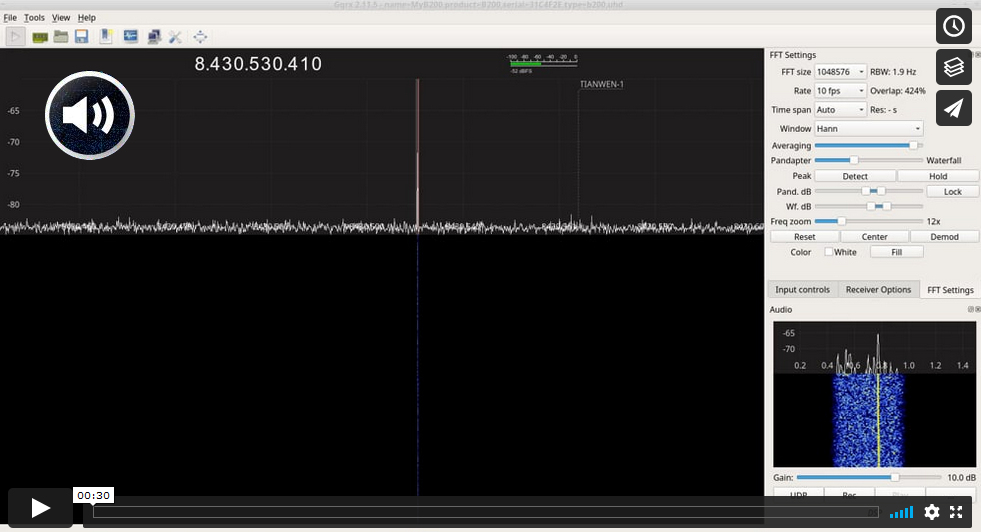
Feb. 16, 2021: Around the world, ham radio operators are doing something once reserved for national Deep Space Networks. “We’re monitoring spacecraft around Mars,” says Scott Tilley, of Roberts Creek, British Columbia, who listened to China’s Tianwen-1 probe go into orbit on Feb. 10th. The signal, which Tilley picked up in his own back yard, was “loud and audible.”  Click to listen:

The signal from Tianwen-1 is dominated by a strong X-band carrier wave with weaker side bands containing the spacecraft’s state vector (position and velocity). Finding this narrow spike of information among all the possible frequencies of deep space communication was no easy task.

“It was a bit like a treasure hunt,” Tilley says. “Normally a mission like this would have its frequency published by the ITU (International Telecommunications Union). China did make a posting, but it was too vague for precise tuning. After Tianwen-1 was launched, observers scanned through 50MHz of spectrum and found the signal. Amateurs have tracked the mission ever since with great accuracy thanks to the decoded state vector from the probe itself.”

So far, Tilley has picked up signals from China’s Tianwen-1 spacecraft, NASA’s Mars Reconnaissance Orbiter, and the United Arab Emirates’ Hope probe–all orbiting Mars approximately 200 million kilometers away. How is such extreme DX’ing possible?

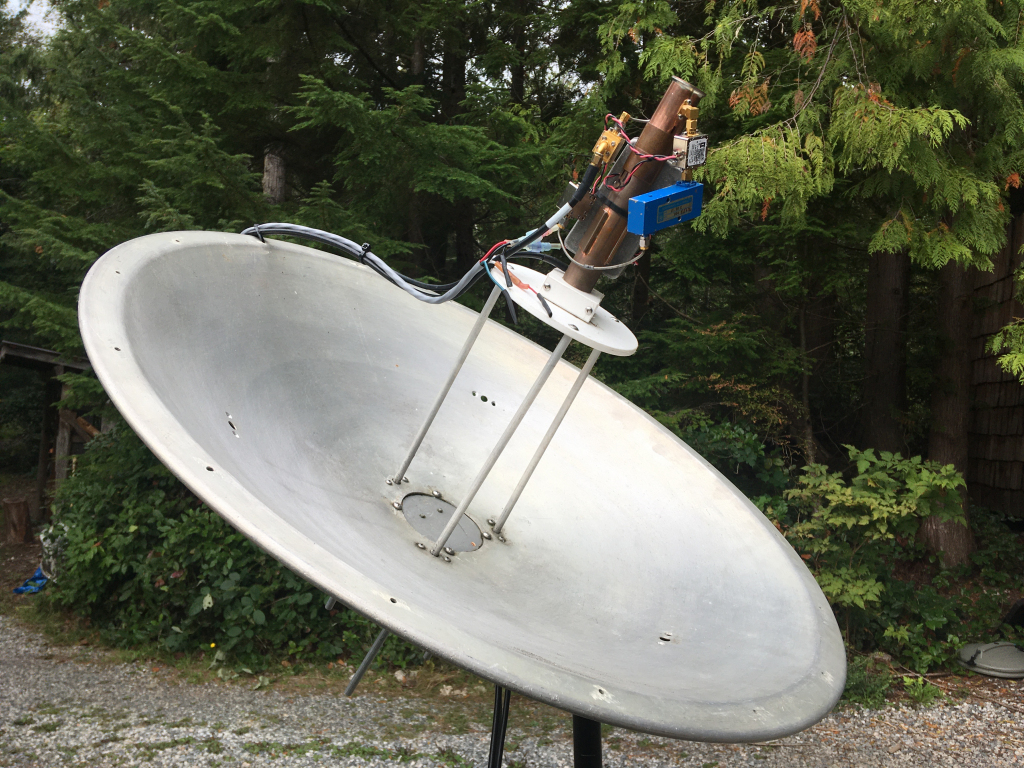
“It helps to have a big antenna,” says Tilley, who uses a 60 cm dish, pictured above. “But the real key,” he says, “is the advent of Software Defined Radios (SDRs) , which have become the norm for hams in the past decade or so.”

In a Software Defined Radio, computers digitally perform the signal mixing and amplification functions of circuits that used to be analog. SDRs are cheap, sensitive, and they give hams the kind of exquisite control over frequency required to tune into distant spacecraft.

“Amateurs really began listening to deep space probes in the late 1990s and early 2000s,” says Tilley. “This sparked an awareness that it was possible. The combination of improving technology and growing awareness has resulted in more and more interplanetary detections.”

Next up: NASA’s Mars 2020 spacecraft carrying the Perseverance rover, due to reach Mars Feb. 18th:

Tilley plans to listen but he doesn’t expect a strong signal. “Perseverance does not have a very large antenna,” says Tilley. “It doesn’t need one because it can use other NASA spacecraft in Mars orbit as relays. The signal will therefore be weak and I doubt many amateurs will record the landing in Jezero crater.”

Tianwen-1, on the other hand, has a relatively large antenna with a booming signal. “China probably plans to use it as a relay for future Chinese space missions,” Tilley speculates. “This makes it a good target for hams hoping to bag their first Martian spacecraft.”

Stay tuned for more radio signals from Mars.

A New Form of Space Weather: Earth Wind

Feb. 12, 2021: The sun is windy. Every day, 24/7, a breeze of electrified gas blows away from the sun faster than a million mph. Solar wind sparks beautiful auroras around the poles of Earth, sculpts the tails of comets, and scours the surface of the Moon.

Would you believe, Earth is windy, too? Our own planet produces a breeze of electrified gas. It’s like the solar wind, only different, and it may have important implications for space weather on the Moon.

“Earth wind” comes from the axes of our planet. Every day, 24/7, fountains of gas shoot into space from the poles. The leakage is tiny compared to Earth’s total atmosphere, but it is enough to fill the magnetosphere with a riot of rapidly blowing charged particles. Ingredients include ionized hydrogen, helium, oxygen and nitrogen.

Once a month, the Moon gets hit by a blast of Earth wind. It happens around the time of the full Moon when Earth’s magnetic tail points like a shotgun toward the lunar disk. For 3 to 5 days, lunar terrain is bombarded by H+, He+, O+, N2+ and other particles.

One effect of Earth wind, just discovered, is to create water. According to a new study published in the January 2021 edition of the Astrophysical Journal Letters, Earth wind can actually make H2O on the lunar surface.

“Hydrogen ions in Earth wind combine with oxygen in Moon rocks and soil to make hydroxyl (OH) and water (H2O),” explains one of the lead authors, Quanqi Shi of Shandong University and the Chinese Academy of Sciences. “This came as a surprise.”

Above: An artist’s concept of Earth wind (blue)

Researchers have long known that hydrogen from space raining down on the Moon can create a temporary form of surface water. Solar wind does it all the time. However, this kind of water was expected to dry up once a month when the Moon enters Earth’s magnetic tail. Terrestrial magnetism deflects solar wind, turning the faucet to the OFF position.

But that’s not what happened.

The researchers looked at data from NASA’s Moon Mineralogy Mapper (M3) onboard India’s Chandrayaan-1 spacecraft, which was orbiting the Moon in 2009 when the Moon made multiple passes through Earth’s magnetic tail.  “We found that lunar surface water does not disappear as expected during the magnetosphere shielding period,” says Shi. “Earth wind must be bridging the gap.”

Above: Sample Chandrayaan-1 observations of lunar surface water [more]

In fact, when it comes to producing water, Earth wind has some big advantages over solar wind. When the full Moon is inside Earth’s magnetic tail, it is surrounded by Earth wind and feels its impact from every direction. The lunar nearside, lunar farside, and lunar poles are all peppered with Earth wind particles. In this sense, Earth wind can potentially make water anywhere–unlike the solar wind which rains down only on the lunar dayside.

Another potential advantage of Earth wind: It is oxygen rich, much more so than solar wind. “Oxygen is another key element of water,” points out Shi. “Whether these oxygen ions can contribute to the formation of lunar water is a very intriguing question for future study.”

Want to learn more? Read the original research here: “Earth Wind as a Possible Exogenous Source of Lunar Surface Hydration

Co-rotating Interaction Region Sparks Auroras

Feb. 3, 2021: What made the auroras of Feb. 2nd so good? It was a co-rotating interaction region (CIR). CIRs are transition zones between slow- and fast-moving streams of solar wind. Solar wind plasma piles up in these regions, creating density gradients and shock waves that can rock Earth’s magnetic field much like a coronal mass ejection (CME).

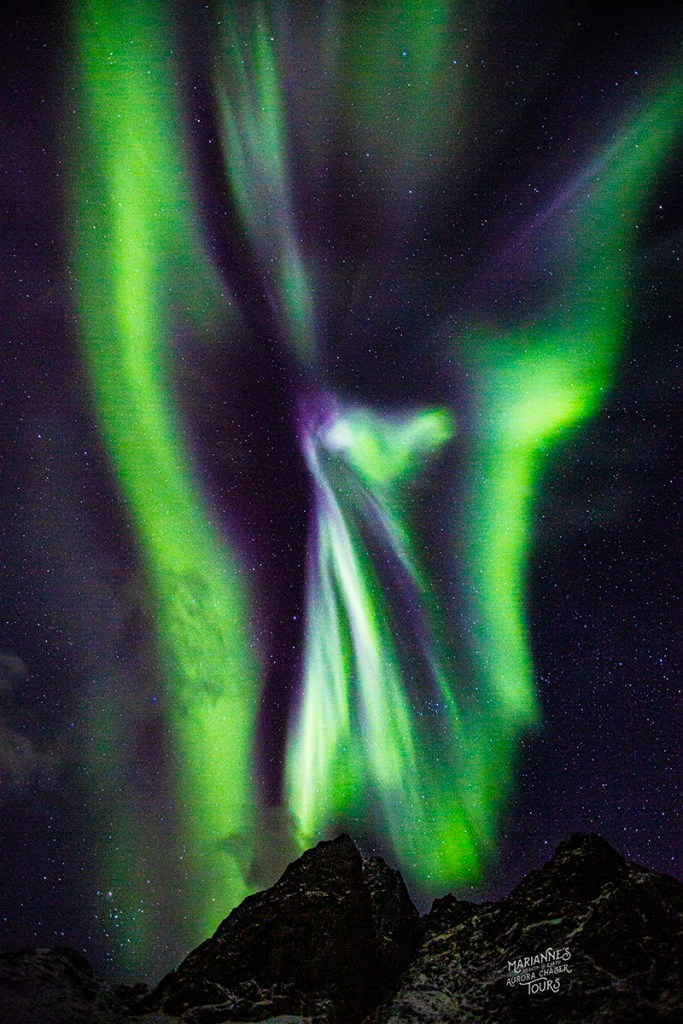
A CIR hit Earth on Feb. 2nd and “the lights were incredible–just fantastic,” reports aurora tour guide Marianne Bergli who witnessed the display from a beach near Tromsø, Norway:

“Every color in the heavens cycled through the sky,” she says. “It. Was. Amazing.”

CIRs are a way for the sun to spark auroras without explosive solar activity. All that’s required is a fast solar wind stream brushing up against a slower one. In the transition zone, thick rivulets of plasma press magnetic fields together, creating strong shock-like structures that mimic CMEs. Indeed, some forecasters refer to co-rotating interaction regions as “mini-CMEs.”

Says Bergli, “I am looking forward to the next one!”

What if … A Perfect CME Hit Earth?

Jan. 21, 2021: You’ve heard of a “perfect storm.” But what about a perfect solar storm? A new study just published in the research journal Space Weather considers what might happen if a worst-case coronal mass ejection (CME) hit Earth. Spoiler alert: You might need a backup generator.

For years, researchers have been wondering, what’s the worst the sun could do? In 2014, Bruce Tsurutani (JPL) and Gurbax Lakhina (Indian Institute of Geomagnetism) introduced the “Perfect CME.” It would be fast, leaving the sun around 3,000 km/s, and aimed directly at Earth. Moreover, it would follow another CME, which would clear the path in front of it, allowing the storm cloud to hit Earth with maximum force.

None of this is fantasy. The Solar and Heliospheric Observatory (SOHO) has observed CMEs leaving the sun at speeds up to 3,000 km/s. And there are many documented cases of one CME clearing the way for another. Perfect CMEs are real.

Using simple calculations, Tsurutani and Lakhina showed that a Perfect CME would reach Earth in only 12 hours, allowing emergency managers little time to prepare, and slam into our magnetosphere at 45 times the local speed of sound. In response to such a shock, there would be a geomagnetic storm perhaps twice as strong as the Carrington Event of 1859. Power grids, GPS and other high-tech services could experience significant outages.

Sounds bad? Turns out it could be worse.

In 2020, a team of researchers led by physicist Dan Welling of the University of Texas at Arlington took a fresh look at Tsurutani and Lakhina’s Perfect CME. Space weather modeling has come a long way in the intervening 6 years, so they were able to come to new conclusions.

“We used a coupled magnetohydrodynamic(MHD)-ring current-ionosphere computer model,” says Welling. “MHD results contain far more complexity and, hopefully, better reflect the real-world system.”

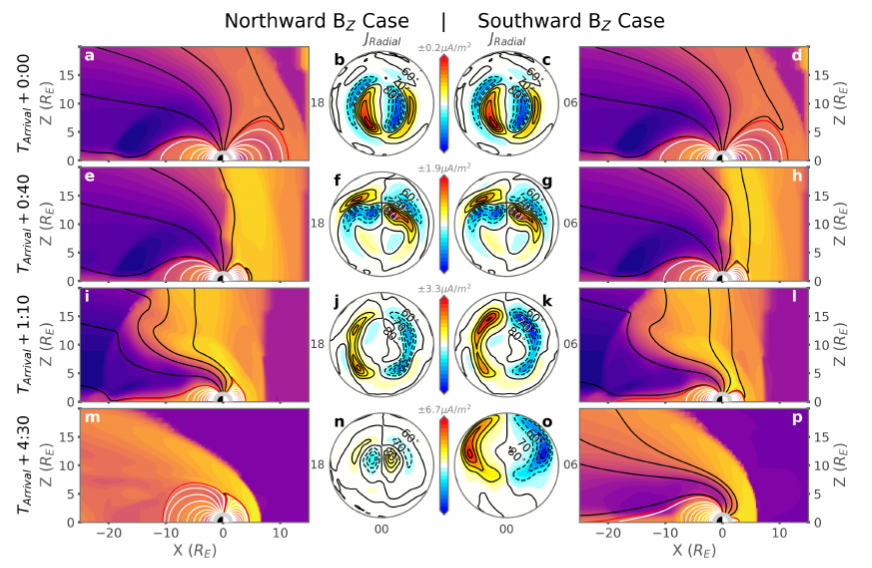
Above: Sample results from computer modeling a Perfect CME impact. The images show the distortion and compression of Earth’s magnetic field as well as induced currents in the atmosphere. Source: Welling et al, 2020.

The team found that geomagnetic disturbances in response to a Perfect CME could be 10 times stronger than Tsurutani and Lakhina calculated, particularly at latitudes above 45 to 50 degrees. “[Our results] exceed values observed during many past extreme events, including the March 1989 storm that brought down the Hydro-Quebec power grid in eastern Canada; the May 1921 railroad storm; and the Carrington Event itself,” says Welling.

A key result of the new study is how the CME would distort and compress Earth’s magnetosphere. The strike would push the magnetopause down until it is only 2 Earth-radii above our planet’s surface. Satellites in Earth orbit would suddenly find themselves exposed to a hail of energetic charged particles, potentially short-circuiting sensitive electronics. A “superfountain” of oxygen ions rising up from the top of Earth’s atmosphere might literally drag satellites down, hastening their demise. (Note: Welling’s group stopped short of modelling the superfountain.)

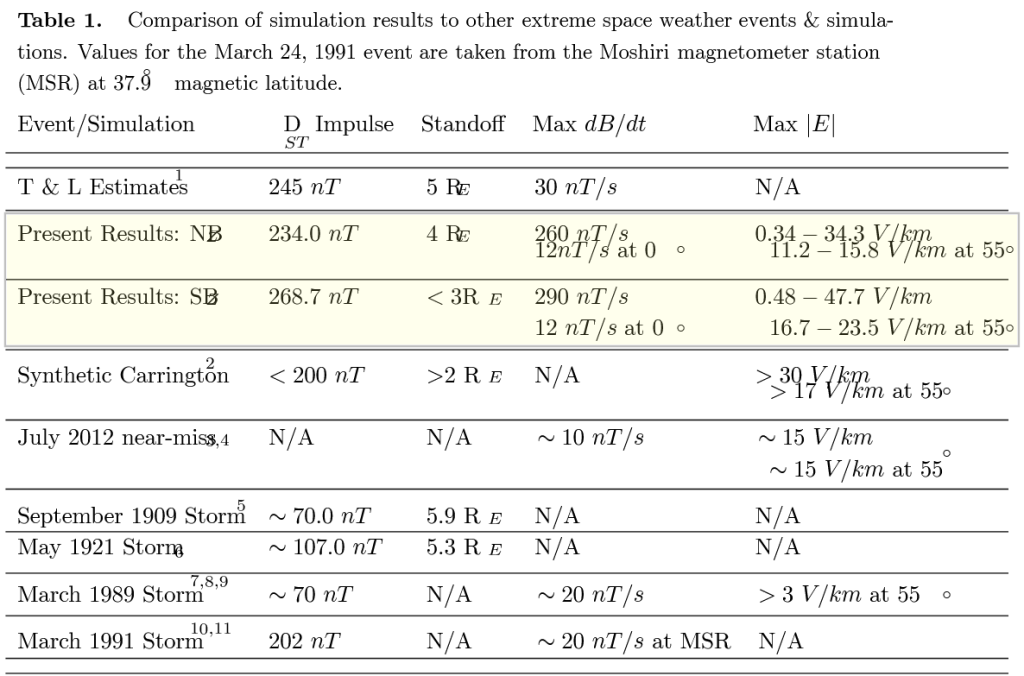
For specialists, Table 1 from Welling et al’s paper compares their simulation of a Perfect CME impact (highlighted in yellow) to past extreme events:

You don’t have to understand all the numbers to get the gist of it. A Perfect CME strike would dwarf many previous storms.

Now for the good news: Perfect CMEs are rare.

Angelos Vourlidas of Johns Hopkins University has studied the statistics of CMEs. He notes that SOHO has captured only two CMEs with velocities greater than 3,000 km/s since the start of operations in 1996. “This means we expect roughly one CME ejected at speeds above 3000 km/s per solar cycle,” he says.  Speed isn’t the only factor, however. To be “perfect,” a 3000 km/s CME would need to follow another CME, clearing its path, and both CMEs must be aimed directly at Earth.

It all adds up to something that doesn’t happen every day. But one day, it will happen. As Welling et al conclude in their paper, “Further exploring and preparing for such extreme activity is important to mitigate space-weather related catastrophes.”

Read the original research here.

A Musical Note from the Magnetosphere

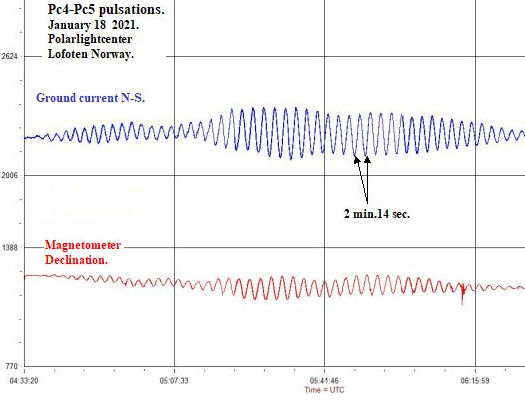
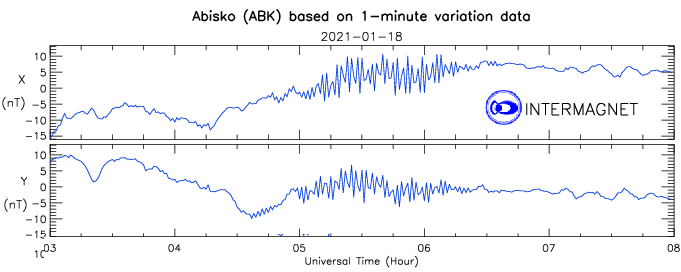
Jan. 19, 2021: High above the Arctic Circle in Lofoten, Norway, citizen scientist Rob Stammes operates a space weather monitoring station. His sensors detect ground currents, auroras, radio bursts, and disturbances in Earth’s magnetic field. Yesterday, he says, “I received a musical note from the magnetosphere.”

“Around 05.30 UTC on Jan. 18th, our local magnetic field began to swing back and forth in a rhythmic pattern,” he says. “Electrical currents in the ground did the same thing. It was a nearly pure sine wave–like a low frequency musical note. The episode lastesd for more than 2 hours.”

Stammes has received such notes before, but they are rare. “I see a pattern like this only about once a year,” he says.

Space physicists call this phenomenon a “pulsation continuous” or “Pc” for short. Imagine blowing across a piece of paper, making it flutter with your breath. Solar wind does the same thing to magnetic fields. Pc waves are essentially flutters propagating down the flanks of Earth’s magnetosphere excited by the breath of the sun.

Above: A magnetometer in Abisko, Sweden, recorded the same waves

Yesterday’s set of waves washed over Norway and Sweden, but almost nowhere else, according to the global INTERMAGNET network of magnetometers. It was a strictly regional phenomenon.

What happens in the sky when such a pure tone emerges from the natural background cacophony of magnetic activity? “I wish I knew,” says Stammes. “I was asleep at the time.” In fact, it’s possible that no one knows. Tones like these are rare, and they all too often occur while skies are cloudy or daylit, blocking any peculiar auroras from view. Stammes says he plans to build an alert system to help him find out. No pun intended: Stay tuned.

Noctilucent Clouds over Argentina

Jan. 8, 2021: They’re back. Noctilucent clouds (NLCs), recently missing, are once again circling the South Pole. And, in an unexpected twist, they’ve just appeared over Argentina as well.

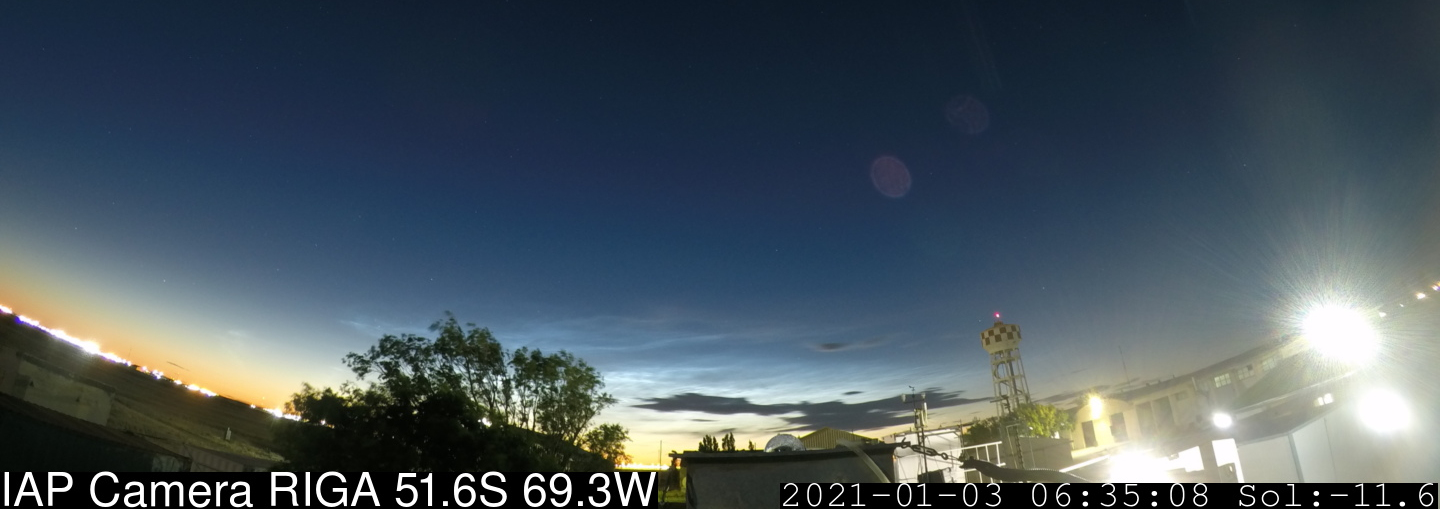
“This is a very rare event,” reports Gerd Baumgarten of Germany’s Leibniz-Institute of Atmospheric Physics, whose automated cameras caught the meteoritic clouds rippling over Rio Grande, Argentina (53.8S) on Jan. 3rd:

A second camera recorded the clouds at even higher latitude: Rio Gallegos (51.6S). At this time of year, noctilucent clouds are supposed to be confined to the Antarctic–not Argentina. In the whole history of atmospheric research, NLCs have been sighted at mid-southern latitudes only a handful of times.

“Personally, I am thrilled to see NLCs in Argentina, as I had not expected them to occur so far north,” says Natalie Kaifler of the German Aerospace Center (DLR), who operates a lidar (laser radar) alongside one of Baumgarten’s cameras.

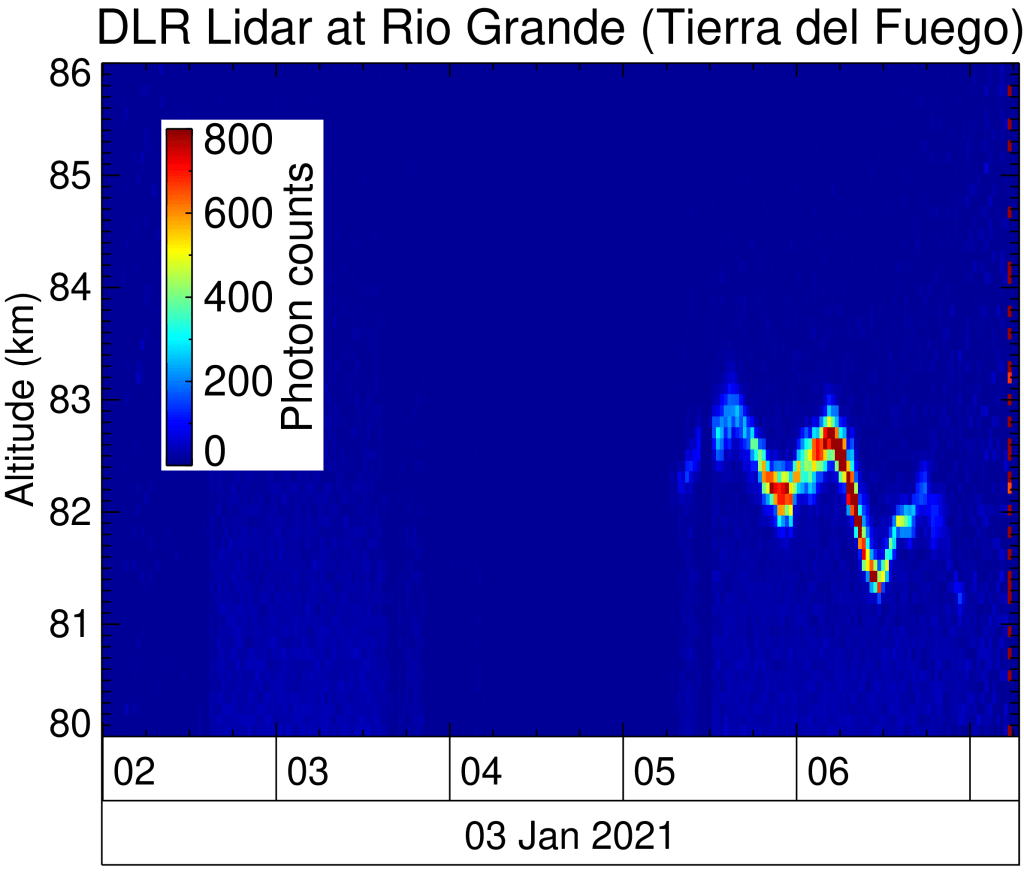
Kaifler’s lidar “pinged” the clouds during the display and confirmed that they are genuine NLCs. Echoes pinpointed their altitude more than 80 km above Earth’s surface:

Above: The ~hour-long oscillations in these lidar echoes may be caused by gravity waves propagating upward from the Andes 82 km below.

NLCs are Earth’s highest clouds. They form when summertime wisps of water vapor rise up from the poles to the edge of space. Water crystallizing around specks of meteor dust ~83 km above Earth’s surface create beautiful electric-blue structures, typically visible from November to February in the south, and May to August in the north.

This season has been unusual, though. The normal onset of NLCs over the South Pole has been delayed for more than a month as strange weather patterns played out above Antarctica. Now, suddenly, they’re back, and showing up in unexpected places.

Baumgarten has set up two cameras in southern Argentina to catch unexpected NLCs. “If it happens again,” he says, “we’ll let you know.” Stay tuned!