June 21, 2023: Around the world, ham radio operators are experimenting with a new way to detect solar flares–the Doppler Shift method. Brian Curtis of Sault Ste Marie, Michigan, demonstrated the technique on June 20th when the sun produced a powerful X1.1-class solar flare:
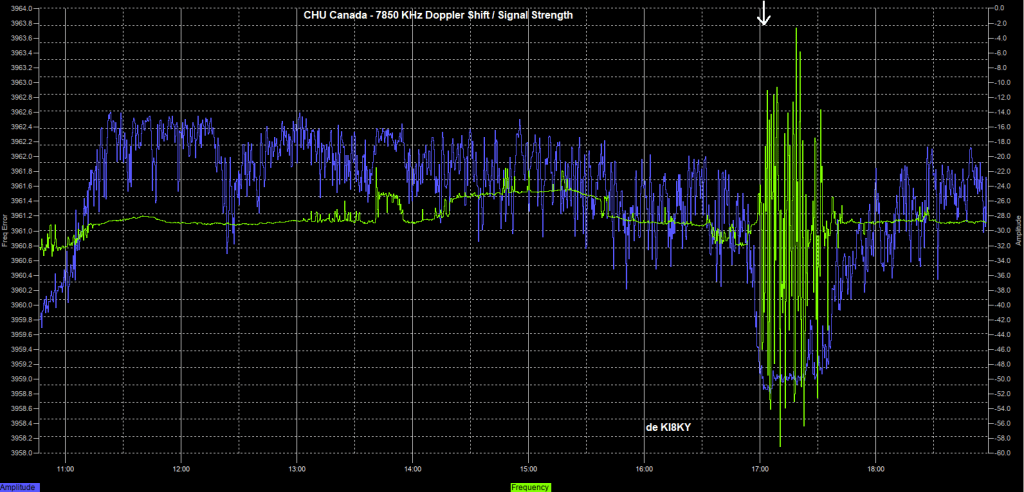
“I monitor the frequency and field strength of Canada’s CHU time station transmitting at 7850 KHz,” explains Curtis. “During the X-class flare event, I was able to detect the Doppler shift of the station’s carrier frequency (green plot). It shifted by 5 Hz, which is a small change, but very obvious!”
When radiation from a solar flare hits Earth’s atmosphere, it ionizes the air, temporarily boosting the thickness of our planet’s ionosphere. Any radio station skipping off the ionosphere will suddenly find its frequency Doppler shifted (because its reflection point is moving). Shortwave stations such as WWV, WWVH, and CHU transmit carriers with atomic-clock grade frequency stability, so they are perfect sources for Doppler monitoring.
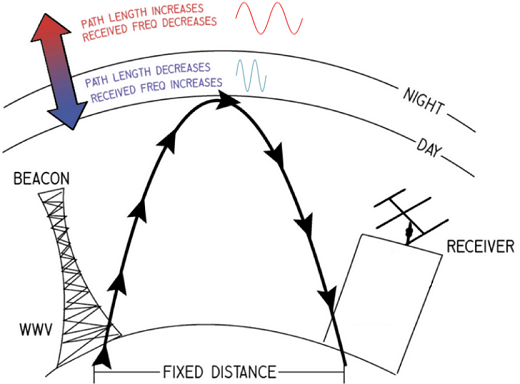
Above: Sudden changes in the ionosphere caused by flares or even sunrise/sunset can Doppler shift the frequency of stations like WWV. Image credit: Collins et al (2021)
“I have been monitoring radio stations for decades, noting sudden changes in signal strength as a means of monitoring space weather events,” says Curtis. “It is only fairly recently (~4 months) that I started to experiment with monitoring the Doppler shift of HF stations. The June 20th X-class flare event is by far the most dramatic that I have witnessed thus far.”
Would you like to detect solar flares this way? The HamSCI citizen science program has developed a Personal Space Weather Station specifically for Doppler shift measurements. This technique can also be used to study solar eclipses, earthquakes and tsunamis, and much more.
 Spaceweather.com