July 20, 2023: (Spaceweather.com) On the evening of July 19th, SpaceX launched a Falcon 9 rocket from Vandenberg Space Force Base in California. Sky watchers from southern California to Arizona witnessed a magnificent exhaust plume. At the San Francisco Volcanic Field north of Flagstaff, photographer Jeremy Perez saw something extra:
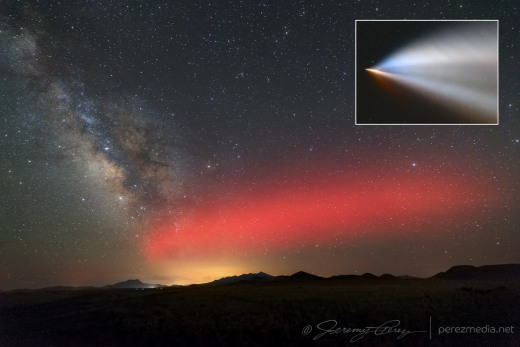
“After the rocket passed overhead, a red fluorescent glow expanded southward and crossed over the Milky Way,” says Perez. “It was visible for almost 20 minutes.”
The red glow is a sign that the rocket punched a hole in the ionosphere–something SpaceX and others have been doing for years. One famous example occured on August 25, 2017, when a Falcon 9 rocket carrying Taiwan’s FORMOSAT-5 satellite created a hole four times bigger than the state of California. On June 19, 2022, another Falcon 9 punched a hole over the east coast of the USA, sparking a display of red lights from New York to the Carolinas that many observers mistook for aurora borealis.
“This is a well studied phenomenon when rockets are burning their engines 200 to 300 km above Earth’s surface,” explains space physicist Jeff Baumgardner of Boston University. “The red glow appears when exhaust gasses from the rocket’s 2nd stage cause the ionosphere to recombine quickly.”
Rocket engines spray water (H2O) and carbon dioxide (CO2) into the ionosphere, quenching local ionization by as much as 70%. A complicated series of charge exchange reactions between oxygen ions (O+) and molecules from the rocket exhaust produce photons at a wavelength of 6300 Å–the same color as red auroras.
This movie from David Blanchard outside Flagstaff shows how the red glow developed as the silvery rocket exhaust faded into the ionosphere:
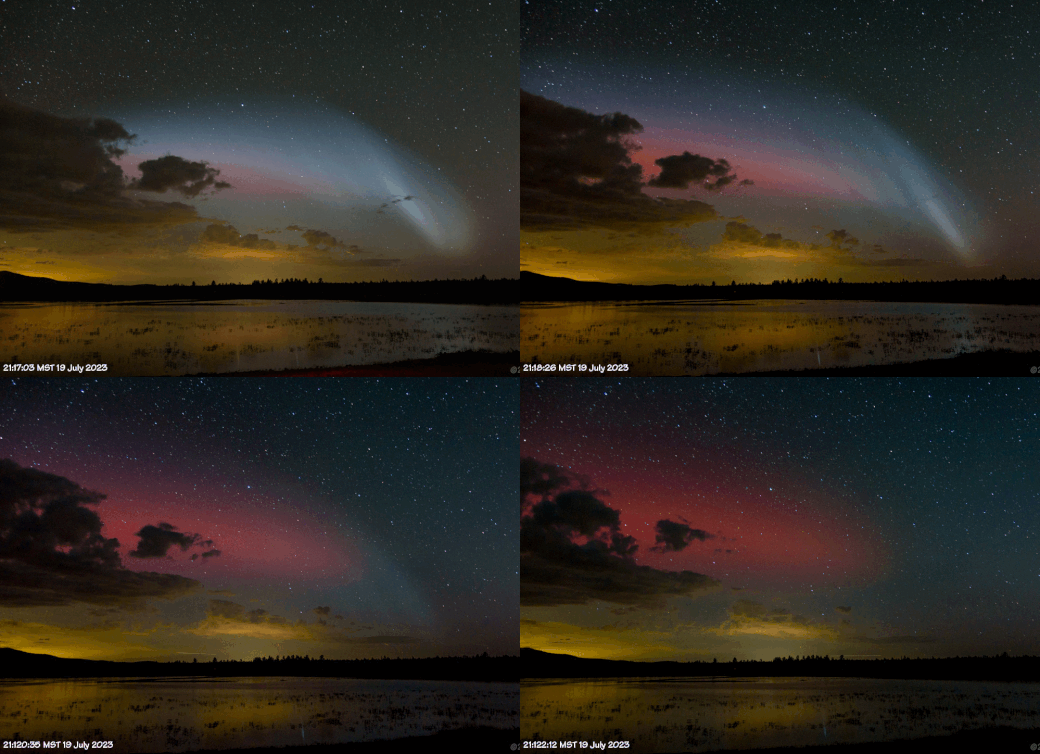
“I watched the show from Upper Lake Mary in the Coconino National Forest,” says Blanchard. “The exhaust plume was spectacular.”
Baumgardner reviewed SpaceX’s video footage from the July 19th launch. “It shows the second stage engine burning at 286 km near the ionosphere’s F-region peak for that time of day. So, it is quite possible that an ionospheric ‘hole’ was made,” he says.
Once rare, ionospheric “punch holes” are increasingly common with record numbers of rocket launches led by SpaceX sending Starlink satellites to low-Earth orbit. Ham radio operators may notice them when shortwave signals fail to skip over the horizon, shooting through holes instead of bouncing back to Earth. Sudden GPS errors can also result from the anomalies. These effects may be troublesome, but they are shortlived; re-ionization occurs as soon as the sun comes up again.
Readers, did you see a red glow from this week’s SpaceX launch? Submit your photos here.
more images: from Cheryl Hanscom Wilcox of Mammoth Lakes, CA; from MaryBeth Kiczenski in the San Juan Mountains of Colorado; from Richard Rast of Mountainair, New Mexico;
 Spaceweather.com
Reblogged this on UNIVERSE.
LikeLike
Why are you minimizing the potential long term affects of punching a hole in the Ionosphere? You don’t know for certain that they won’t be cumulative damage! This is never been done before, so why are you reporting as if it’s no big deal? Some researchers say it’s contributing to the hole in the ozone as well as climate change. Not only do rocket emissions harm the ozone, but they increase global warming… particles emitted by rockets are almost 500 times more efficient at holding heat in the atmosphere than all other sources combined.
https://www.euronews.com/green/2023/02/06/space-race-rocket-launches-can-damage-the-ozone-layer-researchers-find
LikeLike