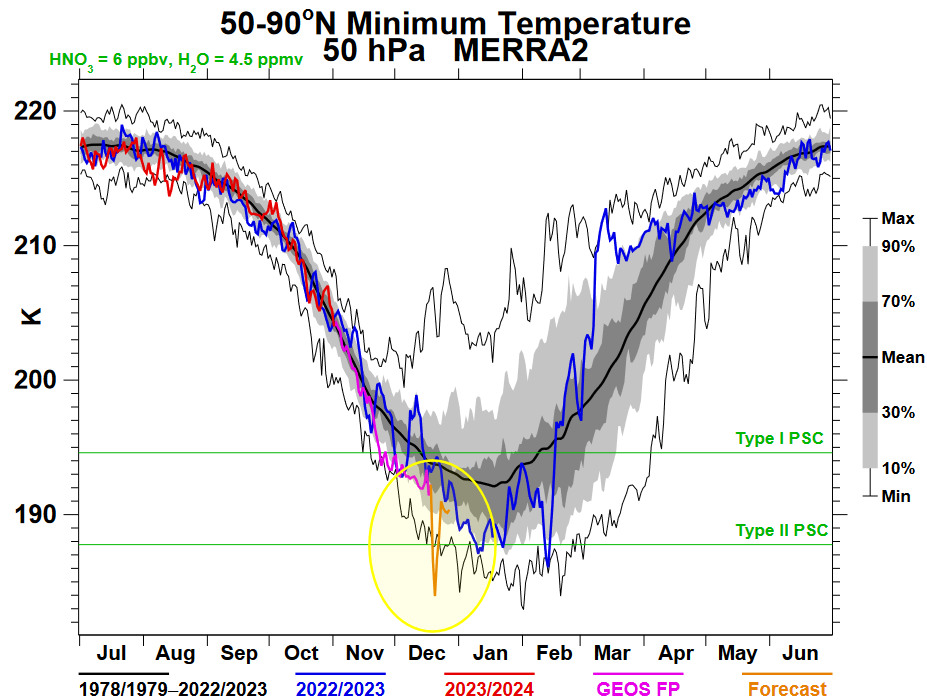
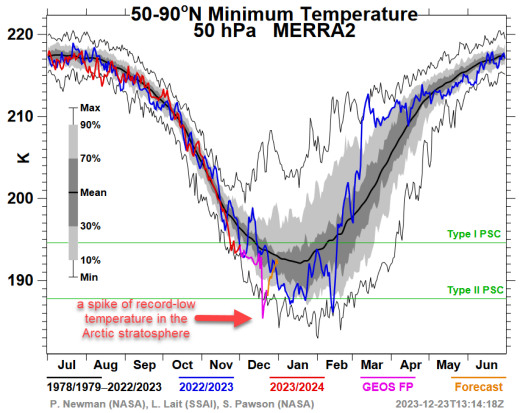
Dec. 24, 2023: (Spaceweather.com) Now we know why polar stratospheric clouds (PSCs) have suddenly exploded. According to NASA’s MERRA-2 climate model, temperatures in the Arctic stratosphere just hit a 40-year record low for the month of December:
Cold air in the stratosphere is exactly what PSCs require. Normally, the stratosphere has no clouds at all. But when the temperature drops to a staggeringly-low -85 C, widely-spaced water molecules coalesce into ice crystals and PSCs begin to form. Their aurora-like colors make them the most beautiful clouds on Earth.
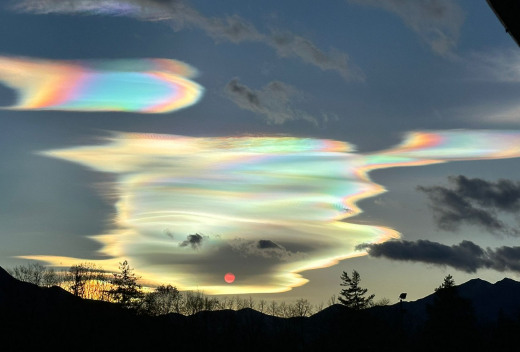
PSCs are normally confined to the Arctic where the stratosphere is coldest. During this week’s extreme cold wave, the clouds descended all the way to mid-latitudes. Here they are over Locarno, Switzerland (+46N):
“I saw these clouds for the first time on Dec. 22nd,” says photographer Branca Cristina. “The colors were amazing!”
At the same time, the clouds were sighted in Torun, Italy (+45N); the next morning they appeared again in Lausanne, Switzerland (+47N). These are extraordinary excursions from normal PSC habitat.
The season for PSCs usually starts in January. The current cold wave has given the season an early start, and could herald many more PSCs in the weeks ahead. To help sky watchers catch these rare clouds, we will henceforth publish daily predictions of temperatures in the Arctic stratosphere. When the air temperature drops below the “Type II PSC” green line, it’s time to look for PSCs. Check out the forecast here.
Dec. 17, 2023: (Spaceweather.com) A cold wave just swept through the Arctic stratosphere. Really cold. We know because on Dec. 17th these colorful clouds appeared over Sweden:
Above: A “PSC selfie” by Lights over Lapland driver Dimitrios Roukounakis
“It’s that magical time of year again,” says Chad Blakley, owner of the aurora tour guide service Lights over Lapland in Abisko, Sweden. “We just witnessed a spectacular display of polar stratospheric clouds.”
Widely considered to be the most beautiful clouds on Earth, polar stratospheric clouds (PSCs) are rare. Earth’s stratosphere is very dry and normally it has no clouds at all. PSCs form when the temperature in the Arctic stratosphere drops to a staggeringly-low -85 C. Then, and only then, can widely-spaced water molecules begin to coalesce into tiny ice crystals. High-altitude sunlight shining through the crystals creates intense iridescent colors that can rival auroras.
NASA forecast models of the polar stratosphere show that temperatures have indeed dropped into the very low range required for colorful Type II PSCs:
Above: Note the temperature dip inside the highlighted yellow oval
During a typical Arctic winter, PSCs appear no more than a handful of times, and the first sightings usually come in January. The apparition on Dec. 17th marks an early start, and may herald many more PSCs to come. Stay tuned!
Dec. 13, 2023: (Spaceweather.com): Every great mystery novel has an unexpected twist. Apparently the same is true of meteor showers.
A paper published in the Planetary Science Journal reports a surprising new twist in the mystery of the Geminids, a strong annual meteor shower that has puzzled astronomers for more than a century.
“Our work has upended years of belief about 3200 Phaethon, the source of the Geminids,” says co-author Karl Battams of the Naval Research Lab. “It’s not what we thought it was.”
Above: Geminids over the Czech Republic in 2018. Credit: Petr Horálek
The Geminids peak every year in mid-December, scattering hundreds of bright meteors across northern winter skies. Numerically it is the best meteor shower of the year.
As meteor showers go, Geminids are newcomers. They first appeared in the mid-1800s when an unknown stream of debris crossed Earth’s orbit. Surprised, 19th century astronomers scoured the sky for the parent comet, but they found nothing. The search would continue for another 100 years.
Enter NASA. In 1983, the space agency’s Infrared Astronomical Satellite (IRAS) found an object now called “3200 Phaethon.” It was definitely the source of the Geminids. The orbit of 3200 Phaethon was such a close match to that of the Geminid debris stream, no other conclusion was possible. Yet here was a puzzler: 3200 Phaethon appeared to be a rocky asteroid.
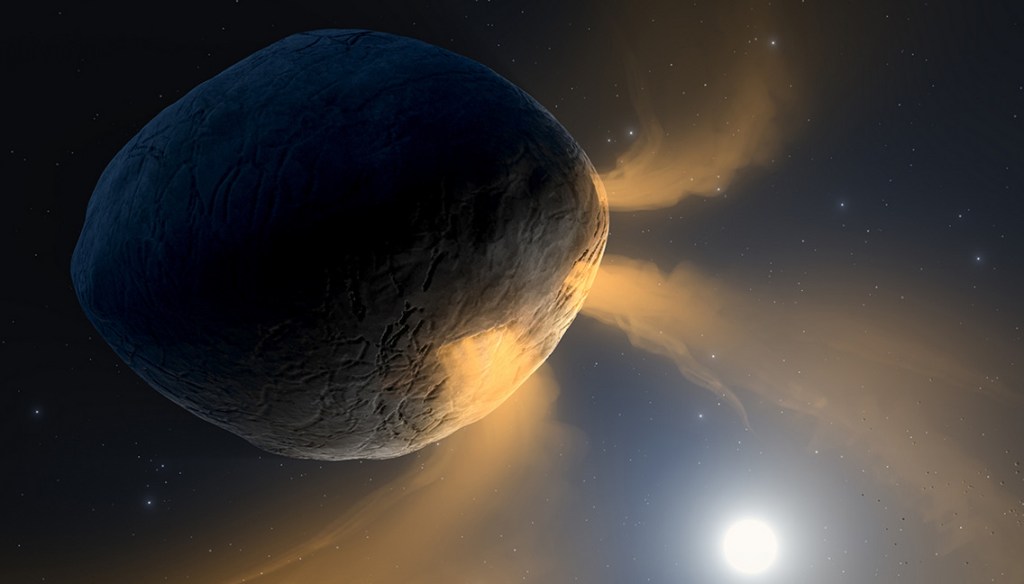
Above: An artist’s concept of 3200 Phaethon
Asteroids are not supposed to make meteor showers. Unlike comets, they don’t have tails and they don’t spew meteoroids. Yet 3200 Phaethon was different. In 2009 and 2012, NASA’s STEREO spacecraft caught 3200 Phaethon sprouting a tail when it passed close to the sun. Apparently, intense solar radiation was blistering meteoroids off 3200 Phaethon’s rocky surface. Astronomers dubbed it a “rock comet,” and the mystery was solved.
Or was it?
Astronomer Qicheng Zhang, lead author of the new paper, was never convinced. For one thing, the Geminid debris stream is massive (1013 kg), while the tail of 3200 Phaethon is puny, providing less than 1% of the mass required to explain the Geminids.
“The tail we see today could never supply enough dust to supply the Geminid meteor shower,” says Zhang.
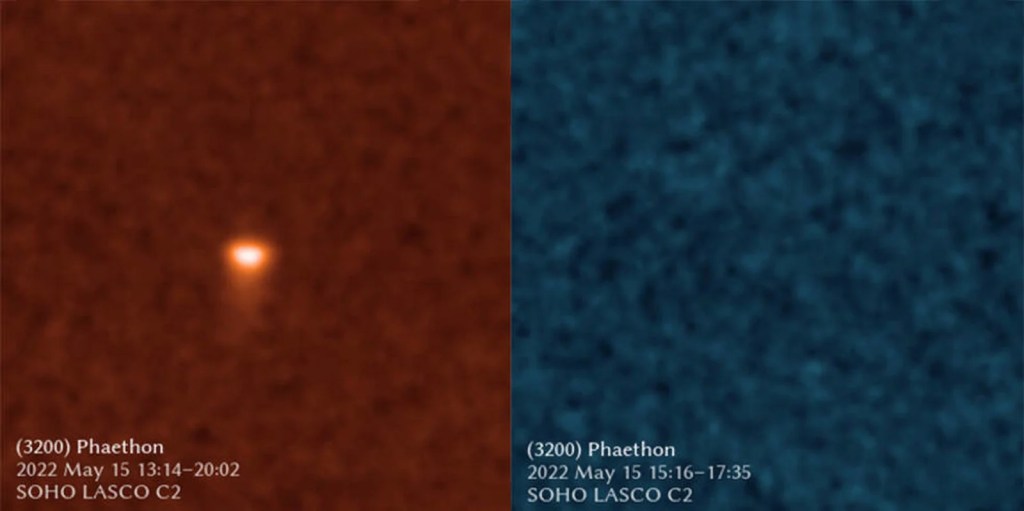
Zhang, Battams, and colleagues decided to take a closer look. Using coronagraphs on the Solar and Heliospheric Observatory (SOHO), they monitored Phaethon as it passed by the sun in 2022. Color filters on the spacecraft revealed no dust or rock. Instead, Phaethon’s tail is made of sodium gas.
Above: SOHO’s orange-filtered view (left), which can detect sodium, shows asteroid 3200 Phaethon glowing brightly.
And therein lies the twist. Meteor showers are made of meteoroids, not gas. Suddenly, the Geminids are a mystery again.
“We’re back to square one,” says Zhang. “Where do the Geminids come from?”
3200 Phaethon is still the main suspect. At least one study suggests that Geminid meteoroids are 1,000 to 10,000 years old. Perhaps something hit the asteroid millennia ago. Phaethon’s rapid rotation makes it susceptible to sudden episodes of mass loss, so even a relatively small impact could create the necessary meteoroids.
The best way to test this idea is to look at the surface of Phaethon with a space probe. Japan plans to do just that. JAXA is building a spacecraft called DESTINY+ to fly by 3200 Phaethon for a closer look. Launch is scheduled for 2025.
Until then, the Geminids remain a beautiful mystery. Look for them streaking across the night sky this week!
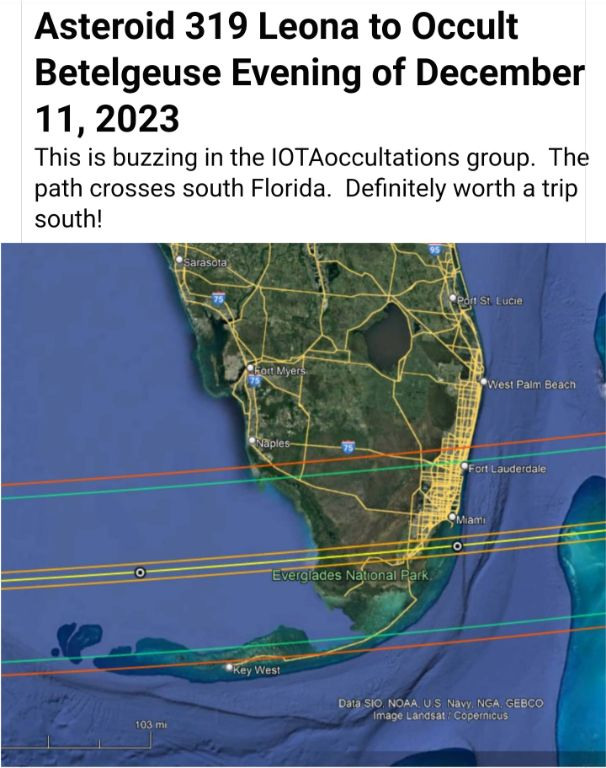
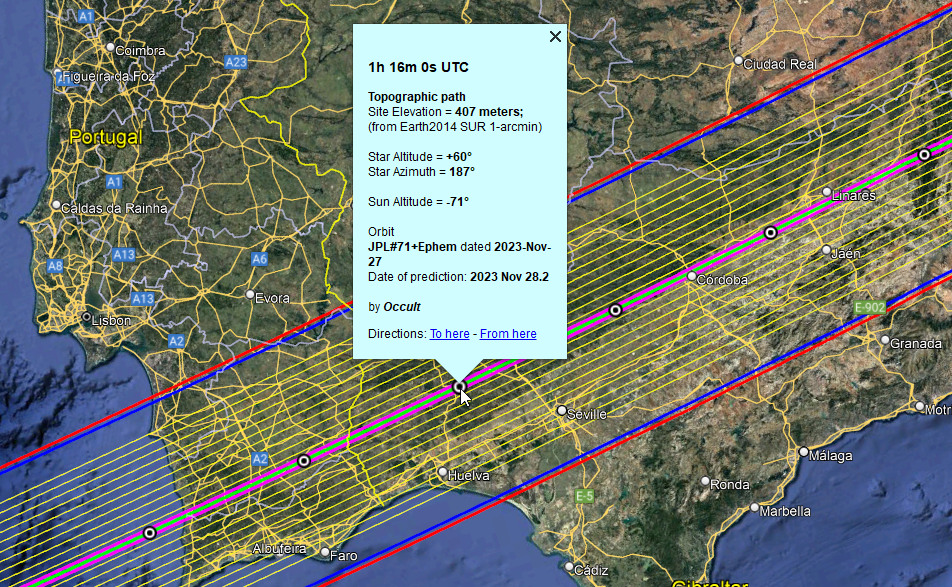
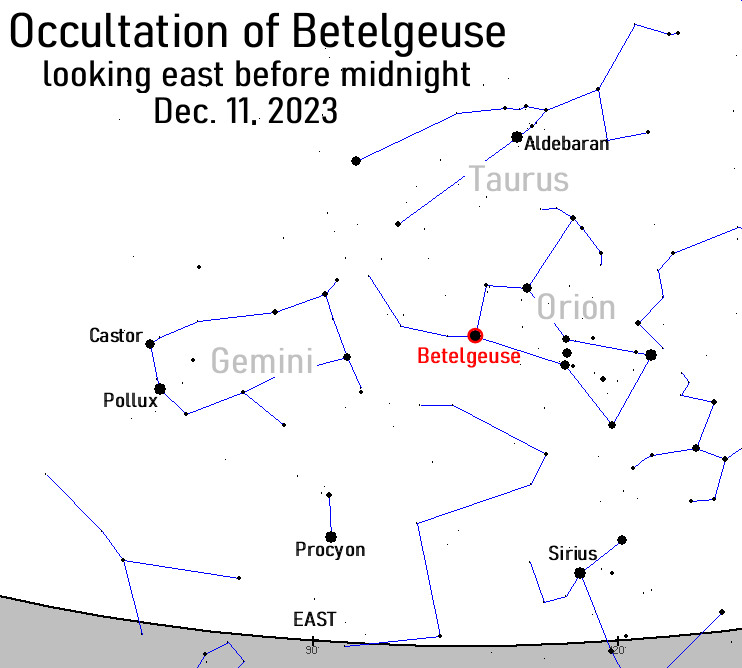
Dec. 10, 2023: (Spaceweather.com) For years, astronomers have worried that Betelgeuse might explode. Instead, it’s about to disappear. On Dec. 11th (USA) and 12th (Europe), main belt asteroid Leona will pass directly in front of Betelgeuse, a first-magnitude star in the shoulder of Orion. Millions of people in a narrow path stretching from South Florida to Italy and Greece can look up and see the red giant dim or even vanish.
“This represents an extraordinary and unique opportunity to analyze the diameter and brightness distribution of Betelgeuse with extreme angular resolution,” says astronomer J. L. Ortiz of the Instituto de Astrofísica de Andalucía, lead author of a newly-released preprint about the occultation.
Betelgeuse is not a typical star. Its diameter is 760 times the sun’s, so it appears as a disk 40 milliarcseconds across the sky, much larger than most other stars. High resolution images of Betelgeuse seem to reveal a star in turmoil with giant convection cells bubbling up to the surface. The passage of the asteroid across Betelgeuse may allow astronomers to map these cells and evaluate their role in a possible future supernova explosion.
Above: Images of Betelgeuse taken by the European Southern Observatory’s Very Large Telescope
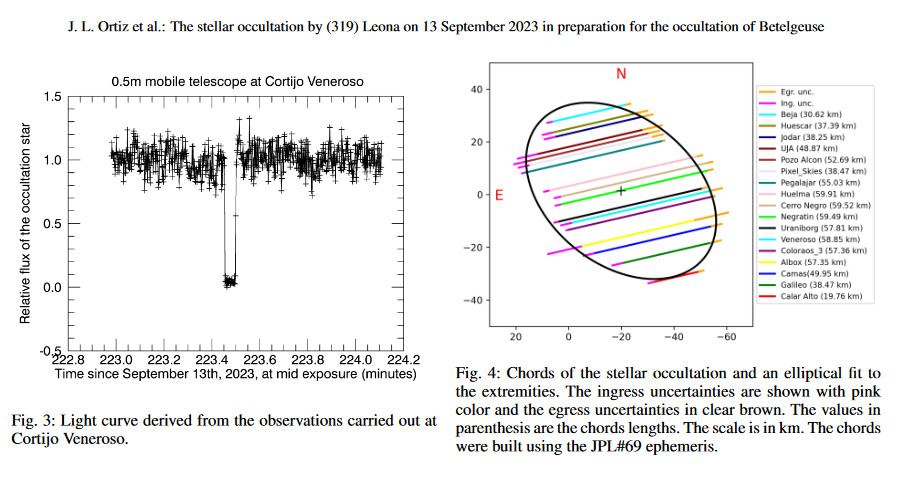
Much is unknown about this occultation. The shape of the asteroid itself is an X-factor. In Sept. 2023, Ortiz and colleagues watched the asteroid occult another star from 17 different locations on Earth. They found that Leona has an oblong shape with dimensions 80 x 55 km, whereas most predictions of the occultation assume the asteroid to be spherical. Leona’s odd shape, plus the fact that it is rotating, could produce some surprises. The occultation path may be wider than expected, and there could be interesting “partial eclipse” effects visible even near the center of the path.
There are huge population centers in the occultation path, especially in south Florida where Leona’s shadow crosses Miami and Fort Lauderdale. For observers there, Betelgeuse will wink out for about 10 seconds on the evening of Dec. 11th just before 8:25 pm Eastern Standard Time. In Europe, the occultation happens on Dec. 12th between 1:10 UT and 1:16 UT. To find out when to look from your location, we recommend downloading this excellent Google Earth file; when viewing the map, click on the little dots for occultation times.
Amateur astronomers who wish to collect research quality light curves are encouraged to read these observing tips from the International Occultation Timing Association. For casual naked-eye observers, here’s a simple sky map.





 Spaceweather.com