July 25, 2024: The biggest flare of Solar Cycle 25 just exploded from the farside of the sun. X-ray detectors on Europe’s Solar Orbiter (SolO) spacecraft registered an X14 category blast:
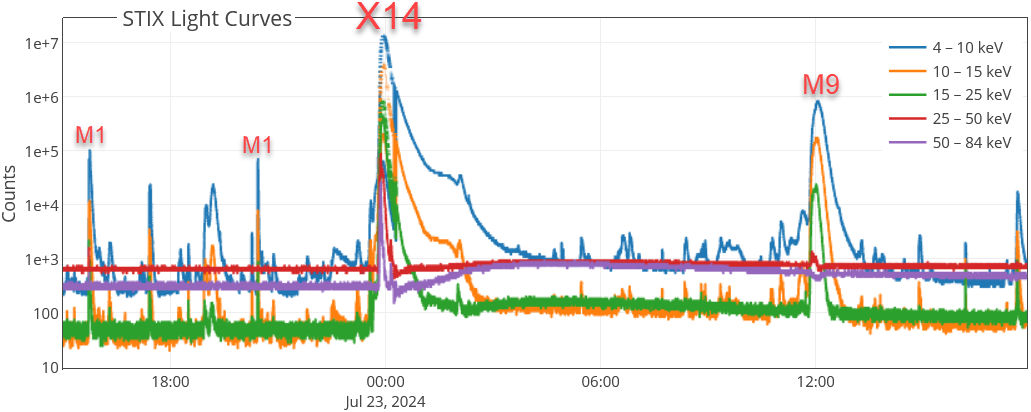
Solar Orbiter was over the farside of the sun when the explosion occured on July 23rd, in perfect position to observe a flare otherwise invisible from Earth.
“From the estimated GOES class, it was the largest flare so far,” says Samuel Krucker of UC Berkeley. Krucker is the principal investigator for STIX, an X-ray telescope on SolO which can detect solar flares and classify them on the same scale as NOAA’s GOES satellites. “Other large flares we’ve detected are from May 20, 2024 (X12) and July 17, 2023 (X10). All of these have come from the back side of the sun.”
Meanwhile on the Earthside of the sun, the largest flare so far registered X8.9 on May 14, 2024. SolO has detected at least three larger farside explosions, which means our planet has been dodging a lot of bullets.
The X14 farside flare was indeed a major event. It hurled a massive CME into space, shown here in a coronagraph movie from the Solar and Heliospheric Observatory (SOHO):
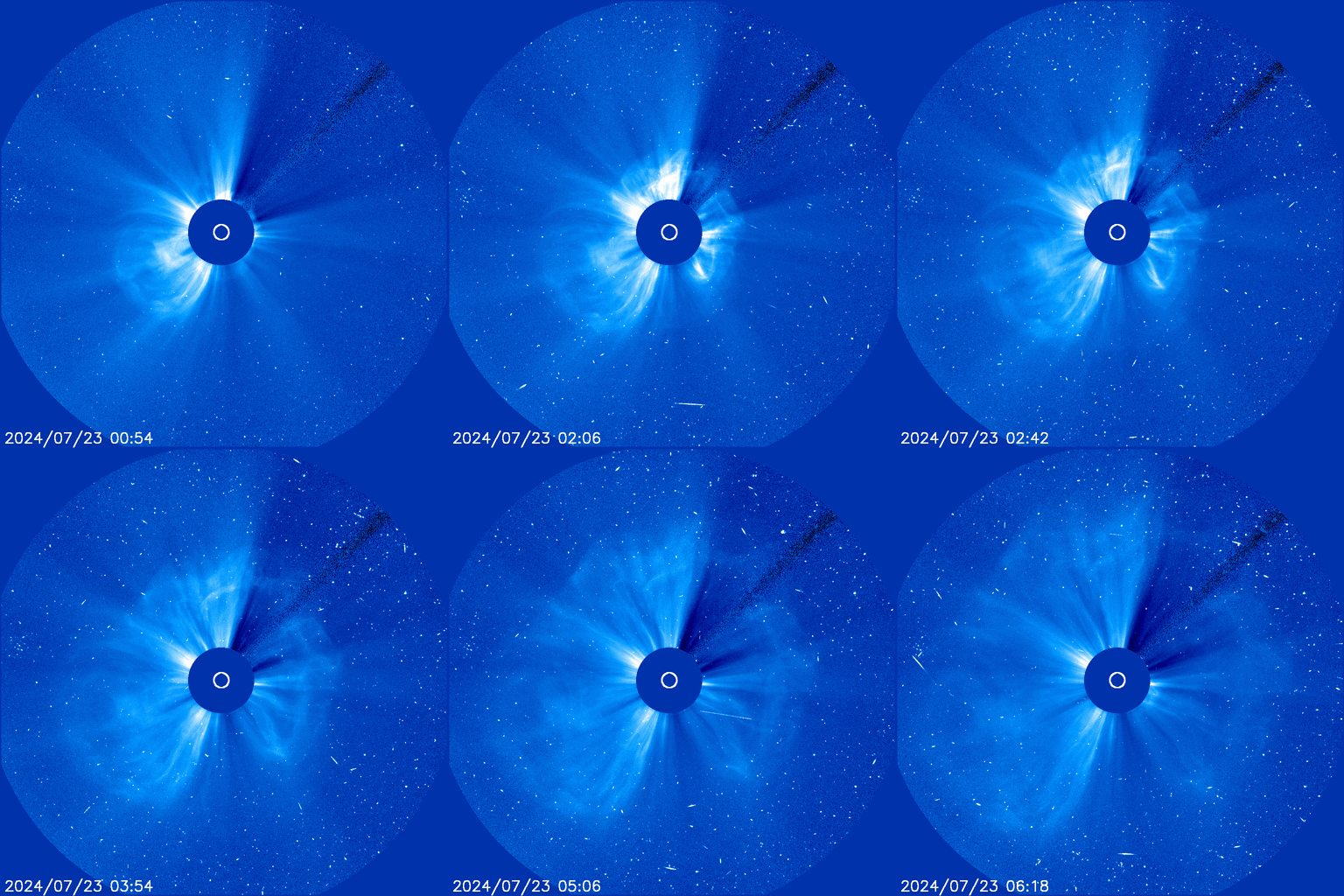
The CME sprayed energetic particles all over the solar system. Earth itself was hit by ‘hard’ protons (E > 100 MeV) despite being on the opposite side of the sun.
“This is a big one–a 360 degree event,” says George Ho of the Southwest Research Institute, principal investigator for one of the energetic particle detectors onboard SolO. “It also caused a high dosage at Mars.”
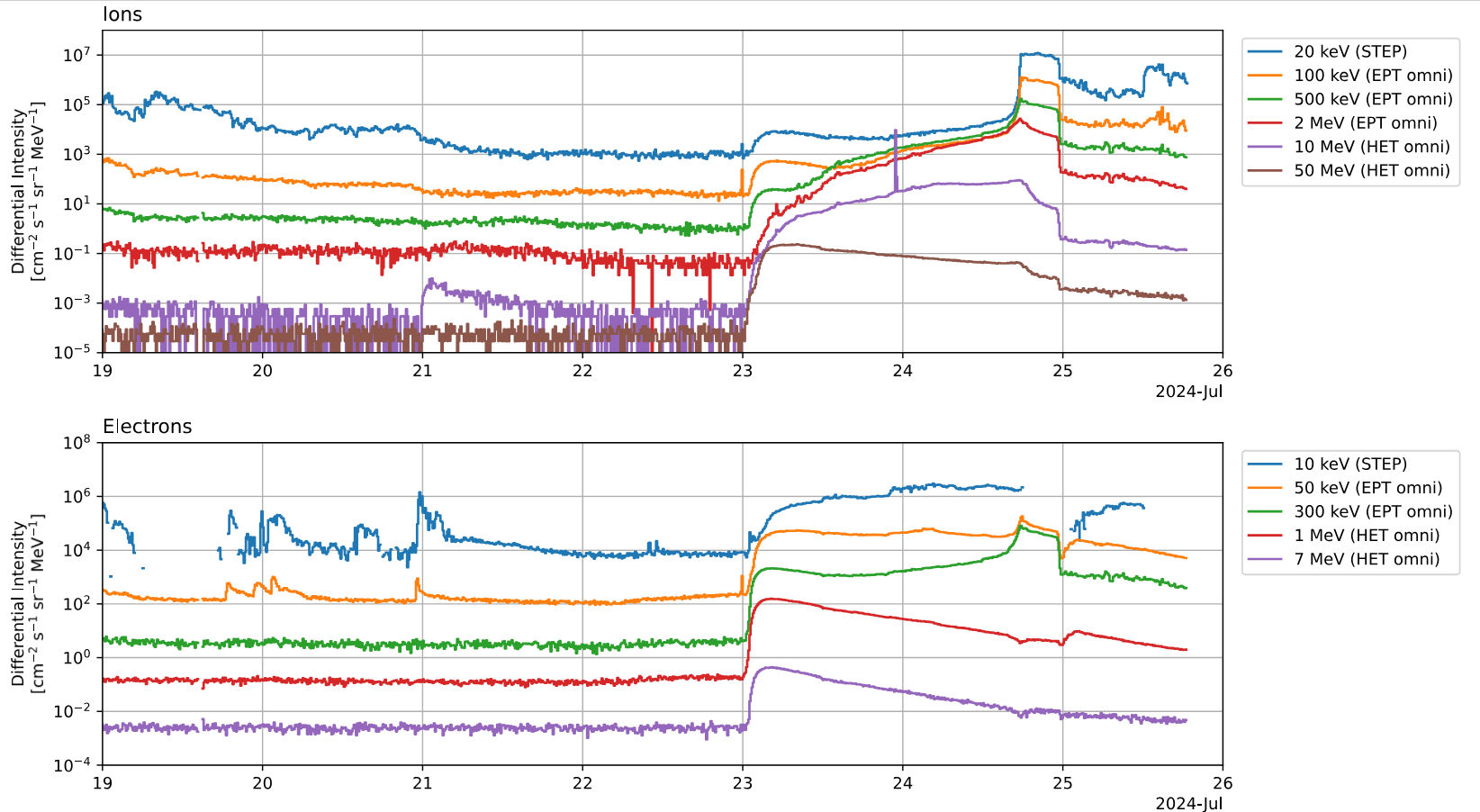
SolO was squarely in the crosshairs of the CME, and on July 24th it experienced a direct hit. In a matter of minutes, particle counts jumped almost a thousand-fold as the spacecraft was peppered by a hail storm energetic ions and electrons.
“This is something we call an ‘Energetic Storm Particle’ (ESP) event,” explains Ho. “It’s when particles are locally accelerated in the CME’s shock front [to energies higher than a typical solar radiation storm]. An ESP event around Earth in March 1989 caused the Great Quebec Blackout.”
So that’s what might have happened if the CME hit Earth instead of SolO. Maybe next time. The source of this blast will rotate around to face our planet a week to 10 days from now, so stay tuned. Solar flare alerts: SMS Text


 Spaceweather.com