Is Interstellar Object 3I/ATLAS Alien Tech?

July 21, 2025 (Spaceweather.com): Carl Sagan famously said, “Extraordinary claims require extraordinary proof.” But he never said we couldn’t discuss extraordinary claims without extraordinary proof. In that spirit, we review a new draft paper by Avi Loeb and colleagues, which asks whether interstellar comet 3I/ATLAS might be a spaceship.

Avi Loeb is a Harvard astronomy professor who became a household name in 2017 after the discovery of ‘Oumuamua, the first known interstellar object to pass through our solar system. While most scientists offered natural explanations, Loeb made headlines by suggesting it could be an artificial probe from an alien civilization.

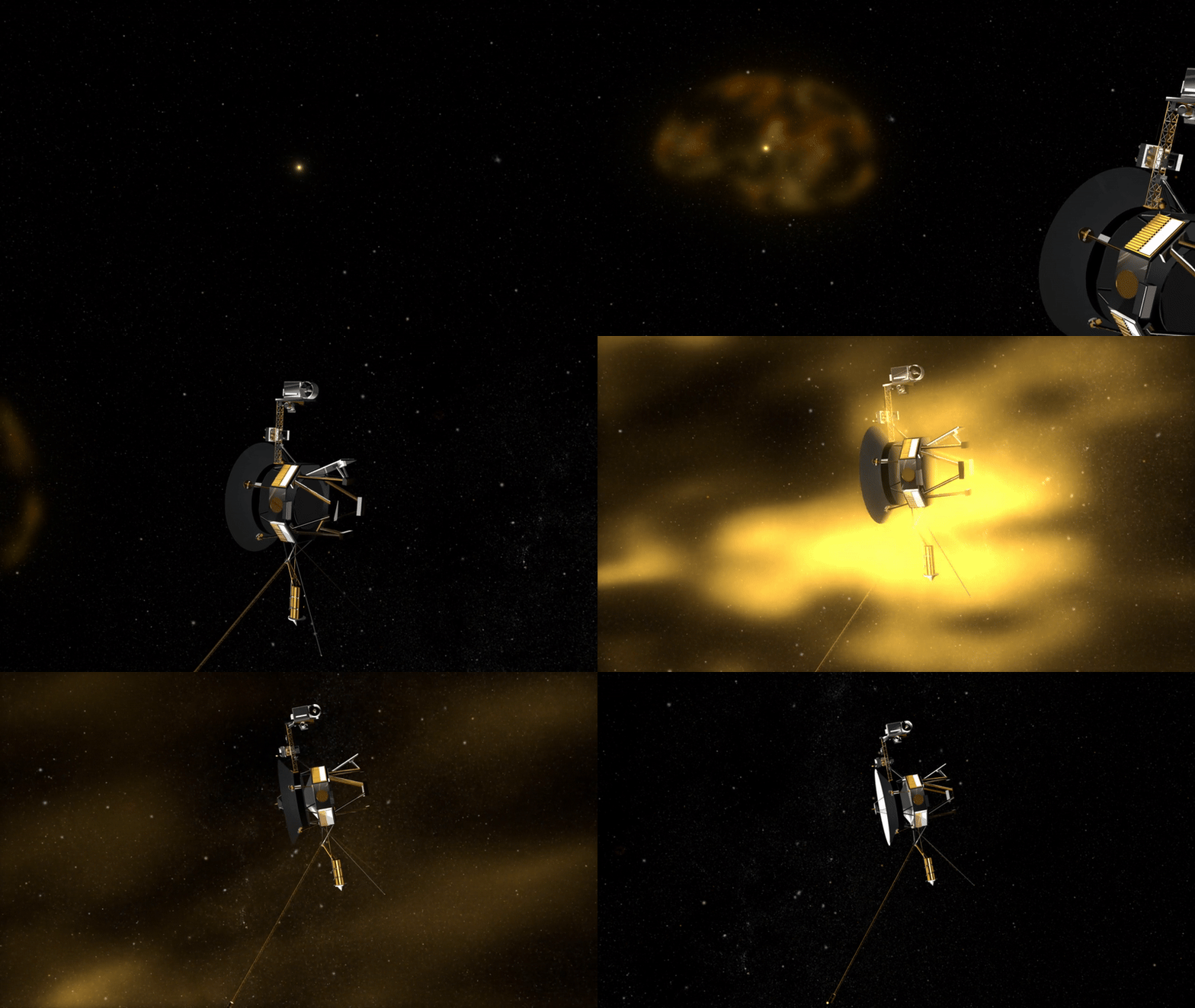
Above: This artist’s concept shows how ‘Oumuamua is usually depicted: as a cigar-shaped asteroid.

The idea might have been dismissed outright if it came from someone less credentialed. But Loeb’s Harvard affiliation lent it gravitas—and he had a point. ‘Oumuamua’s strange cigar-like shape and unexplained acceleration fit the Hollywood stereotype of a spacecraft. It sped up slightly as it left the solar system, possibly due to outgassing like a comet. Yet no gas or dust was ever seen.

Loeb’s reception has been frosty. Many mainstream researchers refuse to even mention his ideas in published papers, arguing that they have been debunked. But Loeb hasn’t backed down. He pioneered Project Galileo in 2021 to search the skies for technological artifacts. He has even searched the ocean floor. In mid-2023, Loeb announced the recovery of metallic spherules in the Pacific, arguing that they may be fragments from an artificial interstellar meteor. (Others disagree.)

Now Loeb is looking at interstellar object 3I/ATLAS as a potential piece of alien technology. In a paper co-authored by Adam Hibberd and Adam Crowl, he lays out nine ideas consistent with it being an intentional alien visitor. We review some of them here:

1. The orbit of 3I/ATLAS is strangely parallel to Earth’s. It lies within 5 degrees of the ecliptic plane–a coincidence with odds of less than 0.2%. The ecliptic plane is a narrow target, and the odds of a random interstellar comet hitting it are indeed low.
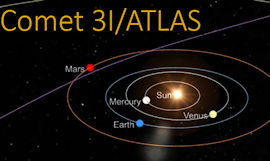
2. 3I/ATLAS will approach three planets during its visit: Venus (0.65au), Mars (0.19au) and Jupiter (0.36au). The cumulative probability of such a triple encounter is about 0.005%. However, it is the kind of pattern you might expect from a planetary survey.

3. 3I/ATLAS is on course to avoid Earth. At perihelion (closest approach to the sun), 3I/ATLAS and Earth will be on opposite sides of the sun. “This could be intentional to avoid detailed observations from Earth-based telescopes when the object is brightest or when gadgets are sent to Earth from that hidden vantage point,” writes Loeb in a blog post. We believe this statement speaks for itself. 

4. Although most astronomers believe 3I/ATLAS is a comet, “no spectral features of cometary gas are found in spectroscopic observations of 3I/ATLAS,” notes Loeb. This is far from conclusive. For one thing, 3I/ATLAS is still very far away, and its spectral features may simply be too faint to observe. More importantly, new images from the Gemini North Telescope show 3I/ATLAS looking exactly like a comet with a normal gaseous envelope. Update: Hubble agrees.
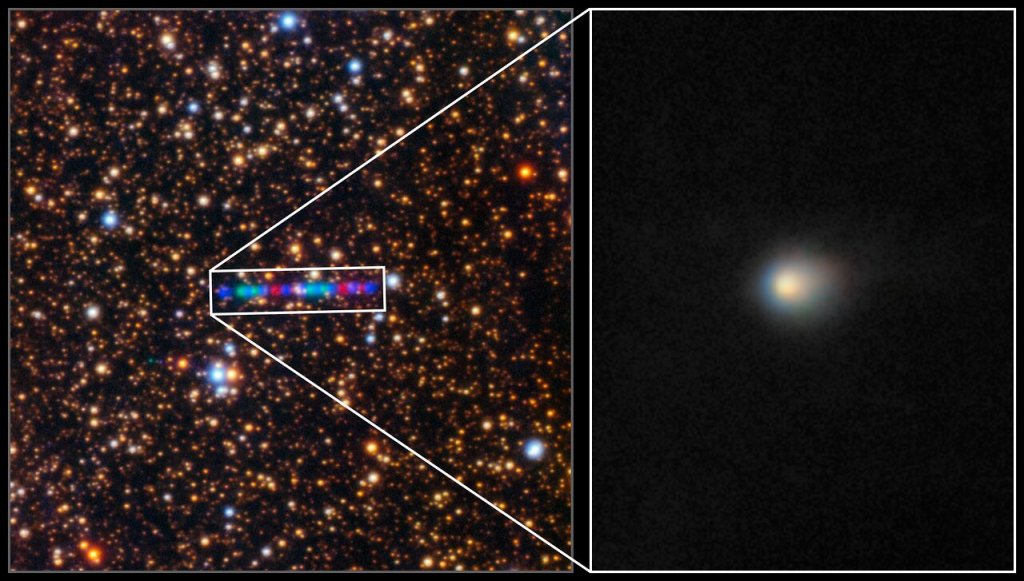
Above: Gemini North picture of 3I/ATLAS. It looks like a comet.

5. 3I/ATLAS has two chances to perform an Oberth maneuver. During its close approaches to the sun and Jupiter, 3I/ATLAS could fire its engines (if any) and become a permanent resident of the Solar System. That’s exactly what an exploratory probe might want to do.

Taken together, these points read more like a collection of curious coincidences than compelling evidence of alien tech. Even the authors admit as much: “This paper is contingent on a remarkable but, as we shall show, testable hypothesis, to which the authors do not necessarily ascribe, yet is certainly worthy of an analysis and a report,” they wrote. 

We agree. It’s okay to talk about these extraordinary claims, even if we don’t believe them–yet. Stay tuned for updates as Loeb’s hypotheses are put to the test.
Moths Follow the Milky Way

July 17, 2025 (Spaceweather.com): Astronomers come in all shapes and sizes–even invertebrates. A new study published in Nature reveals that Australian moths can see and decipher the night sky. They pay particular attention to the Milky Way and seem capable of navigating using the Carina nebula as a visual landmark.


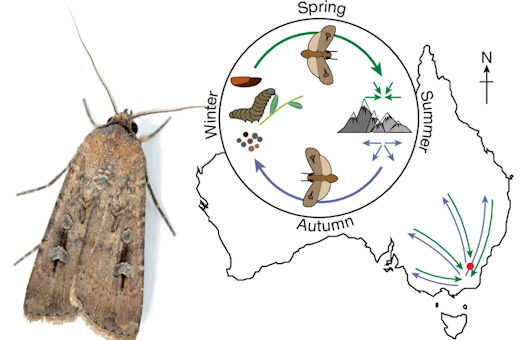
Above: A male Bogong moth and a diagram of their annual migration.

Every spring in southeast Australia, billions of Bogong moths take flight under cover of darkness. It’s the beginning of an epic migration as much as 1,000 kilometers long. Their destination: a small cluster of caves in the Australian Alps–places the moths have never visited before, yet somehow navigate to with remarkable precision. Their compass, it turns out, is the night sky itself.

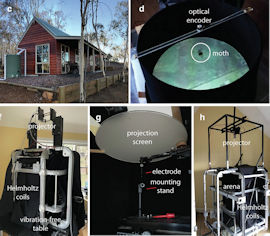
Reaching this conclusion required the researchers to do something you probably don’t want to think about too closely: They attached the moths to tiny little tethers. Moths could lift off and pick a direction, but not escape. 

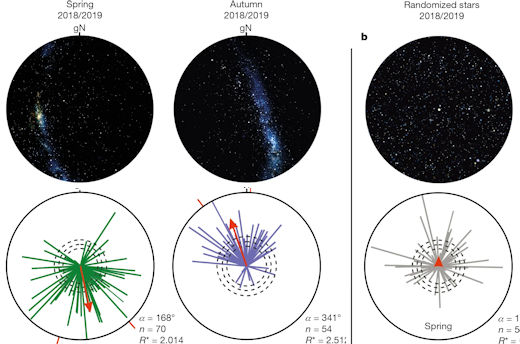
The experiment unfolded inside a special moth planetarium (pictured right). Star patterns were projected onto an overhead screen, while the ambient magnetic field was nulled by Helmholtz coils, guaranteeing that the participants could not “cheat” using magnetic navigation. When shown a normal star field, the moths oriented in the correct direction. But when the stars were scrambled into random patterns, they lost their bearings.

To dig deeper, the researchers recorded activity from visual neurons in the moths’ brains as a projected night sky rotated overhead. Neurons fired most strongly when the stars aligned with the moth’s inherited migratory heading. Some neurons were tuned to the brightest region of the Milky Way (especially near the Carina nebula) suggesting that this band of starlight is a visual landmark.

Clouds produced the next revelation: Bogong moths remained oriented even when stars were hidden. In those cases, they relied on Earth’s magnetic field instead, revealing a dual-compass system similar to that of migratory birds. When both stellar and magnetic cues were removed, the moths became disoriented again. 

Upper row: Laboratory-projected night skies during spring and autumn, and an autumn sky with its stars randomly arranged. Lower row: The moths’ reaction to each sky.

In recent years, scientists have discovered that many creatures are guided by the stars. In addition to humans, the list includes migratory songbirds, possibly seals, dung beetles, cricket frogs, and now Bogong moths. The list of lifeforms guided by magnetism is even longer, ranging in size from microbes to whales. 

You can read the original research here.

The Bastille Day Event, 25 Years Later

July 14, 2025: You know a solar flare is strong when even the Voyager spacecraft feel it. Twenty-five years ago, on July 14, 2000, the sun unleashed one of the most powerful solar storms of the Space Age—an event so intense, its shockwaves rippled all the way to the edge of the solar system.

Voyager 2 felt the explosion 180 days later; Voyager 1, 245 days. The debris was still coherent and traveling faster than 600 km/s (1.9 million mph) when it slammed into the two spacecraft—then more than 9 billion kilometers from the sun.

Here on Earth, the effects were almost immediate. Within minutes, extreme ultraviolet and X-ray radiation bathed our planet and its satellites. Ground-based sensors registered a rare GLE (ground-level event) as energetic particles cascaded through the atmosphere.

“People flying in commercial jets at high latitudes would have received double their usual radiation dose,” recalled Clive Dyer of the University of Surrey Space Centre. “It was quite an energetic event—one of the strongest of its time.”

Because the flare happened on July 14th, it’s called “The Bastille Day Event” after France’s national holiday. However, auroras did not appear until the following day, July 15th, when a coronal mass ejection (CME) arrived. The 1500 km/s impact triggered an extreme geomagnetic storm (Kp=9).

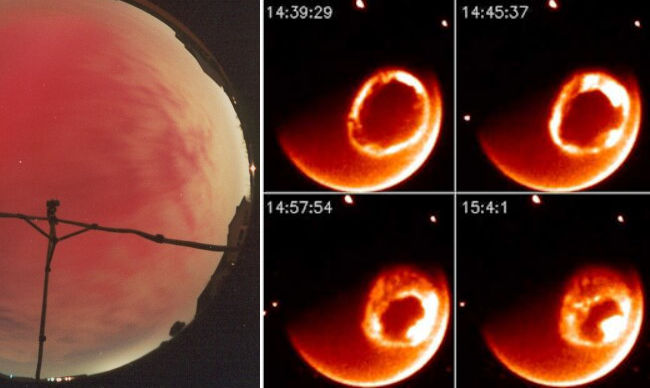
Above: Auroras on July 15, 2000, photographed by (left) Ronnie Sherrill in North Carolina and (right) NASA’s IMAGE spacecraft.

In New York, Lou Michael Moure remembers his sky catching fire: “I was living on Long Island. A family member ran into my room, shouting about ‘the sky on fire.’ Sure enough, the sky blazed white, green, then red from horizon to horizon.” In North Carolina, Uwe Heine was doing yardwork when bright red auroras appeared straight overhead: “I told our neighbor those weren’t sunset colors. It was an aurora—and super rare this far south!”

By the time the storm ended on July 16th, auroras had been sighted as far south as Texas, Florida, and even Mexico.

The Bastille Day Event was important because, for the first time in history, spacecraft throughout the solar system were equipped with instruments capable of studying such a storm. Most notably, it was the first major solar storm observed by SOHO, the Solar and Heliospheric Observatory, which gave researchers an unprecedented look at how extreme flares unfold and evolve.

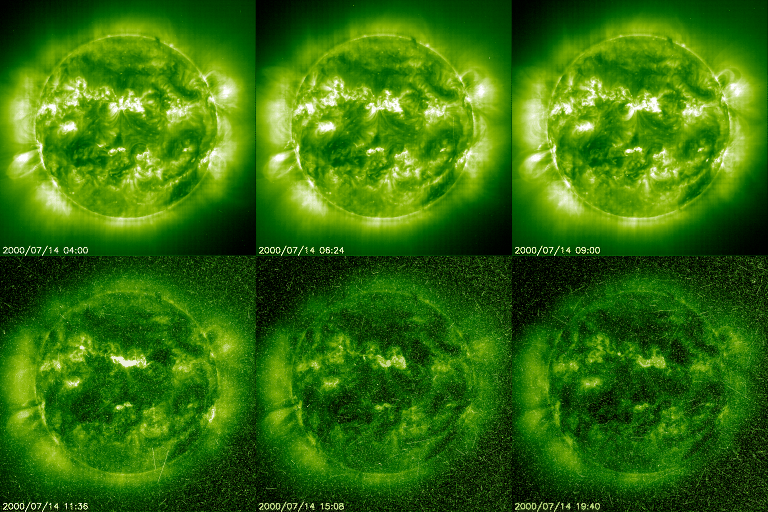
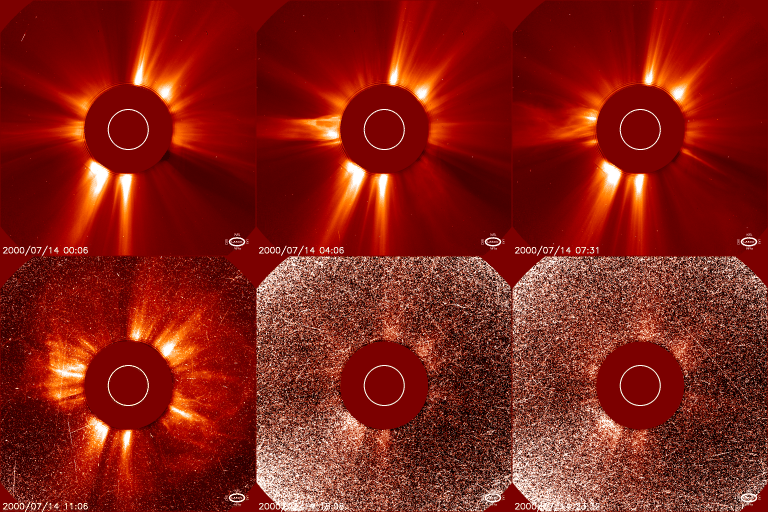
Above: SOHO images of the X5.7-class Bastille Day solar flare (left) and CME (right). “Snow” in the images is a result of energetic protons hitting the spacecraft

Later studies described how an X5.7-class flare, erupting near the center of the solar disk, released 10³³ ergs of magnetic energy—equivalent to a thousand billion WWII-era atomic bombs. The resulting CME generated a massive barrier of magnetic field and plasma, which swept away galactic cosmic rays as it raced through the heliosphere. Even the Voyagers felt this unusual dip in cosmic radiation, known as a Forbush Decrease.

Could it happen again? It could happen again this week. We’re currently near the peak of Solar Cycle 25, and another X-flare is well within the realm of possibility.

Happy Bastille Day.