Is 3I/ATLAS Really a Comet?

August 26, 2025: (Spaceweather.com) The most intriguing mystery in astronomy today is the nature of interstellar object 3I/ATLAS. Most astronomers believe it is a comet. However, Avi Loeb of Harvard University famously makes the case that it might be something else–like alien tech.

Into this debate comes new data from the James Webb Space Telescope. A paper just submitted to the Astrophysical Journal Letters reports that 3I/ATLAS looks like a comet, albeit a strange one. Here are the images from JWST:
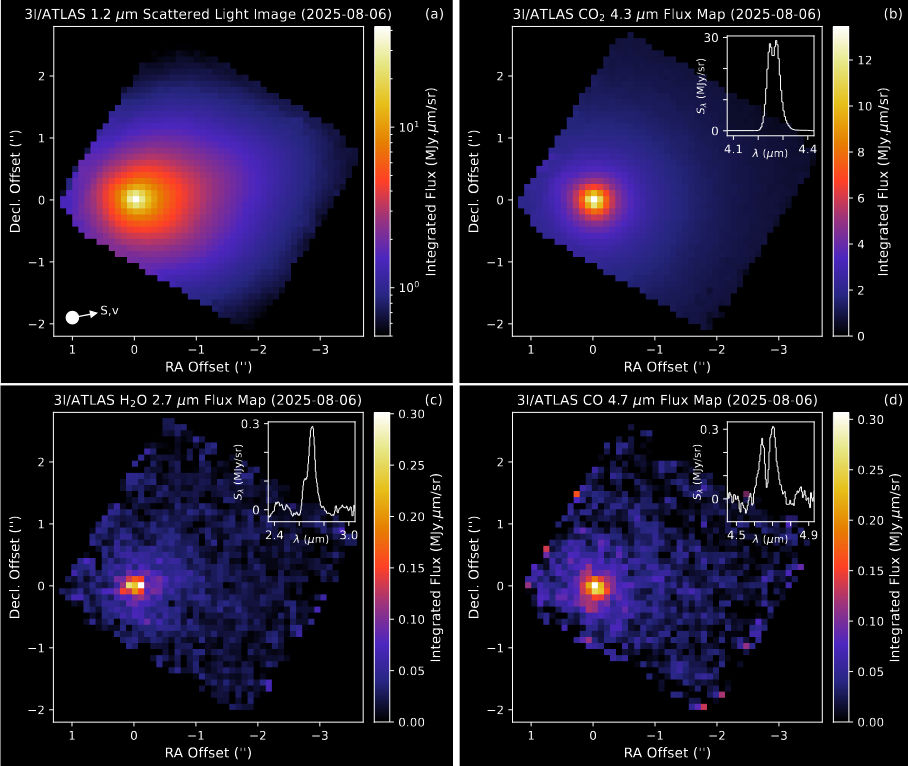
Above: These JWST images show the distribution of carbon dioxide (panel b), water (panel c) and carbon monoxide (panel d). Most of the light is coming from CO2.

The infrared space telescope found most of the ingredients we expect to find in comets. There’s a fuzzy coma, volatile ices, and all the usual molecules: water (H20), carbon dioxide (CO2), carbon monoxide (CO). If 3I/ATLAS is a spacecraft, it has an uncanny disguise.

However, there’s also something strange. The ratios of the different molecules are quite unexpected and don’t match what we see in Solar System comets. In particular, the CO2/H20 ratio of 8 ± 1 is extremely high. Only one other comet, C/2016 R2, is known to have similar chemistry, and astronomers have long considered it to be a “freak.”
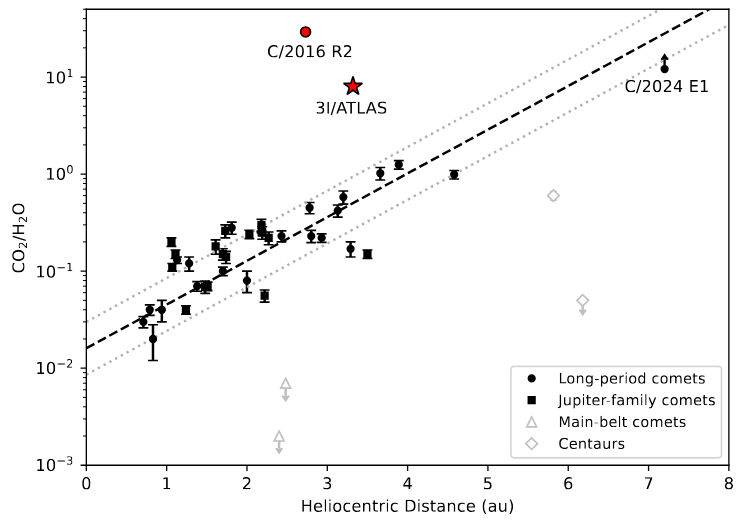
Above: Carbon dioxide-to-water ratios in known comets. 3I/ATLAS does not fit the trend.

Typical comets have a lot more water in their atmospheres, with H20 almost always outnumbering CO2. It could be that water production in 3I/ATLAS has not yet fully “turned on” because it is still too cold. If so, solar heating might restore ratios to normal. 3I/ATLAS will reach its closest point to the sun (1.36 AU) on Oct. 29, 2025, potentially bringing forth a geyser of water vapor to mix with the other gases.

Or, maybe, 3I/ATLAS is just strange–like it came from another star system. Stay tuned for updates.

Do Geomagnetic Storms Cause High Blood Pressure?

Aug. 15, 2025 (Spaceweather.com): Solar activity might be doing more than sparking auroras. A new study in Communications Medicine suggests it could be nudging your blood pressure, too.

Researchers in China analyzed more than half a million blood pressure readings taken over six years in the cities of Qingdao and Weihai. They compared those measurements to the Ap index, a standard measure of geomagnetic activity. The result: Blood pressure rises and falls in rhythm with magnetic unrest.

A sample of the dataset showing the correlation between BP and Ap. See Fig 1 for more.

Both systolic and diastolic blood pressure showed a bimodal pattern, with peaks in spring and autumn, mirroring the seasonal ups and downs of geomagnetic activity. In years when geomagnetic activity was strong, blood pressure peaked about one month after the Ap index. During quieter years, the lag stretched to two months. The data revealed matching cycles at 12, 6, and sometimes 3 months — present in the Ap index but absent from other environmental factors.

“We found that blood pressure and geomagnetic activity share distinct seasonal patterns,” says Quanqi Shi, one of the paper’s co-authors from Shandong University. “There seems to be a genuine link between the two.”

Importantly, the study found no similar multi-month patterns in air temperature or PM2.5, two well-known influences on blood pressure. While temperature correlated more strongly with blood pressure in a straightforward statistical sense, its effect lacked the 6- and 3-month cycles seen in geomagnetic data.

The authors stop short of saying that geomagnetic activity causes high blood pressure. Their data cannot prove cause and effect. Still, Shi and his colleagues are exploring how such a link might work.

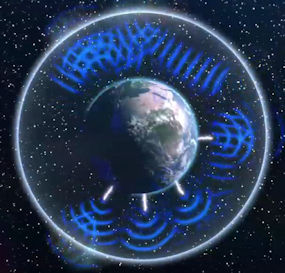
“One possible mechanism involves the modulation of ultra-low frequency waves, specifically Schumann resonances (pictured right), which occur within Earth’s magnetosphere. The fundamental frequency of Schumann resonances is approximately 7.8 Hz, with harmonics around 14.1, 20.3, 26.4, and 32.5 Hz. These fluctuations may interfere with human brain waves such as alpha (8–12 Hz), beta (12–30 Hz), and gamma (30–100 Hz),” Shi explains.

“The brain could then modulate neuroendocrine activity (for example, by altering the secretion of hormones such as vasopressin), which can gradually influence vascular tone and fluid balance. Such physiological adjustments may take weeks to accumulate, potentially explaining the observed 1-2 month delay.”

“This is just a hypothesis,” he stresses. “Further targeted studies are needed to confirm and clarify its potential mechanisms.”

Want to learn more? The full paper may be found here.

Space Hurricanes Are Real

Aug. 1, 2025 (Spaceweather.com): Hurricane season just got worse. Chinese researchers have discovered a new kind of storm at the edge of space. They call it a “space hurricane.”

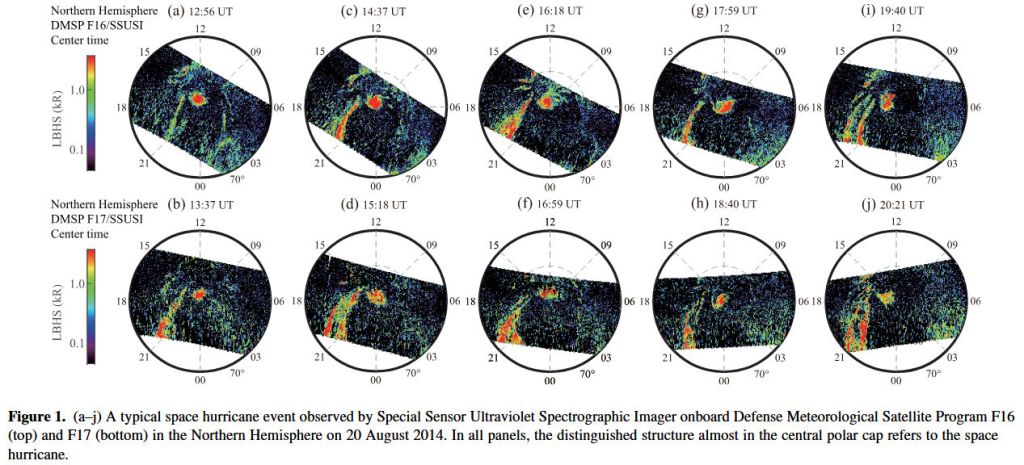
The first known example appeared in Defense Meteorological Satellite (DMSP) images on Aug. 20, 2014. A massive swirl of charged particles appeared above the North Pole. Spinning silently, it resembled a terrestrial hurricane in shape, with spiral arms and a calm “eye” glowing with auroral light. A detailed study of this event was published in the July 2025 edition of Space Weather.

Above: A ‘ space hurricane’ observed by DMSP satellites. Note the eye and spiral arms.

“The space hurricane formed during very quiet conditions,” says lead author Sheng Lu of Shandong University. “Solar activity was low.” 

Most researchers had overlooked these events because they weren’t linked to solar storms. This team looked for auroras under calm conditions and found something new. The DMSP F17 satellite flew through the space hurricane’s center; ten minutes later, SWARM B crossed the edge. Their data confirmed the hurricane was an active electrodynamic storm, not just an auroral display.

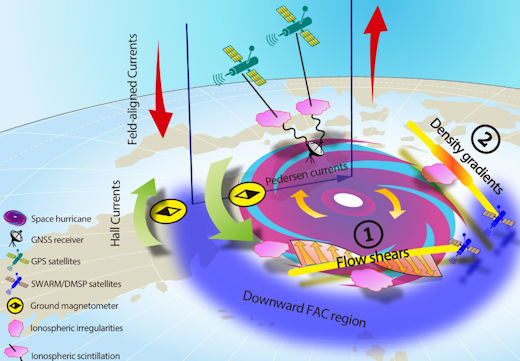
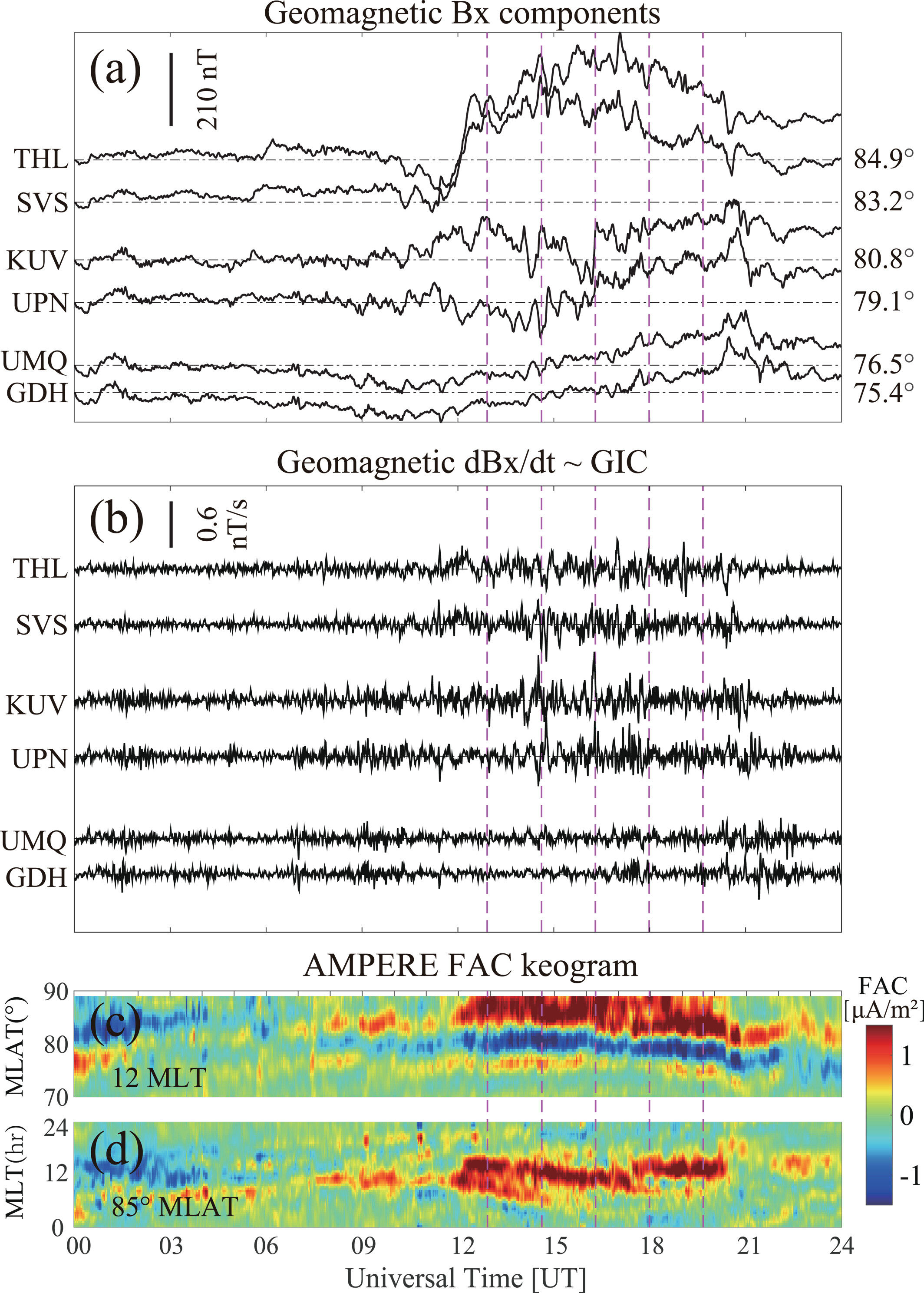
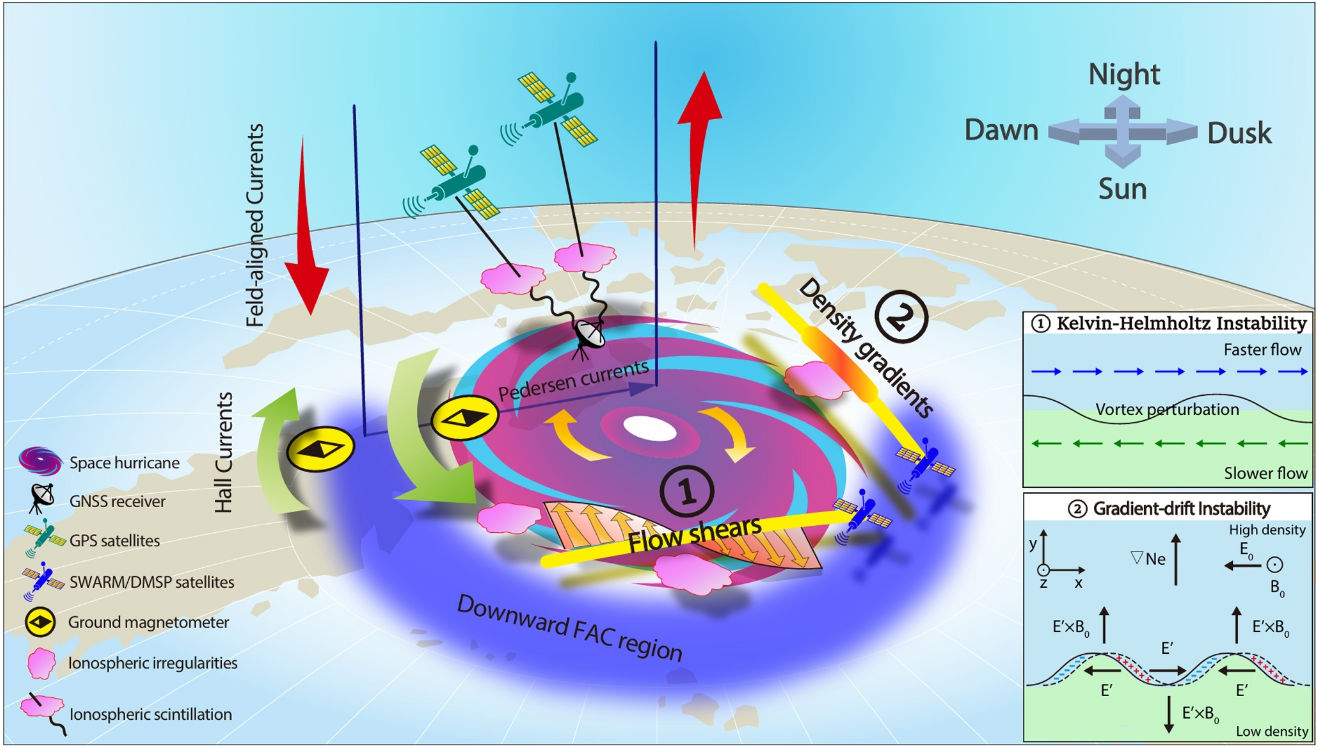
The hurricane’s effects mimicked those of actual geomagnetic storms. Using GPS data from the Canadian High Arctic Ionospheric Network, the researchers found that satellite signals passing through the hurricane’s edge experienced strong phase scintillations–a type of “twinkling” that can reduce GPS accuracy. Meanwhile, ground-based magnetometers in Greenland recorded sharp shifts in Earth’s magnetic field as large as 400 nT–comparable to a G1-class geomagnetic storm.

Above: The anatomy of a space hurricane. Credit: Lu et al (2025) [Expand]

Savvy aurora chasers know that the best time to catch Northern Lights is when the interplanetary magnetic field (IMF) tilts south. This opens a hole in Earth’s magnetosphere, allowing solar wind to enter. We tend to ignore times when the IMF tilts north and closes the door. Yet that is precisely when space hurricanes form, according to the study. 

Space hurricanes are stealthy, appearing when traditional metrics of space weather forecasting indicate little of interest. Note to forecasters: Not all storms come from the sun.

Want to learn more? Read the original research here.