June 4, 2025 (Spaceweather.com) — Solar storms are supposed to make radiation go up, right? A severe solar storm on June 1st did just the opposite. The Oulu Cosmic Ray Station in Finland registered the biggest drop in cosmic radiation in more than 20 years:
This is called a “Forbush Decrease,” named after American physicist Scott Forbush who studied cosmic rays in the early 20th century. It happens when a coronal mass ejection (CME) sweeps past Earth and pushes galactic cosmic rays away from our planet.
On June 1, 2025, a fast-moving CME crossed Earth’s orbit and thinned our planet’s radiation environment. Cosmic ray fluxes dropped as much as 25%. To find another Forbush Decrease this deep, you have to go all the way back to October 30, 2003, when CMEs related to the famous Halloween Storms were pummeling Earth.
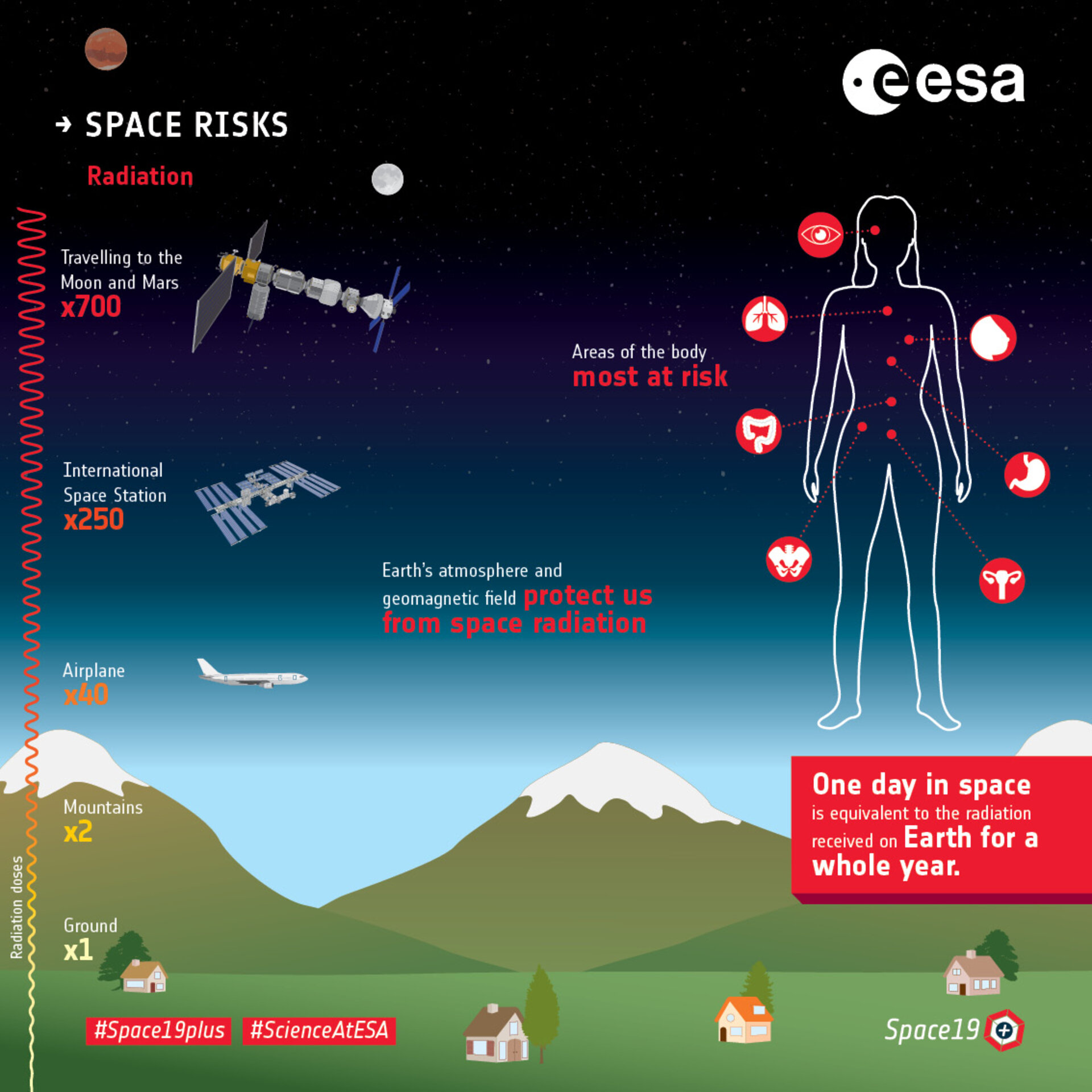
Galactic cosmic rays are an astronaut’s worst enemy. The European Space Agency has called them “the radiation showstopper for Mars exploration,” noting that “one day in space is equivalent to the radiation received on Earth for a whole year.”
The most vulnerable parts of the human body are those with rapidly dividing cells, including bone marrow, reproductive organs, gastrointestinal tract, and skin. Forbush Decreases can provide temporary relief; the problem is, there are not enough Forbush Decreases to make a Mars journey completely safe.
The current Forbush Decrease will subside in a week or two–just enough time for a quick trip to the Moon, albeit not beyond.
May 21, 2025: (Spaceweather.com) More than 14 thousand years ago, there was a solar storm so big, trees still remember it. Dwarfing modern solar storms, the event would devastate technology if it happened again today. Spoiler alert: It could.
Above: Subfossil trees along the banks of the Drouzet river in France [ref]
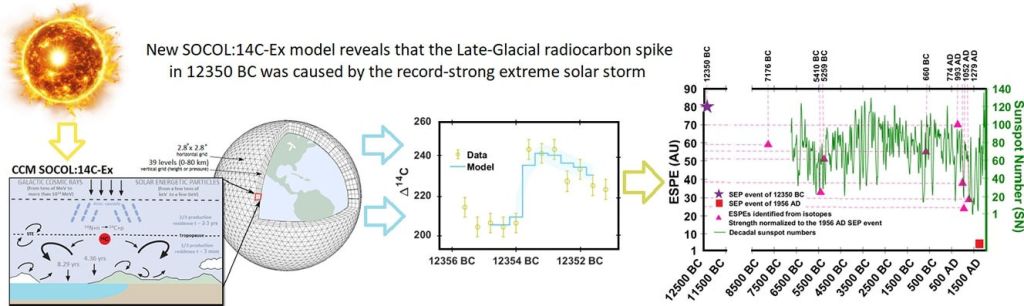
The record-strong storm is described by a paper in the upcoming July 2025 edition of the peer-reviewed journal Earth and Planetary Science Letters. It occured in 12,350 BC and is classified as a “Miyake Event.”
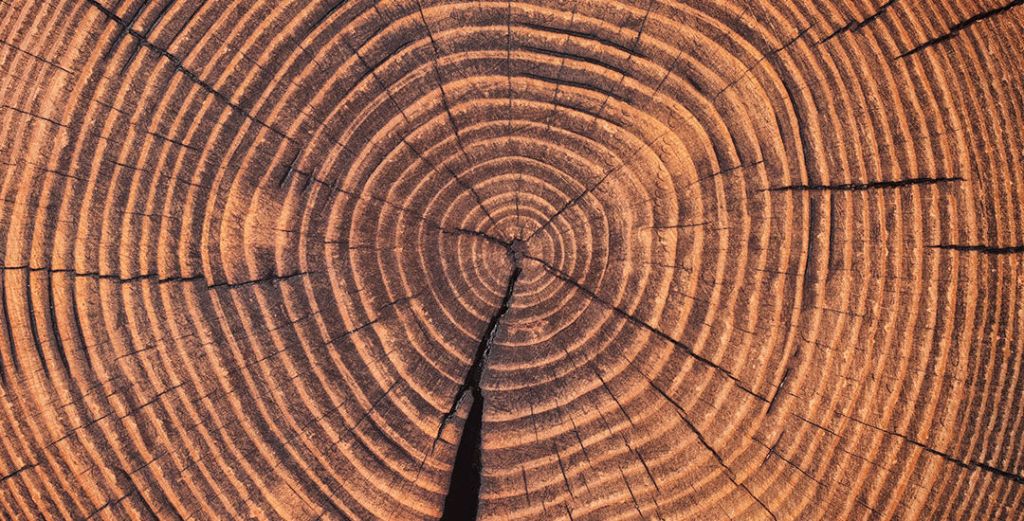
Miyake Events are solar storms that make the Carrington Event of 1859 look puny. Trees “remember” them in their rings, which store the carbon-14 created by gargantuan storms. At least six Miyake Events have been discovered and confirmed since Fusa Miyake found the first one in 2012. The list so far includes 664-663 BC, 774 AD, 993 AD, 5259 BC, 7176 BC, and 12,350 BC.
The Miyake Event of 12,350 BC is especially intriguing. It appears as a carbon-14 spike in Scots Pine trees along the banks of the Drouzet river in France, with a matching beryllium-10 spike in Greenland ice cores. The event was global and, based on the size of the spikes, very big.
At first, no one could say how big the storm was because it happened during the Ice Age.
Carbon-14 storage is complicated. When a solar storm creates carbon-14 in the upper atmosphere, the radioisotope doesn’t immediately appear in the woody flesh of trees. Getting there involves months to years of atmospheric circulation influenced by climate and geography, and even then the carbon-14 has to arrive during the tree’s growing season, otherwise it won’t be “taken up.” High-altitude trees are favored because they encounter the carbon-14 first, while different species each have their own sensitivity.
All these factors are a harder to tease out in the Ice Age. Most known Miyake Events occurred after the Ice Age, during the Holocene, a period of relatively stable and warm climate starting about 12,000 years ago. Climate scientists have atmospheric circulation models for the Holocene, so interpreting Miyake Events in 7176 BC, 5259 BC, 664-663 BC, 993 AD, 774 AD was relatively straightforward. Not so, the event of 12,350 BC.
To solve this problem, Kseniia Golubenko and Ilya Usoskin from the University of Oulu in Finland developed a chemistry-climate model (SOCOL:14C-Ex) specifically for Ice Age solar storms. It takes into account ice sheet boundaries, sea levels, and geomagnetic fields that existed during the Pleistocene’s Late Glacial period. Using this model, they were able to interpret tree ring data for 12,350 BC.
According to their paper, 12,350 BC is the biggest Miyake Event yet. It produced a hailstorm of solar particles 500 times greater than the most intense solar particle storm recorded by modern satellites in 2005. During the 2005 event, an airline passenger flying over the poles might have received a year’s worth of sea-level cosmic radiation in just one hour. During the 12350 BC event, the same dose would have been received in a mere eight seconds.
This would seem to set a new standard for worst-case scenarios in space weather. However, the real news is deeper: The door to the Ice Age has been kicked open by SOCOL:14C-Ex. Older tree rings may now be interpreted with confidence, potentially revealing even worse storms.
May 12, 2025 (Spaceweather.com): Solar eclipses aren’t just for homo sapiens. Researchers have long known that birds, insects, and many mammals pay attention when the Moon slides in front of the sun. Now we can add trees to the list.
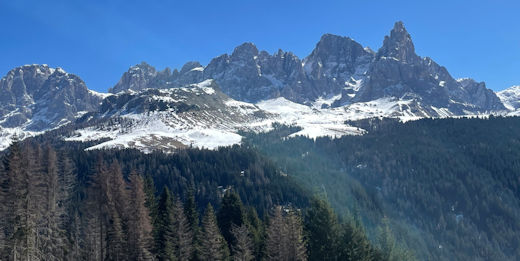
Above: The study’s location in the Dolomite Mountains of Italy. Photo credit: Monica Gagliano
A paper just published in the journal Royal Society Open Science reports the extraordinary reaction of an Italian mountain forest to a partial eclipse on Oct. 25, 2022. Electrical signals inside spruce trees began to pulse in unison, with older trees seeming to anticipate the eclipse before it happened.
This is unconventional research, and it may challenge what some readers think about trees. However, it is serious work conducted by experts in plant communication and published in a peer-reviewed journal of the Royal Society.
The paper reports how scientists led by Alessandro Chiolerio of the Italian Institute of Technology and Monica Gagliano of Southern Cross University attached electrodes to three Norway spruce trees and five tree stumps. Their device is like an EKG for trees. The trees were different ages, ranging from 20 to 70 years old, allowing the team to compare how age might influence bioelectrical responsiveness to the eclipse.
Above: Electrodes connected to the spruce trees during the eclipse. Photo credit: Monica Gagliano
As the eclipse approached, electrical signals from different trees began to align; their waveforms became more similar in shape and timing. This synchronization peaked during the eclipse and gradually diminished afterward. The older trees started showing electrical changes earlier, hours before the eclipse began, while the youngest tree responded later and more weakly. The tree stumps also exhibited a bioelectrical response, albeit less pronounced than in the standing trees.
The researchers interpreted this as a coordinated “organism-like” response to a large-scale environmental event, possibly involving communication or shared signaling pathways.
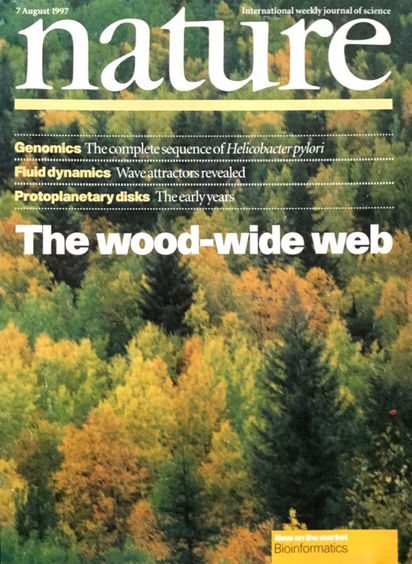
The idea that trees may “talk” to one another is key to the burgeoning field of plant communication. A growing body of research (especially since the 1990s) suggests that trees form symbiotic relationships with fungi, creating vast underground networks called the “Wood Wide Web.” Through these networks, trees exchange nutrients, water, and even chemical signals. They also reportedly recognize their own young and give preferential treatment to kin. Even tree stumps may retain connections to this network.
“Basically, we are watching the famous ‘Wood Wide Web’ in action!” says Gagliano.
Although the researchers successfully detected electrical activity in the trees, they have no idea what was being said–if anything. Perhaps it was simply a basic response to changes in temperature or light levels (about 1/3rd of the sun was covered during the eclipse). The researchers don’t yet speak the “language” of arboreal electricity, so they can’t decipher what they overheard. Repeating the experiment in different forests during more eclipses may be revealing.
Stay tuned for updates from the forest.
Recommended reading: Two good introductory books on plant communication and networking are “Finding the Mother Tree” by Suzanne Simard and “The Light Eaters” by Zoe Schlanger.
April 22, 2025: (Spaceweather.com) Planting season is a hectic time for farmers. For many, it means working through the night using GPS-guided tractors to plant thousands of acres in a short period of time. The season was in full swing on May 10, 2024, when the biggest solar storm in decades struck Earth.
“Our tractors acted like they were demon possessed,” says Elaine Ramstad, a Spaceweather.com reader and aurora chaser who helps out on a family farm in Northern Minnesota. “All my cousins called me during the May 10th storm to tell me that ‘my auroras’ were driving them crazy while they were planting.”
Above: Northern Lights over Elaine Ramstad’s cousin’s family beet farm on May 10, 2024
Modern farmers rely heavily on GPS. Guided by satellites, smart tractors can work around the clock, seeding perfectly straight rows with precise amounts of seed and fertilizer. When harvesting time comes, the tractors can return to exactly the same spots to pick the crops.
This kind of precision agriculture has become widespread. “I would guess 80% or more of all farmers in the Midwest use at least basic GPS for something–whether it’s auto-steer or yield mapping,” says Ethan Smidt, a service manager for John Deere. “At least 50% of all farmers are VERY reliant on GPS and use it on every machine all year long.”
Solar activity poses a growing problem for farm-tech. During big solar storms, a layer of Earth’s atmosphere called “the ionosphere” fills with bubbles, waves, and turbulence, which severely distort radio signals from GPS satellites. Sometimes tractors and harvesters can’t lock on, which stops them in their tracks. Or the signal may be garbled, causing them to juke back and forth.
Above: Crooked rows in Iowa caused by a solar storm.
May 10th wasn’t the end of it. Tractors went off-course again during the autumnal storms of Oct. 6th and 10th.
Ramstad was helping her cousins defoliate sugar beets on Oct. 6th when her tractor started acting up: “As the aurora activity began, my GPS was off by close to a foot. Twice while on Autosteer, the tractor danced a row to the left, to the right — and then the defoliator was off a row, so I had to loop around and start over. By nightfall, there was no controlling the Autosteer.”
Indiana farmer Michael Spencer had a similar experience: “This fall was the first time I was able to see the aurora. My hair was standing on end from the beauty, however, it did make the John Deere tech dance. When the storms were strongest around Oct. 7th, my tractor’s Autosteer system would ‘jump the line’–meaning, the tractor would make a quick jolt left or right and I would have to manually reset.”
Above: A beet defoliator–an example of massive hardware thrown off course by solar activity.
It doesn’t take an historic solar storm to cause problems. While the May 10th storm was a rare and extreme category G5, storms in October were much more common category G3 and G4 events. All of them sent massive pieces of hardware off course.
NASA says that Solar Maximum has arrived, and it could last for another 1 to 2 years, confusing tractors again in 2025 and 2026. Stay tuned for more crooked rows. Solar storm alerts:SMS Text
March 10, 2025: Last October, NOAA and NASA announced that Solar Max has arrived. Only half the sun got the memo. The majority of solar activity has been happening in just one of the sun’s hemispheres–the south. For instance, the solar superstorm of May 10, 2024, was caused by a monster southern sunspot.
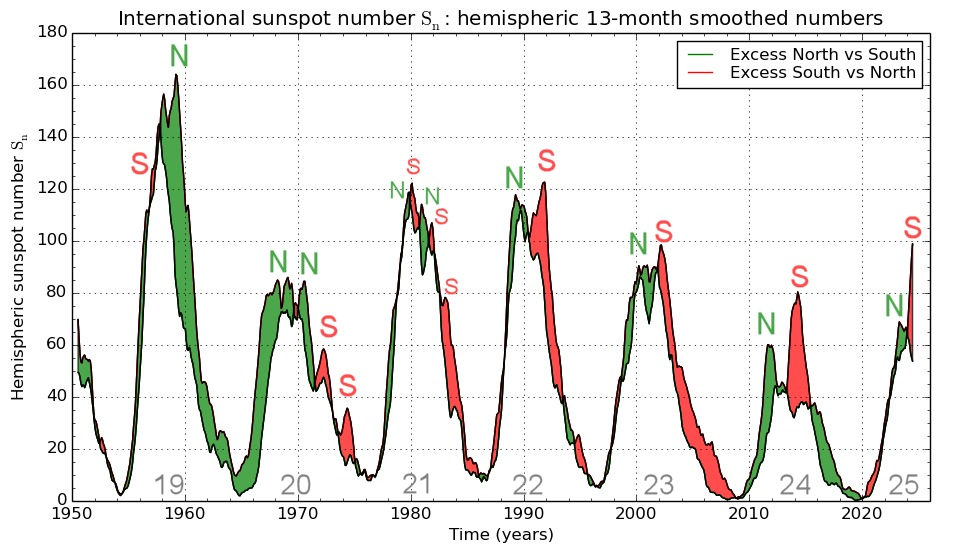
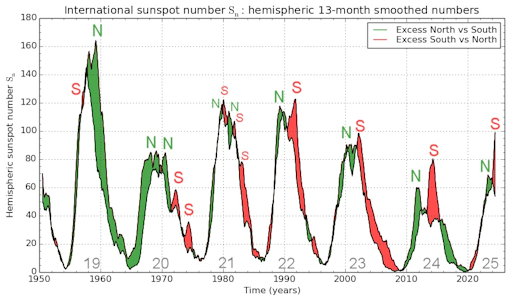
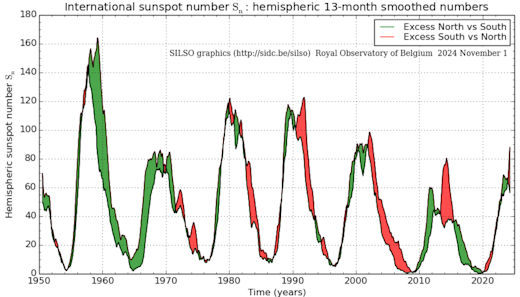
It makes you wonder, is the other half of Solar Max still coming? This plot of hemispheric sunspot numbers from SILSO provides some context:
Here we see all seven solar cycles of the Space Age, punctuated by current Solar Cycle 25 on the far right. The most recent cycles are double peaked, with northern sunspots (green) and southern sunspots (red) reaching their own Solar Max ~two years apart. This isn’t big news. Researchers have long known that the two hemispheres of the sun are slightly out of sync. The north vs. south delay is called the “Gnevyshev gap.”
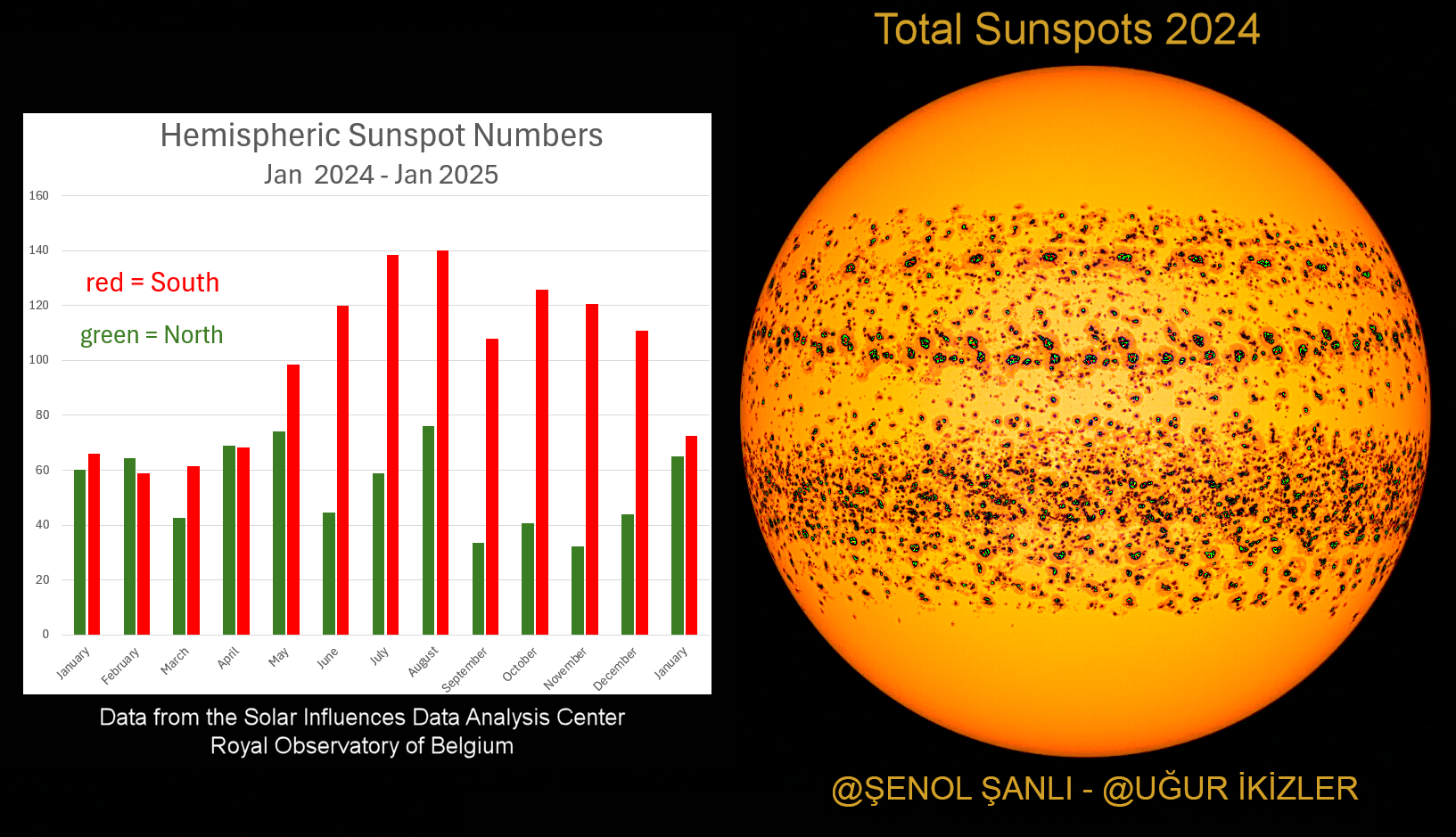
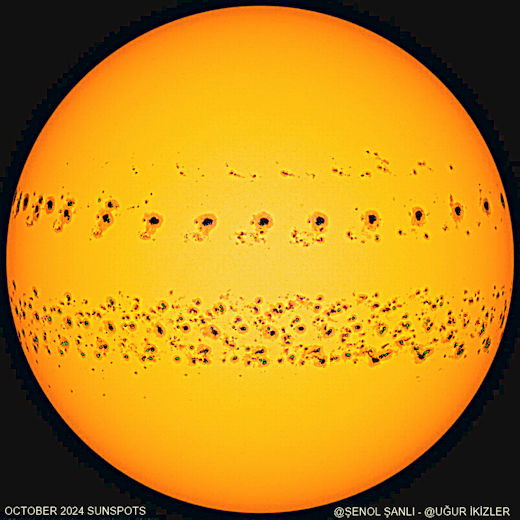
This composite image of last year’s sunspots shows how dominant the southern hemisphere has been:
For forecasters of the solar cycle, this raises an interesting possibility: Maybe the northern peak is still coming. Indeed, there are signs in February 2025 that the pendulum is swinging. This month’s sunspots have been more evenly distributed between the two hemispheres, a sign that activity may be shifting north.
On the other hand, the northern peak might have already occurred. Take another look at the first plot. There is a puny northern peak near the beginning of Solar Cycle 25. Perhaps that was it. (Indeed, that would jibe with the north-first, south-second order of recent double peaks.)
This discussion focuses attention on the north-south balance of sunspots. A northern shift in the months ahead could herald a second peak and another year or two of excellent auroras before Solar Cycle 25 finally peters out. Stay tuned!
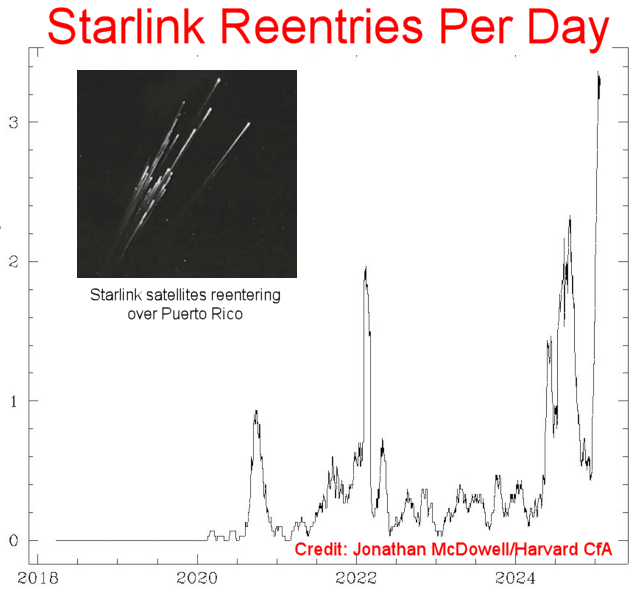
Feb. 5, 2025 (Spaceweather.com): What goes up, must come down–which could be a problem when you’re launching thousands of satellites. Since 2018, SpaceX has placed more than 7,000 Starlink satellites into Earth orbit, and now they are starting to come down. In January alone, more than 120 Starlinks deorbited, creating a shower of fireballs.
“The sustained rate of daily reentries is unprecedented,” says Jonathan McDowell, an astronomer at the Harvard Center for Astrophysics who tracks satellites. “They are retiring and incinerating about 4 or 5 Starlinks every day.”
Planners have long known this would happen. First generation (Gen1) Starlink satellites are being retired to make way for newer models. “More than 500 of the 4700 Gen1 Starlinks have now reentered,” says McDowell.
When Starlinks reenter, they disintegrate before hitting the ground, adding metallic vapors to the atmosphere. A study published in 2023 found evidence of the lingering debris. In February 2023, NASA flew a WB-57 aircraft 60,000 feet over Alaska to collect aerosols. 10% of the particles contained aluminum and other metals from the “burn-up” of satellites.
What we’re observing is a giant uncontrolled experiment in atmospheric chemistry. The demise of just one Gen1 Starlink satellite produces about 30 kilograms (66 pounds) of aluminum oxide, a compound that eats away at the ozone layer. A new study finds these oxides have increased 8-fold between 2016 and 2022, and the recent surge is increasing the pollution even more.
On the bright side, each reentry produces a beautiful fireball–and the odds are increasing that you’ll see one. Visit the Aerospace Corporation for reentry predictions, and submit your photos here.
Jan. 30, 2025: (Spaceweather.com) How bad can a solar storm be? Just ask a tree. Unlike human records, which go back hundreds of years, trees can remember solar storms for millennia.
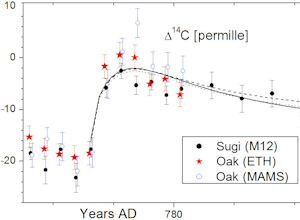
Nagoya University doctoral student Fusa Miyake made the discovery in 2012 while studying rings in the stump of a 1900-year-old Japanese cedar. One ring, in particular, drew her attention. Grown in the year 774–75 AD, it contained a 12% jump in radioactive carbon-14 (14C), about 20 times greater than ordinary fluctuations from cosmic radiation. Other teams confirmed the spike in wood from Germany, Russia, the United States, Finland, and New Zealand. Whatever happened, trees all over the world experienced it.
Most researchers think it was a solar storm—an extraordinary one. Often, we point to the Carrington Event of 1859 as the worst-case scenario for solar storms. The 774-75 AD storm was at least 10 times stronger; if it happened today, it would floor modern technology. Since Miyake’s initial discovery, she and others have confirmed five more examples (12,450 BC, 7176 BC, 5259 BC, 664-663 BC, 993 AD). Researchers call them “Miyake Events.”
It’s not clear that all Miyake Events are caused by the sun. Supernova explosions and gamma-ray bursts also produce carbon-14 spikes. However, the evidence tilts toward solar storms. For each of the confirmed Miyake Events, researchers have found matching spikes of 10Be and 36Cl in ice cores. These isotopes are known to trace strong solar activity. Moreover, the 774-75 AD Miyake Event had eyewitnesses; historical reports of auroras suggest the sun was extremely active around that time.
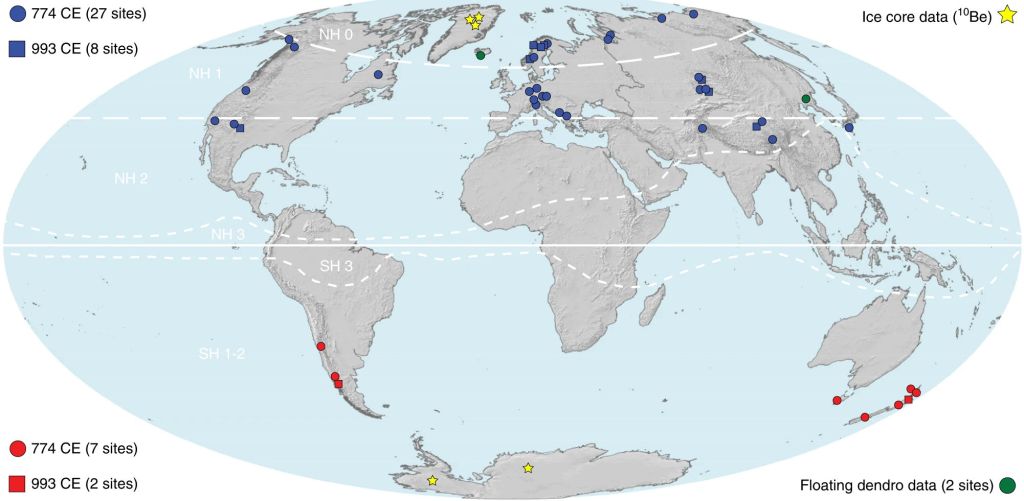
Miyake Events have placed dendrochronologists (scientists who study tree rings) in the center of space weather research. After Miyake’s initial discovery in 2012, the international tree ring community began working together to look for evidence of solar superstorms. Their collaboration is called “the COSMIC initiative.” First results published in a 2018 edition of Nature confirm that Miyake Events in 774-75 AD and 993 AD were indeed global. Trees on five continents recorded carbon spikes.
Above: A global map of COSMIC tree ring and ice core measurements [more]
“There could be additional Miyake Events throughout the Holocene” says Irina Panyushkina, a member of the COSMIC initiative from the University of Arizona’s Laboratory for Tree-Ring Research. “An important new source of data are floating tree-ring records from Eurasia and the Great Lakes region. These are very old rings that could potentially capture 14C spikes as far back as 15,000 years. Eventually, I believe we will have a complete record of Miyake Events throughout that period.”
Four more candidates for Miyake Events have recently been identified (5628 BC, 5410 BC, 1052 C, and 1279 C). Confirmation requires checking trees on many continents and finding matching spikes of 10Be and 36Cl in ice cores. It’s all part of the “slow and systematic process” of radiocarbon tree ring research, says Dr. Panyushkina.
A complete survey of Miyake Events could tell us how often solar superstorms occur and how much peril the sun presents to a technological society. Stay tuned for updates from the trees.
Nov. 4, 2024: At the end of October, amateur astronomer Senol Sanli made a composite 31-day image of the month’s sunspots. Take a look. Notice anything?
The two hemispheres of the sun are not the same. There’s a lopsided distribution of sunspots, with three times more in the south compared to the north. According to hemispheric sunspot data from the Royal Observatory of Belgium (WDC-SILSO), October was the fifth month in a row the sun’s southern hemisphere significantly outperformed the north. You can see the same pattern visually in composite images from September, August, July, and, to a lesser extent, June 2024.
What’s going on? Solar physicists have long known that the two hemispheres of the sun don’t always operate in sync. Solar Max in the north can be offset from Solar Max in the south by as much as two years, a delay known as the “Gnevyshev gap.” The assymetry is illustrated in this graph of north-vs-south sunspot numbers from the last 6 solar cycles:
Is the sun’s southern hemisphere experiencing its Solar Max right now? Maybe. We won’t know for sure until years from now when we can look back and see the final shape of Solar Cycle 25. Meanwhile, stay tuned for more southern sunspots.
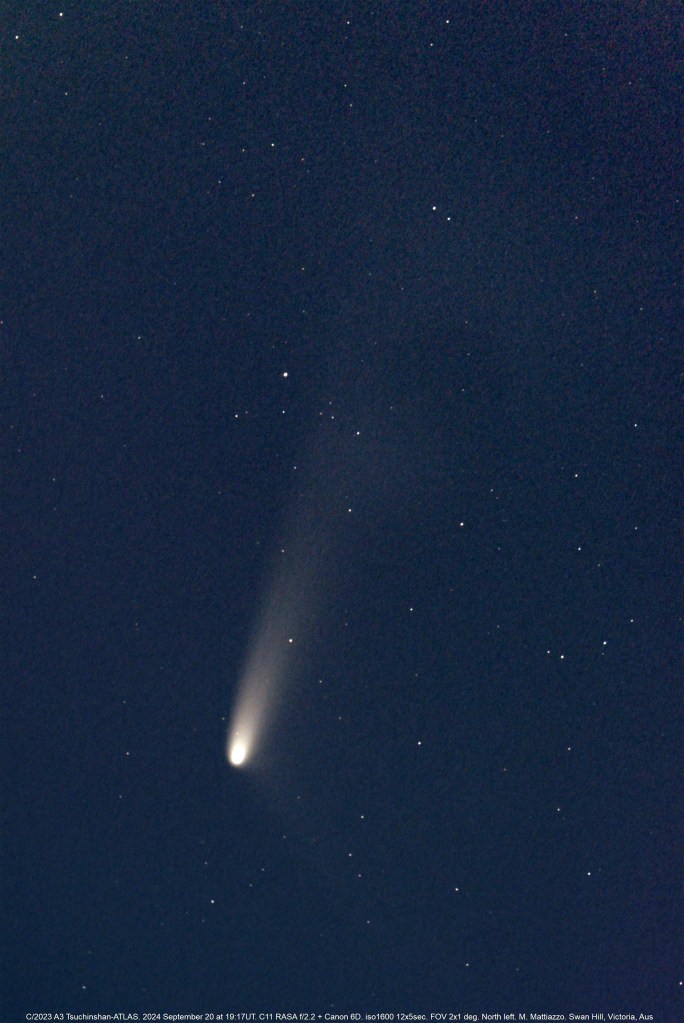
Sept. 20, 2024: (Spaceweather.com) Comet Tsuchinshan-ATLAS (C/2023 A3) has just emerged from behind the sun, and its appearance has astronomers buzzing with anticipation. “The comet is brightening rapidly,” says Australian astrophotographer Michael Mattiazzo, who has been monitoring the comet in dawn twilight:
Above: Comet Tsuchinshan-ATLAS at dawn on Sept. 21st over Swan Hill, Australia
“The comet was only 6 degrees above the horizon when I photographed it on Sept. 21st,” says Mattiazzo. “Using 15x70mm binoculars, I estimated its visual magnitude to be +3.9.”
This is very good news. Some astronomers predicted Comet Tsuchinshan-ATLAS would fall apart during its transit behind the sun. The fact that it is still intact and healthy means we could witness a bright naked-eye comet next month.
“Prospects remain excellent for a visually impressive evening display in mid-October,” says Qicheng Zhang of the Lowell Observatory. “Weather permitting, the entire Northern Hemisphere should be able to see Comet Tsuchinshan-ATLAS.”
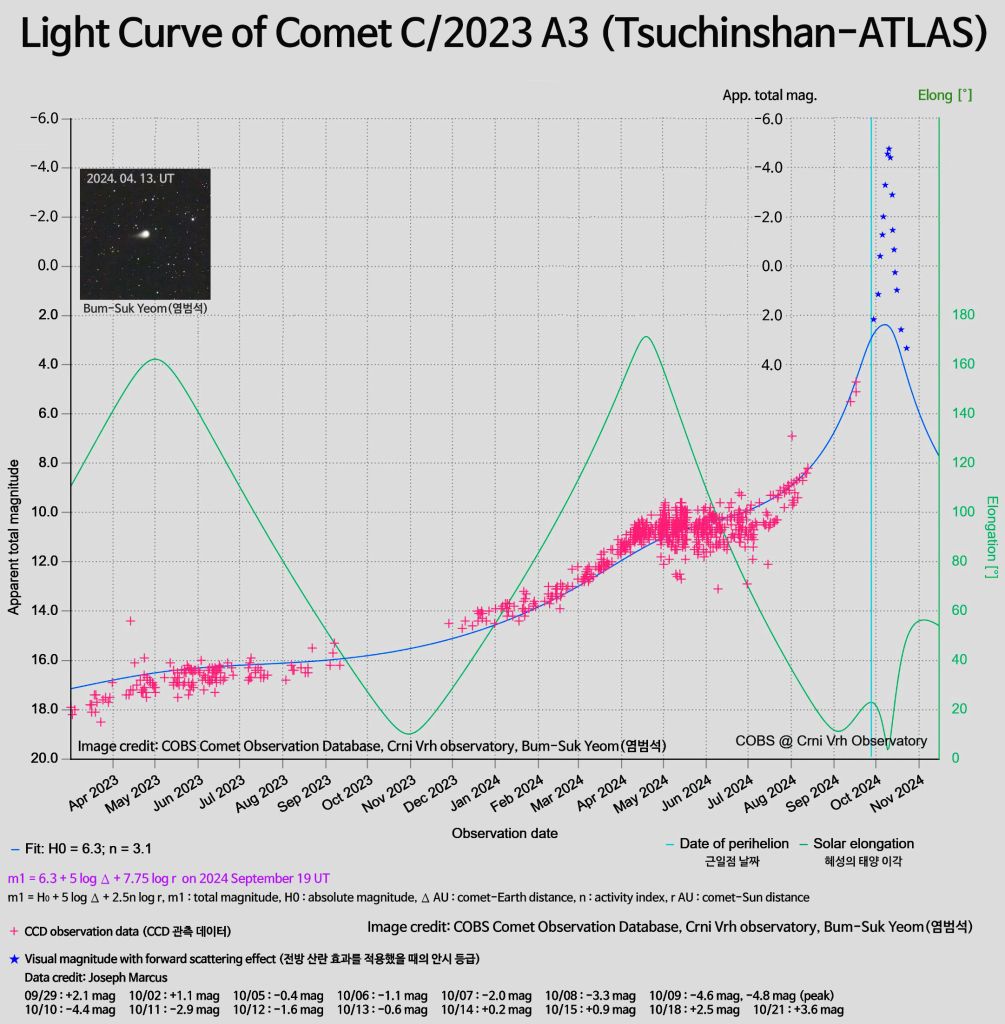
Nick James of the British Astronomical Association just wrote an article anticipating the bright comet. “It makes its closest approach to Earth on October 12 when it will be 0.47 au away in the constellation of Virgo,” he says. “There is a possibility that the comet will be at a negative magnitude as it emerges into the evening sky from Oct. 10th onwards.”
Above: This light curve from astronomer Bum-Suk Yeom shows a huge spike in the comet’s brightness around Oct. 9-10. [more]
“Negative magnitude” means the comet could be visible in broad daylight, especially on Oct. 9th when light from the nearby sun will be forward scattered by comet dust, amplifying the comet’s brightness. “[Daylight photography of the comet] should only be attempted if you know what you are doing,” cautions James. “The sun will be very close by and this is potentially a very dangerous observation, similar to observing Venus at inferior conjunction.”
It’s been done before, though. Witness Comet McNaught in 2007, which was seen in broad daylight by thousands of observers. Could a repeat display be in the offing? Stay tuned for updates as Comet Tsuchinshan-ATLAS approaches Earth.
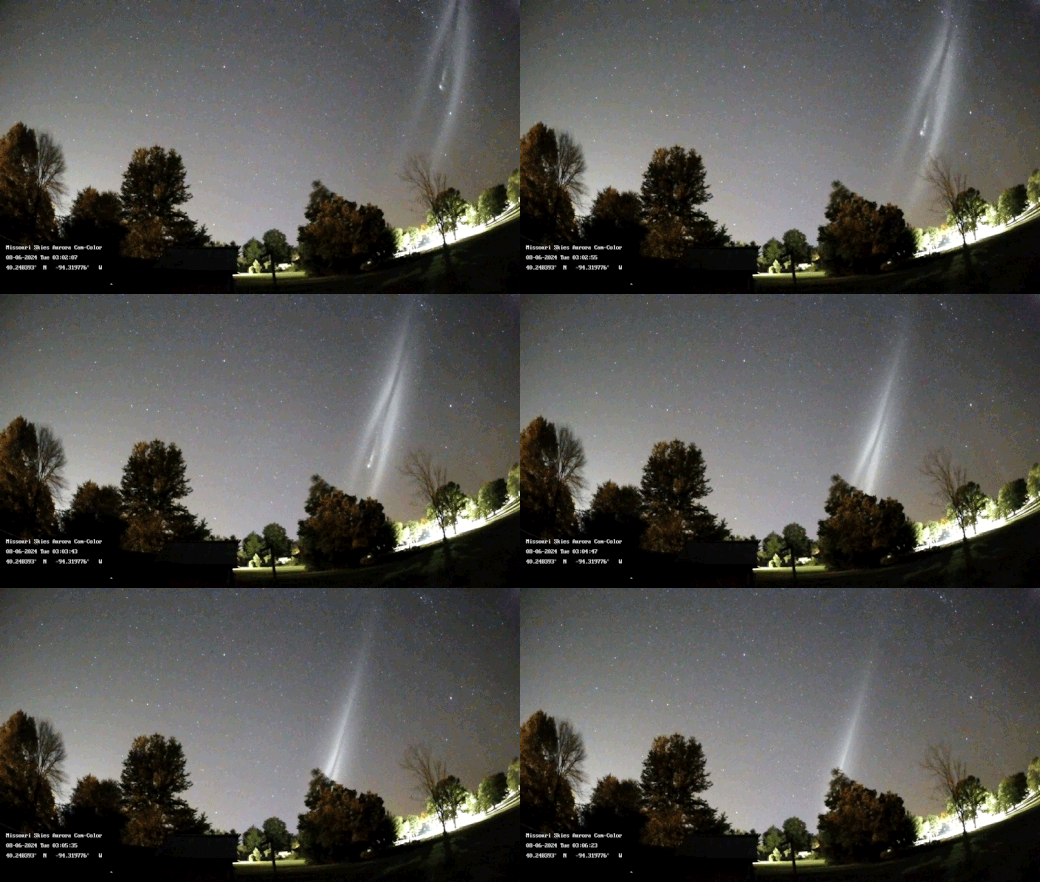
Aug. 6, 2024: Earth orbit is about to get a lot more crowded. On Aug. 6th, China launched the first 18 satellites of its new Thousand Sails megaconstellation. Sky watchers in the USA watched it happen as the the booster stage of the Long March rocket created a spectacular display across the Midwest:
“I did not see it in person,” says Dan Bush, of Albany, Missouri. “But my automated camera was monitoring the sky for Perseids. In the morning when I checked the footage for meteors, I discovered I had recorded this remarkable event.”
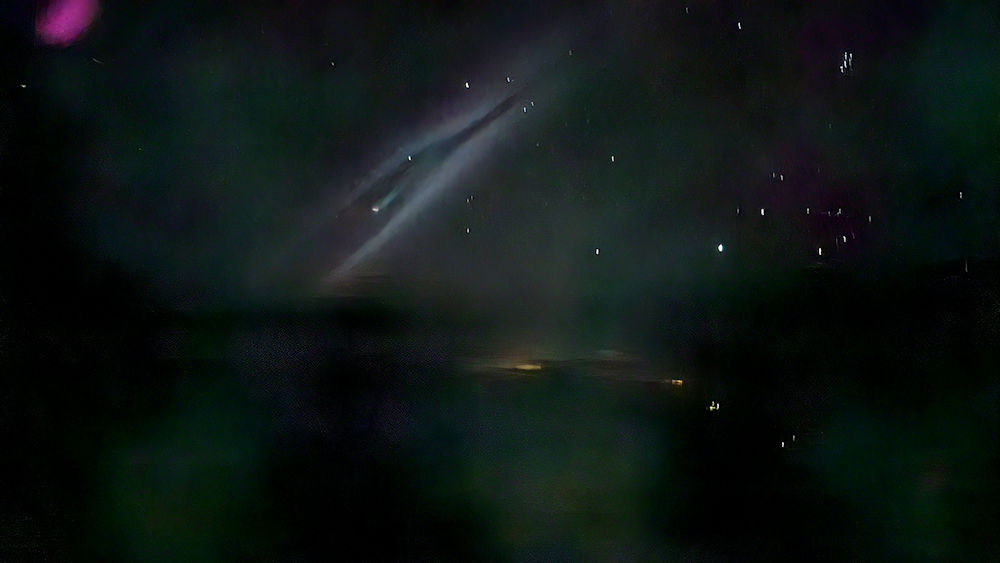
Pilot Alexander Goroshko of Westjet Airlines witnessed the display from a plane flying over Denver at 39,000 ft. “It looked amazing from the flight deck,” he says. Another pilot, Marc Livolsi, saw it twice over Ft. Dodge, Iowa, and one orbit later over Jackson, Wyoming.
The comet-like plumes are fuel dumped by the rocket booster as a safety precaution before re-entering Earth’s atmosphere. SpaceX does this all the time; their fuel dumps and deorbit burns frequently look like spirals because the rockets spin to release the Starlink satellites. This may be a case of a spiral viewed at an angle.
Thousand Sails is a Chinese initiative to compete with Starlink. Officials say that 108 satellites are planned for launch this year in separate batches of 36 and 54 satellites; another 500+ are planned for 2025. Ultimately the megaconstellation will contain more than 14,000 satellites (Starlink currently has about 6,200).
A Long March-6 rocket carrying 18 Thousand Sails satellites blasts off from the Taiyuan Satellite Launch Center in China’s Shanxi Province on Aug. 6, 2024.
Environmentalists have raised many concerns about Starlink including light-pollution of the night sky, a potentially hazardous traffic jam in low-Earth orbit, metallic contamination of the stratosphere, and even ozone depletion. Thousand Sails and a second proposed Chinese megaconstellation named “SatNet” (13,000 satellites) will only multiply these concerns.
Meanwhile, sky watchers have another phenomenon to track. If you photographed the Thousand Sails fuel dump, please submit your pictures here.








 Spaceweather.com