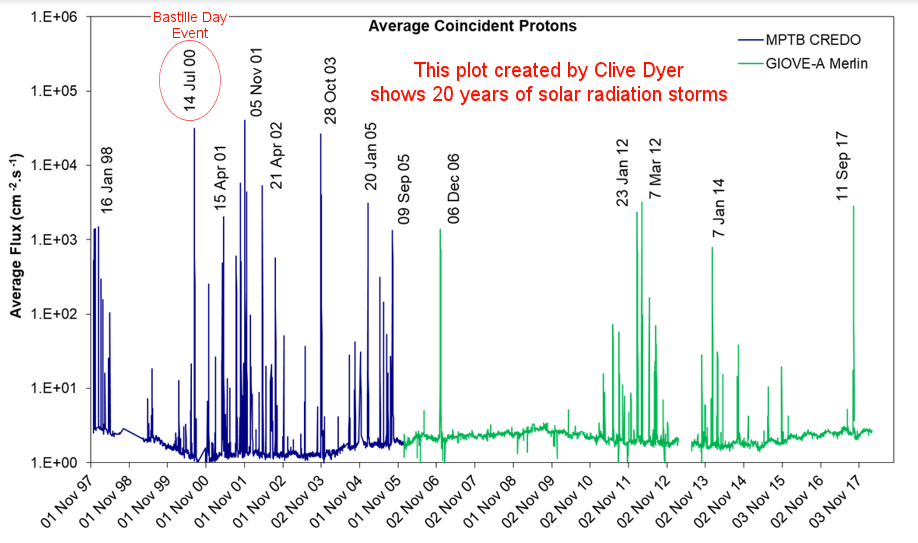
The Bastille Day Event

July 14, 2022: You know a solar flare is strong when even the Voyager spacecraft feel it. Twenty-two years ago today (July 14, 2000) the sun exploded with so much force, it sent shockwaves to the edge of the solar system.

Earth was on the doorstep of the blast, nicknamed the “Bastille Day Event” because it happened on the national day of France. Subatomic particles accelerated by the flare peppered satellites and penetrated deep into Earth’s atmosphere. Radiation sensors on Earth’s surface registered a rare GLE–a “ground-level event.”
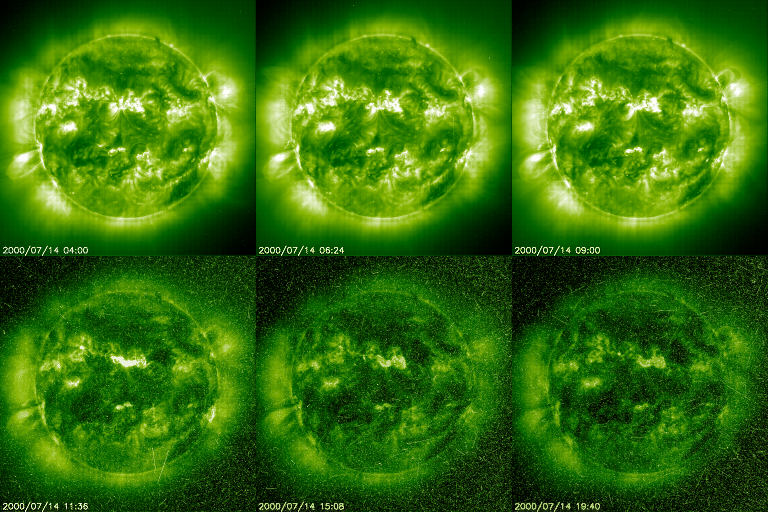
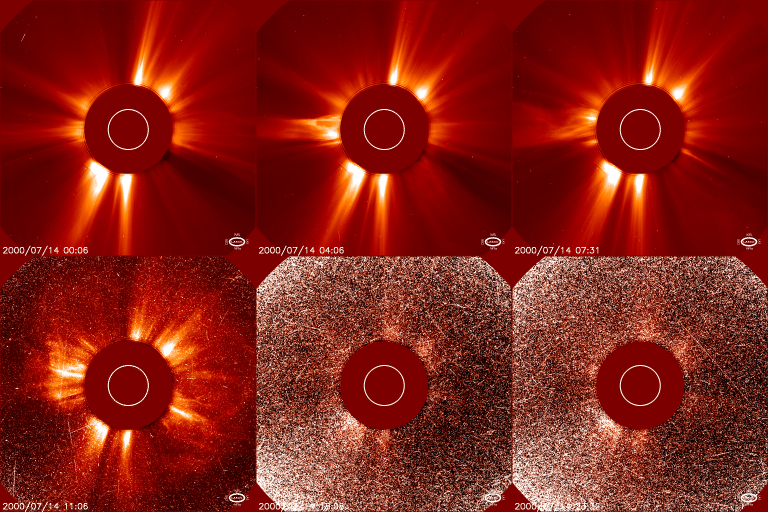
Above: SOHO images of the Bastille Day solar flare (left) and CME (right). The onset of snow in the images is a result of energetic protons hitting the spacecraft

“People flying in commercial jets at high latitudes would have received double their usual radiation dose,” says Clive Dyer of the University of Surrey Space Centre in Guildford UK, who studies extreme space weather. “It was quite an energetic event–one of the strongest of the past 20 years.”

A day later the CME arrived. Impact on July 15th sparked an extreme (Kp=9) geomagnetic storm. The sun had just set on the east coast of North America when the first auroras appeared.

“I was out in the yard doing chores and saw bright red auroras straight overhead,” recalls Uwe Heine of Caswell County, North Carolina. “I called over to our neighbor, Carrie, who was also outside. I told her those were not sunset colors. It was an aurora, and super rare to see this far south!”

Above: Auroras on July 15, 2000, photographed by (left) Grant Privett of Farnborough UK and (right) NASA’s IMAGE spacecraft.

In New York, the sky exploded with light, recalls Lou Michael Moure. “I was living on Long Island at the time. A family member came running into my room, begging me to come outside to see ‘the sky on fire.’ The sky truly looked as if it was ablaze. Hues of white and green eventually gave way to reds that blanketed the heavens from horizon to horizon.”

By the time the storm was over on July 16th, auroras had been sighted as far south as Texas, Florida and Mexico.

A few other storms of the Space Age have have been equally strong, but the Bastille Day Event is special to researchers. It was the first major solar storm after the launch of SOHO, the Solar and Heliospheric Observatory. Data from the revolutionary young satellite taught researchers a lot, very quickly, about the physics of extreme flares.
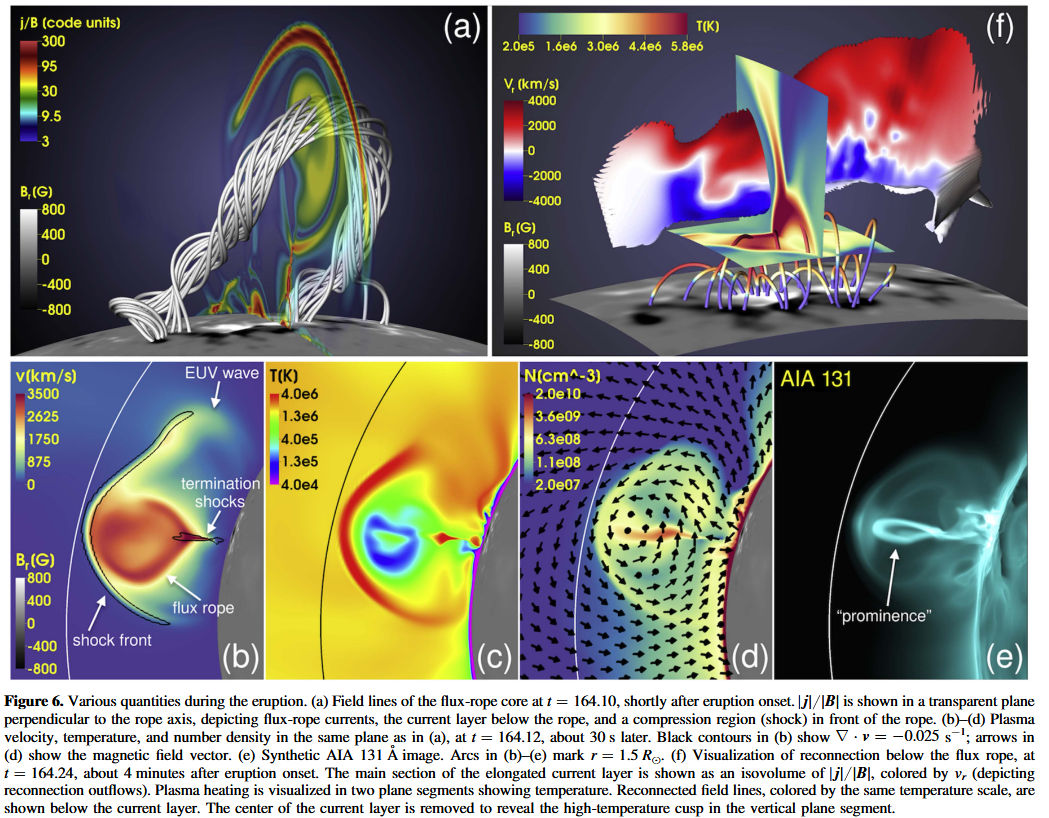
Above: A modern MHD computer simulation of the Bastille Day explosion. Credit: Tibor Török et al., The Astrophysical Journal, 856:75 (22pp), 2018 March 20.

Tibor Török of Predictive Science, Inc., is one of many researchers still studying the Bastille Event decades later. “The event took place close to disk center, so we had a great view of the action,” he says. Török recently applied a modern magnetohydrodynamic (MHD) computer model to some of the data, and found that 1033 ergs of magnetic energy were released in the explosion–about the same as a thousand billion WWII atomic bombs.

No wonder the Voyagers felt it.

It took the Bastille Day CME months to reach the distant spacecraft. Voyager 2 felt it 180 days later, Voyager 1 took 245 days. Being near the edge of the solar system, both spacecraft were naturally bathed in high levels of cosmic rays. The CME swept aside that ambient radiation, creating a temporary reduction called a “Forbush Decrease.” Conditions returned to normal 3 to 4 months later and, finally, the storm was over.

Could another Bastille Day Event be in the offing? Solar Cycle 25 is ramping up, with a new Solar Max expected in 2025. Stay tuned.

more aurora photos: from Ronnie Sherrill of Troutman, North Carolina

Starfish Prime: The First Accidental Geomagnetic Storm

July 9, 2022: Sixty years ago today, one of the biggest geomagnetic storms of the Space Age struck Earth. It didn’t come from the sun.

“We made it ourselves,” recalls Clive Dyer of the University of Surrey Space Centre in Guildford UK. “It was the first anthropogenic space weather event.”

On July 9, 1962, the US military detonated a thermonuclear warhead 250 miles above the Pacific Ocean–a test called “Starfish Prime.” What happened next surprised everyone. Witnesses from Hawaii to New Zealand reported auroras overhead, magnificent midnight “rainbow stripes” that tropical sky watchers had never seen before. Radios fell silent, then suddenly became noisy as streetlights went dark in Honolulu.

Above: ‘Nuclear auroras’ viewed from Honolulu (left) and from a surveillance aircraft (right) on July 9, 1962.

Essentially, Starfish Prime created an artificial solar storm complete with auroras, geomagnetic activity, and blackouts. Much of the chaos that night was caused by the electromagnetic pulse (EMP)–a ferocious burst of radiation that ionized the upper atmosphere. Ionized air over the Pacific pinned down Earth’s magnetic field, then let it go again when the ionization subsided. The rebound created a manmade geomagnetic storm for hundreds of miles around the blast zone.

Dyer, who is widely known for his studies of extreme space weather events, was still in school when the bomb exploded. “In 1962 the Cold War was red hot, and we all thought the end was nigh,” he says. “Starfish Prime was a defining event.”

“The explosion led to the early demise of all the spacecraft in orbit at the time. These included Ariel-1, the UK’s first spacecraft, and Telstar-1, a US communications satellite which had the bad luck to be launched the very next day.”

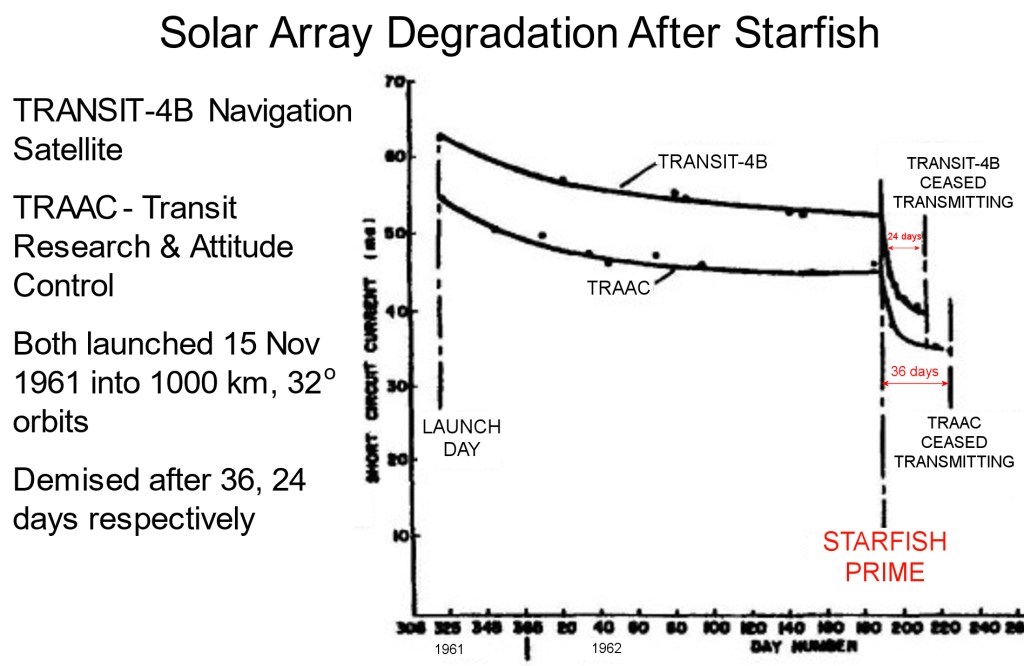
Credit: R.E. Fischell, “ANNA-1B Solar Cell Damage Experiment,” Transcript of the Photovoltaic Specialists Conference, April 10, 1963, Washington DC.

Normally, geomagnetic storms bring down satellites via orbital decay. The upper atmosphere heats up and expands to the point where it can pull satellites down toward Earth. Starfish Prime was different.

“The explosion filled Earth’s magnetosphere with energetic electrons,” explains Dyer. “Electrons were injected by the gradual beta decay of fission products and added to our planet’s natural radiation belts. There were increased fluxes of trapped electrons for many years after the blast.”

These artificial electrons hit satellites hard, degrading their electronics and solar arrays.

“Ariel-1 became almost unusable after 4 days due to power degradation and tape recorder failure,” recalls Dyer. “The Telstar satellite lasted until November 1962 when its command decoder failed. It still managed to provide the first transatlantic TV feed, synchronize UK/US time to 1 microsecond and inspired the Tornado’s rock classic ‘Telstar,’ which used recordings of a flushing toilet played backwards.”

Starfish Prime serves as a warning of what could happen if Earth is blasted by high doses of radiation. Sixty years later, researchers are still learning what it can teach us about the vulnerability of power grids. An even scarier atmospheric explosion may have been Soviet test 184 (also designated K3) on October 22, 1962, which set fires and knocked out hundreds of miles of power lines in Kazakhstan. That, however, is a different anniversary.

A Sudden Increase in Noctilucent Clouds

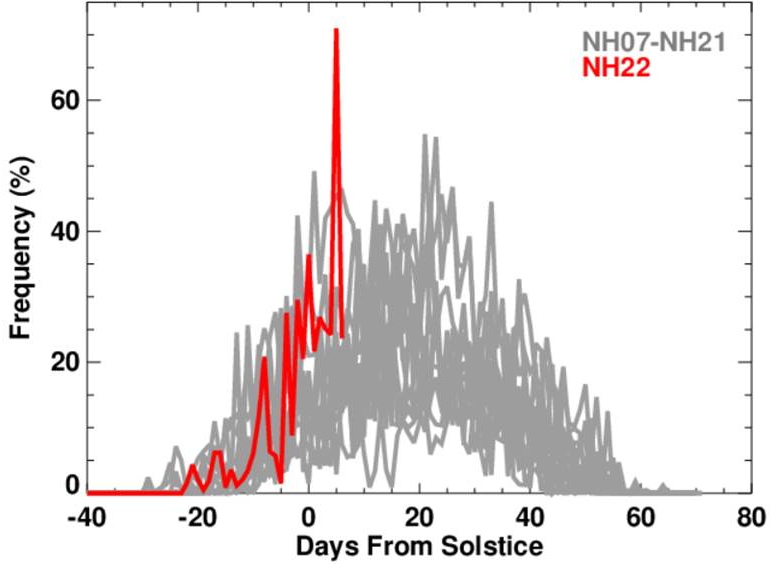
July 1, 2022: Something unexpected just happened in the mesosphere. As June came to an end, NASA’s AIM spacecraft detected a sharp increase in the frequency of noctilucent clouds (NLCs), the most in 15 years:

“In the last couple of days we saw a huge spike in the clouds,” says Cora Randall, a professor at the University of Colorado Boulder. Randall works with AIM data and she prepared the plot, above.

NLCs are Earth’s highest clouds. Seeded by meteoroids, they float at the edge of space more than 80 km above the ground. NLCs form when summertime wisps of water vapor rise up to the mesosphere, allowing water to crystallize around specks of meteor smoke.

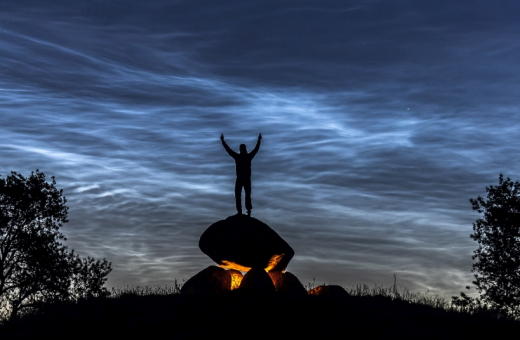
Oliver Schwenn witnessed the outbreak on June 30th from Aarhus, Denmark:

“I photographed the display shortly before midnight,” says Schwenn. “The clouds were shining brightly in the night sky.”

What’s causing this? It could be SpaceX.

“We’re speculating that the spike might be due to extra water vapor transported to higher latitudes from rocket launches,” says Randall. “But much more quantitative analysis would be required to confirm that or not.”

The timing makes sense. It takes about 10 days for water vapor from rocket engines to waft up to the mesosphere. This takes us back to SpaceX’s launch of the Globalstar satellite on June 19th, which caused a number of remarkable phenomena in the sky due to the extra burn time of its second-stage engine. Noctilucent clouds may be yet another by-product of that unusual launch.

Noctilucent clouds are normally a polar phenomenon. However, since the outburst began we have received reports of NLCs from as far south as Washington State and Oregon. Look for the clouds, ripply and electric-blue, just after sunset.

Strange Things in the Sky, Courtesy of SpaceX

June 20, 2022: On Sunday morning, June 19th, SpaceX launched a Falcon 9 rocket from Cape Canaveral (0427 UT) carrying a Globalstar communications satellite. Within hours, people around the world started seeing strange things in the sky. First came the “smoke ring.” Jerrod Wood video recorded it from central Illinois:

“I believe it shows the orbital insertion of the Globalstar FM15 satellite,” says Wood.

He’s right. Almost two hours after launch, the upper stage of the Falcon 9 rocket deployed the Globalstar satellite; the smoke ring Wood saw was the “puff” of separation. At the time, the rocket was more than 1100 km high, so people were able to see it across much of North America. Check out these images: from Arizona, Missouri, Iowa and California.

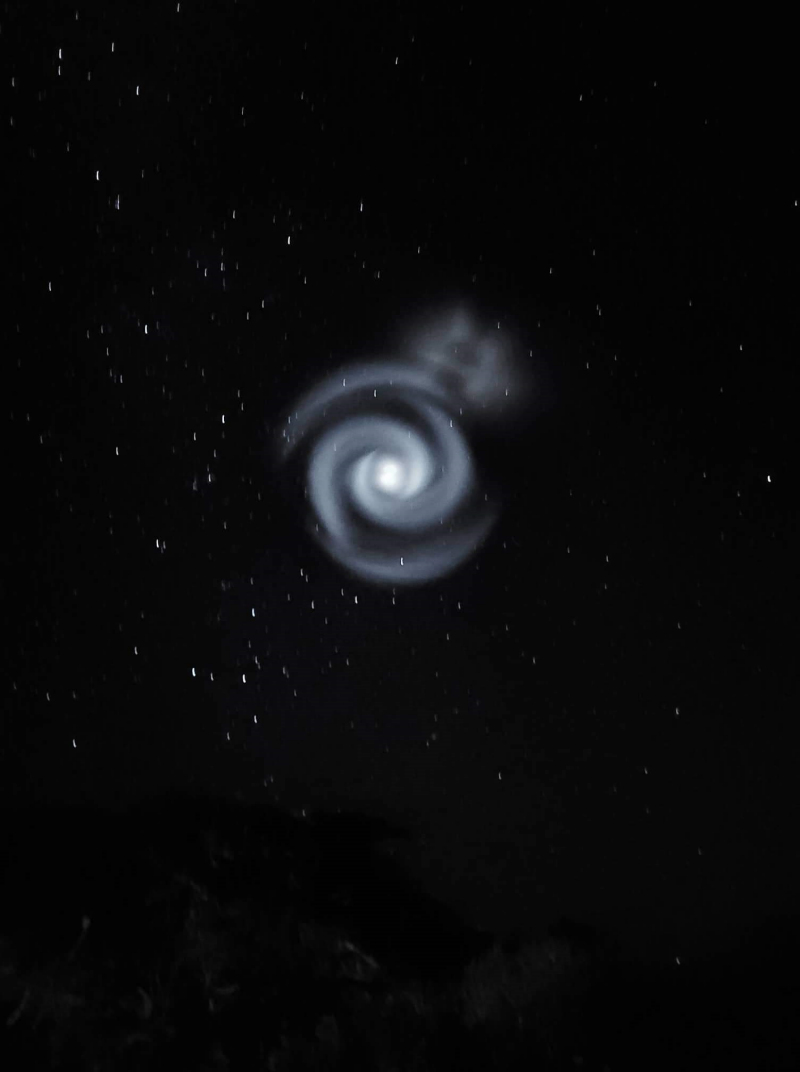
An hour after the smoke ring, things got really strange. Sky watchers in New Zealand saw this:

“It looked like a beautiful galaxy,” says photographer Alasdair Burns of Twinkle Dark Sky Tours on Stewart Island. “It was a very slowly rotating spiral that started small and gradually expanded. Eventually it became so large and faint that it could no longer be seen. There were a group of us on our balcony watching it and none of us had ever seen anything like it.”

This spiral was caused by the Falcon 9’s upper stage venting leftover fuel just before deorbiting into the Pacific Ocean. The upper stage was probably spinning on its longest axis to stabilize flight orientation–hence the spiral shape. Similar spirals have been seen after previous Falcon 9 launches.

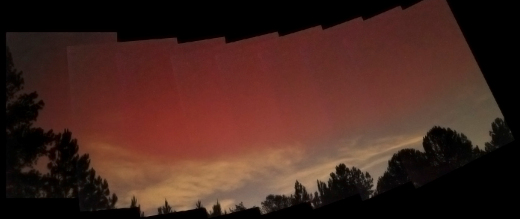
Finally, David Cortner of Rutherford College, North Carolina, saw something truly head-scratching. He calls it a “rocket powered aurora.” This 8-frame mosaic shows a red band that appeared approximately 11 minutes after the Falcon 9’s liftoff from Cape Canaveral:

“I went out to watch the midnight launch,” says Cortner. “Here in western North Carolina, I was hoping for a faint, moonlit ‘jellyfish’–the kind of display we see after many SpaceX launches.” But that’s not what happened.

“The rocket’s trajectory was much higher than I expected,” he continues. “It was almost 500 km high by the time it was due east of me, not 150-200 km like most SpaceX flights up the Atlantic coast. As a result, the rocket passed by unseen.”

“Instead, I noticed this red glow spreading along the flight path a minute or two after the rocket’s closest approach,” he says. “It looked like the aurora borealis.”

Could it have been auroras? Probably not. Low-latitude red auroras typically appear only during strong geomagnetic storms. At the time of the photo, however, global geomagnetic activity was low (Kp=3); there was no space weather event in progress.

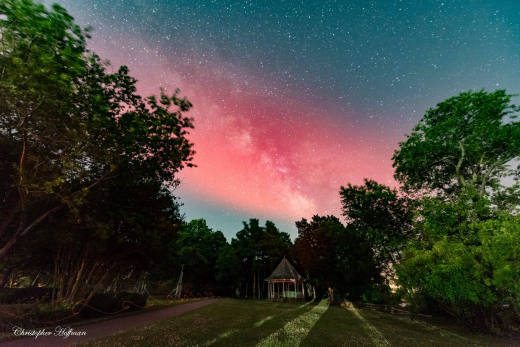
SPACEX MYSTERY, SOLVED: The mystery of SpaceX’s “rocket powered auroras” has been solved. On Sunday morning, June 19th, SpaceX launched a Falcon 9 rocket from Cape Canaveral. Photographers accustomed to seeing these launches were surprised when something unusual appeared. A red glow stretched across the Milky Way. It looked like the aurora borealis, as shown in this photo from Christopher Hoffman in Saint Mary’s County, Maryland:

“I went out with some first time photographers to teach them how to set up their cameras for night sky photography,” says Hoffman. “We took a 30 second exposure, and when the exposure was finished I saw this red glowing area covering the Milky Way.”

Photographers in New York, Ohio, North Carolina and Tennessee saw it, too. The glow appeared about 10 minutes after the Falcon 9 rocket lifted off, and many observers likened its appearance to auroras. However, there was no geomagnetic storm in progress. It had to be the rocket.

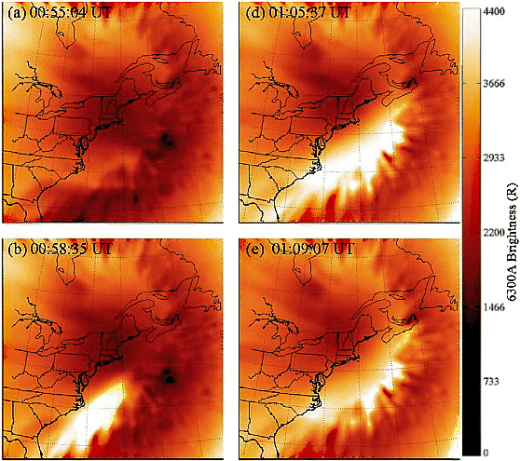
What happened? Space physicist Jeff Baumgardner of Boston University has the answer: “This glow is probably the exhaust gasses from the rocket’s 2nd stage causing the ionosphere to recombine quickly. This is a well studied phenomenon when rocket engines are firing in the altitude regime 200-250 km.”

Above: A similar display of red light appeared over the eastern USA following the launch of a Titan IV rocket on April 30, 2005. [full story]

In simplified form, here is what happens: The upper atmosphere is filled with oxygen ions (O+). Of particular interest is the F-layer of the ionosphere, because it is rich in O+. When the Falcon 9 rocket reaches the F-layer, it adds water (H2O) and carbon dioxide (CO2) to the mix, spewing the molecules out of its engine. Oxygen ions are hungry for electrons, and the newly arriving molecules are eager to provide them. Electrons “re-combine” with oxygen, turning ions into atoms. As electrons cascade down the oxygen atom’s energy levels, they emit red photons at a wavelength of 6300 Å–the same color as red auroras.

more images: from Josh Thum of Sevierville, Tennessee; from Brenda Calinawan of Kortright, New York; from David Cortner of Rutherford College, NC

Comet K2 Has Arrived

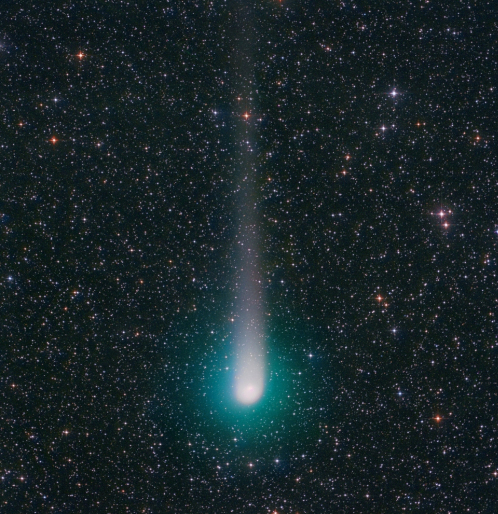
June 28, 2022: For the past 3 million years, Comet C/2017 K2 (PanSTARRS) has been falling toward the sun–a long, slow journey from the Oort cloud. Finally, it’s here. Austrian astrophotographer Michael Jaeger photographed “Comet K2” entering the inner solar system on June 25th:

“This is a 22-minute exposure with my 16-inch telescope,” says Jaeger. “The comet was about 9th magnitude.”

Comet K2 caused a sensation when it was discovered in 2017. At first, it appeared to be one of the biggest comets in modern history, with a nucleus as much as 160 km wide. Hubble Space Telescope observations have since downsized it to 18 km. That’s still big (typical comet nuclei measure 1 to 3 km), but not a record setter. K2 is comparable in size to Halley’s Comet.

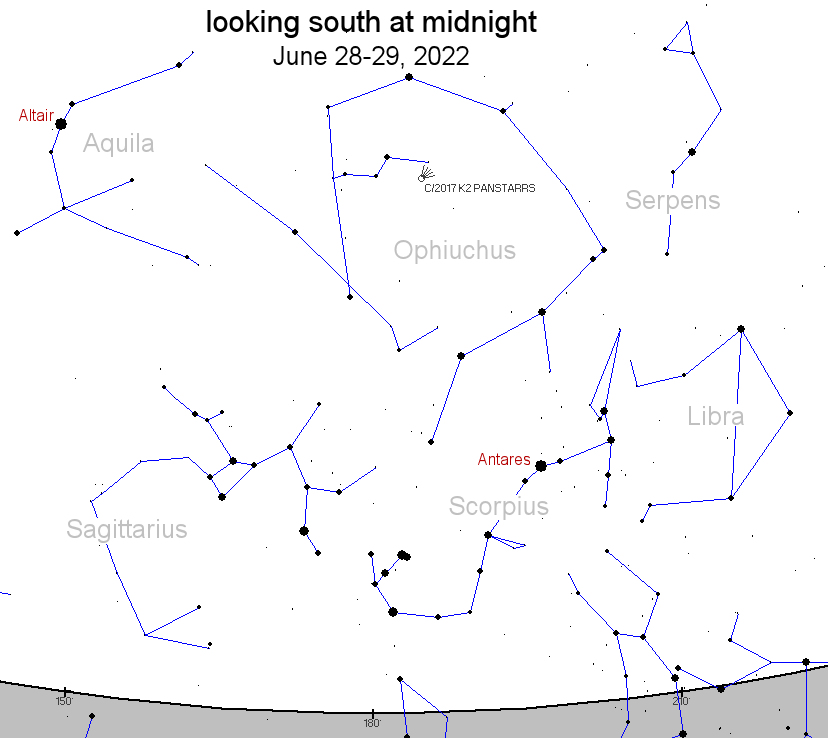
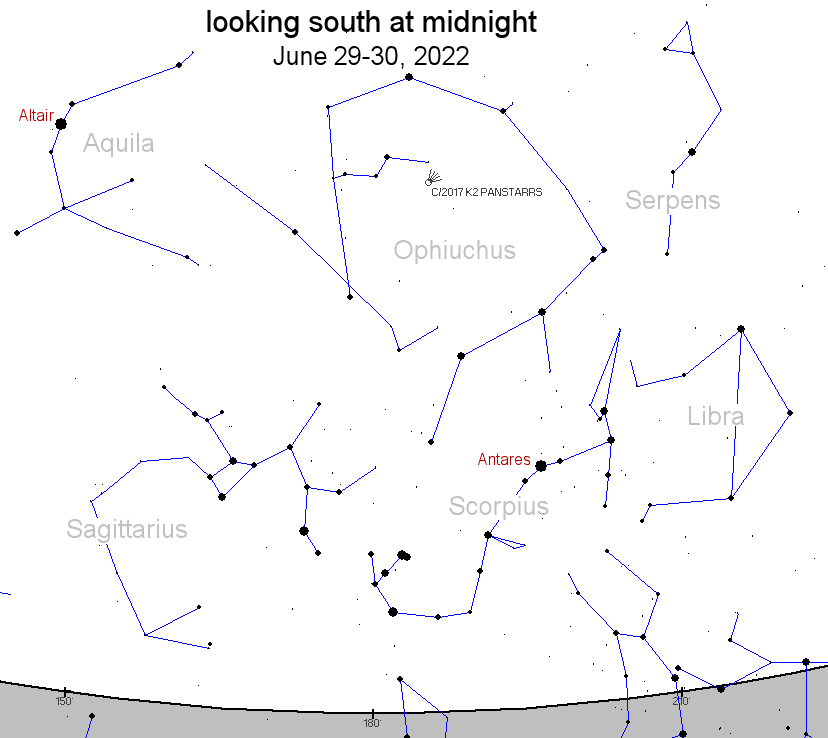
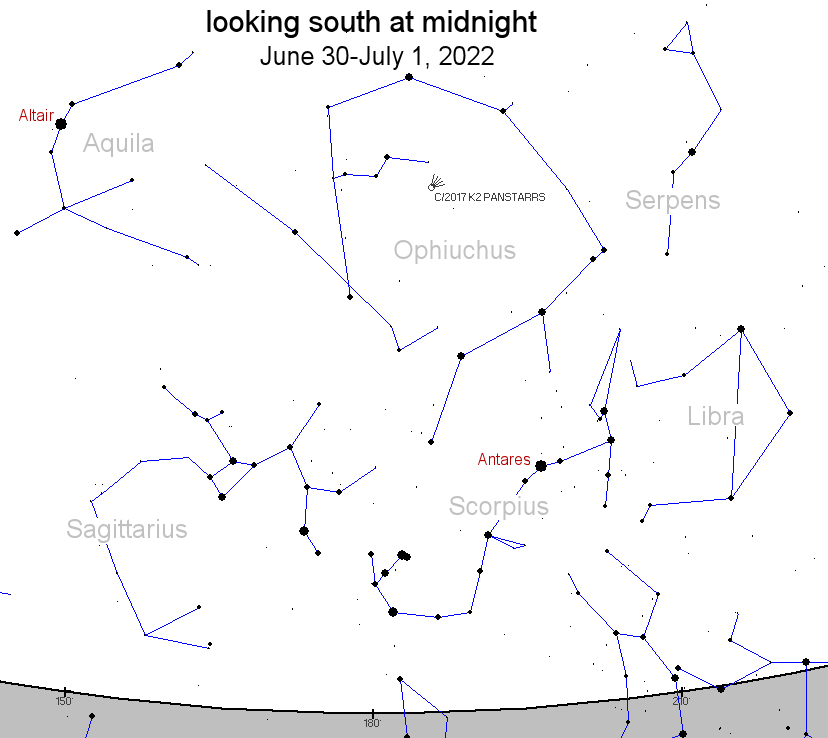
The comet will make its closest approach to Earth (1.8 AU away) on July 14th, brightening to 7th or 8th magnitude. This is too dim to see with the naked eye, but an easy target for backyard telescopes. A good time to look is now before the full Moon of July 13th interferes. Comet K2 may be found high in the midnight sky in the constellation Ophiuchus.

Sky maps: June 29, 30, July 1. Additional resources: current coordinates, 3D orbit, light curve.

Slow-motion Solar Flare and CME

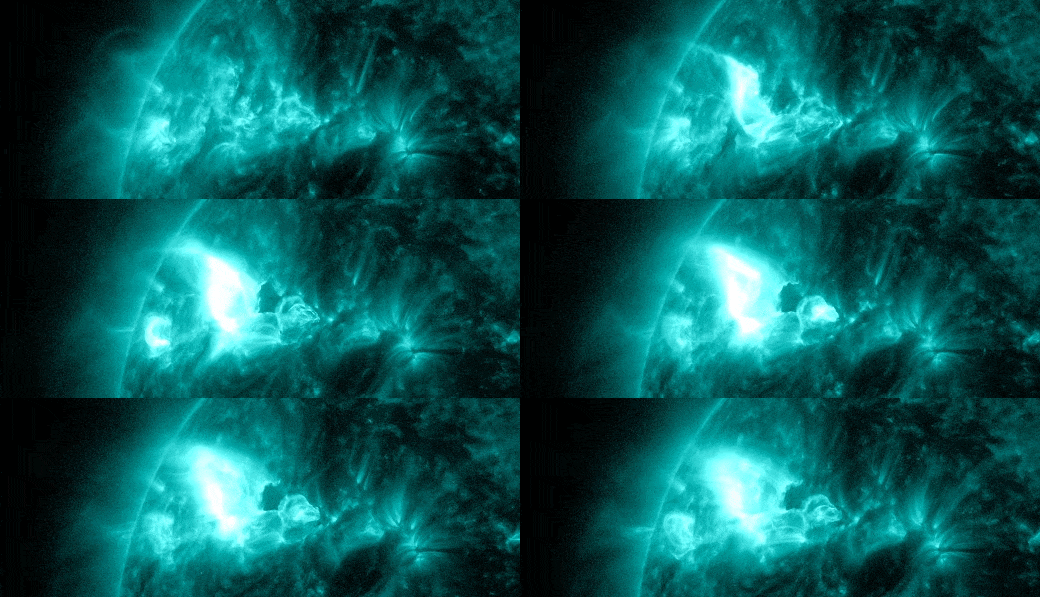
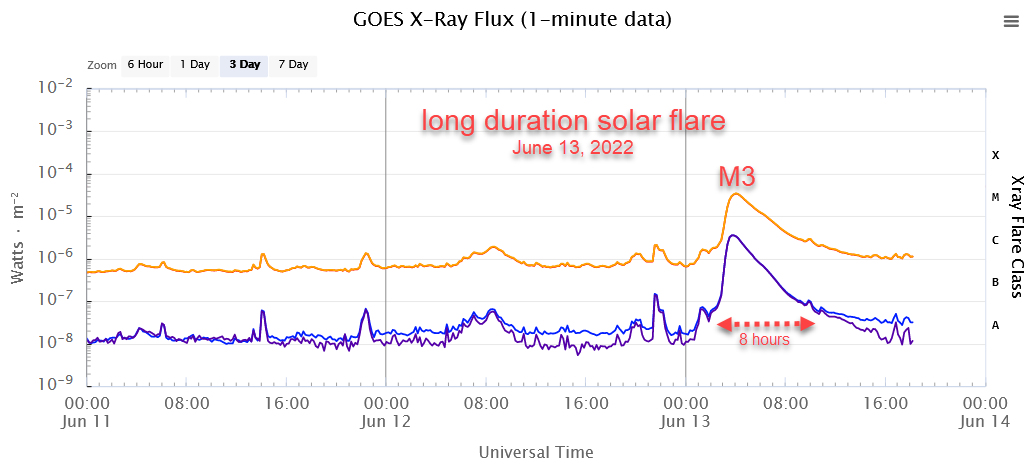
June 13, 2022: Growing sunspot AR3032 exploded on June 13th (0407 UT), producing an M3-class solar flare that lasted nearly 8 hours from beginning to end. NASA’s Solar Dynamics Observatory recorded the slow-motion blast:

Extreme ultraviolet radiation from the flare ionized the top of Earth’s atmosphere, causing a shortwave radio blackout over Japan and southeast Asia: blackout map. Radio operators in the area may have noticed unusual propagation effects at frequencies below 30 MHz for more than an hour after the flare’s peak.

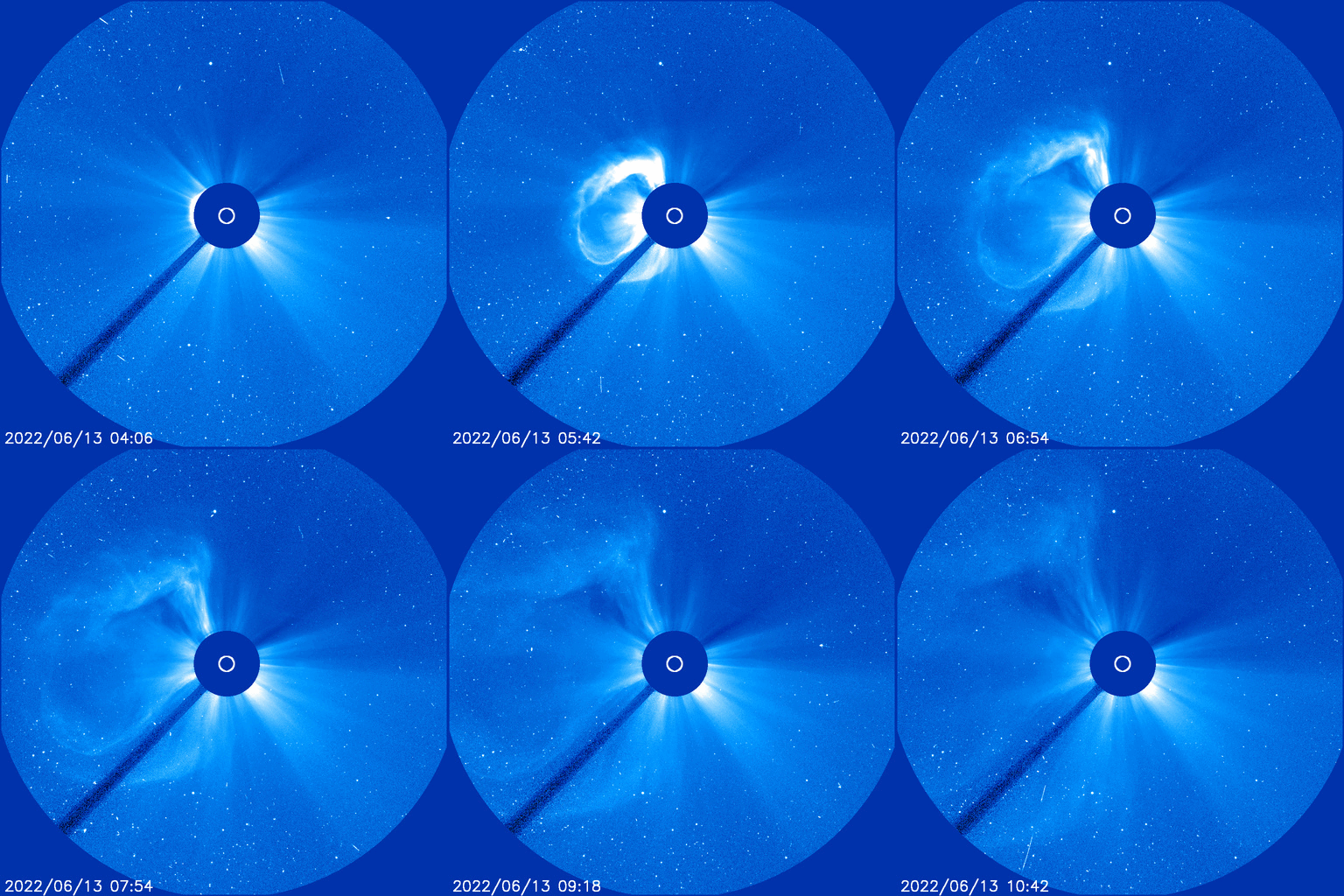
Also, the explosion hurled a magnificent CME into space, according to coronagraphs onboard the Solar and Heliospheric Observatory (SOHO). Click to set the scene in motion:

NOAA analysts have determined that the CME will pass near Earth later this week, possibly delivering a glancing blow to our planet’s magnetosphere. Their simulation suggests an arrival time of 0900 UT on June 15th. Minor G1-class geomagnetic storms are likely if and when the CME makes contact. Solar flare alerts: SMS Text.

Mapping a Magnetic Superstorm

June 13, 2022: Researchers have mapped the best and worst places in the USA to be during a severe geomagnetic storm. For residents of some big cities, the news is not good.

“Resistive structures in the crust and mantle of the Earth make cities along the east coast of the USA especially vulnerable to geomagnetic storms,” says Jeffrey Love of the US Geological Survey (USGS), who led the study. “Hazards are greatest for power systems serving Boston, New York, Philadelphia, Baltimore, and Washington, DC, – a megalopolis of over 50 million people.”

Above: Resistive structures in the crust of the Earth measured by the Earthscope project. Credit: Kelbert et al. (2019) [more]

These conclusions are based on a new study of the biggest geomagnetic storm of the Space Age–the Great Québec Blackout of March 13, 1989. Millions of Quebecois spent a long winter night without lights or heat after a pair of CMEs hammered Earth’s magnetic field. The Hydro-Québec power grid was down for more than 9 hours.

What would happen if the same geomagnetic storm struck again? That’s what Love’s team wanted to find out. They combined old measurements of magnetic activity during the 1989 storm with new measurements of Earth’s crust to pinpoint the hazard zones.

At this point, it may be useful to review what happens during a geomagnetic storm. When a CME hits Earth’s magnetic field, our magnetic field vibrates. If you had a sensitive-enough compass, you could see the needle quivering. Next, because of Faraday’s Law, electrical currents begin to flow through conductors. Power lines, pipes, even rocks conduct these geomagnetically induced currents (GICs). Together, Earth and power lines form an electrical circuit; if too much current flows into the power grid it can cause a blackout.

Above: During a geomagnetic storm, geomagnetically induced current (GIC) flows through power lines and the Earth itself. Credit: GAO

In 1989 researchers didn’t know much about the Earth-half of the circuit. That has changed. In 2006, the Earthscope project began sounding our planet’s crust to determine the 3D electrical properties of deep rock. It turns out, there are huge variations in conductivity from place to place. The type of rock a city sits on determines how vulnerable it is to geomagnetic storms.

In retrospect, Québec was especially vulnerable. The province sits on an expanse of Precambrian igneous rock that does a poor job conducting electricity. When the March 13th CMEs arrived, storm currents found a more attractive path in the high-voltage transmission lines of Hydro-Québec. Unusual frequencies began to flow through the lines, transformers overheated and circuit breakers tripped.

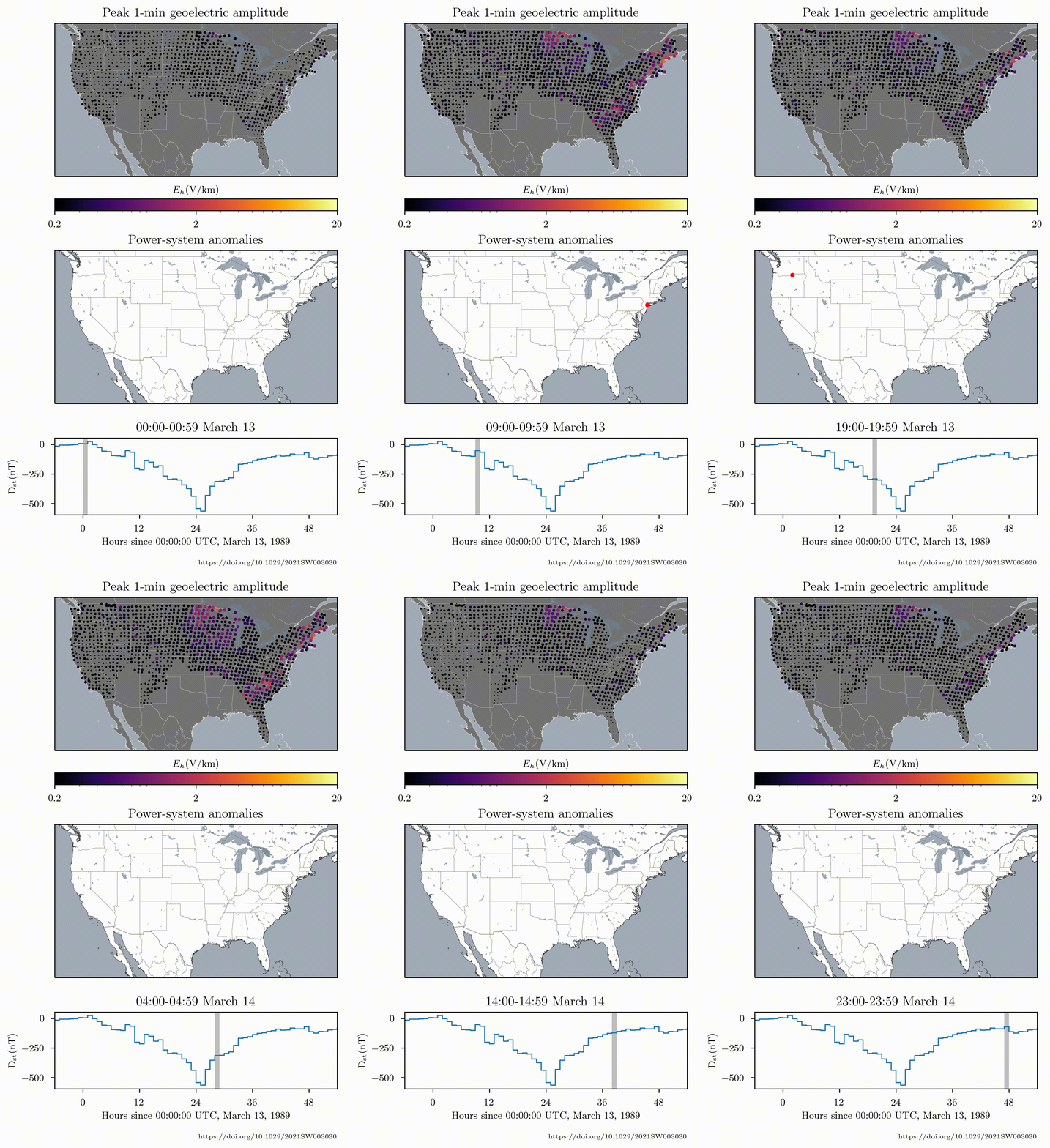
Assuming that the Québec storm was underway again, Love’s team mapped electric fields around much of North America. Measured in units of Volts per kilometer (V/km), these fields predict how much current will be pushed through wires at ground level. The higher the value, the bigger the hazard.

Above: If you live near an orange dot you might be in trouble during a geomagnetic superstorm. The color-coded dots represent peak geoelectric field amplitudes. Credit: Love et al (2022). [movie]

“Peak 1-min-resolution geoelectric field amplitudes ranged from 21.66 V/km in Maine and 19.02 V/km in Virginia to <0.02 V/km in Idaho,” says Love. “Our maps show where utility companies might concentrate their efforts to mitigate the impacts of future magnetic superstorms.”

With Solar Cycle 25 ramping up to a new Solar Maximum expected in 2025, the hazard maps are coming not a moment too soon.

You can read Love et al.’s original research in the May 2022 edition of the research journal Space Weather. Click here.

Rare Early Morning Sky Show

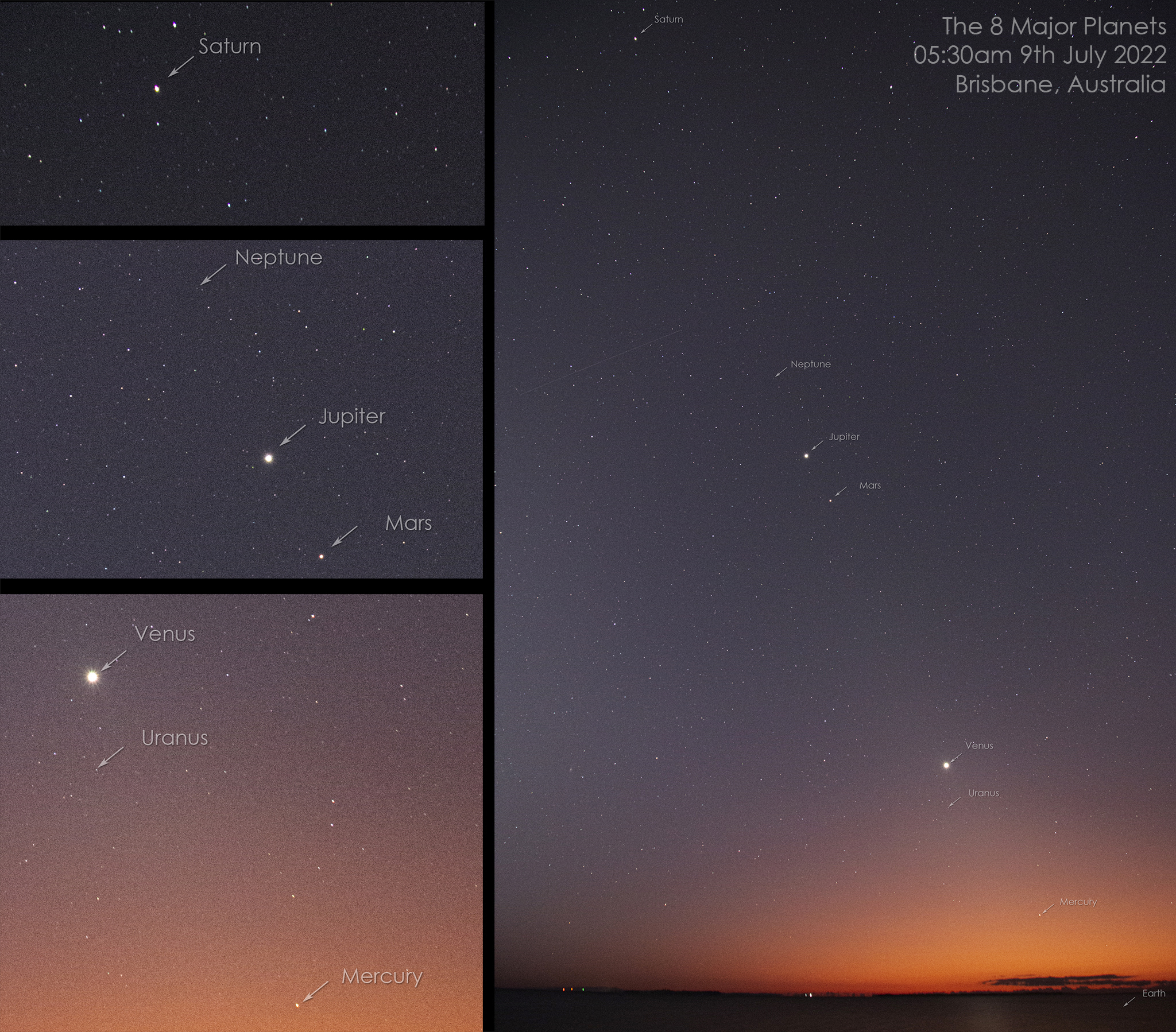
June 12, 2022: How many planets can you see before breakfast? Tom Harradine of Brisbane, Australia, woke up early Thursday morning and found the entire solar system sprawled across the dawn sky:

“This might not be a very spectacular image, but it is relatively unique,” says Harradine. “Captured here in a single photograph are all the major planets of our Solar System, spanning about 90° across the eastern dawn Brisbane sky. Mercury, Venus, Mars, Jupiter and Saturn can be seen with the unaided eye. Uranus and Neptune require binoculars.”

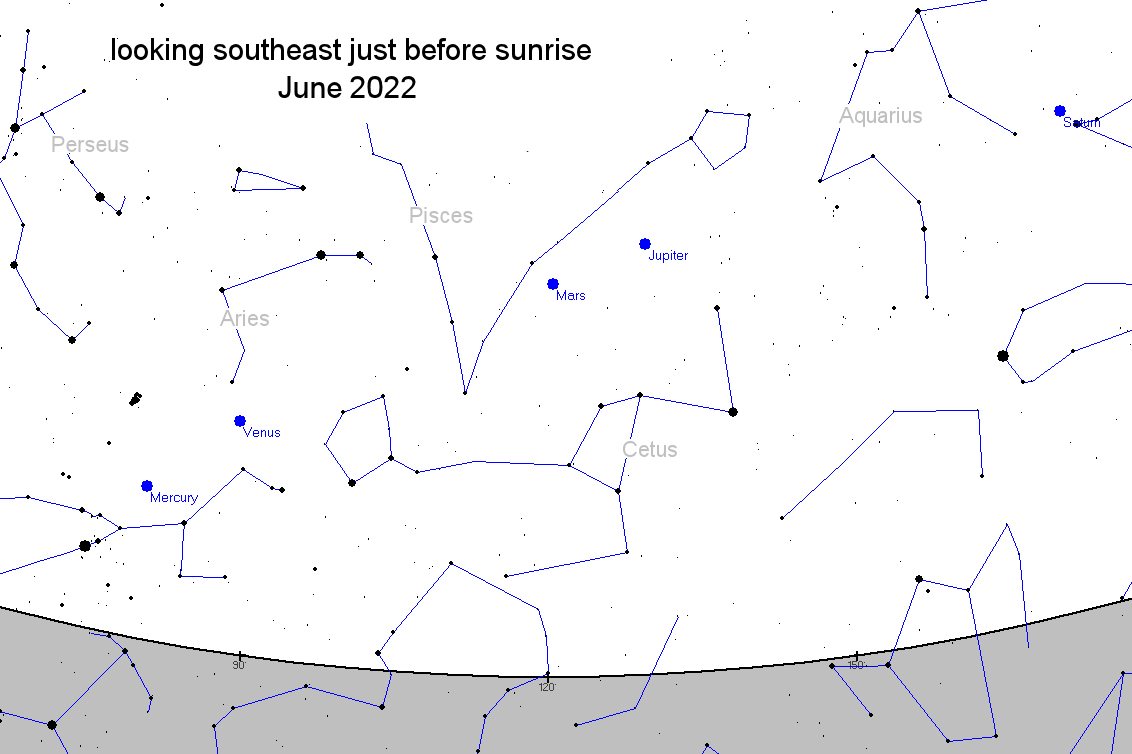
This is the first time since December 2004 that the five naked-eye planets have appeared together in this way. They are arrayed in order of distance from the sun: Mercury, Venus, Mars, Jupiter and Saturn. In the mornings ahead, Mercury will climb higher and brighten, making the group even easier to see.

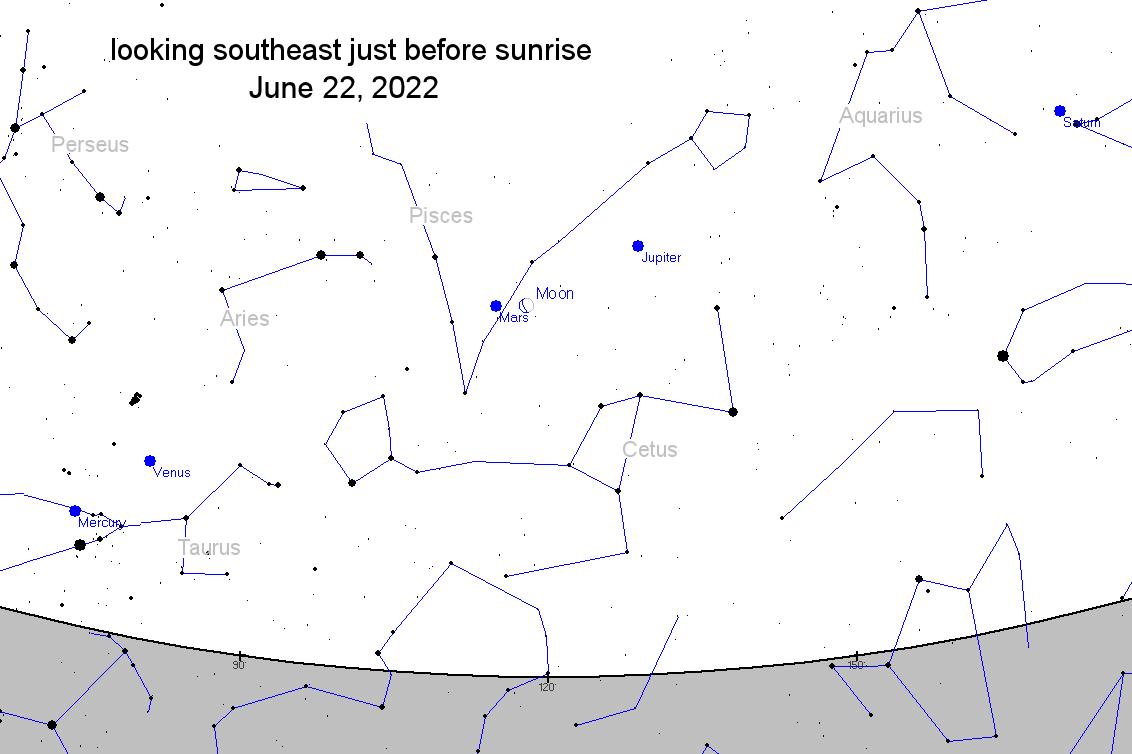
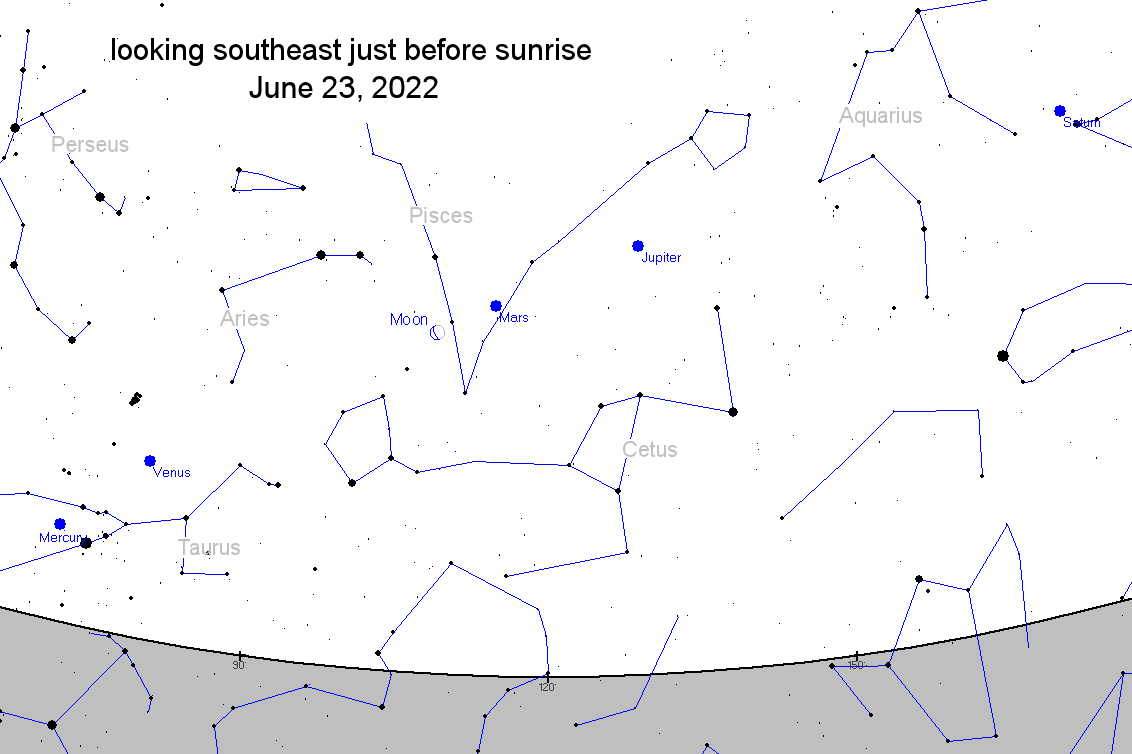
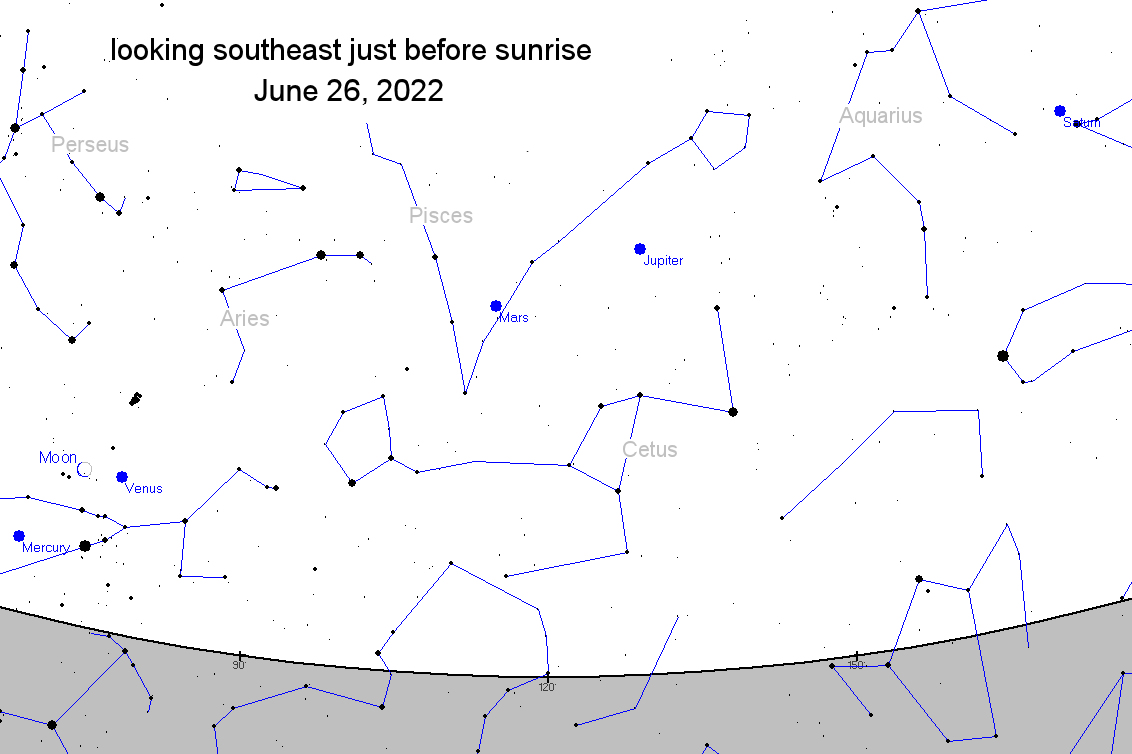
Dates of special interest include June 16th when Mercury is farthest from the sun and June 21st through 26th when the Moon hops from planet to planet, producing a series of early morning conjunctions. Set your alarm for dawn and enjoy the show! Sky maps: today, June 21, 22, 23, 24, 25, 26.

more images: from Paolo Bardelli of Sumirago (Varese), Italy; from James Glucksman of Kakanui, New Zealand; from Bob Beal of Washington, Utah; from Noeleen Lowndes of Gold Coast Qld Australia; from Gary Dowdle of Fort Davis, Texas;

Reversed Polarity Sunspot

June 2, 2022: A new and unusual sunspot has emerged in the sun’s southern hemisphere: AR3027. It is a reversed-polarity sunspot; its magnetic field is backwards.

Above: A magnetic map of the sun’s surface from NASA’s Solar Dynamics Observatory.

According to Hale’s Law, Solar Cycle 25 sunspots in the sun’s southern hemisphere should have a +/- polarity. That’s positive on the left, negative on the right. However, the magnetogram above shows the opposite. Sunspot AR3027 is breaking the law!

Studies show that about 3% of all sunspots violate Hale’s Law. In some ways, reversed polarity sunspots act totally normal. For instance, they have the same lifespan and tend to be about the same size as normal sunspots.

In one key way they are different: According to a 1982 survey by Frances Tang of the Big Bear Solar Observatory, reversed polarity sunspots are more than twice as likely to develop complex magnetic fields, in which + and – are mixed together. Reversed polarity sunspots are therefore more likely to explode.

AR3027 could become a source of flares in the days ahead. Stay tuned! Solar flare alerts: SMS Text.

Realtime Space Weather Photo Gallery
Free:
Spaceweather.com Newsletter

The Tau Herculid Meteor Shower — Possible Outburst

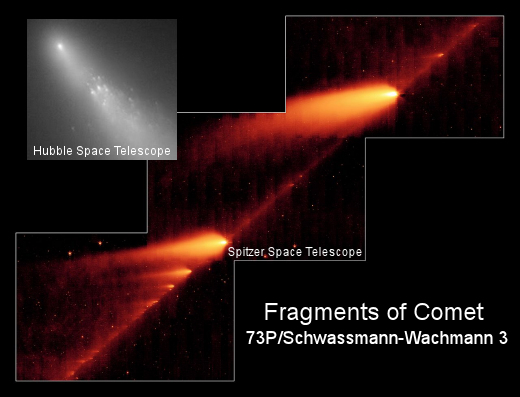
May 25, 2022: In late 1995, Comet 73P/Schwassmann-Wachmann 3 exploded. Almost 30 years later, some of the debris might hit Earth.


Above: NASA images of Comet 73P still crumbling years after its initial breakup. [more]

Multiple forecasters agree that a meteor shower could erupt on May 31, 2022, when Earth runs into one or more debris streams from Comet 73P. The display could be as intense as a meteor storm (1000 or more meteors per hour) or as weak as nothing at all. No one knows how much debris is inside the approaching streams, so meteor rates are hard to estimate.

Whatever happens, people in North America are in a good position to see it. Almost the entire continent will be in Moon-free darkness when the shower peaks. Maximum activity is expected around 1:00 am Eastern Daylight Time (05:00 UT) on Tuesday morning, May 31st. The shower’s radiant (the point from which all meteors stream) will be almost straight above Baja California.

Above: Altitude contours for the shower’s radiant. Baja California is favored with zenith observing geometry. Image credit: Josselin Desmars (IMCCE/IPSA) [more]

This isn’t the first time Earth has sampled debris from Comet 73P. In 1930, at least a handful of meteors were observed shortly after the comet’s discovery by German astronomers. The meteors emerged from a radiant near 4th magnitude star tau Herculis, so the shower has since been called “the tau Herculid meteor shower.” NASA cameras also detected minor tau Herculid activity in 2011 and 2017.

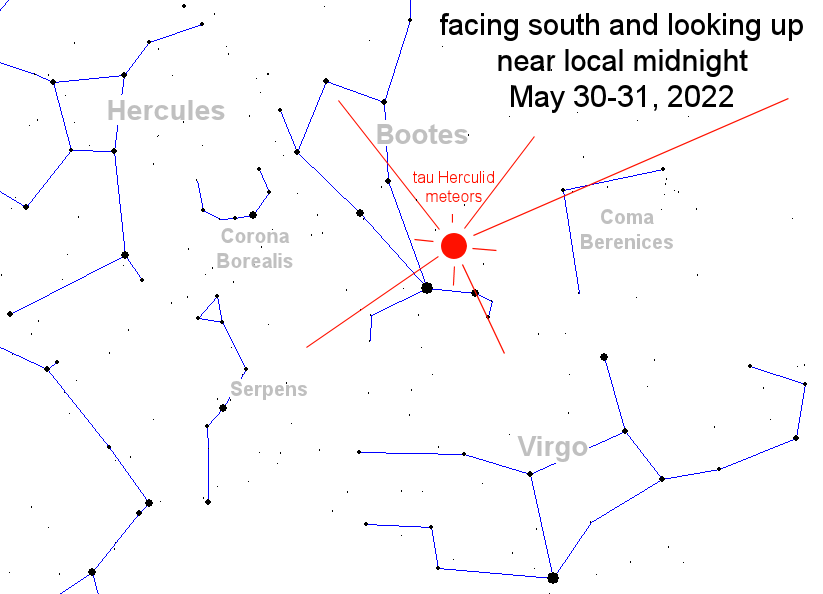
Based on past performance, the tau Herculids seem unlikely to produce a good show. For nearly a century the shower has been a dud. The X-factor this year is fresh material from the comet’s catastrophic breakup. If the new meteoroids reach Earth–and that is a big IF–shooting stars will fly from a point near the bright star Arcturus in the constellation Bootes. Here is a sky map to help you find it.

To learn more about the tau Herculid meteor shower, we recommend this comprehensive paper by Joe Rao, a lecturer at the Hayden Planetarium in New York. Also, a new analysis by Jérémie Vaubaillon of the Institute for Celestial Mechanics and Computation of Ephemerides in Paris raises the possibility of two additional outbursts on May 31st resulting from debris shed by Comet 73P in the years 1892 and 1897.

It all adds up to a date with the night sky at the end of the month. Don’t miss it!