SPOTLESS SUN SPARKS PINK AURORAS

Nov. 23, 2017: On Nov. 22nd, the face of the sun was unblemished by sunspots, and NOAA classified solar activity as “very low.”  Nevertheless, the skies above Tromsø, Norway, exploded with a remarkable outburst of pink auroras. “Suddenly, the whole valley turned white (with a hint of pink),” says Frank Meissner, who witnessed and photographed the display. “It was over after about 20 seconds.”

How bright was it? “The brightness of the auroras may be compared to the car lights in the background of my photo,” points out Meissner.

In nearby Kvaløya, aurora tour guide Marianne Bergli witnessed a surge of pink that was, if anything, even more dramatic:

“Ironically, our guests stopped taking pictures,” says Bergli. “They were awestruck and frozen to the spot by the incredible pink and green lights overhead.”

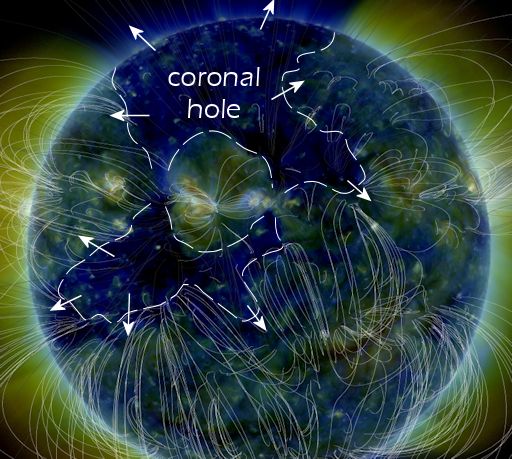
This outburst was powered by a stream of solar wind flowing from a hole in the sun’s atmosphere. Such holes are common during Solar Minimum, and they require no sunspots to form. That’s why auroras continue throughout the 11-year solar cycle.

The pink color of the outburst tells us something interesting about the solar wind on Nov. 22nd: it seems to have been unusually penetrating. Most auroras are green–a verdant glow caused by energetic particles from space hitting oxygen atoms 100 km to 300 km above Earth’s surface. Pink appears when the energetic particles descend lower than usual, striking nitrogen molecules at the 100 km level and below.

In recent winters, big displays of pink and white auroras have coincided with spotless suns often enough to make observers wonder if there is a connection.  If so, more outbursts are in the offing as the sun continues its plunge toward a deep Solar Minimum. Stay tuned for pink!

Realtime Aurora Photo Gallery

Evolution of a Coronal Hole

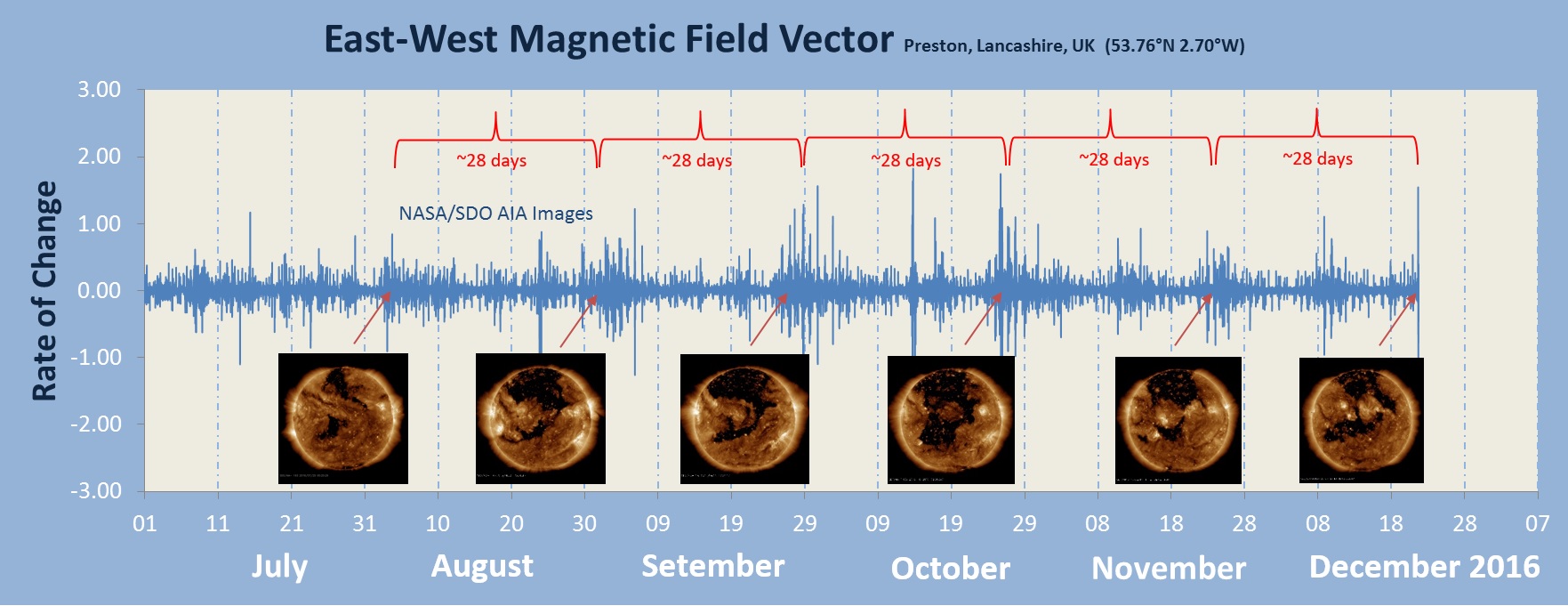
Dec. 26, 2016: Christmas 2016 was special for sky watchers around the Arctic Circle.  The skies filled with some of the best Northern Lights of the year, including rare outbursts of white and pink. The source of the display: A giant “coronal hole” in the sun’s atmosphere sprayed our planet with solar wind. The hole opened up in July 2016 and it has been strobing Earth with solar wind every ~28 days ever since as the hole pirouettes with the slowly rotating sun.

Spaceweather.com reader Stuart Green has prepared a plot showing the evolution of the coronal hole and the effect it has had on the magnetic field at his private observatory in Preston, England.  Click on the image to inspect the full 6 months:

Inset images come from NASA’s Solar Dynamics Observatory. The coronal hole is the giant dark region, starting small in July, then growing and shape-shifting as the year unfolds.

The background strip chart recording shows the instability of the magnetic field around Green’s private observatory. When the coronal hole is facing Earth, big changes are measured.

“I’ve been recording geomagnetic activity over the past three years using a home built/ home designed magnetometer,” says Green. “The sensor is buried in my garden about 0.5m below the surface in an East/West orientation to allow very sensitive (sub nanotesla) measurements of magnetic declination during geomagnetic storms. The plots show the change in magnetic flux density in nanotesla occurring between readings every 2.5 minutes.”

Green’s presentation suggests that this yawning hole is a long-lived feature on the sun, and it will probably be back as potent as ever 28 days from now.  Stay tuned for magnetic unrest–and more Arctic auroras–in January.

Cosmic Rays Continue to Intensify

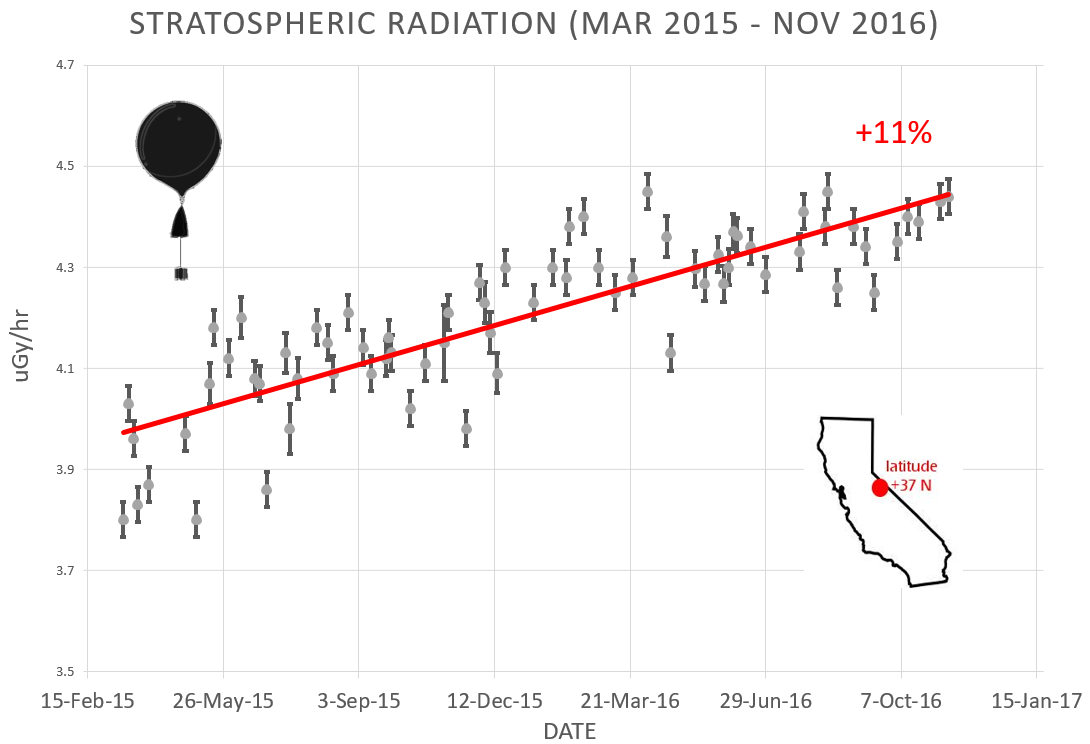
Nov. 15, 2016: As the sunspot cycle declines, we expect cosmic rays to increase. Is this actually happening? The answer is “yes.” Spaceweather.com and the students of Earth to Sky Calculus have been monitoring radiation levels in the stratosphere with frequent high-altitude balloon flights over California. Here are the latest results, current as of Nov. 11, 2016:

Data show that cosmic ray levels are intensifying with an 11% increase since March 2015.

Cosmic rays are high-energy photons and subatomic particles accelerated in our direction by distant supernovas and other violent events in the Milky Way. Usually, cosmic rays are held at bay by the sun’s magnetic field, which envelops and protects all the planets in the Solar System. But the sun’s magnetic shield is weakening as the solar cycle shifts from Solar Max to Solar Minimum. As the sunspot cycle goes down, cosmic rays go up.

The sensors we send to the stratosphere measure X-rays and gamma-rays which are produced by the crash of primary cosmic rays into Earth’s atmosphere. In this way we are able to track increasing levels of radiation. The increase is expected to continue for years to come as solar activity plunges toward a deep Solar Minimum in 2019-2020.

Recently, we have expanded the scope of our measurements beyond California with launch sites in three continents: North America, South America and soon above the Arctic Circle in Europe. This Intercontinental Space Weather Balloon Network will allow us to probe the variable protection we receive from Earth’s magne

The Heliophysics Summer School: 10 Years and Counting

Some institutions of cutting-edge learning are very old.  Harvard: 380 years.  Princeton: 270 years. Caltech: 125 years.

Others are a little younger.

This year, academicians around the world are celebrating the 10th anniversary of the “Heliophysics Summer School,” a fresh-faced academy that introduces the next generation of scientists to a field of study that, arguably, didn’t even exist when the new millennium began.

“Heliophysics is something new and exciting,” says Lika Guhathakurta of NASA Headquarters.

“It’s a leap across scientific boundaries,” says Karel Schrijver, formerly of the Lockheed Martin Solar & Astrophysics Laboratory.

“It is a blueprint for the Universe,” says Amitava Bhattacharjee, Professor of Astrophysical Sciences at Princeton University.

It begins with Helios, our sun. Of all the objects in the cosmos, the sun affects our planet most. It is the 900lb gorilla of the Solar System, shaping climate, weather, even life itself.

Earth and the sun are deeply and intricately connected, not only by simple rays of light and heat, but also by a complex web of electricity, magnetism, solar wind and extreme ultraviolet radiation.  Lines of electrical current and magnetic force can sometimes be traced, without interruption, all the way from the ground beneath our feet to the base of seething sunspots 93 million miles away.  Our planet and our star are, in a sense, one.

“Back in the early 2000s, NASA had a division called the ‘Sun-Earth connection,’ which recognized this link,” recalls Guhathakurta.  ”When Mike Griffin became the NASA administrator in April of 2005, he asked us to come up with a one-word description of our division that captured both the holistic simplicity and the vast scope of the sun-Earth system. Ultimately it is Sun-Earth connection division director Dick Fisher who is credited with inventing the word ‘heliophysics’.”

Re-naming the “Sun-Earth connection” wasn’t just a marketing ploy, it signaled an authentic shift in thinking about stars and their relationships to planets, moons, asteroids and comets.

“Heliophysics is a unique science,” says George Siscoe of Boston University. “You can see this by realizing that all matter in the universe is organized macroscopically by two long-range forces: gravity and magnetism. As the saying goes, gravity sucks, hence the origin of dense objects like planets, stars, galaxies, etc. But magnetism repels, hence magnetospheres, solar storms, geomagnetic storms, and all large-scale magnetically organized structures in the universe. A very important part of heliophysics is made up of the structures that result when the pull of gravity and the push of magnetism compete.”

Once upon a time, the study of gravity and magnetism were separated by high academic walls.  They had their own textbooks, their own course numbers, and their own professors who rarely talked shop together. Heliophysics breaks down these barriers—and many others.

“In a sense,” says Shrijver, “heliophysics is the equivalent of what ecology is to the life sciences: a discipline that brings awareness of the processes that couple a vast network of conditions into the whole. In order to make heliophysics work as the equivalent of ecology, a sense of community needs to exist: heliophysics is thus also the activity of teaching across traditional discipline boundaries to stimulate the curiosity of one discipline to reach out to the expertise of another.”

Heliophysics plays out on scales ranging from the fusion of subatomic particles taking place in the heart of the sun to the grand sweep of magnetic storms that can engulf entire planets.  It stitches together aspects of weather, climate, plasma physics, Earth science, astronomy, and even biology.  A true heliophysicist is at home discussing all topics, all scales.

Enter the Heliophysics Summer School:

“A new science needs new scientists,” says Guhathakurta, “and 10 years ago we set out to create them. The Heliophysics Summer School was established for this purpose.”

Funded by NASA and managed by UCAR, the first Heliophysics Summer School was convened in July 2007.  The Deans were George Siscoe and Karel Schrijver. During an intense, immersive two-week session, 35 young scientists were instructed by 23 experts in topics ranging from practical techniques in supercomputer modeling to the fundamental physics of magnetic explosions.  Lab sections tested the exhausted but excited students’ mastery of concepts that, heretofore, were rarely discussed in the same room, much less the same lab activity.

Since then hundreds of students from dozens of countries have attended the summer school.  Graduates with extraordinary promise compete for and receive Jack Eddy Fellowships, named after John A “Jack” Eddy, a pioneering researcher in solar physics who shaped thinking about the Sun-Earth connection in the 20th century. These fellowships provide the support they need to continue their studies as heliophysics post-docs at leading Universities.  Later, some Jack Eddy Fellows return to the Heliophysics Summer School as instructors.

“We’ve created a whole heliophysics life cycle,” says Guhathakurta.  “Caterpillars enter the cocoon of the Summer School and emerge as beautiful Heliophysics butterflies.  Jack Eddy Fellows are the Monarchs.”

Not bad for a school that’s only 10 years old…

Stay tuned for the next article in this series: The Heliophysics Textbooks.

Earth’s Inconstant Magnetic Field

by Dr. Tony Phillips (Spaceweather.com)

Every few years, scientist Larry Newitt of the Geological Survey of Canada goes hunting. He grabs his gloves, parka, a fancy compass, hops on a plane and flies out over the Canadian arctic. Not much stirs among the scattered islands and sea ice, but Newitt’s prey is there–always moving, shifting, elusive.

His quarry is Earth’s north magnetic pole.

At the moment it’s located in northern Canada, about 600 km from the nearest town: Resolute Bay, population 300, where a popular T-shirt reads “Resolute Bay isn’t the end of the world, but you can see it from here.” Newitt stops there for snacks and supplies–and refuge when the weather gets bad. “Which is often,” he says.

Scientists have long known that the magnetic pole moves. James Ross located the pole for the first time in 1831 after an exhausting arctic journey during which his ship got stuck in the ice for four years. No one returned until the next century. In 1904, Roald Amundsen found the pole again and discovered that it had moved–at least 50 km since the days of Ross.

The pole kept going during the 20th century, north at an average speed of 10 km per year, lately accelerating “to 40 km per year,” says Newitt. At this rate it will exit North America and reach Siberia in a few decades.

Keeping track of the north magnetic pole is Newitt’s job. “We usually go out and check its location once every few years,” he says. “We’ll have to make more trips now that it is moving so quickly.”

Earth’s magnetic field is changing in other ways, too: Compass needles in Africa, for instance, are drifting about 1 degree per decade. And globally the magnetic field has weakened 10% since the 19th century. When this was mentioned by researchers at a recent meeting of the American Geophysical Union, many newspapers carried the story. A typical headline: “Is Earth’s magnetic field collapsing?”

Probably not. As remarkable as these changes sound, “they’re mild compared to what Earth’s magnetic field has done in the past,” says University of California professor Gary Glatzmaier.

Sometimes the field completely flips. The north and the south poles swap places. Such reversals, recorded in the magnetism of ancient rocks, are unpredictable. They come at irregular intervals averaging about 300,000 years; the last one was 780,000 years ago. Are we overdue for another? No one knows.

see captionLeft: Magnetic stripes around mid-ocean ridges reveal the history of Earth’s magnetic field for millions of years. The study of Earth’s past magnetism is called paleomagnetism. Image credit: USGS. [more]

According to Glatzmaier, the ongoing 10% decline doesn’t mean that a reversal is imminent. “The field is increasing or decreasing all the time,” he says. “We know this from studies of the paleomagnetic record.” Earth’s present-day magnetic field is, in fact, much stronger than normal. The dipole moment, a measure of the intensity of the magnetic field, is now 8 × 10²² amps × m2. That’s twice the million-year average of 4× 10²² amps × m2.

To understand what’s happening, says Glatzmaier, we have to take a trip … to the center of the Earth where the magnetic field is produced.

At the heart of our planet lies a solid iron ball, about as hot as the surface of the sun. Researchers call it “the inner core.” It’s really a world within a world. The inner core is 70% as wide as the moon. It spins at its own rate, as much as 0.2° of longitude per year faster than the Earth above it, and it has its own ocean: a very deep layer of liquid iron known as “the outer core.”

see captionRight: a schematic diagram of Earth’s interior. The outer core is the source of the geomagnetic field.

Earth’s magnetic field comes from this ocean of iron, which is an electrically conducting fluid in constant motion. Sitting atop the hot inner core, the liquid outer core seethes and roils like water in a pan on a hot stove. The outer core also has “hurricanes”–whirlpools powered by the Coriolis forces of Earth’s rotation. These complex motions generate our planet’s magnetism through a process called the dynamo effect.

Using the equations of magnetohydrodynamics, a branch of physics dealing with conducting fluids and magnetic fields, Glatzmaier and colleague Paul Roberts have created a supercomputer model of Earth’s interior. Their software heats the inner core, stirs the metallic ocean above it, then calculates the resulting magnetic field. They run their code for hundreds of thousands of simulated years and watch what happens.

What they see mimics the real Earth: The magnetic field waxes and wanes, poles drift and, occasionally, flip. Change is normal, they’ve learned. And no wonder. The source of the field, the outer core, is itself seething, swirling, turbulent. “It’s chaotic down there,” notes Glatzmaier. The changes we detect on our planet’s surface are a sign of that inner chaos.

They’ve also learned what happens during a magnetic flip. Reversals take a few thousand years to complete, and during that time–contrary to popular belief–the magnetic field does not vanish. “It just gets more complicated,” says Glatzmaier. Magnetic lines of force near Earth’s surface become twisted and tangled, and magnetic poles pop up in unaccustomed places. A south magnetic pole might emerge over Africa, for instance, or a north pole over Tahiti. Weird. But it’s still a planetary magnetic field, and it still protects us from space radiation and solar storms.

And, as a bonus, Tahiti could be a great place to see the Northern Lights. In such a time, Larry Newitt’s job would be different. Instead of shivering in Resolute Bay, he could enjoy the warm South Pacific, hopping from island to island, hunting for magnetic poles while auroras danced overhead.

Sometimes, maybe, a little change can be a good thing.

SCIENCE FAIR AT THE EDGE OF SPACE

March 31, 2016: Around the USA, science fairs are underway in all 50 states. Middle-school student Sydney R. of Turlock, California, decided to do her experiment at the edge of space. On March 23rd, she flew packets of baker’s yeast to the stratosphere onboard an Earth to Sky Calculus helium balloon. The fungi reached an altitude of 116,181 feet:

At the apex of the flight, the yeast absorbed doses of cosmic radiation more than 100x Earth-normal. Meanwhile, back on Earth, control samples remained in their usual place in the kitchen cupboard. The two samples, flown vs. control, form the basis of Sydney’s experiment.

She plans to do some “space baking.” Sydney has a recipe for brownies that calls for yeast, and she is going to prepare the dessert using both kinds of leavening. Does space yeast make the same delicious brownies as terrestrial yeast? Hungry astronauts would love to know.

Cosmic Rays Continue to Intensify

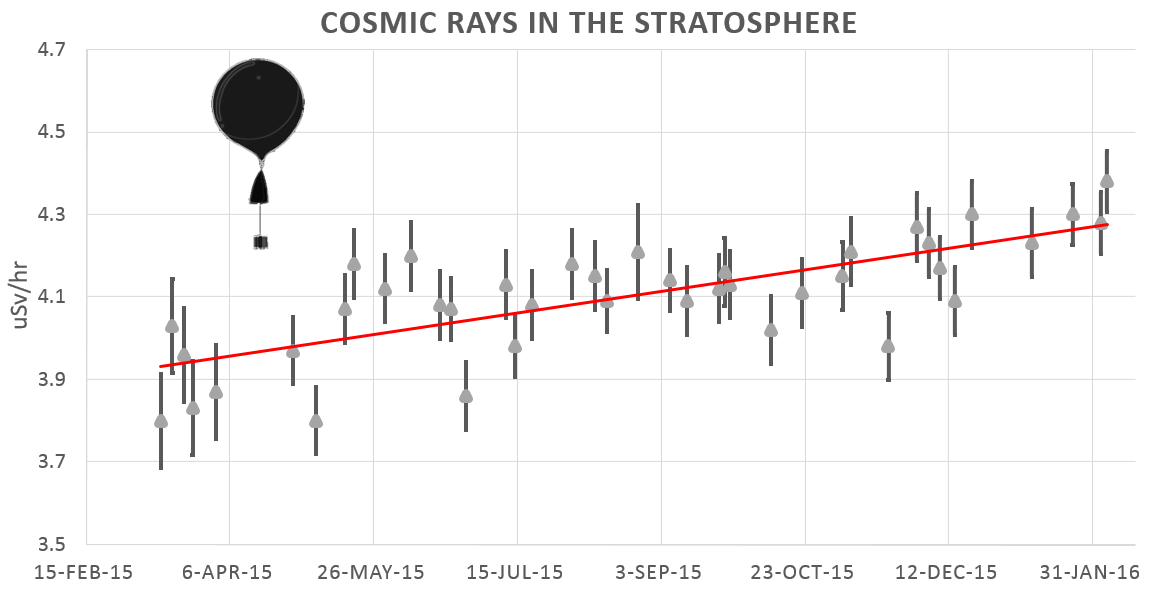
Last month, we reported that cosmic rays are intensifying. Measurements so far in February indicate that the trend is continuing. In fact, the latest balloon flight over California on Feb. 5th detected the highest value yet:

The data show that cosmic rays in the mid-latitude stratosphere now are approximately 10% stronger than they were one year ago. All of these measurements were collected by Spaceweather.com and the students of Earth to Sky Calculus.

Cosmic rays, which are accelerated toward Earth by distant supernova explosions and other violent events, are an important form of space weather. They can seed clouds, trigger lightning, and penetrate commercial airplanes. Indeed, our measurements show that someone flying back and forth across the continental USA, just once, can absorb as much ionizing cosmic radiation as 2 to 5 dental X-rays. Likewise, cosmic rays can affect mountain climbers, high-altitude drones, and astronauts onboard the International Space Station.

This type of radiation is modulated by solar activity. Solar storms and CMEs tend to sweep aside cosmic rays, making it more difficult for cosmic rays to reach Earth. On the other hand, low solar activity allows an extra dose of cosmic rays to reach our planet. Indeed, the ongoing increase in cosmic ray intensity is probably due to a decline in the solar cycle. Solar Maximum has passed and we are heading toward a new Solar Minimum. Forecasters expect solar activity to drop sharply in the years ahead, and cosmic rays are poised to increase accordingly. Stay tuned for more radiation.

The Richter Scale of Solar Flares

by Dr. Tony Phillips (Spaceweather.com)

A solar flare is an explosion on the Sun that happens when energy stored in twisted magnetic fields (usually above sunspots) is suddenly released. Flares produce a burst of radiation across the electromagnetic spectrum, from radio waves to x-rays and gamma-rays.

Scientists classify solar flares according to their x-ray brightness in the wavelength range 1 to 8 Angstroms. There are 3 categories: X-class flares are big; they are major events that can trigger planet-wide radio blackouts and long-lasting radiation storms. M-class flares are medium-sized; they can cause brief radio blackouts that affect Earth’s polar regions. Minor radiation storms sometimes follow an M-class flare. Compared to X- and M-class events, C-class flares are small with few noticeable consequences here on Earth.

This figure shows a series of solar flares detected by NOAA satellites in July 2000:


Each category for x-ray flares has nine subdivisions ranging from, e.g., C1 to C9, M1 to M9, and X1 to X9. In this figure, the three indicated flares registered (from left to right) X2, M5, and X6. The X6 flare triggered a radiation storm around Earth nicknamed the Bastille Day event.

 Class
Peak (W/m2)between 1 and 8 Angstroms
 B  I < 10-6
 C  10-6 < = I < 10-5
 M  10-5 < = I < 10-4
 X  I > = 10-4

Return to Spaceweather.com

Neutron Bubble Chamber in the Stratosphere

June 23, 2015: For nearly two years, Spaceweather.com and the students of Earth to Sky Calculus have been using helium balloons to monitor X-rays and gamma-rays in the stratosphere. Their successful program has detected multiple radiation events in response to solar storms. On June 18th they added something new. For the first time, the group’s Space Weather Payload included a bubble chamber for measuring neutrons. The device flew 109,012 feet above California’s Sierra Nevada mountain range, then parachuted back to Earth, landing near Death Valley National Park. The results: Neutrons were detected.

Circled above are some of the bubbles that formed as neutrons passed through the chamber. By counting the bubbles, it is possible to estimate the total dose of neutron radiation absorbed during the 3 hour flight. The answer is 600 microRads (energy range 200 keV – 15 MeV). Interestingly, this is almost the same dose detected by onboard X-ray and gamma-ray sensors: 620 microRads (energy range 10 keV to 20 MeV). Lesson: if you only count X-rays and gamma-rays, then you are missing at least half of the radiation in the atmosphere. Neutrons matter, too.

Indeed, neutrons are a very important form of cosmic radiation, providing much of the biologically effective radiation dose at altitudes of interest to aviation and space tourism.  Low-energy neutrons also cause single-event upsets in aircraft avionics, especially devices that contain Boron 10. Adding a neutron sensor to the Space Weather Payload allows the students to monitor this type of radiation at altitudes ranging from ground level to 120,000 feet.


Planets in a Bottle –Lesson Plan

This is a prototype lesson plan for “Planet in a Bottle” yeast experiments .

Objective: The student will measure the viability of yeast samples and explore environmental conditions which affect the health of yeast microbes. The yeast samples may be common store-bought Baker’s yeast, or more exotic forms which have been exposed to extreme environments as part of the Earth to Sky balloon program.

Overview: Students mix yeast with a nutrient broth consisting of warm water and table sugar in a plastic water bottle. A common 9 inch party balloon is used to cap the bottle. As yeast digest the sugar they produce carbon dioxide and inflate the balloon. A healthy 1/4 oz sample of baker’s yeast can inflate a balloon to 12 inch circumference in less than 30 minutes. Simple variations of this experiment may be used to discover environmental factors that inhibit or promote the health of the yeast colony. Students can compare these factors to conditions on other planets. ingredients for a Planet in a Bottle

Materials:

  • 1 cup lukewarm water
  • 3 cubes sugar
  • 1 quarter-oz package of yeast
  • 1 empty half-liter plastic water bottle
  • 1 nine or ten inch party balloon
  • 1 cloth measuring tape
  • 1 small funnel (optional)

Procedure:

  1. Mix water + sugar in water bottle until the cubes are dissolved.
  2. Using the funnel add yeast, the gently swirl the mixture.
  3. Cap the bottle with a balloon.
  4. Use the cloth measuring tape to measure the circumference of the balloon every 15 minutes.

a healthy yeast sample inflates a balloon with carbon dioxide This basic recipe can be considered an “Earth in a Bottle.” It is a warm, healthy environment for yeast with plenty of nutrients. The total amount of CO2 in the balloon when it reaches its greatest volume is proportional to the number of healthy yeast microbes present in the initial sample. For the procedure outlined above, the balloon will achieve its maximum volume less than two hours after the yeast are added to the nutrient mix.

The rate at which the balloon inflates is proportional to the growth rate of the yeast colony. After the yeast are added to the nutrient broth they begin to divide and increase in number. As the colony size increases so does the rate of CO2 production, so long as there is an ample supply of nutrients. If the environment inside the bottle is conducive to yeast growth, the maximum rate of CO2 production will be high. Conversely, if the environment is hostile to yeast, the maximum rate of CO2 production will be low.

Students can begin to explore conditions on other planets with simple variations to the basic recipe. Although we cannot create truly accurate extraterrestrial conditions in a water bottle, there are many simple variations that are representative of conditions on other planets. A few examples are listed below:

Example variations:

  • Mercury — Mercury’s surface is very hot. Mercury in a Bottle: Boil the water before adding sugar and yeast.
  • Venus — Venus is very hot, and has an acidic atmosphere. Venus in a Bottle: Instead of water and sugar, use scalding hot orange juice as a nutrient mix. Citric acid in the juice represents sulfuric acid in Venus’s hot atmosphere. Lemon juice or vinegar can also be used to increase the acidity of the nutrient mix. Venus’s atmosphere also has a high pressure, so that the simulation can be made more realistic by heating the nutrient mix in a pressure cooker.
  • Students monitor yeast growthThe Moon — The moon has no atmosphere, so that yeast on its surface would be exposed to a strong vacuum and solar radiation. Moon in a Bottle: Expose the yeast to a vacuum, using a hand pump bell jar, and to radiation in a microwave oven and/or from a UV lamp.
  • Mars — Mars is cold and has a thin atmosphere which allows much solar UV radiation to penetrate to its surface. Mars in a Bottle: freeze the yeast, then expose the microbes to ultraviolet radiation from a UV lamp before adding yeast to the nutrient mix.  Note:  Flying the yeast to the stratosphere on an Earth to Sky research balloon gives the yeast a very Mars-like experience.
  • Europa — this moon of Jupiter may harbor the largest ocean in the solar system. The icy surface is a combination of pure water ice, Epsom salts, and unknown minerals. Europa in a Bottle: Freeze a briny mixture of water and Epsom salt. Break the ice into chips and mix the salty ice chips with a cold nutrient solution.
  • Callisto — this moon of Jupiter may have a salty ocean beneath its frozen crust. Callisto in a Bottle: Add common table salt or Epsom salts to the nutrient mix to simulate a salty environment.
  • Pluto — Pluto is the most distant planet from the sun and is very cold. Pluto in a Bottle: freeze the yeast in a deep freezer before adding to the nutrient mix.