Do Sunspots Make Clouds on Neptune?

Aug. 23, 2023 (Spaceweather.com): A new paper in the research journal Icarus offers dramatic proof that solar activity can affect planetary weather. The big surprise: The planet is Neptune, 2.5 billion miles from the sun. Images taken by the Hubble Space Telescope over a period of 28 years show bright clouds forming in sync with the 11-year solar cycle:

The connection between Neptune and solar activity is surprising to planetary scientists because Neptune is our solar system’s farthest major planet. It receives only 0.1% of the sunlight we get on Earth. Yet Neptune’s cloudy weather seems to be driven by solar activity, and not the planet’s four seasons, which each last approximately 40 years.

Other planets in our solar system don’t behave this way. While clouds on Earth may be influenced by the solar cycle, the modulation is no more than a few percent; and even that small amount is controversial. Neptune’s clouds, on the other hand, are bright, flamboyant and global. Their correlation with the solar cycle is obvious at a glance.

Chavez and her colleagues believe they have an explanation.

“Our findings support the theory that the sun’s ultraviolet rays, when strong enough, may be triggering a photochemical reaction that ultimately leads to high-altitude clouds on Neptune,” says Imke de Pater, emeritus professor of astronomy at UC Berkeley and a senior co-author of the study.

Their paper describes how UV rays from the sun (which are strongest when the sunspot number is high) penetrate Neptune’s upper atmosphere and break apart molecules of methane gas. This sets off a chemical reaction yielding hydrocarbons (C𝑥H𝑦). If these hydrocarbons sink into the atmosphere, they could condense to form hazes and clouds.

Above: 21 years of images from the Keck Observatory in Hawaii confirm Hubble’s observations. [more]

Why doesn’t this happen on every planet? “Neptune is unique,” says de Pater. Unlike other planets in our solar system, Neptune has a lot of methane in its stratosphere. (How it gets there is a mystery, but that’s another story.) Solar UV rays have little trouble reaching the gas and kick-starting cloud formation.

Based on the data so far, it seems to take about two years for Neptune’s clouds to fully form once the solar cycle reaches its peak. Solar Cycle 25 is rising now with a peak expected in 2024. This means Neptune’s cloudy season is about to begin. Stay tuned.

Hyperbolic Comet Nishimura

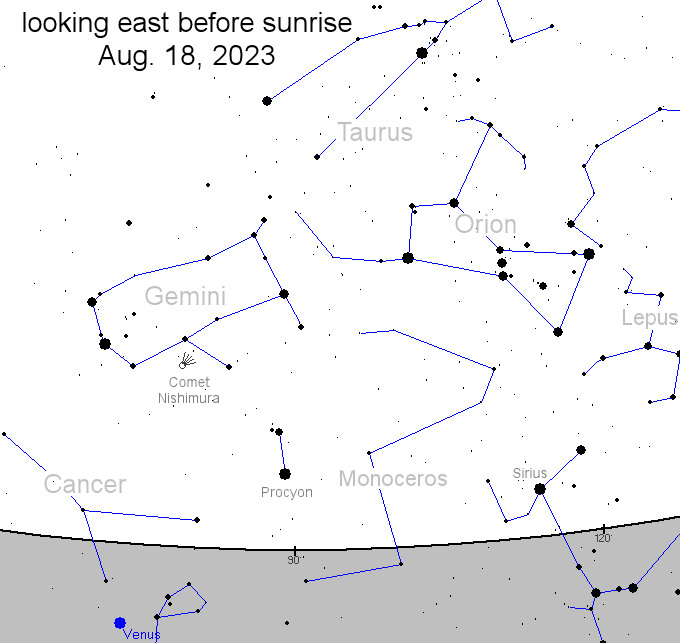
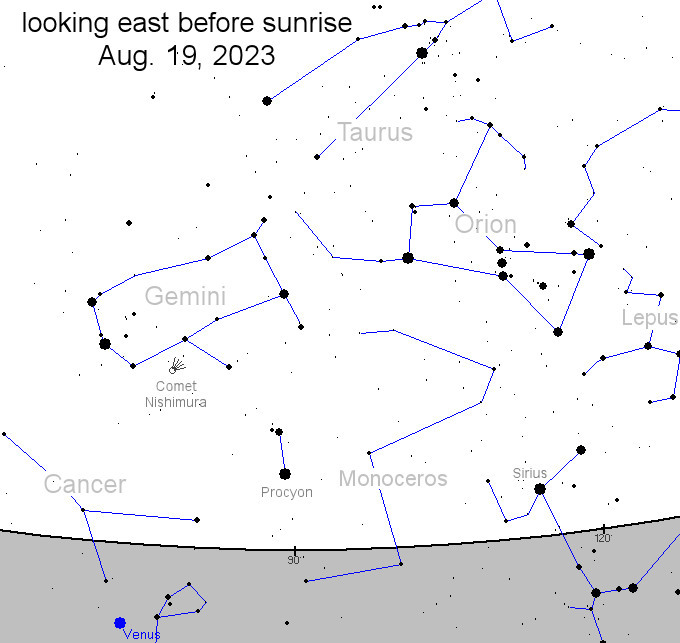
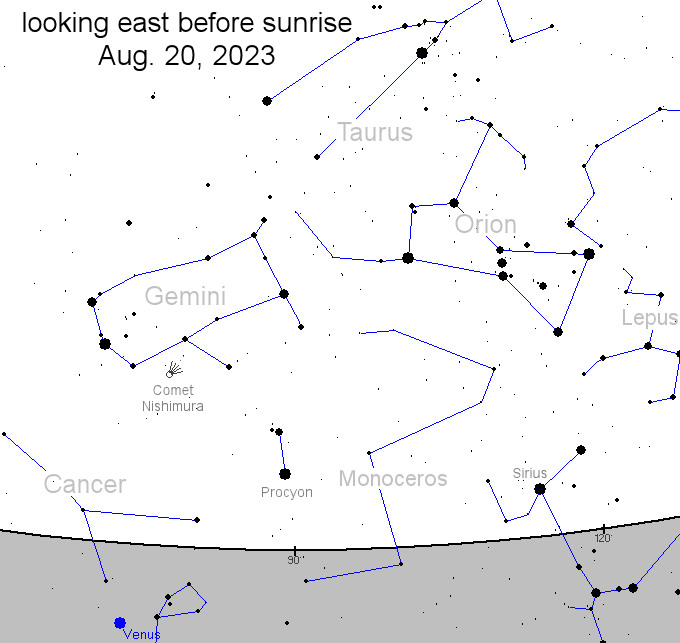
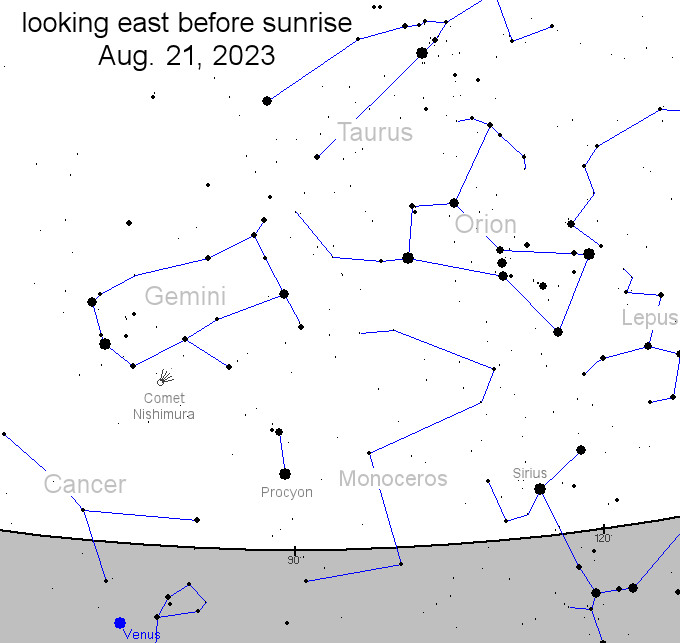
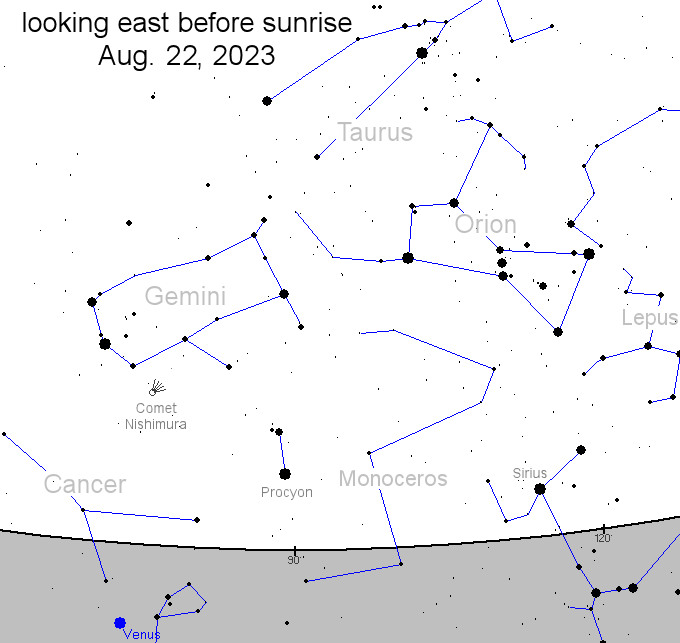
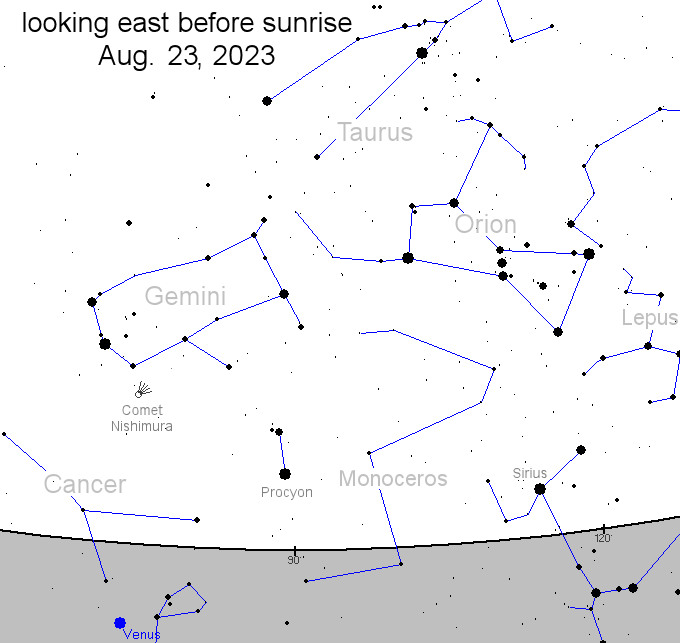
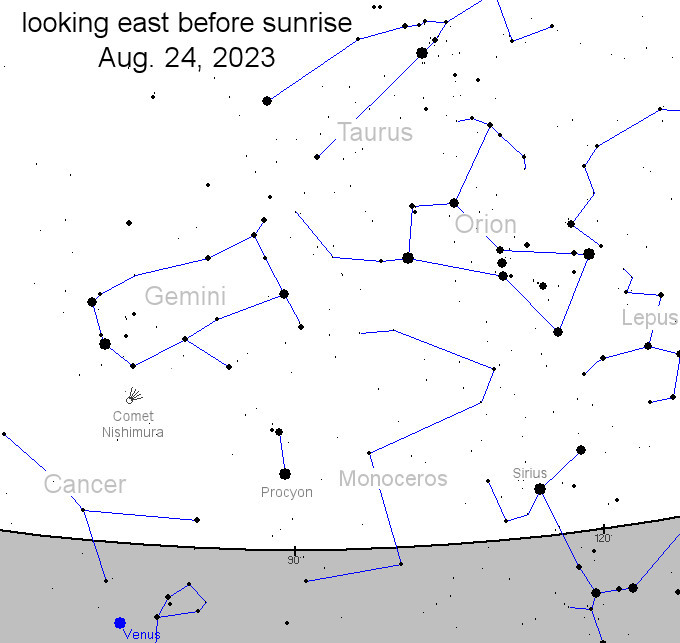
August 19, 2023 (Spaceweather.com): A hyperbolic comet is falling into our solar system. Japanese amateur astronomer Hideo Nishimura discovered it just a few days ago in the constellation Gemini. Although it is relatively dim right now (magnitude +9), Comet Nishimura (C/2023 P1) could soon brighten more than 100-fold to become a naked-eye object in mid-September.

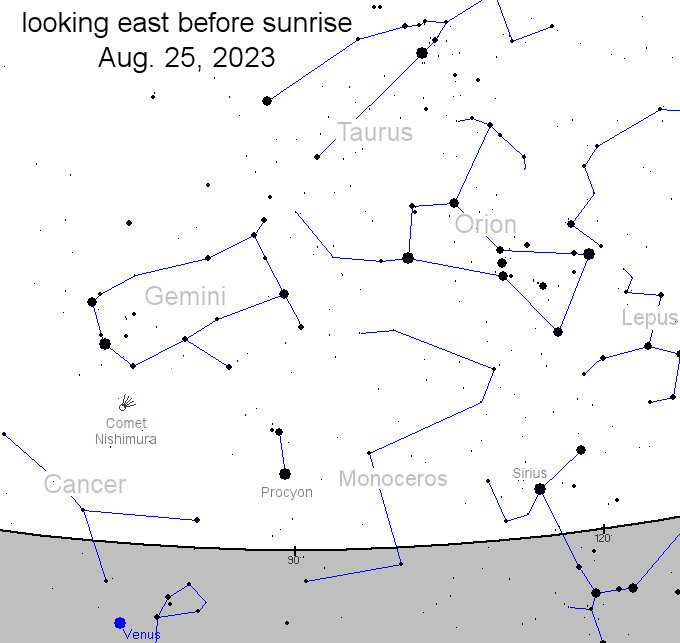
Above: A sky map with an inset photo of the comet from Dan Bartlett of June Lake, CA

A “hyperbolic comet” is a comet with too much energy to remain trapped inside the solar system. It will visit us only once, with the sun acting as a gravitational slingshot, sending the comet hurtling back into deep space after its flyby. Does that mean Comet Nishimura is an interstellar comet? Not necessarily. It might have come from the Oort Cloud. Indeed, that is more likely.

Because this is Comet Nishimura’s first trip to the inner solar system, it is extra unpredictable. On Sept. 18th, the comet will make its closest approach to the sun deep inside the orbit of Mercury. Anything could happen when intense sunlight touches the comet’s pristine surface for the first time. Possibilities range from dramatic brightening to a disappointing fizzle. Standard models suggest a peak brightness of 3rd magnitude. This would make it visible to the naked eye from rural areas.

Monitoring is encouraged. Comet Nishimura can be found in the pre-dawn sky using backyard telescopes larger than 6 inches. A date of particular interest is Aug. 25th when the comet lines up with Gemini’s brightest stars, Castor and Pollux, making it particularly easy to find.

Sky maps: Aug. 18, 19, 20, 21, 22, 23, 24, 25. Ephemeris: from JPL.

Ham Radio Operators Hack a NASA Spacecraft

July 5, 2023 (Spaceweather.com): Ham radio operators are picking up a strong signal from space. It’s NASA’s STEREO-A spacecraft returning home after 17 years.

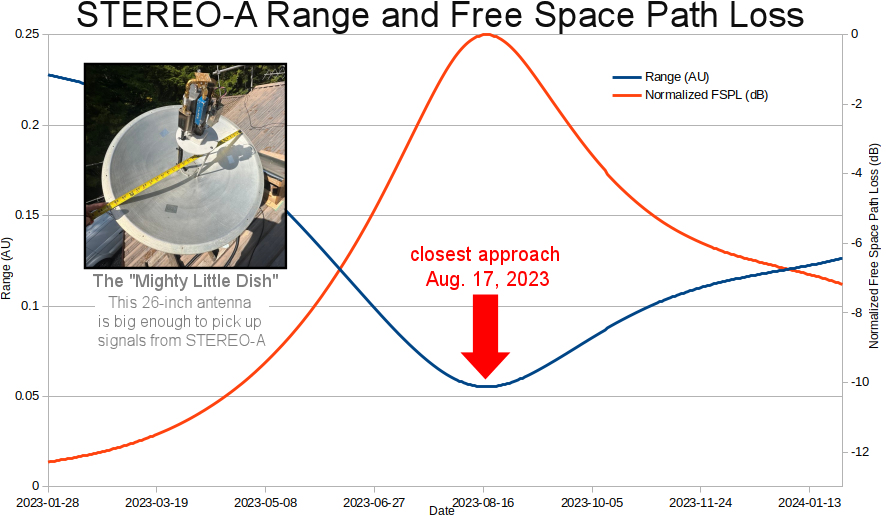
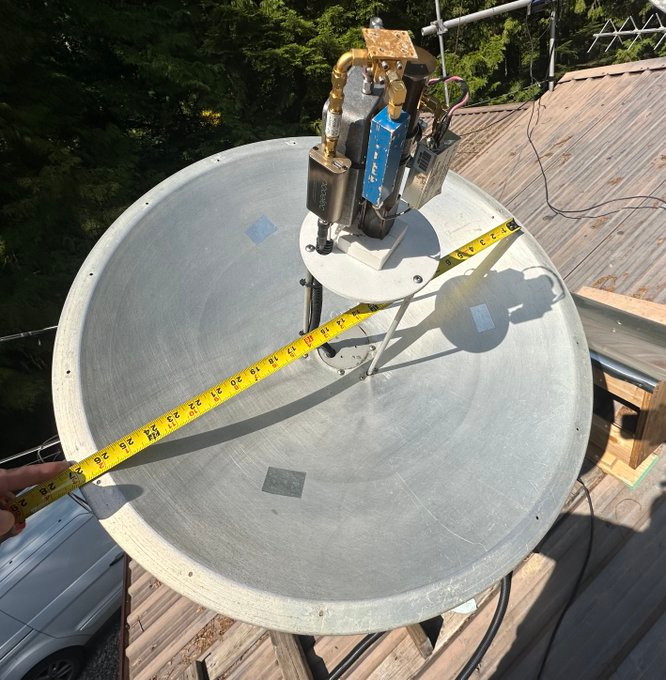
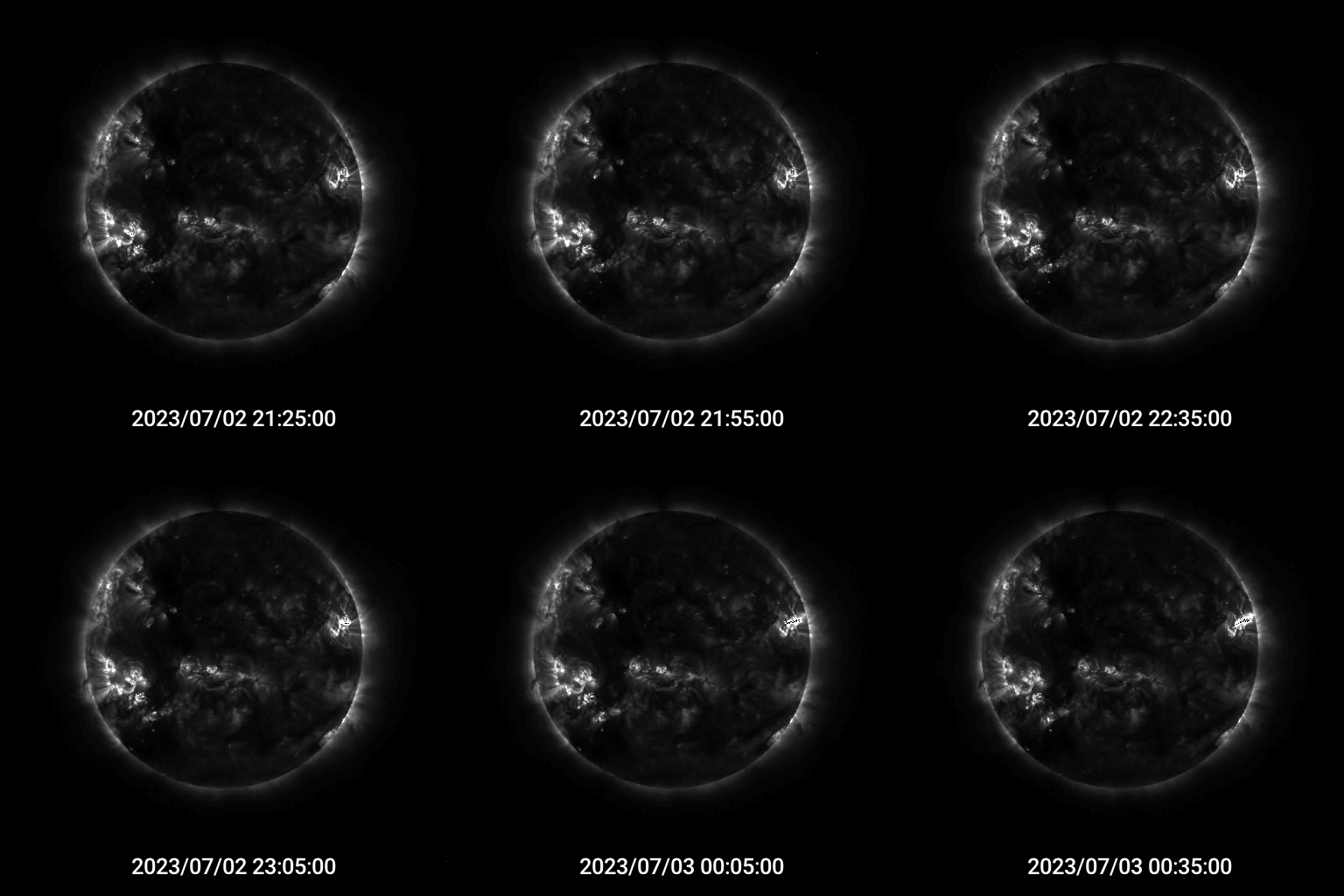
“I’m having fun with STEREO-A,” reports Scott Tilley (VE7TIL) of Roberts Creek, British Columbia. “The spacecraft is coming close to Earth this summer, and I can now receive its signal using a small 26-inch dish in my backyard.” Here is what he picked up on July 2nd:

See also an animated version of these data. The X-flare is right here.

“We caught an X-flare in progress,” Tilley says. “Naked-eye sunspot AR3354 was really crackling.”

STEREO-A left Earth on Oct. 26, 2006, launched from Cape Canaveral with its sister ship STEREO-B. Both spacecraft were on a mission to the farside of the sun. Over the years, they would circle behind behind the sun, beaming images back to Earth so scientists could make 3D models of solar activity. In 2014, STEREO-B failed and was not heard from again. STEREO-A kept going, and now it is on its way back.

Above: STEREO-A coronagraph images of Mercury passing the sun, eavesdropped by Scott Tilley.

Earlier this summer, Tilley began hearing rumors that other radio operators were picking up signals from STEREO-A at 8443.580 MHz. He decided to check it out. “The central carrier is very loud, almost 30dB above the noise,” he says. “I also noticed data sidebands, which are unusual to see on such a distant object for my small antenna.”

At first, the signal was indecipherable. But Tilley found lots of information about its format posted by NASA on public websites; it wasn’t a secret. Using a program called “SatDump” written by Alan Antoine (F4LAU), he successfully demodulated the data. Now Tilley is monitoring data streams from almost all of STEREO-A’s science instruments including its extreme ultraviolet imager (EUVI), two coronagraphs (COR1 and COR2), the heliospheric imager (HI) and a solar radio burst receiver (S/WAVES).

At closest approach on August 17th, STEREO-A will be only 0.05 AU (7.5 million km) from Earth. By then, signals from the spacecraft will have more than doubled in strength, making it even easier to “hack.” 

“What started out as a passing curiosity is now turning into a summer pastime,” says Tilley. “This is a unique time to play with STEREO-A.”

Hams, would you like to monitor STEREO-A? A technical blog post just published by Tilley explains exactly how to do it.

Dangerous but Beautiful: The Inferior Conjunction of Venus

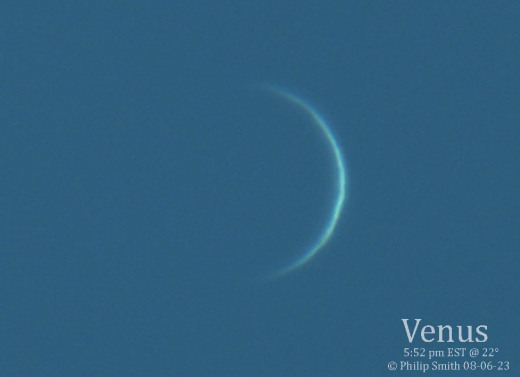
Aug. 7, 2023: (Spaceweather.com) Observing Venus this week may be one of the most dangerous things you can do with a telescope. The planet is only 12 degrees from the blinding sun. The results, however, are undeniably beautiful:

Philip Smith took this picture in broad daylight on Aug. 6th from his home in Manorville, NY. “This is exactly how it looked,” he says. “The colors have not been altered.”

Like the Moon, Venus has phases, and at the moment it is a marvelously thin crescent. This happens during a special time called “inferior conjunction” when Venus passes between the sun and Earth. This year’s inferior conjunction is less than a week away on Aug. 13th–so now is primetime for catching the crescent.

Smith explains how he did it: “The hardest part was finding Venus with the sun so nearby. I put solar filters on my telescope and started with the sun to get a good sharp focus. Then I had the telescope go to Venus. I took off the finder scope’s solar filter first and put my hand behind it to make sure the sun was not in its path. Then I removed the main telescope’s solar filter–and all was good!”

At closest approach on Aug. 13th, Venus and the sun will be separated by a little more than 7 degrees. This means careful daytime shots of Venus will be possible throughout the conjunction. Got a picture? Submit it here.

more images: from Mariano Ribas of Buenos Aires, Argentina; from Daniel Mello of Rio de Janeiro, Brazil; from Robert Spellman of Apple Valley, CA; from Bum-Suk Yeom of Iksan, South Korea; from Philippe Tosi of Nîmes, France

more observing tips: from Sky & Telescope

A Comet Shaped Like the Millennium Falcon

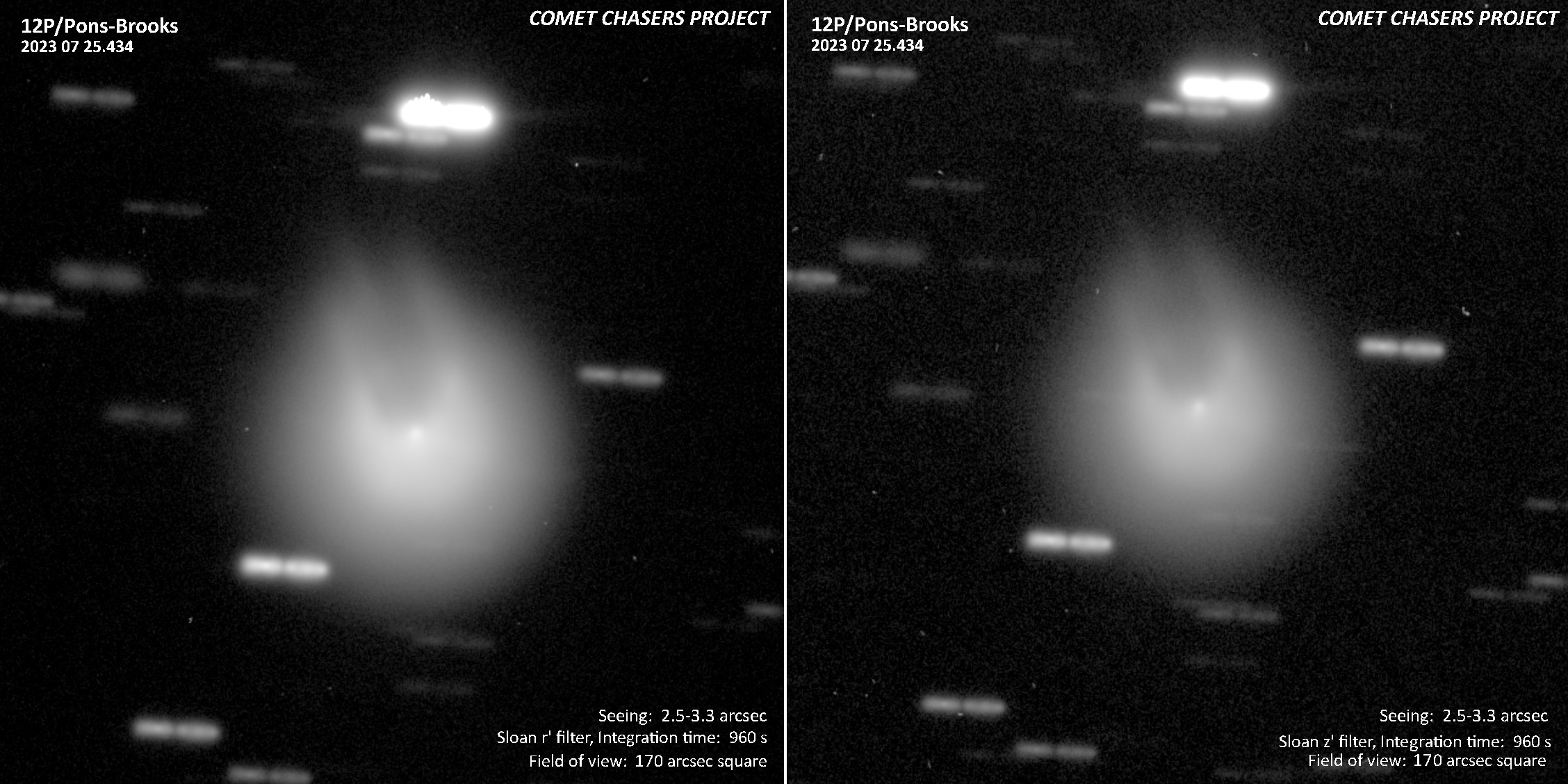
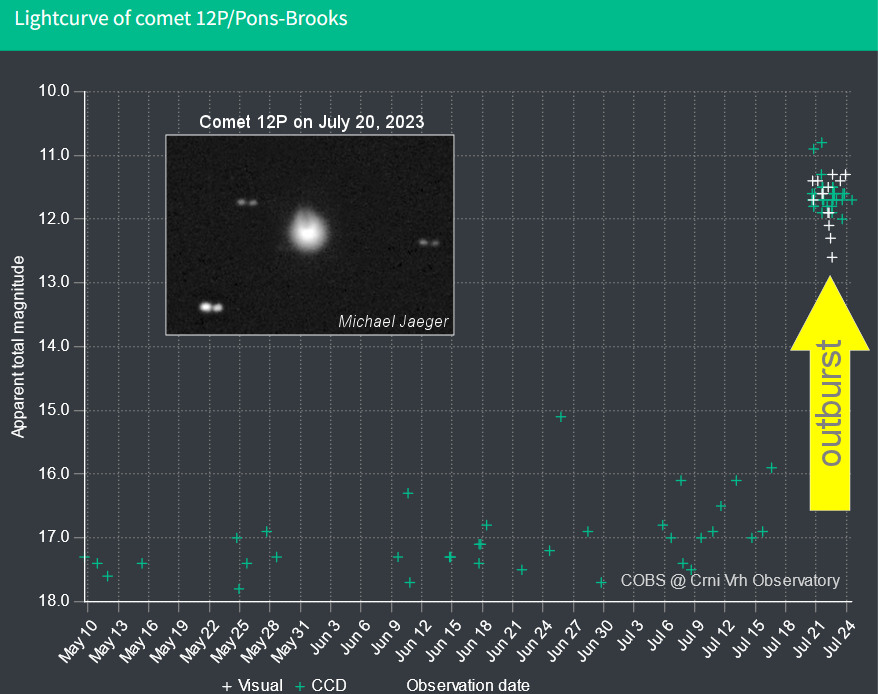
July 25, 2023: (Spaceweather.com) Until a few days ago, Comet 12P/Pons-Brooks looked like a perfectly ordinary comet. Then, something on its surface exploded. Now it resembles “the fastest hunk of junk in the galaxy”–the Millennium Falcon:

These images are hot off the press (July 25.434) from the Comet Chasers, a team of researchers led by Helen Usher of Cardiff/The Open Universities. They are using telescopes at the Las Cumbres Observatory network to monitor this comet’s unusual eruption.

The action began on July 20th when the comet abruptly brightnened 100-fold. Astronomers watched as double plumes of debris streamed out of the comet’s core, sweeping back to form the Falcon shape. It is now shining with about the same brightness as an 11th magnitude star, making it an easy target for mid-sized backyard telescopes.

Comet 12P/Pons-Brooks is famous for exploding. Discovered in 1812 by Pons and discovered again in 1883 by Brooks, the bursty comet visits the inner solar system every 71 years. Since the 19th century at least seven significant outbursts have been observed.

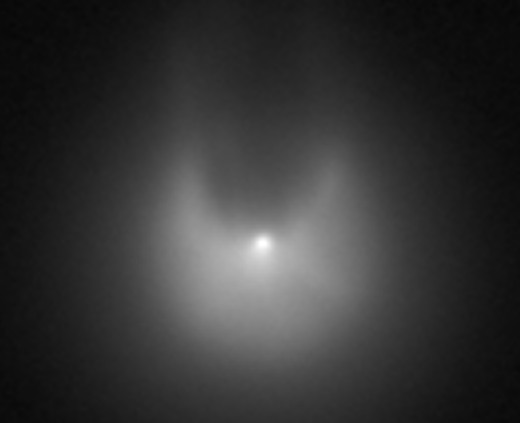
At the Astronomical Station Vidojevica in Serbia, astronomers Igor Smolić and Marco Grazdanovic took a closer look using the station’s big 1.4 meter telescope:

“This is a 60x30s exposure,” says Smolić. “[It reveals the origin of the ‘horns’ curving out of the comet’s compact core].”

Richard Miles of the British Astronomical Association thinks 12P may be one of 10 to 20 known comets with active ice volcanoes. The “magma” is a cold mixture of liquid hydrocarbons and dissolved gasses, all trapped beneath a surface which has the consistency of wax. These bottled-up volatiles love to explode when sunlight opens a fissure.

The best may be yet to come. The comet is currently beyond the orbit of Mars, but falling toward the sun for a close encounter in April 2024. At that time it is expected to become a naked-eye object at 4th or 5th magnitude.The timing is significant because 12P will reach maximum brightness only a few days before the total solar eclipse on April 8, 2024. Sky watchers in the path of totality could look up and see an outburst for themselves.

Amateur astronomers are encouraged to monitor developments. Comet 12P is currently crossing the head of Draco not far from the north celestial pole. Check out those horns! And submit your photos here.

more images: from Thomas Wildoner of Weatherly, PA; from David Strange of Salcombe Regis, East Devon, UK

A Strong Farside CME Just Hit Solar Orbiter

July 26, 2023: On July 24th, a bright CME rocketed away from the farside of the sun. Its plane-of-sky speed in SOHO coronagraph images exceeded 1,500 km/s (3.4 million mph):

If this CME had hit Earth, a strong (possibly severe) geomagnetic storm would have surely resulted. Instead, it flew in the opposite direction and hit Europe’s Solar Orbiter (SolO) spacecraft.

The CME reached SolO on July 26th (0200 UT), barely 32 hours after it left the sun. Considering that a typical CME would take two or three days to reach the spacecraft at its current location, a transit of only 32 hours confirms this CME was a fast-mover.

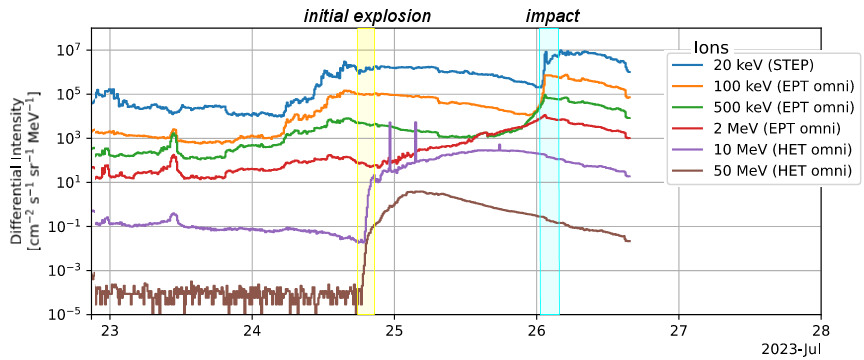
“This was definitely a big event,” says George Ho of the Johns Hopkins Applied Physics Lab, co-principal investigator for the Energetic Particle Detector suite onboard Solar Orbiter. Ho checked the data right after the initial explosion on July 24th and saw a 10,000-fold increase of 50 MeV ions reaching the spacecraft. “This indicates a strong incoming interplanetary shock.”

This plot shows two waves of energetic particles washing over Solar Orbiter:

Above: Data from Solar Orbiter’s EPD/Electron-Proton Telescope (Principal Investigator Javier Pacheco from University of Alcala, Spain)

The first wave (yellow) was accelerated by whatever unseen explosion launched the CME. Traveling close to the speed of light, these particles reached the spacecraft soon after the blast. A second wave (blue) traveled with the CME itself and hit the spacecraft 30+ hours later.

“During the 1989 Quebec blackout, it was this type of shock-driven particle increase during the CME arrival that knocked off the power,” notes Ho.

Launched in Feb. 2020, Solar Orbiter is on a mission to study solar storms at point blank range. Mission accomplished. This storm actually swallowed the spacecraft. Mission scientists will analyze the data from this storm and others to improve future forecasts of space weather. Stay tuned.

This story was brought to you by Spaceweather.com

SpaceX Punched a Hole in the Ionosphere

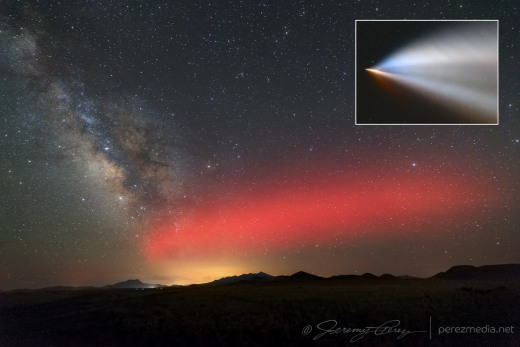
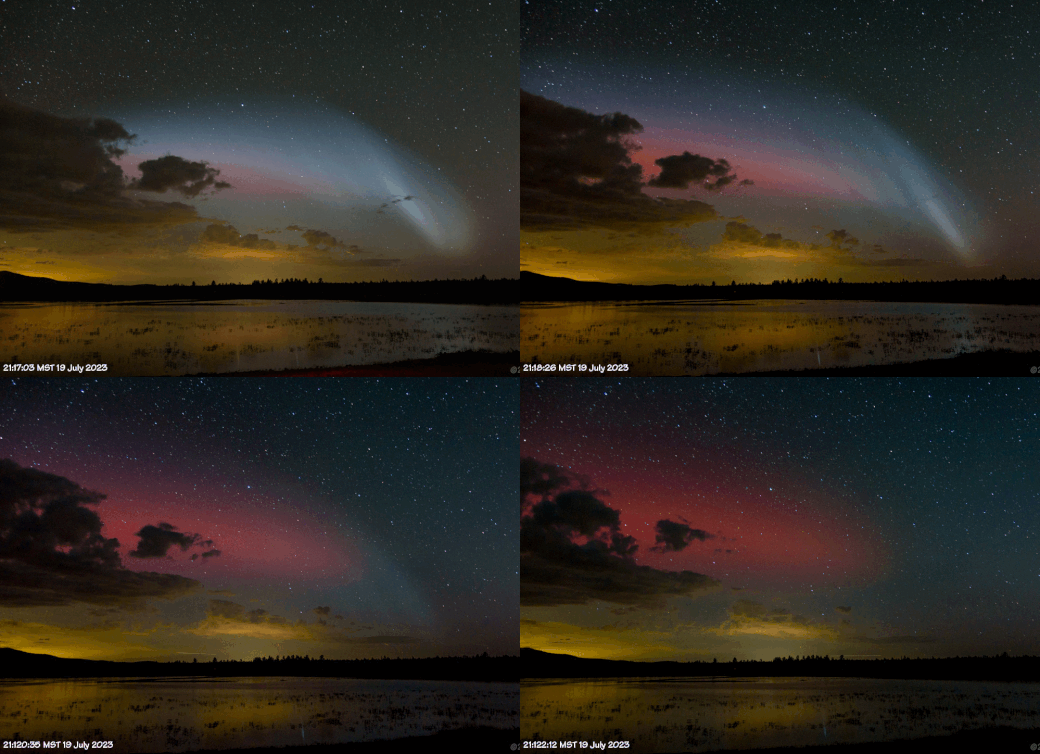
July 20, 2023: (Spaceweather.com) On the evening of July 19th, SpaceX launched a Falcon 9 rocket from Vandenberg Space Force Base in California. Sky watchers from southern California to Arizona witnessed a magnificent exhaust plume. At the San Francisco Volcanic Field north of Flagstaff, photographer Jeremy Perez saw something extra:

“After the rocket passed overhead, a red fluorescent glow expanded southward and crossed over the Milky Way,” says Perez. “It was visible for almost 20 minutes.”

The red glow is a sign that the rocket punched a hole in the ionosphere–something SpaceX and others have been doing for years. One famous example occured on August 25, 2017, when a Falcon 9 rocket carrying Taiwan’s FORMOSAT-5 satellite created a hole four times bigger than the state of California. On June 19, 2022, another Falcon 9 punched a hole over the east coast of the USA, sparking a display of red lights from New York to the Carolinas that many observers mistook for aurora borealis.

“This is a well studied phenomenon when rockets are burning their engines 200 to 300 km above Earth’s surface,” explains space physicist Jeff Baumgardner of Boston University. “The red glow appears when exhaust gasses from the rocket’s 2nd stage cause the ionosphere to recombine quickly.”

Rocket engines spray water (H2O) and carbon dioxide (CO2) into the ionosphere, quenching local ionization by as much as 70%. A complicated series of charge exchange reactions between oxygen ions (O+) and molecules from the rocket exhaust produce photons at a wavelength of 6300 Ă…–the same color as red auroras.

This movie from David Blanchard outside Flagstaff shows how the red glow developed as the silvery rocket exhaust faded into the ionosphere:

“I watched the show from Upper Lake Mary in the Coconino National Forest,” says Blanchard. “The exhaust plume was spectacular.”

Baumgardner reviewed SpaceX’s video footage from the July 19th launch. “It shows the second stage engine burning at 286 km near the ionosphere’s F-region peak for that time of day. So, it is quite possible that an ionospheric ‘hole’ was made,” he says.

Once rare, ionospheric “punch holes” are increasingly common with record numbers of rocket launches led by SpaceX sending Starlink satellites to low-Earth orbit. Ham radio operators may notice them when shortwave signals fail to skip over the horizon, shooting through holes instead of bouncing back to Earth. Sudden GPS errors can also result from the anomalies. These effects may be troublesome, but they are shortlived; re-ionization occurs as soon as the sun comes up again.

Readers, did you see a red glow from this week’s SpaceX launch? Submit your photos here.

more images: from Cheryl Hanscom Wilcox of Mammoth Lakes, CA; from MaryBeth Kiczenski in the San Juan Mountains of Colorado; from Richard Rast of Mountainair, New Mexico;

A New Way to Detect Solar Flares

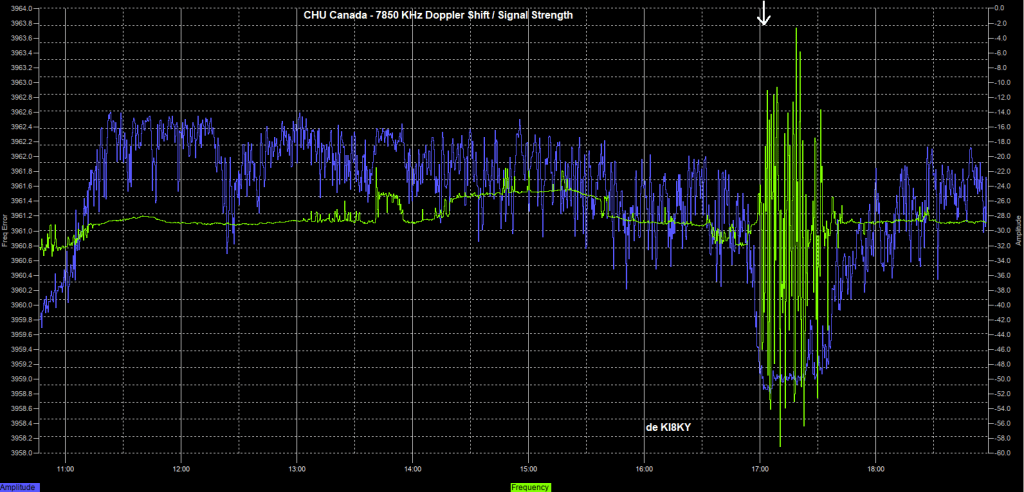
June 21, 2023: Around the world, ham radio operators are experimenting with a new way to detect solar flares–the Doppler Shift method. Brian Curtis of Sault Ste Marie, Michigan, demonstrated the technique on June 20th when the sun produced a powerful X1.1-class solar flare:

“I monitor the frequency and field strength of Canada’s CHU time station transmitting at 7850 KHz,” explains Curtis. “During the X-class flare event, I was able to detect the Doppler shift of the station’s carrier frequency (green plot). It shifted by 5 Hz, which is a small change, but very obvious!”

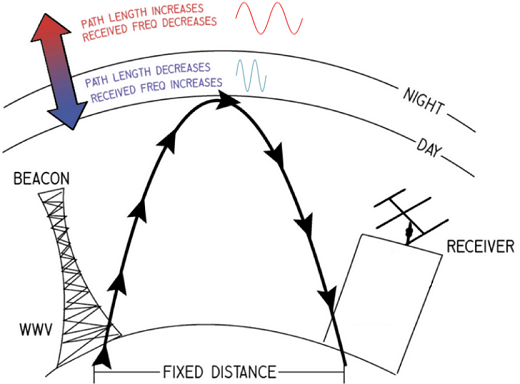
When radiation from a solar flare hits Earth’s atmosphere, it ionizes the air, temporarily boosting the thickness of our planet’s ionosphere. Any radio station skipping off the ionosphere will suddenly find its frequency Doppler shifted (because its reflection point is moving). Shortwave stations such as WWV, WWVH, and CHU transmit carriers with atomic-clock grade frequency stability, so they are perfect sources for Doppler monitoring.

Above: Sudden changes in the ionosphere caused by flares or even sunrise/sunset can Doppler shift the frequency of stations like WWV. Image credit: Collins et al (2021)

“I have been monitoring radio stations for decades, noting sudden changes in signal strength as a means of monitoring space weather events,” says Curtis. “It is only fairly recently (~4 months) that I started to experiment with monitoring the Doppler shift of HF stations. The June 20th X-class flare event is by far the most dramatic that I have witnessed thus far.”

Would you like to detect solar flares this way? The HamSCI citizen science program has developed a Personal Space Weather Station specifically for Doppler shift measurements. This technique can also be used to study solar eclipses, earthquakes and tsunamis, and much more.

Sunspot Counts Hit 21-Year High

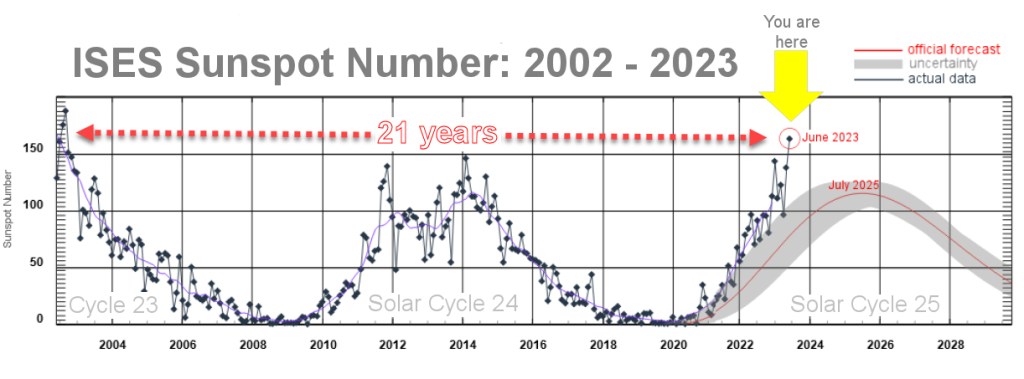
July 2, 2023: The sun is partying like it’s 2002. That’s the last time sunspot counts were as high as they are now. The monthly average sunspot number for June 2023 was 163, according to the Royal Observatory of Belgium’s Solar Influences Data Analysis Center. This eclipses every month since Sept. 2002:

Solar Cycle 25 wasn’t expected to be this strong. When it began in Dec. 2019, forecasters believed it would be a weak cycle akin to its immediate predecessor Solar Cycle 24. If that forecast had panned out, Solar Cycle 25 would be one of the weakest solar cycles in a century.

Instead, Solar Cycle 25 has shot past Solar Cycle 24 and may be on pace to rival some of the stronger cycles of the 20th century. The last time sunspot numbers were this high, the sun was on the verge of launching the Great Halloween Storms of 2003, which included the strongest X-ray solar flare ever recorded (X45), auroras as far south as Texas, and a CME so powerful it was ultimately detected by the Voyager spacecraft at the edge of the solar system.

Stay tuned. Solar flare alerts: SMS Text

This story was brought to you by Spaceweather.com

Solar Max is Boosting Airglow

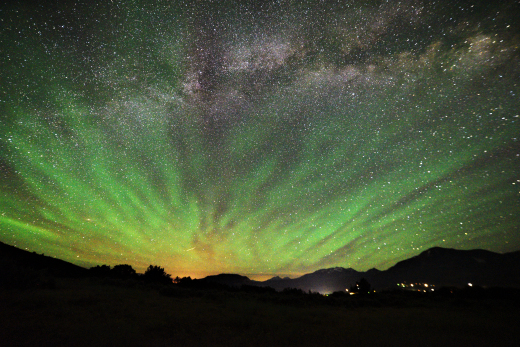
June 26, 2023: There was no geomagnetic storm on June 22nd. Nevertheless, the sky turned green over rural Colorado. Aaron Watson photographed the dramatic display from the West Elk Mountains:

“I woke up around midnight to crystal clear skies,” says Watson. “I noticed some wispy rays and, at first, I thought maybe it was noctilucent clouds. Upon closer inspection there was an intense green glow rippling across the entire sky.”

Although this looks a lot like aurora borealis, it is something completely different: airglow. Cameras with nighttime exposure settings can pick up the faint emission from anywhere on Earth even when geomagnetic activity is low. All that’s required is a very dark sky.

“Airglow is produced by photochemistry in Earth’s upper atmosphere,” says space scientist Scott Bailey of Virginia Tech. “And it is very interesting photochemistry.”

He explains: There is a layer of air about 95 km above Earth’s surface where two forms of oxygen mix together: Molecular oxygen (O2, the kind of oxygen we breathe) and atomic oxygen (O, a reactive species that is toxic to people). Both species are abundant in a wafer-thin zone only 10 km deep. O2 collides with O, exciting the atoms, which later relax by emitting green photons.

“I photographed it, too!” reports Christie Allen, who lives in southern Colorado. “Green rays were emerging from the Sangre de Cristo mountain range to our east.”

“At first I thought they were auroras,” she says, “but now I know it was airglow.”

Although airglow does not require solar activity, there is a strong link to the solar cycle. As long ago as 1935, Lord Rayleigh realized that airglow peaks during years around Solar Maximum. Modern studies (e.g., 2011, 2015 and 2022) have confirmed the effect. Airglow is up to 40% brighter when the sun is most active.

“Solar activity boosts airglow by heating the upper atmosphere,” says Bailey. “Warmer air causes more collisions and, thus, more green light to emerge. This is why green airglow tends to be most intense around Solar Max.”

That means *now* is the time to look for airglow. Solar Cycle 25 is intensifying with Maximum perhaps less than a year away. Get away from city lights, wait for the Moon to set, and point your camera at the midnight sky. It might not be as dark as you think.

This story was brought to you by Spaceweather.com