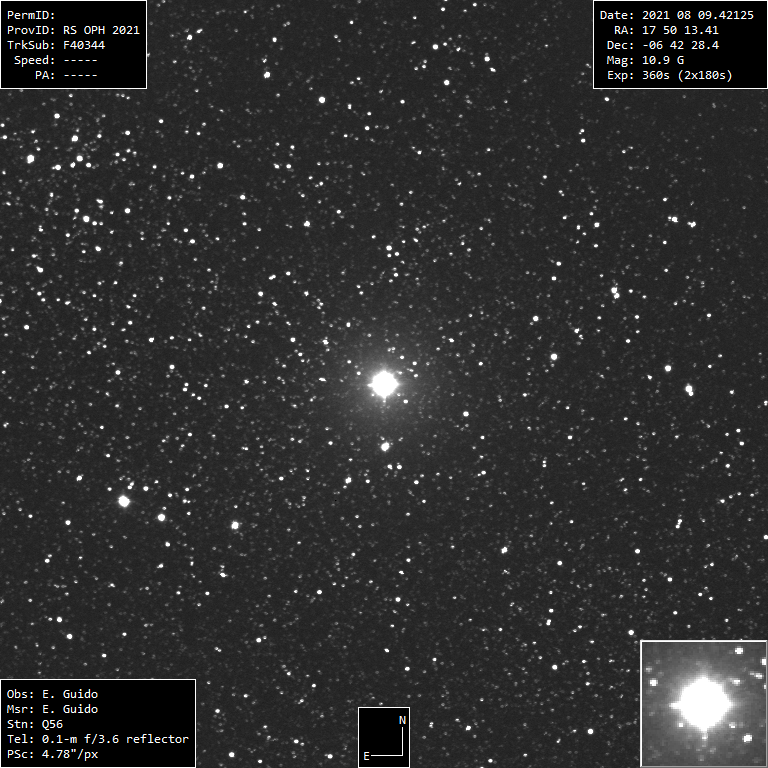
August 9, 2021: Every 20 years or so, a thermonuclear explosion occurs on the surface of RS Oph, a white dwarf in the constellation Ophiuchus. Yesterday, it happened again. On Aug. 8th, the brightness of the tiny star increased 600-fold, from magnitude +12 to +5. Keith Geary of Ireland was the first to notice. Hours later, Italian astronomer Ernesto Guido and colleagues photographed the outburst using a remote-controlled telescope in Australia:
This is called a “recurrent nova,” and it is rare. In the whole Milky Way galaxy, only 7 star systems are known to produce such explosions.
RS Oph is actually a binary star–a very lopsided one. On one side is a white dwarf, on the other is a red giant. There’s very little distance between the two, so the gravity of the white dwarf is able to pull gaseous material off the larger star down onto itself. Every couple of decades, enough matter accumulates to trigger an explosion. The last time this happened was back in 2006.
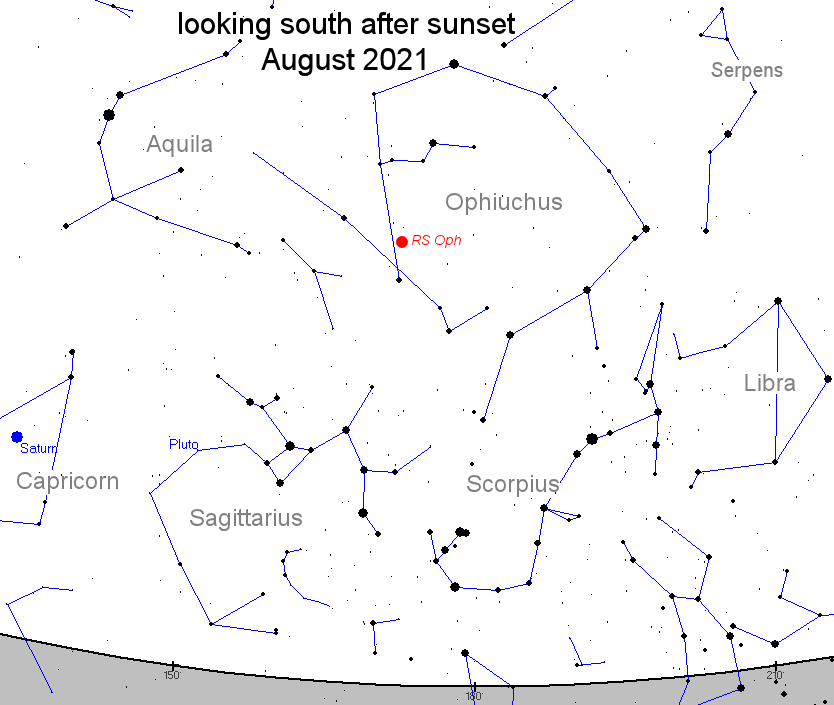
At 5th magnitude, the current outburst is visible to the unaided eye, albeit just barely. Binoculars or a telescope will allow you to see it with ease. Look south after sunset. Ophiuchus hangs high in the sky just above the better known constellations Scorpius and Sagittarius. Sky maps:simple, detailed, really detailed.
Update: Variable star observer Filipp Romanov of Yuzhno-Morskoy, Russia, has just seen RS Oph and estimates that its magnitude has increased further to +4.6.
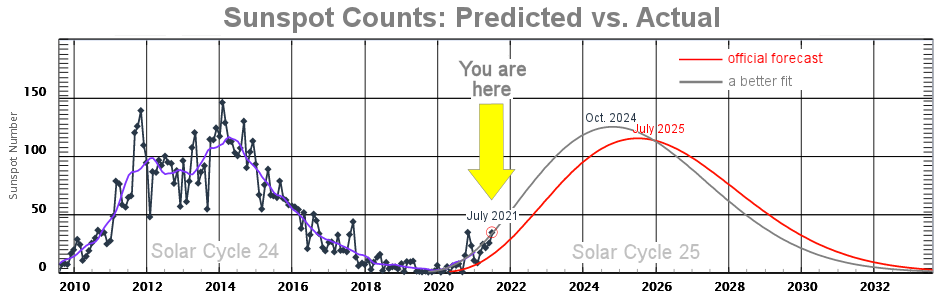
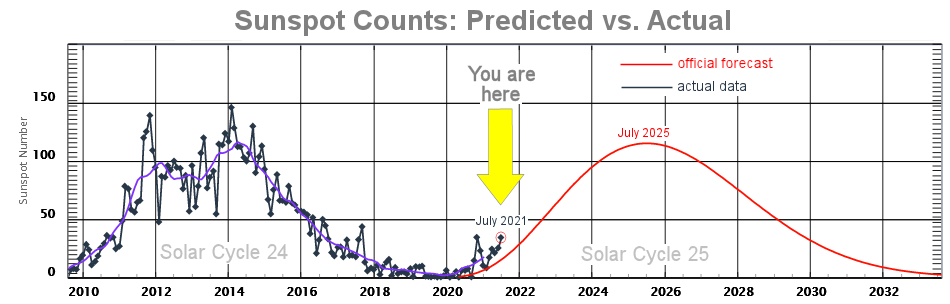
Aug. 3, 2021: Solar Cycle 25 is heating up faster than expected. The latest sign may be found in sunspot counts from July 2021. Continuing a trend that started last year, they overperform the official forecast:
Issued by the NOAA/NASA Solar Cycle 25 Prediction Panel in 2019, the official forecast calls for Solar Cycle 25 to peak in July 2025. However, a better fit to current data shows Solar Cycle 25 peaking in October 2024. This is just outside the 8-month error bars of the Panel’s forecast.
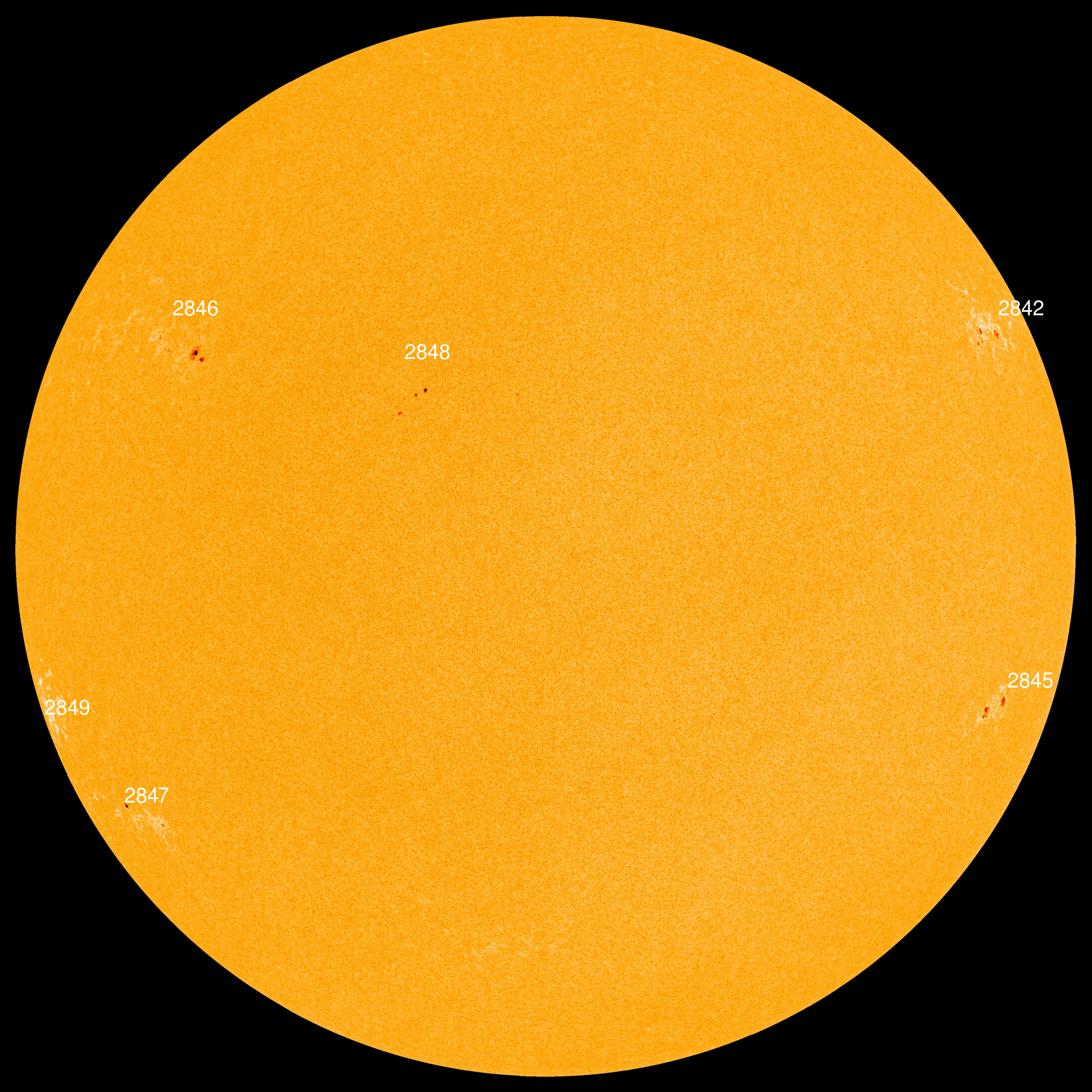
July 2021 was a remarkable month. Solar Cycle 25 crossed multiple thresholds, including its first X-flare and, at one point, 6 sunspots on the solar disk. The last time so many sunspots were seen at the same time was Sept. 2017 (SWx archive). One farside CME in July was so strong it affected Earth despite being on the “wrong” side of the sun. A handful of other CMEs narrowly missed our planet.
If solar activity increases apace, some of those blows will soon begin to land. Stay tuned.
July 29, 2021: They called it “Starfish Prime.” On July 9, 1962, the US military exploded a thermonuclear warhead 250 miles above the Pacific Ocean. What happened next surprised everyone.
Witnesses from Hawaii to New Zealand reported auroras dancing overhead, magnificent midnight “rainbow stripes” that tropical sky watchers had never seen before. Radios fell silent, then suddenly became noisy. Burglar alarms sounded as local streetlights in Honolulu went black.
Above: ‘Nuclear auroras’ viewed from Honolulu (left) and from a surveillance aircraft (right) on July 9, 1962.
Starfish Prime essentially created an artificial solar storm complete with auroras, geomagnetic activity, and blackouts. Much of the chaos that night was caused by the electromagnetic pulse (EMP)–a ferocious burst of radiation that can ionize the atmosphere and pepper the ground below with secondary particles akin to cosmic rays. Government and industry researchers have been studying the Starfish Prime EMP for decades.
A new paper just published in the research journal Earth and Space Science suggests they might be overlooking something.
“Typical EMP simulations found in government and industry reports use over-simplified models of the Earth,” says lead author Jeffrey Love of the United States Geological Survey. “They do not provide accurate estimates of the hazard in complex geological settings.”
In their paper, Love et al describe how a high-altitude nuclear blast jerks Earth’s magnetic field. First, the EMP ionizes a layer of air underneath the bomb. This layer presses downward, pinning Earth’s magnetic field lines in their pre-blast locations. Next, as the ionization subsides, the magnetic field springs back. It’s a sort of heaving, lurching geomagnetic storm.
Geomagnetic storms are famous for causing power blackouts. Usually the sun is to blame, but EMPs can do it, too. Lurching magnetic fields cause electrical currents to flow through the ground. Literally, rocks beneath your feet begin to tingle with electricity. These currents, in turn, make their way into grounded electric-power grids, potentially damaging transformers and blacking out power supplies.
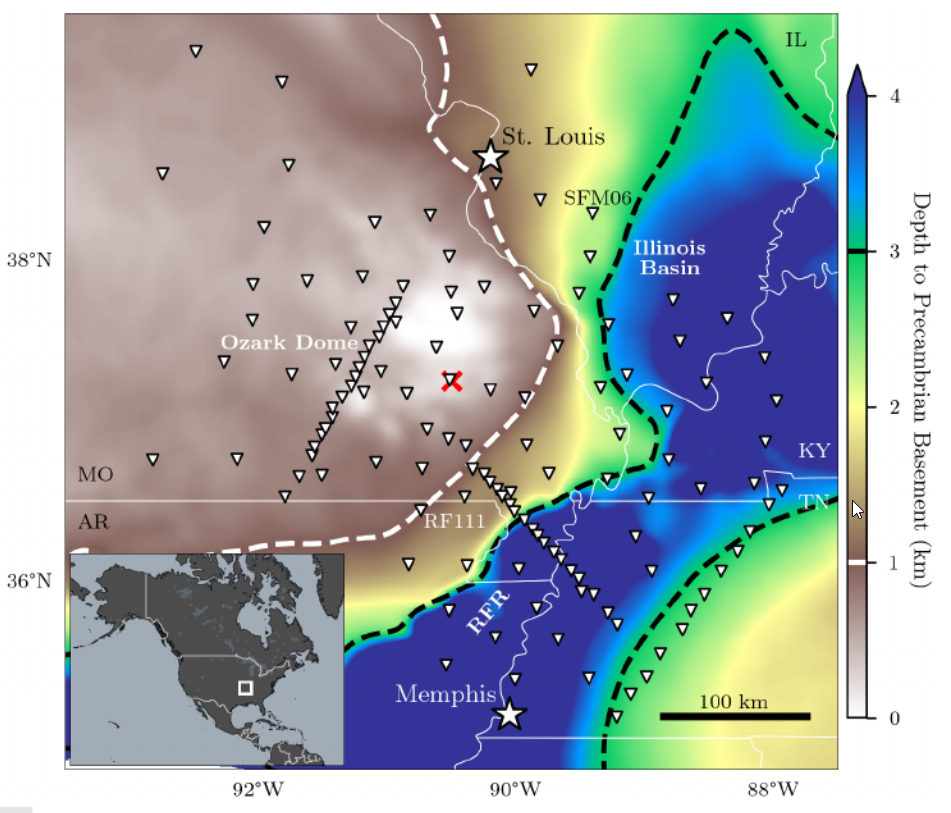
Above: A geological map of the midcontinental USA. Triangle mark places where magnetotelluric measurements have been made.
The crucial point of Love’s paper is this: Earth is not the same everywhere. In recent years, researchers have been sounding Earth’s crust to determine the 3D electrical properties of our planet. These magnetotelluric surveys reveal huge variations in conductivity from place to place, depending on the mix of underlying rock.
Love has been one of the pioneers in applying this type of Earth data to space weather, predicting how global geomagnetic storms might affect local power lines. Now he and his colleagues are doing the same with EMPs.
The team focused their attention on the eastern midcontinental USA, a region bracketed by St. Louis, Missouri, and Memphis, Tennessee. Between 2016 and 2019, the USGS conducted a magnetotelluric survey of the area, so the data are fresh. The terrain is remarkable for its mix of rock types. Underneath it all is a layer of Precambrian basement rock, which is electrically resistive; this is overlain by differing depths of younger, electrically conductive sedimentary rock. Notable features include the Ozark Dome, where the sedimentary layer is thin, and the Reelfoot Rift, which is deeply filled with sedimentary rock.
Love’s team simulated a nuclear explosion about 300 km above this region. They found a huge range of geoelectric responses. Some power lines in the simulation had excess voltages near 2000 V, while others were closer to 0 V. Both were sharp departures from previous studies.
“Given the results of our analysis for the Eastern Midcontinent, it is reasonable to envision performing similar analyses for other places,” the authors conclude. A geophysicists’s work is never done…
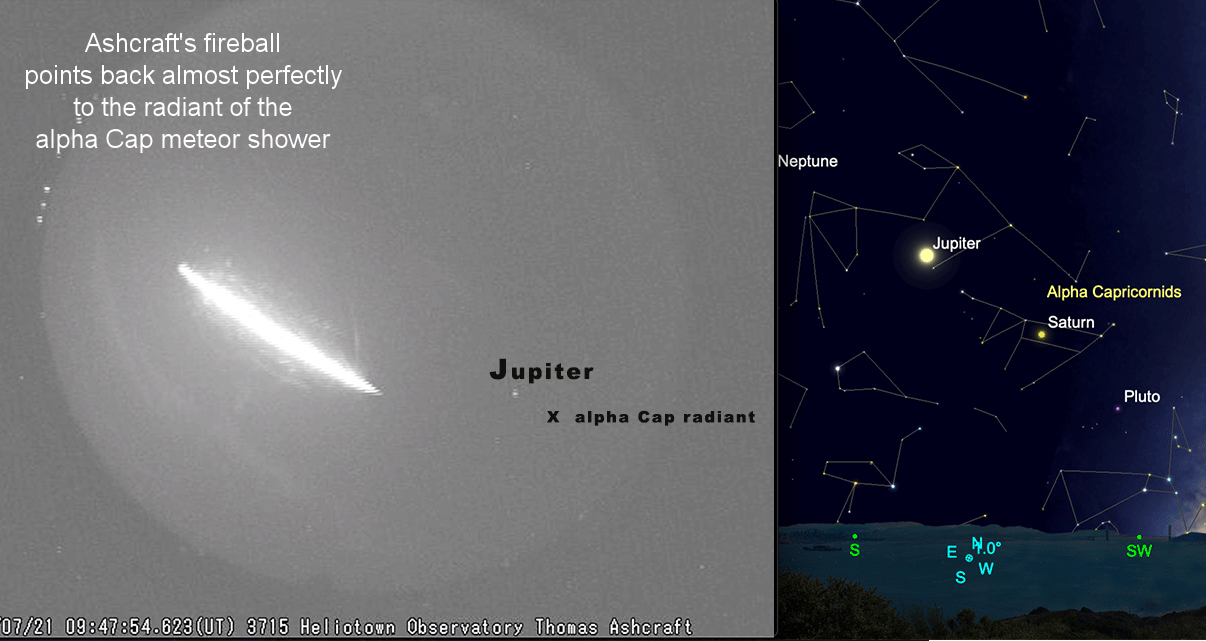
July 24, 2021: Today, meteor storms are rare, but a few hundred years from now they could be commonplace. Consider this fireball, recorded by Thomas Ashcraft on July 21st, a preview of things to come:
“This is a probable alpha Capricornid,” says Ashcraft, who operates an automated meteor camera in rural New Mexico. “It was magnitude -11, about as bright as a waxing gibbous Moon.” Next: Turn up the volume. The soundtrack is a 54.309 MHz digital TV signal reflected from the fireball’s ionized trail.
Alpha Capricornid meteors are debris from Comet 169P/NEAT. They appear every year in late July, peaking around the July-August boundary with 5 to 9 meteors per hour. Many “alpha Caps” are slow, bright fireballs.
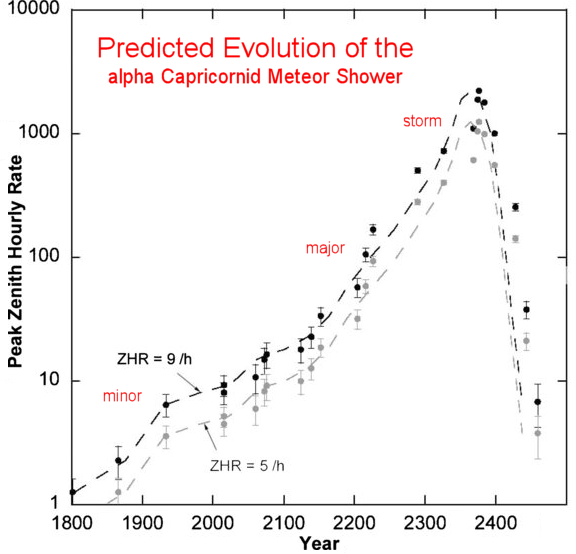
This is a minor shower today, but in the not-too-distant future, it could turn into a regular meteor storm. Researchers Peter Jenniskens (SETI Institute) and Jeremie Vaubaillon (Paris Observatory) have studied the alpha Capricornid debris stream. They believe it resulted from a major fragmentation event ~5000 years ago when as much as half of the original comet disintegrated. Since then, the debris has been drifting toward Earth.
“In the next 300 years, the alpha Capricornids are likely to grow into a major annual shower,” they write in an article in the Astronomical Journal. “Rates will increase dramatically in the 23rd and 24th centuries to a peak of ZHR = 2200/hr on an annual basis, half the visible shower peak rate during the 1999 Leonid storm.”
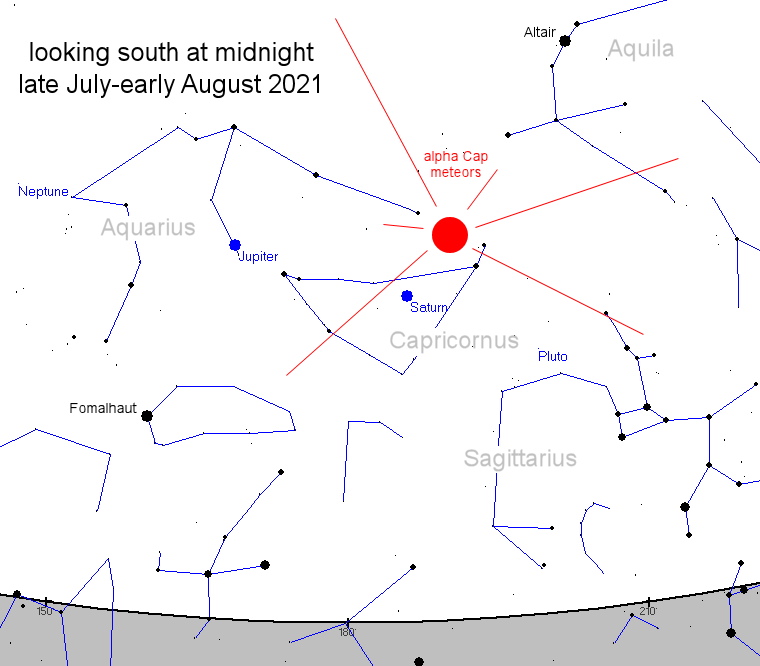
If they’re right, every alpha Capricornid we see today heralds a storm to come. Watch for them in the nights ahead slowly spilling out of the constellation Capricornus. The best time to look is during the hours around midnight when the shower’s radiant may be found in the southern sky beautifully bracketed by Jupiter and Saturn: sky map.
Bonus: Another meteor shower, the southern Delta Aquarids (SDAs), also peaks in late July, sending streaks of light from the same general part of the sky. SDAs zip along ~twice as fast as alpha Caps and tend to be fainter. Nevertheless, they will add to your midnight meteor count. Enjoy!
July 21, 2021: Noctilucent cloud (NLC) season is now 8 weeks old. This animation from NASA’s AIM spacecraft shows everything that has happened since the first clouds appeared in late May:
The last frame says it all: Noctilucent clouds are still bright and abundant. In fact, at the highest latitudes they are setting records.
“We’re seeing more clouds at 80°N than in any other year since AIM was launched,” says Cora Randall of the University of Colorado’s Laboratory for Atmospheric and Space Research. “Cloud frequencies at 80°N are around 85%, whereas it’s more typical to see frequencies of about 75%.” (‘Frequencies’ are a measure of patchiness. 100% is complete coverage; 0% is no clouds at all.)
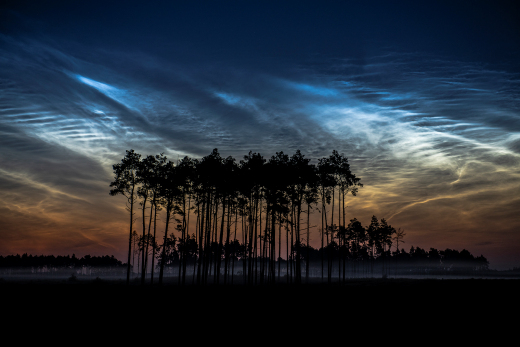
“This morning, I watched a fantastic display, the best of the year so far ,” reports Marek Nikodem, who photographed the clouds from Szubin, Poland (53°N) on July 21st:
“It’s not the end of the season yet,” he says. Indeed, it’s not.
NLCs are Earth’s highest clouds. They form when summertime wisps of water vapor rise up to the edge of space, about 83 km high, and crystalize around disintegrated meteoroids. When you see one, you’re literally seeing a cloud of frosted meteor smoke.
Earlier this summer, NLCs were seen in Europe as far south as the mediterranean coast of Spain (+37N). Given the current surge, another low-latitude excursion cannot be ruled out before the season ends in August. Watch for them!
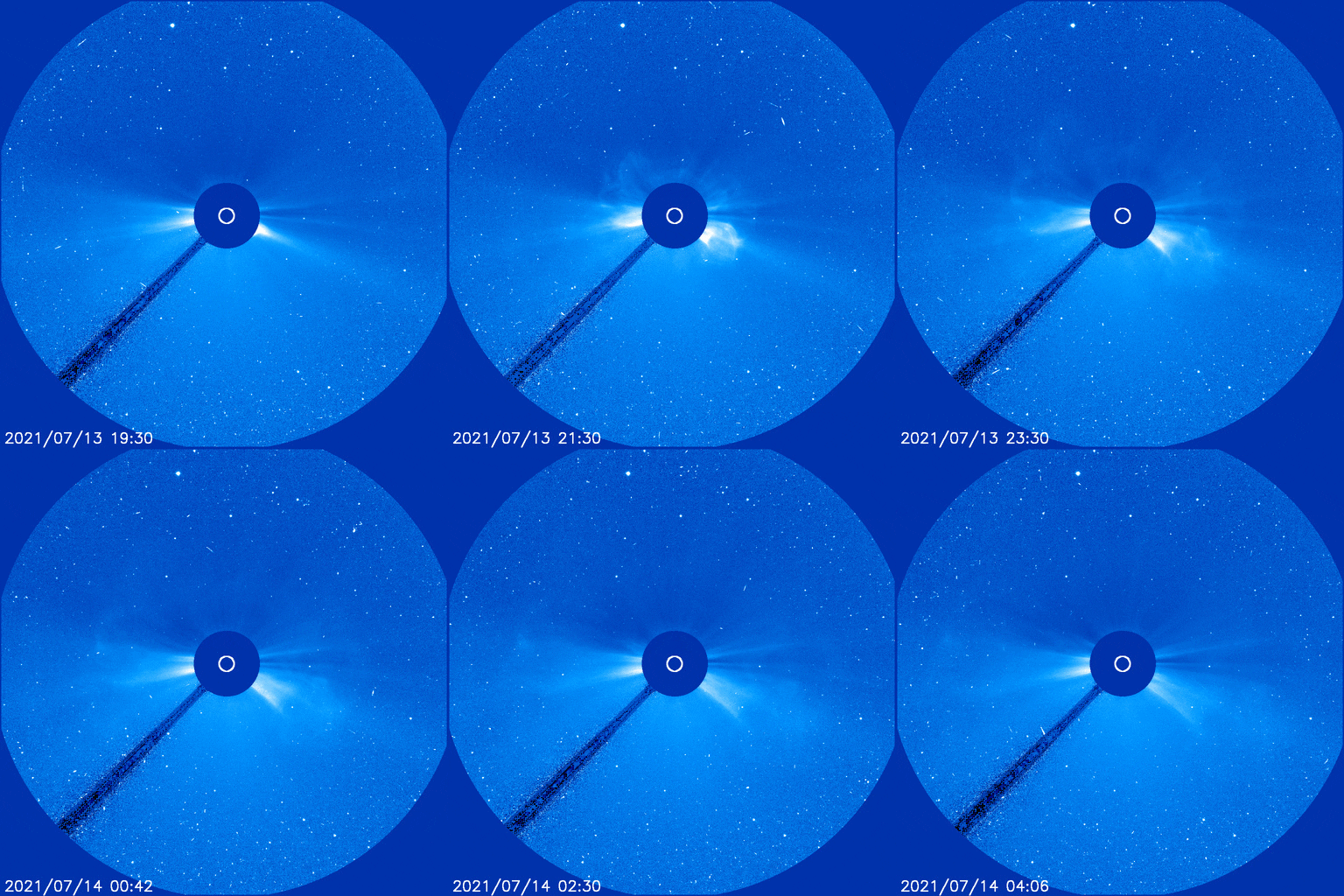
July 15, 2021: Imagine an explosion on the farside of the sun so powerful, we could feel it here on Earth. It happened on July 13th. The debris emerged in a circular cloud known as a ‘halo CME‘:
Above: The July 13th CME imaged by SOHO coronagraphs
When space weather forecasters first saw this explosion, there was a moment of excitement. It appeared to be heading directly toward Earth. However, data from NASA’s STEREO-A spacecraft indicated otherwise. The CME was heading directly away from us–a farside event.
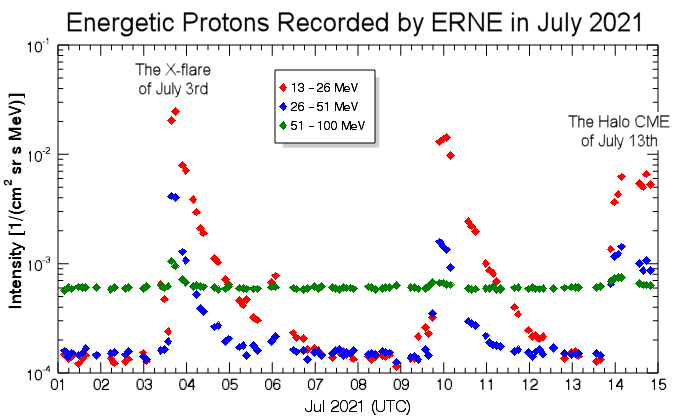
Now for the interesting part: Although the explosion occured on the farside, separated from Earth by the massive body of the sun, it still peppered our planet with high-energy particles. The Energetic and Relativistic Nuclei and Electron (ERNE) detector onboard SOHO recorded a surge in radiation not long after the CME appeared:
How did this radiation reach Earth? Rami Vainio, a professor of space physics at the University of Turku (Finland), who works with ERNE data says “it’s not possible to answer that question definitely without a detailed analysis involving multiple spacecraft.” However, he speculates that the lift-off of the CME may have created a global shock wave on the farside of the sun. Particles spilling over the edge might have spiraled toward our planet.
Of particular interest are the green data points (51 to 100 MeV). These are the most energetic protons ERNE can detect. An uptick in green after the CME indicates unusually “hard” radiation—the kind accelerated in the leading edge of a fast-moving CME.
The source of the blast might have been the same sunspot (AR2838) that produced the first X-flare of Solar Cycle 25 on July 3rd. That sunspot is currently transiting the farside of the sun approximately where the CME came from. Within the next week AR2838 is expected to return–and then, maybe, the real fun begins. Stay tuned!
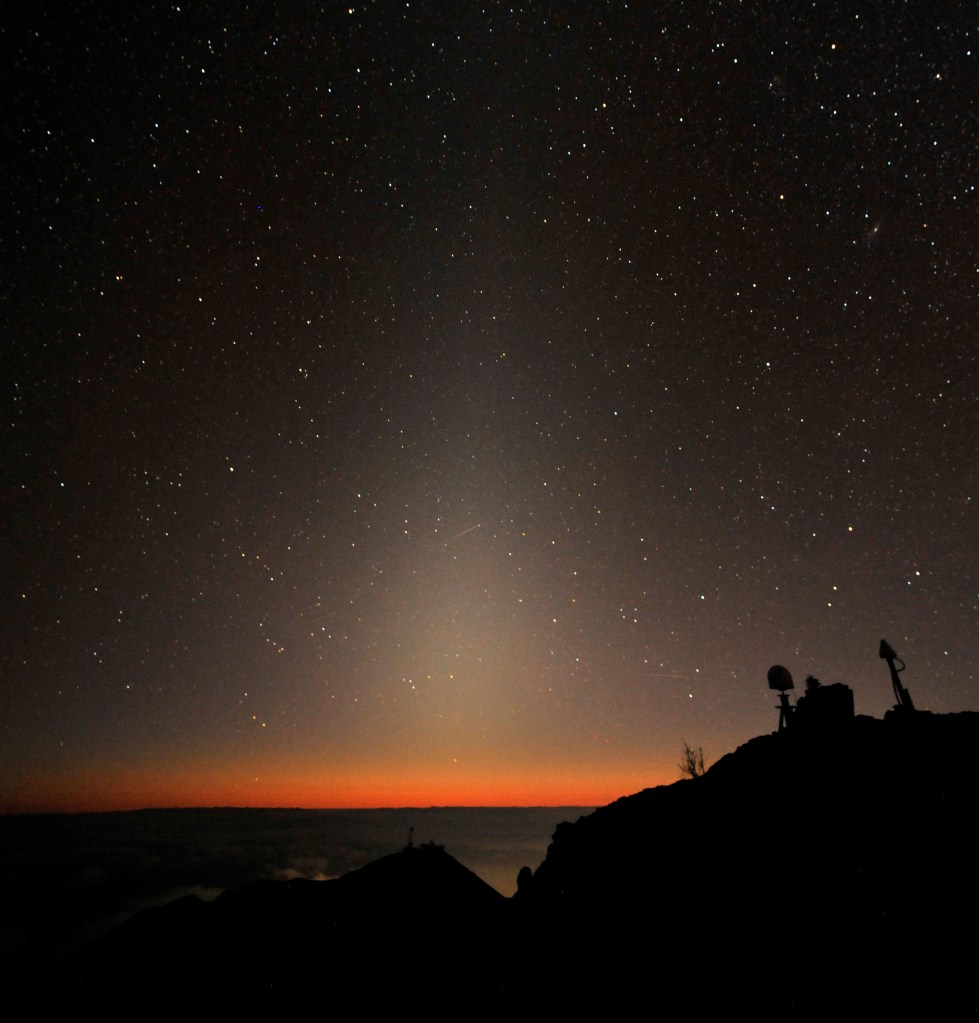
July 6, 2021: Dust storms on Mars are bigger than we thought; they even spill into space. According to a recent paper in JGR Planets, Mars appears to be leaking dust, filling a huge volume of the inner solar system with gritty debris. You can see it with your naked eye. The bright triangle in this image from the Haleakalā Observatory in Hawaii is marsdust:
“A friend described it as blazing,” says Rob Ratkowski, who took the picture on Feb. 10th. “It was bright and very obvious.”
It’s called Zodiacal Light, and astronomers have long wondered what causes it. The usually faint triangle is sunlight scattered by dust in the plane of our solar system. The dust, it turns out, comes from Mars.
NASA’s Juno spacecraft flew through the dust cloud en route to Jupiter between 2011 and 2016. Dust grains smashed into Juno at about 10,000 mph, chipping off submillimeter pieces of spacecraft. Juno’s oversized solar arrays turned out to be excellent dust detectors, registering as many as 200 hits per day.
Ironically, the sandblasting allowed researchers to map the cloud for the first time. One theory of Zodiacal Light held that asteroids were responsible. Yet, as Juno flew through the asteroid belt toward Jupiter, impact rates sharply dropped, sometimes to zero. Asteroids were not the answer. Instead, they realized, the dust must be coming from Mars. Orbital elements of the dust grains essentially match that of the Red Planet.
Mars is the dustiest place in the Solar System, with dust storms that envelop the entire planet for months. But how does this dust escape? During storms, dust is sometimes launched to very high altitudes in the Martian atmosphere; researchers call it ‘rocket dust‘. However, leaving Mars requires overcoming escape velocity (~5 km/s), and even rocket dust has trouble doing that. Dust grains would have an easier time launching from Phobos and Deimos; however, those small moons don’t produce enough dust to explain the Zodiacal Light.
So, there’s still a mystery here. Mars has the dust, but researchers haven’t yet figured out how Mars delivers it. Lead author John Leif Jørgensen (Technical University of Denmark) and colleagues hope other scientists will help them solve this final piece of the puzzle.
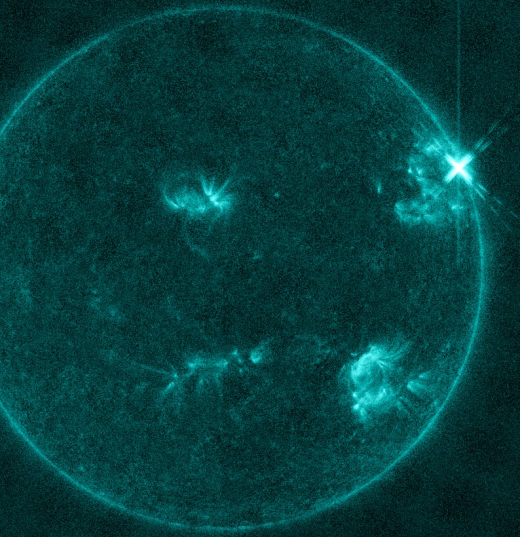
July 3, 2021: Now, Solar Cycle 25 has really begun. On July 3rd, new sunspot AR2838 produced the first X-class solar flare since Sept. 2017. NASA’s Solar Dynamics Observatory recorded the extreme ultraviolet flash:
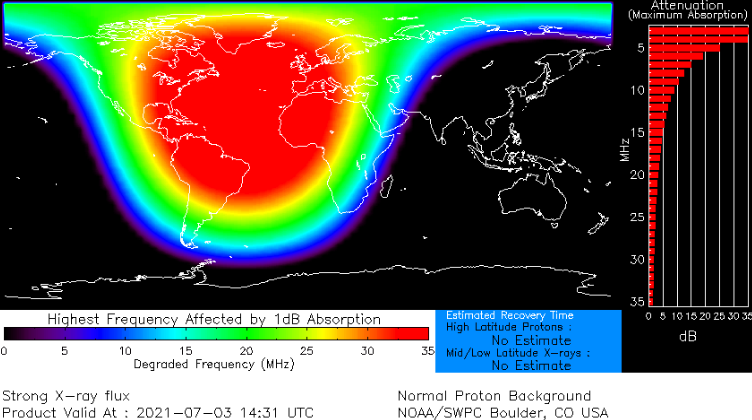
A pulse of X-rays ionized the top of Earth’s atmosphere, causing a shortwave radio blackout over the Atlantic Ocean: blackout map. Mariners, aviators, and amateur radio operators may have noticed unusual propagation effects below 30 MHz just after 1429 UT.
X-flares are the strongest kind of solar flare. They are typically responsible for the deepest radio blackouts and the most intense geomagnetic storms. This is the first X-flare of young Solar Cycle 25. More are in the offing. During the previous solar cycle (Solar Cycle 24) the sun produced 49 of them. Forecasters believe that Solar Cycle 25 should be at least that active. We can therefore expect dozens more X-flares as the sun approaches Solar Maximum in the year ~2025. Solar flare alerts:SMS Text.
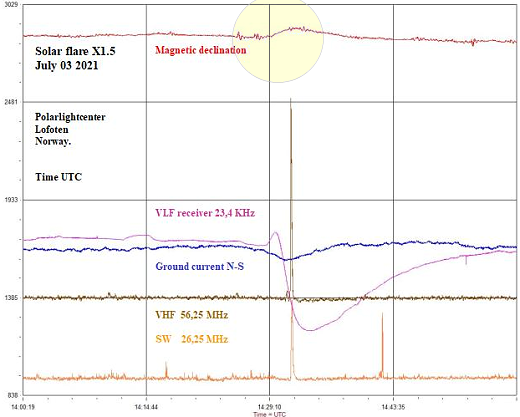
SOLAR FLARE CAUSES RARE ‘MAGNETIC CROCHET’: The X-flare of July 3rd did something rare. “It disturbed all of my instruments,” reports Rob Stammes, who operates a space weather observatory in Lofoten, Norway. The flare produced a radio burst, an ionospheric disturbance, a surge of electrical currents in the ground, and a deflection of the observatory’s local magnetic field. All of these are shown in the strip chart recording, below.
“This is a first in many years,” says Stammes. “The magnetic disturbance (circled in yellow) is especially rare.”
The phenomenon is called a ‘magnetic crochet.’ Radiation from the flare ionized the top of Earth’s atmosphere and caused currents to flow 60 km to 100 km above Earth’s surface. These currents, in turn, altered Earth’s polar magnetic field. Unlike geomagnetic disturbances that arrive with CMEs days after a flare, a magnetic crochet occurs while the flare is in progress. They tend to occur during fast impulsive flares like this one.
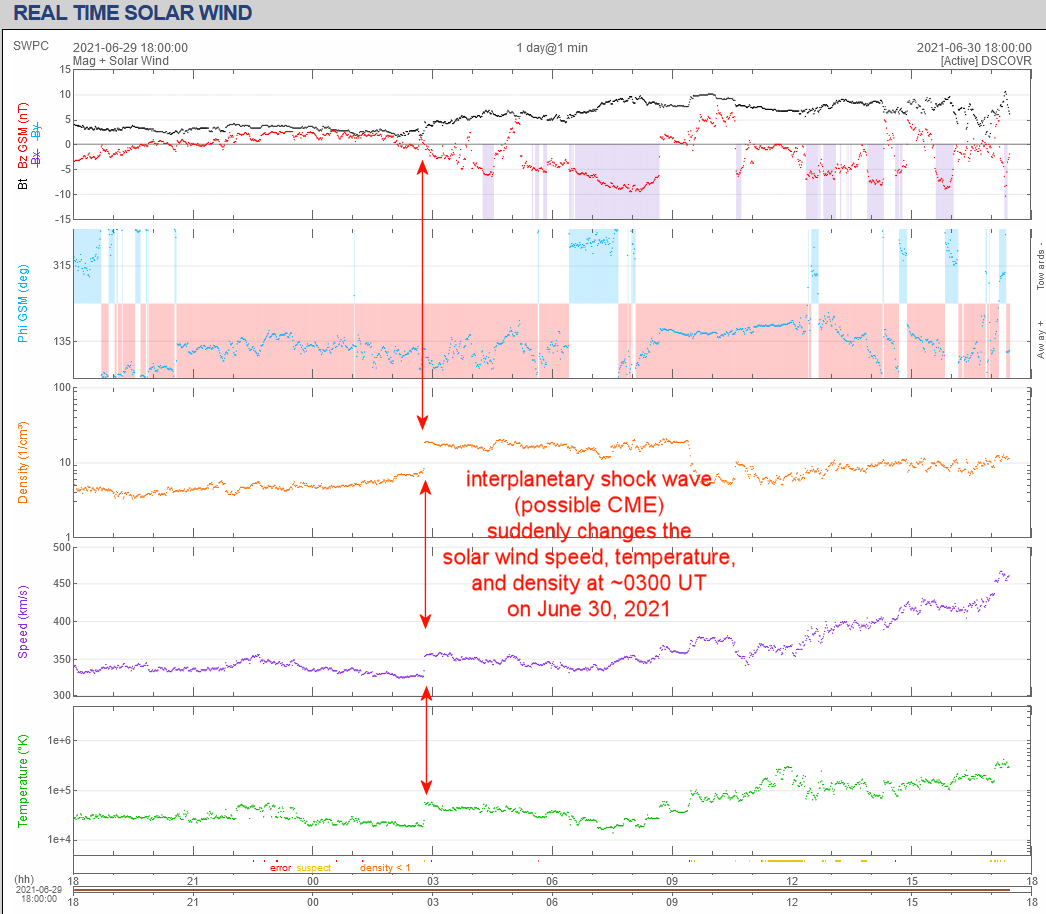
June 30, 2021: This was not in the forecast. A low-amplitude interplanetary shock wave (data) hit Earth’s magnetic field during the early hours of June 30th, sparking mid-summer auroras over Canada:
Catalin Tapardel photographed the display from the Municipal District of Opportunity (#17) in Alberta. “I caught the auroras hovering just above an expanse of noctilucent clouds,” says Tapardel.
We don’t know where this shock wave came from. It might be the early arrival of the June 27th CME, originally expected July 1st, or perhaps a different stealthy CME that “flew under the radar” when it left the sun. If it’s the latter, another jolt could occur in the next 24 hours.
Update: Philip Granrud also saw the auroras from Kalispell, Montana. “…and a patch of noctilucent clouds, too!” he says. “It was a beautiful night in Montana.”
June 23, 2021: Astronomers have just discovered a comet so big, it might actually be a minor planet. The object is named 2014 UN271. Astronomers Pedro Bernardinelli and Gary Bernstein found it in archival images from the Dark Energy Survey. It appears to be about 100 km wide, 2 or 3 times bigger than record-breaking Comet Hale-Bopp of the 1990s.
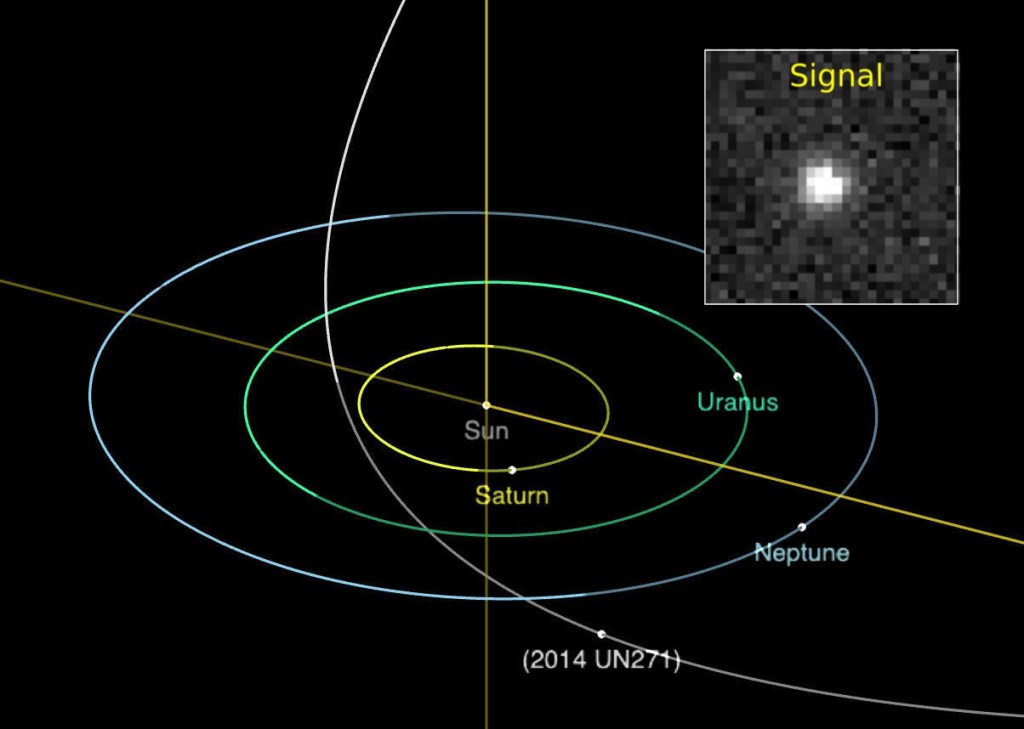
Above: A discovery image and orbit of huge Comet Bernardinelli-Bernstein
Now for the bad news. Although 2014 UN271 is falling toward the sun, we may never see it with our naked eyes. At closest approach in early 2031, the behemoth comet will be just outside the orbit of Saturn, too far for naked-eye viewing. Some astronomers are estimating a maximum brightness near magnitude +17, about the same as Pluto’s moon Charon.
It’s still an amazing discovery. 2014 UN271 has an extremely elongated orbit stretching from ~the neighborhood of Saturn out to a staggering distance of almost a light year. At the far reaches of its orbit, 2014 UN271 barely feels the sun’s gravity and could be snatched out of the Solar System altogether by the ephemeral pull of galactic tides. Discovering such a traveler during its brief time among the planets is very lucky indeed.
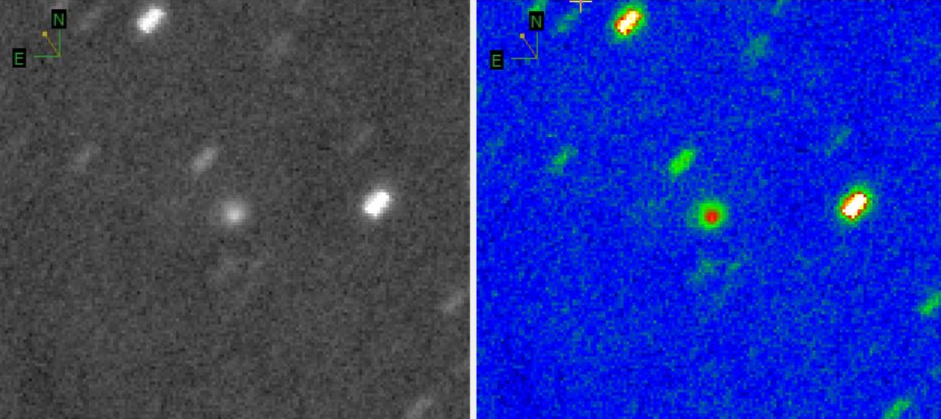
Above: Images of 2014 UN271 taken June 22, 2021. Credit: L. Demetz, L. Buzzi, A. Aletti
There is talk of a space mission to intercept 2014 UN271. The European Space Agency is building a probe called Comet Interceptor designed to investigate comets coming from deep space. It, or something like it, might be able to visit 2014 UN271 a decade from now.
With an object like this, we have to expect surprises. 2014 UN271 certainly poses no threat to Earth, but it could brighten more (or less) than expected. Multiple groups of astronomers have already detected signs of out-gassing even though 2014 UN271 is still beyond Uranus. Early signs of activity may bode well for future visibility through small telescopes if not the unaided eye.
Update: This object has been officially designated a comet and named Comet Bernardinelli-Bernstein (C/2014 UN271).



 Spaceweather.com