Partial Solar Eclipse

Jan. 5, 2019: When the sun rises over Beijing on Jan 6th, something will be missing. As in … 31.5% of the sun. On that morning, the New Moon is going to pass in front of the sun, off center, turning the usual disk into a crescent. This movie created by graphic artist Larry Koehn shows the eclipse zone, which includes significant population centers in China, Korea and Japan:

This is not a total eclipse. At maximum, the Moon will cover 71% of the sun–a deep crescent that may be seen by the residents of Srednekolymsk, a small town in northern Russia. Elsewhere, such as Tokyo, Seoul, and Beijing, less than half of the sun will vanish behind the black lunar disk. The zone of visibility stretches from coastal China to the Aleutian islands of Alaska.

Sunrise observers of the eclipse could witness scenes like this:

James Kevin Ty took this picture from the Philippines during a similar eclipse in Jan. 2010. “The low-hanging sun was dim and I didn’t need any special filter to photograph it using my Canon 350D,” says Ty. “In the foreground, a young couple sat together in a boat enjoying the romantic view.”

Many people watching the eclipse at sunrise or sunset may be tempted to stare at the relatively dim sun. BE CAREFUL. Even the tiniest sliver of sun left uncovered by the Moon can hurt your eyes. Eclipse glasses are recommended for safety.

Observing tip: Try looking down. Beneath a leafy tree, you might be surprised to find hundreds of crescent-shaped sunbeams dappling the grass. Overlapping leaves create natural pinhole cameras, each one casting an image of the crescent-sun onto the ground beneath the canopy. Note the crescent-eyed turkey shown above. Partial eclipse shadow play is safe–and lots of fun.

During the eclipse, photographers in Asia will be posting photos to Spaceweather.com. Monitor our realtime photo gallery for the latest:

Realtime Solar Eclipse Photo Gallery

China Lands on the Farside of the Moon

Jan. 3, 2019: Going where no nation has gone before, today China successfully landed a rover on the farside of the Moon. The Chang’e 4 lunar probe touched down in the South Pole-Aitken Basin, the largest, deepest and oldest known crater in the solar system, at 10:26 am Beijing time on Jan. 3rd.

From Earth, we can see only one side of the Moon. The other side, the farside, is perpetually hidden from view. Apollo astronauts have flown over the farside of the Moon, and many satellites have photographed the Moon from behind–revealing it to be a rugged, heavily cratered landscape startlingly different from the side we typically see.

China’s rover will be the first to explore a farside crater, probing it with ground-penetrating radar and measuring its mineral composition with an infrared spectrometer. If water is present, the rover might find it.

The first pictures of the landing site have been relayed to Earth by the Queqiao satellite, which China launched in May 21, 2018, specifically for this purpose. This is what the South Pole-Aitken Basin looks like from the inside:

The landing was remarkable. Mission control had no line-of-sight contact with the lunar farside, so the lander had to perform many complex maneuvers autonomously. (1) As it descended to an altitude of about 2 km, onboard cameras captured the shadows of objects on the lunar surface, identifying large obstacles such as rocks and craters so the probe could avoid them. (2) At 100 meters up, the probe hovered to identify smaller obstacles and measured the slopes on the surface. Its computer calculated again and selected the safest site. (3) At 2 meters above the surface, the engine stopped. Then the golden lander with a silver rover on top touched down on the desolate gray surface with four legs, throwing up some dust. The probe performed the entire landing process, lasting about 12 minutes with no intervention from ground control.

Realtime Space Weather Photo Gallery

GIFTS FROM THE EDGE OF SPACE: The students of Earth to Sky Calculus are about to kick off a new year of cosmic ray balloon launches, continuing a 5-year campaign to monitor increasing levels of radiation in Earth’s atmosphere. You can help. Buy any gift item from the Earth to Sky Store and we’ll give you 10% off to celebrate the New Year.

All items in the Earth to Sky Store have flown to the edge of space onboard cosmic ray balloons. Each one comes with a greeting card showing the item in flight and telling the story of its journey. All sales support the Earth to Sky Calculus cosmic ray ballooning program and hands-on STEM research.

Far Out Gifts: Earth to Sky Store
All sales support hands-on STEM education

First Images of Ultima Thule

Jan. 2, 2019: The first high-resolution images of Ultima Thule have reached Earth following New Horizons’ historic flyby on New Year’s Day. Hot off the presses, the photos reveal a pair of roughly spherical planetestimals stuck together in the middle. The contact binary strangely resembles BB-8:

“This flyby is a historic achievement,” says New Horizons Principal Investigator Alan Stern of the Southwest Research Institute in Boulder, Colorado. “Never before has any spacecraft team tracked down such a small body so far away in the abyss of space. We’re getting our first close-up look at ancient planetesimals.”

Planetestimals are the building blocks of planets. Here in the inner solar system, no pristine examples remain for us to study. They have been swallowed by planets, hammered by asteroids, and scorched by solar radiation. Ultima Thule, however, has been preserved in the deep freeze of the outer solar system for more than 4 billion years. It is truly a relic of the genesis of planets.

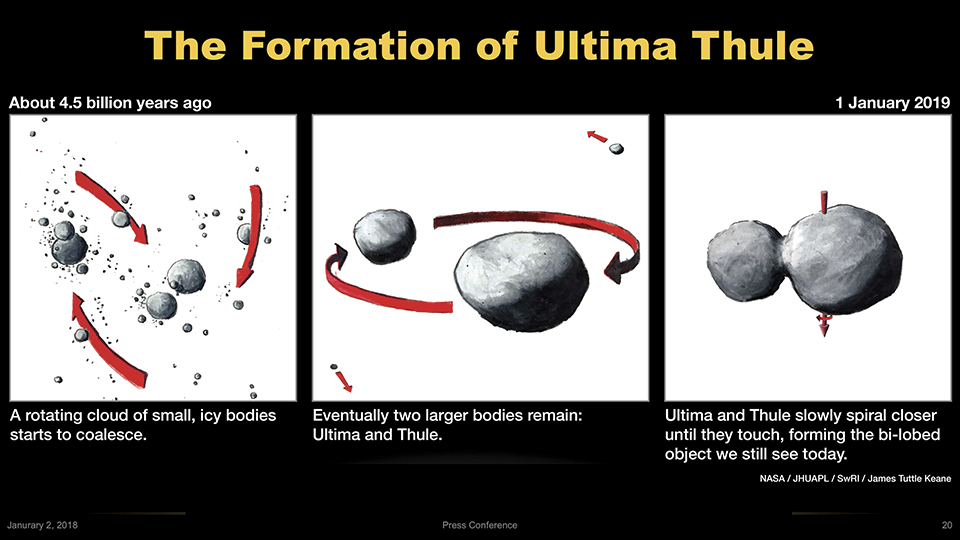
Mission scientists believe that Ultima Thule formed by accretion. A swarm of smaller planetesimals gathered under the pull of their own meagre gravity to form two spherical bodies, medium-sized planetesimals which themselves slowly bumped together and stuck. The result was Ultima Thule.

This is just the beginning of Ultima Thule’s revelations. First images released today have a resolution of about 140 meters per pixel. Images arriving in the days and weeks ahead will be as much as 5 times sharper, possibly revealing craters, hills, landslides, rilles and other unknowns.

New Horizons also scanned the area for tiny moons–the debris of the original swarm that gave birth to this strange object. Detections, if any, will be revealed in future transmissions from the spacecraft.

Browse: Slides from the science briefing and latest images from New Horizons

Rare Video of Clouds in the Stratosphere

Dec. 27, 2018: The habits of a weatherman are hard to break–even on holiday. So it was that Dutch meteorologist Jacob Kuiper found himself outside on Christmas morning, looking up. What he saw amazed him. “The sky was filling with strange clouds,” says Kuiper. “At first I thought they were some form of cirrus, but these clouds were uncommonly wavy with unusual curls. When I saw the telltale flashes of color, I realized they must be polar stratospheric clouds (PSCs).”

Kuiper made a time-lapse video of the display. Note the hypnotic waves and how, at the 25 second mark, ordinary clouds may be seen scudding far below them:

https://player.vimeo.com/video/308454218

Polar stratospheric clouds are not your ordinary Christmas clouds. Indeed, they have little to do with regular weather, floating so high above Earth that even airplanes cannot reach them.

Normally, the stratosphere is free of clouds–completely transparent. It’s very dry up there with a wide separation between molecules of water. When the temperature drops to around -85ºC, however, those sparse molecules begin to reluctantly gather, forming crystals of ice that become PSCs.

“I have been working in the National Meteorological Office in the central part of The Netherlands (KNMI) for 40 years,” says Kuiper. “Only twice have I seen a display of stratospheric clouds this widespread. It was thrilling. I didn’t expect the stratosphere over our country to be cold enough, but one of the stratosphere scientists in our Met. Office confirmed my idea. He also was quite surprised.”


Above: PSCs inside the Arctic Circle in 2017. Photo credit: Mia Stålnacke of Kiruna, Sweden

Tiny ice crystals in PSCs can produce episodes of iridescence so brilliant that they are sometimes mistaken for auroras. The display Kuiper recorded contained only a few brief flashes of those colors–just enough for an identification.

PSCs come in two varieties: Type I contains hydrated droplets of nitric acid and sulphuric acid. These are chemicals that can destroy ozone. Indeed, an ozone hole formed over the UK in Feb. 2016 following an outbreak of Type 1 PSCs. Type II PSCs are icy and colorful, and they do little damage to the ozone layer. The clouds Kuiper witnessed may be a mixture of both.

The display was so rare that researchers in the Met Office conducted an extra round of Christmas radio soundings to probe the stratosphere. They are still processing the data, so stay tuned!

Realtime Space Weather Photo Gallery

A GIFT FROM THE EDGE OF SPACE: The students of Earth to Sky Calculus are about to kick off a new year of cosmic ray balloon launches, continuing a 5-year campaign to monitor increasing levels of radiation in Earth’s atmosphere. You can help. Buy any gift item from the Earth to Sky Store and we’ll give you 10% off to celebrate the New Year.

All items in the Earth to Sky Store have flown to the edge of space onboard cosmic ray balloons. Each one comes with a greeting card showing the item in flight and telling the story of its journey. All sales support the Earth to Sky Calculus cosmic ray ballooning program and hands-on STEM research.

Far Out Gifts: Earth to Sky Store
All sales support hands-on STEM education

Ultima Thule’s First Puzzle

Dec. 23, 2018: NASA’s New Horizons spacecraft is 12 million km from Ultima Thule and closing fast. On New Year’s Day, it will fly by the mysterious Kuiper Belt Object three times closer than it buzzed Pluto in 2015 revealing … no one knows what. In fact, the mysteries have already begun.

Long range images of Ultima Thule reveal that it has no light curve. In other words, its brightness is constant.


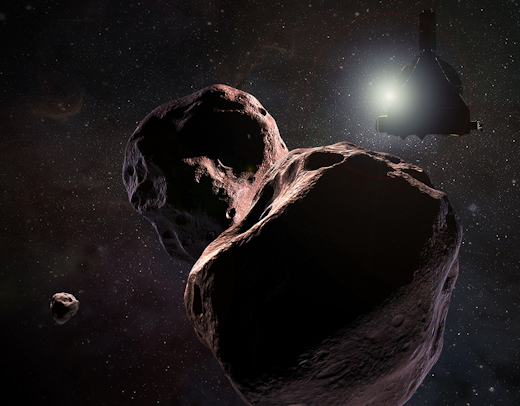
Above: An artist’s concept of Ultima Thule, a double-lobed object in the Kuiper Belt

“It’s really a puzzle,” says New Horizons Principal Investigator Alan Stern of the Southwest Research Institute. And here’s why:

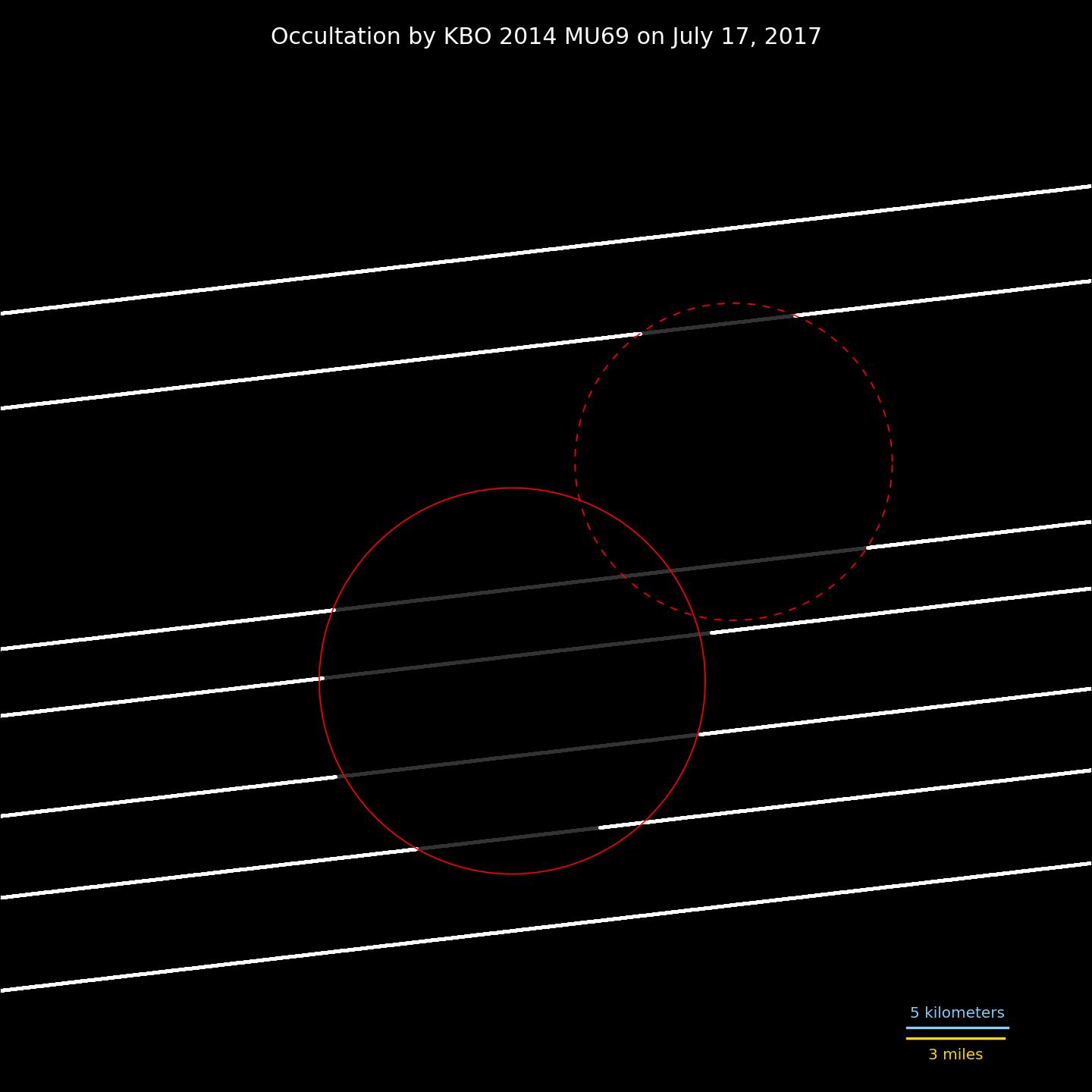
Last year, astronomers watched a distant star pass behind Ultima Thule. Starlight winked in and out in a pattern suggesting an elongated object with two bulbous lobes. Ultima Thule could be a binary system. You would expect the reflected brightness of such an object to vary as it rotates in the sunlight. Yet Ultima Thule does not behave that way.

What’s going on? New Horizons science team members have different ideas. “It’s possible that Ultima’s rotation pole is aimed almost right at the spacecraft,” speculates Marc Buie of the Southwest Research Institute. Such an alignment, however, is unlikely.

“Another explanation,” says the SETI Institute’s Mark Showalter, “is that Ultima may be surrounded by a cloud of dust that obscures its light curve–much the same way that a comet’s coma often overwhelms the light reflected by its central nucleus.”

“A more bizarre scenario is one in which Ultima is surrounded by many tiny tumbling moons,” suggests University of Virginia’s Anne Verbiscer, a New Horizons assistant project scientist. “If each moon has its own light curve, then together they could create a jumbled superposition of light curves that make it look to New Horizons like Ultima has a small light curve.”

“It’s hard to say which of these ideas is right,” Stern says. “We’ll get to the bottom of this puzzle soon – New Horizons will swoop over Ultima and take high-resolution images on Dec. 31 and Jan. 1, and the first of those images will be available on Earth just a day later. When we see those high–resolution images, we’ll know the answer to Ultima’s vexing first puzzle. Stay tuned!”

GIFTS FROM THE EDGE OF SPACE: The students of Earth to Sky Calculus are about to kick off a new year of cosmic ray balloon launches, continuing a 5-year campaign to monitor increasing levels of radiation in Earth’s atmosphere. You can help. Buy any gift item from the Earth to Sky Store and we’ll give you 10% off to celebrate the New Year.

All items in the Earth to Sky Store have flown to the edge of space onboard cosmic ray balloons. Each one comes with a greeting card showing the item in flight and telling the story of its journey. All sales support the Earth to Sky Calculus cosmic ray ballooning program and hands-on STEM research.

Far Out Gifts: Earth to Sky Store
All sales support hands-on STEM education

The Mystery of Ultima Thule

Dec. 31, 2018: When NASA’s New Horizons spacecraft flew past Pluto three years ago, mission scientists watching the first close-up images were shocked. Despite being stuck in the deep freeze of the Solar System 6 billion km from the sun, Pluto was not the frozen-stiff world many expected it to be. The geography of the dethroned 9th planet was alive with mountain ranges, windswept dunes, bladed terrain and much more. In one quick flyby, New Horizons turned planetary science on its head.

Get ready to be shocked again. New Horizons is just hours away from a new world even more mysterious than Pluto.


Above: A speculative artist’s concept of Ultima Thule with a small moon

Its name is “Ultima Thule” (2014 MU69), which means means “beyond the borders of the known world.” Indeed, the little space rock is profoundly unknown. Located almost a billion kilometers farther from the sun than Pluto, Ultima Thule has never been much more than a faint speck of light in telescopes. It inhabits the distant Kuiper Belt where, seemingly, almost anything is possible.

“Really, we have no idea what to expect,” says New Horizons principal investigator Alan Stern, of the Southwest Research Institute. “Will it have an atmosphere? Will it have rings? Will it have moons? Any of that could be possible, and soon we’ll know the answers.”

On New Year’s Eve and New Year’s Day, New Horizons will swoop three times closer to Ultima Thule than it flew past Pluto in July 2015, shattering previous records for the most distant body explored by a human spacecraft. First images will be posted on a web site set up by the New Horizons’ team: SeeUltimaThuleNow.com

We already know one thing about Ultima Thule. Its shape is elongated and strange. In 2017, astronomers watched a distant star pass behind Ultima Thule. Starlight winked in and out in a pattern suggesting two lobes with diameters of 20 and 18 km, respectively. Ultima Thule could be a small binary system.

“Ultima Thule is 100 times smaller than Pluto, but its scientific value is incalculable,” says Stern. “From everything we know, it was formed 4.5 or 4.6 billion years ago, 4 billion miles from the sun. It has been stored at that enormous distance from the sun, at a temperature of nearly absolute zero, ever since, so it likely represents the best sample of the ancient solar nebula ever studied.”

“Nothing like it has ever been explored,” he says.

China’s Mission to the Farside of the Moon

Dec. 8, 2018: China is going where no one has gone before–the farside of the Moon. At 2:23 am on Dec. 8th (local time in Sichuan province), a Long March 3B rocket blasted off from the Xichang Satellite Launch Centre, propelling a lander and rover toward the lunar farside. Zhou Kun photographed the launch:

“I took the picture only 500 meters away from the rocket,” says Kun. “The sound of the launch was tremendous and shocking. Three sets of 20-second exposures were used to render the rocket’s trajectory.”

From Earth, we can see only one side of the Moon. The other side, the lunar farside, is perpetually hidden from view. Apollo astronauts have flown over the farside of the Moon, and many satellites have photographed the Moon from behind–revealing it to be a rugged, heavily cratered landscape startlingly different from the side we typically see. But no one has ever landed there.

China’s Chang’e 4 mission aims to be the first. Reportedly, the lander will touch down inside a 186-kilometer-wide crater called Von Kármán. The crater is part of the South Pole–Aitken basin, the largest known impact structure in the Solar System. The Chang’e-4 rover will explore the landing site, probing it with ground-penetrating radar and measuring the mineral composition with an infrared spectrometer. If water is present, the rover might find it.


Above: An artist’s rendering of China’s Chang’e-4 lunar rover

And that’s just the beginning. The lander will also conduct experiments in lunar gardening. A small climate-controlled greenhouse in the lander will test whether potato and thale-cress (Arabidopsis) seeds can sprout and photosynthesize in low gravity without the twin protections of a thick atmosphere and magnetic field.

Communicating with the farside of the Moon is tricky. There’s no direct line of sight. To overcome this problem, on May 21, 2018, China launched a satellite named Queqiao (Chinese for “Magpie Bridge”) to relay signals between the lunar farside and Earth. Queqiao will be able to talk to ground stations in China, Argentina and Namibia, sending back radio signals and TV images. However, Chang’e 4 will have to perform the critical landing completely autonomously–a daring plan.

Landing is expected to occur early in the New Year, if successful catapulting the China National Space Administration to the forefront of lunar exploration. Stay tuned for updates and, meanwhile, congratulations to China for daring mighty things.

Realtime Space Weather Photo Gallery

CHRISTMAS GIFTS FROM THE EDGE OF SPACE: So far in 2018, the students of Earth to Sky Calculus have launched 42 space weather balloons to the stratosphere, measuring cosmic rays over 3 continents, 2 hemispheres, and 7 different US states. You can help them pay their helium bill by purchasing a Christmas gift from the edge of space:

Every item in the Earth to Sky Store has flown to the stratosphere alongside an array of cosmic ray sensors. Carried aloft by giant balloons, these unique gifts travel above 99.7% of Earth’s atmosphere, experiencing space-like blasts of cosmic rays, extreme cold, and a wild ride parachuting back to Earth after the balloon explodes. Even Amazon doesn’t carry items this far out!

Don’t forget to enter coupon code “SPACESANTA” at checkout for a 10% holiday discount.

Far Out Gifts: Earth to Sky Store

Voyager 2 Reaches Interstellar Space

Dec. 10, 2018: Voyager 2 has exited the sun’s magnetic bubble and entered interstellar space. Mission scientists announced the breakthrough yesterday at the American Geophysical Union meeting in Washington DC. Its twin, Voyager 1, crossed the same boundary in 2012, but Voyager 2’s crossing is arguably more significant because it carries a working instrument that can sense interstellar plasmas, providing the first in situ sampling of matter between the stars.

The most compelling evidence of Voyager 2’s exit from the heliosphere came from its onboard Plasma Science Experiment (PLS), an instrument that stopped working on Voyager 1 in 1980. Until recently, Voyager 2 was surrounded mainly by the solar wind–a type of plasma flowing outward from the sun. On Nov. 5th, Voyager 2’s plasma instrument observed a sharp decline in the solar wind, and since that date, it has observed no solar wind flow–a clear sign that the probe has left the heliosphere.

Replacing the solar wind is a blizzard of galactic cosmic rays. The sun’s magnetic field substantially protects the solar system from cosmic rays, fending off the high energy debris of supernova explosions in the Milky Way and elsewhere. Now that Voyager 2 has exited that protective shell, it is baldly exposed to cosmic rays, and its cosmic ray subsystem is registering a surge.

Launched in 1977, Voyager 2 now is slightly more than 11 billion miles (18 billion kilometers) from Earth. Mission operators still can communicate with Voyager 2 as it enters this new phase of its journey, but information – moving at the speed of light – takes about 16.5 hours to travel from the spacecraft to Earth.

The Voyager probes are powered using heat from the decay of radioactive material, contained in a radioisotope thermal generator (RTG). The power output of the RTGs diminishes by about four watts per year, which means that various parts of the Voyagers, including the cameras on both spacecraft, have been turned off over time to manage power. Thanks to these precautions, the Voyagers could continue to send back at least some data for years to come.

“There is still a lot to learn about the region of interstellar space immediately beyond the heliosphere,” said Ed Stone, Voyager project scientist based at Caltech in Pasadena, California. Stay tuned for updates from the stars.

Realtime Space Weather Photo Gallery

CHRISTMAS GIFTS FROM THE EDGE OF SPACE: So far in 2018, the students of Earth to Sky Calculus have launched 42 space weather balloons to the stratosphere, measuring cosmic rays over 3 continents, 2 hemispheres, and 7 different US states. You can help them pay their helium bill by purchasing a Christmas gift from the edge of space:

Every item in the Earth to Sky Store has flown to the stratosphere alongside an array of cosmic ray sensors. Carried aloft by giant balloons, these unique gifts travel above 99.7% of Earth’s atmosphere, experiencing space-like blasts of cosmic rays, extreme cold, and a wild ride parachuting back to Earth after the balloon explodes. Even Amazon doesn’t carry items this far out!

Don’t forget to enter coupon code “SPACESANTA” at checkout for a 10% holiday discount.

Far Out Gifts: Earth to Sky Store
All sales support hands-on STEM education

A Big Hole in the Sun’s Atmosphere

Dec. 6, 2018:  A large hole in the sun’s atmosphere is facing Earth and spewing a stream of solar wind in our direction. NASA’s Solar Dynamics Observatory is monitoring the structure, shown here in a false-color UV image taken on Dec. 6th:

The hole (technical term: “coronal hole”) is so large it almost completely bisects the solar disk, stretching more than a million km across the sun’s equator.

We’ve seen this coronal hole before. It has been spinning around with the sun, lashing Earth with solar wind approximately once a month since September. Last month, the lashing commenced on Nov. 9th, lasted for almost 3 days, and caused sharp tremors in the geomagnetic field. Solar winds blowing faster than 600 km/s sparked an explosion of Phoenix-shaped auroras over Norway:

“The display over Senja, Norway, on Nov. 11th was nothing short of magical,” recalls photographer Adrien Mauduit. “Huge colorful pillars took the shape of a fiery bird.”

The same stream of solar wind will return on Dec. 8th or 9th and it may be even more potent this time because the underlying coronal hole has hrown larger in the intervening month. Arctic sky watchers, mark your calendars and warm your cameras. The Phoenix might rise again. Free: Aurora Alerts.

Realtime Aurora Photo Gallery

ZEN ASTRONAUT: Are the holidays stressing you out? Get your zen from the edge of space. On Dec. 2, 2018, the students of Earth to Sky Calculus launched a cosmic ray balloon to the stratosphere. This meditating spaceman pendant went along for the ride:

The students are selling the pendants to support their ballooning program. You can have one for $129.95. They make great gifts for space fans and are guaranteed to soothe holiday stress. Each premium stainless steel pendant comes with a greeting card showing the astronaut in flight and telling the story of its journey to the edge of space and back again.

Far Out Gifts: Earth to Sky Store
All sales support hands-on STEM education

A Comet as Big as the Full Moon

Dec. 4, 2018: On Dec. 16th, Comet 46P/Wirtanen will approach Earth less than 11.5 million km away–making it one of the 10 closest-approaching comets of the Space Age. It’s a small comet, with a nucleus barely 1 km wide, but such proximity makes even a small things appear large. The comet’s gaseous atmosphere is now as wide as a full Moon. Mike Broussard of Perry, Louisiana, photographed the comet on Dec. 2nd and inserted the Moon for scale:

“The comet still has a couple of weeks before closest approach and it is already as big as a full Moon,” says Broussard, who could see the comet with his naked eye–“just barely using averted vision and only when it was in the darkest section of the sky,” he adds.

Despite its close approach, 46P/Wirtanen will never become a Great Comet like Comet Hayakutake in 1996 or Comet Hale-Bopp in 1997. Wirtanen’s relatively small core of dirty ice cannot produce enough gas and dust to create a really bright, flamboyant tail. The best case scenario is probably a big diffuse cloud of magnitude +3 or +4, barely visible to the unaided eye but an easy target for binoculars and small wide-field telescopes.

Last night in Cape Cod, Massachusetts, photographer Chris Cook didn’t even need a telescope to capture Wirtanen’s green glow. He took this picture using a Canon 6D digital camera with a 35 mm lens:

“This was my first sighting of Comet 46P/Wirtanen–just under naked eye visibility for my skies, but in 7×50 binoculars I could see a very large coma (ball of gas) almost 1° in diameter!” reports Cook. “It reminds me of Comet Hayakutake’s massive coma but not nearly as bright.”

Celebrated astrophotographer Juan Carlos Casado, who last night took his own HDR image of the comet above a church tower in Spain, offers some advice to novices: “Use Raw file format, a fast lens (at least f/2.8) and ISO settings between 1600 and 3200. The exposure will depend on the focal length. I normally use the 500 rule–that is, exposure = 500 / focal (mm) with a tripod. It also helps in areas with light pollution to use an antipollution filter. I am now using Optolong L-Pro clip filter which gives excellent color balance.”

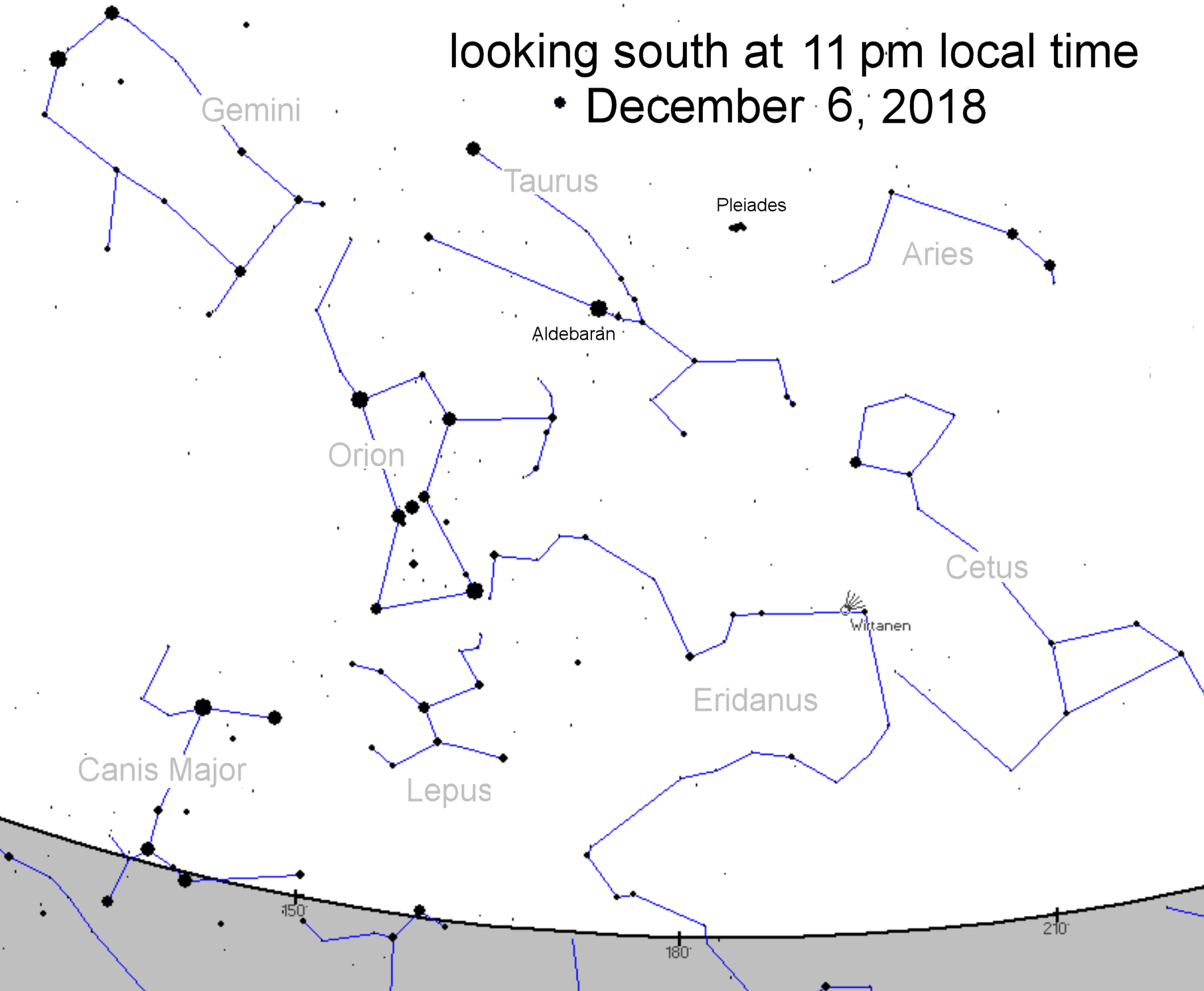
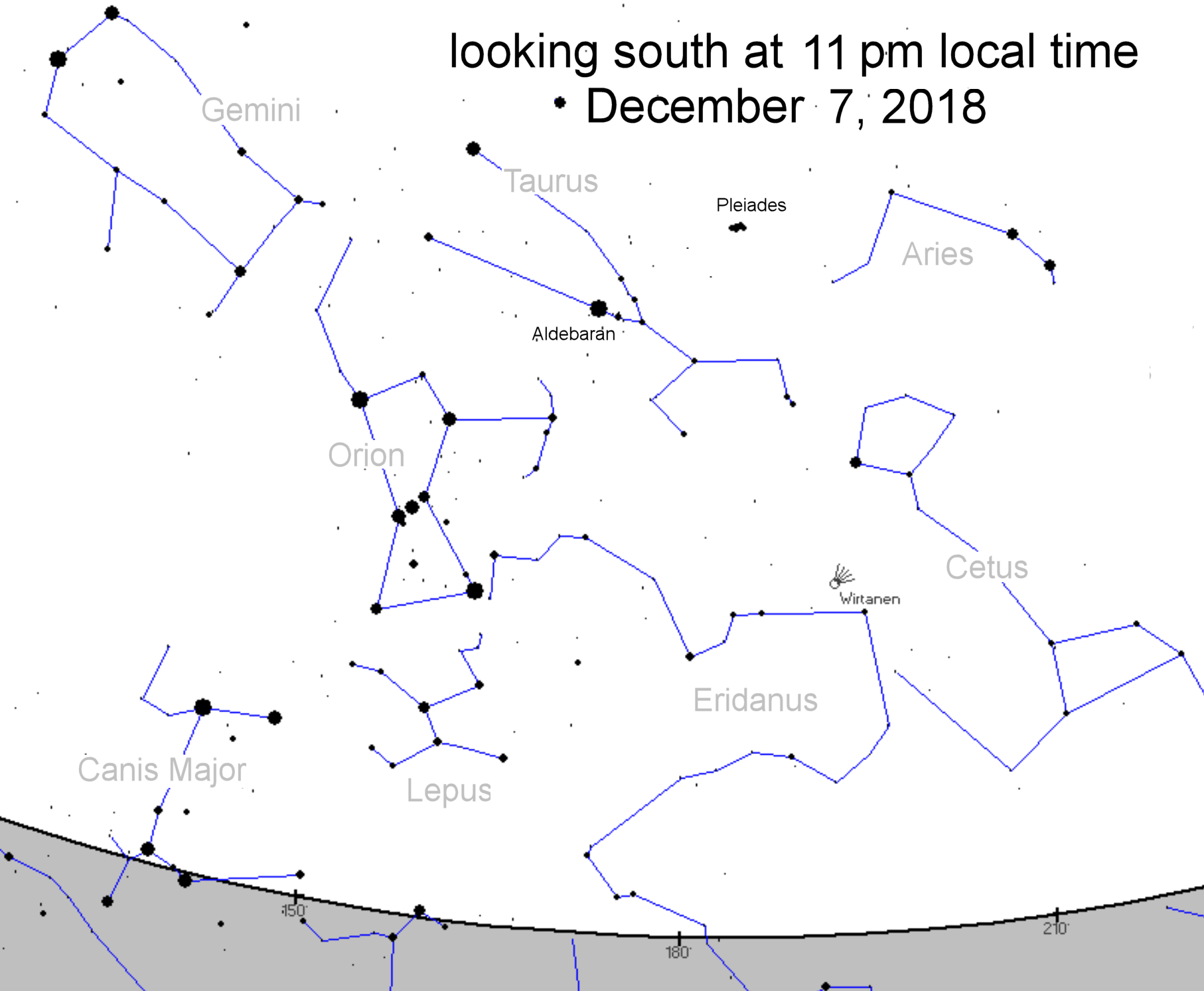
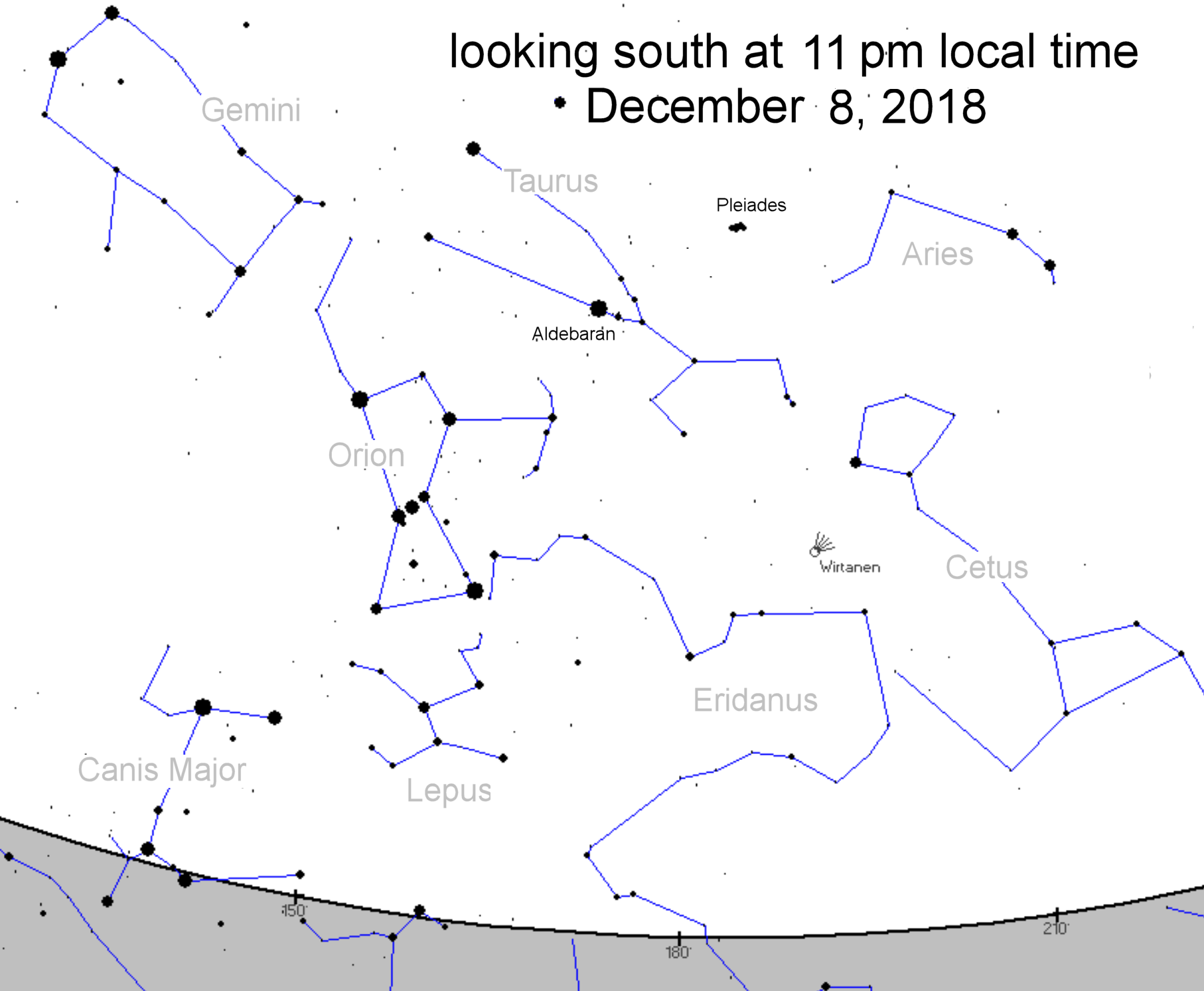
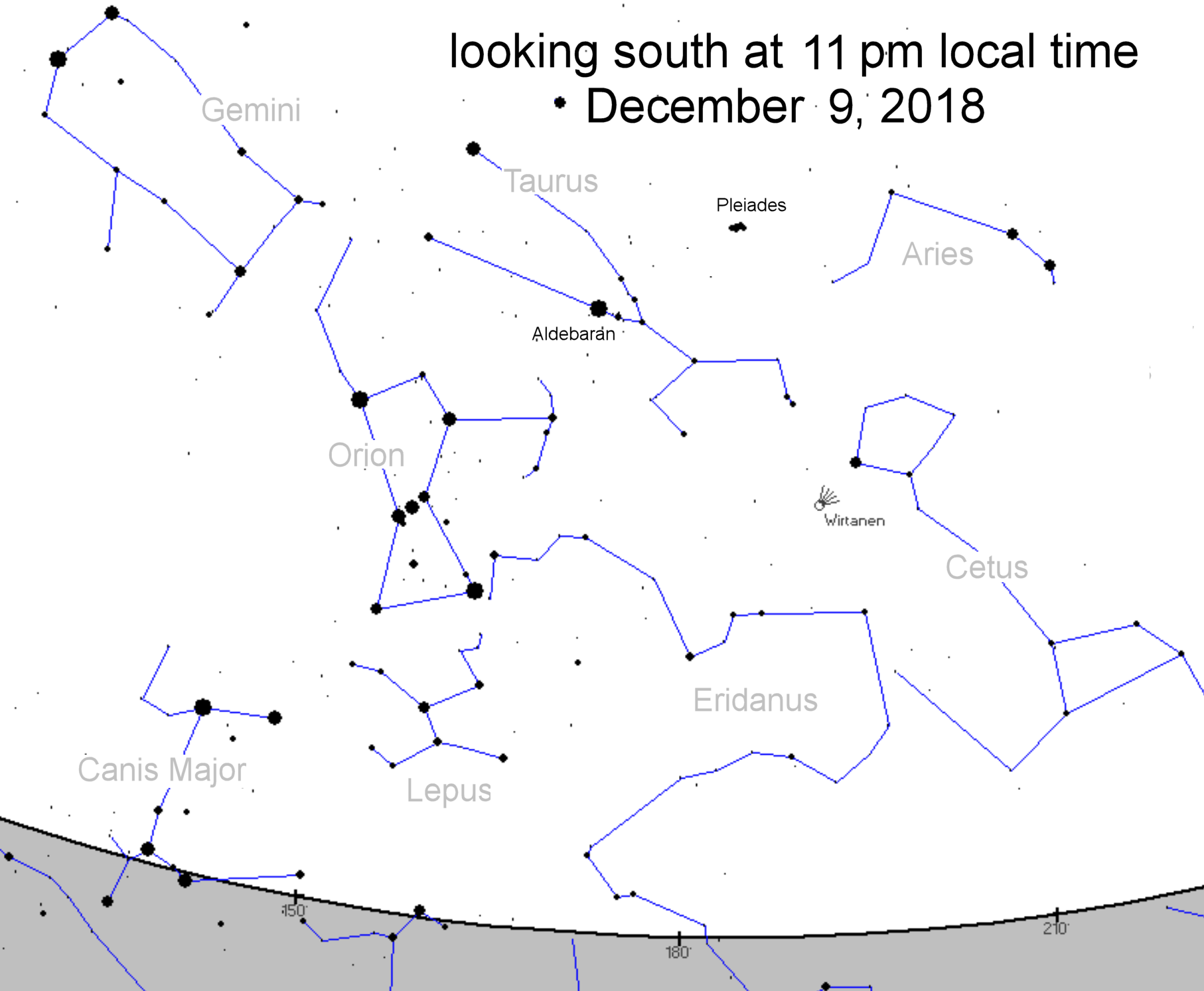
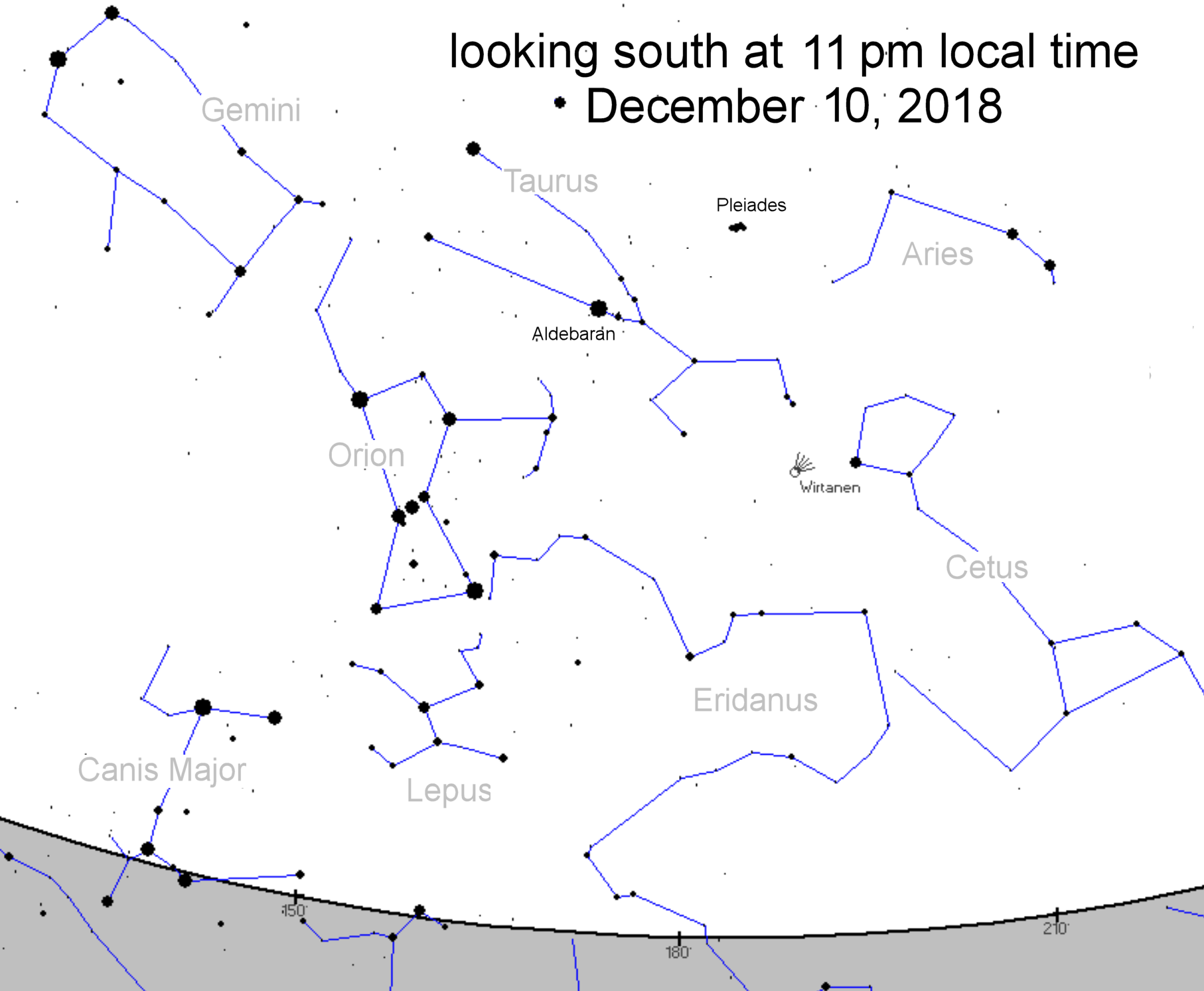
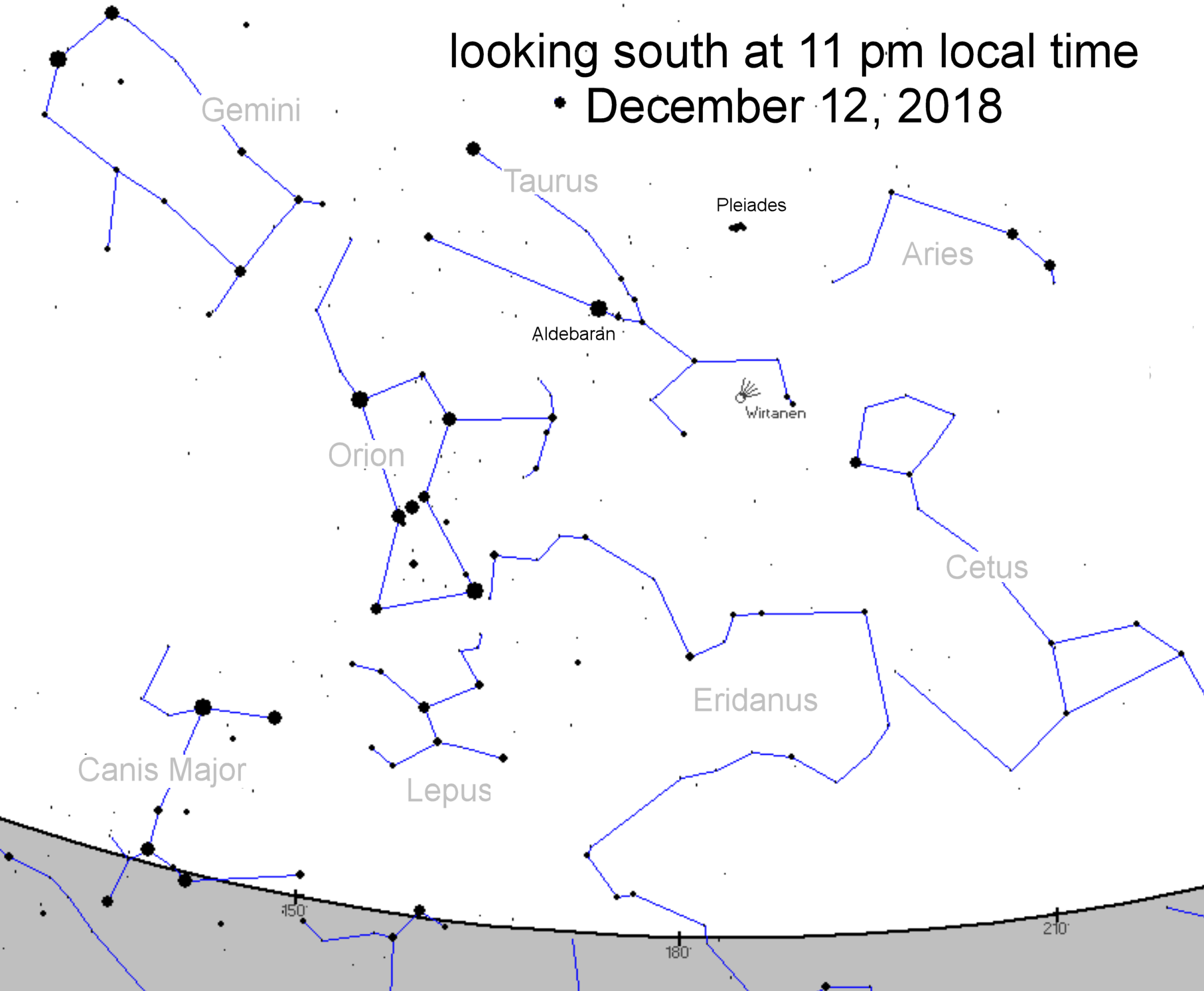
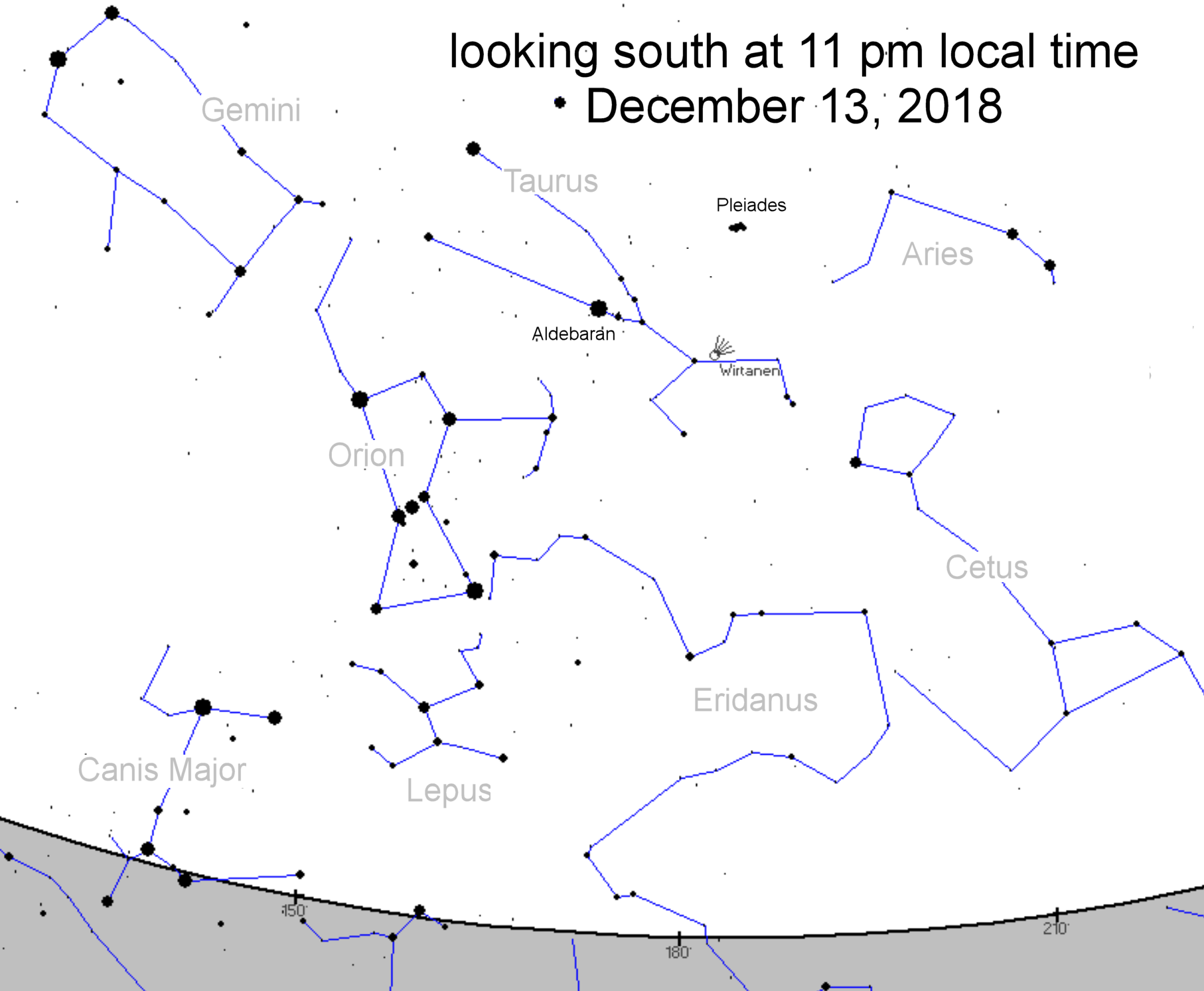
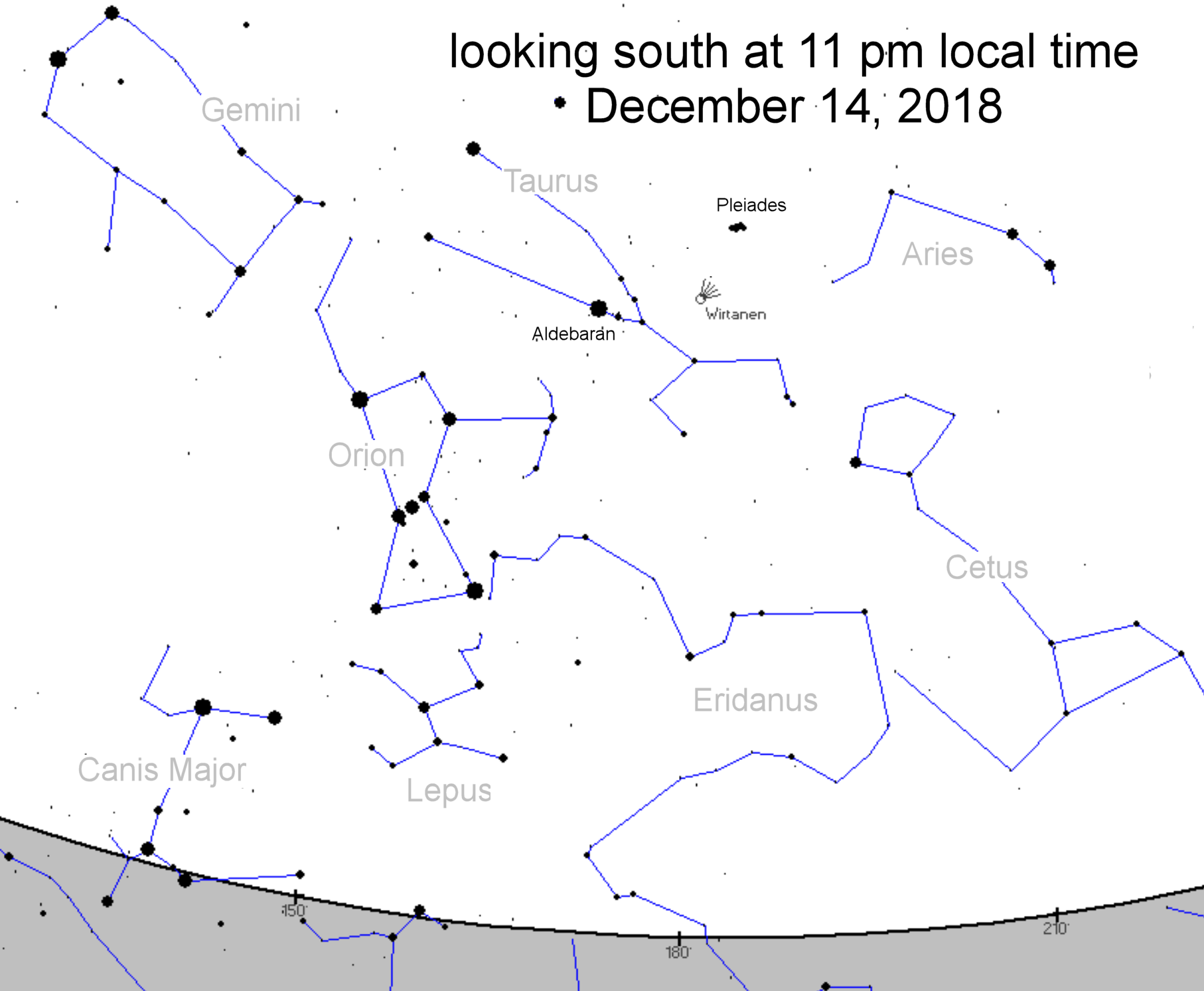
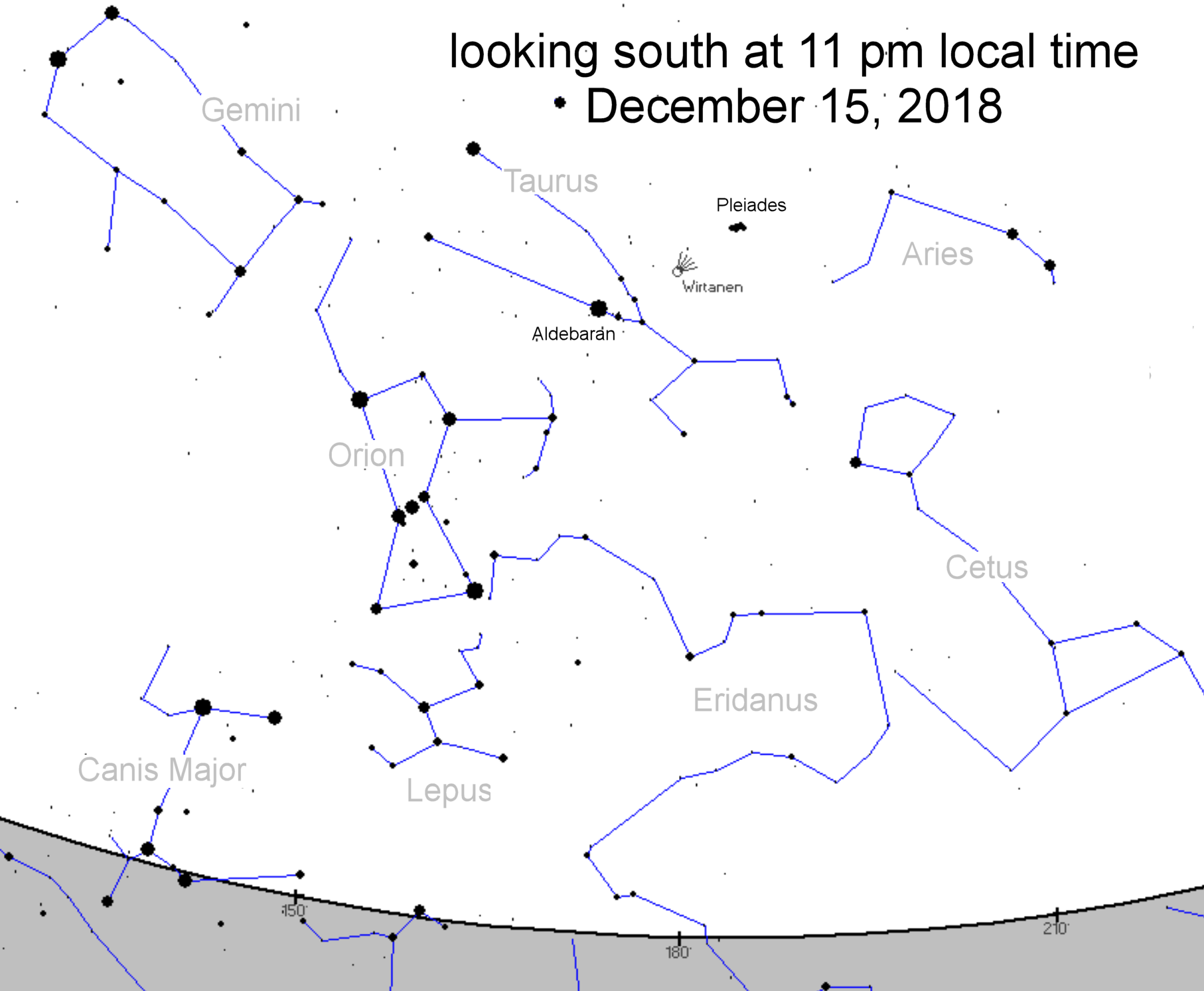
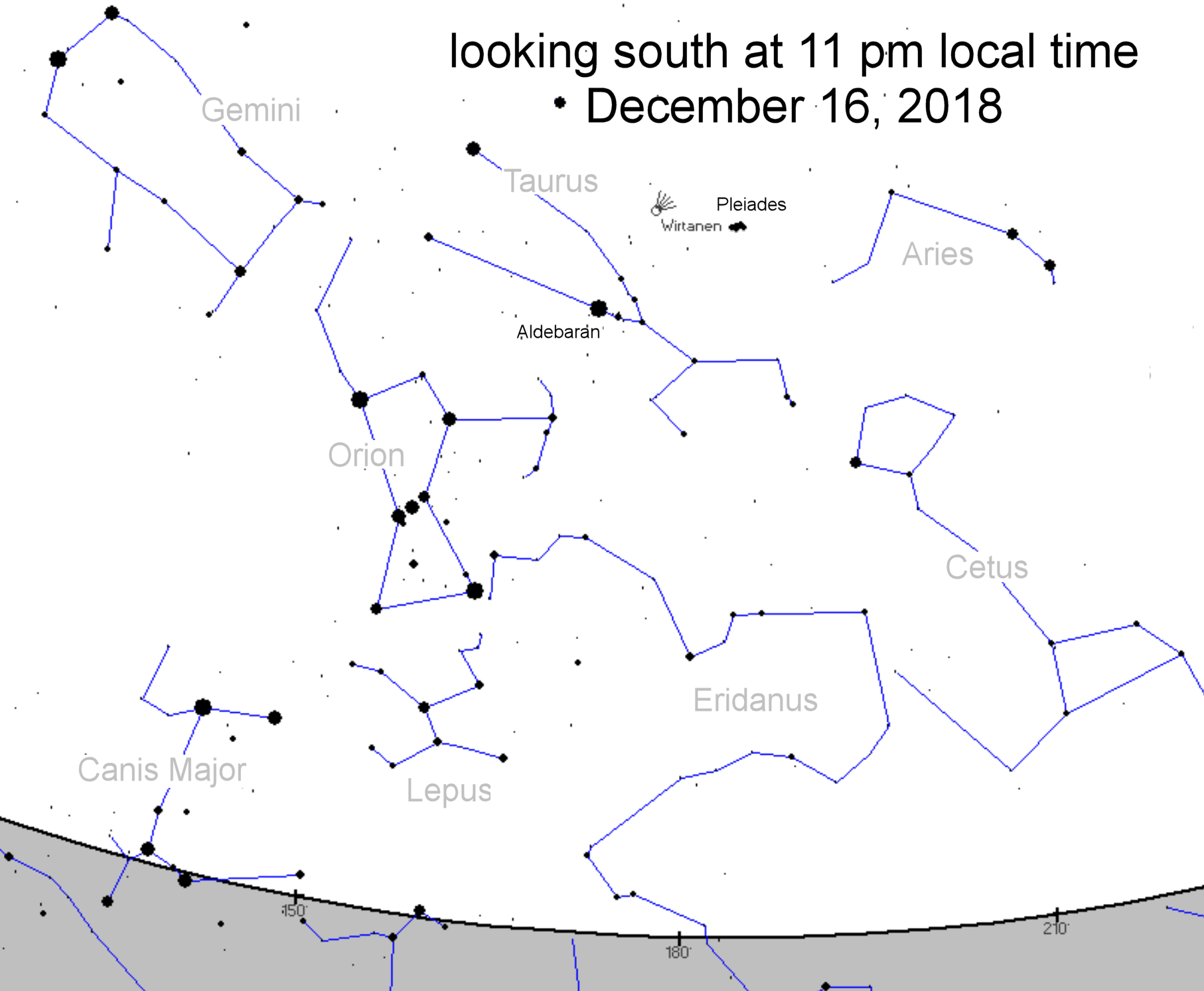
On the nights of closest approach, 46P/Wirtanen can be found in the constellation Taurus rising in the east at sunset and high in the sky at midnight. Sky watchers in the northern hemisphere may orient themselves using these sky maps: Dec. 5, Dec. 6, Dec. 7, Dec. 8, Dec. 9, Dec. 10, Dec. 11, Dec. 12, Dec. 13, Dec. 14, Dec. 15, Dec. 16

More resources: orbital elements; ephemeris; 3D orbit; light curve.