The “Inevitable” Fragmentation of Comet Tsuchinshan-ATLAS

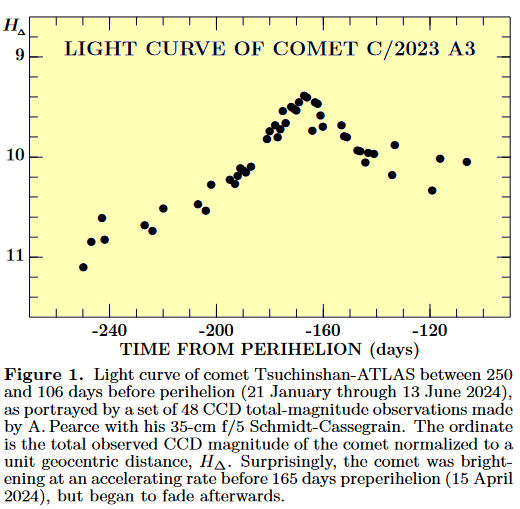
July 12, 2024: Comet Tsuchinshan-ATLAS (C/2023 A3) is about to fall apart. It’s “inevitable,” according to a new study by astronomer Zdenek Sekanina. “Evidence suggests that the comet has entered an advanced phase of fragmentation,” he writes.

Above: Comet Tsuchinshan-ATLAS photographed by José J. Chambó

If true, this is disappointing news. Discovered in early 2023, the comet appears to be heading for a magnificent close encounter with the sun later this year, perhaps becoming as bright as Venus in October 2024. Instead, it could fall apart before it has a chance to become a naked-eye object.

Sekanina’s arguments are threefold: First, the comet has failed to brighten as it approaches the sun. Second, the comet’s orbit seems to be affected by a “non-gravitational acceleration.” This could happen if, say, inner jets are pushing apart a disintegrating nucleus. Third, the comet’s dust tail has an unusually narrow, teardrop shape with a peculiar orientation. 

Together, these observations suggest a crumbling comet “in which increasing numbers of fractured refractory solids stay assembled in dark, porous blobs of exotic shape, becoming undetectable as they gradually disperse in space,” says Sekanina.

Above: This is what a break-up looks like–Comet LINEAR 24 years ago.

“That is a fascinating paper,” says Nick James, director of the Comet Section of the British Astronomical Association. “Sekanina is very well respected in the field, so it carries a lot of weight. To use ‘inevitable’ in any prediction about a comet may be unwise! But it is definitely a testable theory and another good reason to observe this comet at every opportunity.”

In fact, James isn’t convinced. In an independent data set, he finds no evidence of non-gravitational accelerations. “This doesn’t look like a comet that is fragmenting to me,” he says.

We’ll soon find out. The comet is brighter than 10th magnitude, well within range of mid-sized backyard telescopes, which means amateur astronomers can monitor the potential break-up. Point your optics here

Nova T CrB is About to Explode

June 28, 2024: (Spaceweather.com) By the time you finish reading this story, there could be a new star in the night sky. Recurrent nova T CrB (pronounced “tee-core-bore”) is poised on the knife edge of a once-in-a-lifetime explosion.

“Our best estimate for the time of eruption is close to now,” says Brad Schaefer, Professor Emeritus of Astronomy at Louisiana State University.

Schaefer is a leading expert on T CrB. He’s been studying the star since he was a teenager. “When I was 18 year old, I calculated when T CrB should erupt again, and I’ve been waiting for this moment ever since,” he says.

T CrB is a “recurrent nova.” That means it erupts not just once, but over and over again. Its explosion in 1866 was the first nova astronomers had ever seen in detail. “No one knew what caused it,” says Schaefer. Another blast in 1946 established its period (79 or 80 years) and led researchers to the modern interpretation:

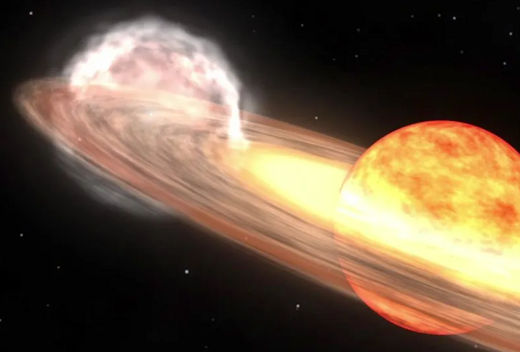
Located 3000 light years away, T CrB is a binary star system consisting of an ancient red giant circled by a hot white dwarf. Hydrogen from the red giant spills onto the surface of the white dwarf. It takes about 80 years to accumulate a critical mass, then–BOOM–a thermonuclear explosion occurs. “It’s an H-bomb that blows up on an incredibly large scale,” says Schaefer.

After an explosion, the process resets and repeats. Looking at old light curves, Schaefer realized that T CrB tells us when it’s about to explode. Approximately 1.1 years before each blow-up, there’s a “pre-eruption dip” in brightness. Amateur astronomers working with the American Association of Variable Star Observers (AAVSO) detected the pre-eruption dip in March 2023:

Above: The pre-eruption dip in March 2023

“If the star behaves in 2023-2024 as it did in 1945-1946, then the next eruption should take place in 2024.4+-0.3,” says Schaefer. “That’s May 2024 plus or minus a few months.”

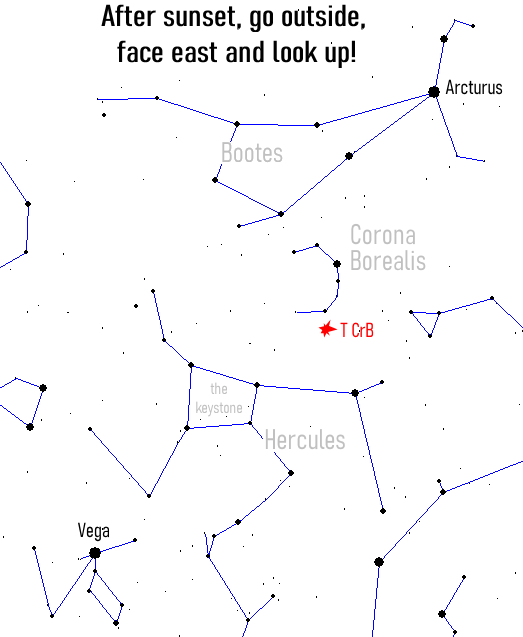
The explosion will be visible to the naked eye. Schaefer expects it to be about as bright as the North Star (2nd magnitude). When it blows, T CrB will burst forth as an extra jewel in the “Northern Crown” (the constellation Corona Borealis), easy to find high in the summer night sky between Hercules and Bootes.

“T CrB will be the brightest nova for generations,” says Schaefer. “It’s a chance for everyone in the world to step outside, look up, and see the hellfire.”

Observing tips: (1) Tonight, go outside and see what Corona Borealis normally looks like: sky map. Then, when the nova explodes, you’ll be able to tell the difference. (2) Sign up for Space Weather Alerts. All subscribers (Basic and Pro) will receive an immediate text message when the nova explodes.

A Nova Will Explode This Summer (Probably)

June 7, 2024: The night sky is about to get a new star. Sometime this summer, astronomers believe, a nova will explode in the constellation Corona Borealis (the Northern Crown). The exploding star will be bright enough to see with the naked eye even from light-polluted cities.


Above: A NASA artist’s concept of the T CrB binary star system

“It’s a once-in-a-lifetime event,” says Rebekah Hounsell of NASA’s Goddard Space Flight Center. “I believe it will create a lot of new astronomers out there.”

T Coronae Borealis (T CrB) is a binary system 3,000 light-years from Earth. It consists of a white dwarf orbiting an ancient red giant. Hydrogen from the red giant is being pulled down onto the surface of the white dwarf, accumulating toward a critical mass. Eventually, it will trigger a thermonuclear explosion.

The outburst will be brief. Once it erupts, the nova will be visible to the naked eye for a little less than a week – but Hounsell is confident it will be quite a sight to see. The expected magnitude is between +2 and +3, similar to stars in the Big Dipper.

“Typically, nova events are faint and far away,” says Elizabeth Hays, chief of the Astroparticle Physics Laboratory at NASA Goddard. “This one will be really close, with a lot of eyes on it. We can’t wait to get the full picture of what’s going on.”

Global Auroras on Mars

Feb 28, 2024: Earth isn’t the only planet with auroras. Mars has them, too–on a global scale.

“Mars is experiencing its greatest level of auroral activity in the past 10 years,” says Nick Schneider of the University of Colorado’s Laboratory for Atmospheric and Space Physics (LASP). “In February alone, there were three episodes of global auroras–an ‘aurora hat trick’ we’ve never seen before.”

Orbiting high above Mars, NASA’s MAVEN spacecraft recorded the auroras on 3-4 Feb, 7-10 Feb and 15-16 Feb. This animation shows the last two of these episodes in a looping time series:

Spaceweather.com actually predicted some of these events, prompted by SOHO coronagraph observations of CMEs heading toward Mars. “Your predictions came true!” says Schneider.

Schneider leads the team for MAVEN’s Imaging Ultraviolet Spectrograph (IUVS), the instrument that detected the auroras. All the purple pixels in the animation are a false color representation of the aurora’s ultraviolet glow. Martian auroras probably have a visible light component, too, but MAVEN’s cameras are not able to see them.

Here on Earth we would love it if auroras were global. Seeing Northern Lights with equal ease from the equator and the poles would check off a lot of bucket lists. Be careful what you wish for, though. Martian auroras can be global because the Red Planet has almost no protection from solar storms. It lacks an Earth-like magnetic field, so particles from the sun penetrate its atmosphere with ease–everywhere.

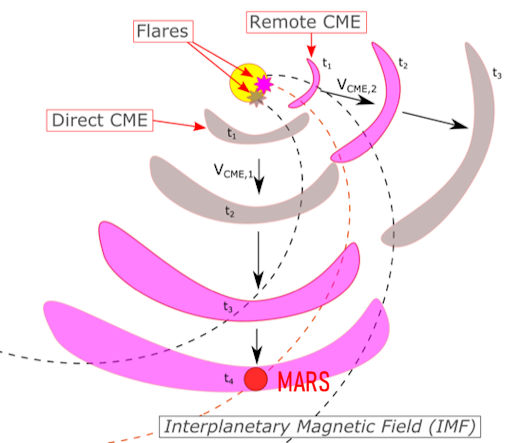
The dramatic auroras of February 2024 were caused by “SEPs”–solar energetic particles. SEPs are accelerated by shock waves within approaching CMEs. When they strike Mars’s atmosphere, they cause it to glow.

“Mars is currently getting hit by roughly 1 to 2 CMEs every month, bringing a hefty supply of SEPs,” says Rebecca Jolitz, a member of the MAVEN Solar Energetic Particle (SEP) instrument team at UC Berkeley’s Space Sciences Lab. “However, a CME doesn’t actually have to hit to be effective. SEPs coming in sideways from ‘remote CMEs’ can light up the skies as well.”

Schneider and Jolitz are looking forward to the months ahead. “Solar Cycle 25 is far from over, and we expect many more CME strikes,” Schneider says. “This will give us a chance to study how solar storms affect the atmosphere of Mars–a key goal of the MAVEN mission. It’s the kind of fun we’ve been waiting for!”

Extra: Schneider notes that SEPs aren’t the only way to make auroras on Mars. Protons in the solar wind and magnetic reconnection can do the trick, too, producing their own forms and colors. Stay tuned for more stories about the rich variety of Martian auroras as Solar Cycle 25 unfolds.

This Comet Did Not Survive the Eclipse

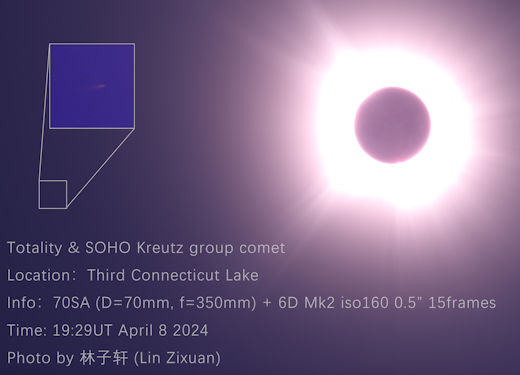
April 10, 2024: (Spaceweather.com) Astronomer Karl Battams of the Naval Research Lab predicted that a sungrazing comet might be visible during Monday’s total eclipse. He was right. Chinese amateur astronomer Lin Zixuan was in New Hampshire for the eclipse, and he photographed the disintegrating comet:

Named “SOHO-5008”, the comet had been discovered earlier the same day by amateur astronomer Worachate Boonplod, who noticed it in SOHO coronagraph images. Battams quickly realized that the comet might be bright enough to photograph in the otherworldly twilight of the Moon’s shadow.

“Ground-based observations of sungrazing comets are extremely rare, so this would be a great opportunity to see an eclipse comet!” says Battams.

Soon after Zixuan photographed the comet, it disintegrated. SOHO has seen this happen more than 5000 times. Most doomed sungrazers (including this one) are members of the Kreutz family. Named after a 19th century German astronomer who studied them in detail, Kreutz sungrazers are fragments from the breakup of a giant comet ~2000 years ago. Several fragments pass by the sun and disintegrate every day, although most are too small to see.

Above: A SOHO coronagraph image of the disintegrating comet

Battams can recall only two other examples of sungrazers seen during a solar eclipse– one in 2020 (also a Worachate Boonplod discovery) and another in 2008. ” I think with modern imaging equipment and techniques, seeing a sungrazer during an eclipse is no longer hugely challenging, but it does require one crucial ingredient: the right comet at the right time. We got lucky this week!” he says.

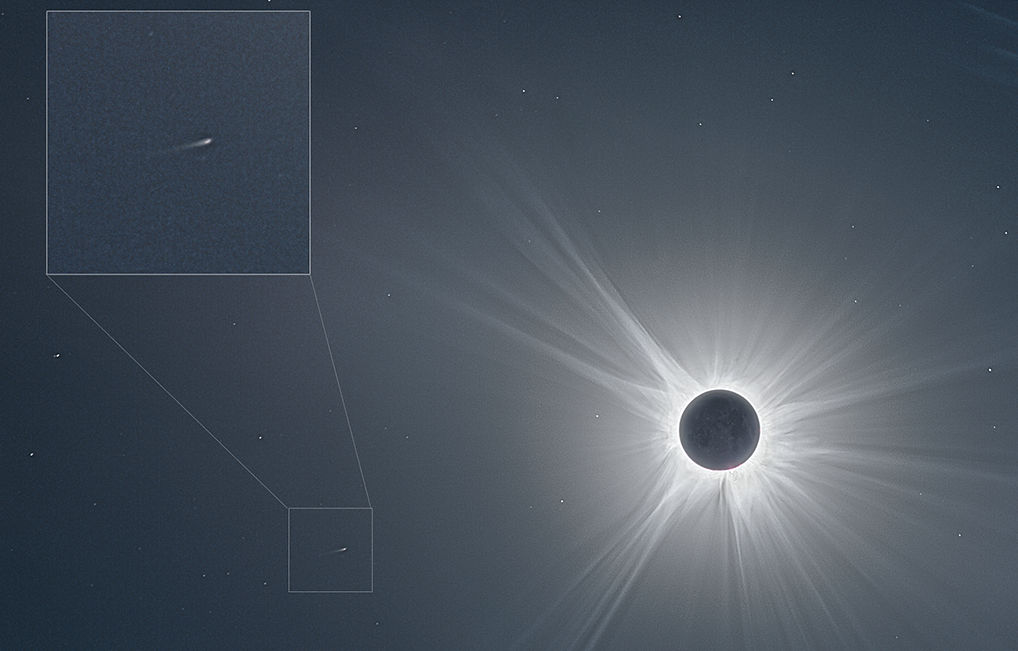
The best picture, so far, of the sungrazer comes from Petr Horálek of Institute of Physics in Opava, who was in Durango, Mexico, for the eclipse:

“I got especially lucky with this shot with the comet SOHO-5008, which was discovered just before the eclipse,” says Horálek. “It was truly windy and partly cloudy, totality took 3 minutes and 25 seconds and the image is the result of HDR shooting (exposure from 1/4000 s to 2s). A total of 83 usable images were used (dark frames and flat fields applied).”