The Centennial Gleissberg Cycle

May 6, 2025: (Spaceweather.com) If you’ve been enjoying the auroras of Solar Cycle 25, we’ve got good news. The next few solar cycles could be even more intense–the result of a little-known phenomenon called the “Centennial Gleissberg Cycle.”
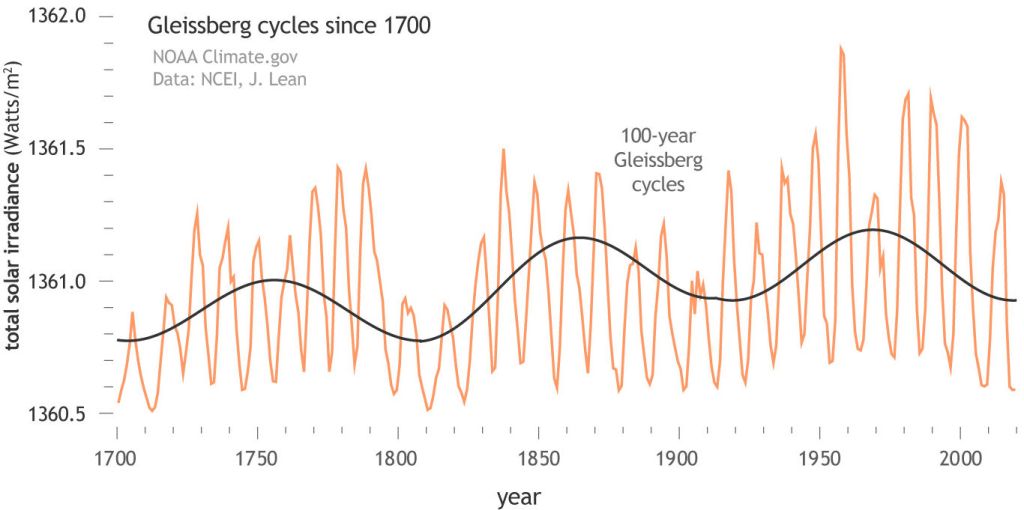
You’ve probably heard of the 11-year sunspot cycle. The Gleissberg Cycle is a slower modulation, which suppresses sunspot numbers every 80 to 100 years. For the past ~15 years, the sun has been near a low point in this cycle, but this is about to change.

New research published in the journal Space Weather suggests that the Gleissberg Cycle is waking up again. If this is true, solar cycles for the next 50 years could become increasingly intense.

“We have been looking at protons in the South Atlantic Anomaly,” explains the paper’s lead author Kalvyn Adams, an astrophysics student at the University of Colorado. “These are particles from the sun that come unusually close to Earth because our planet’s magnetic shield is weak over the south Atlantic Ocean.”
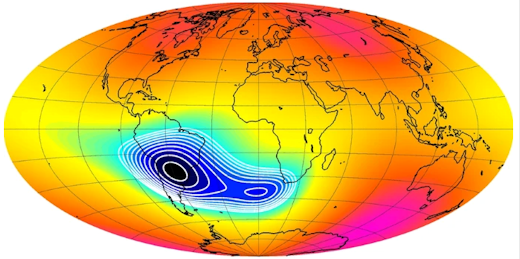

Above: The South Atlantic Anomaly (blue) is a weak spot in Earth’s magnetic field where particles from the sun can come relatively close to Earth [more]

It turns out that protons in the South Atlantic Anomaly are a “canary in a coal mine” for the Gleissberg Cycle. When these protons decrease, it means the Gleissberg Cycle is about to surge. “That’s exactly what we found,” says Adams. “The protons are clearly decreasing in measurements we obtained from NOAA’s Polar Operational Environmental Satellites.”

Protons in the South Atlantic Anomaly are just the latest in a growing body of evidence suggesting that the “Gleissberg Minimum” has passed. Current sunspot counts are up; the sun’s ultraviolet output has increased; and the overall level of solar activity in Solar Cycle 25 has exceeded forecasts. It all adds up to an upswing in the 100-year cycle.

It also means that Joan Feyman was right. Before she passed away in 2020, the pioneering solar physicist was a leading researcher of the Gleissberg Cycle, and she firmly believed that the centennial oscillation was responsible for the remarkable weakness of Solar Cycle 24 (2012-2013). In a seminal paper published in 2014, she argued that the minimum of the Gleissberg Cycle fell almost squarely on top of Solar Cycle 24, making it the weakest cycle in 100 years. The tide was about to turn.

The resurgence of the Gleissberg Cycle makes a clear prediction for the future: Solar Cycles 26 through 28 should be progressively intense. Solar Cycle 26, peaking in ~2036, would be stronger than current Solar Cycle 25, and so on. The projected maximum of the Gleissberg Cycle is around 2055, aligning more or less with Solar Cycle 28. That cycle could be quite intense.

“With a major increase in launch rates, it’ll be important to plan for changes to the space environment that thousands of satellites and spacecraft are flying through from all sides,” says Adams. “Solar activity and particle fluxes could all be very different in the decades ahead.”

For more information, read Adams’s original research here.
Space Hurricanes Are Real

Aug. 1, 2025 (Spaceweather.com): Hurricane season just got worse. Chinese researchers have discovered a new kind of storm at the edge of space. They call it a “space hurricane.”

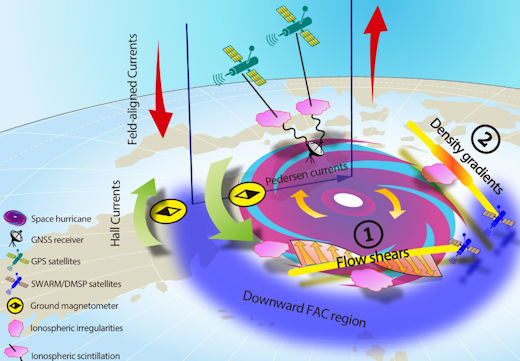
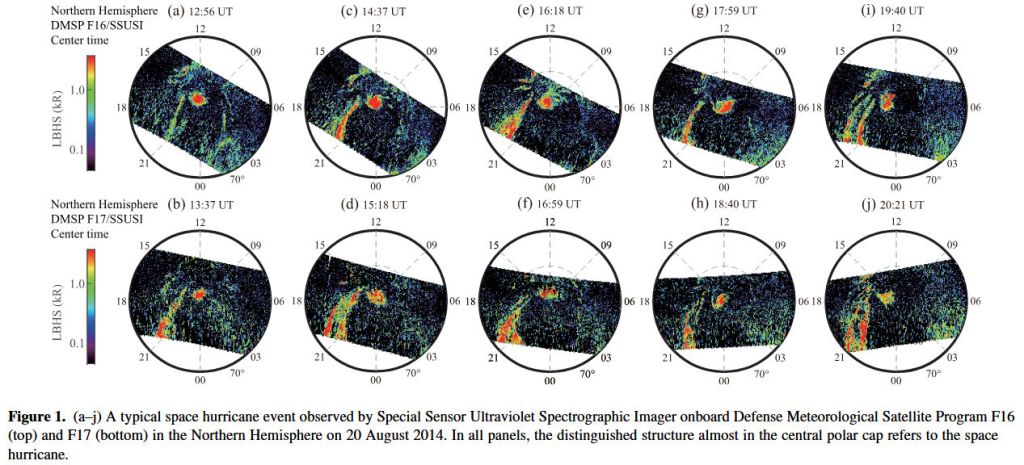
The first known example appeared in Defense Meteorological Satellite (DMSP) images on Aug. 20, 2014. A massive swirl of charged particles appeared above the North Pole. Spinning silently, it resembled a terrestrial hurricane in shape, with spiral arms and a calm “eye” glowing with auroral light. A detailed study of this event was published in the July 2025 edition of Space Weather.

Above: A ‘ space hurricane’ observed by DMSP satellites. Note the eye and spiral arms.

“The space hurricane formed during very quiet conditions,” says lead author Sheng Lu of Shandong University. “Solar activity was low.” 

Most researchers had overlooked these events because they weren’t linked to solar storms. This team looked for auroras under calm conditions and found something new. The DMSP F17 satellite flew through the space hurricane’s center; ten minutes later, SWARM B crossed the edge. Their data confirmed the hurricane was an active electrodynamic storm, not just an auroral display.

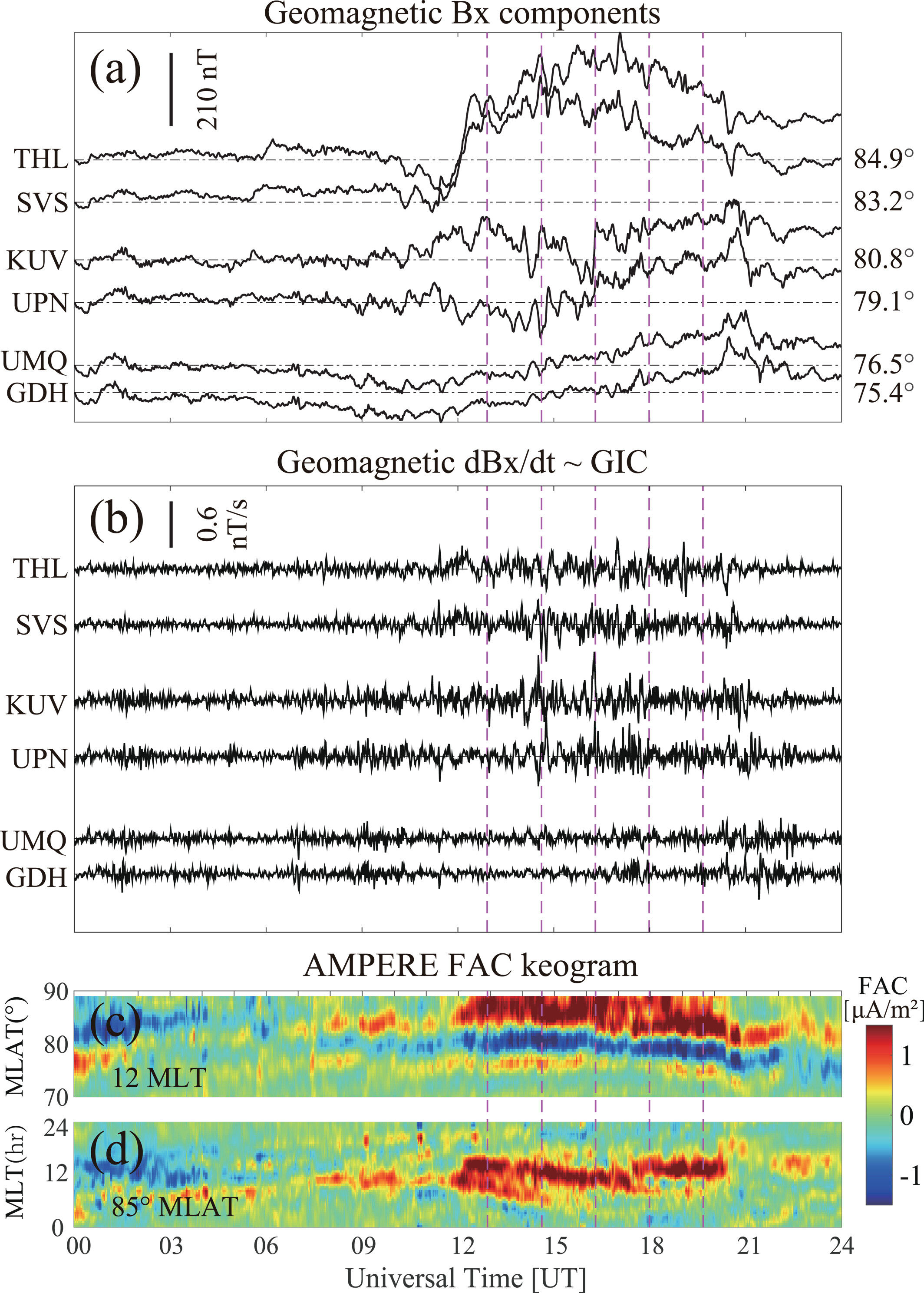
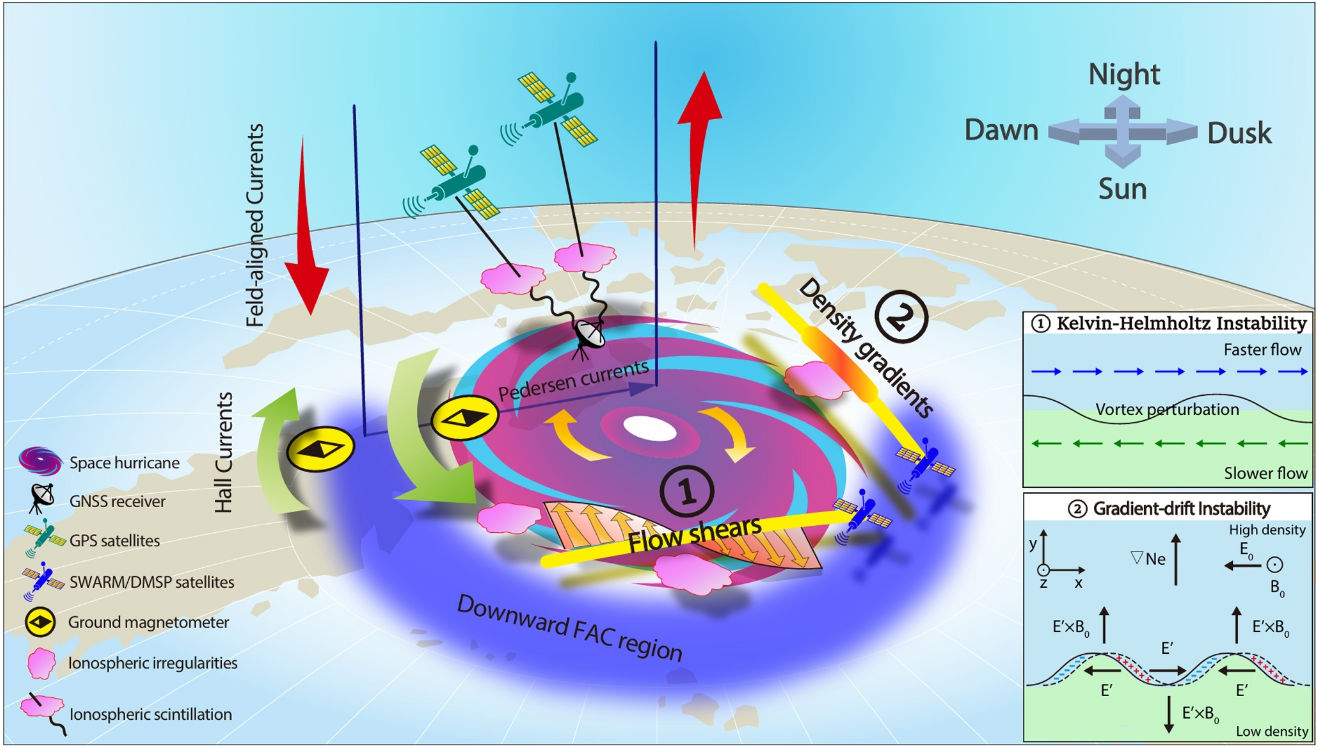
The hurricane’s effects mimicked those of actual geomagnetic storms. Using GPS data from the Canadian High Arctic Ionospheric Network, the researchers found that satellite signals passing through the hurricane’s edge experienced strong phase scintillations–a type of “twinkling” that can reduce GPS accuracy. Meanwhile, ground-based magnetometers in Greenland recorded sharp shifts in Earth’s magnetic field as large as 400 nT–comparable to a G1-class geomagnetic storm.

Above: The anatomy of a space hurricane. Credit: Lu et al (2025) [Expand]

Savvy aurora chasers know that the best time to catch Northern Lights is when the interplanetary magnetic field (IMF) tilts south. This opens a hole in Earth’s magnetosphere, allowing solar wind to enter. We tend to ignore times when the IMF tilts north and closes the door. Yet that is precisely when space hurricanes form, according to the study. 

Space hurricanes are stealthy, appearing when traditional metrics of space weather forecasting indicate little of interest. Note to forecasters: Not all storms come from the sun.

Want to learn more? Read the original research here.

South Pacific Auroras Confirm May 10th Was a Great Storm

May 16, 2024: On the south Pacific island of New Caledonia, no one expects to see auroras. Ever. Situated about halfway between Tonga and Australia, the cigar-shaped island is too close to the equator for Northern or Southern Lights. Yet on May 10, 2024, this happened:

“I have rarely been so happy when taking a photo!” says Frédéric Desmoulins, who photographed the display from Boulouparis in the island’s south province. “I could see the red color of the auroras with my naked eye. According to the New Caledonian Astronomy Society, these photos are the first for this territory.”

“The auroral visibility from New Caledonia is really unique and extremely valuable,” says Hisashi Hayakawa, a space weather researcher at Japan’s Nagoya University. “As far as we know, the last time sky watchers saw auroras in the area was during the Carrington Event of Sept. 1859, when auroras were sighted from a ship in the Coral Sea.”

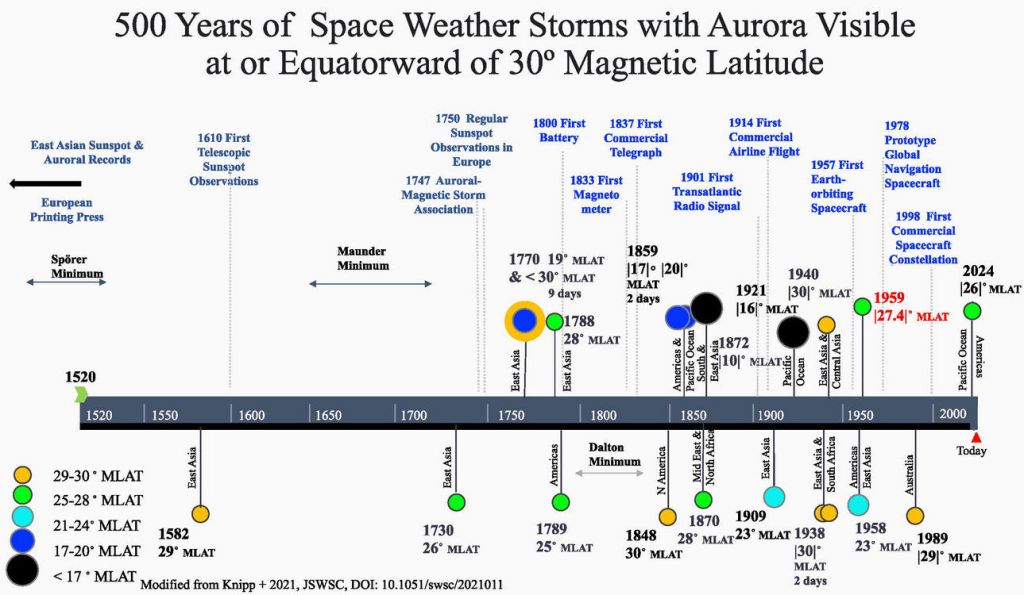
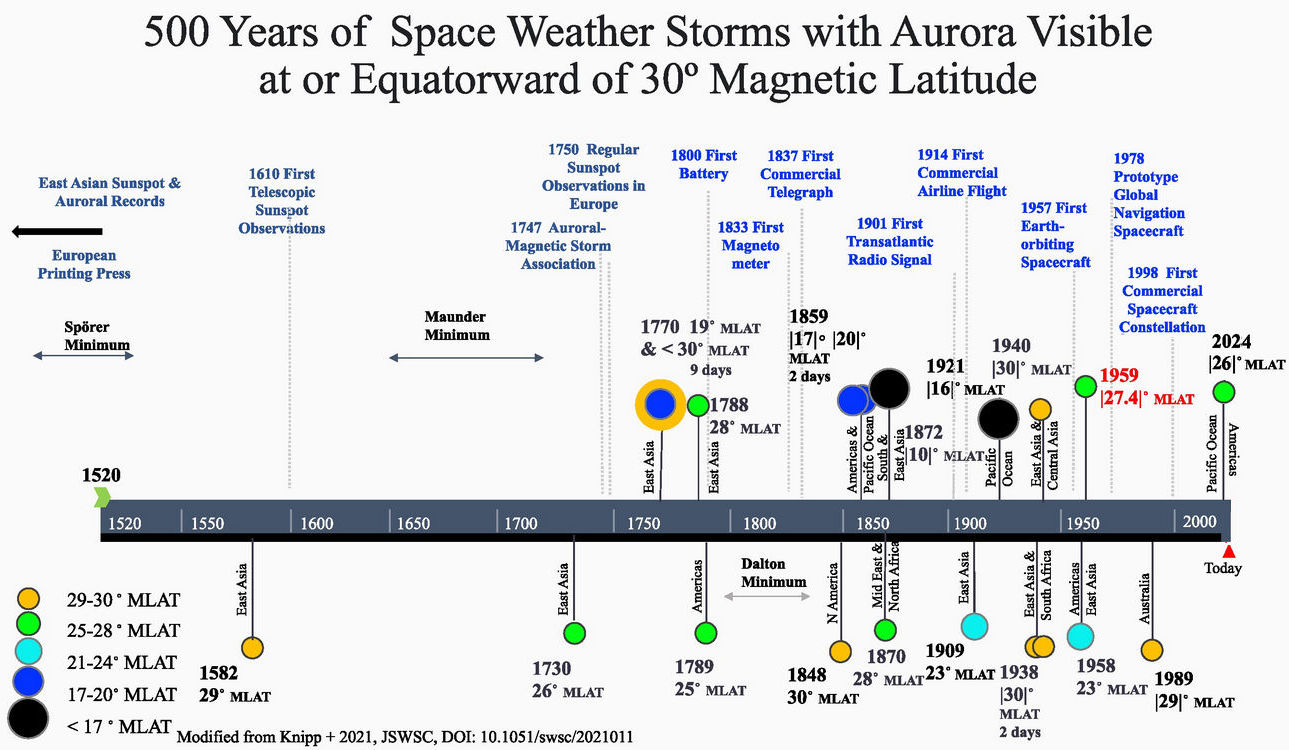
Hayakawa specializes in historical studies of great auroral storms. He tries to go back in time as far as possible. The problem is, magnetometers and modern sensors didn’t exist hundreds or thousands of years ago. Instead, he looks for records of aurora sightings in old newspapers, diaries, ships logs, even cuneiform tablets. Great Storms are identified by their low latitude–anything with naked-eye auroras below 30° MLAT (magnetic latitude).

“May 10th was definitely a Great Storm,” declares Hayakawa. “Naked-eye auroras sightings in New Caledonia (MLAT = -26.4°) and Puerto Rico (MLAT = 27.2°) confirm this in both hemispheres.”

In fact, it is among the top 20 Great Storms of the past 500 years. The above timeline from a research paper by Hayakawa has been modified to display the May 10th event. It is the green dot on the far-right end of the timeline.

This isn’t just an arcane historical curiosity. “We need to know about Great Storms of the past to understand how big storms might become today,” explains Hayakawa. “Our modern technological society depends upon it.”

Readers, if you witnessed auroras at low latitudes on May 10th, please submit your photos to our gallery and fill out this questionnaire from Hayakawa. Your observations may be included in a future research paper about this extreme storm.