COMET 3I/ATLAS IS NOT HIDING FROM EARTH

This week the internet is buzzing with headlines like “Mysterious Object Is Up to No Good While It’s Hidden Behind the Sun.” They’re referring to interstellar Comet 3I/ATLAS. Harvard astronomer Avi Loeb and others have suggested it might be a spaceship deliberately hiding from humans. There’s just one problem with this argument: We can still see it from Earth.

For example, the CCOR-1 coronagraph onboard NOAA’s GOES-19 satellite is tracking the comet and monitoring its brightness:
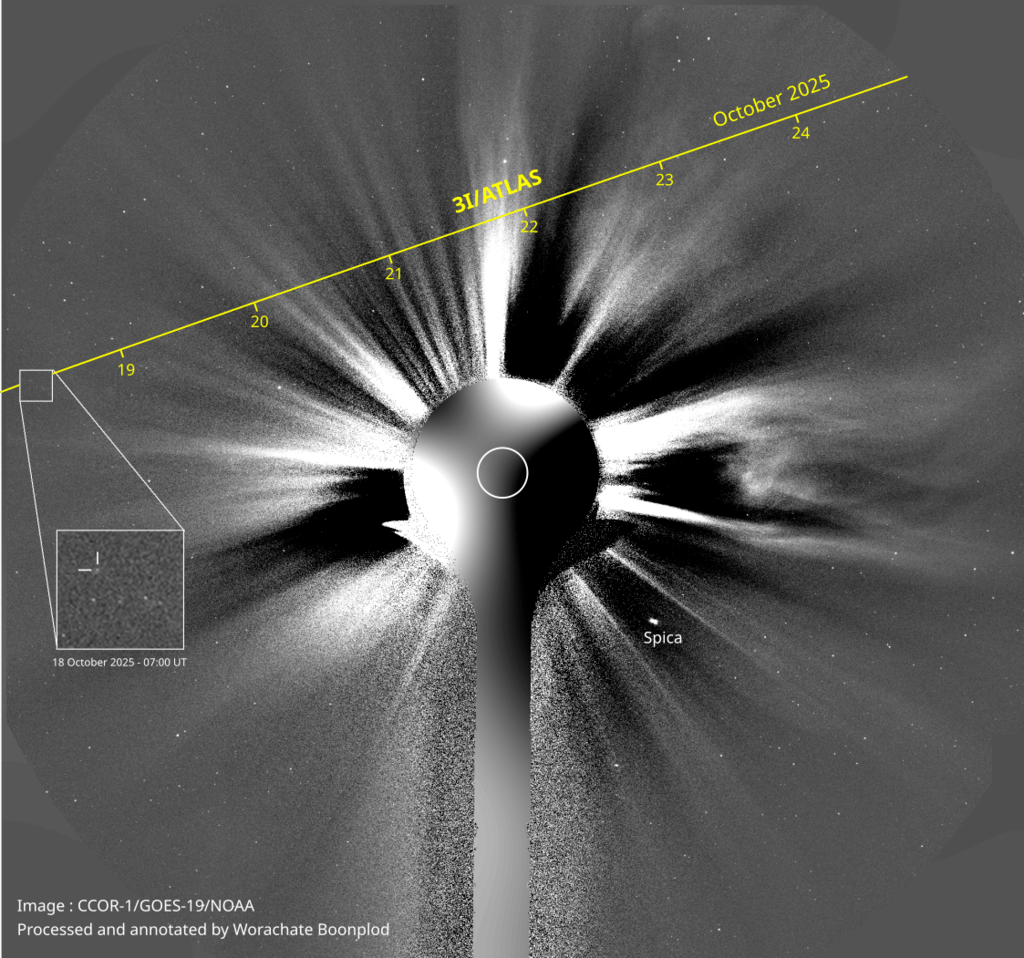
So is NASA’s quartet of PUNCH spacecraft, and coronagraphs onboard the Solar and Heliospheric Observatory (SOHO, not far from Earth). Comet 3I/ATLAS is under constant surveillance.

“Unless 3I/ATLAS fades substantially in the next couple of days, we should be able to keep eyeballs on it right through its perihelion (closest approach to the sun),” says coronagraph expert Karl Battams.

Tracking the comet is not easy because it is so faint. Battams explains how it is done: “Objects at the threshold of detection like 3I/ATLAS are a challenge for coronagraphs. We often have to employ image stacking techniques. For this to work, we have to have a very precise understanding of the pointing and distortion of the telescopes so that we can find the exact pixels that correspond to the comet. It gets fiddly, but we make it work.”

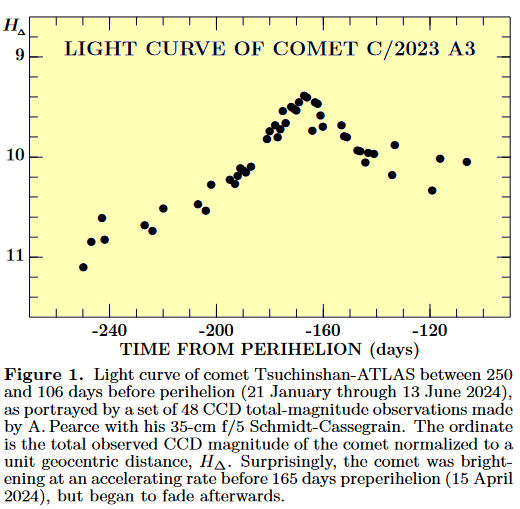
If 3I/ATLAS changes direction or surges in brightness, we will know. So far, it’s acting like a comet. T. Marshall Eubanks from Space Initiatives Inc assembled this light curve, including recent data from CCOR-1 and PUNCH:

These data confirm that 3I/ATLAS is following a fairly standard model of comet brightness with contributions from gas and dust. If this is a spacecraft, it is wearing an uncanny disguise.

In December, 3I/ATLAS will emerge from the glare of the sun. Telescopes on Earth’s surface can then rejoin the monitoring effort. Our bet: They will see a comet, not a spaceship. Stay tuned.
The Tail of Comet ATLAS is Backwards

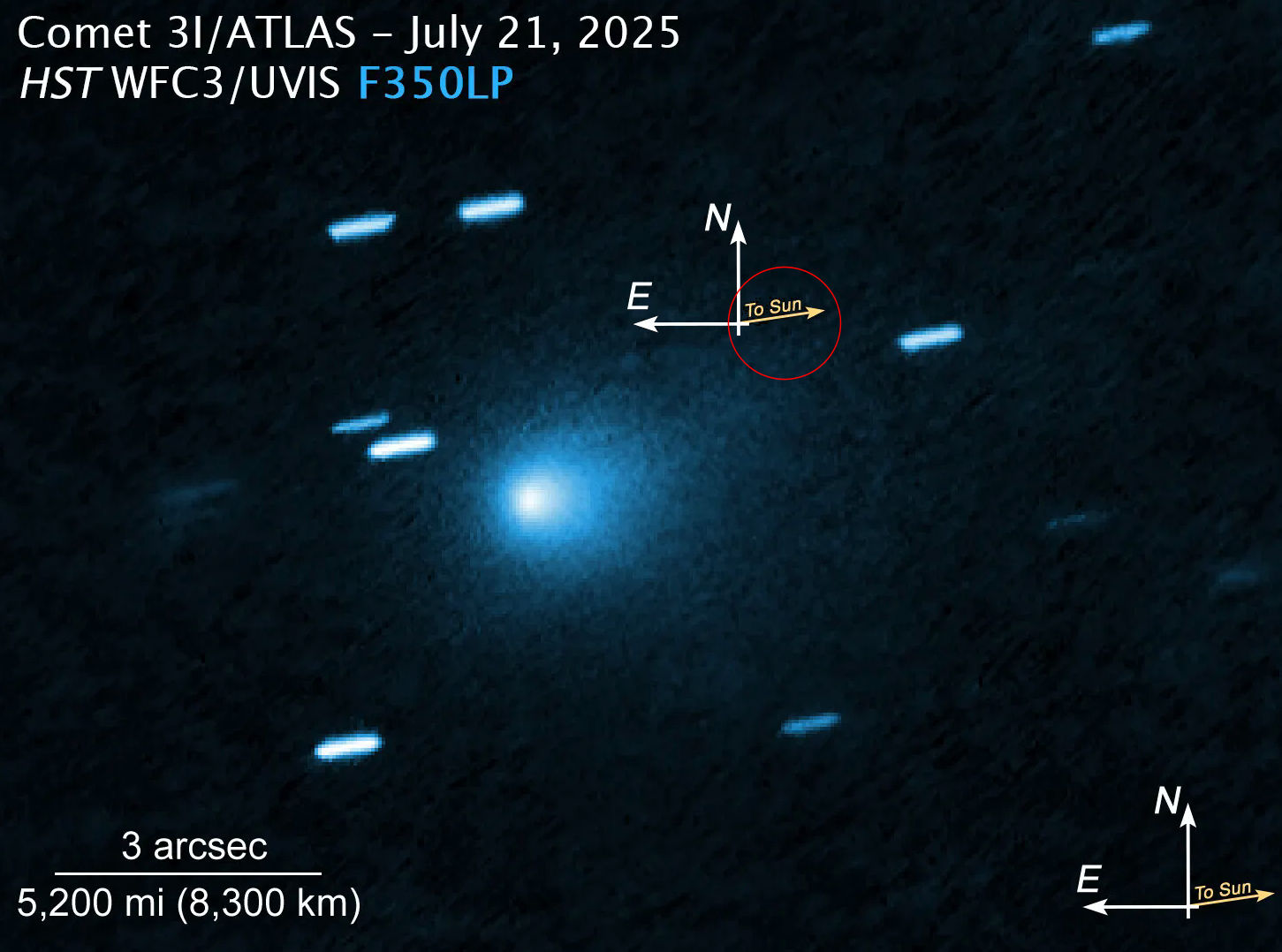
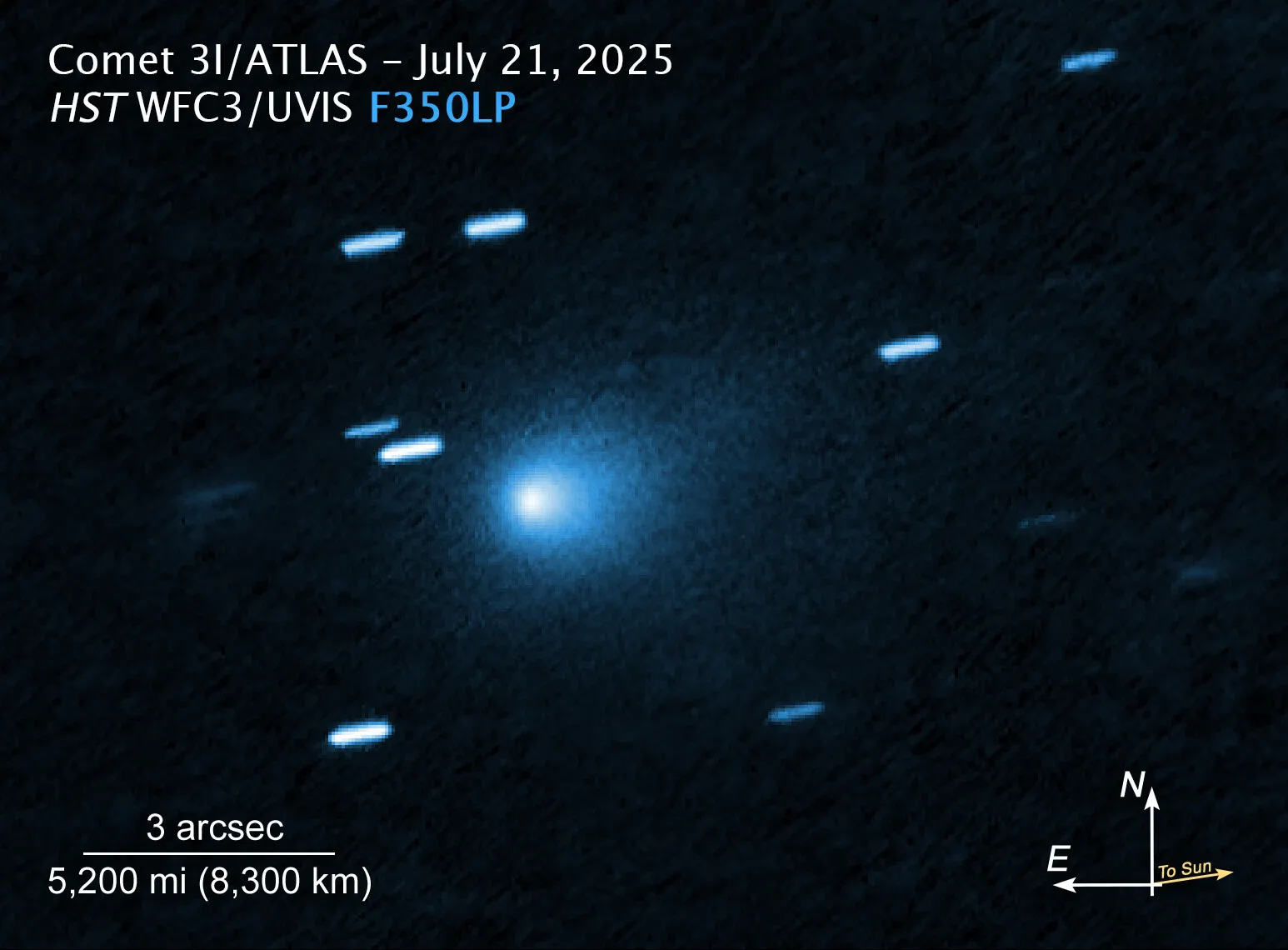
Aug. 25, 2025 (Spaceweather.com) — In July, when astronomers used the Hubble Space Telescope to photograph 3I/ATLAS, they had a “Eureka!” moment. The mysterious interstellar visitor had a fuzzy atmosphere and a growing tail. Clearly, it was a comet. 

However, something was not quite right. Take a look, and see if you can spot the problem:

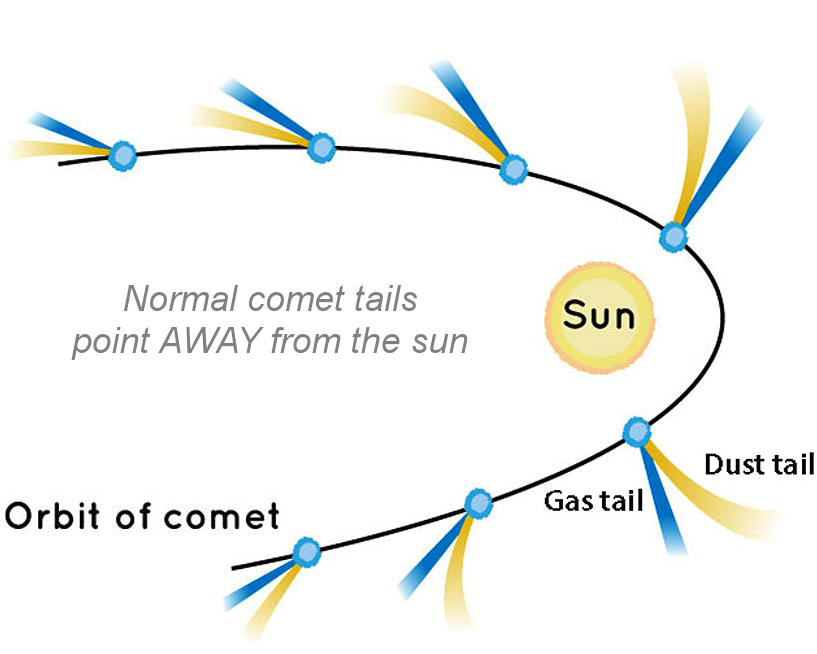
The tail of 3I/ATLAS points almost straight toward the sun. Normally, comet dust tails are pushed away from the sun by radiation pressure. 3I/ATLAS is doing the opposite—it’s backwards.

Why? Researchers led by David Jewitt of UCLA believe they have an explanation: “It is due to the preferential sublimation of ice on the hot day side of the nucleus and the near absence of sublimation on the night side,” they wrote in a paper reporting the observations.  

In other words, 3I/ATLAS *is* a comet, but only the sun-heated side is producing lots of dust. The emerging dust particles are too big for radiation pressure to bend them back into an ordinary tail.

This is unusual, but not unheard of. Solar system comets have been known to produce sunward fans or jets, typically from localized “hot spots” on their rotating nuclei. What makes 3I/ATLAS different is the dominance of its sunward plume, dwarfing a barely visible anti-solar tail behind it.

If 3I/ATLAS is indeed a comet, it may have been wandering through the galaxy for longer than our Solar System has existed. Billions of years of cosmic ray bombardment will have altered its surface–knocking hydrogen atoms out while heavier molecules remained behind. This process could create a hardened crust that might not sputter dust and gas like fresher comets from the Solar System. 

Researchers will be very interested to see how the tail of 3I/ATLAS evolves as it approaches the sun for a close encounter in October 2025. Will it remain backward? Or will the crust crumble and allow smaller particles to escape, forming a more normal anti-solar tail?

Of course, if it is a spaceship as Harvard professor Avi Loeb suggests, something completely different may occur. Either way, stay tuned.

Is 3I/ATLAS Really a Comet?

August 26, 2025: (Spaceweather.com) The most intriguing mystery in astronomy today is the nature of interstellar object 3I/ATLAS. Most astronomers believe it is a comet. However, Avi Loeb of Harvard University famously makes the case that it might be something else–like alien tech.

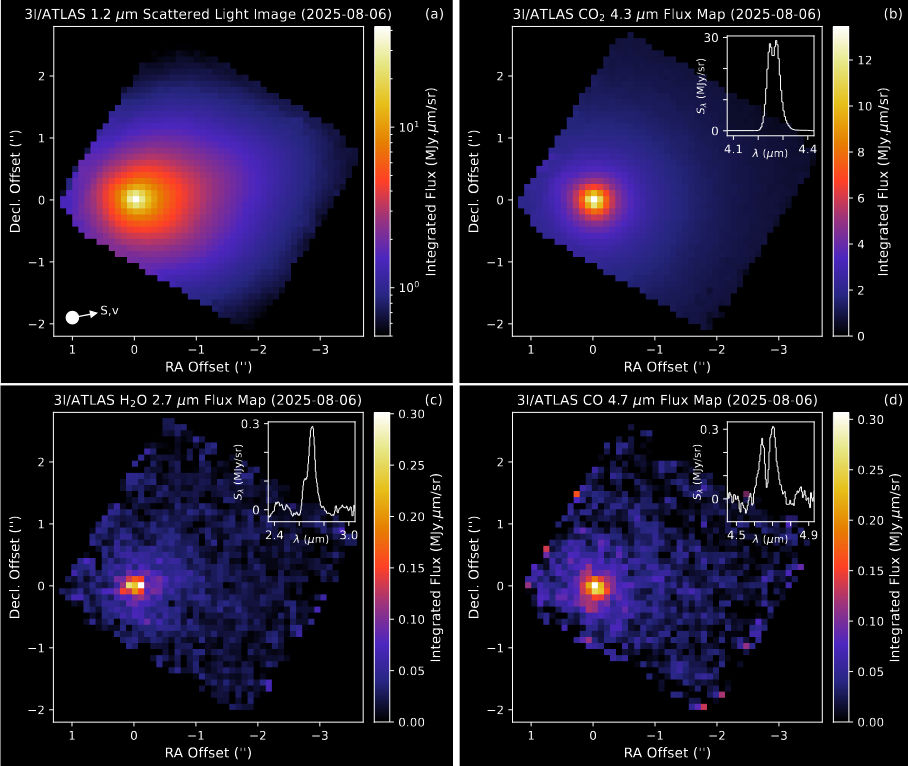
Into this debate comes new data from the James Webb Space Telescope. A paper just submitted to the Astrophysical Journal Letters reports that 3I/ATLAS looks like a comet, albeit a strange one. Here are the images from JWST:

Above: These JWST images show the distribution of carbon dioxide (panel b), water (panel c) and carbon monoxide (panel d). Most of the light is coming from CO2.

The infrared space telescope found most of the ingredients we expect to find in comets. There’s a fuzzy coma, volatile ices, and all the usual molecules: water (H20), carbon dioxide (CO2), carbon monoxide (CO). If 3I/ATLAS is a spacecraft, it has an uncanny disguise.

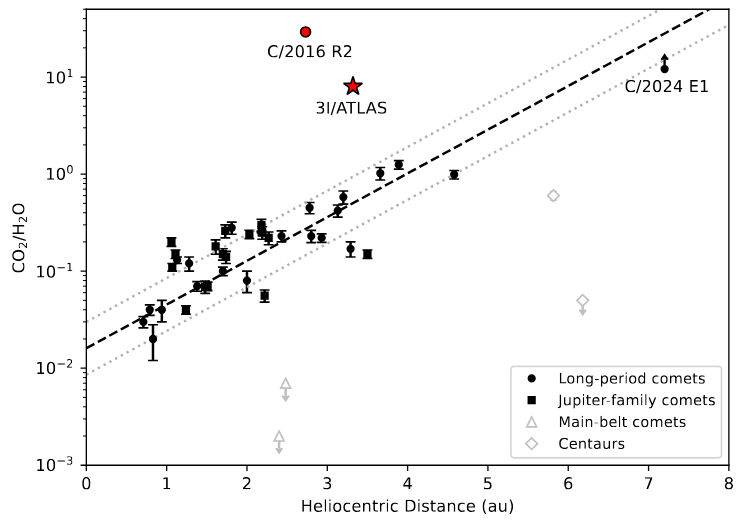
However, there’s also something strange. The ratios of the different molecules are quite unexpected and don’t match what we see in Solar System comets. In particular, the CO2/H20 ratio of 8 ± 1 is extremely high. Only one other comet, C/2016 R2, is known to have similar chemistry, and astronomers have long considered it to be a “freak.”

Above: Carbon dioxide-to-water ratios in known comets. 3I/ATLAS does not fit the trend.

Typical comets have a lot more water in their atmospheres, with H20 almost always outnumbering CO2. It could be that water production in 3I/ATLAS has not yet fully “turned on” because it is still too cold. If so, solar heating might restore ratios to normal. 3I/ATLAS will reach its closest point to the sun (1.36 AU) on Oct. 29, 2025, potentially bringing forth a geyser of water vapor to mix with the other gases.

Or, maybe, 3I/ATLAS is just strange–like it came from another star system. Stay tuned for updates.

The “Inevitable” Fragmentation of Comet Tsuchinshan-ATLAS

July 12, 2024: Comet Tsuchinshan-ATLAS (C/2023 A3) is about to fall apart. It’s “inevitable,” according to a new study by astronomer Zdenek Sekanina. “Evidence suggests that the comet has entered an advanced phase of fragmentation,” he writes.

Above: Comet Tsuchinshan-ATLAS photographed by José J. Chambó

If true, this is disappointing news. Discovered in early 2023, the comet appears to be heading for a magnificent close encounter with the sun later this year, perhaps becoming as bright as Venus in October 2024. Instead, it could fall apart before it has a chance to become a naked-eye object.

Sekanina’s arguments are threefold: First, the comet has failed to brighten as it approaches the sun. Second, the comet’s orbit seems to be affected by a “non-gravitational acceleration.” This could happen if, say, inner jets are pushing apart a disintegrating nucleus. Third, the comet’s dust tail has an unusually narrow, teardrop shape with a peculiar orientation. 

Together, these observations suggest a crumbling comet “in which increasing numbers of fractured refractory solids stay assembled in dark, porous blobs of exotic shape, becoming undetectable as they gradually disperse in space,” says Sekanina.

Above: This is what a break-up looks like–Comet LINEAR 24 years ago.

“That is a fascinating paper,” says Nick James, director of the Comet Section of the British Astronomical Association. “Sekanina is very well respected in the field, so it carries a lot of weight. To use ‘inevitable’ in any prediction about a comet may be unwise! But it is definitely a testable theory and another good reason to observe this comet at every opportunity.”

In fact, James isn’t convinced. In an independent data set, he finds no evidence of non-gravitational accelerations. “This doesn’t look like a comet that is fragmenting to me,” he says.

We’ll soon find out. The comet is brighter than 10th magnitude, well within range of mid-sized backyard telescopes, which means amateur astronomers can monitor the potential break-up. Point your optics here

This Comet Did Not Survive the Eclipse

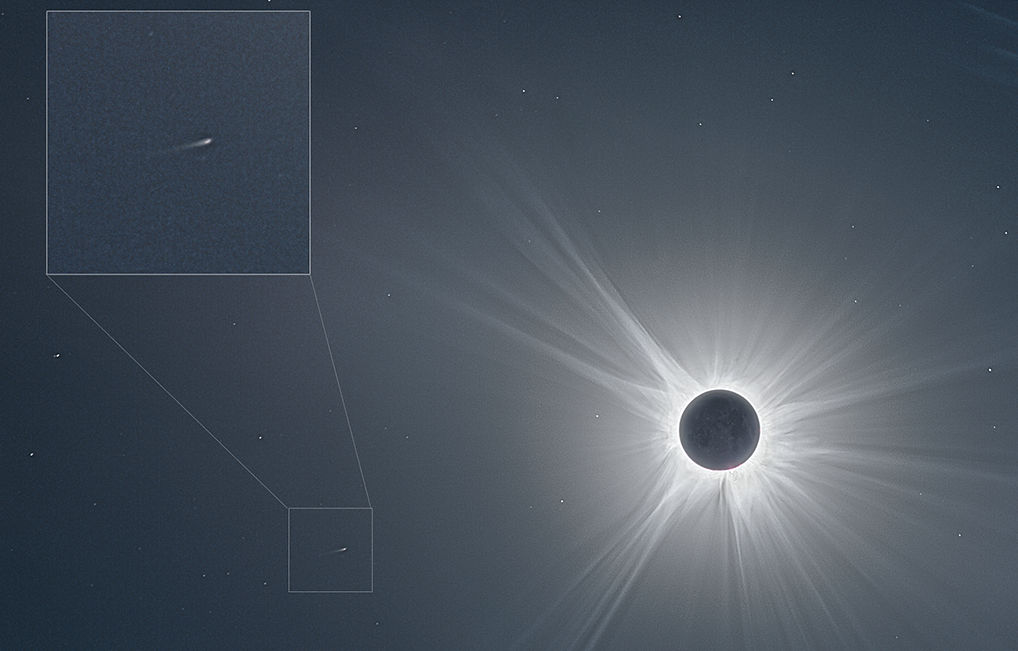
April 10, 2024: (Spaceweather.com) Astronomer Karl Battams of the Naval Research Lab predicted that a sungrazing comet might be visible during Monday’s total eclipse. He was right. Chinese amateur astronomer Lin Zixuan was in New Hampshire for the eclipse, and he photographed the disintegrating comet:

Named “SOHO-5008”, the comet had been discovered earlier the same day by amateur astronomer Worachate Boonplod, who noticed it in SOHO coronagraph images. Battams quickly realized that the comet might be bright enough to photograph in the otherworldly twilight of the Moon’s shadow.

“Ground-based observations of sungrazing comets are extremely rare, so this would be a great opportunity to see an eclipse comet!” says Battams.

Soon after Zixuan photographed the comet, it disintegrated. SOHO has seen this happen more than 5000 times. Most doomed sungrazers (including this one) are members of the Kreutz family. Named after a 19th century German astronomer who studied them in detail, Kreutz sungrazers are fragments from the breakup of a giant comet ~2000 years ago. Several fragments pass by the sun and disintegrate every day, although most are too small to see.

Above: A SOHO coronagraph image of the disintegrating comet

Battams can recall only two other examples of sungrazers seen during a solar eclipse– one in 2020 (also a Worachate Boonplod discovery) and another in 2008. ” I think with modern imaging equipment and techniques, seeing a sungrazer during an eclipse is no longer hugely challenging, but it does require one crucial ingredient: the right comet at the right time. We got lucky this week!” he says.

The best picture, so far, of the sungrazer comes from Petr Horálek of Institute of Physics in Opava, who was in Durango, Mexico, for the eclipse:

“I got especially lucky with this shot with the comet SOHO-5008, which was discovered just before the eclipse,” says Horálek. “It was truly windy and partly cloudy, totality took 3 minutes and 25 seconds and the image is the result of HDR shooting (exposure from 1/4000 s to 2s). A total of 83 usable images were used (dark frames and flat fields applied).”