COMET 3I/ATLAS IS NOT HIDING FROM EARTH

This week the internet is buzzing with headlines like “Mysterious Object Is Up to No Good While It’s Hidden Behind the Sun.” They’re referring to interstellar Comet 3I/ATLAS. Harvard astronomer Avi Loeb and others have suggested it might be a spaceship deliberately hiding from humans. There’s just one problem with this argument: We can still see it from Earth.

For example, the CCOR-1 coronagraph onboard NOAA’s GOES-19 satellite is tracking the comet and monitoring its brightness:
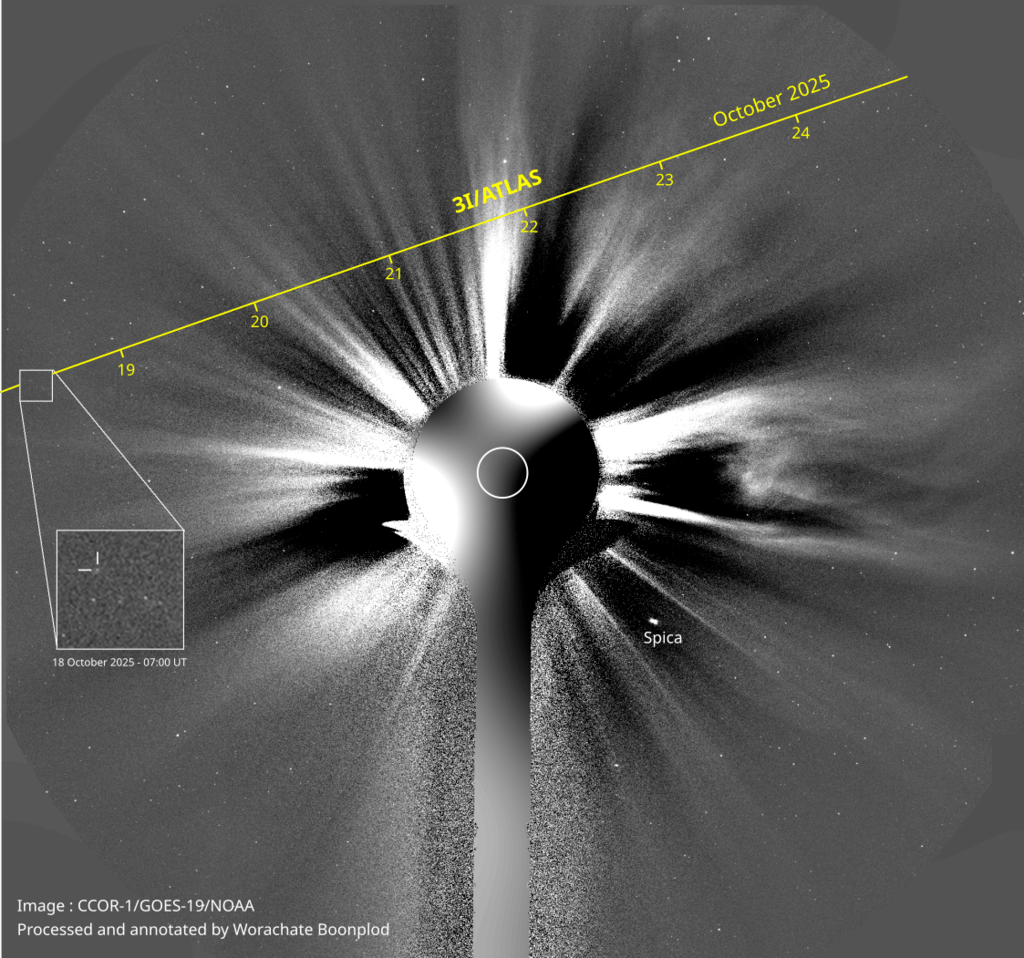
So is NASA’s quartet of PUNCH spacecraft, and coronagraphs onboard the Solar and Heliospheric Observatory (SOHO, not far from Earth). Comet 3I/ATLAS is under constant surveillance.

“Unless 3I/ATLAS fades substantially in the next couple of days, we should be able to keep eyeballs on it right through its perihelion (closest approach to the sun),” says coronagraph expert Karl Battams.

Tracking the comet is not easy because it is so faint. Battams explains how it is done: “Objects at the threshold of detection like 3I/ATLAS are a challenge for coronagraphs. We often have to employ image stacking techniques. For this to work, we have to have a very precise understanding of the pointing and distortion of the telescopes so that we can find the exact pixels that correspond to the comet. It gets fiddly, but we make it work.”

If 3I/ATLAS changes direction or surges in brightness, we will know. So far, it’s acting like a comet. T. Marshall Eubanks from Space Initiatives Inc assembled this light curve, including recent data from CCOR-1 and PUNCH:

These data confirm that 3I/ATLAS is following a fairly standard model of comet brightness with contributions from gas and dust. If this is a spacecraft, it is wearing an uncanny disguise.

In December, 3I/ATLAS will emerge from the glare of the sun. Telescopes on Earth’s surface can then rejoin the monitoring effort. Our bet: They will see a comet, not a spaceship. Stay tuned.
The Tail of Comet ATLAS is Backwards

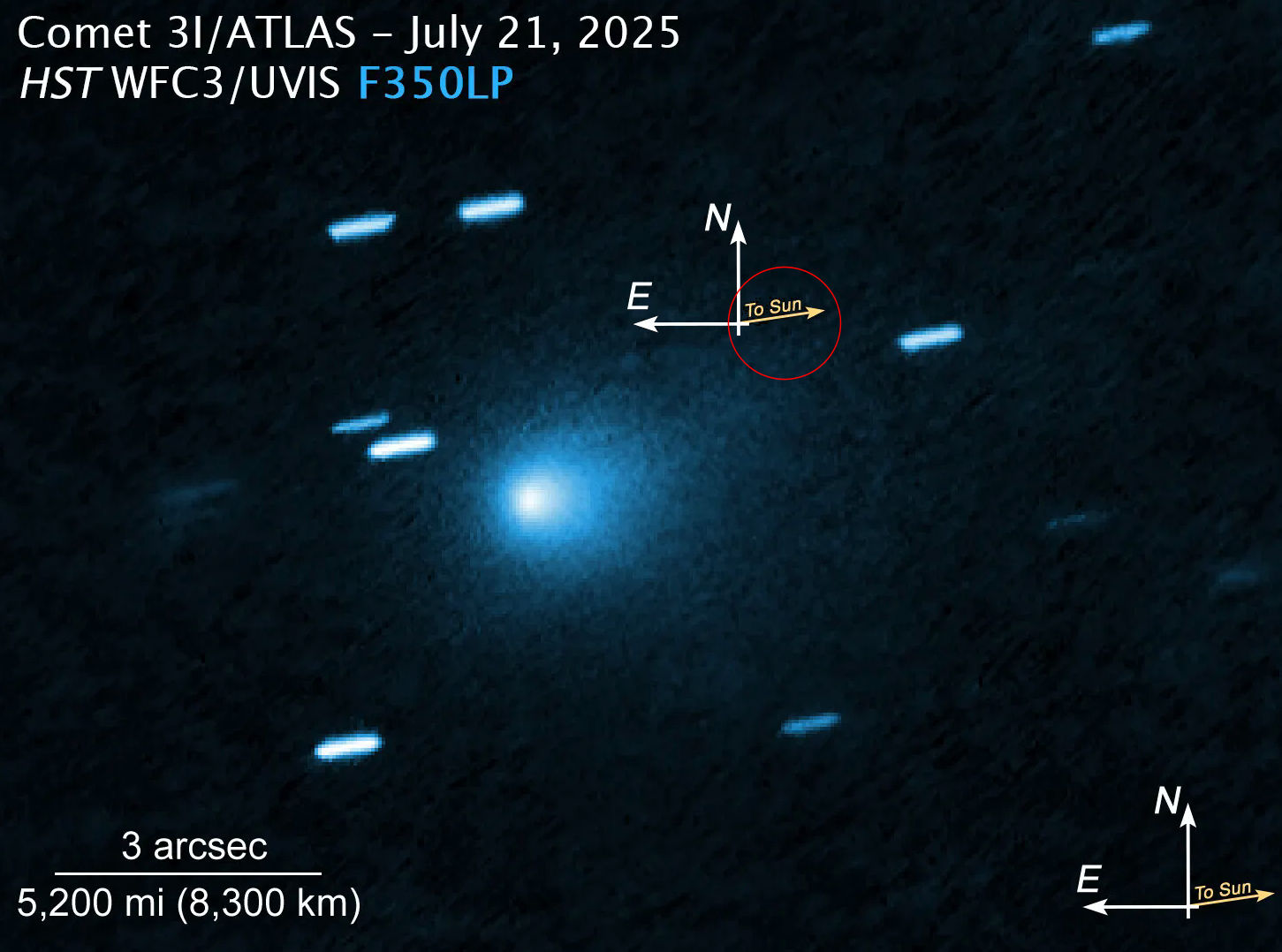
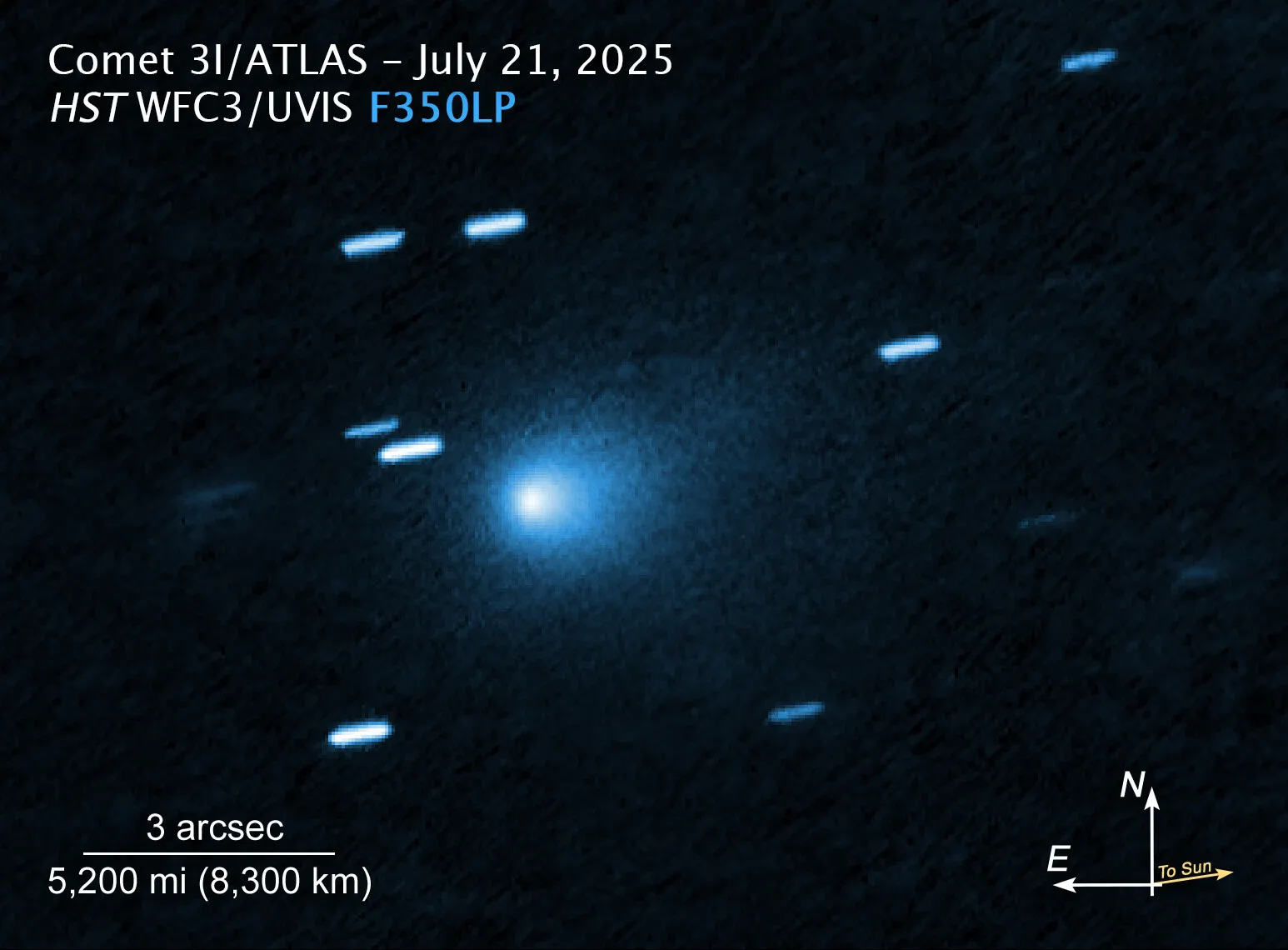
Aug. 25, 2025 (Spaceweather.com) — In July, when astronomers used the Hubble Space Telescope to photograph 3I/ATLAS, they had a “Eureka!” moment. The mysterious interstellar visitor had a fuzzy atmosphere and a growing tail. Clearly, it was a comet. 

However, something was not quite right. Take a look, and see if you can spot the problem:

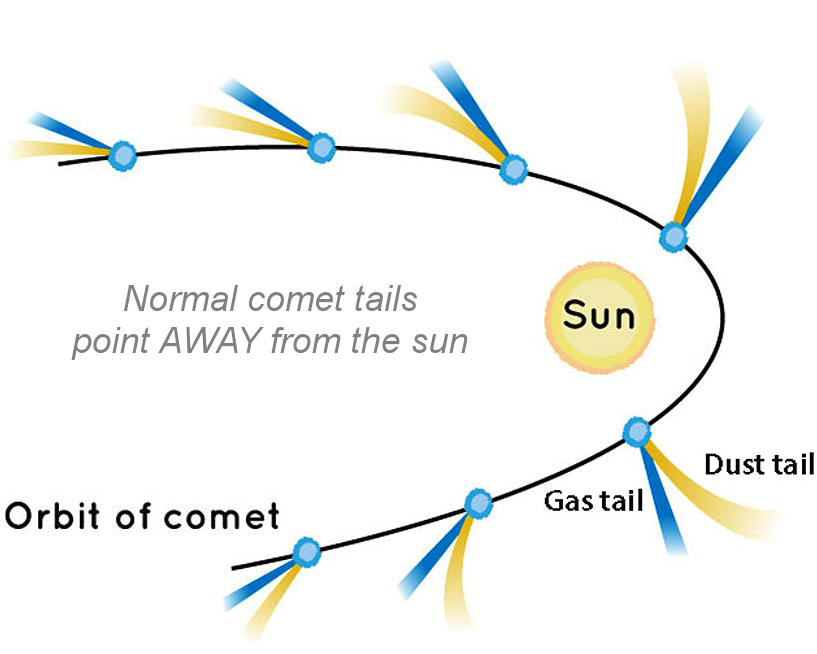
The tail of 3I/ATLAS points almost straight toward the sun. Normally, comet dust tails are pushed away from the sun by radiation pressure. 3I/ATLAS is doing the opposite—it’s backwards.

Why? Researchers led by David Jewitt of UCLA believe they have an explanation: “It is due to the preferential sublimation of ice on the hot day side of the nucleus and the near absence of sublimation on the night side,” they wrote in a paper reporting the observations.  

In other words, 3I/ATLAS *is* a comet, but only the sun-heated side is producing lots of dust. The emerging dust particles are too big for radiation pressure to bend them back into an ordinary tail.

This is unusual, but not unheard of. Solar system comets have been known to produce sunward fans or jets, typically from localized “hot spots” on their rotating nuclei. What makes 3I/ATLAS different is the dominance of its sunward plume, dwarfing a barely visible anti-solar tail behind it.

If 3I/ATLAS is indeed a comet, it may have been wandering through the galaxy for longer than our Solar System has existed. Billions of years of cosmic ray bombardment will have altered its surface–knocking hydrogen atoms out while heavier molecules remained behind. This process could create a hardened crust that might not sputter dust and gas like fresher comets from the Solar System. 

Researchers will be very interested to see how the tail of 3I/ATLAS evolves as it approaches the sun for a close encounter in October 2025. Will it remain backward? Or will the crust crumble and allow smaller particles to escape, forming a more normal anti-solar tail?

Of course, if it is a spaceship as Harvard professor Avi Loeb suggests, something completely different may occur. Either way, stay tuned.

Is 3I/ATLAS Really a Comet?

August 26, 2025: (Spaceweather.com) The most intriguing mystery in astronomy today is the nature of interstellar object 3I/ATLAS. Most astronomers believe it is a comet. However, Avi Loeb of Harvard University famously makes the case that it might be something else–like alien tech.

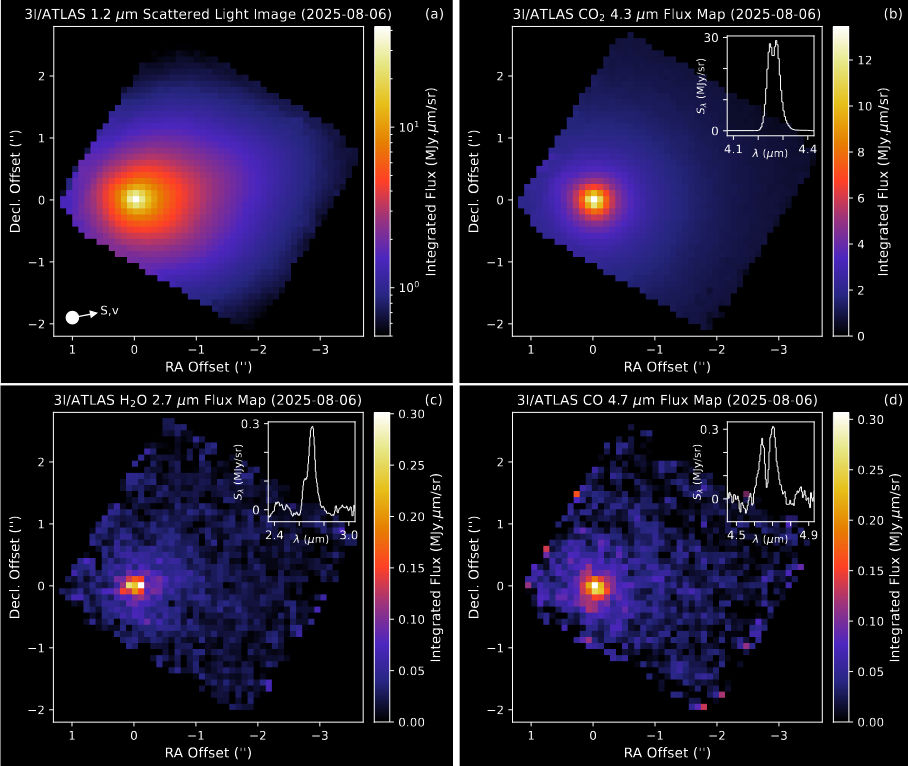
Into this debate comes new data from the James Webb Space Telescope. A paper just submitted to the Astrophysical Journal Letters reports that 3I/ATLAS looks like a comet, albeit a strange one. Here are the images from JWST:

Above: These JWST images show the distribution of carbon dioxide (panel b), water (panel c) and carbon monoxide (panel d). Most of the light is coming from CO2.

The infrared space telescope found most of the ingredients we expect to find in comets. There’s a fuzzy coma, volatile ices, and all the usual molecules: water (H20), carbon dioxide (CO2), carbon monoxide (CO). If 3I/ATLAS is a spacecraft, it has an uncanny disguise.

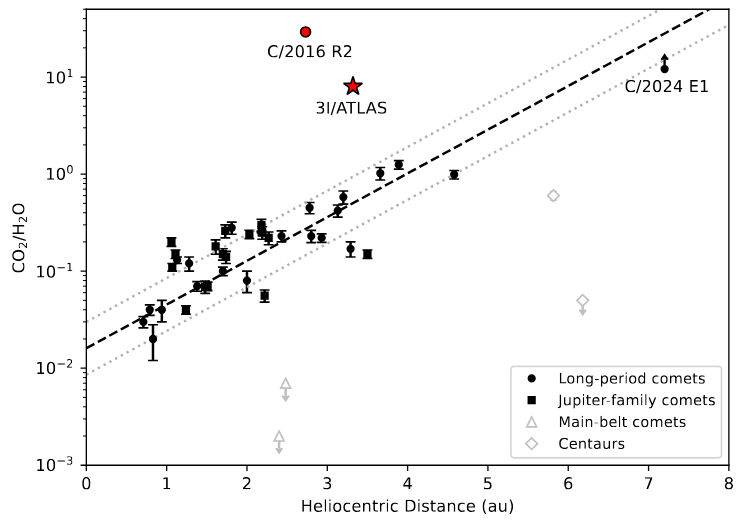
However, there’s also something strange. The ratios of the different molecules are quite unexpected and don’t match what we see in Solar System comets. In particular, the CO2/H20 ratio of 8 ± 1 is extremely high. Only one other comet, C/2016 R2, is known to have similar chemistry, and astronomers have long considered it to be a “freak.”

Above: Carbon dioxide-to-water ratios in known comets. 3I/ATLAS does not fit the trend.

Typical comets have a lot more water in their atmospheres, with H20 almost always outnumbering CO2. It could be that water production in 3I/ATLAS has not yet fully “turned on” because it is still too cold. If so, solar heating might restore ratios to normal. 3I/ATLAS will reach its closest point to the sun (1.36 AU) on Oct. 29, 2025, potentially bringing forth a geyser of water vapor to mix with the other gases.

Or, maybe, 3I/ATLAS is just strange–like it came from another star system. Stay tuned for updates.

Solar Maximum in the Sun’s Southern Hemisphere

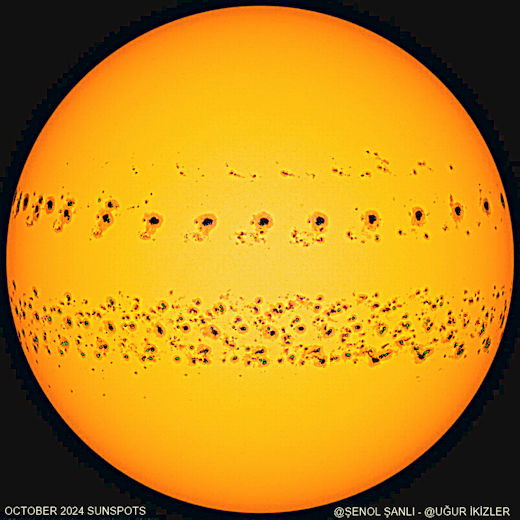
Nov. 4, 2024: At the end of October, amateur astronomer Senol Sanli made a composite 31-day image of the month’s sunspots. Take a look. Notice anything?

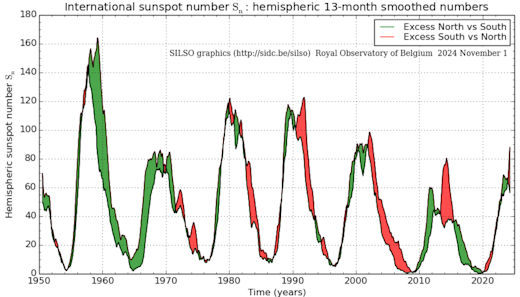
The two hemispheres of the sun are not the same. There’s a lopsided distribution of sunspots, with three times more in the south compared to the north. According to hemispheric sunspot data from the Royal Observatory of Belgium (WDC-SILSO), October was the fifth month in a row the sun’s southern hemisphere significantly outperformed the north. You can see the same pattern visually in composite images from September, August, July, and, to a lesser extent, June 2024.

What’s going on? Solar physicists have long known that the two hemispheres of the sun don’t always operate in sync. Solar Max in the north can be offset from Solar Max in the south by as much as two years, a delay known as the “Gnevyshev gap.” The assymetry is illustrated in this graph of north-vs-south sunspot numbers from the last 6 solar cycles:

Is the sun’s southern hemisphere experiencing its Solar Max right now? Maybe. We won’t know for sure until years from now when we can look back and see the final shape of Solar Cycle 25. Meanwhile, stay tuned for more southern sunspots.

Major Farside Solar Flare

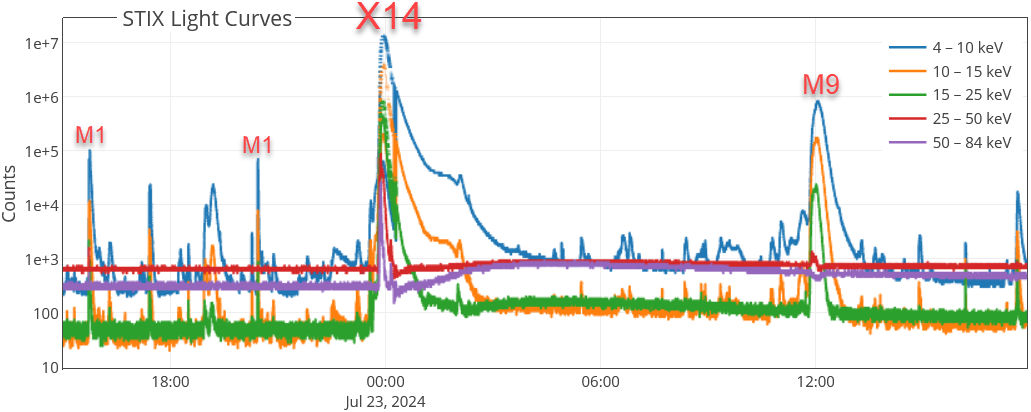
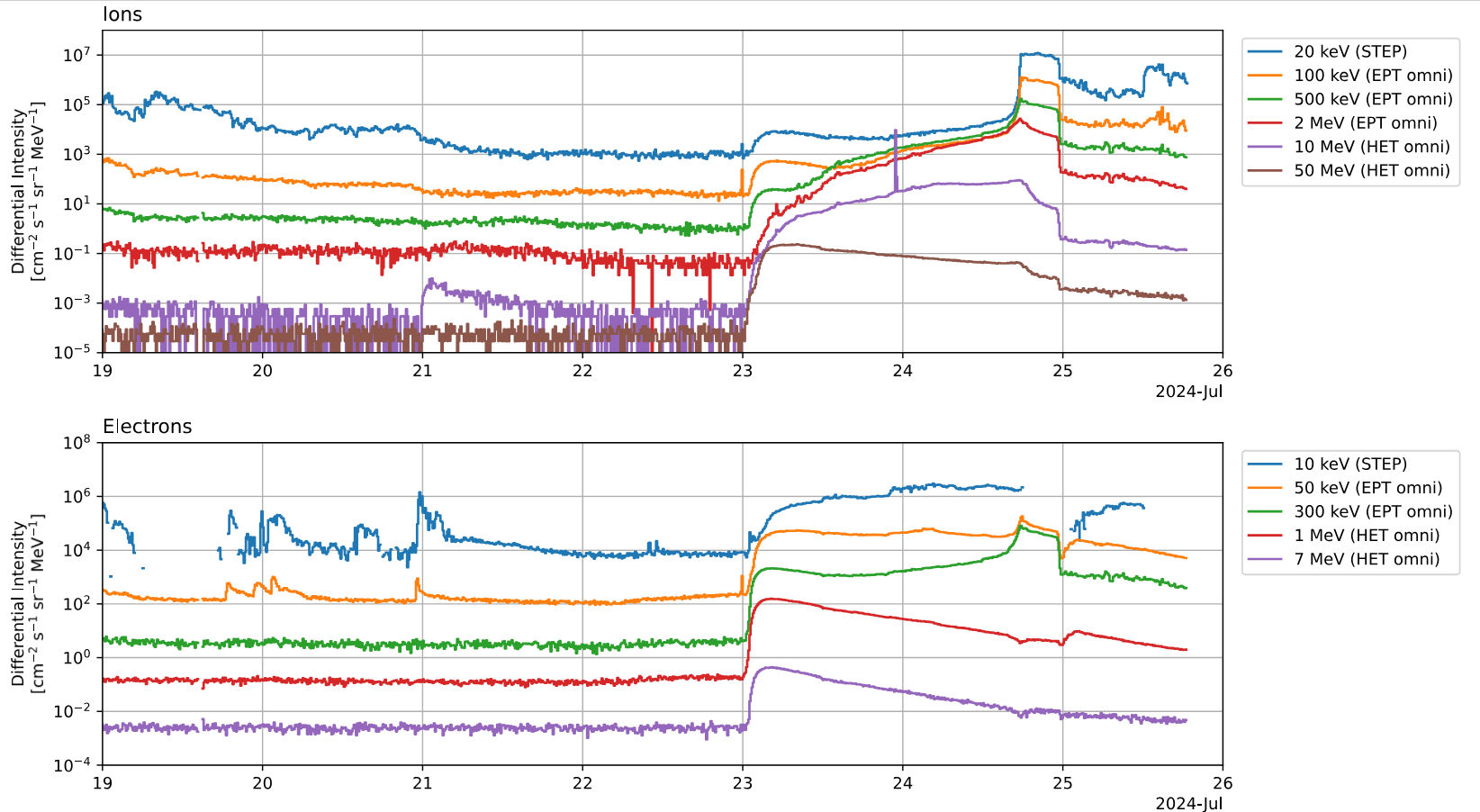
July 25, 2024: The biggest flare of Solar Cycle 25 just exploded from the farside of the sun. X-ray detectors on Europe’s Solar Orbiter (SolO) spacecraft registered an X14 category blast:

Solar Orbiter was over the farside of the sun when the explosion occured on July 23rd, in perfect position to observe a flare otherwise invisible from Earth.

“From the estimated GOES class, it was the largest flare so far,” says Samuel Krucker of UC Berkeley. Krucker is the principal investigator for STIX, an X-ray telescope on SolO which can detect solar flares and classify them on the same scale as NOAA’s GOES satellites. “Other large flares we’ve detected are from May 20, 2024 (X12) and July 17, 2023 (X10). All of these have come from the back side of the sun.”

Meanwhile on the Earthside of the sun, the largest flare so far registered X8.9 on May 14, 2024. SolO has detected at least three larger farside explosions, which means our planet has been dodging a lot of bullets.

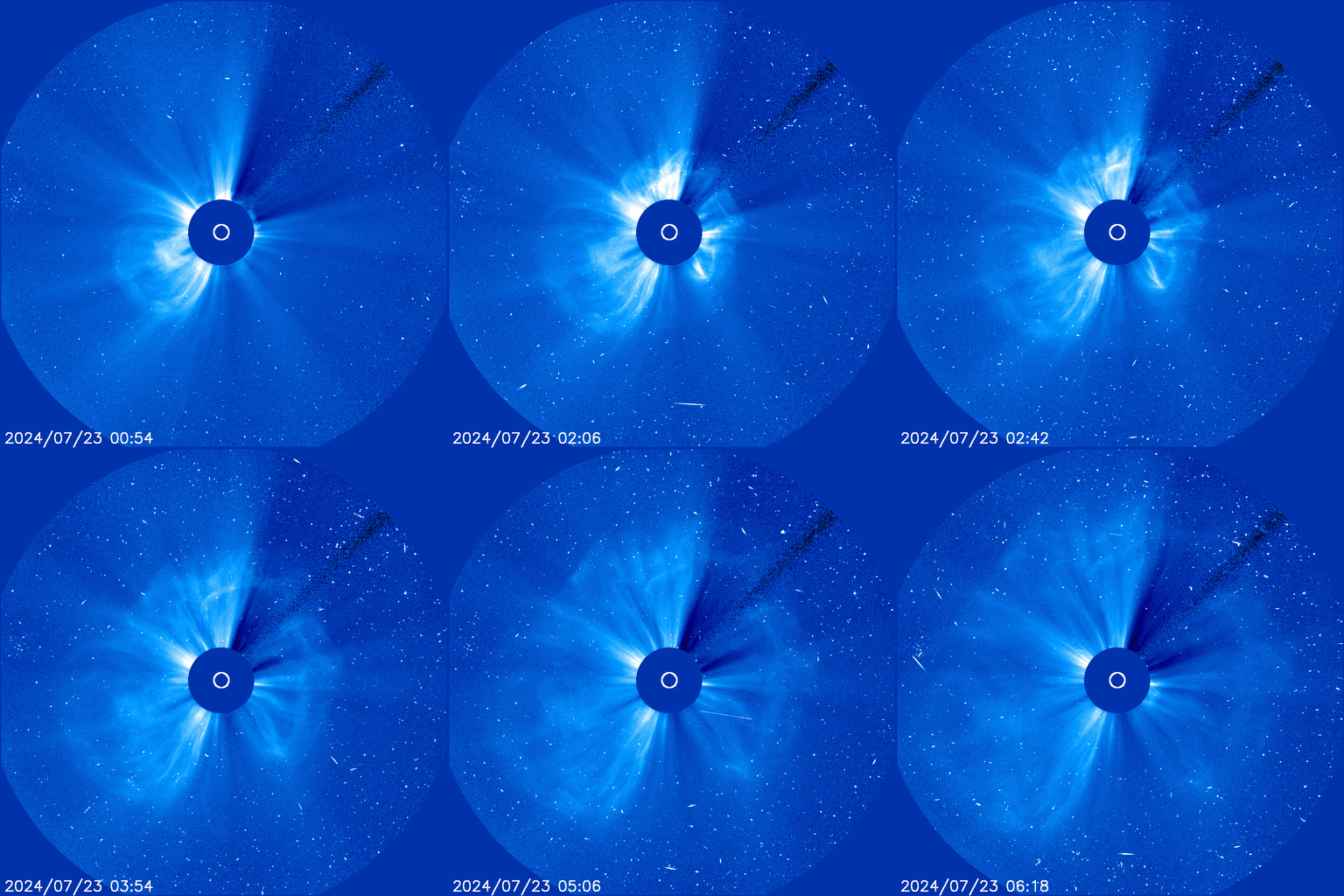
The X14 farside flare was indeed a major event. It hurled a massive CME into space, shown here in a coronagraph movie from the Solar and Heliospheric Observatory (SOHO):

The CME sprayed energetic particles all over the solar system. Earth itself was hit by ‘hard’ protons (E > 100 MeV) despite being on the opposite side of the sun.

“This is a big one–a 360 degree event,” says George Ho of the Southwest Research Institute, principal investigator for one of the energetic particle detectors onboard SolO. “It also caused a high dosage at Mars.”

SolO was squarely in the crosshairs of the CME, and on July 24th it experienced a direct hit. In a matter of minutes, particle counts jumped almost a thousand-fold as the spacecraft was peppered by a hail storm energetic ions and electrons.

“This is something we call an ‘Energetic Storm Particle’ (ESP) event,” explains Ho. “It’s when particles are locally accelerated in the CME’s shock front [to energies higher than a typical solar radiation storm]. An ESP event around Earth in March 1989 caused the Great Quebec Blackout.”

So that’s what might have happened if the CME hit Earth instead of SolO. Maybe next time. The source of this blast will rotate around to face our planet a week to 10 days from now, so stay tuned. Solar flare alerts: SMS Text

Nova T CrB is About to Explode

June 28, 2024: (Spaceweather.com) By the time you finish reading this story, there could be a new star in the night sky. Recurrent nova T CrB (pronounced “tee-core-bore”) is poised on the knife edge of a once-in-a-lifetime explosion.

“Our best estimate for the time of eruption is close to now,” says Brad Schaefer, Professor Emeritus of Astronomy at Louisiana State University.

Schaefer is a leading expert on T CrB. He’s been studying the star since he was a teenager. “When I was 18 year old, I calculated when T CrB should erupt again, and I’ve been waiting for this moment ever since,” he says.

T CrB is a “recurrent nova.” That means it erupts not just once, but over and over again. Its explosion in 1866 was the first nova astronomers had ever seen in detail. “No one knew what caused it,” says Schaefer. Another blast in 1946 established its period (79 or 80 years) and led researchers to the modern interpretation:

Located 3000 light years away, T CrB is a binary star system consisting of an ancient red giant circled by a hot white dwarf. Hydrogen from the red giant spills onto the surface of the white dwarf. It takes about 80 years to accumulate a critical mass, then–BOOM–a thermonuclear explosion occurs. “It’s an H-bomb that blows up on an incredibly large scale,” says Schaefer.

After an explosion, the process resets and repeats. Looking at old light curves, Schaefer realized that T CrB tells us when it’s about to explode. Approximately 1.1 years before each blow-up, there’s a “pre-eruption dip” in brightness. Amateur astronomers working with the American Association of Variable Star Observers (AAVSO) detected the pre-eruption dip in March 2023:

Above: The pre-eruption dip in March 2023

“If the star behaves in 2023-2024 as it did in 1945-1946, then the next eruption should take place in 2024.4+-0.3,” says Schaefer. “That’s May 2024 plus or minus a few months.”

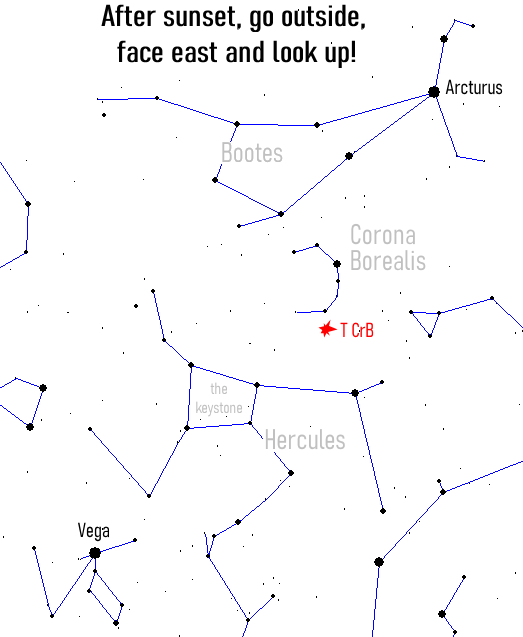
The explosion will be visible to the naked eye. Schaefer expects it to be about as bright as the North Star (2nd magnitude). When it blows, T CrB will burst forth as an extra jewel in the “Northern Crown” (the constellation Corona Borealis), easy to find high in the summer night sky between Hercules and Bootes.

“T CrB will be the brightest nova for generations,” says Schaefer. “It’s a chance for everyone in the world to step outside, look up, and see the hellfire.”

Observing tips: (1) Tonight, go outside and see what Corona Borealis normally looks like: sky map. Then, when the nova explodes, you’ll be able to tell the difference. (2) Sign up for Space Weather Alerts. All subscribers (Basic and Pro) will receive an immediate text message when the nova explodes.

A Nova Will Explode This Summer (Probably)

June 7, 2024: The night sky is about to get a new star. Sometime this summer, astronomers believe, a nova will explode in the constellation Corona Borealis (the Northern Crown). The exploding star will be bright enough to see with the naked eye even from light-polluted cities.


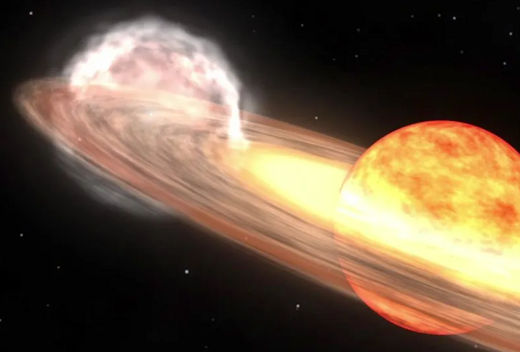
Above: A NASA artist’s concept of the T CrB binary star system

“It’s a once-in-a-lifetime event,” says Rebekah Hounsell of NASA’s Goddard Space Flight Center. “I believe it will create a lot of new astronomers out there.”

T Coronae Borealis (T CrB) is a binary system 3,000 light-years from Earth. It consists of a white dwarf orbiting an ancient red giant. Hydrogen from the red giant is being pulled down onto the surface of the white dwarf, accumulating toward a critical mass. Eventually, it will trigger a thermonuclear explosion.

The outburst will be brief. Once it erupts, the nova will be visible to the naked eye for a little less than a week – but Hounsell is confident it will be quite a sight to see. The expected magnitude is between +2 and +3, similar to stars in the Big Dipper.

“Typically, nova events are faint and far away,” says Elizabeth Hays, chief of the Astroparticle Physics Laboratory at NASA Goddard. “This one will be really close, with a lot of eyes on it. We can’t wait to get the full picture of what’s going on.”