Moths Follow the Milky Way

July 17, 2025 (Spaceweather.com): Astronomers come in all shapes and sizes–even invertebrates. A new study published in Nature reveals that Australian moths can see and decipher the night sky. They pay particular attention to the Milky Way and seem capable of navigating using the Carina nebula as a visual landmark.
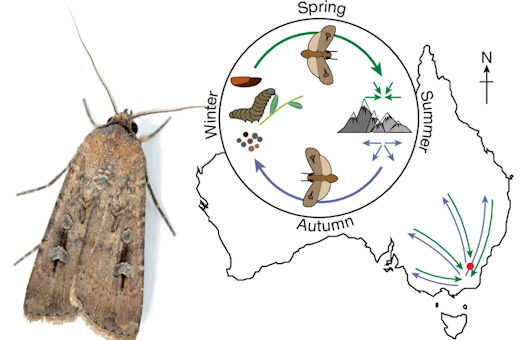

Above: A male Bogong moth and a diagram of their annual migration.

Every spring in southeast Australia, billions of Bogong moths take flight under cover of darkness. It’s the beginning of an epic migration as much as 1,000 kilometers long. Their destination: a small cluster of caves in the Australian Alps–places the moths have never visited before, yet somehow navigate to with remarkable precision. Their compass, it turns out, is the night sky itself.

Reaching this conclusion required the researchers to do something you probably don’t want to think about too closely: They attached the moths to tiny little tethers. Moths could lift off and pick a direction, but not escape. 
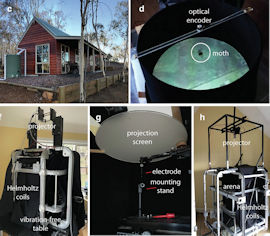
The experiment unfolded inside a special moth planetarium (pictured right). Star patterns were projected onto an overhead screen, while the ambient magnetic field was nulled by Helmholtz coils, guaranteeing that the participants could not “cheat” using magnetic navigation. When shown a normal star field, the moths oriented in the correct direction. But when the stars were scrambled into random patterns, they lost their bearings.

To dig deeper, the researchers recorded activity from visual neurons in the moths’ brains as a projected night sky rotated overhead. Neurons fired most strongly when the stars aligned with the moth’s inherited migratory heading. Some neurons were tuned to the brightest region of the Milky Way (especially near the Carina nebula) suggesting that this band of starlight is a visual landmark.

Clouds produced the next revelation: Bogong moths remained oriented even when stars were hidden. In those cases, they relied on Earth’s magnetic field instead, revealing a dual-compass system similar to that of migratory birds. When both stellar and magnetic cues were removed, the moths became disoriented again. 
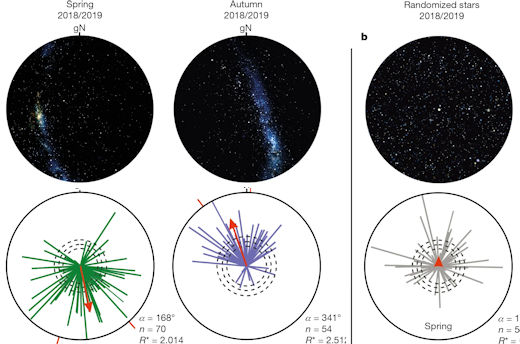
Upper row: Laboratory-projected night skies during spring and autumn, and an autumn sky with its stars randomly arranged. Lower row: The moths’ reaction to each sky.

In recent years, scientists have discovered that many creatures are guided by the stars. In addition to humans, the list includes migratory songbirds, possibly seals, dung beetles, cricket frogs, and now Bogong moths. The list of lifeforms guided by magnetism is even longer, ranging in size from microbes to whales. 

You can read the original research here.
The Electric Forest: Trees Respond to a Solar Eclipse

May 12, 2025 (Spaceweather.com): Solar eclipses aren’t just for homo sapiens. Researchers have long known that birds, insects, and many mammals pay attention when the Moon slides in front of the sun. Now we can add trees to the list.

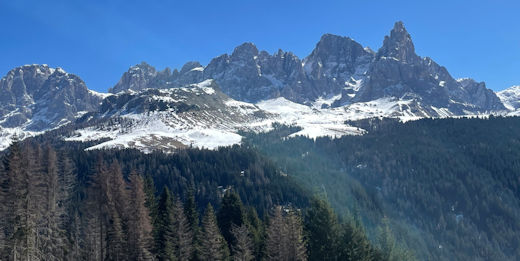
Above: The study’s location in the Dolomite Mountains of Italy. Photo credit: Monica Gagliano

A paper just published in the journal Royal Society Open Science reports the extraordinary reaction of an Italian mountain forest to a partial eclipse on Oct. 25, 2022. Electrical signals inside spruce trees began to pulse in unison, with older trees seeming to anticipate the eclipse before it happened.

This is unconventional research, and it may challenge what some readers think about trees. However, it is serious work conducted by experts in plant communication and published in a peer-reviewed journal of the Royal Society.

The paper reports how scientists led by Alessandro Chiolerio of the Italian Institute of Technology and Monica Gagliano of Southern Cross University attached electrodes to three Norway spruce trees and five tree stumps. Their device is like an EKG for trees. The trees were different ages, ranging from 20 to 70 years old, allowing the team to compare how age might influence bioelectrical responsiveness to the eclipse.


Above: Electrodes connected to the spruce trees during the eclipse. Photo credit: Monica Gagliano

As the eclipse approached, electrical signals from different trees began to align; their waveforms became more similar in shape and timing. This synchronization peaked during the eclipse and gradually diminished afterward. The older trees started showing electrical changes earlier, hours before the eclipse began, while the youngest tree responded later and more weakly. The tree stumps also exhibited a bioelectrical response, albeit less pronounced than in the standing trees.

The researchers interpreted this as a coordinated “organism-like” response to a large-scale environmental event, possibly involving communication or shared signaling pathways. 

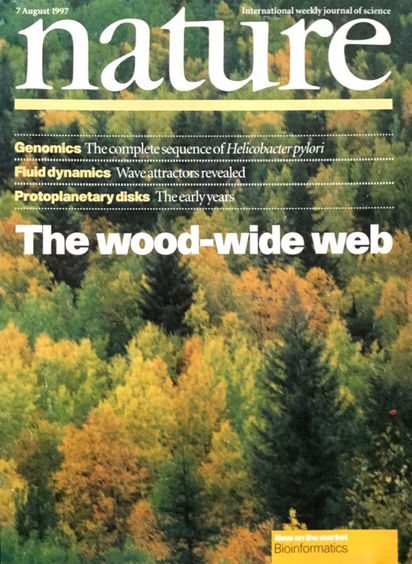
The idea that trees may “talk” to one another is key to the burgeoning field of plant communication. A growing body of research (especially since the 1990s) suggests that trees form symbiotic relationships with fungi, creating vast underground networks called the “Wood Wide Web.” Through these networks, trees exchange nutrients, water, and even chemical signals. They also reportedly recognize their own young and give preferential treatment to kin. Even tree stumps may retain connections to this network.

“Basically, we are watching the famous ‘Wood Wide Web’ in action!” says Gagliano.

Although the researchers successfully detected electrical activity in the trees, they have no idea what was being said–if anything. Perhaps it was simply a basic response to changes in temperature or light levels (about 1/3rd of the sun was covered during the eclipse). The researchers don’t yet speak the “language” of arboreal electricity, so they can’t decipher what they overheard. Repeating the experiment in different forests during more eclipses may be revealing.

Stay tuned for updates from the forest.

Recommended reading: Two good introductory books on plant communication and networking are “Finding the Mother Tree” by Suzanne Simard and “The Light Eaters” by Zoe Schlanger.

A Warning From the Trees: Miyake Events

Jan. 30, 2025: (Spaceweather.com) How bad can a solar storm be? Just ask a tree. Unlike human records, which go back hundreds of years, trees can remember solar storms for millennia.

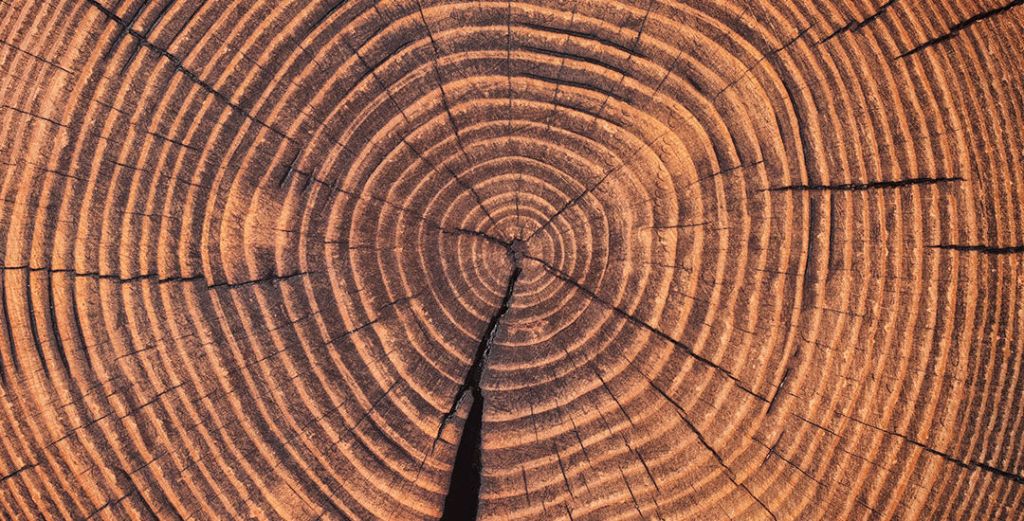
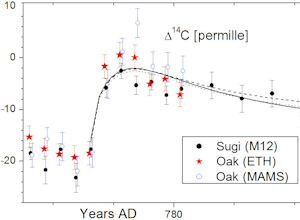
Nagoya University doctoral student Fusa Miyake made the discovery in 2012 while studying rings in the stump of a 1900-year-old Japanese cedar. One ring, in particular, drew her attention. Grown in the year 774–75 AD, it contained a 12% jump in radioactive carbon-14 (14C), about 20 times greater than ordinary fluctuations from cosmic radiation. Other teams confirmed the spike in wood from Germany, Russia, the United States, Finland, and New Zealand. Whatever happened, trees all over the world experienced it.

Most researchers think it was a solar storm—an extraordinary one. Often, we point to the Carrington Event of 1859 as the worst-case scenario for solar storms. The 774-75 AD storm was at least 10 times stronger; if it happened today, it would floor modern technology. Since Miyake’s initial discovery, she and others have confirmed five more examples (12,450 BC, 7176 BC, 5259 BC, 664-663 BC, 993 AD). Researchers call them “Miyake Events.”

Right: The 774-775 AD carbon-14 spike. [more]

It’s not clear that all Miyake Events are caused by the sun. Supernova explosions and gamma-ray bursts also produce carbon-14 spikes. However, the evidence tilts toward solar storms. For each of the confirmed Miyake Events, researchers have found matching spikes of 10Be and 36Cl in ice cores. These isotopes are known to trace strong solar activity. Moreover, the 774-75 AD Miyake Event had eyewitnesses; historical reports of auroras suggest the sun was extremely active around that time.

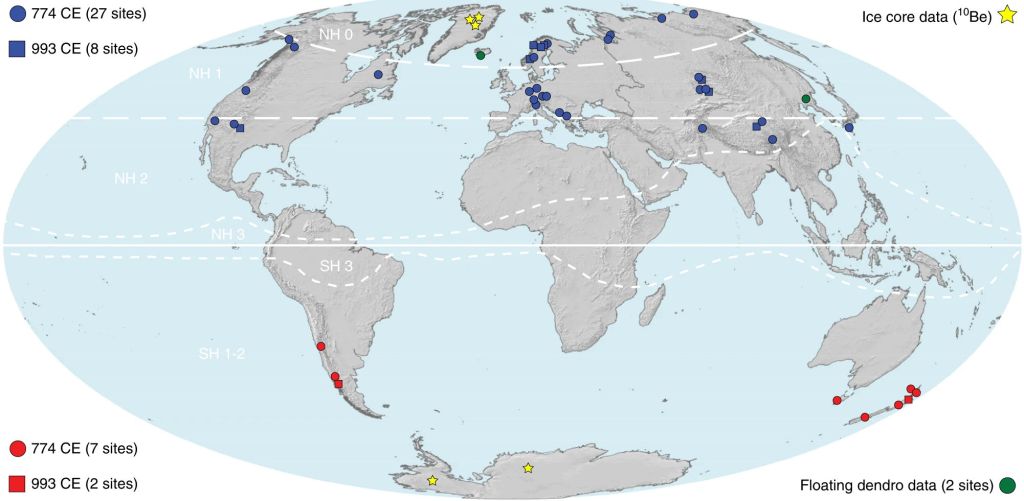
Miyake Events have placed dendrochronologists (scientists who study tree rings) in the center of space weather research. After Miyake’s initial discovery in 2012, the international tree ring community began working together to look for evidence of solar superstorms. Their collaboration is called “the COSMIC initiative.” First results published in a 2018 edition of Nature confirm that Miyake Events in 774-75 AD and 993 AD were indeed global. Trees on five continents recorded carbon spikes.


Above: A global map of COSMIC tree ring and ice core measurements [more]

“There could be additional Miyake Events throughout the Holocene” says Irina Panyushkina, a member of the COSMIC initiative from the University of Arizona’s Laboratory for Tree-Ring Research. “An important new source of data are floating tree-ring records from Eurasia and the Great Lakes region. These are very old rings that could potentially capture 14C spikes as far back as 15,000 years. Eventually, I believe we will have a complete record of Miyake Events throughout that period.”

Four more candidates for Miyake Events have recently been identified (5628 BC, 5410 BC, 1052 C, and 1279 C). Confirmation requires checking trees on many continents and finding matching spikes of 10Be and 36Cl in ice cores. It’s all part of the “slow and systematic process” of radiocarbon tree ring research, says Dr. Panyushkina.

A complete survey of Miyake Events could tell us how often solar superstorms occur and how much peril the sun presents to a technological society. Stay tuned for updates from the trees.

South Pacific Auroras Confirm May 10th Was a Great Storm

May 16, 2024: On the south Pacific island of New Caledonia, no one expects to see auroras. Ever. Situated about halfway between Tonga and Australia, the cigar-shaped island is too close to the equator for Northern or Southern Lights. Yet on May 10, 2024, this happened:

“I have rarely been so happy when taking a photo!” says Frédéric Desmoulins, who photographed the display from Boulouparis in the island’s south province. “I could see the red color of the auroras with my naked eye. According to the New Caledonian Astronomy Society, these photos are the first for this territory.”

“The auroral visibility from New Caledonia is really unique and extremely valuable,” says Hisashi Hayakawa, a space weather researcher at Japan’s Nagoya University. “As far as we know, the last time sky watchers saw auroras in the area was during the Carrington Event of Sept. 1859, when auroras were sighted from a ship in the Coral Sea.”

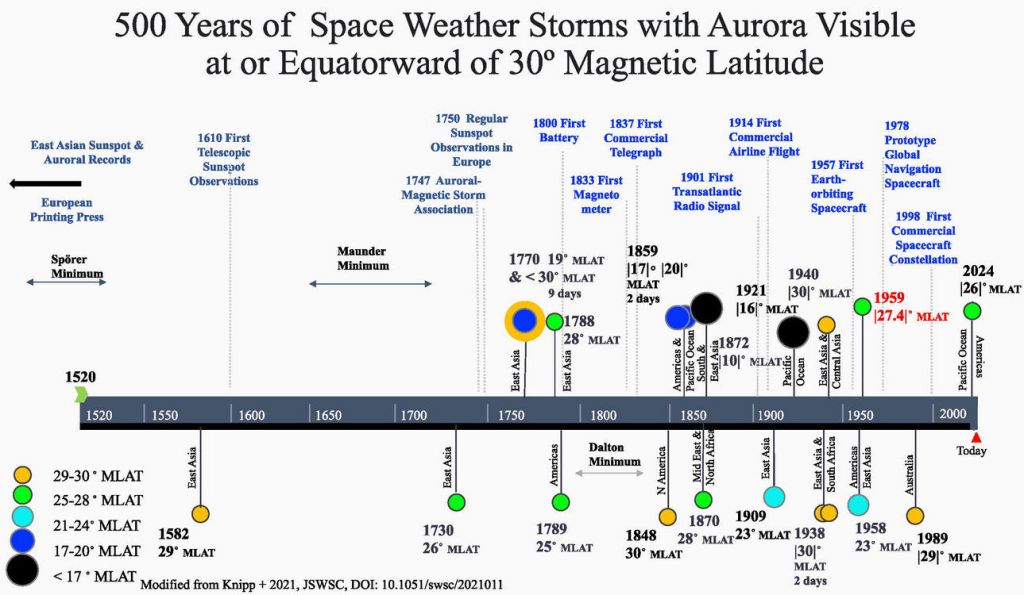
Hayakawa specializes in historical studies of great auroral storms. He tries to go back in time as far as possible. The problem is, magnetometers and modern sensors didn’t exist hundreds or thousands of years ago. Instead, he looks for records of aurora sightings in old newspapers, diaries, ships logs, even cuneiform tablets. Great Storms are identified by their low latitude–anything with naked-eye auroras below 30° MLAT (magnetic latitude).

“May 10th was definitely a Great Storm,” declares Hayakawa. “Naked-eye auroras sightings in New Caledonia (MLAT = -26.4°) and Puerto Rico (MLAT = 27.2°) confirm this in both hemispheres.”

In fact, it is among the top 20 Great Storms of the past 500 years. The above timeline from a research paper by Hayakawa has been modified to display the May 10th event. It is the green dot on the far-right end of the timeline.

This isn’t just an arcane historical curiosity. “We need to know about Great Storms of the past to understand how big storms might become today,” explains Hayakawa. “Our modern technological society depends upon it.”

Readers, if you witnessed auroras at low latitudes on May 10th, please submit your photos to our gallery and fill out this questionnaire from Hayakawa. Your observations may be included in a future research paper about this extreme storm.