The “Inevitable” Fragmentation of Comet Tsuchinshan-ATLAS

July 12, 2024: Comet Tsuchinshan-ATLAS (C/2023 A3) is about to fall apart. It’s “inevitable,” according to a new study by astronomer Zdenek Sekanina. “Evidence suggests that the comet has entered an advanced phase of fragmentation,” he writes.

Above: Comet Tsuchinshan-ATLAS photographed by José J. Chambó

If true, this is disappointing news. Discovered in early 2023, the comet appears to be heading for a magnificent close encounter with the sun later this year, perhaps becoming as bright as Venus in October 2024. Instead, it could fall apart before it has a chance to become a naked-eye object.

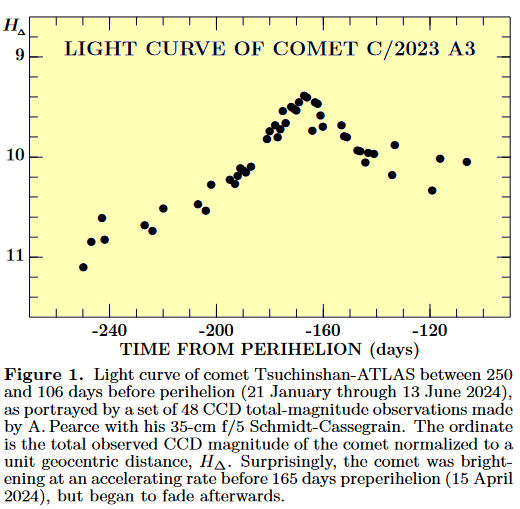
Sekanina’s arguments are threefold: First, the comet has failed to brighten as it approaches the sun. Second, the comet’s orbit seems to be affected by a “non-gravitational acceleration.” This could happen if, say, inner jets are pushing apart a disintegrating nucleus. Third, the comet’s dust tail has an unusually narrow, teardrop shape with a peculiar orientation. 

Together, these observations suggest a crumbling comet “in which increasing numbers of fractured refractory solids stay assembled in dark, porous blobs of exotic shape, becoming undetectable as they gradually disperse in space,” says Sekanina.

Above: This is what a break-up looks like–Comet LINEAR 24 years ago.

“That is a fascinating paper,” says Nick James, director of the Comet Section of the British Astronomical Association. “Sekanina is very well respected in the field, so it carries a lot of weight. To use ‘inevitable’ in any prediction about a comet may be unwise! But it is definitely a testable theory and another good reason to observe this comet at every opportunity.”

In fact, James isn’t convinced. In an independent data set, he finds no evidence of non-gravitational accelerations. “This doesn’t look like a comet that is fragmenting to me,” he says.

We’ll soon find out. The comet is brighter than 10th magnitude, well within range of mid-sized backyard telescopes, which means amateur astronomers can monitor the potential break-up. Point your optics here

This Comet Did Not Survive the Eclipse

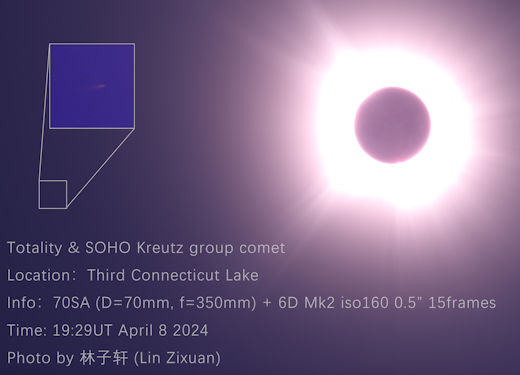
April 10, 2024: (Spaceweather.com) Astronomer Karl Battams of the Naval Research Lab predicted that a sungrazing comet might be visible during Monday’s total eclipse. He was right. Chinese amateur astronomer Lin Zixuan was in New Hampshire for the eclipse, and he photographed the disintegrating comet:

Named “SOHO-5008”, the comet had been discovered earlier the same day by amateur astronomer Worachate Boonplod, who noticed it in SOHO coronagraph images. Battams quickly realized that the comet might be bright enough to photograph in the otherworldly twilight of the Moon’s shadow.

“Ground-based observations of sungrazing comets are extremely rare, so this would be a great opportunity to see an eclipse comet!” says Battams.

Soon after Zixuan photographed the comet, it disintegrated. SOHO has seen this happen more than 5000 times. Most doomed sungrazers (including this one) are members of the Kreutz family. Named after a 19th century German astronomer who studied them in detail, Kreutz sungrazers are fragments from the breakup of a giant comet ~2000 years ago. Several fragments pass by the sun and disintegrate every day, although most are too small to see.

Above: A SOHO coronagraph image of the disintegrating comet

Battams can recall only two other examples of sungrazers seen during a solar eclipse– one in 2020 (also a Worachate Boonplod discovery) and another in 2008. ” I think with modern imaging equipment and techniques, seeing a sungrazer during an eclipse is no longer hugely challenging, but it does require one crucial ingredient: the right comet at the right time. We got lucky this week!” he says.

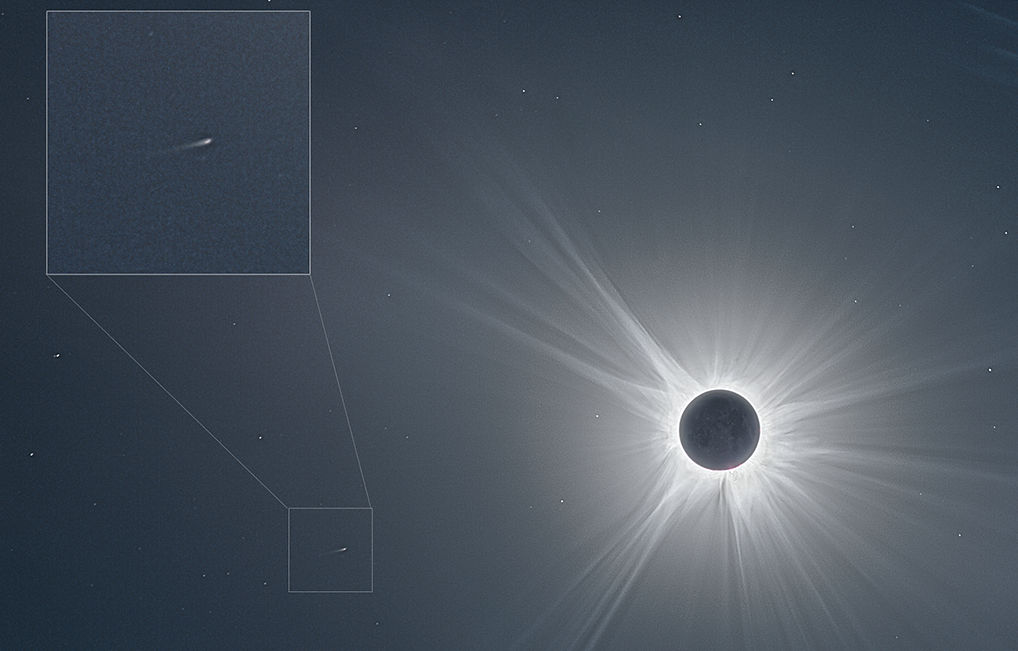
The best picture, so far, of the sungrazer comes from Petr Horálek of Institute of Physics in Opava, who was in Durango, Mexico, for the eclipse:

“I got especially lucky with this shot with the comet SOHO-5008, which was discovered just before the eclipse,” says Horálek. “It was truly windy and partly cloudy, totality took 3 minutes and 25 seconds and the image is the result of HDR shooting (exposure from 1/4000 s to 2s). A total of 83 usable images were used (dark frames and flat fields applied).”