Solar Maximum in the Sun’s Southern Hemisphere

Nov. 4, 2024: At the end of October, amateur astronomer Senol Sanli made a composite 31-day image of the month’s sunspots. Take a look. Notice anything?
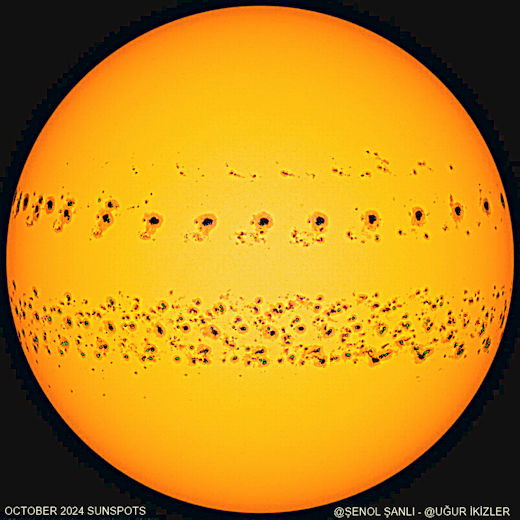
The two hemispheres of the sun are not the same. There’s a lopsided distribution of sunspots, with three times more in the south compared to the north. According to hemispheric sunspot data from the Royal Observatory of Belgium (WDC-SILSO), October was the fifth month in a row the sun’s southern hemisphere significantly outperformed the north. You can see the same pattern visually in composite images from September, August, July, and, to a lesser extent, June 2024.

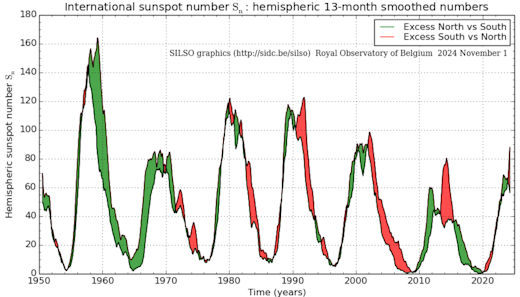
What’s going on? Solar physicists have long known that the two hemispheres of the sun don’t always operate in sync. Solar Max in the north can be offset from Solar Max in the south by as much as two years, a delay known as the “Gnevyshev gap.” The assymetry is illustrated in this graph of north-vs-south sunspot numbers from the last 6 solar cycles:
Is the sun’s southern hemisphere experiencing its Solar Max right now? Maybe. We won’t know for sure until years from now when we can look back and see the final shape of Solar Cycle 25. Meanwhile, stay tuned for more southern sunspots.
Major Farside Solar Flare

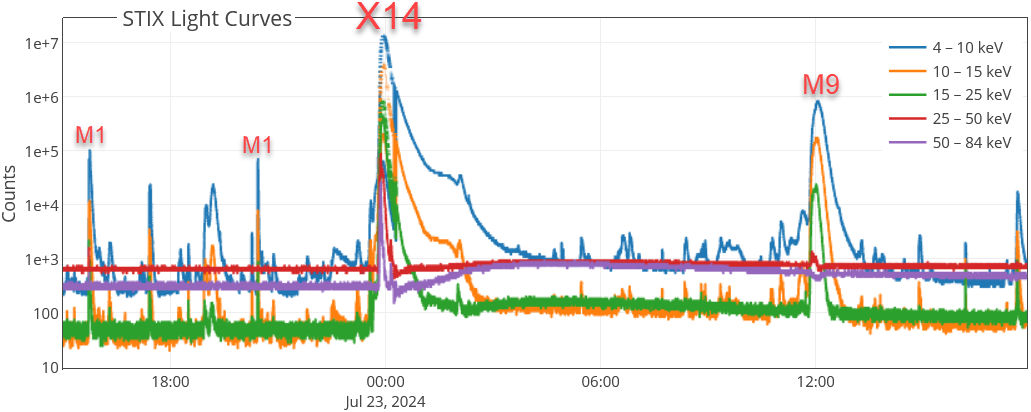
July 25, 2024: The biggest flare of Solar Cycle 25 just exploded from the farside of the sun. X-ray detectors on Europe’s Solar Orbiter (SolO) spacecraft registered an X14 category blast:

Solar Orbiter was over the farside of the sun when the explosion occured on July 23rd, in perfect position to observe a flare otherwise invisible from Earth.

“From the estimated GOES class, it was the largest flare so far,” says Samuel Krucker of UC Berkeley. Krucker is the principal investigator for STIX, an X-ray telescope on SolO which can detect solar flares and classify them on the same scale as NOAA’s GOES satellites. “Other large flares we’ve detected are from May 20, 2024 (X12) and July 17, 2023 (X10). All of these have come from the back side of the sun.”

Meanwhile on the Earthside of the sun, the largest flare so far registered X8.9 on May 14, 2024. SolO has detected at least three larger farside explosions, which means our planet has been dodging a lot of bullets.

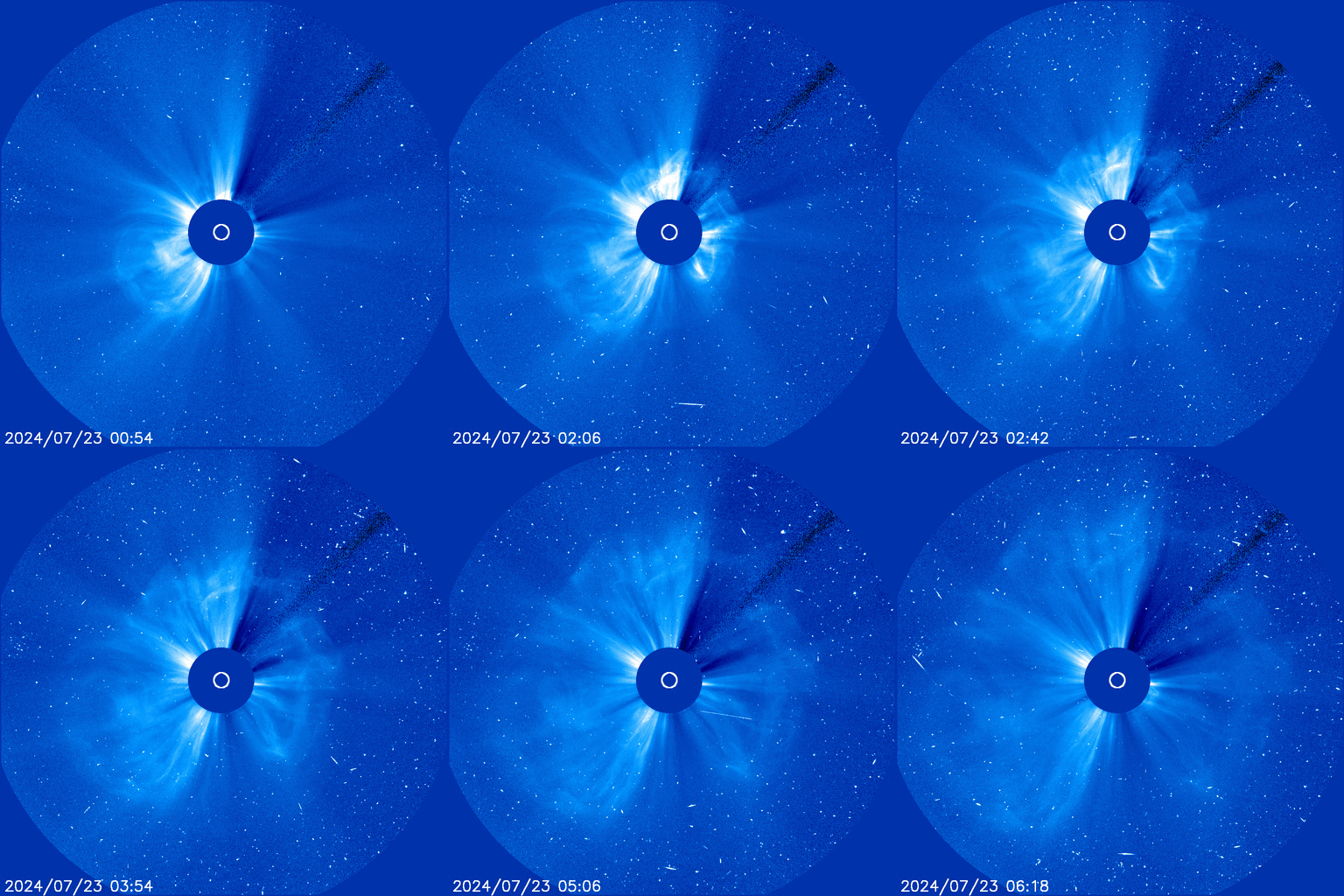
The X14 farside flare was indeed a major event. It hurled a massive CME into space, shown here in a coronagraph movie from the Solar and Heliospheric Observatory (SOHO):

The CME sprayed energetic particles all over the solar system. Earth itself was hit by ‘hard’ protons (E > 100 MeV) despite being on the opposite side of the sun.

“This is a big one–a 360 degree event,” says George Ho of the Southwest Research Institute, principal investigator for one of the energetic particle detectors onboard SolO. “It also caused a high dosage at Mars.”

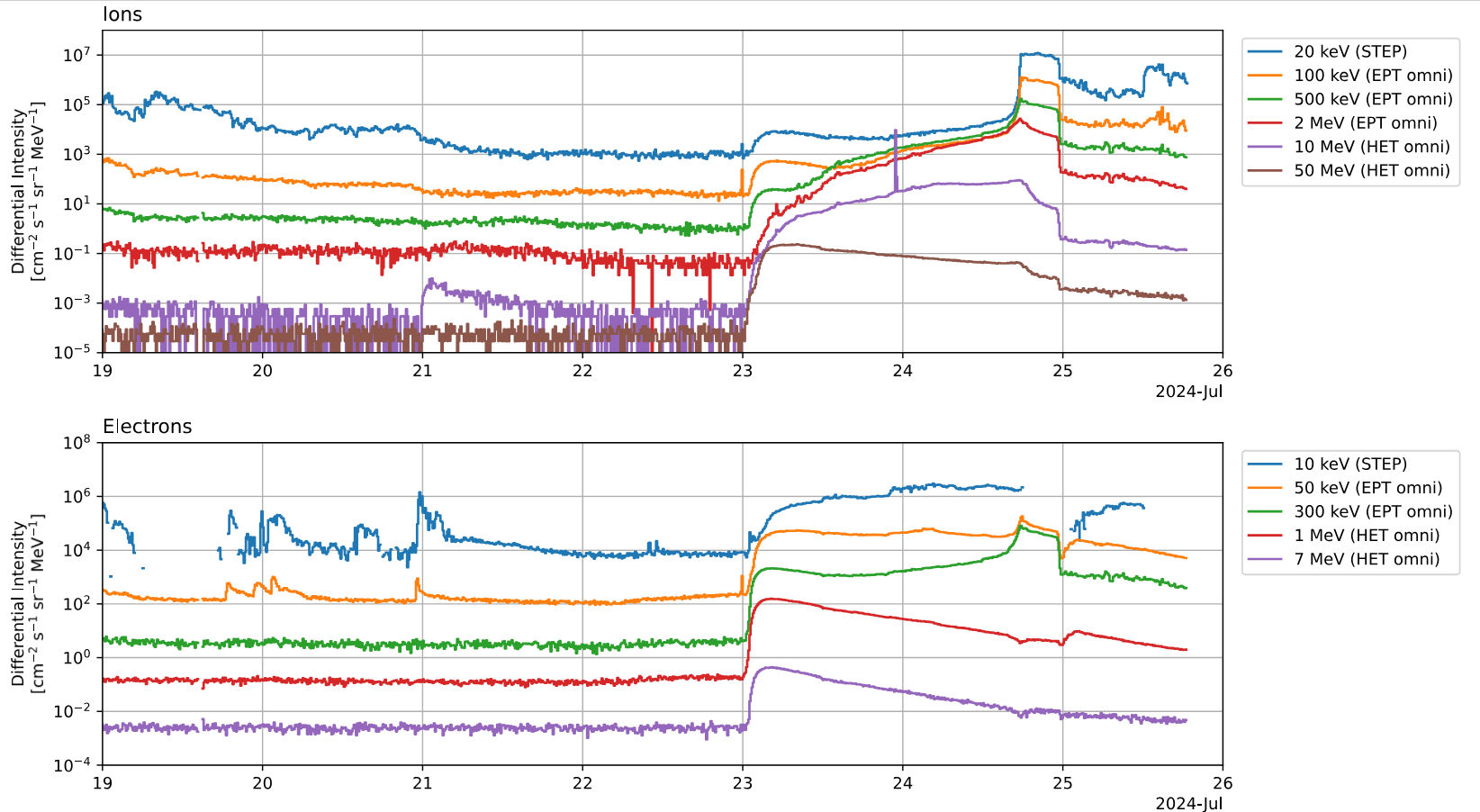
SolO was squarely in the crosshairs of the CME, and on July 24th it experienced a direct hit. In a matter of minutes, particle counts jumped almost a thousand-fold as the spacecraft was peppered by a hail storm energetic ions and electrons.

“This is something we call an ‘Energetic Storm Particle’ (ESP) event,” explains Ho. “It’s when particles are locally accelerated in the CME’s shock front [to energies higher than a typical solar radiation storm]. An ESP event around Earth in March 1989 caused the Great Quebec Blackout.”

So that’s what might have happened if the CME hit Earth instead of SolO. Maybe next time. The source of this blast will rotate around to face our planet a week to 10 days from now, so stay tuned. Solar flare alerts: SMS Text

Global Auroras on Mars

Feb 28, 2024: Earth isn’t the only planet with auroras. Mars has them, too–on a global scale.

“Mars is experiencing its greatest level of auroral activity in the past 10 years,” says Nick Schneider of the University of Colorado’s Laboratory for Atmospheric and Space Physics (LASP). “In February alone, there were three episodes of global auroras–an ‘aurora hat trick’ we’ve never seen before.”

Orbiting high above Mars, NASA’s MAVEN spacecraft recorded the auroras on 3-4 Feb, 7-10 Feb and 15-16 Feb. This animation shows the last two of these episodes in a looping time series:

Spaceweather.com actually predicted some of these events, prompted by SOHO coronagraph observations of CMEs heading toward Mars. “Your predictions came true!” says Schneider.

Schneider leads the team for MAVEN’s Imaging Ultraviolet Spectrograph (IUVS), the instrument that detected the auroras. All the purple pixels in the animation are a false color representation of the aurora’s ultraviolet glow. Martian auroras probably have a visible light component, too, but MAVEN’s cameras are not able to see them.

Here on Earth we would love it if auroras were global. Seeing Northern Lights with equal ease from the equator and the poles would check off a lot of bucket lists. Be careful what you wish for, though. Martian auroras can be global because the Red Planet has almost no protection from solar storms. It lacks an Earth-like magnetic field, so particles from the sun penetrate its atmosphere with ease–everywhere.

The dramatic auroras of February 2024 were caused by “SEPs”–solar energetic particles. SEPs are accelerated by shock waves within approaching CMEs. When they strike Mars’s atmosphere, they cause it to glow.

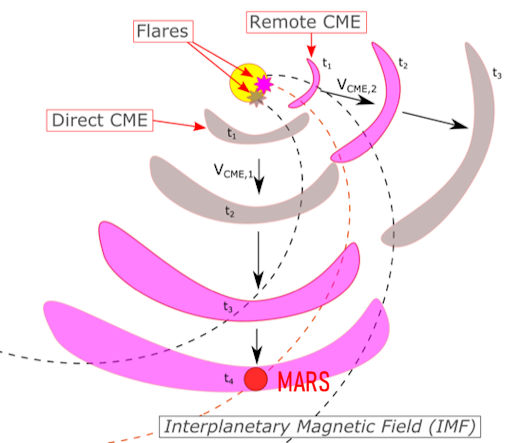
“Mars is currently getting hit by roughly 1 to 2 CMEs every month, bringing a hefty supply of SEPs,” says Rebecca Jolitz, a member of the MAVEN Solar Energetic Particle (SEP) instrument team at UC Berkeley’s Space Sciences Lab. “However, a CME doesn’t actually have to hit to be effective. SEPs coming in sideways from ‘remote CMEs’ can light up the skies as well.”

Schneider and Jolitz are looking forward to the months ahead. “Solar Cycle 25 is far from over, and we expect many more CME strikes,” Schneider says. “This will give us a chance to study how solar storms affect the atmosphere of Mars–a key goal of the MAVEN mission. It’s the kind of fun we’ve been waiting for!”

Extra: Schneider notes that SEPs aren’t the only way to make auroras on Mars. Protons in the solar wind and magnetic reconnection can do the trick, too, producing their own forms and colors. Stay tuned for more stories about the rich variety of Martian auroras as Solar Cycle 25 unfolds.