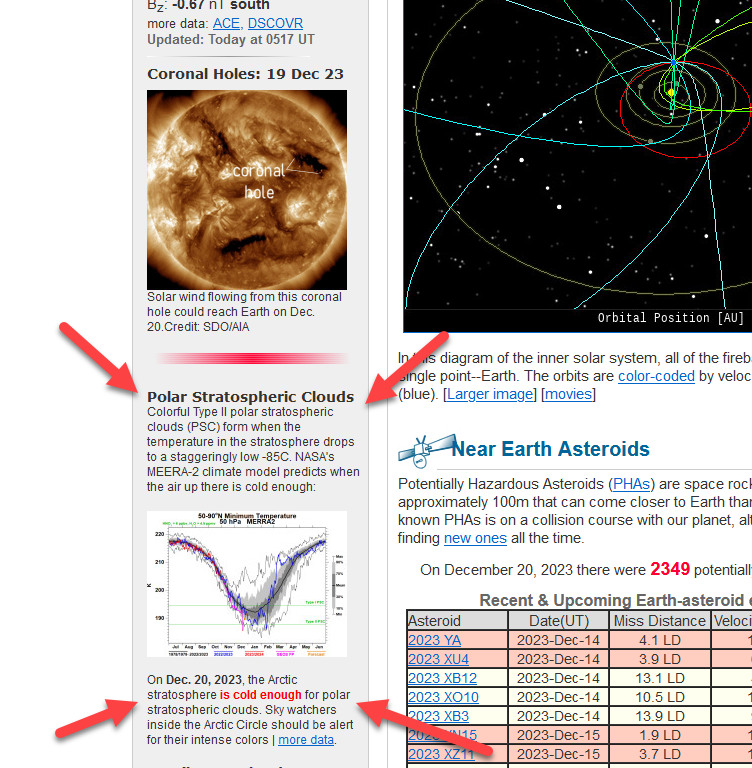
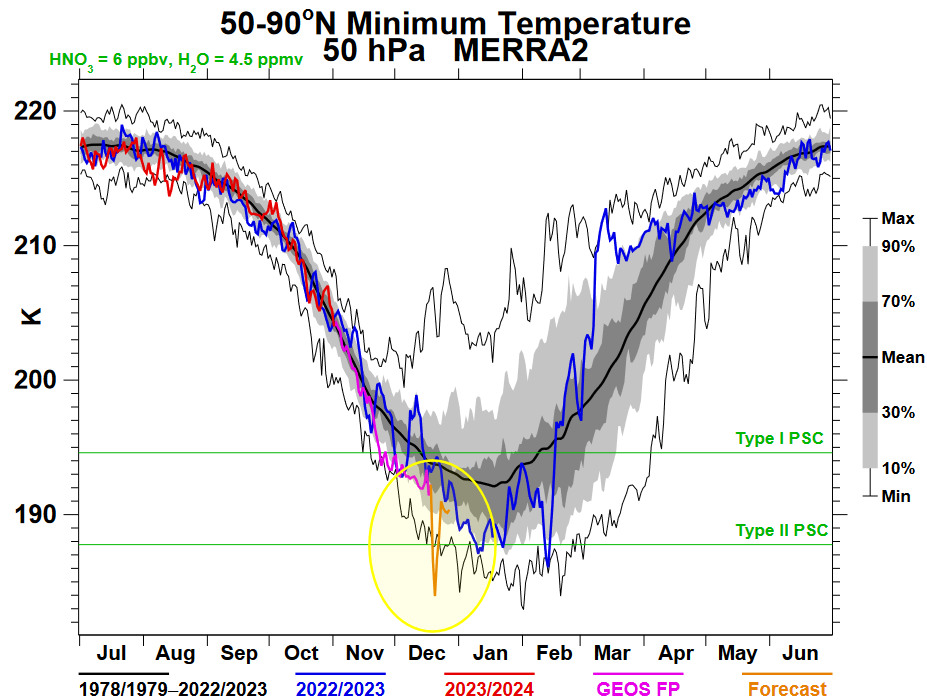
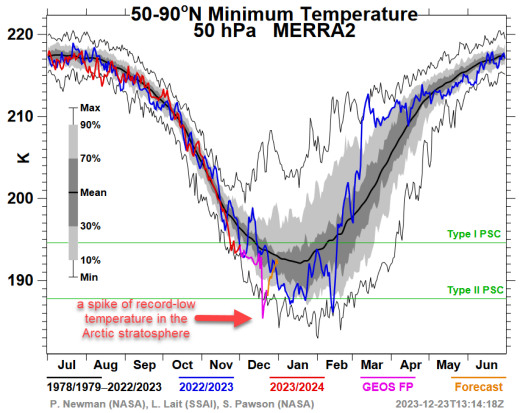
Dec. 24, 2023: (Spaceweather.com) Now we know why polar stratospheric clouds (PSCs) have suddenly exploded. According to NASA’s MERRA-2 climate model, temperatures in the Arctic stratosphere just hit a 40-year record low for the month of December:
Cold air in the stratosphere is exactly what PSCs require. Normally, the stratosphere has no clouds at all. But when the temperature drops to a staggeringly-low -85 C, widely-spaced water molecules coalesce into ice crystals and PSCs begin to form. Their aurora-like colors make them the most beautiful clouds on Earth.
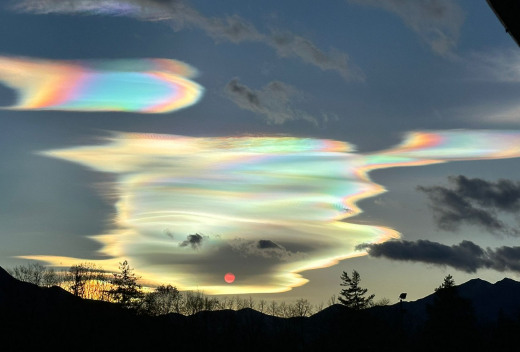
PSCs are normally confined to the Arctic where the stratosphere is coldest. During this week’s extreme cold wave, the clouds descended all the way to mid-latitudes. Here they are over Locarno, Switzerland (+46N):
“I saw these clouds for the first time on Dec. 22nd,” says photographer Branca Cristina. “The colors were amazing!”
At the same time, the clouds were sighted in Torun, Italy (+45N); the next morning they appeared again in Lausanne, Switzerland (+47N). These are extraordinary excursions from normal PSC habitat.
The season for PSCs usually starts in January. The current cold wave has given the season an early start, and could herald many more PSCs in the weeks ahead. To help sky watchers catch these rare clouds, we will henceforth publish daily predictions of temperatures in the Arctic stratosphere. When the air temperature drops below the “Type II PSC” green line, it’s time to look for PSCs. Check out the forecast here.
Dec. 17, 2023: (Spaceweather.com) A cold wave just swept through the Arctic stratosphere. Really cold. We know because on Dec. 17th these colorful clouds appeared over Sweden:
Above: A “PSC selfie” by Lights over Lapland driver Dimitrios Roukounakis
“It’s that magical time of year again,” says Chad Blakley, owner of the aurora tour guide service Lights over Lapland in Abisko, Sweden. “We just witnessed a spectacular display of polar stratospheric clouds.”
Widely considered to be the most beautiful clouds on Earth, polar stratospheric clouds (PSCs) are rare. Earth’s stratosphere is very dry and normally it has no clouds at all. PSCs form when the temperature in the Arctic stratosphere drops to a staggeringly-low -85 C. Then, and only then, can widely-spaced water molecules begin to coalesce into tiny ice crystals. High-altitude sunlight shining through the crystals creates intense iridescent colors that can rival auroras.
NASA forecast models of the polar stratosphere show that temperatures have indeed dropped into the very low range required for colorful Type II PSCs:
Above: Note the temperature dip inside the highlighted yellow oval
During a typical Arctic winter, PSCs appear no more than a handful of times, and the first sightings usually come in January. The apparition on Dec. 17th marks an early start, and may herald many more PSCs to come. Stay tuned!
Dec. 13, 2023: (Spaceweather.com): Every great mystery novel has an unexpected twist. Apparently the same is true of meteor showers.
A paper published in the Planetary Science Journal reports a surprising new twist in the mystery of the Geminids, a strong annual meteor shower that has puzzled astronomers for more than a century.
“Our work has upended years of belief about 3200 Phaethon, the source of the Geminids,” says co-author Karl Battams of the Naval Research Lab. “It’s not what we thought it was.”
Above: Geminids over the Czech Republic in 2018. Credit: Petr Horálek
The Geminids peak every year in mid-December, scattering hundreds of bright meteors across northern winter skies. Numerically it is the best meteor shower of the year.
As meteor showers go, Geminids are newcomers. They first appeared in the mid-1800s when an unknown stream of debris crossed Earth’s orbit. Surprised, 19th century astronomers scoured the sky for the parent comet, but they found nothing. The search would continue for another 100 years.
Enter NASA. In 1983, the space agency’s Infrared Astronomical Satellite (IRAS) found an object now called “3200 Phaethon.” It was definitely the source of the Geminids. The orbit of 3200 Phaethon was such a close match to that of the Geminid debris stream, no other conclusion was possible. Yet here was a puzzler: 3200 Phaethon appeared to be a rocky asteroid.
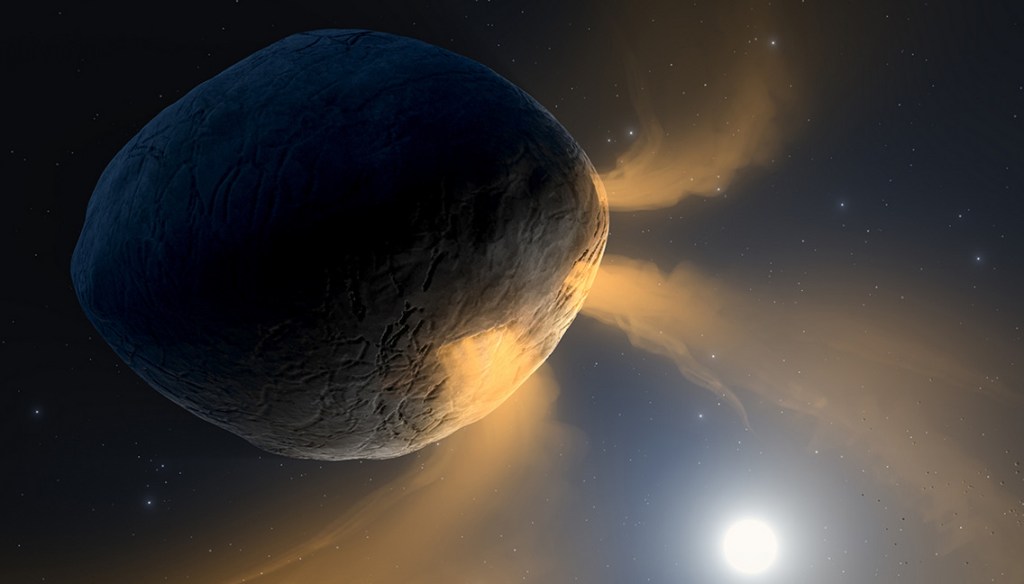
Above: An artist’s concept of 3200 Phaethon
Asteroids are not supposed to make meteor showers. Unlike comets, they don’t have tails and they don’t spew meteoroids. Yet 3200 Phaethon was different. In 2009 and 2012, NASA’s STEREO spacecraft caught 3200 Phaethon sprouting a tail when it passed close to the sun. Apparently, intense solar radiation was blistering meteoroids off 3200 Phaethon’s rocky surface. Astronomers dubbed it a “rock comet,” and the mystery was solved.
Or was it?
Astronomer Qicheng Zhang, lead author of the new paper, was never convinced. For one thing, the Geminid debris stream is massive (1013 kg), while the tail of 3200 Phaethon is puny, providing less than 1% of the mass required to explain the Geminids.
“The tail we see today could never supply enough dust to supply the Geminid meteor shower,” says Zhang.
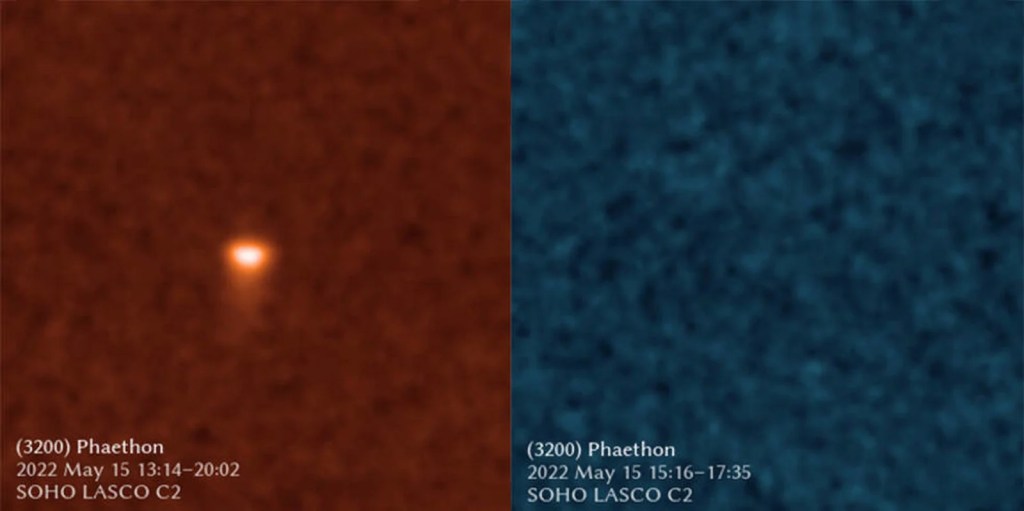
Zhang, Battams, and colleagues decided to take a closer look. Using coronagraphs on the Solar and Heliospheric Observatory (SOHO), they monitored Phaethon as it passed by the sun in 2022. Color filters on the spacecraft revealed no dust or rock. Instead, Phaethon’s tail is made of sodium gas.
Above: SOHO’s orange-filtered view (left), which can detect sodium, shows asteroid 3200 Phaethon glowing brightly.
And therein lies the twist. Meteor showers are made of meteoroids, not gas. Suddenly, the Geminids are a mystery again.
“We’re back to square one,” says Zhang. “Where do the Geminids come from?”
3200 Phaethon is still the main suspect. At least one study suggests that Geminid meteoroids are 1,000 to 10,000 years old. Perhaps something hit the asteroid millennia ago. Phaethon’s rapid rotation makes it susceptible to sudden episodes of mass loss, so even a relatively small impact could create the necessary meteoroids.
The best way to test this idea is to look at the surface of Phaethon with a space probe. Japan plans to do just that. JAXA is building a spacecraft called DESTINY+ to fly by 3200 Phaethon for a closer look. Launch is scheduled for 2025.
Until then, the Geminids remain a beautiful mystery. Look for them streaking across the night sky this week!
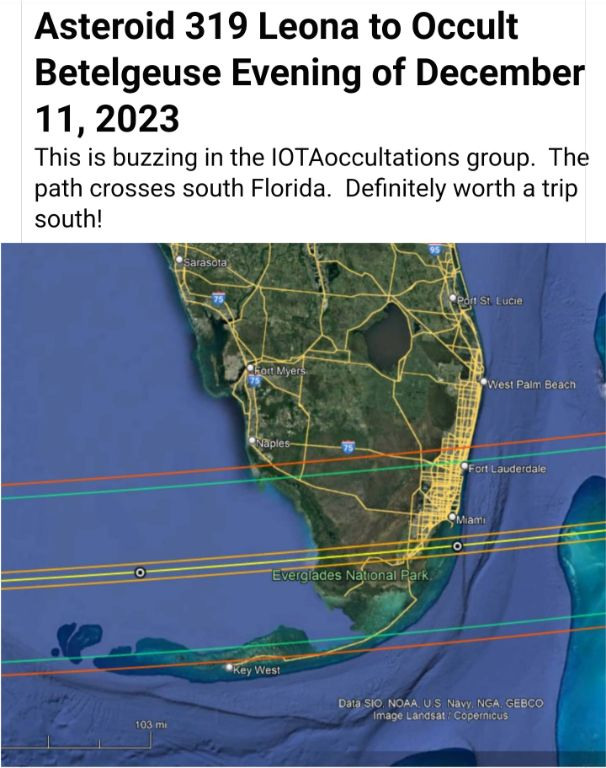
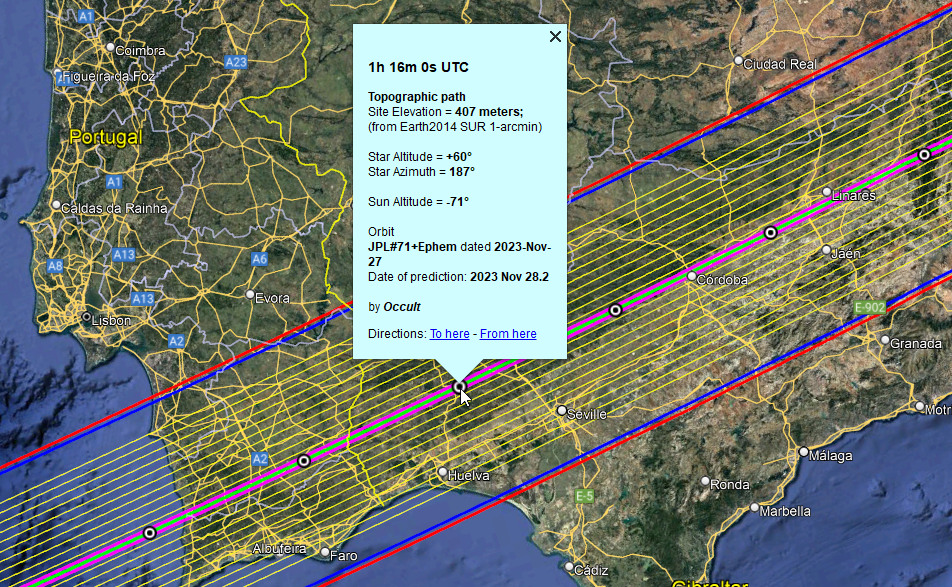
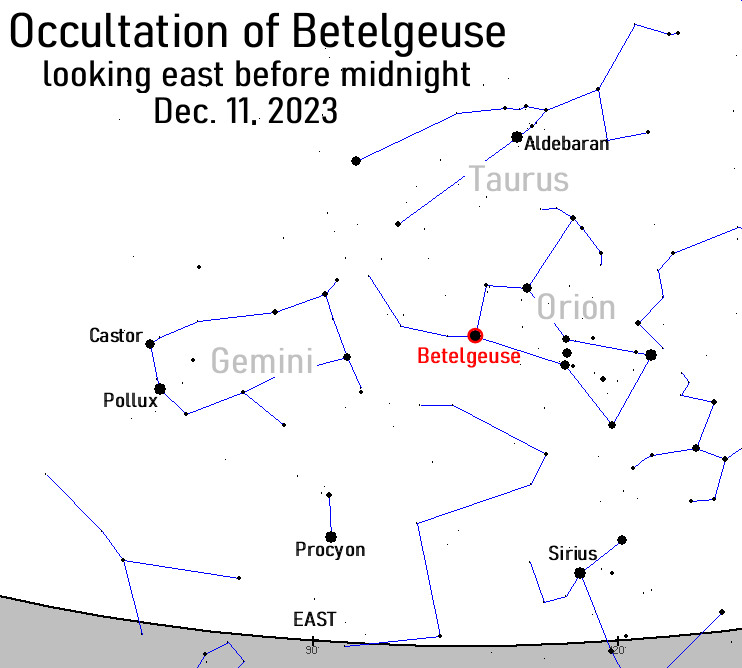
Dec. 10, 2023: (Spaceweather.com) For years, astronomers have worried that Betelgeuse might explode. Instead, it’s about to disappear. On Dec. 11th (USA) and 12th (Europe), main belt asteroid Leona will pass directly in front of Betelgeuse, a first-magnitude star in the shoulder of Orion. Millions of people in a narrow path stretching from South Florida to Italy and Greece can look up and see the red giant dim or even vanish.
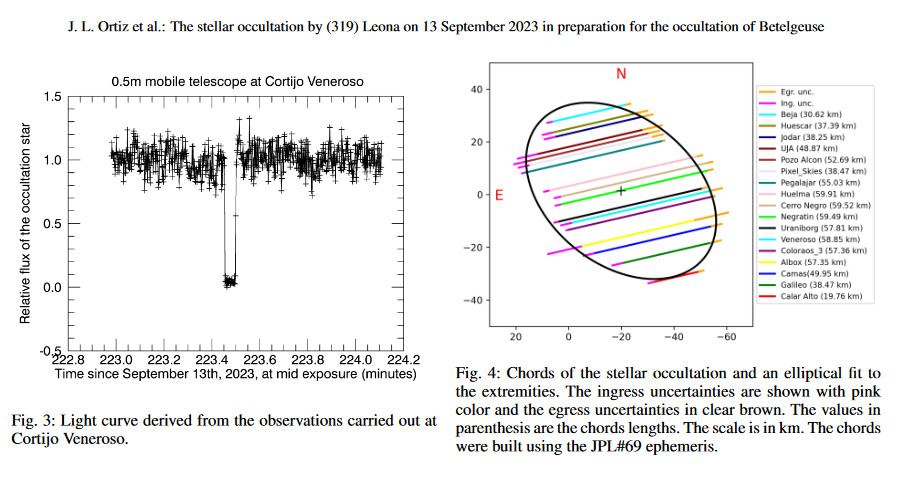
“This represents an extraordinary and unique opportunity to analyze the diameter and brightness distribution of Betelgeuse with extreme angular resolution,” says astronomer J. L. Ortiz of the Instituto de Astrofísica de Andalucía, lead author of a newly-released preprint about the occultation.
Betelgeuse is not a typical star. Its diameter is 760 times the sun’s, so it appears as a disk 40 milliarcseconds across the sky, much larger than most other stars. High resolution images of Betelgeuse seem to reveal a star in turmoil with giant convection cells bubbling up to the surface. The passage of the asteroid across Betelgeuse may allow astronomers to map these cells and evaluate their role in a possible future supernova explosion.
Above: Images of Betelgeuse taken by the European Southern Observatory’s Very Large Telescope
Much is unknown about this occultation. The shape of the asteroid itself is an X-factor. In Sept. 2023, Ortiz and colleagues watched the asteroid occult another star from 17 different locations on Earth. They found that Leona has an oblong shape with dimensions 80 x 55 km, whereas most predictions of the occultation assume the asteroid to be spherical. Leona’s odd shape, plus the fact that it is rotating, could produce some surprises. The occultation path may be wider than expected, and there could be interesting “partial eclipse” effects visible even near the center of the path.
There are huge population centers in the occultation path, especially in south Florida where Leona’s shadow crosses Miami and Fort Lauderdale. For observers there, Betelgeuse will wink out for about 10 seconds on the evening of Dec. 11th just before 8:25 pm Eastern Standard Time. In Europe, the occultation happens on Dec. 12th between 1:10 UT and 1:16 UT. To find out when to look from your location, we recommend downloading this excellent Google Earth file; when viewing the map, click on the little dots for occultation times.
Amateur astronomers who wish to collect research quality light curves are encouraged to read these observing tips from the International Occultation Timing Association. For casual naked-eye observers, here’s a simple sky map.
Nov. 20, 2023: There’s a new phenomenon in the night sky: “SpaceX auroras.” They’re red, roughly spherical, and brightly visible to the naked eye for as much as 10 minutes at a time. “We are seeing 2 to 5 of them each month,” reports Stephen Hummel of the McDonald Observatory in Texas, who photographed this one on Nov. 3rd:
Spoiler alert: They’re not auroras. The bright red balls are caused by SpaceX rockets burning their engines in the ionosphere.
The phenomenon is closely related to something we reported earlier this year. Falcon 9 rockets leaving Earth can “punch a hole in the ionosphere.” The ionosphere is a layer of ionized gas surrounding our planet; it is crucial to over-the-horizon shortwave radio communication and can affect the quality of GPS signals. Water-filled rocket exhaust can quench local ionization by as much as 70%, erasing the ionosphere along the rocket’s path. For reasons having to do with chemistry, ionospheric holes emit a red glow (630 nm).
“SpaceX auroras” are exactly the same–except instead of rockets going up, they are caused by rockets coming down. The second stage of the Falcon 9 rocket burns its engines in order to de-orbit and return to Earth, creating an ionospheric hole as it descends.
“We first noticed these SpaceX de-orbit burns over the McDonald Observatory in February 2023,” says Boston University space physicist Jeff Baumgarder, who has been studying ionospheric holes for more than 40 years. “The engine burns are only about 2 seconds long, just enough delta V to bring the second stage down over the south Atlantic Ocean. These burns happen ~90 minutes ( ~one orbital period) after launch. During the burn, the engine releases about 400lbs of exhaust gasses, mostly water and carbon dioxide. All this happens at ~300km altitude, near the peak of the ionosphere, so a significant hole is made.”
“The resulting ‘auroras’ can be very bright, easily visible with the naked eye and much brighter than Starlink satellites themselves, although only for a few seconds,” notes Hummel.
The question is, are SpaceX auroras good or bad?
Hummel is the McDonald Observatory Dark Skies Sr. Outreach Program Coordinator, so naturally he’s concerned about the effect these events may have on observational astronomy.
“The frequency of these red clouds could increase as SpaceX targets more launches in the future,” says Hummel. “Their impact on astronomical science is still being evaluated. Starlink satellites are a known issue, but the effects of the rocket launches themselves are a growing area of attention.”
For Jeff Baumgarder, who has his own dedicated camera at McDonald, the events are a golden opportunity for research.
“The saying ‘one person’s signal is another person’s noise’ is appropriate here,” says Baumgardner. “We are delighted with the rocket burns. They give us an opportunity to explore how space traffic affects the ionosphere. The ionospheric density is different night to night, so we can learn something about the efficiency of the chemistry by observing many events.”
Other sky watchers are beginning to see SpaceX auroras as well. Are you one of them? Submit your pictures here.
Nov. 14, 2023: (Spaceweather.com): A phenomenon rarely seen in centuries might have just appeared in the night sky over Colorado–a “Bright Night.” Philosophers and scientists have reported Bright Nights for literally thousands of years. It’s when an otherwise dark and moonless night fills with a soft glow, allowing observers to see distant mountains or read a newspaper. Pliny the Elder, an Army commander in ancient Rome, described the phenomenon as a “nocturnal sun” (~ 113 BCE).
In the modern world, Bright Nights are seldom seen. Most of our planet’s human population lives in cities, and even rural landscapes are somewhat lit by distant urban bulbs. The “nocturnal sun” has been overwhelmed.
Or has it? Enter Aaron Watson, an experienced night-sky photographer who regularly visits the darkest of dark-sky sites in remote parts of Colorado. On multiple occasions this year he has photographed red auroras and green airglow invisible from any ordinary countryside. Last month, he was at one of his favorite inky-dark sites when he may have experienced a modern Bright Night.
Above: Bright airglow over Colorado on Oct. 9, 2023. Credit: Aaron Watson
“I go outside on most clear nights to observe,” says Watson, “but the night of Oct 9th was noticeably different. Although there was no Moon, or any other source of light, the landscape was softly illuminated. Nearby juniper trees made dark silhouettes against the glowing night sky. I could easily see my telescope and equipment. My partner was with me, and I could see her face quite well. I remarked, ‘Wow, it’s so bright out!’ and she agreed.”
“A ‘Bright Night’ sounds exactly like what I experienced!” says Watson.
As the landscape grew in brightness, Watson decided to photograph the sky. When he pointed his lens toward the stars, the viewscreen of his camera filled with green light. “It was a very strong green airglow–perhaps the brightest I have ever seen,” he says. A 20 second exposure produced the photo shown above.
Bright Nights have been a mystery since at least the first century. Watson’s photo could be a clue. It seems to confirm a hypothesis published in 2017 by Gordon Shepherd, then a professor at Canada’s York University, who believed that Bright Nights were caused by intense displays of airglow.
Shepherd came to this conclusion using a satellite sensor he built himself: The Wind Imaging Interferometer (WINDII), which orbited Earth for 14 years onboard NASA’s Upper Atmosphere Research Satellite. When he and co-author Youngmin Cho examined WINDII’s archive, they found a number of apparent Bright Nights in the sensor’s airglow data.
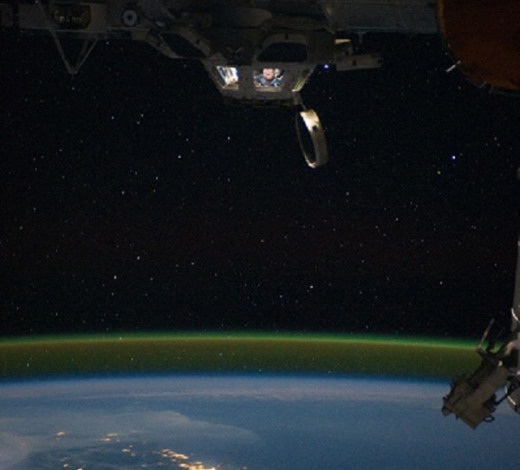
Airglow is just what it sounds like: A diffuse glow that fills the air. It is produced by photochemistry in Earth’s upper atmosphere, with its green color coming from atomic oxygen. Frequently photographed by astronauts on the ISS, airglow can be detected by sensitive cameras on almost any dark night from all locations on Earth. Rarely, however, is it visible without a camera.
Airglow seen from the International Space Station
In their paper, Shepherd and Cho highlighted 11 events where WINDII detected airglow bright enough to see with the human eye. All were correlated with giant waves of high-altitude air called “zonal waves.” Zonal waves are linked to Earth’s jet stream, and play a crucial role in weather and climate. During the events Shepherd and Cho studied, zonal waves piled up (“constructively interfered”) to create high pressure regions hundreds to thousands of miles wide. By forcing atomic oxygen into a higher concentration, the zonal waves created an intense Bright Night glow.
The amorphous glow in Watson’s photo is just what one would expect of broad zonal wave activity. “The airglow was strong in all directions,” recalls Watson. “It had a flat color density without ripples or other fine structures”–just as one would expect from Shepherd and Cho’s hypotheses.
Bright Nights might not be a thing of the past, after all.
Would you like to experience a Bright Night? Good news: Solar activity is boosting airglow, making the job of zonal waves that much easier. On the next moonless night, find a dark-dark site far from city lights. Bring a newspaper to read–and let us know what happens.
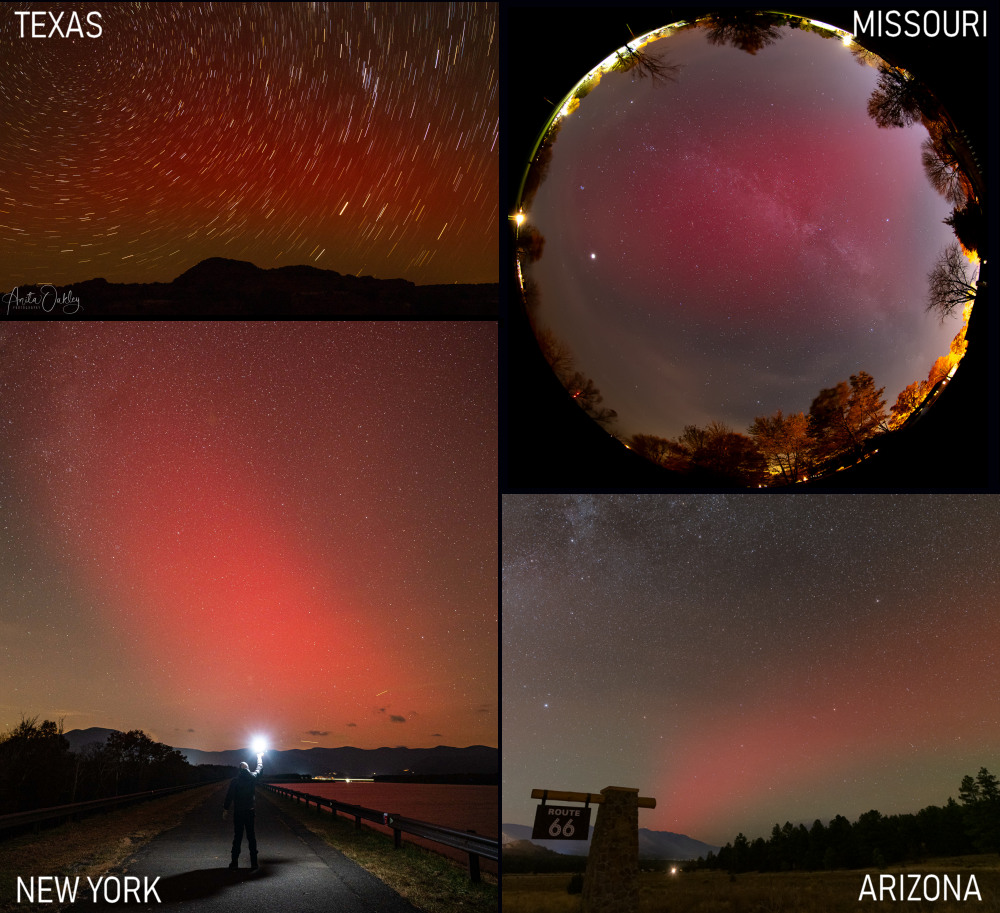
Nov. 6, 2023: (Spaceweather.com) During this past weekend’s strong G3-class geomagnetic storm, low-latitude auroras spread as far south as Texas and Arizona. Upon further review, most of those lights were not auroras at all. Everything red in this montage is an “SAR arc”:
Credits: Texas (Anita Oakley); Missouri (Dan Bush); New York (James Perez-Rogers); Arizona (Jeremy Perez)
“This was a new phenomenon to me,” says Jeremy Perez, who took the Arizona picture. “I had never heard of SARs before, but I kept shooting anyway.”
SAR arcs were discovered in 1956 at the beginning of the Space Age. Researchers didn’t know what they were and unwittingly gave them a misleading name: “Stable Auroral Red arcs” or SAR arcs. In fact, SAR arcs are neither stable nor auroras.
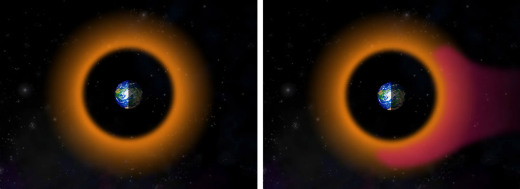
Auroras appear when charged particles rain down from space, hitting the atmosphere and causing it to glow. SAR arcs form differently. They are a sign of heat energy leaking into the upper atmosphere from Earth’s ring current system–a donut-shaped circuit carrying millions of amps around our planet.
An artist’s concept of Earth’s ring current, quiet (left) and active (right) [more]
“On Nov. 5th, the ring current was pumped up by hours of strong geomagnetic storming, with energy dissipating into these SAR arcs,” says Jeff Baumgardner of Boston University’s Center for Space Physics. “It was a global event. Our cameras registered SAR arc activity from Italy to New Zealand.”
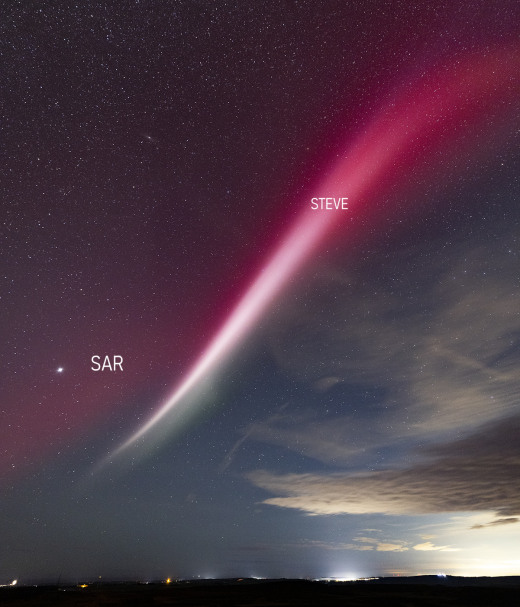
Recent research has linked SAR arcs to another phenomenon that is not an aurora: STEVE. The mauve ribbon in the sky was not originally thought to have anything to do with Earth’s ring current. Yet in 2015, observers in New Zealand caught a bright red SAR arc transforming itself into STEVE like a caterpillar into a butterfly.
On Nov. 5th, Mark Savage may have witnessed the same metamorphosis over Northumberland, UK:
Visible to the naked eye, STEVE materialized from an overhanging red arc. “The entire process took about 10 minutes,” says Savage. This timescale roughly matches that of another SAR-to-STEVE transition observed over Canada in April 2022. Clearly, the two phenomena are linked, but researchers aren’t sure how.
“The connection is still elusive,” says Carlos Martinis, a leading researcher in the field at Boston University. “Sometimes SAR arcs evolve into STEVE–but not always. This is a very active field of research, involving citizen scientists and researchers.”
Oct. 31, 2023: (Spaceweather.com) Imagine waking up to this headline: “Half of Earth’s Satellites Lost!” Impossible? It actually happened during the Great Halloween Storms of 2003.
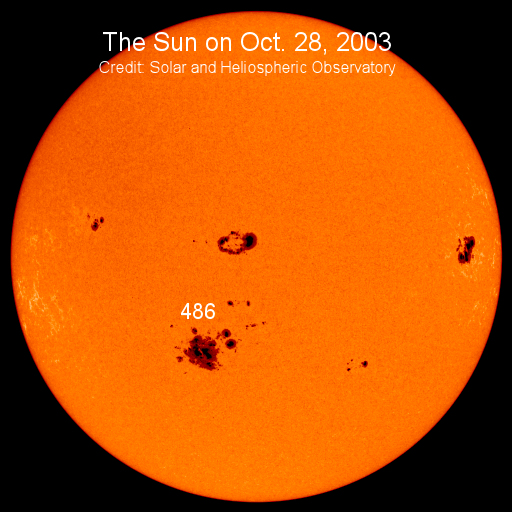
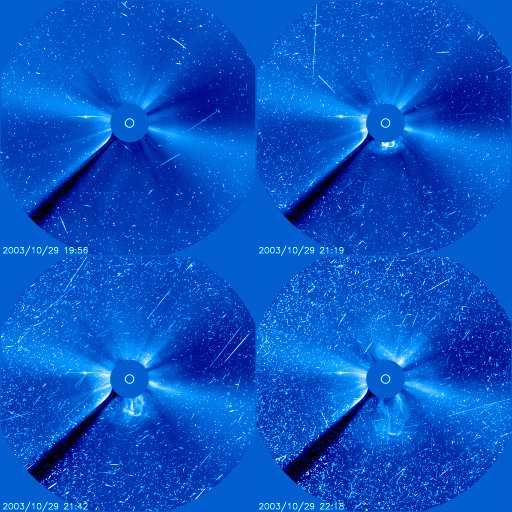
Turn back the clock 20 years. Solar Cycle 23 was winding down, and space weather forecasters were talking about how quiet things would soon become. Suddenly, the sun unleashed two of the strongest solar flares of the Space Age–an X17 flare on Oct. 28 followed by an X10 on Oct 29, 2003. Both hurled fast CMEs directly toward Earth.
A CME heading straight for Earth on Oct. 28, 2003. The source was an X17-flare in the magnetic canopy of giant sunspot 486. Image credit: SOHO. Movie
Traveling 2125 km/s and 1948 km/s, respectively, each CME reached Earth in less than a day, sparking extreme (G5) geomagnetic storms on Oct. 29, 30, and 31, 2003. Auroras descended as far south as Georgia, California, New Mexico, Arizona, Texas, and Oklahoma: photo gallery.
Onboard the International Space Station, astronauts took shelter in the hardened Zvezda service module to protect themselves from high energy particles. Meanwhile, airline pilots were frantically changing course. Almost every flight over Earth’s poles detoured to lower latitudes to avoid radiation, costing as much as $100,000 per flight. Many Earth-orbiting satellites experienced data outages, reboots and even unwanted thruster firings. Some operators simply gave up and turned their instruments off.
There’s a dawning awareness that something else important happened, too. Many of Earth’s satellites were “lost”–not destroyed, just misplaced. In a 2020 paper entitled “Flying Through Uncertainty,” USAF satellite operators recalled how “the majority of satellites (in low Earth orbit) were temporarily lost, requiring several days of around-the-clock work to reestablish their positions.”
Active sunspot 486 was the source of the 2003 Halloween storms
How did this happen? The Halloween storms pumped an extra 3 Terrawatts of power into Earth’s upper atmosphere. Geomagnetic heating puffed up the atmosphere, sharply increasing aerodynamic drag on satellites. Some satellites in low-Earth orbit found themselves off course by one to tens of kilometers.
Most satellite operators today have never experienced anything like the Halloween storms. That’s a problem because the number of objects they need to track has sharply increased. Since 2003, the population of active satellites has ballooned to more than 7,000, with an additional 20,000+ pieces of debris larger than 10 cm. Losing track of so many objects in such a congested environment could theoretically trigger a cascade of collisions, rendering low Earth orbit unusable for years following an extreme geomagnetic storm.
Oct. 25, 2023 (Spaceweather.com): When Solar Cycle 25 began in 2020, leading forecasters thought it would be weak and slow to develop. Fast forward three years: NOAA is now predicting a quicker, stronger solar cycle. The revised forecast, published yesterday, shows Solar Max coming sometime between January and October 2024:
NOAA’s original prediction for Solar Cycle 25 is shown in pink (), the broad band indicating the uncertainty of the forecast. It has become clear in recent years that the original prediction was too low, which prompted NOAA to issue a new one. The magenta line () traces the new forecast, and takes into account recent high sunspot counts.
Uncertainties in the new forecast are bounded by different shades of magenta. There is roughly a 25% chance that the smoothed sunspot number will fall within the dark-shaded region; a 50% chance it will fall in the medium-shaded region; and a 75% chance it will fall in the lightest of the shaded regions.
If this new forecast is correct, Solar Cycle 25 could land in the ballpark of Solar Cycle 23, which peaked in 2000-2001, and produced the famous Halloween Storms of 2003. However, the odds still favor Solar Cycle 25 being a bit weaker than Solar Cycle 23. Either way, next year’s Solar Max could be potent.
NOAA plans to update this new forecast every month. Check out their Space Weather Prediction Testbed for the latest prediction.
Oct. 23, 2023: (Spaceweather.com) A recent display of auroras over Canada has experts scratching their heads. The mystery? They were orange:
“This was a first for me,” says Harlan Thomas, who photographed the display over Sibbald Pond west of Calgary, Alberta, on Oct. 19th. “The orange was sublime, just incredible. The pillars in the center stayed there glowing for more than 20 minutes.”
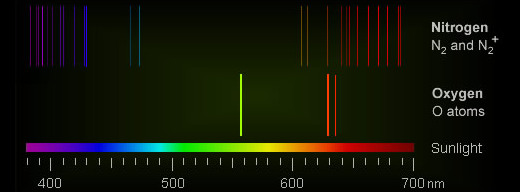
Auroras aren’t supposed to be orange. Consider the following: Auroras get their colors from atoms and molecules in Earth’s atmosphere. During geomagnetic storms, energetic particles rain down from space, striking the air and causing it to glow. Red, green, purple and even pink are common signs of excited oxygen and nitrogen.
The problem is, there’s nothing in the air capable of making bright orange. Theoretically, nitrogen and oxygen (N2, N2+, and O2+) can produce emissions at orange wavelengths. However, these emissions are very weak compared to other colors produced by the same molecules. Any orange should be overwhelmed.
Aurora colors produced by atoms and molecules in Earth’s atmosphere. [more]
The answer may be hiding in plain sight. Take another look at Thomas’s photo. Bright red auroras appear on top, overlapping green auroras lower down. Red and green mixing together may have produced the yellow-orange glow.
Indeed, aurora physicist Kjellmar Oksavik of the University of Bergen in Norway believes that’s the correct explanation:
“Red auroras are formed by low-energy electrons colliding with atomic oxygen at high altitudes (200-400 km). Here, oxygen atoms are excited into a quantum state called O(1D), where they can emit a red photon at 630.0 nanometers,” Oksavik says.
“Green auroras are formed by higher-energy electrons penetrating deeper and colliding with atomic oxygen at lower altitudes (100-150 km),” he continues. “Here, oxygen atoms are excited into a state called O(1S), where they emit a green photon at 557.7 nanometers.”
“In between, there can be a mixing of the two processes, which fools the camera and eye to believe that it is orange. In reality, it is both red and green at the same time,” he says.
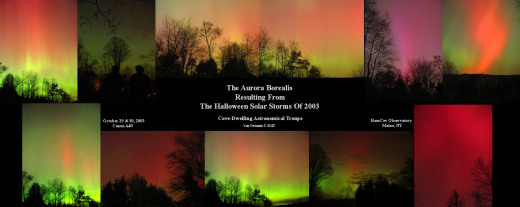
More examples of orange recorded during the Halloween Storms of 2003. Credit: Jay Edwards [more]
Oksavik points out one more thing in Harlan Thomas’s photo: “It beautifully reveals the alignment of Earth’s magnetic field. The bright pillar in the center is a textbook example of a very tall auroral ray. These are aligned along the magnetic field and caused by a broad energy spectrum of electrons [raining down from space]. Slower electrons collide high up (red light), while more energetic electrons travel further down into a much denser atmosphere (green light).” The overlap naturally produces a yellow-orange glow–no mystery molecule required.







 ), the broad band indicating the uncertainty of the forecast. It has become clear in recent years that the original prediction was too low, which prompted NOAA to issue a new one. The magenta line (
 ) traces the new forecast, and takes into account recent high sunspot counts.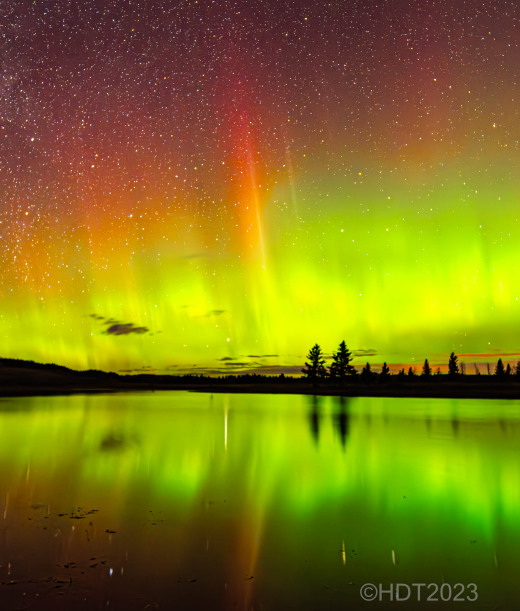
 Spaceweather.com