A Pure Sine Wave Just Rippled Through the Magnetosphere

Oct. 18, 2023: In a quiet room, you can hear a pin drop. Norwegian citizen scientist Rob Stammes just heard a pin drop on Earth’s magnetic field.

“It was very quiet when it happened,” says Stammes, who runs a space weather observatory in Lofoten, Norway. On Oct. 17th, his magnetometer was monitoring Earth’s magnetic field as it does every night, and the instrument’s needle had settled itself into a straight line, indicating very low geomagnetic activity.  Suddenly, Earth’s magnetic field began to ring.
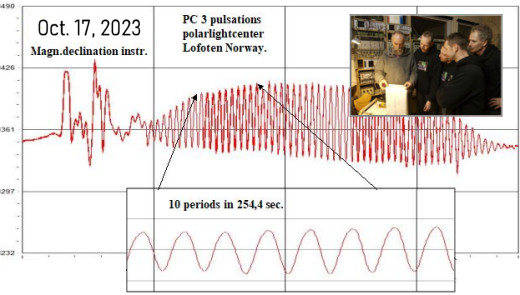
“A very stable ~25 second magnetic oscillation appeared in my recordings, and lasted for more than 20 minutes,” he says. “It was fantastic to see the magnetic field swing back and forth by about 0.1 degrees, peak to peak.”

This kind of pure tone is rare, but it has happened before. Researchers call it a “pulsation continuous” — or “Pc” for short. Pc waves are classified into 5 types depending on their period. The waves Stammes caught fall into category Pc3.

The “pin dropping” was a gentle gust of solar wind. Imagine blowing across a piece of paper, making it flutter with your breath. The solar wind can have a similar effect Earth’s magnetic field. Pc3 waves are essentially flutters propagating down the flanks of our planet’s magnetosphere excited by the breath of the sun.

A NASA animation of waves fluttering down the sides of Earth’s magnetosphere [more]

Stammes is a longtime observer of Pc waves. Usually he catches them during Solar Minimum when “the room is quiet” for months at a time. “Recording one now so close to Solar Max is unexpected,” he says. “Lately, my magnetometer traces have been too noisy for such delicate waves–so it came a surprise!”

Pc3 waves, which can only be heard in moments of quiet, can also bring the quiet to an end. The oscillations sometimes flow all the way around Earth’s magnetic field and cause a “tearing instability” in our planet’s magnetic tail. This, in turn, sets the stage for magnetic reconnection and geomagnetic storms.

That didn’t happen on Oct. 17th, though. The pin dropped, the magnetosphere rang, and quiet resumed. Stammes is already listening for more. Stay tuned!

The Millennium Falcon Flies Again

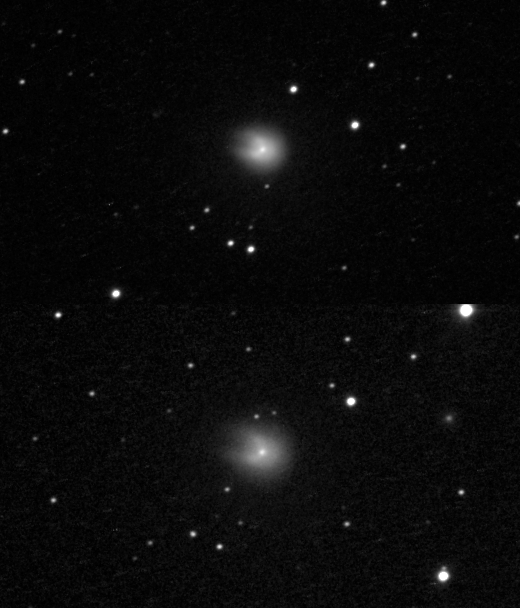
Oct. 8, 2023 : (Spaceweather.com) For the second time this year, a cryovolcanic eruption on Comet 12P/Pons-Brooks has expelled a cloud of debris in the shape of the Millennium Falcon. It was weird enough the first it happened in July. Now, in October, scientists are confronted with the challenge of explaining how a comet can shapeshift itself into a Star Wars freighter twice:

This image was taken on Oct. 7, 2023, by Jose Manual Perez of the Comet Chasers, the same group that discovered the outburst two days earlier. The double horns of the Falcon look just like they did in July 2023.

Richard Miles of the British Astronomical Association thinks 12P may be one of 10 to 20 known comets with active ice volcanoes. “The two ‘horns’ may be caused by a peculiarly-shaped cryovolcanic vent with some sort of blockage causing material to be expelled with a weird flow pattern,” he speculates.

This is *not* just a funny-shaped comet tail, he stresses. Miles used a JPL ephemeris to compare the direction of the horns with the expected direction of the comet’s dust and ion tails. It was a complete mismatch.

“The difference between the July horns and its October ones is about 55-60° projected on the sky,” says Miles. “The mismatch between either of these directions and the ion tail direction and dust tail direction was almost the most it could be!

Amateur astronomer Lars Zielke of Tvis, Denmark, has been tracking the outburst every night. This animation shows the change in only 24 hours (Oct. 7-8):

“What a difference in size!” says Zielke. “I think there is a hint of a globular dust cloud expanding around the comet’s core, and it is easy to see the expansion of the ‘horns’ of the Falcon.”

Comet 12P could attract widespread interest next year–especially if it continues to explode. The comet is falling toward the sun for a close encounter in April 2024 when it is expected to become a naked-eye object at 4th or 5th magnitude. Talk about perfect timing. 12P will reach maximum brightness only a few days before the total solar eclipse on April 8, 2024. Sky watchers in the path of totality could look up and see an outburst for themselves.

Amateur astronomers are encouraged to monitor developments. After its latest outburst, the comet is shining as brightly as an 11th magnitude star, putting it within range of mid-sized backyard telescopes. Look for 12P in the constellation Hercules just across the border from the bright star Vega. [sky map]

The Sun’s Magnetic Poles are Vanishing

Oct. 5, 2023: (Spaceweather.com) The sun is about to lose something important: Its magnetic poles.

Recent measurements by NASA’s Solar Dynamic Observatory reveal a rapid weakening of magnetic fields in the polar regions of the sun. North and south magnetic poles are on the verge of disappearing. This will lead to a complete reversal of the sun’s global magnetic field perhaps before the end of the year.

An artist’s concept of the sun’s dipolar magnetic field. Credit: NSF/AURA/NSO.

If this were happening on Earth, there were be widespread alarm. Past reversals of our planet’s magnetic field have been linked to calamities ranging from sudden climate change to the extinction of Neanderthals. On the sun, it’s not so bad.

“In fact, it’s routine,” says Todd Hoeksema, a solar physicist at Stanford University. “This happens every 11 years (more or less) when we’re on the verge of Solar Maximum.”

Vanishing poles and magnetic reversals have been observed around the peak of every single solar cycle since astronomers learned to measure magnetic fields on the sun. Hoeksema is the director of Stanford’s Wilcox Solar Observatory (WSO), that is observing its fifth reversal since 1980.

The last five polar field reversals observed at the Wilcox Solar Observatory

“One thing we have learned from these decades of data is that no two polar field reversals are alike,” he says.

Sometimes the transition is swift, taking only a few months for the poles to vanish and reappear on opposite ends of the sun. Sometimes it takes years, leaving the sun without magnetic poles for an extended period of time.

“Even more strange,” says Hoeksema, “sometimes one pole switches before the other, leaving both poles with the same polarity for a while.”

Indeed, such a scenario could be playing out now. The sun’s south magnetic pole has almost completely vanished, but the north magnetic pole is still hanging on, albeit barely.

How does all this effect us on Earth? One way we feel solar field reversals is via the heliospheric current sheet:

An artist’s concept of the heliospheric current sheet.

The sun is surrounded by a wavy ring of electricity that the solar wind pulls and stretches all the way out to the edge of the Solar System. This structure is a part of the sun’s magnetosphere. During field reversals, the current sheet becomes extra wavy and highly tilted.  As the sun spins, we dip in and out of the steepening undulations. Passages from one side to another can cause geomagnetic storms and auroras.

Most of all, the vanishing of the poles means we’re on the verge of Solar Maximum. Solar Cycle 25 is shaping up to be stronger than forecasters expected, and its peak could be relatively intense. Stay tuned for updates!

Van Gogh Waves in the Magnetosphere

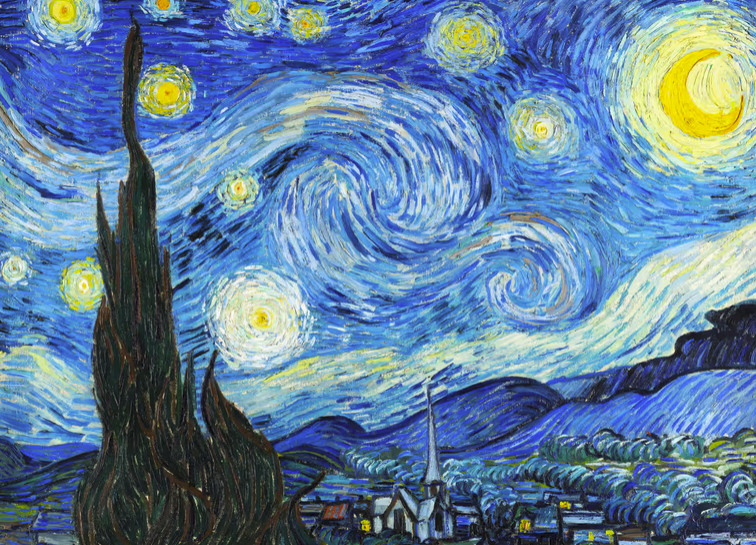
Sept. 27, 2023: (Spaceweather.com) When Vincent van Gogh painted “The Starry Night” in 1889, little did he know he was working at the forefront of 21st century astrophysics. A paper recently published in Nature Communications reveals that the same kind of waves pictured in the famous painting can cause geomagnetic storms on Earth.

Above: Vincent van Gogh’s ‘Starry Night’, which he painted in 1889: more

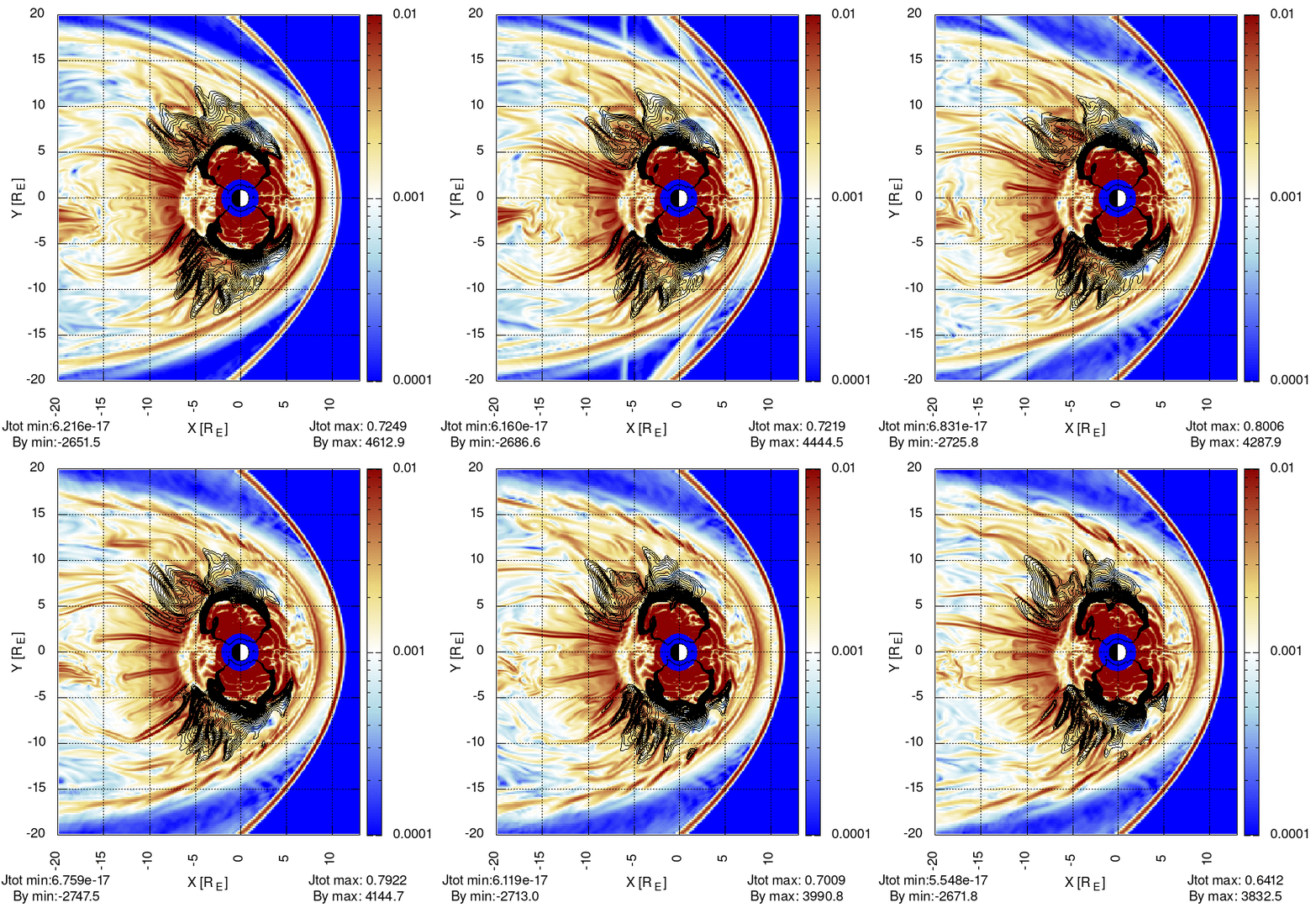
Physicists call them “Kelvin Helmholtz waves.” They ripple into existence when streams of gas flow past each other at different velocities. Van Gogh saw them in high clouds outside the window of his asylum in Saint-Rémy, France. They also form in space where the solar wind flows around Earth’s magnetic field.

“We have found Kelvin-Helmholtz waves rippling down the flanks of Earth’s magnetosphere,” says Shiva Kavosi of Embry–Riddle Aeronautical University, lead author of the Nature paper. “NASA spacecraft are surfing the waves, and directly measuring their properties.”

This was first suspected in the 1950s by theoreticians who made mathematical models of solar wind hitting Earth’s magnetic field. However, until recently it was just an idea; there was no proof the waves existed. When Kavosi’s team looked at data collected by NASA’s THEMIS and MMS spacecraft since 2007, they saw clear evidence of Kelvin Helmholtz instabilities.

“The waves are huge,” says Kavosi. “They are 2 to 6 Earth radii in wavelength and as much as 4 Earth radii in amplitude.”

This computer model shows van Gogh waves moving down the flank of Earth’s magnetosphere. Credit: Shiva Kasovi. [full-sized animation]

Imagine a wave taller than Earth curling over and breaking. That’s exactly what happens. Kelvin-Helmholtz waves naturally break onto Earth’s magnetic field, propelling energetic particles deep into the magnetosphere. This revs up Earth’s radiation belts, triggering geomagnetic storms and auroras.

A key finding of Kavosi’s paper is that the waves prefer equinoxes. They appear 3 times more frequently around the start of spring and fall than summer and winter. Researchers have long known that geomagnetic activity is highest around equinoxes. Kelvin-Helmholtz wave activity could be one reason why.

Our planet’s seasonal dependence of geomagnetic activity has always been a bit of a puzzle. After all, the sun doesn’t know when it’s autumn on Earth. One idea holds that, around the time of the equinoxes, Earth’s magnetic field links to the sun’s because of the tilt of Earth’s magnetic poles. This is called the Russell-McPherron effect after the researchers who first described it in 1973. Kavosi’s research shows that Kelvin-Helmholtz waves might be important, too.

Northern autumn has just begun, which means Kelvin Helmholtz waves are rippling around our planet, stirring up “Starry Night” auroras. Happy autumn!

Annular Solar Eclipse — Oct. 14, 2023

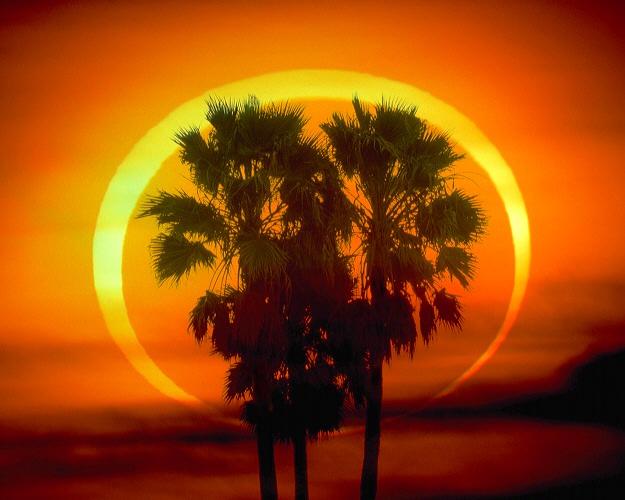
Sept. 14, 2023: (Spaceweather.com) Mark your calendar. On Oct. 14th, the Moon will pass in front of the sun, producing an annular solar eclipse visible from North and South America. In this map, the yellow band shows where the eclipse will be best:

This should not be confused with a total eclipse, where the Moon completely covers the sun. During an annular eclipse, the Moon is a little too small for complete coverage–a result of the Moon’s elliptical orbit. When the Moon passes in front of the sun, an annulus remains visible, creating a “ring of fire” in the sky. It is still very cool. Indeed, you will literally feel cool as the diffuse shadow of the Moon passes overhead, dimming the landscape and lowering the air temperature by a few degrees.

The “path of annularity” is about 100 miles wide. Along its centerline, the sun will be ring-shaped for more than 4 minutes, with as much as 95% coverage of the solar disk. Be careful! Even a 5% sliver of the sun can be blindingly bright. Watch the event using ISO-approved eclipse glasses.

Outside the path, observers will see the sun turn into a crescent, fat or thin depending on how far they are from the centerline. This is called a “partial eclipse,” also best seen using eclipse glasses. Almost all of North and South America is in the partial eclipse zone.

Above: An annular eclipse over Southern California in Jan. 1992. Photo credit: Dennis L. Mammana

There’s a lot to experience during an eclipse. Listen for changes to birdsong and insect sounds. Wildlife is known to respond to the arrival of the Moon’s shadow.   Also, look under leafy trees. Crescent-shaped sunbeams lancing through the foliage can dapple the ground with tiny images of the eclipsed sun. Amateur astronomers with solar-filtered binoculars can watch brilliant beads of sunlight glittering through through lunar mountains especially around the Moon’s north and south poles.

To learn more about the eclipse, we recommend GreatAmericanEclipse.com. Their Field Guide to the 2023 and 2024 Solar Eclipses is a must-have for anyone planning an eclipse adventure, and they also sell safe eclipse glasses and solar binoculars.

“Stealthy CME” Sparks Geomagnetic Storm

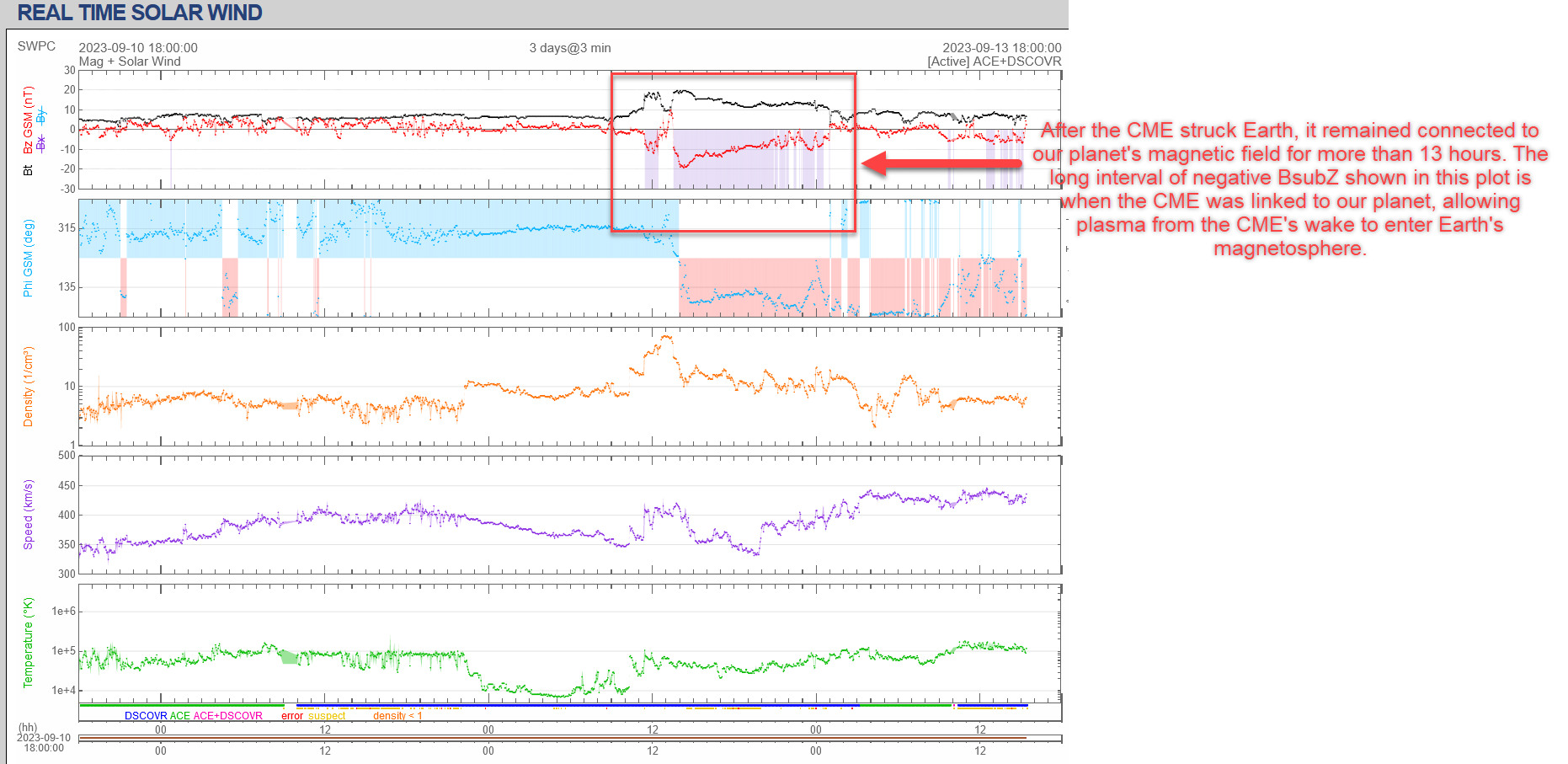
Sept. 13, 2023: (Spaceweather.com) An unexpected CME hit Earth’s magnetic field on Sept. 12th (1237 UT) and sparked a G2-class geomagnetic storm. Magnetically, the CME remained connected to our planet for more than 13 hours, allowing plasma from the CME’s wake to enter Earth’s magnetosphere. This fueled a display of auroras photographed as far south as Missouri (+40.2N) and Nebraska (+40.9N).

Matthew Merrell knew the storm was underway, and he waited anxiously for the sun to set over his home in central Minnesota. As darkness fell, he saw the auroras:

“It was a great start to the night with pillars visible as soon as the sky was dark enough,” says Merrell. “By 10:00 pm it was just a gentle glow with very little motion.”

Merrell witnessed only the subsiding tail-end of the storm, a G1-class event. At its G2 apex, the storm produced “BRIGHT” and “stunning” activity over Scotland, “massive rays” above Ireland, and an all-sky explosion of color over Iceland. Magnetometer needles in Britain swung wildly with more than 15 hours of dramatic undulations.

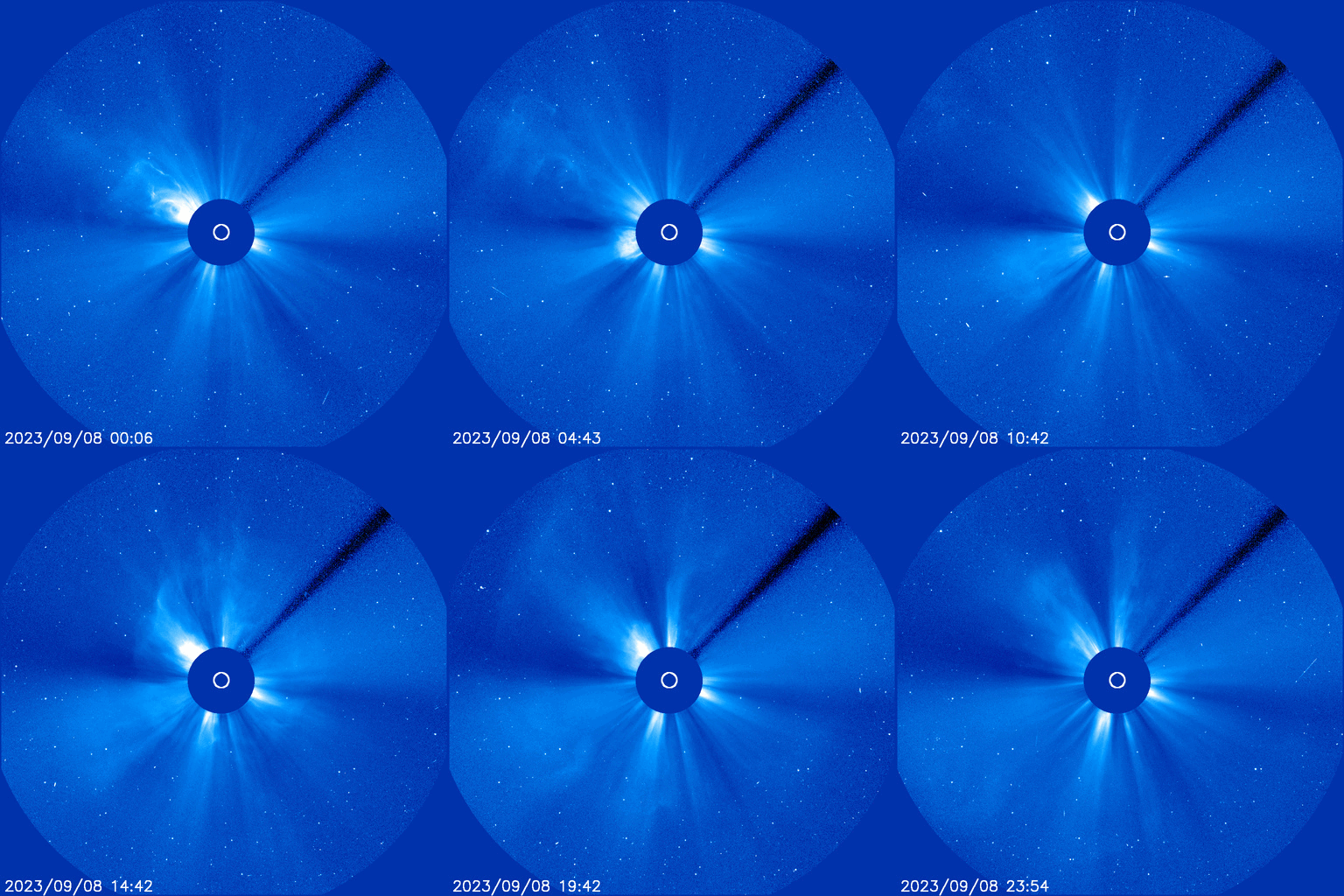
Forecasters did not see this coming. One surprised NOAA analyst called it a “stealthy CME.” In retrospect, it was probably one of many relatively bright CMEs that left the sun on Sept. 8th, shown here in a 24 hour time-lapse from the Solar and Heliospheric Observatory (SOHO):

When the sun spits out so many storm clouds in such a short period of time, it can be hard to disentangle them and figure out which one(s) might be heading toward Earth. Notably the movie includes a distinct halo CME. At the time it was thought to be a farside event, but maybe it is the one that hit Earth yesterday.

Did you miss the storm? Subscribers to our Space Weather Alert Service received instant text messages when the CME arrived and, later, when the geomagnetic storm began. Give it a try! Aurora alerts: SMS Text

Rare Blue Supermoon

Aug. 30, 2023 (Spaceweather.com): Tonight, a quirky mixture of science, hyperbole and folklore will cause millions of people to go outside and stare at the sky. We’re talking about the Super Blue Moon. This is what it will look like:

Above: The supermoon of July 14, 2022, photographed by Oliver Schwenn of Aarhus, Denmark [full story]

No, it won’t be blue. The supermoon on Wednesday evening, Aug. 30th, will look a lot like any ordinary full Moon. However, there are three things that make it special.

First, the science: This week’s full Moon is the biggest and brightest of 2023. Astronomers call it a “perigee moon.” The Moon’s orbit is an ellipse with one side (“perigee”) about 50,000 km closer than the other (“apogee”). Full Moons that occur on the perigee side of the Moon’s orbit are extra big and bright. This week’s Moon will become full within 9 hours of perigee, making it the closest full Moon of the year (357,181 km away).

Next, the hyperbole: About 10 years ago, many science journalists and even some astronomers started calling perigee Moons “supermoons.” A supermoon is 8% bigger and 15% brighter than an average full Moon. Would you call Clark Kent “super” if he were only 8% faster and 15% stronger than an average human? No, but let’s roll with it! People love super things.

Finally, the folklore: You’ve probably heard the expression “Once in a blue Moon.” It means “rare.” Modern folklore provides a more precise definition. When there are two full Moons in a calendar month, the second one is “blue.” Such blue moons come along every 2 to 3 years. August already had one full Moon on Aug. 2nd; now it is about to have another (blue) one on Aug. 30th.

Don’t take “blue” too literally. Most blue Moons are pale gray when they are high in the sky, or orange when they are rising and setting. However, if the Moon *does* turn blue, it could mean that a volcano is erupting or a wildfire is nearby. Run!

In summary, this week’s Super Blue Moon will be about 15% bigger than an average moon and, in the eye of the beholder, immeasurably prettier. Go out after sunset on Aug. 30th, look east, and watch it rise into the darkening summer sky. If you take a picture, submit it here.

Do Sunspots Make Clouds on Neptune?

Aug. 23, 2023 (Spaceweather.com): A new paper in the research journal Icarus offers dramatic proof that solar activity can affect planetary weather. The big surprise: The planet is Neptune, 2.5 billion miles from the sun. Images taken by the Hubble Space Telescope over a period of 28 years show bright clouds forming in sync with the 11-year solar cycle:

The connection between Neptune and solar activity is surprising to planetary scientists because Neptune is our solar system’s farthest major planet. It receives only 0.1% of the sunlight we get on Earth. Yet Neptune’s cloudy weather seems to be driven by solar activity, and not the planet’s four seasons, which each last approximately 40 years.

Other planets in our solar system don’t behave this way. While clouds on Earth may be influenced by the solar cycle, the modulation is no more than a few percent; and even that small amount is controversial. Neptune’s clouds, on the other hand, are bright, flamboyant and global. Their correlation with the solar cycle is obvious at a glance.

Chavez and her colleagues believe they have an explanation.

“Our findings support the theory that the sun’s ultraviolet rays, when strong enough, may be triggering a photochemical reaction that ultimately leads to high-altitude clouds on Neptune,” says Imke de Pater, emeritus professor of astronomy at UC Berkeley and a senior co-author of the study.

Their paper describes how UV rays from the sun (which are strongest when the sunspot number is high) penetrate Neptune’s upper atmosphere and break apart molecules of methane gas. This sets off a chemical reaction yielding hydrocarbons (C𝑥H𝑦). If these hydrocarbons sink into the atmosphere, they could condense to form hazes and clouds.

Above: 21 years of images from the Keck Observatory in Hawaii confirm Hubble’s observations. [more]

Why doesn’t this happen on every planet? “Neptune is unique,” says de Pater. Unlike other planets in our solar system, Neptune has a lot of methane in its stratosphere. (How it gets there is a mystery, but that’s another story.) Solar UV rays have little trouble reaching the gas and kick-starting cloud formation.

Based on the data so far, it seems to take about two years for Neptune’s clouds to fully form once the solar cycle reaches its peak. Solar Cycle 25 is rising now with a peak expected in 2024. This means Neptune’s cloudy season is about to begin. Stay tuned.

Hyperbolic Comet Nishimura

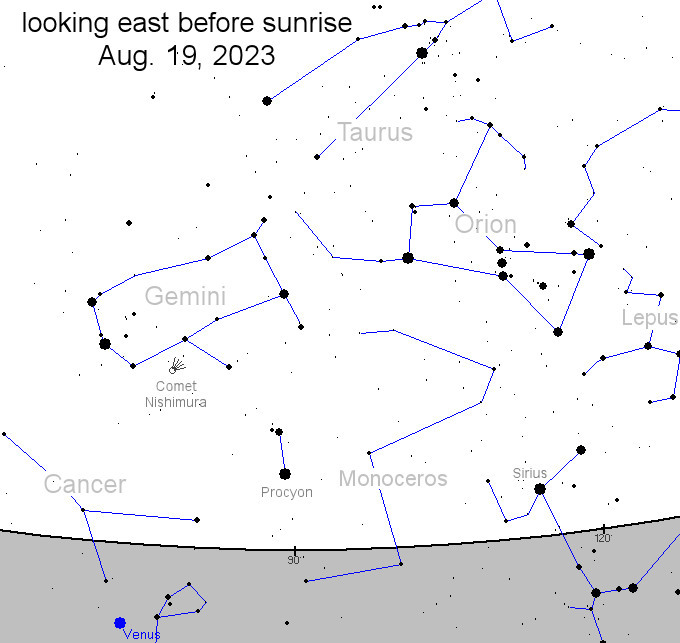
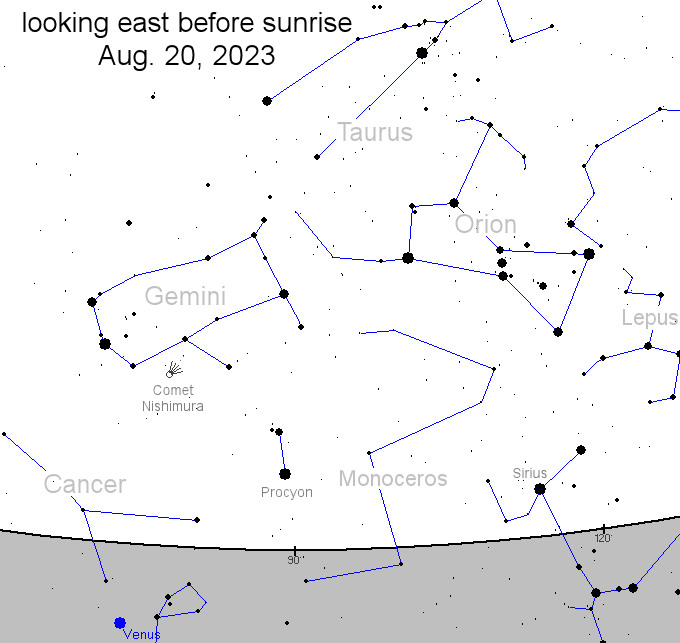
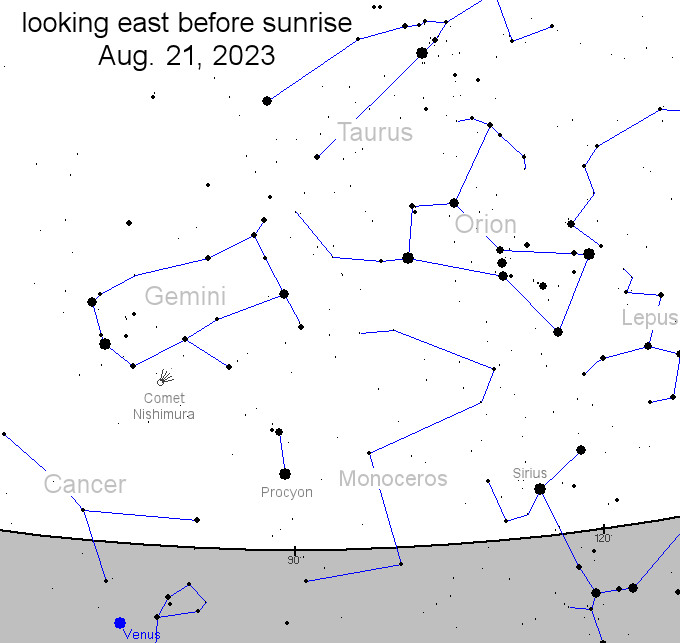
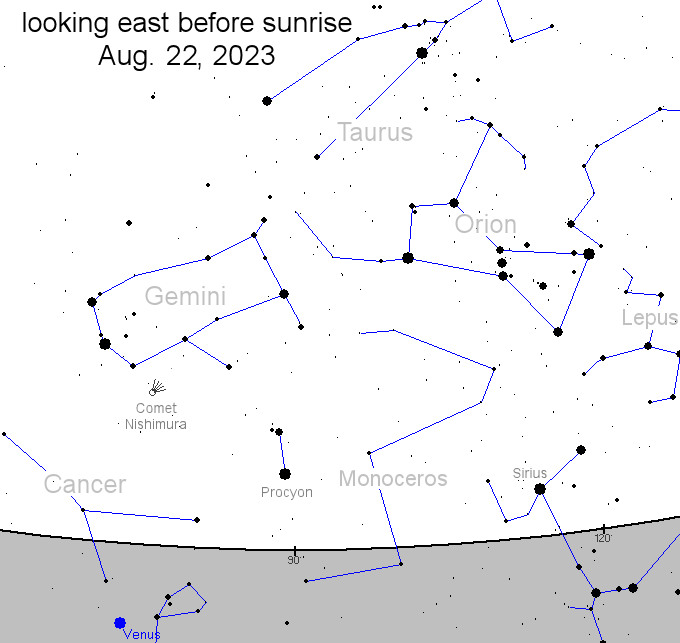
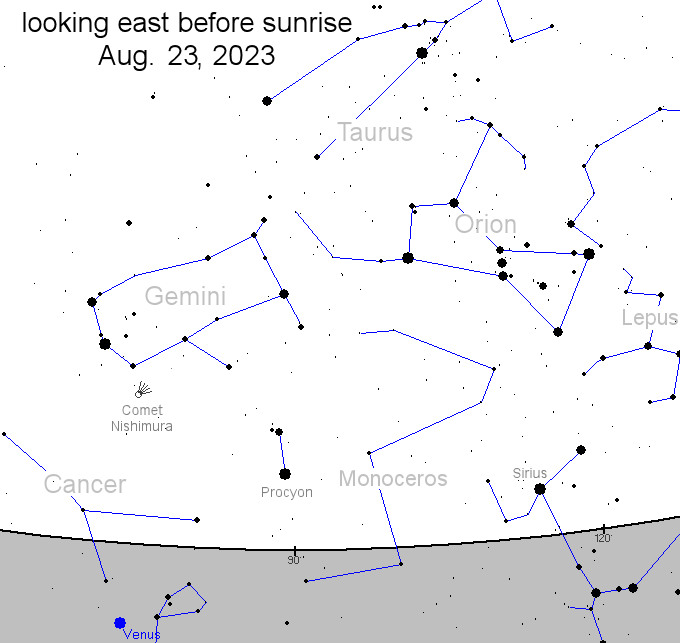
August 19, 2023 (Spaceweather.com): A hyperbolic comet is falling into our solar system. Japanese amateur astronomer Hideo Nishimura discovered it just a few days ago in the constellation Gemini. Although it is relatively dim right now (magnitude +9), Comet Nishimura (C/2023 P1) could soon brighten more than 100-fold to become a naked-eye object in mid-September.

Above: A sky map with an inset photo of the comet from Dan Bartlett of June Lake, CA

A “hyperbolic comet” is a comet with too much energy to remain trapped inside the solar system. It will visit us only once, with the sun acting as a gravitational slingshot, sending the comet hurtling back into deep space after its flyby. Does that mean Comet Nishimura is an interstellar comet? Not necessarily. It might have come from the Oort Cloud. Indeed, that is more likely.

Because this is Comet Nishimura’s first trip to the inner solar system, it is extra unpredictable. On Sept. 18th, the comet will make its closest approach to the sun deep inside the orbit of Mercury. Anything could happen when intense sunlight touches the comet’s pristine surface for the first time. Possibilities range from dramatic brightening to a disappointing fizzle. Standard models suggest a peak brightness of 3rd magnitude. This would make it visible to the naked eye from rural areas.

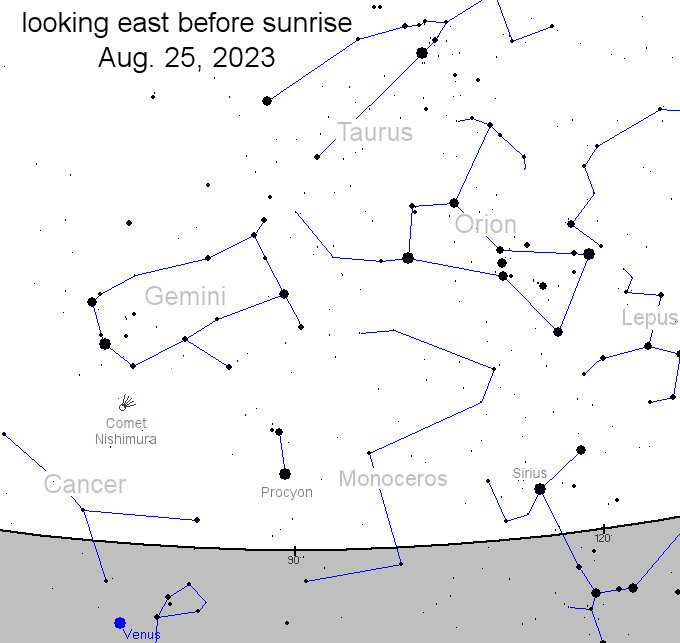
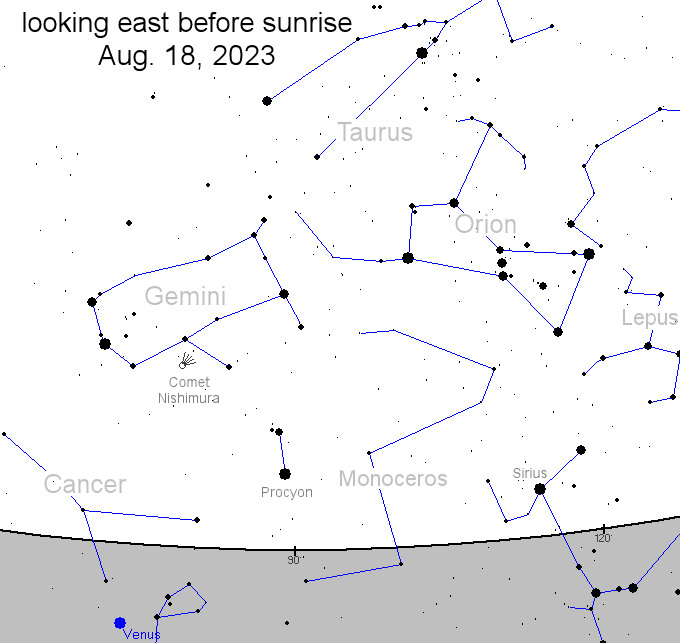
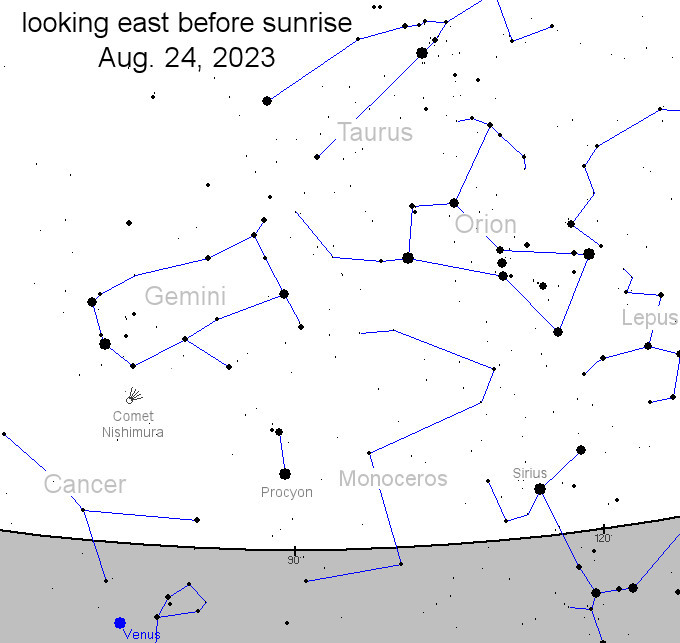
Monitoring is encouraged. Comet Nishimura can be found in the pre-dawn sky using backyard telescopes larger than 6 inches. A date of particular interest is Aug. 25th when the comet lines up with Gemini’s brightest stars, Castor and Pollux, making it particularly easy to find.

Sky maps: Aug. 18, 19, 20, 21, 22, 23, 24, 25. Ephemeris: from JPL.

Ham Radio Operators Hack a NASA Spacecraft

July 5, 2023 (Spaceweather.com): Ham radio operators are picking up a strong signal from space. It’s NASA’s STEREO-A spacecraft returning home after 17 years.

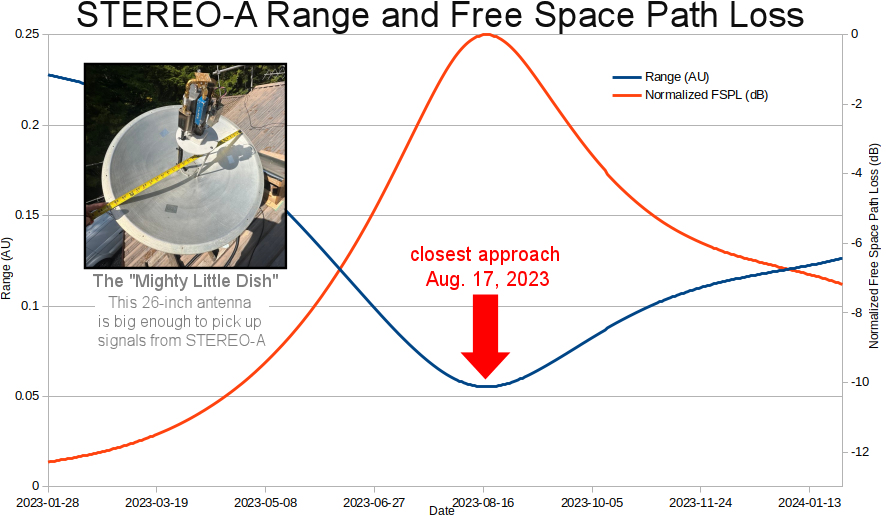
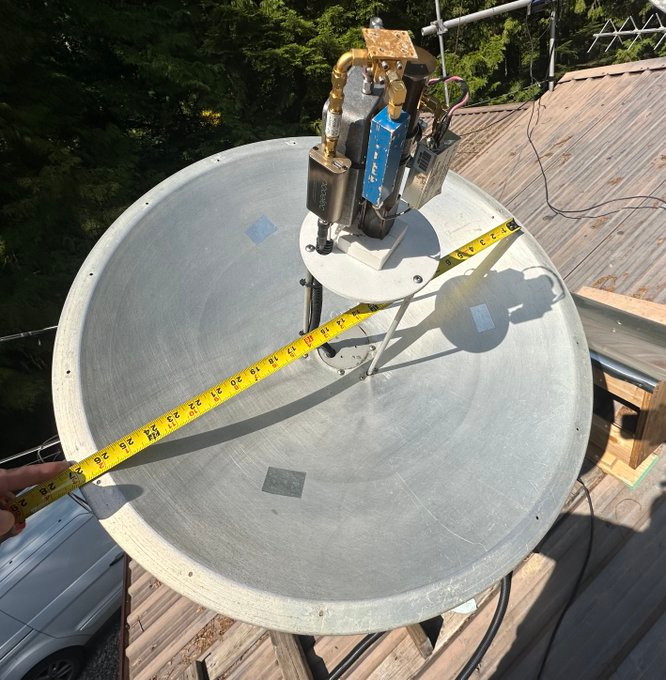
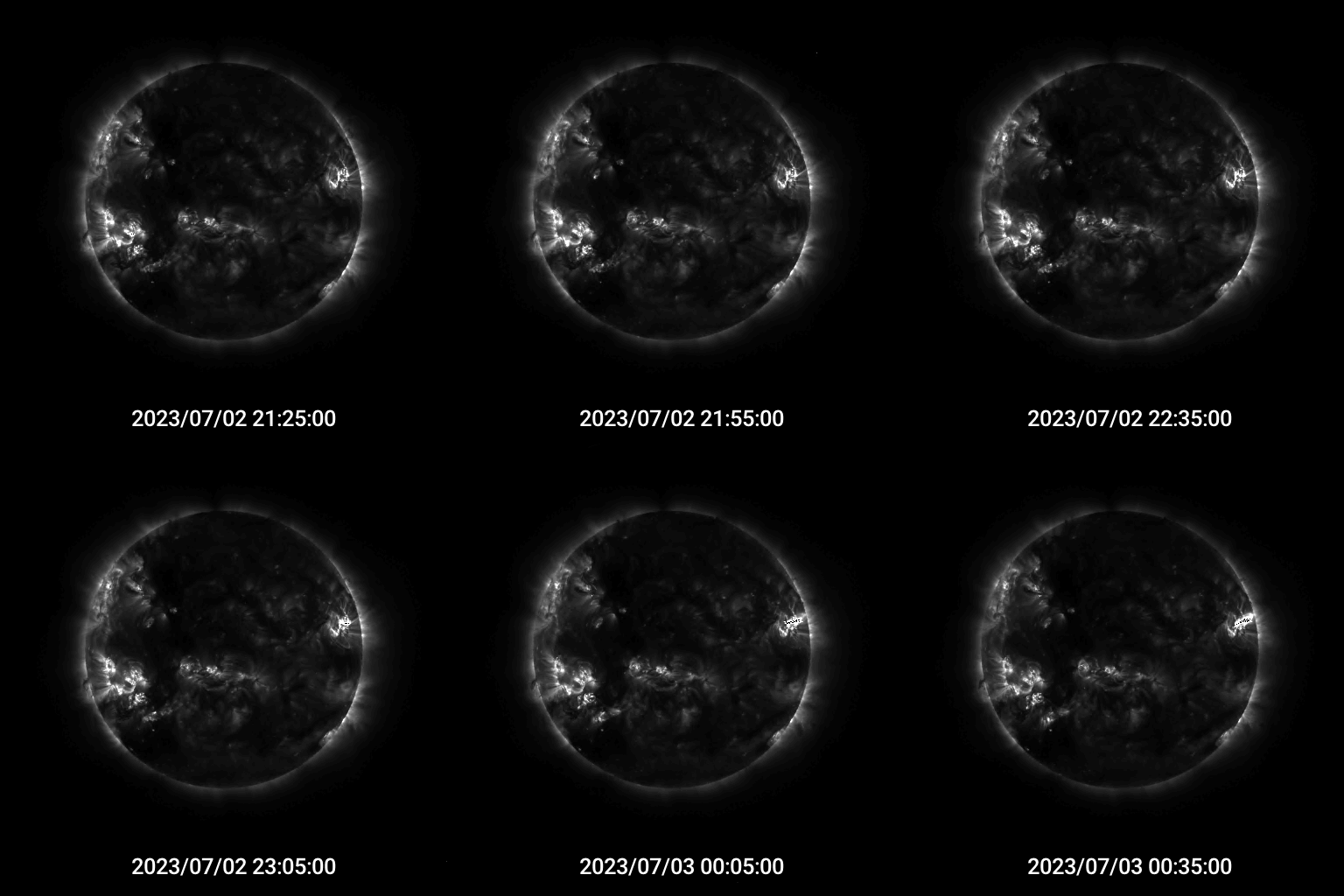
“I’m having fun with STEREO-A,” reports Scott Tilley (VE7TIL) of Roberts Creek, British Columbia. “The spacecraft is coming close to Earth this summer, and I can now receive its signal using a small 26-inch dish in my backyard.” Here is what he picked up on July 2nd:

See also an animated version of these data. The X-flare is right here.

“We caught an X-flare in progress,” Tilley says. “Naked-eye sunspot AR3354 was really crackling.”

STEREO-A left Earth on Oct. 26, 2006, launched from Cape Canaveral with its sister ship STEREO-B. Both spacecraft were on a mission to the farside of the sun. Over the years, they would circle behind behind the sun, beaming images back to Earth so scientists could make 3D models of solar activity. In 2014, STEREO-B failed and was not heard from again. STEREO-A kept going, and now it is on its way back.

Above: STEREO-A coronagraph images of Mercury passing the sun, eavesdropped by Scott Tilley.

Earlier this summer, Tilley began hearing rumors that other radio operators were picking up signals from STEREO-A at 8443.580 MHz. He decided to check it out. “The central carrier is very loud, almost 30dB above the noise,” he says. “I also noticed data sidebands, which are unusual to see on such a distant object for my small antenna.”

At first, the signal was indecipherable. But Tilley found lots of information about its format posted by NASA on public websites; it wasn’t a secret. Using a program called “SatDump” written by Alan Antoine (F4LAU), he successfully demodulated the data. Now Tilley is monitoring data streams from almost all of STEREO-A’s science instruments including its extreme ultraviolet imager (EUVI), two coronagraphs (COR1 and COR2), the heliospheric imager (HI) and a solar radio burst receiver (S/WAVES).

At closest approach on August 17th, STEREO-A will be only 0.05 AU (7.5 million km) from Earth. By then, signals from the spacecraft will have more than doubled in strength, making it even easier to “hack.” 

“What started out as a passing curiosity is now turning into a summer pastime,” says Tilley. “This is a unique time to play with STEREO-A.”

Hams, would you like to monitor STEREO-A? A technical blog post just published by Tilley explains exactly how to do it.