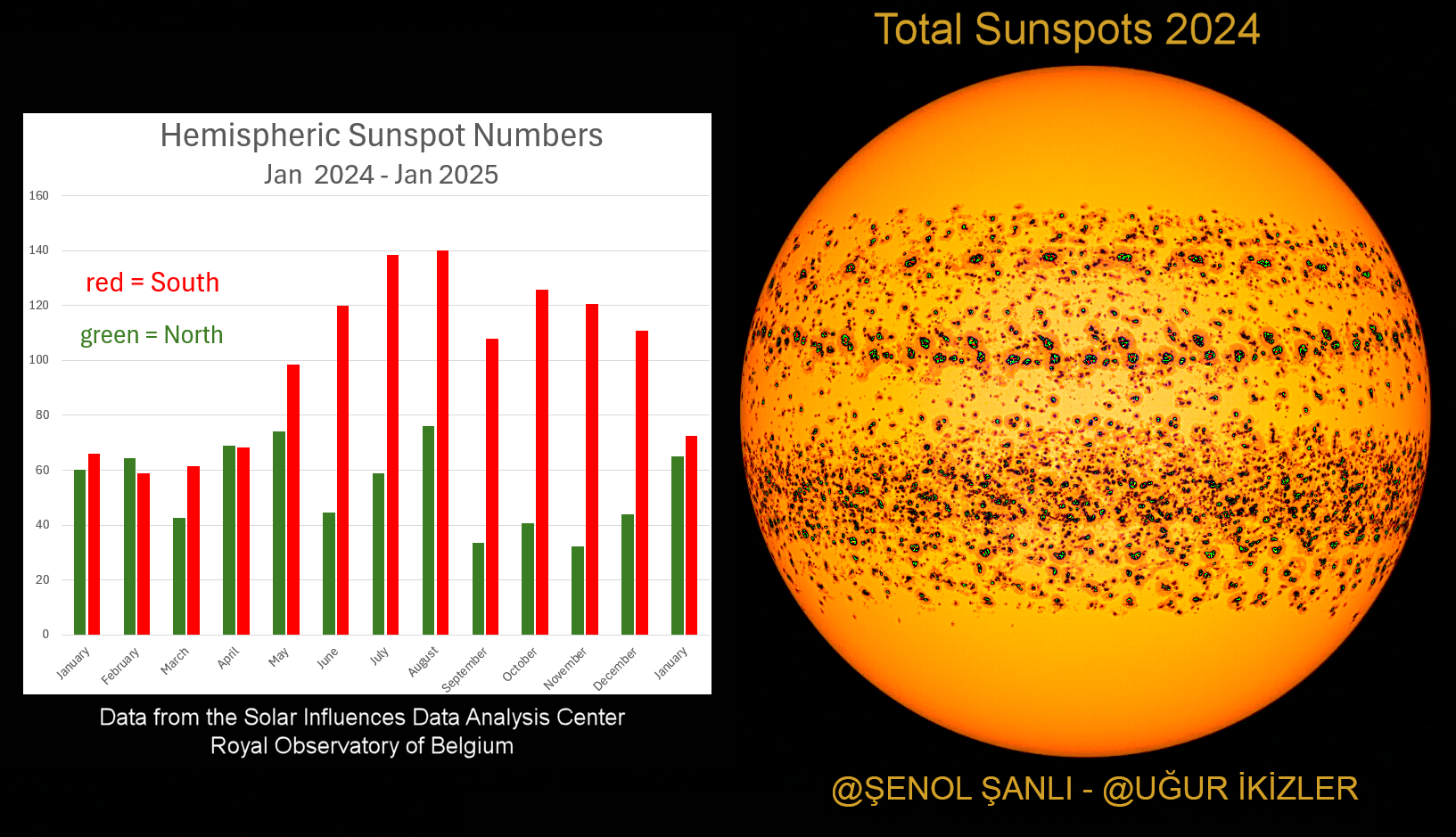
March 10, 2025: Last October, NOAA and NASA announced that Solar Max has arrived. Only half the sun got the memo. The majority of solar activity has been happening in just one of the sun’s hemispheres–the south. For instance, the solar superstorm of May 10, 2024, was caused by a monster southern sunspot.
It makes you wonder, is the other half of Solar Max still coming? This plot of hemispheric sunspot numbers from SILSO provides some context:
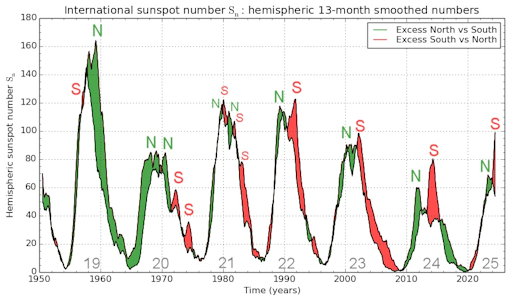
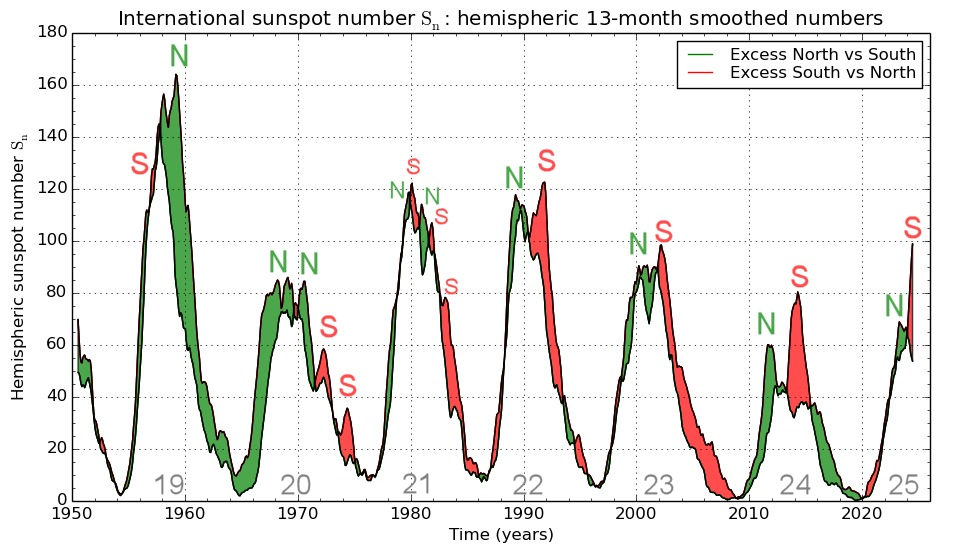
Here we see all seven solar cycles of the Space Age, punctuated by current Solar Cycle 25 on the far right. The most recent cycles are double peaked, with northern sunspots (green) and southern sunspots (red) reaching their own Solar Max ~two years apart. This isn’t big news. Researchers have long known that the two hemispheres of the sun are slightly out of sync. The north vs. south delay is called the “Gnevyshev gap.”
This composite image of last year’s sunspots shows how dominant the southern hemisphere has been:
For forecasters of the solar cycle, this raises an interesting possibility: Maybe the northern peak is still coming. Indeed, there are signs in February 2025 that the pendulum is swinging. This month’s sunspots have been more evenly distributed between the two hemispheres, a sign that activity may be shifting north.
On the other hand, the northern peak might have already occurred. Take another look at the first plot. There is a puny northern peak near the beginning of Solar Cycle 25. Perhaps that was it. (Indeed, that would jibe with the north-first, south-second order of recent double peaks.)
This discussion focuses attention on the north-south balance of sunspots. A northern shift in the months ahead could herald a second peak and another year or two of excellent auroras before Solar Cycle 25 finally peters out. Stay tuned!
 Spaceweather.com
Yes, the solar maximum PERIOD is definately here!It seems the over-90-percent road to solar maximum definately started about November 2024 and will probably last until the very end of 2025.
The definate solar maximum, to which we are slowly climbing against, will happen in July 2025 +/- 1 month.The level will not be very much higher than current in March 2025, but might end up at R=160.
The northern hemisphere could have had its maximum already in October 2023!This commences quite good with the first treshold or perhaps 1st maximum period, which occurred November 2023.The southern hemisphere has had a maximum which from the past solar cycles been quite near the overall maximum.
It seems we are compatible to cycle 23 at the moment. We are, though, not so far away from competing with both cycles 22 and 21, but personally I do not believe the current solar cycle can reach those levels at solar maximum this summer.At the current stage we see a 13-rotational average comparable to November 2002.
Now we can look forward to increased activity towards summer of 2025.
All of the above is a result of daily studies both R-numbers (SILSO), Solar Flux 10,7cm/2800 MHz, CV-International and Sunspot Area mvh.
Regards
Kjell Inge Malde
Director CV-Helios Network
LikeLike