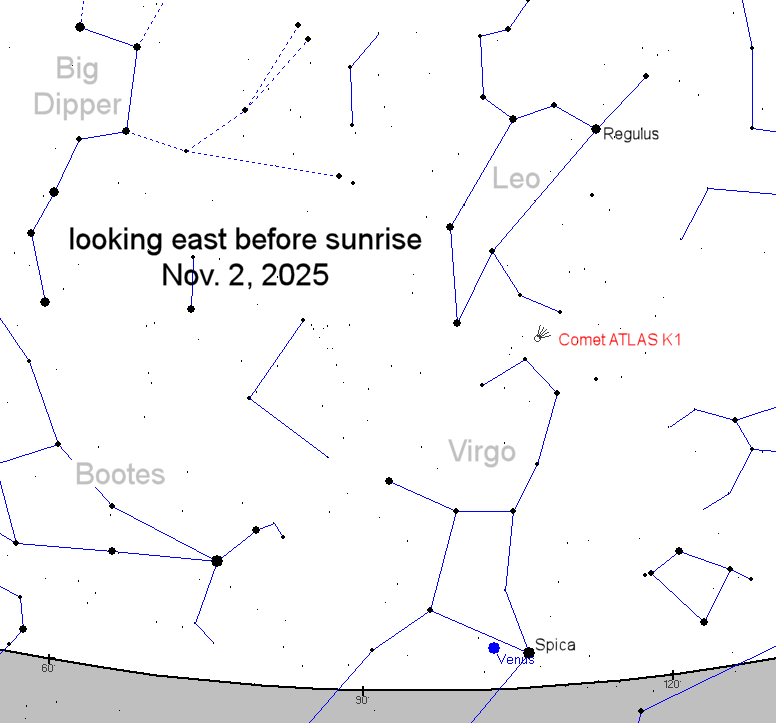
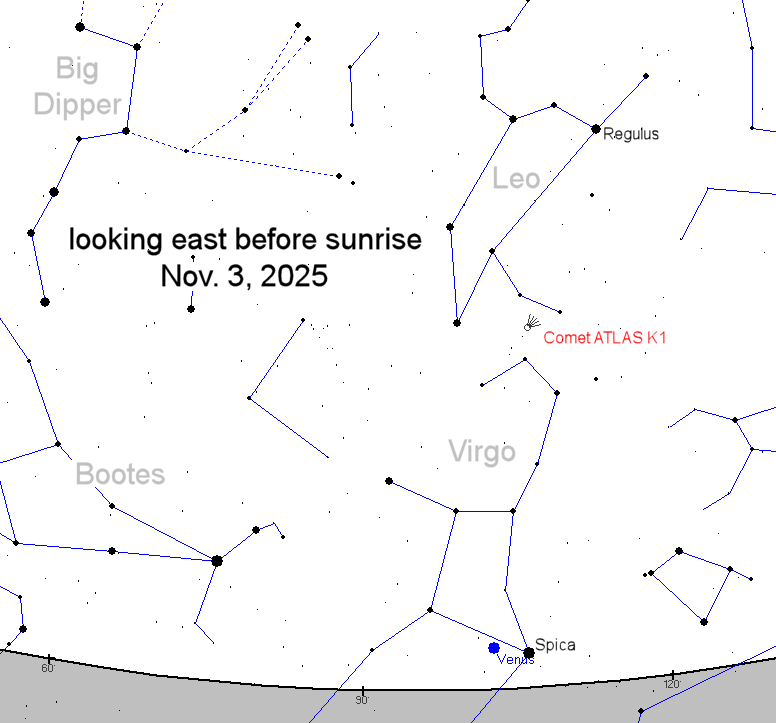
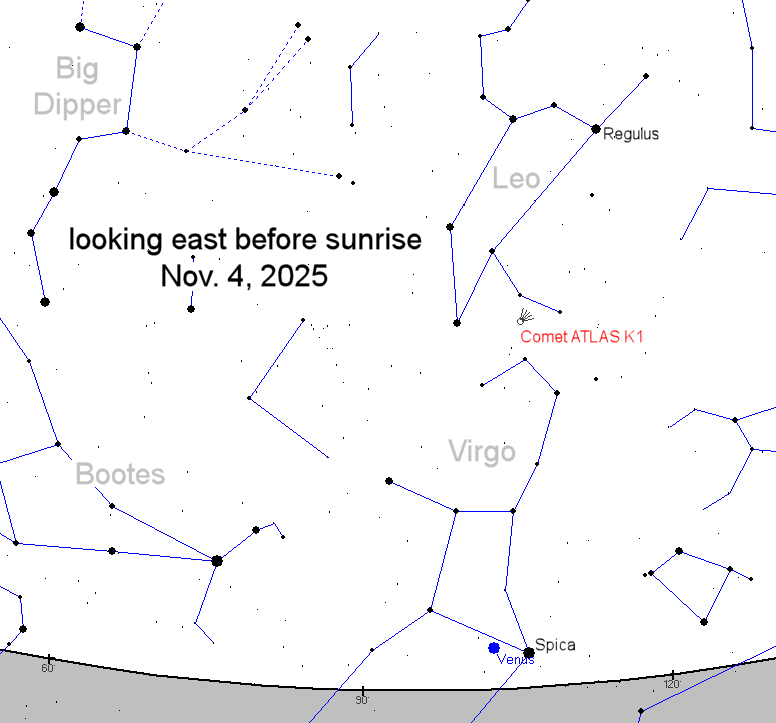
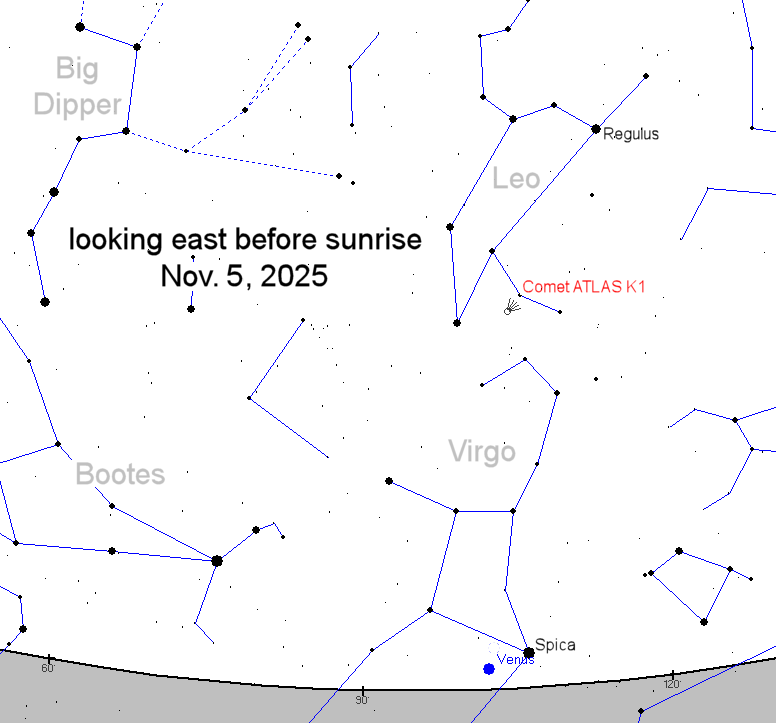
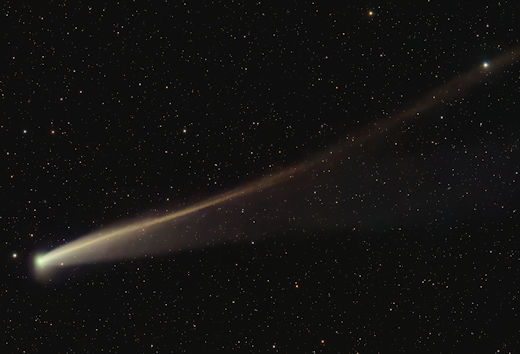
Nov. 1, 2025: (Spaceweather.com) Most comets are green, and sometimes blue. In June Lake, California, amateur astronomer Dan Bartlett is tracking a rare golden comet. Introducing, Comet ATLAS (C/2025 K1):
“This comet was not supposed to survive its Oct 8th perihelion (0.33 AU),” says Bartlett. “But it did survive, and now it is displaying a red/brown/golden color rarely seen in comets.”
What’s going on? The chemistry of this Oort Cloud comet is strange. It lacks the carbon compounds normally found in comets, according to spectroscopy by David Schleicher of the Lowell Observatory. “All of the carbon-bearing species, including CN, are unusually low,” he wrote in Astronomer’s Telegram #17362.
In sunlight, cometary gases turn green because of diatomic carbon (C2), and blue because of ionized carbon monoxide (CO+). Subtracting these colors apparently leaves gold. We don’t know exactly why–or if it may have something to do with its recent close encounter with the sun.
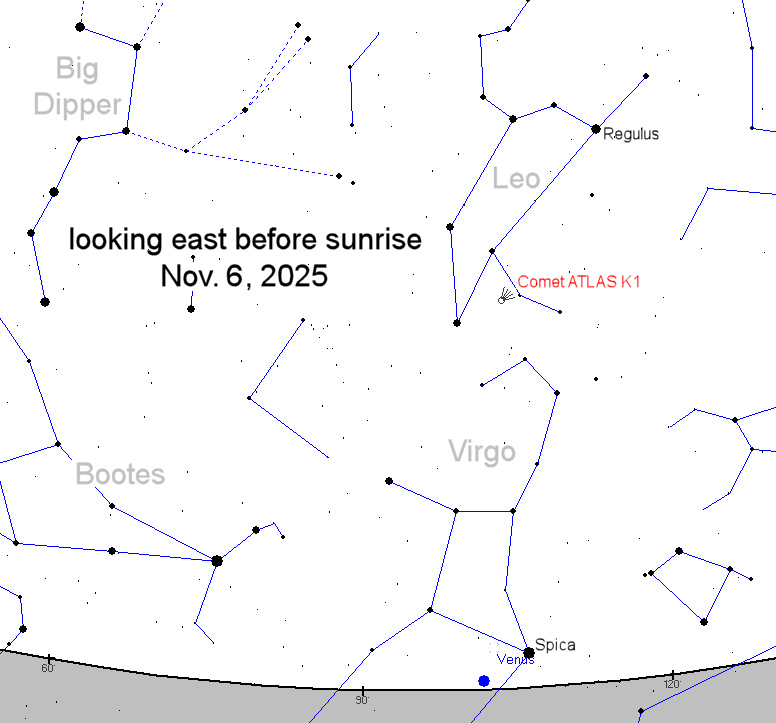
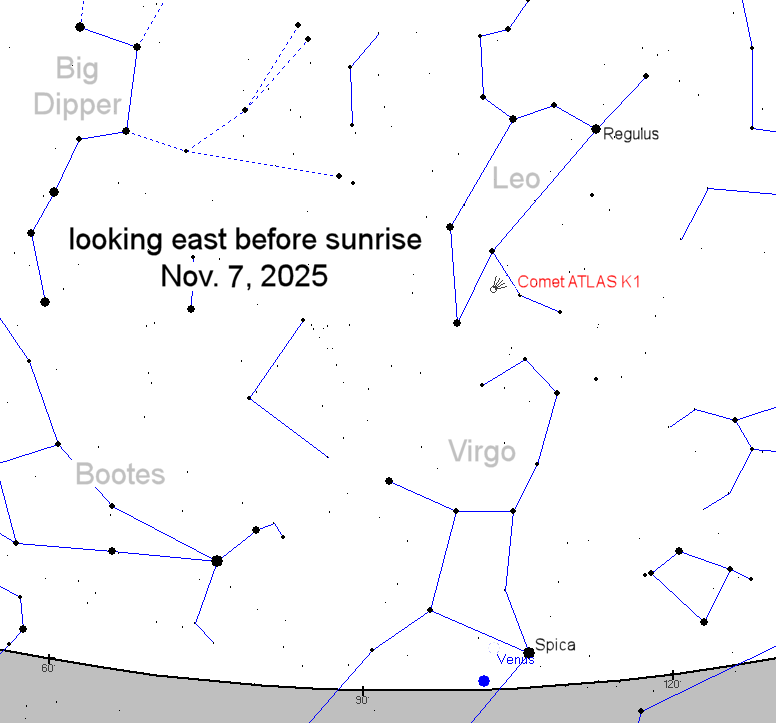
“The comet is fairly impressive at 9th magnitude,” says Bartlett. That makes it a relatively easy target for backyard telescopes. Point your optics to the boundary between Virgo and Leo in the eastern sky shortly before sunrise. Sky maps:Nov. 2, 3, 4, 5, 6, 7.
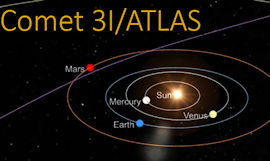
This week the internet is buzzing with headlines like “Mysterious Object Is Up to No Good While It’s Hidden Behind the Sun.” They’re referring to interstellar Comet 3I/ATLAS. Harvard astronomer Avi Loeb and others have suggested it might be a spaceship deliberately hiding from humans. There’s just one problem with this argument: We can still see it from Earth.
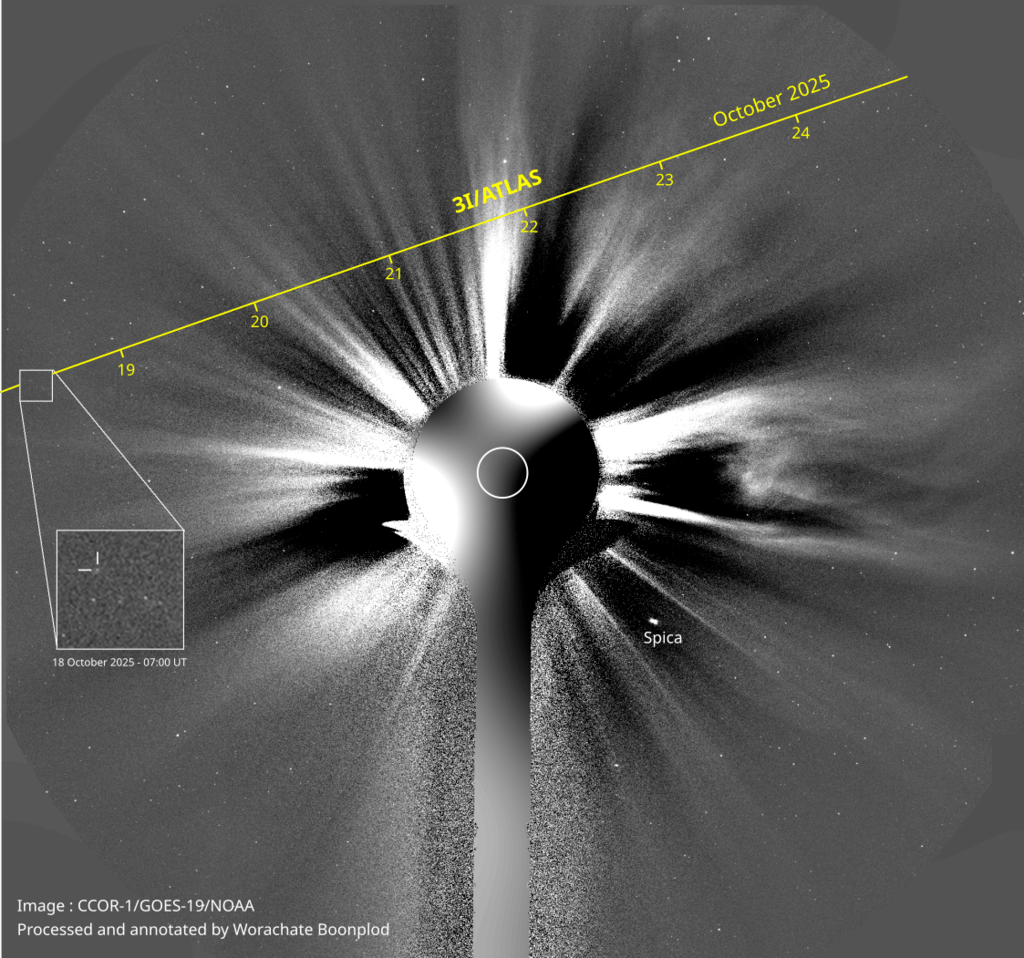
For example, the CCOR-1 coronagraph onboard NOAA’s GOES-19 satellite is tracking the comet and monitoring its brightness:
So is NASA’s quartet of PUNCH spacecraft, and coronagraphs onboard the Solar and Heliospheric Observatory (SOHO, not far from Earth). Comet 3I/ATLAS is under constant surveillance.
“Unless 3I/ATLAS fades substantially in the next couple of days, we should be able to keep eyeballs on it right through its perihelion (closest approach to the sun),” says coronagraph expert Karl Battams.
Tracking the comet is not easy because it is so faint. Battams explains how it is done: “Objects at the threshold of detection like 3I/ATLAS are a challenge for coronagraphs. We often have to employ image stacking techniques. For this to work, we have to have a very precise understanding of the pointing and distortion of the telescopes so that we can find the exact pixels that correspond to the comet. It gets fiddly, but we make it work.”
If 3I/ATLAS changes direction or surges in brightness, we will know. So far, it’s acting like a comet. T. Marshall Eubanks from Space Initiatives Inc assembled this light curve, including recent data from CCOR-1 and PUNCH:
These data confirm that 3I/ATLAS is following a fairly standard model of comet brightness with contributions from gas and dust. If this is a spacecraft, it is wearing an uncanny disguise.
In December, 3I/ATLAS will emerge from the glare of the sun. Telescopes on Earth’s surface can then rejoin the monitoring effort. Our bet: They will see a comet, not a spaceship. Stay tuned.
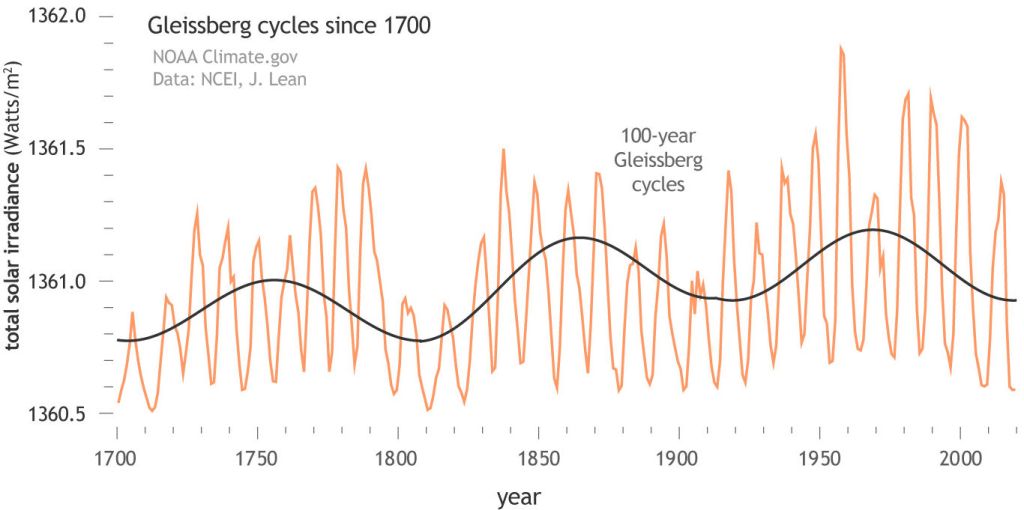
May 6, 2025: (Spaceweather.com) If you’ve been enjoying the auroras of Solar Cycle 25, we’ve got good news. The next few solar cycles could be even more intense–the result of a little-known phenomenon called the “Centennial Gleissberg Cycle.”
You’ve probably heard of the 11-year sunspot cycle. The Gleissberg Cycle is a slower modulation, which suppresses sunspot numbers every 80 to 100 years. For the past ~15 years, the sun has been near a low point in this cycle, but this is about to change.
New research published in the journal Space Weather suggests that the Gleissberg Cycle is waking up again. If this is true, solar cycles for the next 50 years could become increasingly intense.
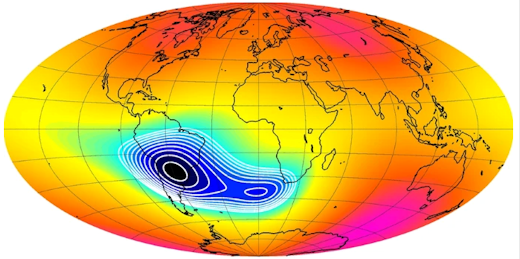
“We have been looking at protons in the South Atlantic Anomaly,” explains the paper’s lead author Kalvyn Adams, an astrophysics student at the University of Colorado. “These are particles from the sun that come unusually close to Earth because our planet’s magnetic shield is weak over the south Atlantic Ocean.”
Above: The South Atlantic Anomaly (blue) is a weak spot in Earth’s magnetic field where particles from the sun can come relatively close to Earth [more]
It turns out that protons in the South Atlantic Anomaly are a “canary in a coal mine” for the Gleissberg Cycle. When these protons decrease, it means the Gleissberg Cycle is about to surge. “That’s exactly what we found,” says Adams. “The protons are clearly decreasing in measurements we obtained from NOAA’s Polar Operational Environmental Satellites.”
Protons in the South Atlantic Anomaly are just the latest in a growing body of evidence suggesting that the “Gleissberg Minimum” has passed. Current sunspot counts are up; the sun’s ultraviolet output has increased; and the overall level of solar activity in Solar Cycle 25 has exceeded forecasts. It all adds up to an upswing in the 100-year cycle.
It also means that Joan Feyman was right. Before she passed away in 2020, the pioneering solar physicist was a leading researcher of the Gleissberg Cycle, and she firmly believed that the centennial oscillation was responsible for the remarkable weakness of Solar Cycle 24 (2012-2013). In a seminal paper published in 2014, she argued that the minimum of the Gleissberg Cycle fell almost squarely on top of Solar Cycle 24, making it the weakest cycle in 100 years. The tide was about to turn.
The resurgence of the Gleissberg Cycle makes a clear prediction for the future: Solar Cycles 26 through 28 should be progressively intense. Solar Cycle 26, peaking in ~2036, would be stronger than current Solar Cycle 25, and so on. The projected maximum of the Gleissberg Cycle is around 2055, aligning more or less with Solar Cycle 28. That cycle could be quite intense.
“With a major increase in launch rates, it’ll be important to plan for changes to the space environment that thousands of satellites and spacecraft are flying through from all sides,” says Adams. “Solar activity and particle fluxes could all be very different in the decades ahead.”
For more information, read Adams’s original research here.
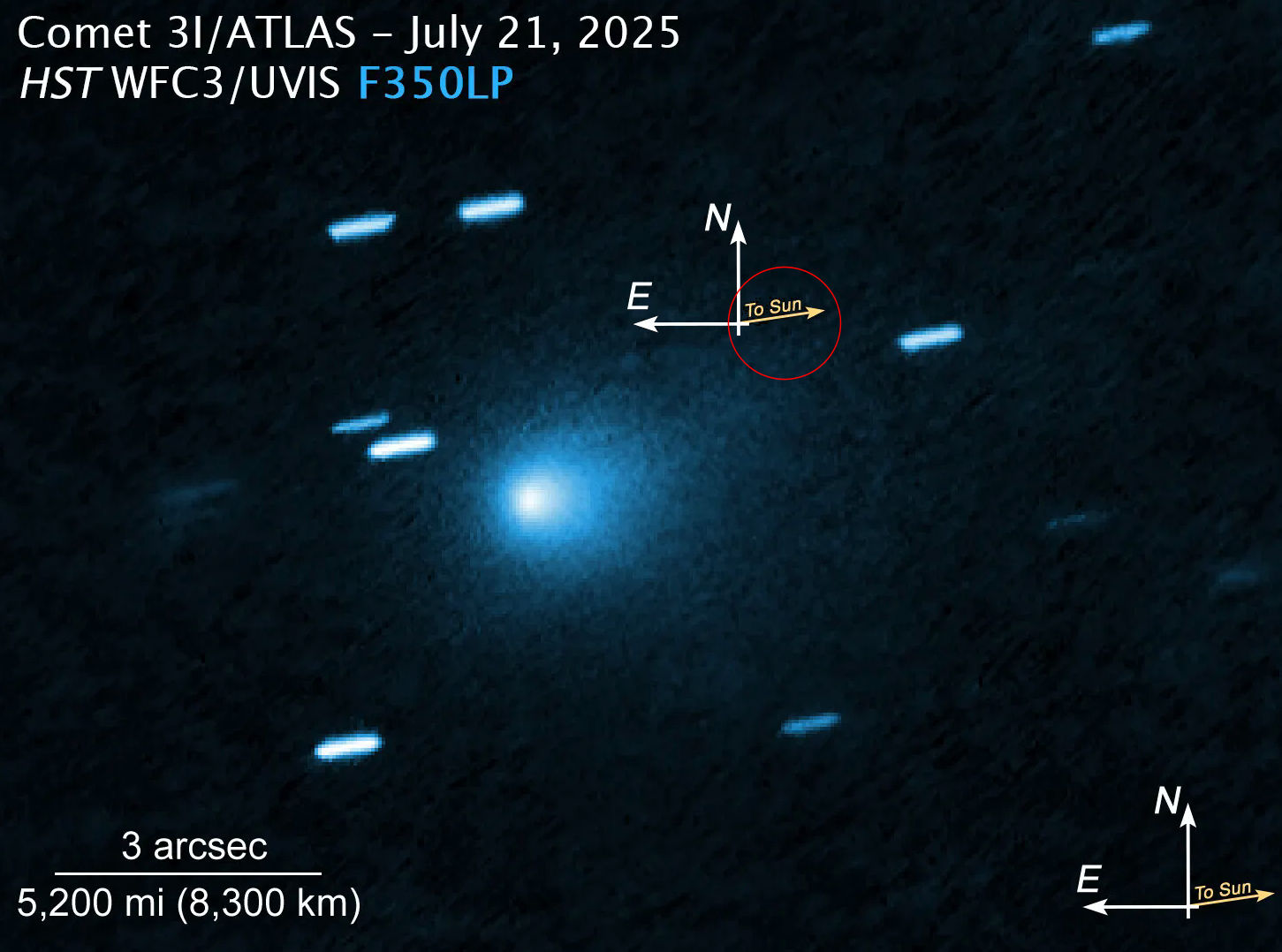
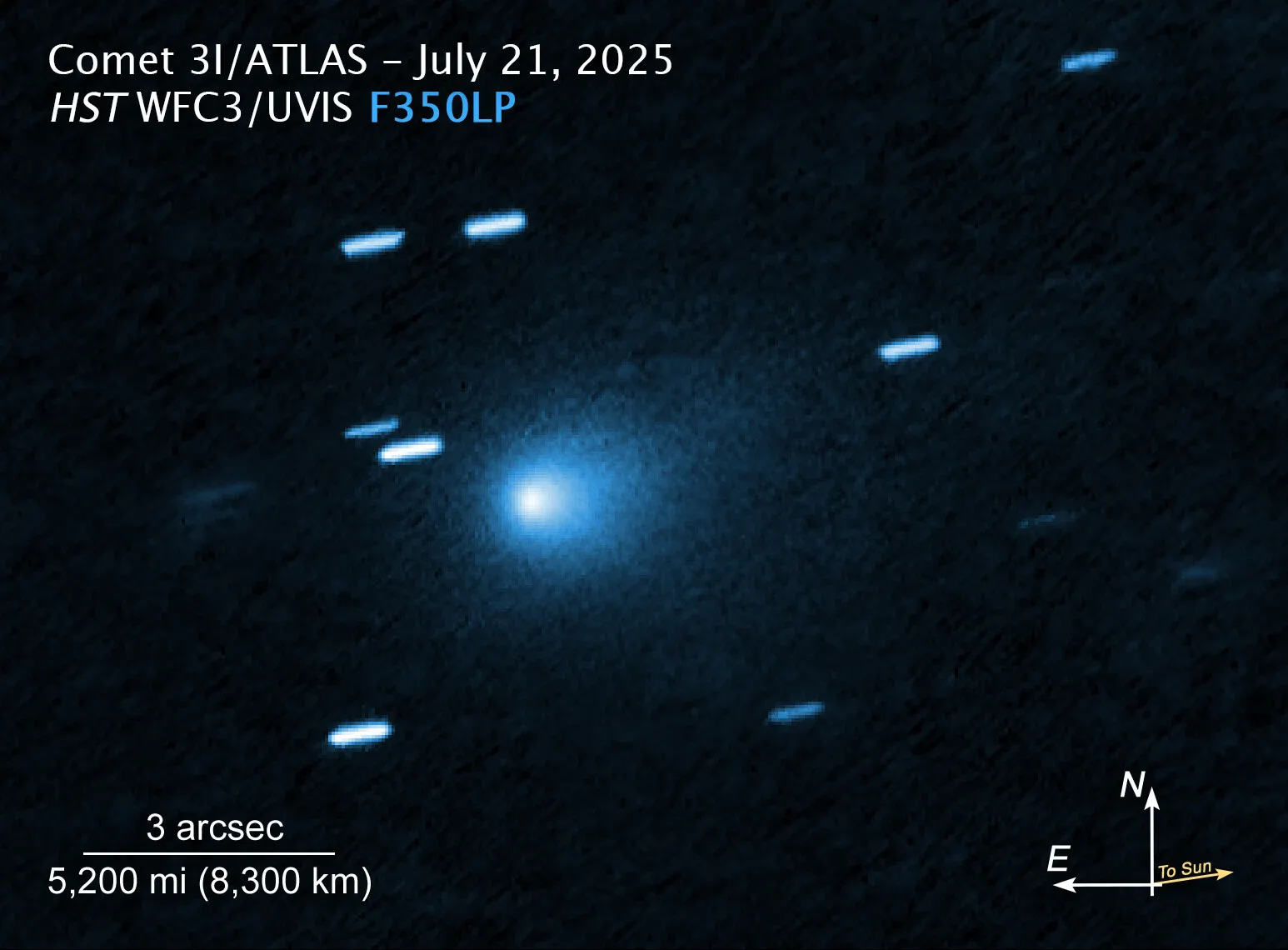
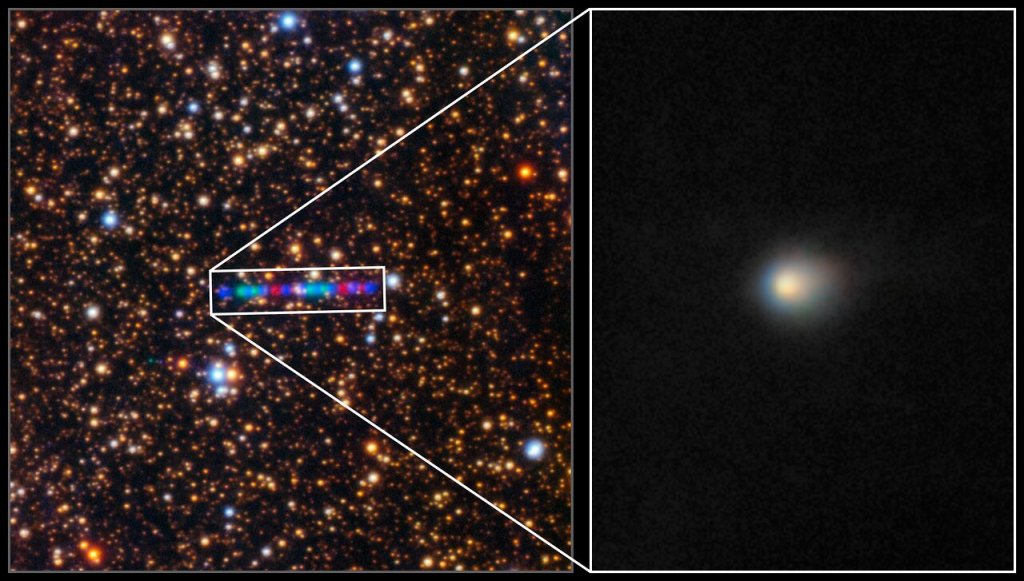
Aug. 25, 2025 (Spaceweather.com) — In July, when astronomers used the Hubble Space Telescope to photograph 3I/ATLAS, they had a “Eureka!” moment. The mysterious interstellar visitor had a fuzzy atmosphere and a growing tail. Clearly, it was a comet.
However, something was not quite right. Take a look, and see if you can spot the problem:
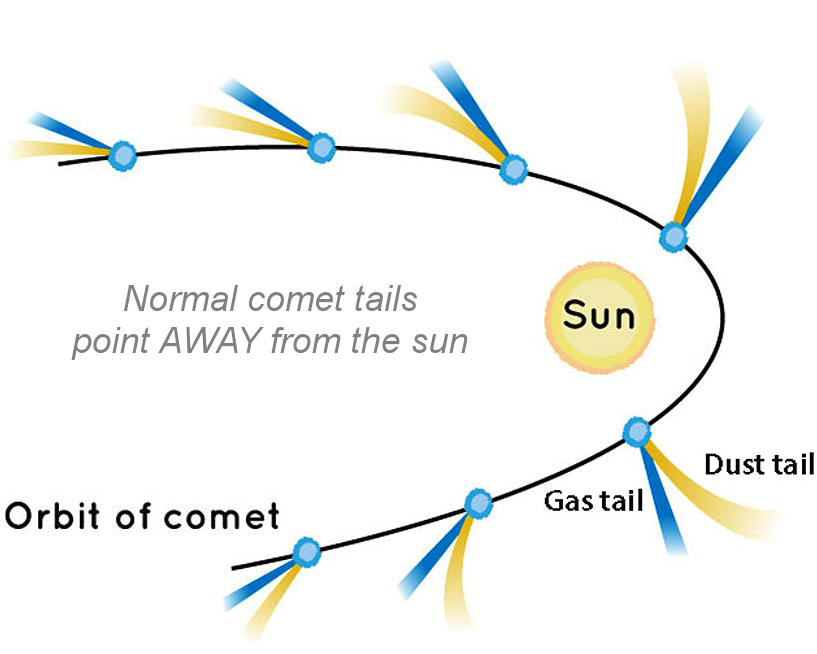
The tail of 3I/ATLAS points almost straight toward the sun. Normally, comet dust tails are pushed away from the sun by radiation pressure. 3I/ATLAS is doing the opposite—it’s backwards.
Why? Researchers led by David Jewitt of UCLA believe they have an explanation: “It is due to the preferential sublimation of ice on the hot day side of the nucleus and the near absence of sublimation on the night side,” they wrote in a paper reporting the observations.
In other words, 3I/ATLAS *is* a comet, but only the sun-heated side is producing lots of dust. The emerging dust particles are too big for radiation pressure to bend them back into an ordinary tail.
This is unusual, but not unheard of. Solar system comets have been known to produce sunward fans or jets, typically from localized “hot spots” on their rotating nuclei. What makes 3I/ATLAS different is the dominance of its sunward plume, dwarfing a barely visible anti-solar tail behind it.
If 3I/ATLAS is indeed a comet, it may have been wandering through the galaxy for longer than our Solar System has existed. Billions of years of cosmic ray bombardment will have altered its surface–knocking hydrogen atoms out while heavier molecules remained behind. This process could create a hardened crust that might not sputter dust and gas like fresher comets from the Solar System.
Researchers will be very interested to see how the tail of 3I/ATLAS evolves as it approaches the sun for a close encounter in October 2025. Will it remain backward? Or will the crust crumble and allow smaller particles to escape, forming a more normal anti-solar tail?
Of course, if it is a spaceship as Harvard professor Avi Loeb suggests, something completely different may occur. Either way, stay tuned.
August 26, 2025: (Spaceweather.com) The most intriguing mystery in astronomy today is the nature of interstellar object 3I/ATLAS. Most astronomers believe it is a comet. However, Avi Loeb of Harvard University famously makes the case that it might be something else–like alien tech.
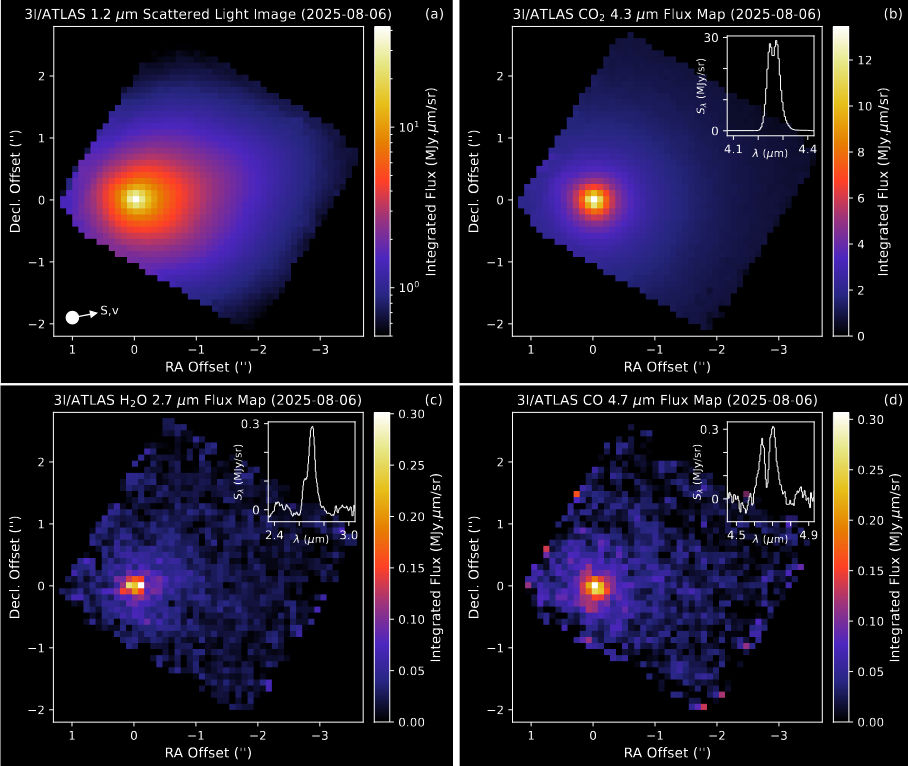
Into this debate comes new data from the James Webb Space Telescope. A paper just submitted to the Astrophysical Journal Letters reports that 3I/ATLAS looks like a comet, albeit a strange one. Here are the images from JWST:
Above: These JWST images show the distribution of carbon dioxide (panel b), water (panel c) and carbon monoxide (panel d). Most of the light is coming from CO2.
The infrared space telescope found most of the ingredients we expect to find in comets. There’s a fuzzy coma, volatile ices, and all the usual molecules: water (H20), carbon dioxide (CO2), carbon monoxide (CO). If 3I/ATLAS is a spacecraft, it has an uncanny disguise.
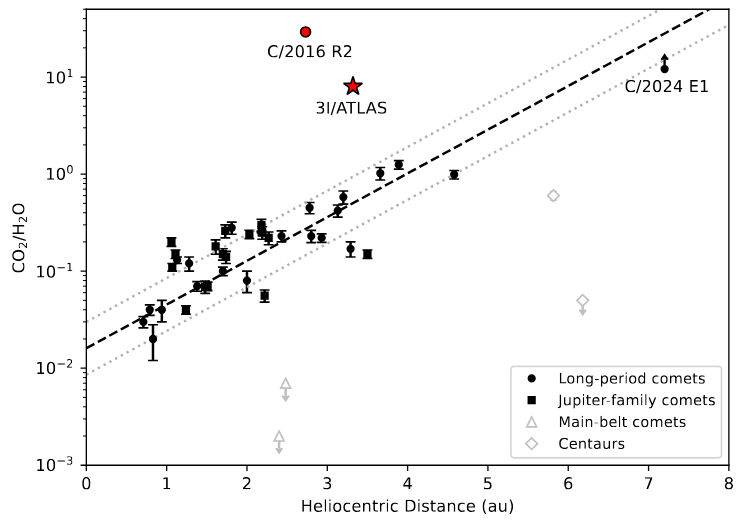
However, there’s also something strange. The ratios of the different molecules are quite unexpected and don’t match what we see in Solar System comets. In particular, the CO2/H20 ratio of 8 ± 1 is extremely high. Only one other comet, C/2016 R2, is known to have similar chemistry, and astronomers have long considered it to be a “freak.”
Above: Carbon dioxide-to-water ratios in known comets. 3I/ATLAS does not fit the trend.
Typical comets have a lot more water in their atmospheres, with H20 almost always outnumbering CO2. It could be that water production in 3I/ATLAS has not yet fully “turned on” because it is still too cold. If so, solar heating might restore ratios to normal. 3I/ATLAS will reach its closest point to the sun (1.36 AU) on Oct. 29, 2025, potentially bringing forth a geyser of water vapor to mix with the other gases.
Or, maybe, 3I/ATLAS is just strange–like it came from another star system. Stay tuned for updates.
Aug. 15, 2025 (Spaceweather.com): Solar activity might be doing more than sparking auroras. A new study in Communications Medicine suggests it could be nudging your blood pressure, too.
Researchers in China analyzed more than half a million blood pressure readings taken over six years in the cities of Qingdao and Weihai. They compared those measurements to the Ap index, a standard measure of geomagnetic activity. The result: Blood pressure rises and falls in rhythm with magnetic unrest.
A sample of the dataset showing the correlation between BP and Ap. See Fig 1 for more.
Both systolic and diastolic blood pressure showed a bimodal pattern, with peaks in spring and autumn, mirroring the seasonal ups and downs of geomagnetic activity. In years when geomagnetic activity was strong, blood pressure peaked about one month after the Ap index. During quieter years, the lag stretched to two months. The data revealed matching cycles at 12, 6, and sometimes 3 months — present in the Ap index but absent from other environmental factors.
“We found that blood pressure and geomagnetic activity share distinct seasonal patterns,” says Quanqi Shi, one of the paper’s co-authors from Shandong University. “There seems to be a genuine link between the two.”
Importantly, the study found no similar multi-month patterns in air temperature or PM2.5, two well-known influences on blood pressure. While temperature correlated more strongly with blood pressure in a straightforward statistical sense, its effect lacked the 6- and 3-month cycles seen in geomagnetic data.
The authors stop short of saying that geomagnetic activity causes high blood pressure. Their data cannot prove cause and effect. Still, Shi and his colleagues are exploring how such a link might work.
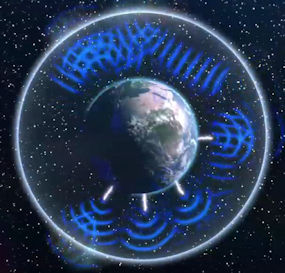
“One possible mechanism involves the modulation of ultra-low frequency waves, specifically Schumann resonances (pictured right), which occur within Earth’s magnetosphere. The fundamental frequency of Schumann resonances is approximately 7.8 Hz, with harmonics around 14.1, 20.3, 26.4, and 32.5 Hz. These fluctuations may interfere with human brain waves such as alpha (8–12 Hz), beta (12–30 Hz), and gamma (30–100 Hz),” Shi explains.
“The brain could then modulate neuroendocrine activity (for example, by altering the secretion of hormones such as vasopressin), which can gradually influence vascular tone and fluid balance. Such physiological adjustments may take weeks to accumulate, potentially explaining the observed 1-2 month delay.”
“This is just a hypothesis,” he stresses. “Further targeted studies are needed to confirm and clarify its potential mechanisms.”
Want to learn more? The full paper may be found here.
Aug. 1, 2025 (Spaceweather.com): Hurricane season just got worse. Chinese researchers have discovered a new kind of storm at the edge of space. They call it a “space hurricane.”
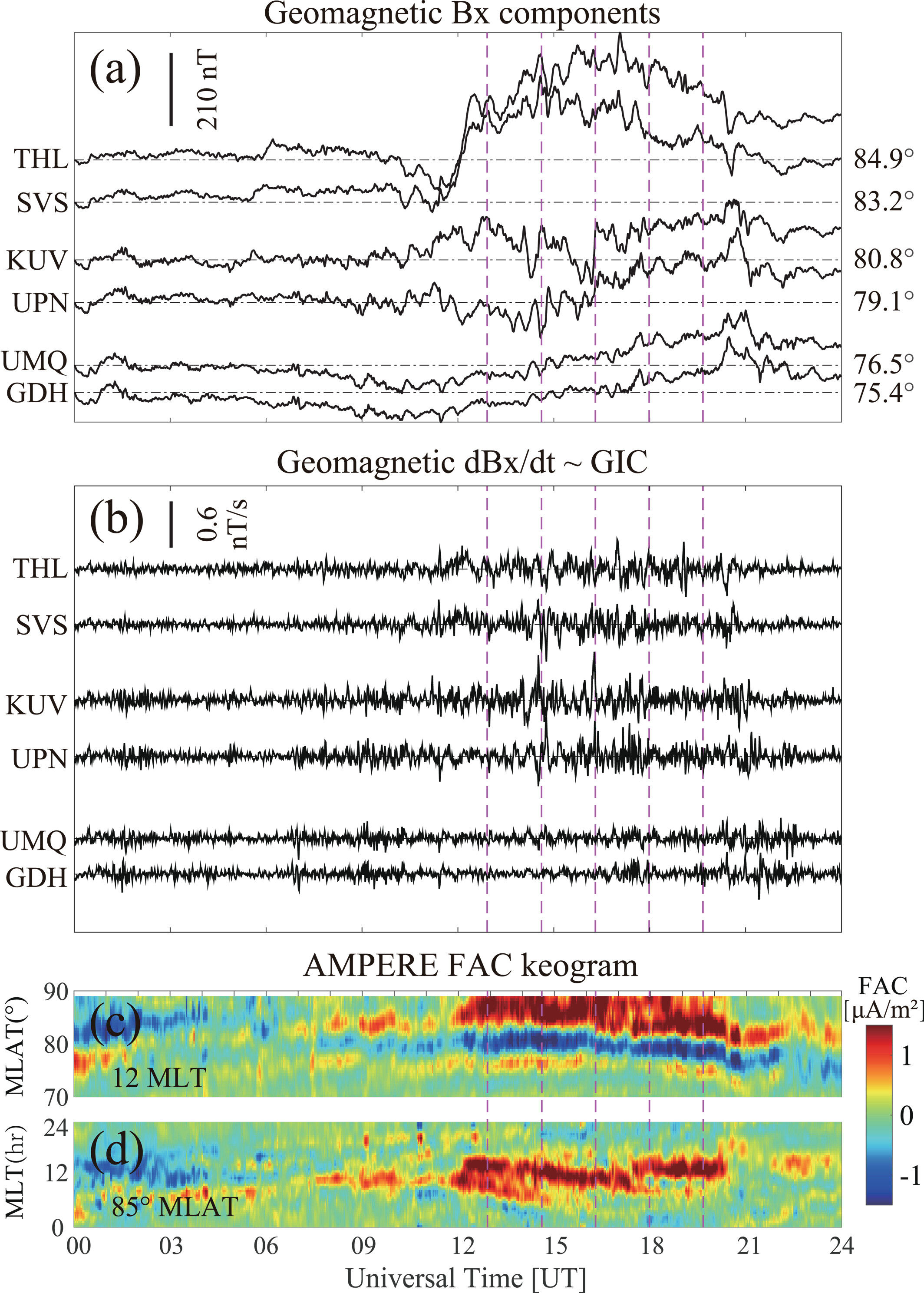
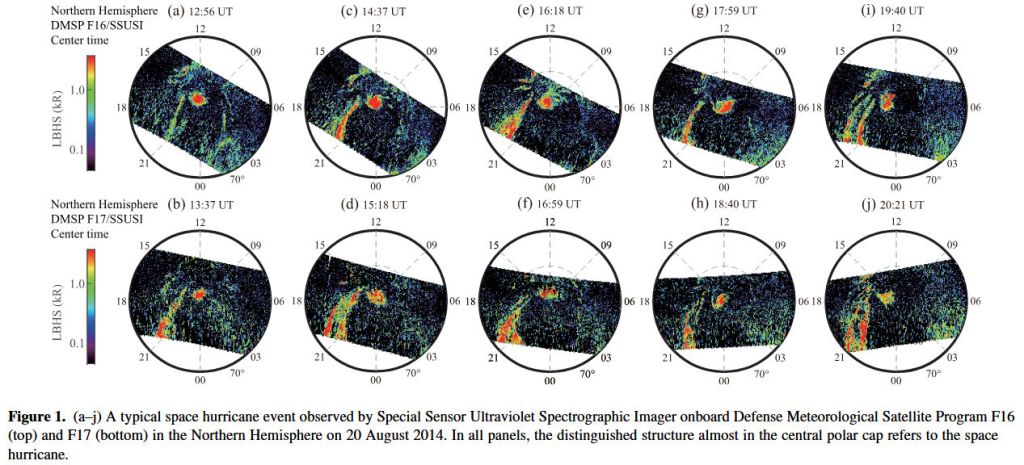
The first known example appeared in Defense Meteorological Satellite (DMSP) images on Aug. 20, 2014. A massive swirl of charged particles appeared above the North Pole. Spinning silently, it resembled a terrestrial hurricane in shape, with spiral arms and a calm “eye” glowing with auroral light. A detailed study of this event was published in the July 2025 edition of Space Weather.
Above: A ‘ space hurricane’ observed by DMSP satellites. Note the eye and spiral arms.
“The space hurricane formed during very quiet conditions,” says lead author Sheng Lu of Shandong University. “Solar activity was low.”
Most researchers had overlooked these events because they weren’t linked to solar storms. This team looked for auroras under calm conditions and found something new. The DMSP F17 satellite flew through the space hurricane’s center; ten minutes later, SWARM B crossed the edge. Their data confirmed the hurricane was an active electrodynamic storm, not just an auroral display.
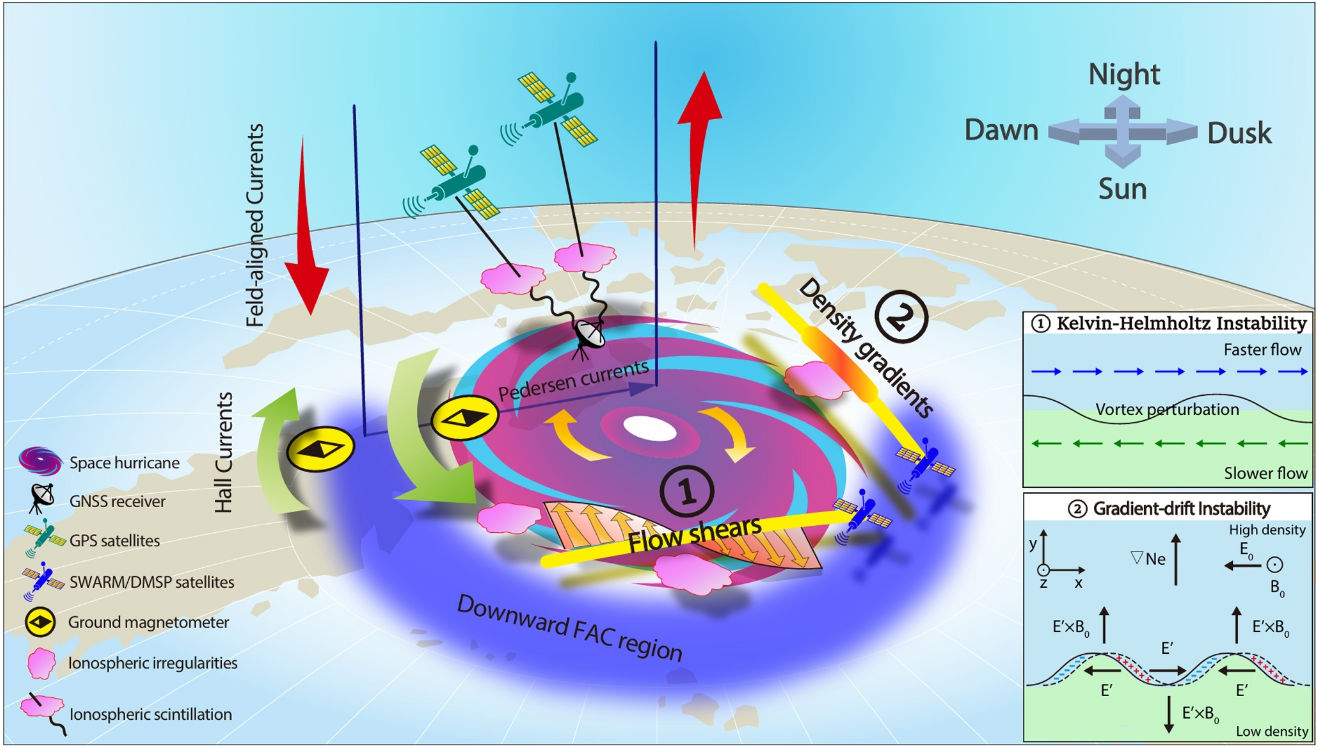
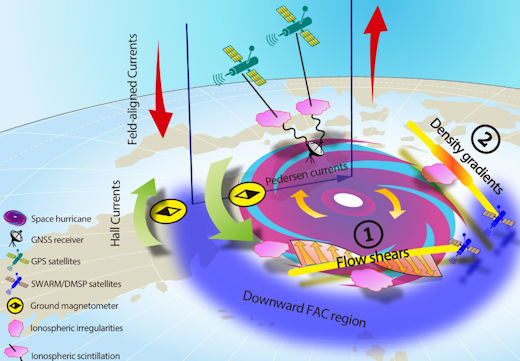
The hurricane’s effects mimicked those of actual geomagnetic storms. Using GPS data from the Canadian High Arctic Ionospheric Network, the researchers found that satellite signals passing through the hurricane’s edge experienced strong phase scintillations–a type of “twinkling” that can reduce GPS accuracy. Meanwhile, ground-based magnetometers in Greenland recorded sharp shifts in Earth’s magnetic field as large as 400 nT–comparable to a G1-class geomagnetic storm.
Above: The anatomy of a space hurricane. Credit: Lu et al (2025) [Expand]
Savvy aurora chasers know that the best time to catch Northern Lights is when the interplanetary magnetic field (IMF) tilts south. This opens a hole in Earth’s magnetosphere, allowing solar wind to enter. We tend to ignore times when the IMF tilts north and closes the door. Yet that is precisely when space hurricanes form, according to the study.
Space hurricanes are stealthy, appearing when traditional metrics of space weather forecasting indicate little of interest. Note to forecasters: Not all storms come from the sun.
Want to learn more? Read the original research here.
July 21, 2025 (Spaceweather.com): Carl Sagan famously said, “Extraordinary claims require extraordinary proof.” But he never said we couldn’t discuss extraordinary claims without extraordinary proof. In that spirit, we review a new draft paper by Avi Loeb and colleagues, which asks whether interstellar comet 3I/ATLAS might be a spaceship.
Avi Loeb is a Harvard astronomy professor who became a household name in 2017 after the discovery of ‘Oumuamua, the first known interstellar object to pass through our solar system. While most scientists offered natural explanations, Loeb made headlines by suggesting it could be an artificial probe from an alien civilization.
Above: This artist’s concept shows how ‘Oumuamua is usually depicted: as a cigar-shaped asteroid.
The idea might have been dismissed outright if it came from someone less credentialed. But Loeb’s Harvard affiliation lent it gravitas—and he had a point. ‘Oumuamua’s strange cigar-like shape and unexplained acceleration fit the Hollywood stereotype of a spacecraft. It sped up slightly as it left the solar system, possibly due to outgassing like a comet. Yet no gas or dust was ever seen.
Loeb’s reception has been frosty. Many mainstream researchers refuse to even mention his ideas in published papers, arguing that they have been debunked. But Loeb hasn’t backed down. He pioneered Project Galileo in 2021 to search the skies for technological artifacts. He has even searched the ocean floor. In mid-2023, Loeb announced the recovery of metallic spherules in the Pacific, arguing that they may be fragments from an artificial interstellar meteor. (Others disagree.)
Now Loeb is looking at interstellar object 3I/ATLAS as a potential piece of alien technology. In a paper co-authored by Adam Hibberd and Adam Crowl, he lays out nine ideas consistent with it being an intentional alien visitor. We review some of them here:
1. The orbit of 3I/ATLAS is strangely parallel to Earth’s. It lies within 5 degrees of the ecliptic plane–a coincidence with odds of less than 0.2%. The ecliptic plane is a narrow target, and the odds of a random interstellar comet hitting it are indeed low.
2. 3I/ATLAS will approach three planets during its visit: Venus (0.65au), Mars (0.19au) and Jupiter (0.36au). The cumulative probability of such a triple encounter is about 0.005%. However, it is the kind of pattern you might expect from a planetary survey.
3. 3I/ATLAS is on course to avoid Earth. At perihelion (closest approach to the sun), 3I/ATLAS and Earth will be on opposite sides of the sun. “This could be intentional to avoid detailed observations from Earth-based telescopes when the object is brightest or when gadgets are sent to Earth from that hidden vantage point,” writes Loeb in a blog post. We believe this statement speaks for itself.
4. Although most astronomers believe 3I/ATLAS is a comet, “no spectral features of cometary gas are found in spectroscopic observations of 3I/ATLAS,” notes Loeb. This is far from conclusive. For one thing, 3I/ATLAS is still very far away, and its spectral features may simply be too faint to observe. More importantly, new images from the Gemini North Telescope show 3I/ATLAS looking exactly like a comet with a normal gaseous envelope. Update:Hubble agrees.
Above: Gemini North picture of 3I/ATLAS. It looks like a comet.
5. 3I/ATLAS has two chances to perform an Oberth maneuver. During its close approaches to the sun and Jupiter, 3I/ATLAS could fire its engines (if any) and become a permanent resident of the Solar System. That’s exactly what an exploratory probe might want to do.
Taken together, these points read more like a collection of curious coincidences than compelling evidence of alien tech. Even the authors admit as much: “This paper is contingent on a remarkable but, as we shall show, testable hypothesis, to which the authors do not necessarily ascribe, yet is certainly worthy of an analysis and a report,” they wrote.
We agree. It’s okay to talk about these extraordinary claims, even if we don’t believe them–yet. Stay tuned for updates as Loeb’s hypotheses are put to the test.
July 17, 2025 (Spaceweather.com): Astronomers come in all shapes and sizes–even invertebrates. A new study published in Nature reveals that Australian moths can see and decipher the night sky. They pay particular attention to the Milky Way and seem capable of navigating using the Carina nebula as a visual landmark.
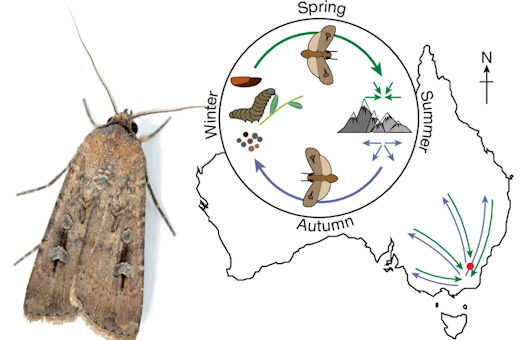
Above: A male Bogong moth and a diagram of their annual migration.
Every spring in southeast Australia, billions of Bogong moths take flight under cover of darkness. It’s the beginning of an epic migration as much as 1,000 kilometers long. Their destination: a small cluster of caves in the Australian Alps–places the moths have never visited before, yet somehow navigate to with remarkable precision. Their compass, it turns out, is the night sky itself.
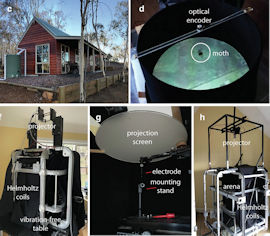
Reaching this conclusion required the researchers to do something you probably don’t want to think about too closely: They attached the moths to tiny little tethers. Moths could lift off and pick a direction, but not escape.
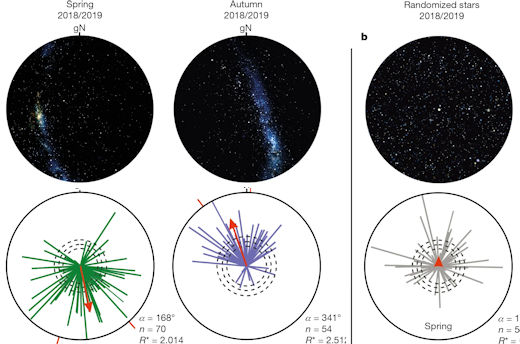
The experiment unfolded inside a special moth planetarium (pictured right). Star patterns were projected onto an overhead screen, while the ambient magnetic field was nulled by Helmholtz coils, guaranteeing that the participants could not “cheat” using magnetic navigation. When shown a normal star field, the moths oriented in the correct direction. But when the stars were scrambled into random patterns, they lost their bearings.
To dig deeper, the researchers recorded activity from visual neurons in the moths’ brains as a projected night sky rotated overhead. Neurons fired most strongly when the stars aligned with the moth’s inherited migratory heading. Some neurons were tuned to the brightest region of the Milky Way (especially near the Carina nebula) suggesting that this band of starlight is a visual landmark.
Clouds produced the next revelation: Bogong moths remained oriented even when stars were hidden. In those cases, they relied on Earth’s magnetic field instead, revealing a dual-compass system similar to that of migratory birds. When both stellar and magnetic cues were removed, the moths became disoriented again.
Upper row: Laboratory-projected night skies during spring and autumn, and an autumn sky with its stars randomly arranged. Lower row: The moths’ reaction to each sky.
In recent years, scientists have discovered that many creatures are guided by the stars. In addition to humans, the list includes migratory songbirds, possibly seals, dung beetles, cricket frogs, and now Bogong moths. The list of lifeforms guided by magnetism is even longer, ranging in size from microbes to whales.
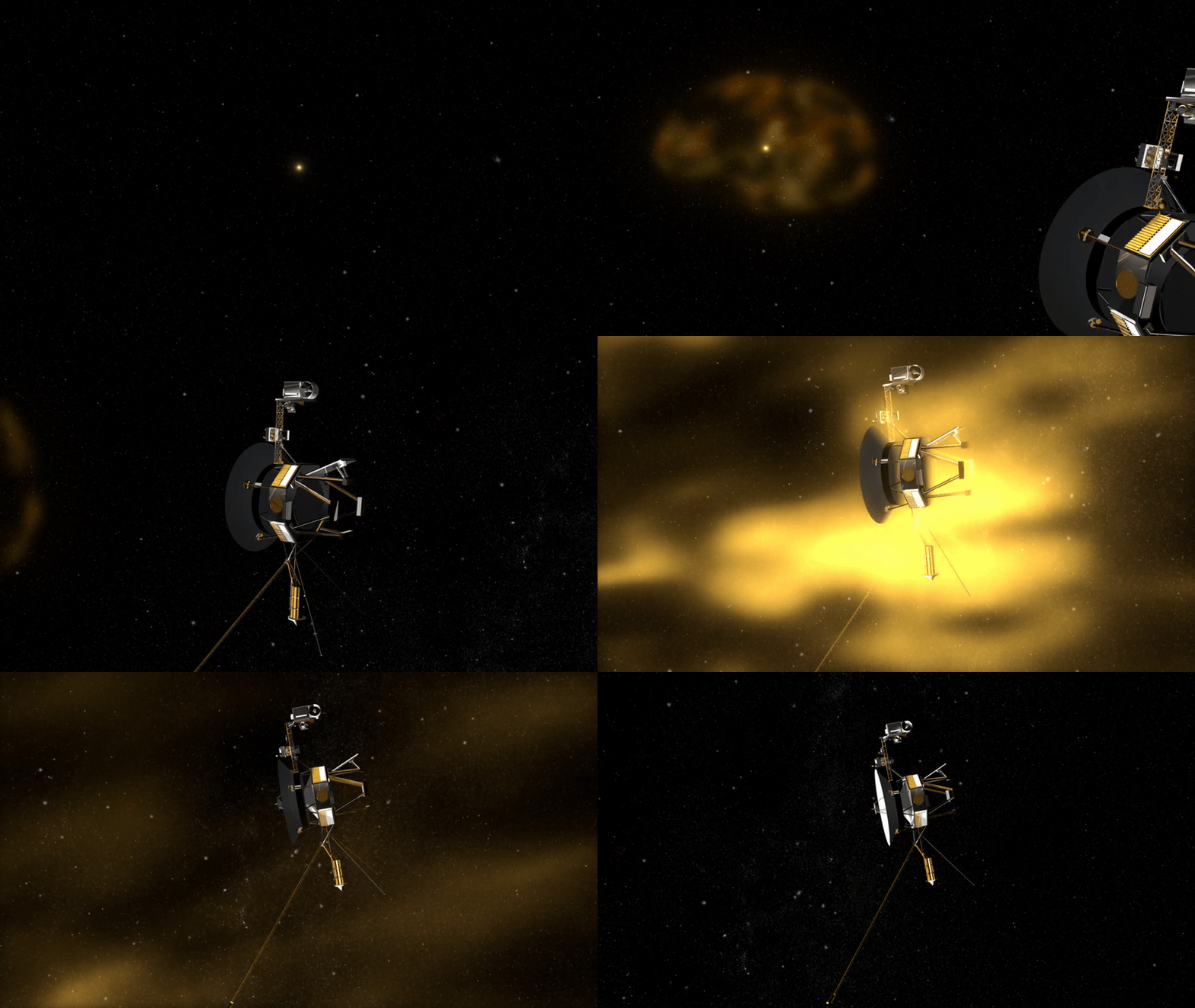
July 14, 2025: You know a solar flare is strong when even the Voyager spacecraft feel it. Twenty-five years ago, on July 14, 2000, the sun unleashed one of the most powerful solar storms of the Space Age—an event so intense, its shockwaves rippled all the way to the edge of the solar system.
Voyager 2 felt the explosion 180 days later; Voyager 1, 245 days. The debris was still coherent and traveling faster than 600 km/s (1.9 million mph) when it slammed into the two spacecraft—then more than 9 billion kilometers from the sun.
Here on Earth, the effects were almost immediate. Within minutes, extreme ultraviolet and X-ray radiation bathed our planet and its satellites. Ground-based sensors registered a rare GLE (ground-level event) as energetic particles cascaded through the atmosphere.
“People flying in commercial jets at high latitudes would have received double their usual radiation dose,” recalled Clive Dyer of the University of Surrey Space Centre. “It was quite an energetic event—one of the strongest of its time.”
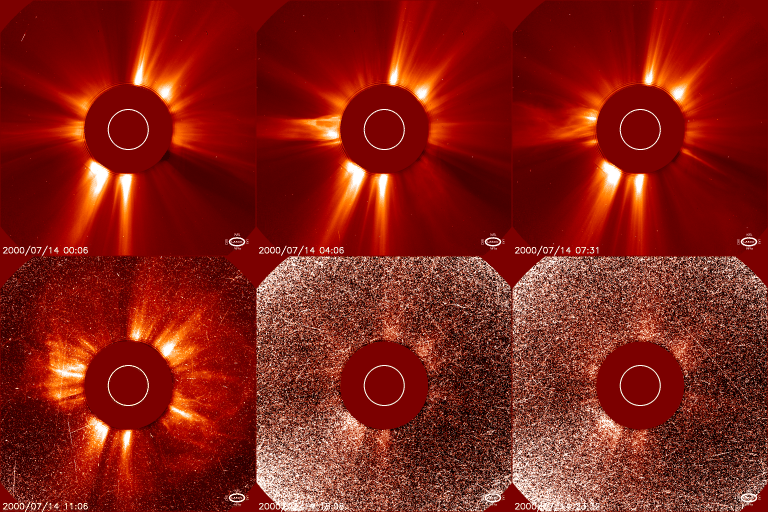
Because the flare happened on July 14th, it’s called “The Bastille Day Event” after France’s national holiday. However, auroras did not appear until the following day, July 15th, when a coronal mass ejection (CME) arrived. The 1500 km/s impact triggered an extreme geomagnetic storm (Kp=9).
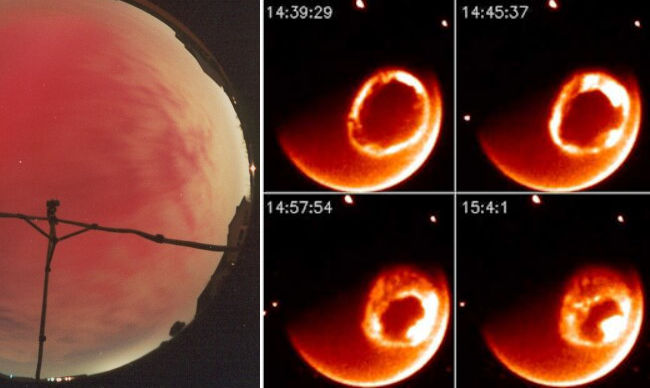
Above: Auroras on July 15, 2000, photographed by (left) Ronnie Sherrill in North Carolina and (right) NASA’s IMAGE spacecraft.
In New York, Lou Michael Moure remembers his sky catching fire: “I was living on Long Island. A family member ran into my room, shouting about ‘the sky on fire.’ Sure enough, the sky blazed white, green, then red from horizon to horizon.” In North Carolina, Uwe Heine was doing yardwork when bright red auroras appeared straight overhead: “I told our neighbor those weren’t sunset colors. It was an aurora—and super rare this far south!”
By the time the storm ended on July 16th, auroras had been sighted as far south as Texas, Florida, and even Mexico.
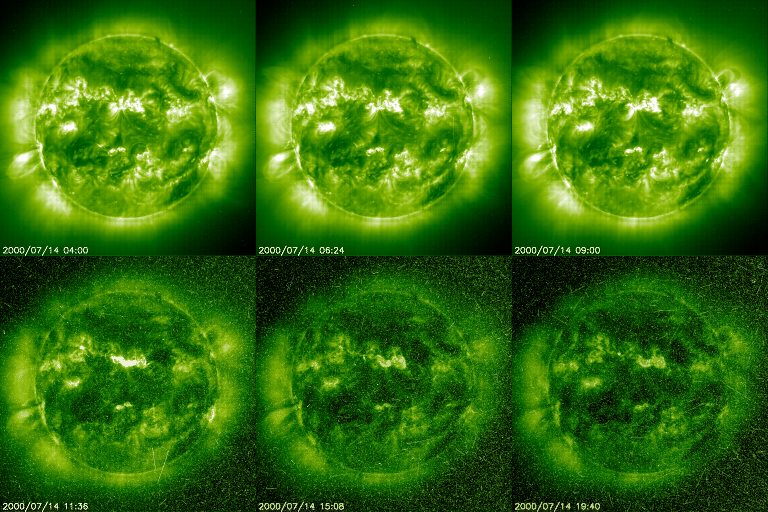
The Bastille Day Event was important because, for the first time in history, spacecraft throughout the solar system were equipped with instruments capable of studying such a storm. Most notably, it was the first major solar storm observed by SOHO, the Solar and Heliospheric Observatory, which gave researchers an unprecedented look at how extreme flares unfold and evolve.
Above: SOHO images of the X5.7-class Bastille Day solar flare (left) and CME (right). “Snow” in the images is a result of energetic protons hitting the spacecraft
Later studies described how an X5.7-class flare, erupting near the center of the solar disk, released 10³³ ergs of magnetic energy—equivalent to a thousand billion WWII-era atomic bombs. The resulting CME generated a massive barrier of magnetic field and plasma, which swept away galactic cosmic rays as it raced through the heliosphere. Even the Voyagers felt this unusual dip in cosmic radiation, known as a Forbush Decrease.
Could it happen again? It could happen again this week. We’re currently near the peak of Solar Cycle 25, and another X-flare is well within the realm of possibility.




 Spaceweather.com