Major Farside Solar Flare

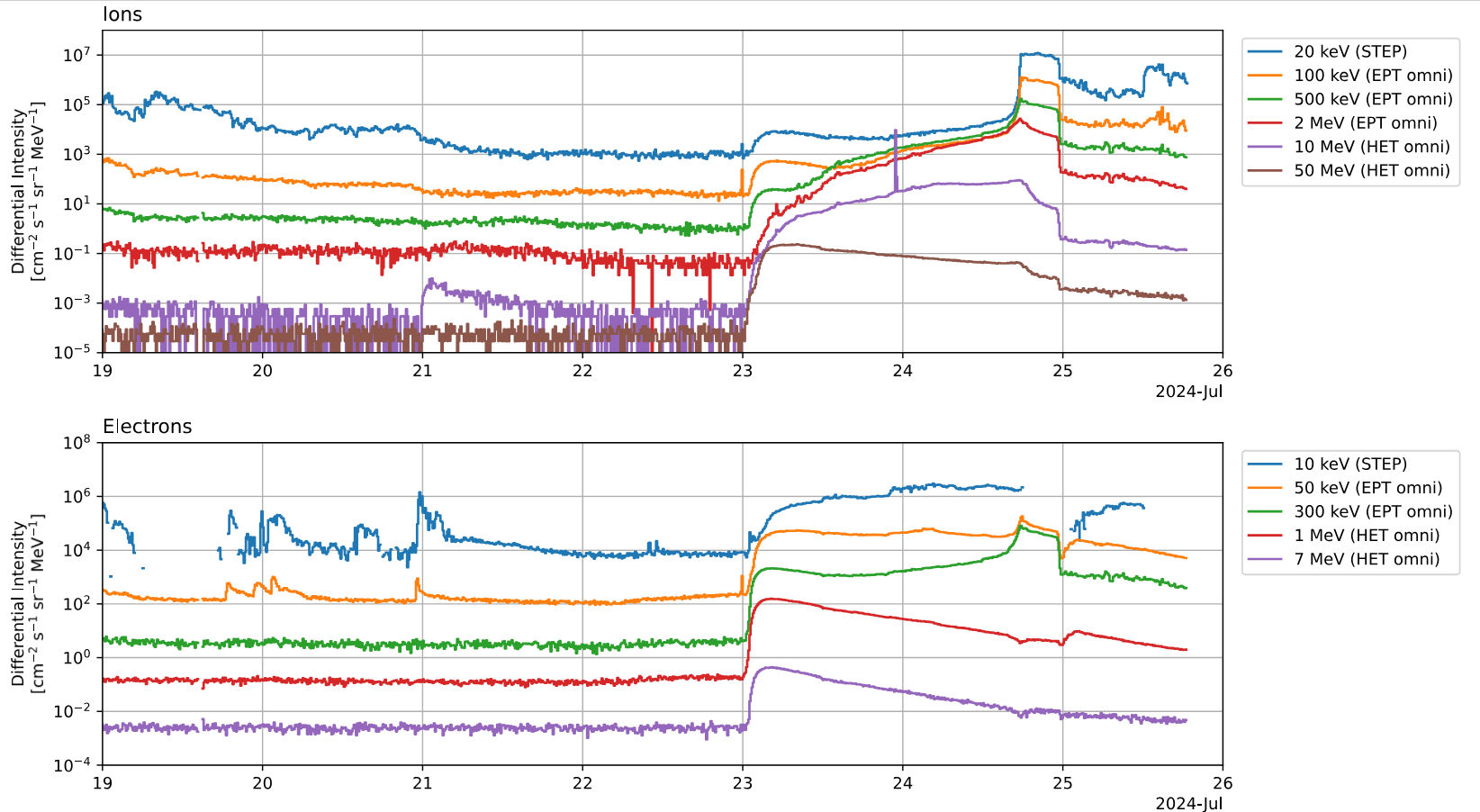
July 25, 2024: The biggest flare of Solar Cycle 25 just exploded from the farside of the sun. X-ray detectors on Europe’s Solar Orbiter (SolO) spacecraft registered an X14 category blast:
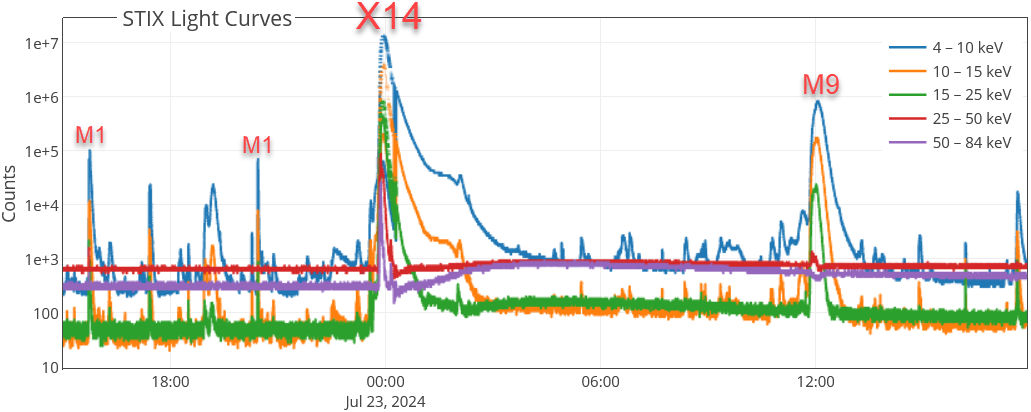
Solar Orbiter was over the farside of the sun when the explosion occured on July 23rd, in perfect position to observe a flare otherwise invisible from Earth.

“From the estimated GOES class, it was the largest flare so far,” says Samuel Krucker of UC Berkeley. Krucker is the principal investigator for STIX, an X-ray telescope on SolO which can detect solar flares and classify them on the same scale as NOAA’s GOES satellites. “Other large flares we’ve detected are from May 20, 2024 (X12) and July 17, 2023 (X10). All of these have come from the back side of the sun.”

Meanwhile on the Earthside of the sun, the largest flare so far registered X8.9 on May 14, 2024. SolO has detected at least three larger farside explosions, which means our planet has been dodging a lot of bullets.

The X14 farside flare was indeed a major event. It hurled a massive CME into space, shown here in a coronagraph movie from the Solar and Heliospheric Observatory (SOHO):
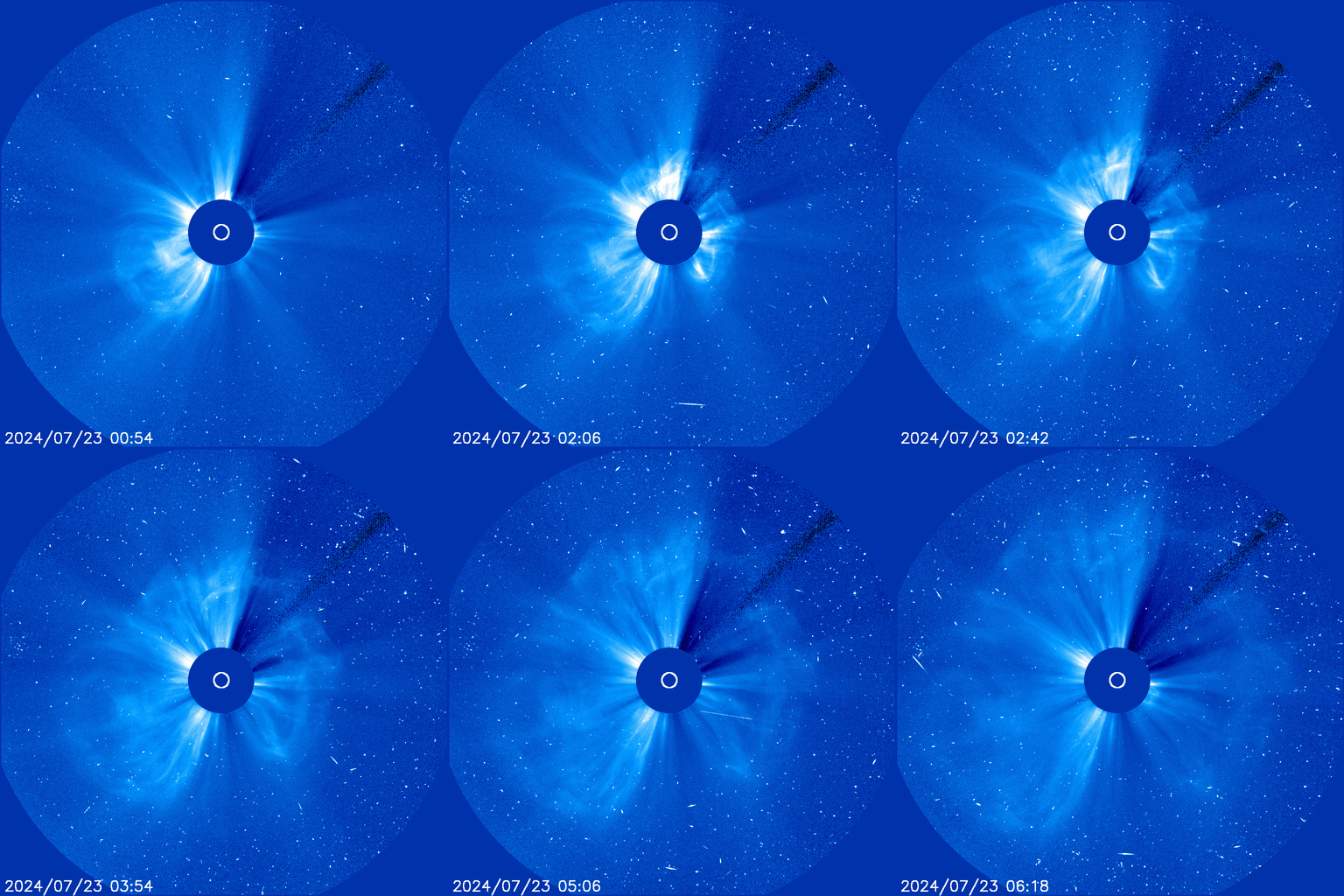
The CME sprayed energetic particles all over the solar system. Earth itself was hit by ‘hard’ protons (E > 100 MeV) despite being on the opposite side of the sun.

“This is a big one–a 360 degree event,” says George Ho of the Southwest Research Institute, principal investigator for one of the energetic particle detectors onboard SolO. “It also caused a high dosage at Mars.”

SolO was squarely in the crosshairs of the CME, and on July 24th it experienced a direct hit. In a matter of minutes, particle counts jumped almost a thousand-fold as the spacecraft was peppered by a hail storm energetic ions and electrons.

“This is something we call an ‘Energetic Storm Particle’ (ESP) event,” explains Ho. “It’s when particles are locally accelerated in the CME’s shock front [to energies higher than a typical solar radiation storm]. An ESP event around Earth in March 1989 caused the Great Quebec Blackout.”

So that’s what might have happened if the CME hit Earth instead of SolO. Maybe next time. The source of this blast will rotate around to face our planet a week to 10 days from now, so stay tuned. Solar flare alerts: SMS Text

The “Inevitable” Fragmentation of Comet Tsuchinshan-ATLAS

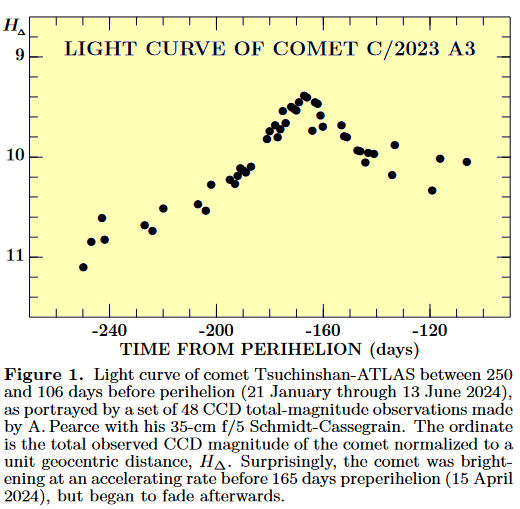
July 12, 2024: Comet Tsuchinshan-ATLAS (C/2023 A3) is about to fall apart. It’s “inevitable,” according to a new study by astronomer Zdenek Sekanina. “Evidence suggests that the comet has entered an advanced phase of fragmentation,” he writes.

Above: Comet Tsuchinshan-ATLAS photographed by José J. Chambó

If true, this is disappointing news. Discovered in early 2023, the comet appears to be heading for a magnificent close encounter with the sun later this year, perhaps becoming as bright as Venus in October 2024. Instead, it could fall apart before it has a chance to become a naked-eye object.

Sekanina’s arguments are threefold: First, the comet has failed to brighten as it approaches the sun. Second, the comet’s orbit seems to be affected by a “non-gravitational acceleration.” This could happen if, say, inner jets are pushing apart a disintegrating nucleus. Third, the comet’s dust tail has an unusually narrow, teardrop shape with a peculiar orientation. 

Together, these observations suggest a crumbling comet “in which increasing numbers of fractured refractory solids stay assembled in dark, porous blobs of exotic shape, becoming undetectable as they gradually disperse in space,” says Sekanina.

Above: This is what a break-up looks like–Comet LINEAR 24 years ago.

“That is a fascinating paper,” says Nick James, director of the Comet Section of the British Astronomical Association. “Sekanina is very well respected in the field, so it carries a lot of weight. To use ‘inevitable’ in any prediction about a comet may be unwise! But it is definitely a testable theory and another good reason to observe this comet at every opportunity.”

In fact, James isn’t convinced. In an independent data set, he finds no evidence of non-gravitational accelerations. “This doesn’t look like a comet that is fragmenting to me,” he says.

We’ll soon find out. The comet is brighter than 10th magnitude, well within range of mid-sized backyard telescopes, which means amateur astronomers can monitor the potential break-up. Point your optics here

Nova T CrB is About to Explode

June 28, 2024: (Spaceweather.com) By the time you finish reading this story, there could be a new star in the night sky. Recurrent nova T CrB (pronounced “tee-core-bore”) is poised on the knife edge of a once-in-a-lifetime explosion.

“Our best estimate for the time of eruption is close to now,” says Brad Schaefer, Professor Emeritus of Astronomy at Louisiana State University.

Schaefer is a leading expert on T CrB. He’s been studying the star since he was a teenager. “When I was 18 year old, I calculated when T CrB should erupt again, and I’ve been waiting for this moment ever since,” he says.

T CrB is a “recurrent nova.” That means it erupts not just once, but over and over again. Its explosion in 1866 was the first nova astronomers had ever seen in detail. “No one knew what caused it,” says Schaefer. Another blast in 1946 established its period (79 or 80 years) and led researchers to the modern interpretation:

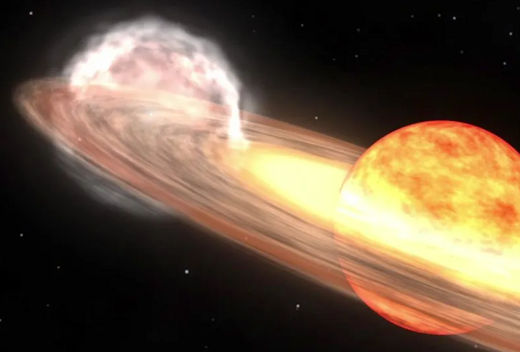
Located 3000 light years away, T CrB is a binary star system consisting of an ancient red giant circled by a hot white dwarf. Hydrogen from the red giant spills onto the surface of the white dwarf. It takes about 80 years to accumulate a critical mass, then–BOOM–a thermonuclear explosion occurs. “It’s an H-bomb that blows up on an incredibly large scale,” says Schaefer.

After an explosion, the process resets and repeats. Looking at old light curves, Schaefer realized that T CrB tells us when it’s about to explode. Approximately 1.1 years before each blow-up, there’s a “pre-eruption dip” in brightness. Amateur astronomers working with the American Association of Variable Star Observers (AAVSO) detected the pre-eruption dip in March 2023:

Above: The pre-eruption dip in March 2023

“If the star behaves in 2023-2024 as it did in 1945-1946, then the next eruption should take place in 2024.4+-0.3,” says Schaefer. “That’s May 2024 plus or minus a few months.”

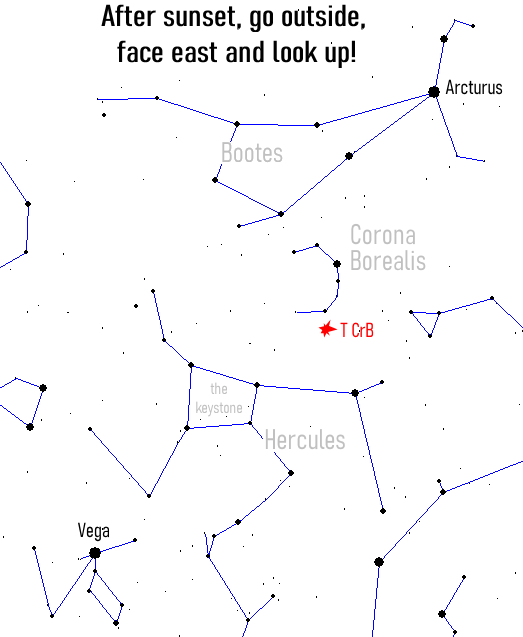
The explosion will be visible to the naked eye. Schaefer expects it to be about as bright as the North Star (2nd magnitude). When it blows, T CrB will burst forth as an extra jewel in the “Northern Crown” (the constellation Corona Borealis), easy to find high in the summer night sky between Hercules and Bootes.

“T CrB will be the brightest nova for generations,” says Schaefer. “It’s a chance for everyone in the world to step outside, look up, and see the hellfire.”

Observing tips: (1) Tonight, go outside and see what Corona Borealis normally looks like: sky map. Then, when the nova explodes, you’ll be able to tell the difference. (2) Sign up for Space Weather Alerts. All subscribers (Basic and Pro) will receive an immediate text message when the nova explodes.

A Nova Will Explode This Summer (Probably)

June 7, 2024: The night sky is about to get a new star. Sometime this summer, astronomers believe, a nova will explode in the constellation Corona Borealis (the Northern Crown). The exploding star will be bright enough to see with the naked eye even from light-polluted cities.


Above: A NASA artist’s concept of the T CrB binary star system

“It’s a once-in-a-lifetime event,” says Rebekah Hounsell of NASA’s Goddard Space Flight Center. “I believe it will create a lot of new astronomers out there.”

T Coronae Borealis (T CrB) is a binary system 3,000 light-years from Earth. It consists of a white dwarf orbiting an ancient red giant. Hydrogen from the red giant is being pulled down onto the surface of the white dwarf, accumulating toward a critical mass. Eventually, it will trigger a thermonuclear explosion.

The outburst will be brief. Once it erupts, the nova will be visible to the naked eye for a little less than a week – but Hounsell is confident it will be quite a sight to see. The expected magnitude is between +2 and +3, similar to stars in the Big Dipper.

“Typically, nova events are faint and far away,” says Elizabeth Hays, chief of the Astroparticle Physics Laboratory at NASA Goddard. “This one will be really close, with a lot of eyes on it. We can’t wait to get the full picture of what’s going on.”

A Red Blob in the Night Sky

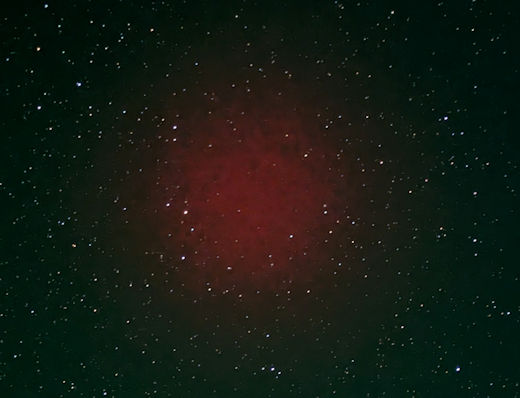
April 10, 2024: This is starting to happen a lot in the state of Texas. On April 10th, around 2:14 in the morning, amateur astronomer Abdur Anwar looked up from Big Bend National Park and saw a glowing red blob glide across the starry sky. “I photographed it using my Google Pixel 6a phone in night mode,” he says.

“Is this a new aurora phenomenon?” he asks.

No, it’s SpaceX.

About 90 minutes before the red blob appeared, a Falcon 9 rocket lifted off from the Cape Canaveral Space Force Station in Florida, carrying 23 Starlink satellites to low-Earth orbit (Starlink Group 6-48). After the satellites were deployed, the rocket’s second stage executed a de-orbit burn, creating the nearly-spherical red light.

It’s not the first time sky watchers have noticed this phenomenon. “We are seeing 2 to 5 of them each month,” reports Stephen Hummel of the McDonald Observatory in Texas, who photographed a spectacular example last November.

The red glow is created by a chemical reaction. De-orbiting Falcon 9 rocket engines spray water (H2O) and carbon dioxide (CO2) into the upper atmosphere–as much as 400 lbs of exhaust gasses. A complicated series of charge exchange reactions between these molecules and O+ atoms produces red light at a wavelength of 6300 Å–coincidentally, the same color as red auroras.

Texas seems to be a great place to observe the phenomenon; most sightings have come from there or neighboring states. Texas is favored because, for Starlink missions launched from Florida, it’s approximately where a de-orbit burn will splash the rocket’s second stage safely into the South Atlantic. The burns happen about 90 minutes after launch–just when Anwar saw the blob.

Would you like to see one? Check the SpaceX schedule for night launches, then look at the sky 90 minutes after liftoff. Human eyes are not very sensitive to the 6300 Å wavelength of the red glow, but cameras have no such trouble. Take a short nighttime exposure and submit your images here.

more images: from Madison J Post near Animas, NM

Rocks and Soil Electrified by the May 10th Superstorm

May 23, 2024: (Spaceweather.com) Across the USA on May 10th and 11th, sky watchers marveled at bright displays of aurora borealis during the biggest geomagnetic storm in decades. Little did they know, something was also happening underfoot.

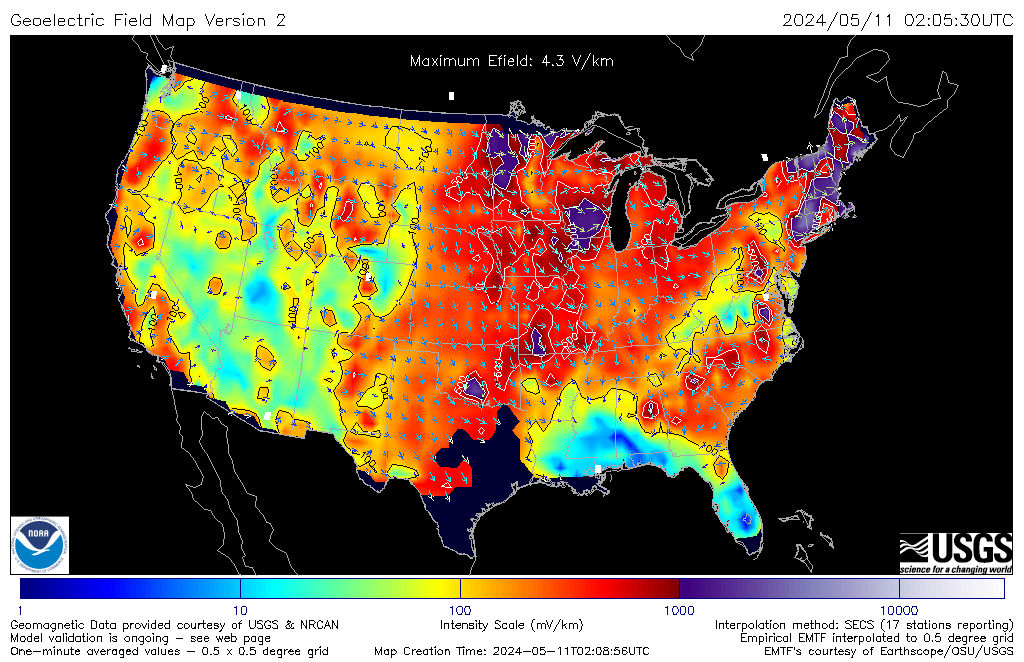
Strong electrical currents were surging through rocks and soil. The biggest voltages along the US eastern seaboard and in the Midwest were as much as 10,000 times normal. A map from NOAA and the US Geological Survey shows some of the ‘hot spots’ during the early hours of May 11th:

Back in March 1989, voltages only a little stronger than the ones shown above brought down the entire Hydro-Québec power system. The resulting Great Québec Blackout plunged millions of Canadians into darkness.

This time, however, power grids stayed up. “We haven’t heard of any serious problems so far,” reports Christopher Balch of NOAA’s Space Weather Prediction Center.

Balch leads an effort at NOAA to model geoelectric fields during solar storms. The map, above, is a snapshot from a real-time display that takes into account the 3D conductivity of the Earth and ongoing geomagnetic activity. A computer at the Space Weather Prediction Center crunches the data to produce minute-by-minute estimates of electricity in the ground.

When researchers talk about geoelectric fields they use units of volts per km (V/km). Earth’s crust naturally contains quiet-time fields measuring as little as 0.01 V/km. During geomagnetic storms, these values skyrocket.

“On May 10-11, geoelectric amplitudes exceeded 10 V/km in Virginia and 9 V/km in the upper Midwest,” says Jeffrey Love, a key member of the collaboration at the USGS. “These are very high. For comparison, we estimate that geoelectric amplitudes reached almost 22 V/km in Virginia during the March 1989 storm.”

This means the May 2024 storm was, electrically speaking, about half as intense as the storm that blacked out Québec 35 years ago. That’s too close for comfort. “Although power companies have taken measures to improve the resilience of their systems, no one would welcome another storm as intense as that of March 1989,” says Love.

Realtime electric field maps are published 24/7 on the NOAA website. During the next geomagnetic storm, click here to see what’s happening underfoot!

South Pacific Auroras Confirm May 10th Was a Great Storm

May 16, 2024: On the south Pacific island of New Caledonia, no one expects to see auroras. Ever. Situated about halfway between Tonga and Australia, the cigar-shaped island is too close to the equator for Northern or Southern Lights. Yet on May 10, 2024, this happened:

“I have rarely been so happy when taking a photo!” says Frédéric Desmoulins, who photographed the display from Boulouparis in the island’s south province. “I could see the red color of the auroras with my naked eye. According to the New Caledonian Astronomy Society, these photos are the first for this territory.”

“The auroral visibility from New Caledonia is really unique and extremely valuable,” says Hisashi Hayakawa, a space weather researcher at Japan’s Nagoya University. “As far as we know, the last time sky watchers saw auroras in the area was during the Carrington Event of Sept. 1859, when auroras were sighted from a ship in the Coral Sea.”

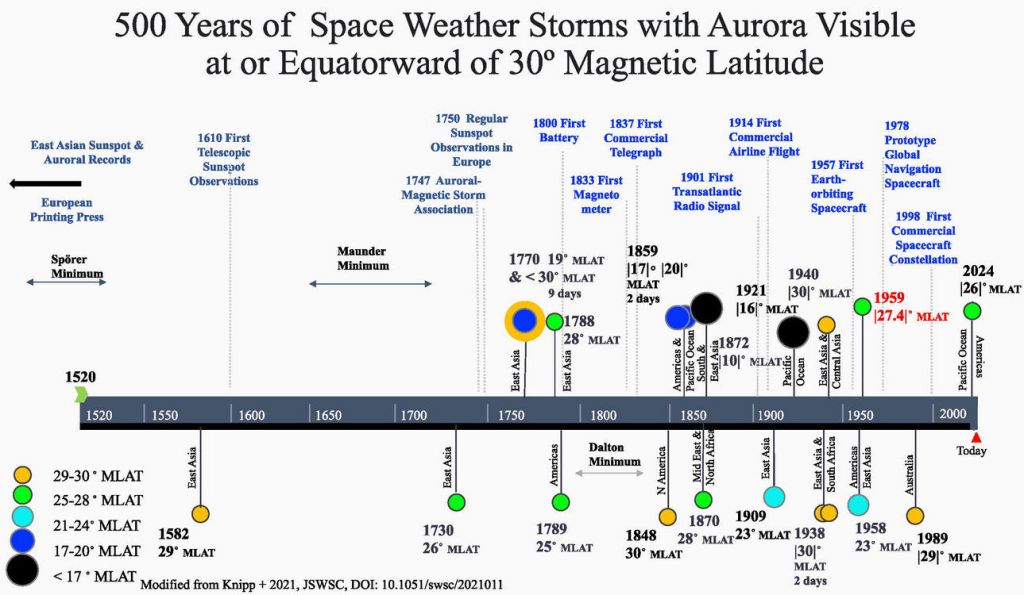
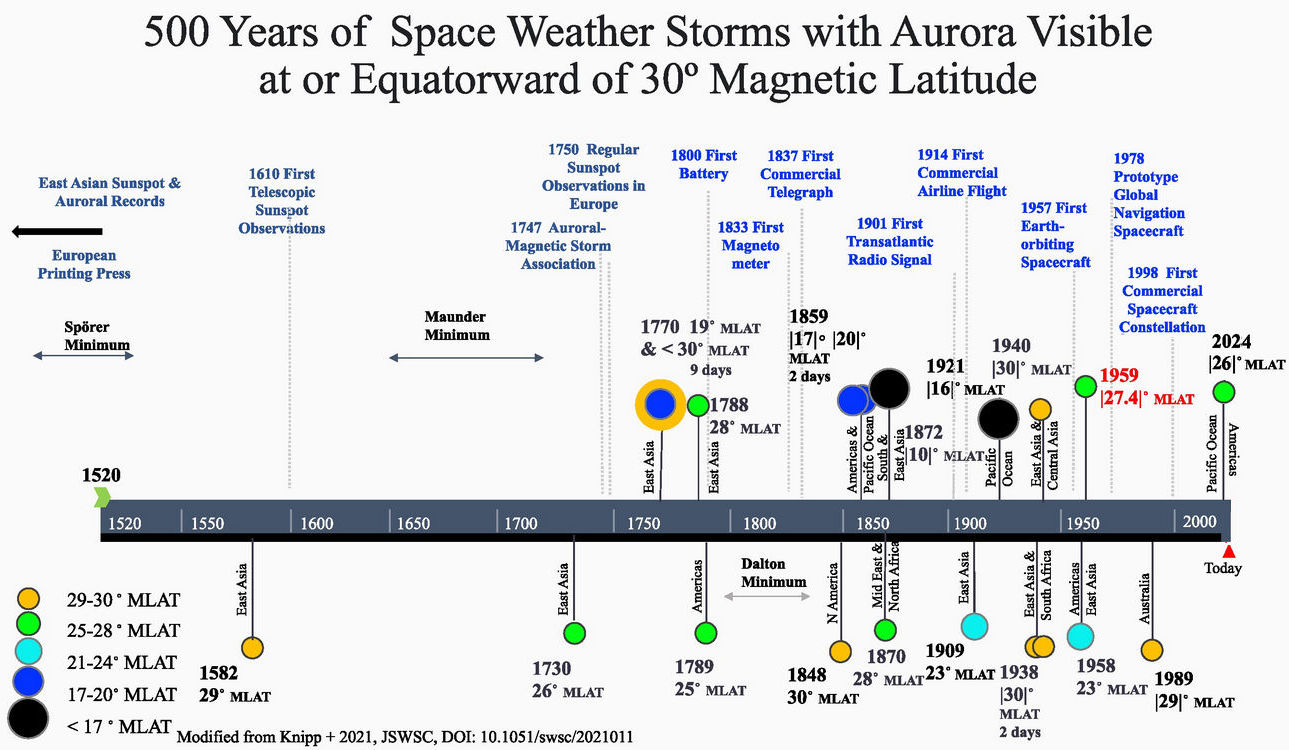
Hayakawa specializes in historical studies of great auroral storms. He tries to go back in time as far as possible. The problem is, magnetometers and modern sensors didn’t exist hundreds or thousands of years ago. Instead, he looks for records of aurora sightings in old newspapers, diaries, ships logs, even cuneiform tablets. Great Storms are identified by their low latitude–anything with naked-eye auroras below 30° MLAT (magnetic latitude).

“May 10th was definitely a Great Storm,” declares Hayakawa. “Naked-eye auroras sightings in New Caledonia (MLAT = -26.4°) and Puerto Rico (MLAT = 27.2°) confirm this in both hemispheres.”

In fact, it is among the top 20 Great Storms of the past 500 years. The above timeline from a research paper by Hayakawa has been modified to display the May 10th event. It is the green dot on the far-right end of the timeline.

This isn’t just an arcane historical curiosity. “We need to know about Great Storms of the past to understand how big storms might become today,” explains Hayakawa. “Our modern technological society depends upon it.”

Readers, if you witnessed auroras at low latitudes on May 10th, please submit your photos to our gallery and fill out this questionnaire from Hayakawa. Your observations may be included in a future research paper about this extreme storm.

Global Auroras on Mars

Feb 28, 2024: Earth isn’t the only planet with auroras. Mars has them, too–on a global scale.

“Mars is experiencing its greatest level of auroral activity in the past 10 years,” says Nick Schneider of the University of Colorado’s Laboratory for Atmospheric and Space Physics (LASP). “In February alone, there were three episodes of global auroras–an ‘aurora hat trick’ we’ve never seen before.”

Orbiting high above Mars, NASA’s MAVEN spacecraft recorded the auroras on 3-4 Feb, 7-10 Feb and 15-16 Feb. This animation shows the last two of these episodes in a looping time series:

Spaceweather.com actually predicted some of these events, prompted by SOHO coronagraph observations of CMEs heading toward Mars. “Your predictions came true!” says Schneider.

Schneider leads the team for MAVEN’s Imaging Ultraviolet Spectrograph (IUVS), the instrument that detected the auroras. All the purple pixels in the animation are a false color representation of the aurora’s ultraviolet glow. Martian auroras probably have a visible light component, too, but MAVEN’s cameras are not able to see them.

Here on Earth we would love it if auroras were global. Seeing Northern Lights with equal ease from the equator and the poles would check off a lot of bucket lists. Be careful what you wish for, though. Martian auroras can be global because the Red Planet has almost no protection from solar storms. It lacks an Earth-like magnetic field, so particles from the sun penetrate its atmosphere with ease–everywhere.

The dramatic auroras of February 2024 were caused by “SEPs”–solar energetic particles. SEPs are accelerated by shock waves within approaching CMEs. When they strike Mars’s atmosphere, they cause it to glow.

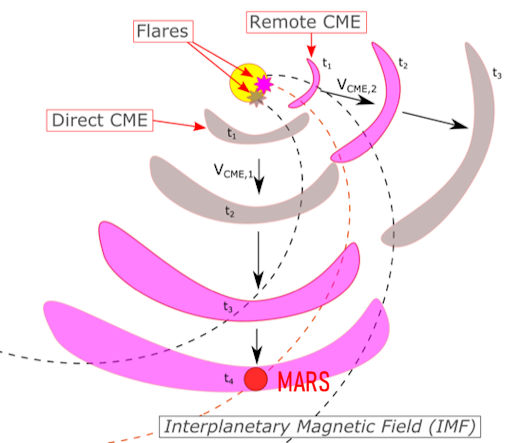
“Mars is currently getting hit by roughly 1 to 2 CMEs every month, bringing a hefty supply of SEPs,” says Rebecca Jolitz, a member of the MAVEN Solar Energetic Particle (SEP) instrument team at UC Berkeley’s Space Sciences Lab. “However, a CME doesn’t actually have to hit to be effective. SEPs coming in sideways from ‘remote CMEs’ can light up the skies as well.”

Schneider and Jolitz are looking forward to the months ahead. “Solar Cycle 25 is far from over, and we expect many more CME strikes,” Schneider says. “This will give us a chance to study how solar storms affect the atmosphere of Mars–a key goal of the MAVEN mission. It’s the kind of fun we’ve been waiting for!”

Extra: Schneider notes that SEPs aren’t the only way to make auroras on Mars. Protons in the solar wind and magnetic reconnection can do the trick, too, producing their own forms and colors. Stay tuned for more stories about the rich variety of Martian auroras as Solar Cycle 25 unfolds.

This Comet Did Not Survive the Eclipse

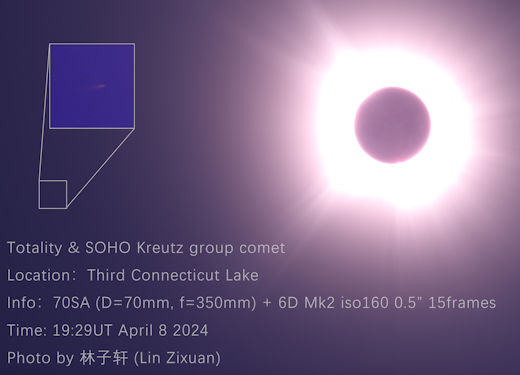
April 10, 2024: (Spaceweather.com) Astronomer Karl Battams of the Naval Research Lab predicted that a sungrazing comet might be visible during Monday’s total eclipse. He was right. Chinese amateur astronomer Lin Zixuan was in New Hampshire for the eclipse, and he photographed the disintegrating comet:

Named “SOHO-5008”, the comet had been discovered earlier the same day by amateur astronomer Worachate Boonplod, who noticed it in SOHO coronagraph images. Battams quickly realized that the comet might be bright enough to photograph in the otherworldly twilight of the Moon’s shadow.

“Ground-based observations of sungrazing comets are extremely rare, so this would be a great opportunity to see an eclipse comet!” says Battams.

Soon after Zixuan photographed the comet, it disintegrated. SOHO has seen this happen more than 5000 times. Most doomed sungrazers (including this one) are members of the Kreutz family. Named after a 19th century German astronomer who studied them in detail, Kreutz sungrazers are fragments from the breakup of a giant comet ~2000 years ago. Several fragments pass by the sun and disintegrate every day, although most are too small to see.

Above: A SOHO coronagraph image of the disintegrating comet

Battams can recall only two other examples of sungrazers seen during a solar eclipse– one in 2020 (also a Worachate Boonplod discovery) and another in 2008. ” I think with modern imaging equipment and techniques, seeing a sungrazer during an eclipse is no longer hugely challenging, but it does require one crucial ingredient: the right comet at the right time. We got lucky this week!” he says.

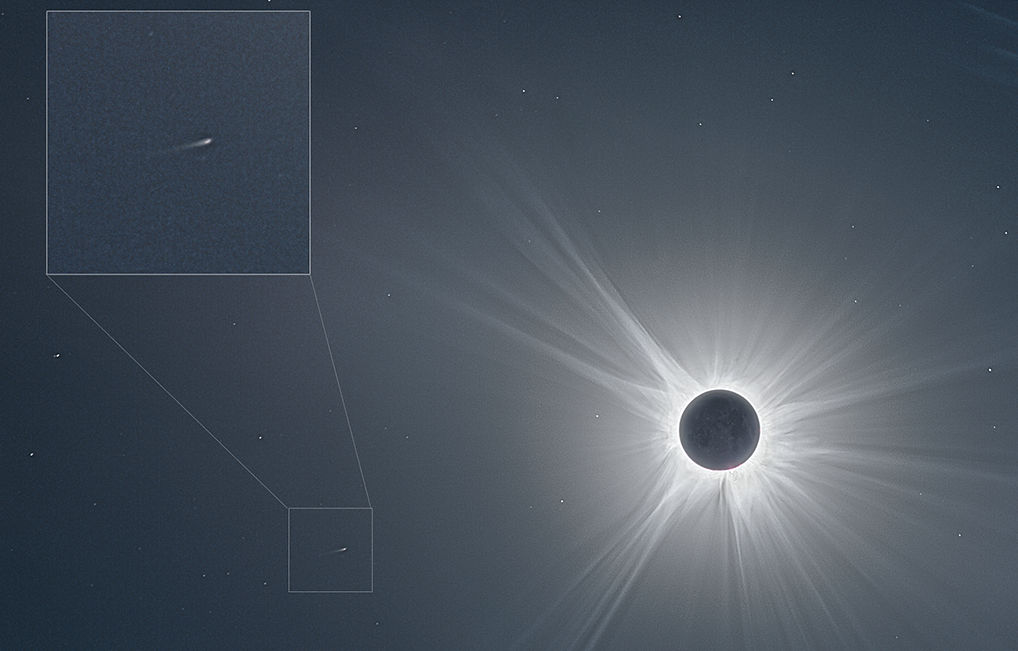
The best picture, so far, of the sungrazer comes from Petr Horálek of Institute of Physics in Opava, who was in Durango, Mexico, for the eclipse:

“I got especially lucky with this shot with the comet SOHO-5008, which was discovered just before the eclipse,” says Horálek. “It was truly windy and partly cloudy, totality took 3 minutes and 25 seconds and the image is the result of HDR shooting (exposure from 1/4000 s to 2s). A total of 83 usable images were used (dark frames and flat fields applied).”

A Sympathetic X-class Solar Flare

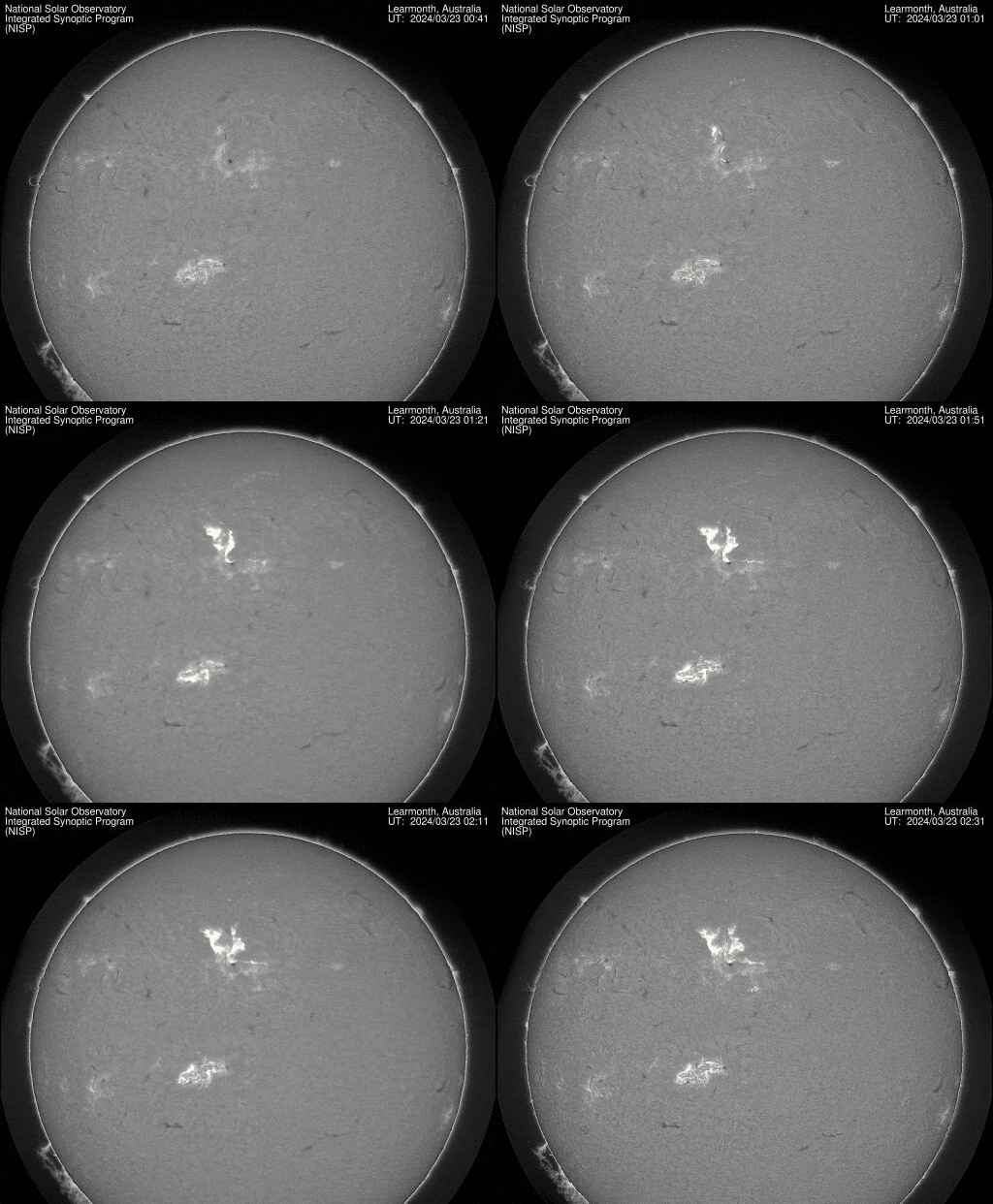
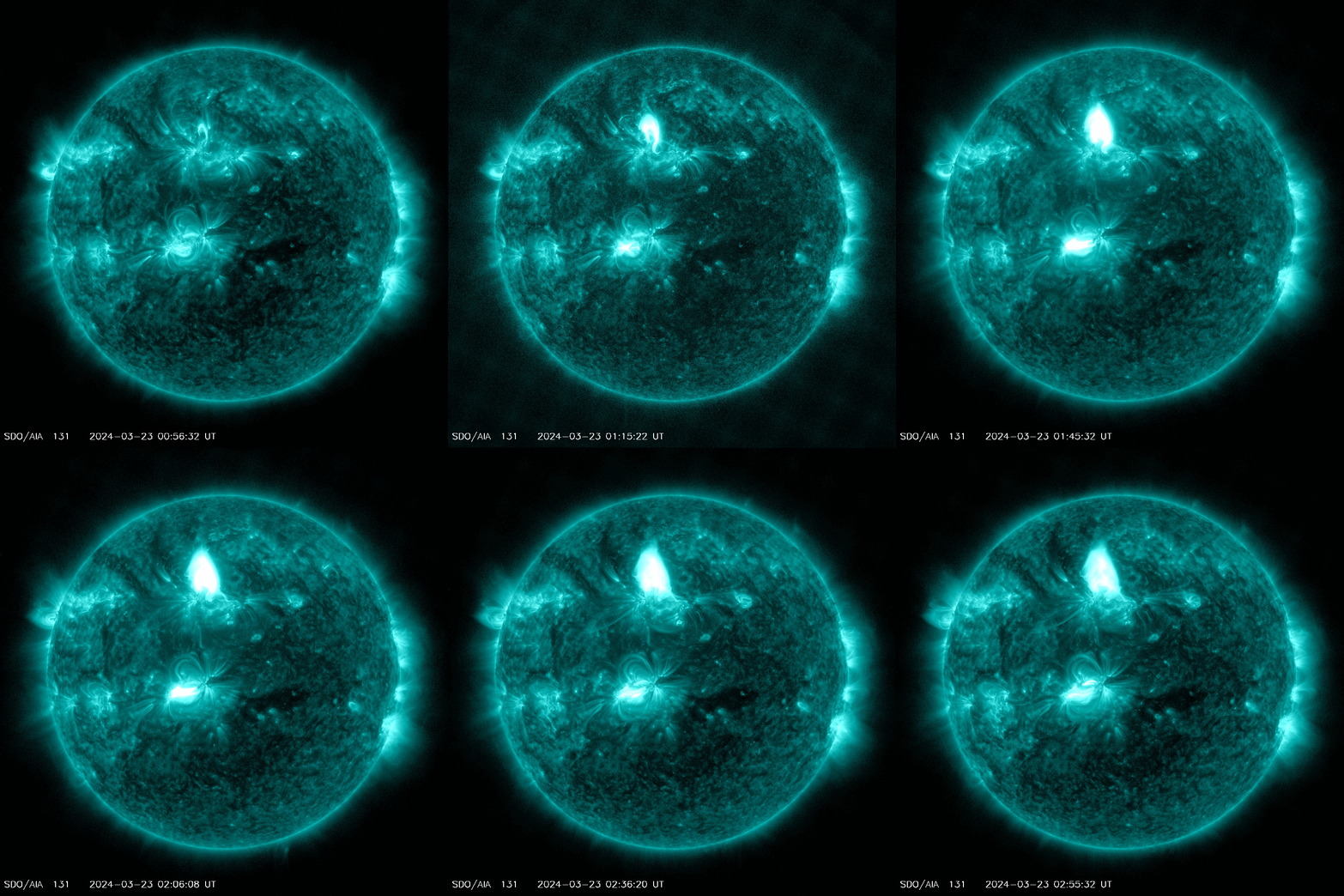
March 24, 2024: Yesterday, the sun produced a solar flare so strong, it took two sunspots to make it. Sunspots AR3614 and AR3615 exploded in tandem on March 23rd (0130 UT), directing their fire straight at Earth. A National Solar Observatory telescope in Australia recorded the double blast:

The explosion from AR3614 (top) was so violent it seemed to rip the fabric of the sun, while AR3615 (bottom) followed very close behind with a less intense blast of its own. The same sequence was captured in this movie from NASA’s Solar Dynamics Observatory.

While this may seem like an incredible coincidence, it probably didn’t happen by chance. Researchers have long known that widely-spaced sunspots can explode in tandem. They’re called “sympathetic solar flares.” Occasionally, magnetic loops in the sun’s corona fasten themselves to distant pairs of sunspots, allowing explosive instabilities to travel from one to the other. This has apparently happened to AR3614 and AR3615.

Some sympathetic flares are so much alike, they are considered to be twins. Yesterday’s double-blast was not a perfect twin, but close enough. It shows that the two sunspots are linked, raising the possibility of more double-flares this weekend. Solar flare alerts: SMS Text.