Sprites above Hurricane Matthew

by Dr. Tony Phillips (Spaceweather.com)

Oct. 2, 2016: On Oct. 1st, Earth weather met space weather above Hurricane Matthew.  As the giant storm system was approaching the Greater Antilles, Frankie Lucena of Puerto Rico photographed red sprites shooting up from the thunderclouds:

Sprites are a strange and beautiful form of lightning that shoot up from the tops of electrical storms. They reach all the way up to the edge of space alongside meteors, auroras, and noctilucent clouds. Some researchers believe cosmic rays help trigger sprites, making them a  true space weather phenomenon.

Seeing sprites above a hurricane is rare. Many hurricanes don’t even have regular lightning because the storms lack a key ingredient for electrical activity: vertical winds. (For more information read the Science@NASA article “Electric Hurricanes.”) But Matthew is not a typical hurricane.  It’s one of the most powerful in recent years, briefly reaching Category 5 at about the time Lucena photographed the sprites.  Perhaps extra-strong winds in the vicinity of the storm set the stage for upward-reaching bolts.

Sprite photographers across the Caribbean and the southeastern USA should be alert for more as the storm system approaches the mainland: observing tips.

Realtime Sprite Photo Gallery

New Maps of the South Atlantic Anomaly

by Dr. Tony Phillips (Spaceweather.com)

Sept. 30, 2016: Researchers have long known that one of the van Allen Radiation Belts dips down toward Earth over South America, creating a zone of high radiation called “The South Atlantic Anomaly” (SAA). Since its discovery in 1958, the SAA has been shape-shifting, growing larger and intensifying.  A map published just last week in the American Geophysical Union’s journal Space Weather Quarterly outlines the anomaly with new precision:

When a spacecraft in low-Earth orbit passes through the anomaly, “the radiation causes faults in spacecraft electronics and can induce false instrument readings,” explains Bob Schaefer of the Johns Hopkins University Applied Physics Lab, lead author of the paper reporting the results. “We actually used these spurious signals to map out the radiation environment at an altitude of 850 km.”

Specifically, they looked at pulses of noise in an ultraviolet photometer carried aboard many polar orbiting Defense Meteorological Satellite Program (DMSP) satellites. When high-energy protons in the SAA pass through these sensors, they  produce spurious signals–or, in the case of this study, valuable data. By monitoring the rate of spurious UV pulses, the researchers were able to trace the outlines of the anomaly and monitor its evolution over a period of years.

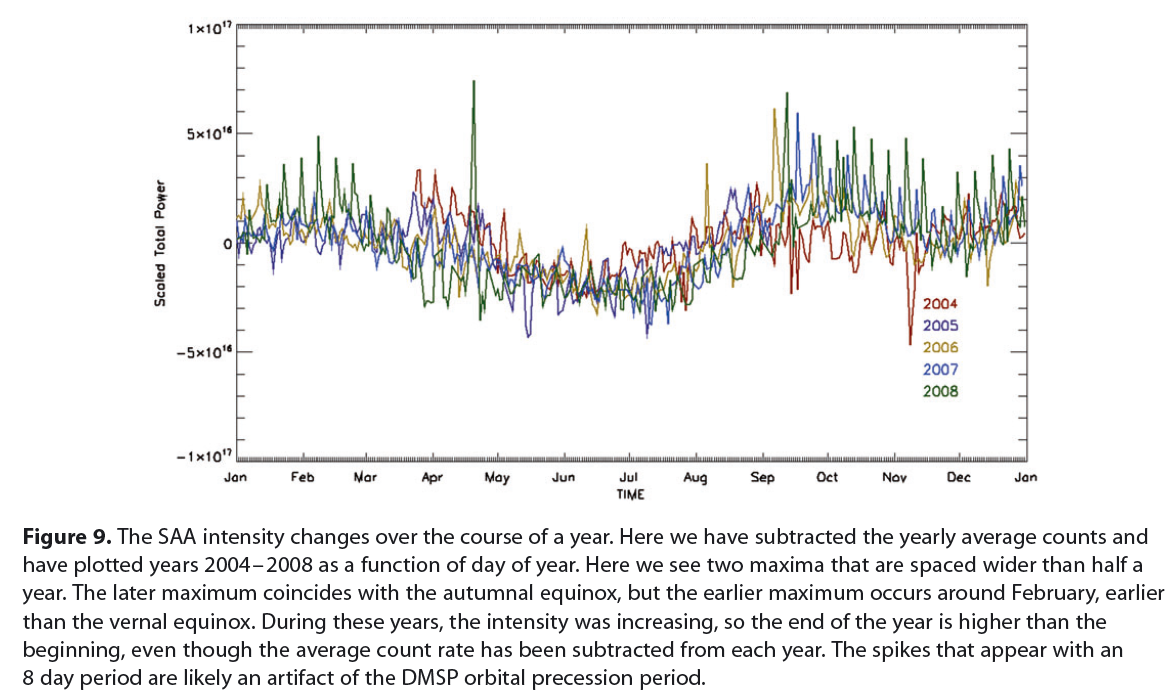
They found that the anomaly is slowly drifting north and west at rates of 0.16 deg/yr and 0.36 deg/yr, respectively. Currently, it is most intense over a broad region centered on Sao Paulo, Brazil, including much of Paraguay, Uruguay, and northern Argentina. They also detected a seasonal variation: On average, the SAA is most intense in February and again in September-October. In this plot, yearly average counts have been subtracted to reveal the double-peaked pattern:

One maximum coincides with an equinox, but the other does not. The authors were not able to explain the origin of this unexpected pattern.

The solar cycle matters, too, as the data revealed a yin-yang anti-correlation with sunspots. “During years of high solar activity, the radiation intensity is lower, while during solar quiet years the radiation intensity is higher,” writes Schaefer.

According to orthodox thinking, the SAA reaches down from space to within about 200 km of Earth’s surface. Below that altitude, its effects should be mitigated by the shielding of Earth’s atmosphere and geomagnetic field. To test this idea, Spaceweather.com and Earth to Sky Calculus have undertaken a program to map the SAA from below using weather balloons equipped with radiation sensors.  Next week we will share the results of our first flight from a launch site in Chile.  Stay tuned!

Cosmic Rays are Intensifying

by Dr. Tony Phillips (Spaceweather.com)

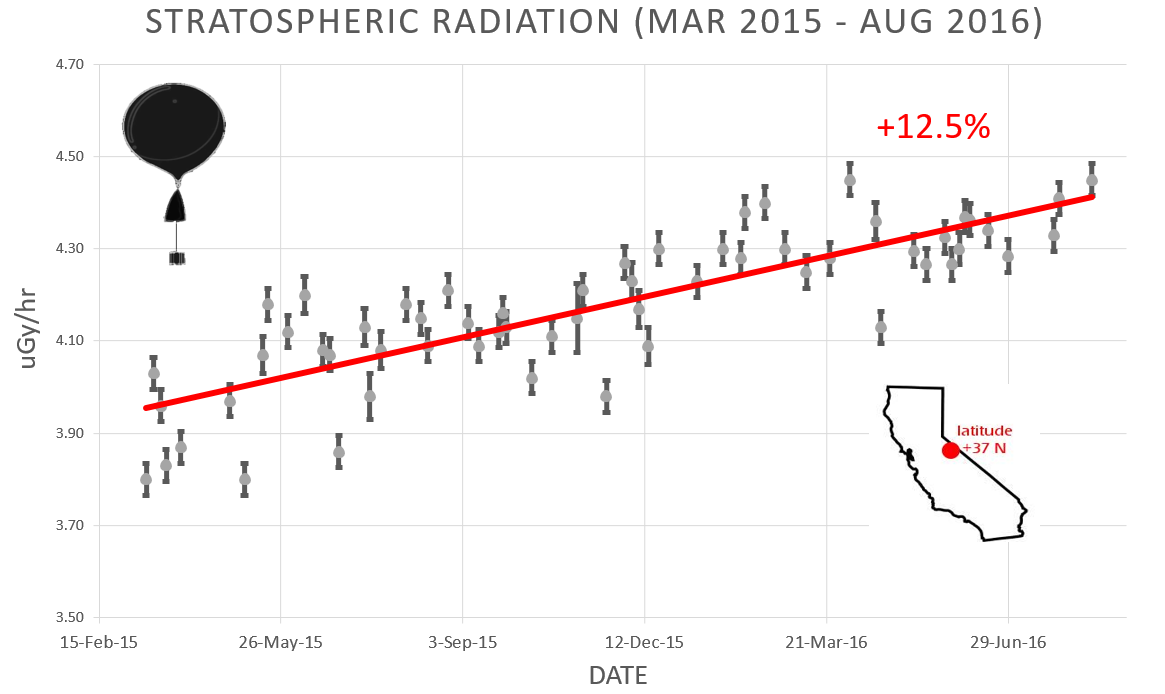
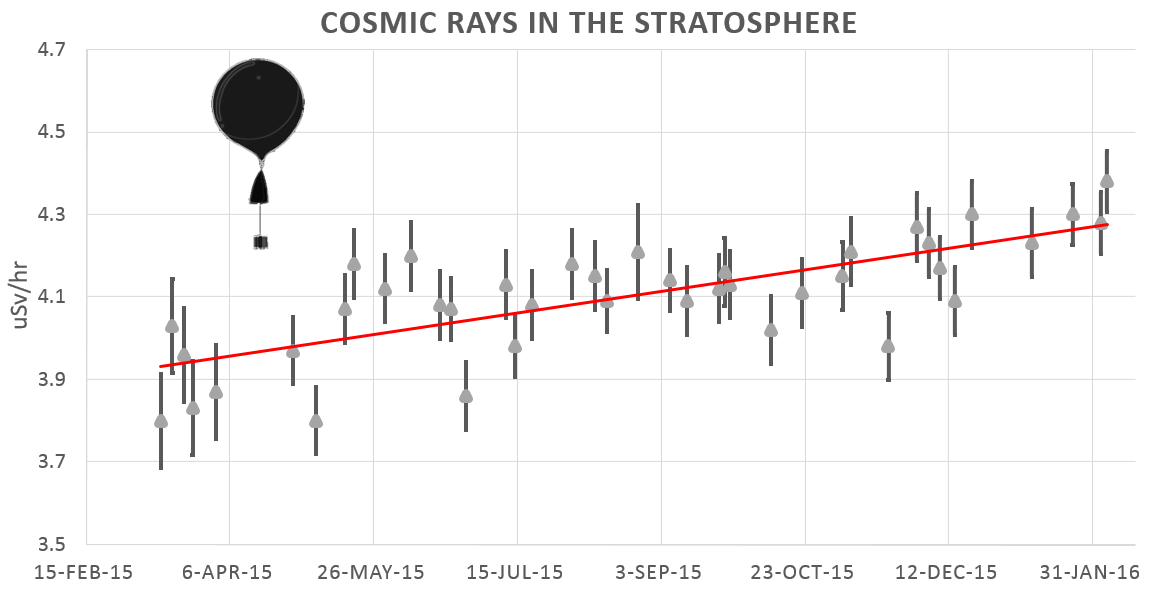
Aug. 30, 2016: Researchers have long known that solar activity and cosmic rays have a yin-yang relationship. As solar activity declines, cosmic rays intensify. Lately, solar activity has been very low indeed. Are cosmic rays responding? The answer is “yes.” Spaceweather.com and the students of Earth to Sky Calculus have been using helium balloons to monitor cosmic rays in the stratosphere over California. Their latest data show an increase of almost 13% since 2015.


Cosmic rays, which are accelerated toward Earth by distant supernova explosions and other violent events, are an important form of space weather. They can seed clouds, trigger lightning, and penetrate commercial airplanes. Furthermore, there are studies ( #1, #2, #3, #4) linking cosmic rays with cardiac arrhythmias and sudden cardiac death in the general population.

Why are cosmic rays intensifying? The main reason is the sun. Solar storm clouds such as coronal mass ejections (CMEs) sweep aside cosmic rays when they pass by Earth. During Solar Maximum, CMEs are abundant and cosmic rays are held at bay. Now, however, the solar cycle is swinging toward Solar Minimum, allowing cosmic rays to return. Another reason could be the weakening of Earth’s magnetic field, which helps protect us from deep-space radiation.

The radiation sensors onboard our helium balloons detect X-rays and gamma-rays in the energy range 10 keV to 20 MeV. These energies span the range of medical X-ray machines and airport security scanners.

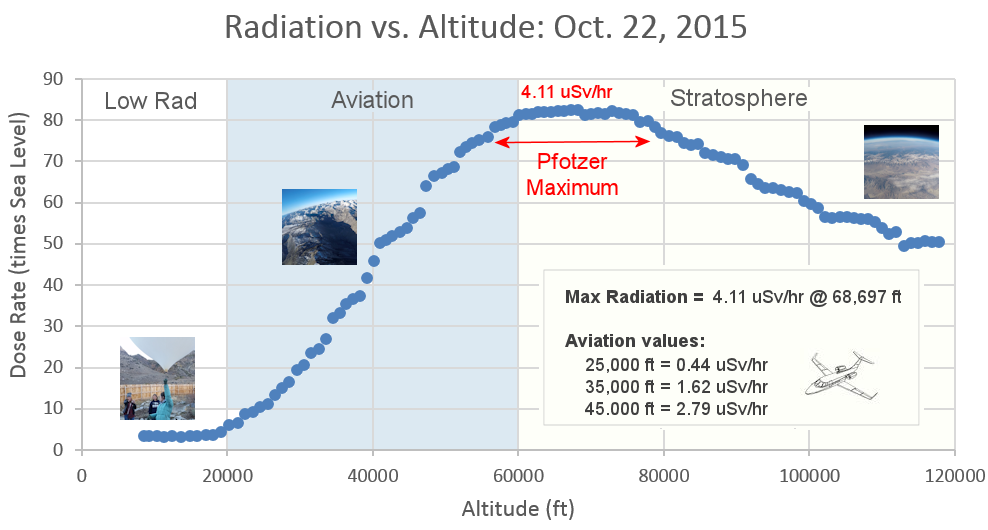
The data points in the graph above correspond to the peak of the Reneger-Pfotzer maximum, which lies about 67,000 feet above central California. When cosmic rays crash into Earth’s atmosphere, they produce a spray of secondary particles that is most intense at the entrance to the stratosphere. Physicists Eric Reneger and Georg Pfotzer discovered this maximum using balloons in the 1930s and it is what we are measuring today.

Cosmic Rays vs. Clouds

The connection between cosmic rays and clouds has long been controversial.  Some researchers hold that cosmic rays hitting Earth’s atmosphere create aerosols which, in turn, seed clouds.  This could make cosmic rays an important player in weather and climate.  Other researchers are less convinced.  Although some laboratory experiments support the idea that cosmic rays help seed clouds, skeptics say the effect is too small to substantially affect the cloudiness of our planet or to avert the course of climate change.

A new study just published in the Aug. 19th issue of Journal of Geophysical Research: Space Physics comes down in favor of cosmic rays. A team of scientists from the Technical University of Denmark (DTU) and the Hebrew University of Jerusalem has linked sudden decreases in cosmic rays (called “Forbush Decreases”) to changes in Earth’s cloud cover.

Forbush Decreases occur when solar storms called “coronal mass ejections (CMEs)” sweep past Earth.  Magnetic fields in CMEs deflect cosmic rays and, essentially, sweep some of the cosmic rays away from our planet.  The research team led by Jacob Svensmark of DTU identified the strongest 26 Forbush Decreases between 1987 and 2007, and looked at ground-based+satellite records of cloud cover to see what happened.  In a press release, their conclusions were summarized as follows: “[Strong Forbush Decreases] cause a reduction in cloud fraction of about 2 percent corresponding to roughly a billion tonnes of liquid water disappearing from the atmosphere.”

If true, that’s amazing.  It would also underscore the importance of measuring cosmic rays in the atmosphere.  Recent balloon flights by Spaceweather.com and Earth to Sky Calculus show that cosmic rays are intensifying. Cloudy days, anyone?

Earth’s Magnetic Field is Changing

by Dr. Tony Phillips (Spaceweather.com)

Anyone watching a compass needle point steadily north might suppose that Earth’s magnetic field is a constant. It’s not. Researchers have long known that changes are afoot. The north magnetic pole routinely moves, as much as 40 km/yr, causing compass needles to drift over time. Moreover, the global magnetic field has weakened 10% since the 19th century.

A new study by the European Space Agency’s constellation of Swarm satellites reveals that changes may be happening even faster than previously thought. In this map, blue depicts where Earth’s magnetic field is weak and red shows regions where it is strong:

Data from Swarm, combined with observations from the CHAMP and Ørsted satellites, show clearly that the field has weakened by about 3.5% at high latitudes over North America, while it has strengthened about 2% over Asia. The region where the field is at its weakest – the South Atlantic Anomaly – has moved steadily westward and weakened further by about 2%. These changes have occured over the relatively brief period between 1999 and mid-2016.

Earth’s magnetic field protects us from solar storms and cosmic rays. Less magnetism means more radiation can penetrate our planet’s atmosphere. Indeed, high altitude balloons launched by Spaceweather.com routinely detect increasing levels of cosmic rays over California. Perhaps the ebbing magnetic field over North America contributes to that trend.

As remarkable as these changes sound, they’re mild compared to what Earth’s magnetic field has done in the past. Sometimes the field completely flips, with north and the south poles swapping places. Such reversals, recorded in the magnetism of ancient rocks, are unpredictable. They come at irregular intervals averaging about 300,000 years; the last one was 780,000 years ago. Are we overdue for another? No one knows.

Swarm is a trio of satellites equipped with vector magnetometers capable of sensing Earth’s magnetic field all the way from orbital altitudes down to the edge of our planet’s core. The constellation is expected to continue operations at least until 2017, and possibly beyond, so stay tuned for updates.

The Solar Cycle is Crashing

by Dr. Tony Phillips  of Spaceweather.com

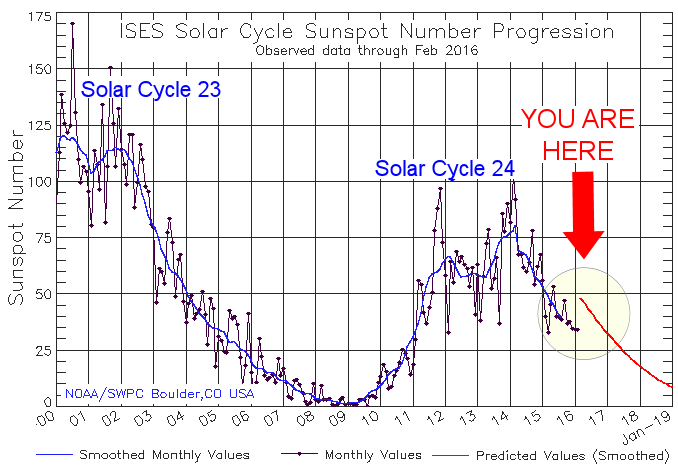
Anyone wondering why the sun has been so quiet lately? The reason may be found in the graph below. The 11-year sunspot cycle is crashing:

For the past two years, the sunspot number has been dropping as the sun transitions from Solar Max to Solar Min. Fewer sunspots means there are fewer solar flares and fewer coronal mass ejections (CMEs). As these explosions subside, we deem the sun “quiet.”

But how quiet is it, really?

A widely-held misconception is that space weather stalls and becomes uninteresting during periods of low sunspot number. In fact, by turning the solar cycle sideways, we see that Solar Minimum brings many interesting changes. For instance, the upper atmosphere of Earth collapses, allowing space junk to accumulate around our planet. The heliosphere shrinks, bringing interstellar space closer to Earth. And galactic cosmic rays penetrate the inner solar system with relative ease. Indeed, a cosmic ray surge is already underway. (Goodbye sunspots, hello deep-space radiation.)

Stay tuned for updates as the sunspot number continues to drop.

Spherical Camera at the Edge of Space

On Feb. 27th, Spaceweather.com and the students of Earth to Sky Calculus launched a helium balloon to the stratosphere to monitor increasing levels of cosmic rays. In addition to radiation sensors, the payload carried something special: a spherical camera. Click and drag on the image below to explore California’s Sierra Nevada from an altitude of 115,300 feet–and don’t forget to look up at the balloon!

The camera, a Ricoh Theta S, will probably become a regular part of our cosmic ray payload. Imagery should improve in future flights as the students learn to lower the profile of the camera’s thermal pack–the strange-looking black object in the center of the 3D image. During its flight to the stratosphere, the camera experienced temperatures as low as -65 C. The thermal pack helps keep the camera’s batteries warm in these harsh conditions.

more spherical images: the students preparing to launch the balloon, the balloon ascending through clouds, the balloon exploding in the stratosphere.

Next week, the camera will take another trip–to Indonesia. The students will be using it to record a total eclipse of the sun on March 9th. Stay tuned for that!

Cosmic Rays Continue to Intensify

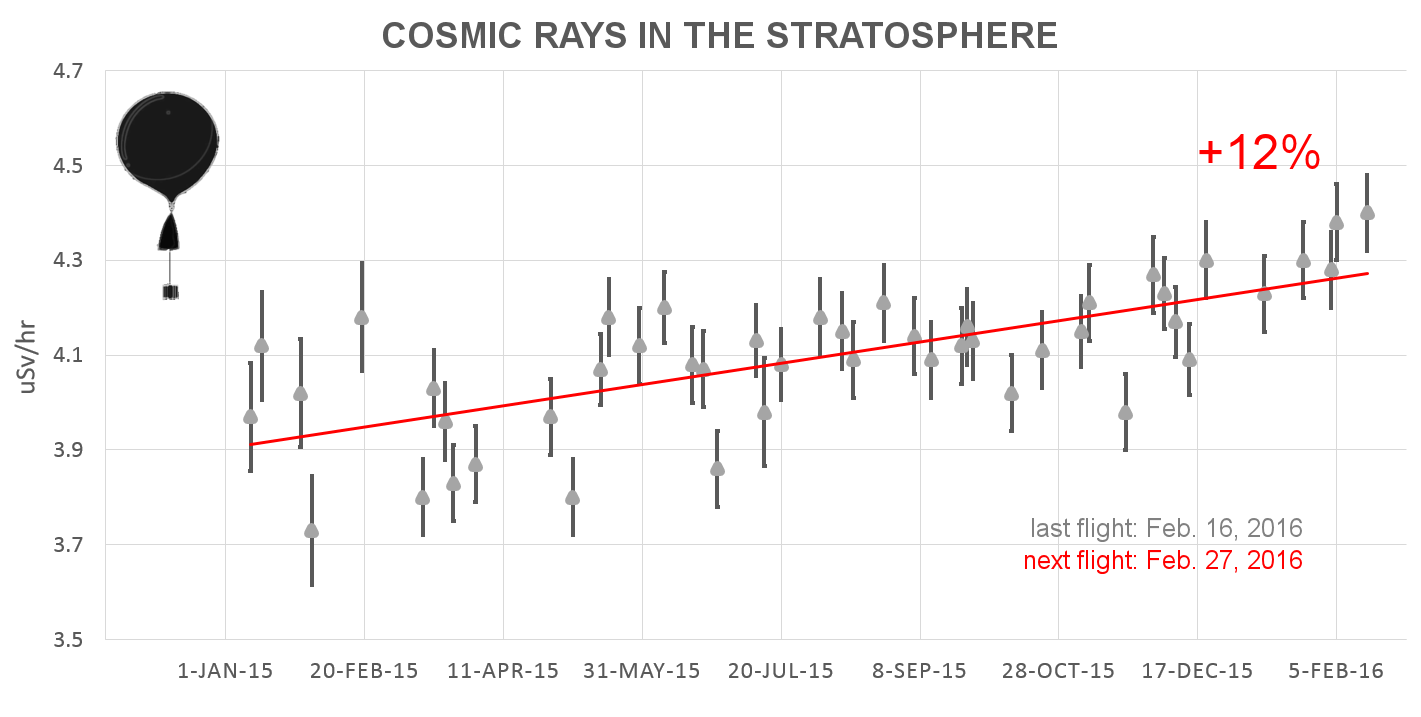
Researchers have long known that solar activity and cosmic rays have a yin-yang relationship. As solar activity declines, cosmic rays intensify. Lately, solar activity has been very low indeed. Are cosmic rays responding? The answer is “yes.” Spaceweather.com and the students of Earth to Sky Calculus have been using helium balloons to monitor cosmic rays in the stratosphere. Their data show that cosmic rays in the mid-latitude stratosphere now are approximately 12% stronger than they were one year ago:


Cosmic rays, which are accelerated toward Earth by distant supernova explosions and other violent events, are an important form of space weather. They can seed clouds, trigger lightning, and penetrate commercial airplanes. Furthermore, there are studies linking cosmic rays with cardiac arrhythmias and sudden cardiac death in the general population. Among patients who have an implanted cardioverter – defibrillator (ICD), the aggregate number of life-saving shocks appears to be correlated with the number of cosmic rays reaching the ground. References: #1, #2, #3, #4.

Why do cosmic rays increase when solar activity is low? Consider the following: To reach Earth, cosmic rays have to penetrate the inner solar system. Solar storms make this more difficult. CMEs and gusts of solar wind tend to sweep aside cosmic rays, lowering the intensity of radiation around our planet. On the other hand, when solar storms subside, cosmic rays encounter less resistance; reaching Earth is a piece of cake.

Forecasters expect solar activity to drop sharply in the years ahead as the 11-year solar cycle swings toward another deep minimum. Cosmic rays are poised to increase accordingly.

Cosmic Rays Continue to Intensify

Last month, we reported that cosmic rays are intensifying. Measurements so far in February indicate that the trend is continuing. In fact, the latest balloon flight over California on Feb. 5th detected the highest value yet:

The data show that cosmic rays in the mid-latitude stratosphere now are approximately 10% stronger than they were one year ago. All of these measurements were collected by Spaceweather.com and the students of Earth to Sky Calculus.

Cosmic rays, which are accelerated toward Earth by distant supernova explosions and other violent events, are an important form of space weather. They can seed clouds, trigger lightning, and penetrate commercial airplanes. Indeed, our measurements show that someone flying back and forth across the continental USA, just once, can absorb as much ionizing cosmic radiation as 2 to 5 dental X-rays. Likewise, cosmic rays can affect mountain climbers, high-altitude drones, and astronauts onboard the International Space Station.

This type of radiation is modulated by solar activity. Solar storms and CMEs tend to sweep aside cosmic rays, making it more difficult for cosmic rays to reach Earth. On the other hand, low solar activity allows an extra dose of cosmic rays to reach our planet. Indeed, the ongoing increase in cosmic ray intensity is probably due to a decline in the solar cycle. Solar Maximum has passed and we are heading toward a new Solar Minimum. Forecasters expect solar activity to drop sharply in the years ahead, and cosmic rays are poised to increase accordingly. Stay tuned for more radiation.

Cosmic Rays are Intensifying

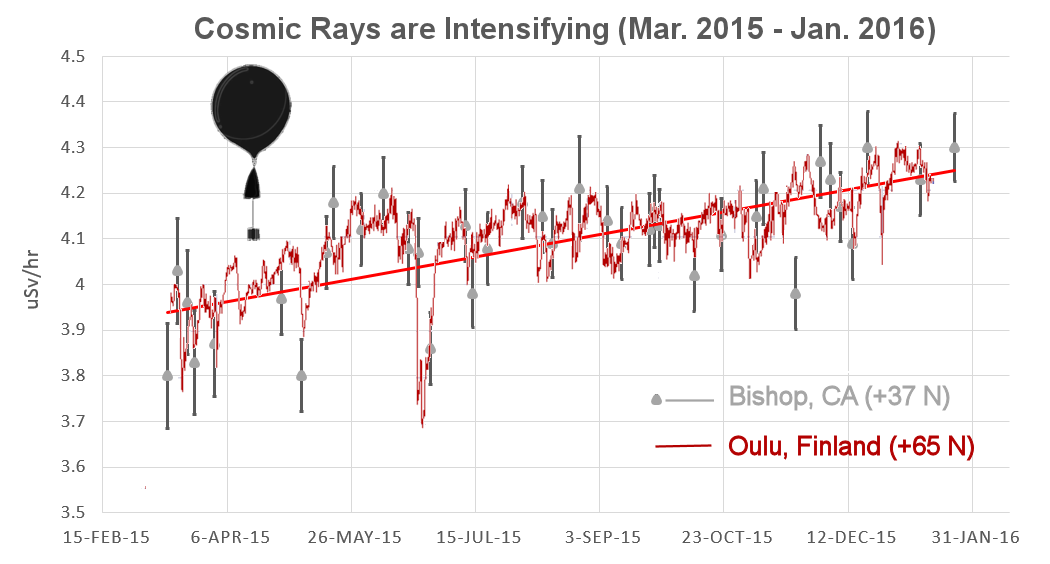
For the past year, neutron monitors around the Arctic Circle have sensed an increasing intensity of cosmic rays. Polar latitudes are a good place to make such measurements, because Earth’s magnetic field funnels and concentrates cosmic radiation there. Turns out, Earth’s poles aren’t the only place cosmic rays are intensifying. Spaceweather.com and the students of Earth to Sky Calculus have been launching helium balloons to the stratosphere to measure radiation, and they find the same trend over California:

In the plot, neutron monitor measurements from the University of Oulu Cosmic Ray Station are traced in red; gamma-ray/X-ray measurements over California are denoted in gray. The agreement between the two curves is remarkable. It means that the intensification of cosmic rays is making itself felt not only over the poles, but also over lower latitudes where Earth’s magnetic field provides a greater degree of protection against deep space radiation.

Cosmic rays, which are accelerated toward Earth by distant supernova explosions and other violent events, are an important form of space weather. They can seed clouds, trigger lightning, and penetrate commercial airplanes. Indeed, our measurements show that someone flying back and forth across the continental USA, just once, can absorb as much ionizing cosmic radiation as 2 to 5 dental X-rays. Likewise, cosmic rays can affect mountain climbers, high-altitude drones, and astronauts onboard the International Space Station.

This type of radiation is modulated by solar activity. Solar storms and CMEs tend to sweep aside cosmic rays, making it more difficult for cosmic rays to reach Earth. On the other hand, low solar activity allows an extra dose of cosmic rays to reach our planet. Indeed, the ongoing increase in cosmic ray intensity is probably due to a decline in the solar cycle. Solar Maximum has passed and we are heading toward a new Solar Minimum. Forecasters expect solar activity to drop sharply in the years ahead, and cosmic rays are poised to increase accordingly. Stay tuned for more radiation.