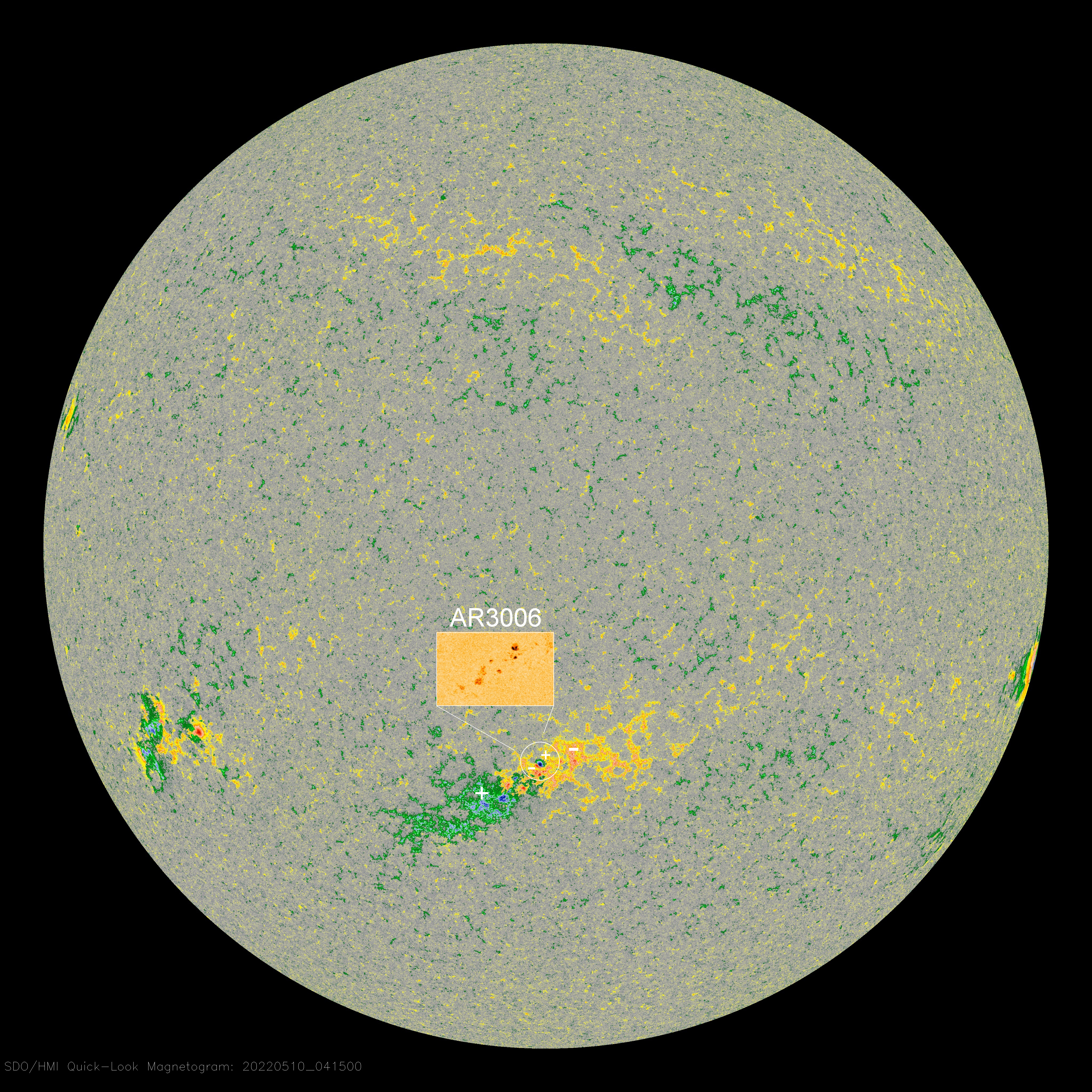
May 10, 2022: Sunspot AR3006 is having an identity crisis. It is supposed to have a +/- magnetic field. Mostly it does. But deep inside the sunspot’s primary core, the polarity is opposite: -/+. Note the circled region in this magnetic map of the sunspot from NASA’s Solar Dynamics Observatory:
The mixture of magnetic polarities makes this sunspot interesting and dangerous. When opposite polarities bump together, it can light the fuse of magnetic reconnection–the explosive power source of solar flares. If AR3006 flares today, it will be geoeffective. The sunspot is directly facing Earth.
Update: The sunspot *did* flare today. An X1.5 class explosion on May 10th (1355 UT) caused a radio backout over the Atlantic Ocean and may have hurled a complicated CME toward Earth. Solar flare alerts:SMS Text
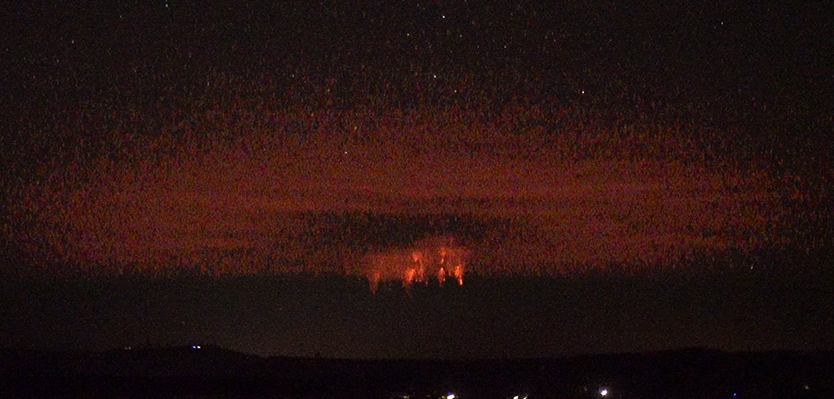
May 2, 2022: For a few milliseconds last Thursday night, an enormous (100 km wide) red ring of light appeared over west Texas. Thomas Ashcraft photographed it from across the state line in New Mexico:
This is an “ELVE”–short for Emissions of Light and Very Low Frequency Perturbations due to Electromagnetic Pulse Sources. It’s a rare species of sprite discovered in 1990 by cameras onboard the space shuttle. Ashcraft may have just taken the best ever picture of one from the ground.
“The ELVE was generated by a super-strong lightning stroke that occurred over west Texas near the town of Borger at April 28 2022 0439:10.5326 UT,” says Ashcraft. “Note also the sprite elements at the bottom of the ELVE.”
The lightning bolt was so strong, it generated an intense electromagnetic pulse (EMP). The red ring marks the spot where the EMP hit Earth’s ionosphere. Normal lightning bolts carry 10 to 30 kilo-ampères of current; this bolt was about 10 times stronger than normal.
Above: A close-up view of the ELVE shows “tiger stripes” and sprites near the center of the ring.
“The lightning stroke that manifested this event registered on VLF radios at least as far away as Germany,” notes Ashcraft. “You can actually hear the lightning stroke in my video.”
Bonus: This is also a Tiger ELVE. Note the linear corrugations across the red ring. These are impressed on the ELVE by gravity waves in the upper atmosphere. Like a tiger, this ELVE has stripes.
Learn more about the history and physics of ELVEs here and here.
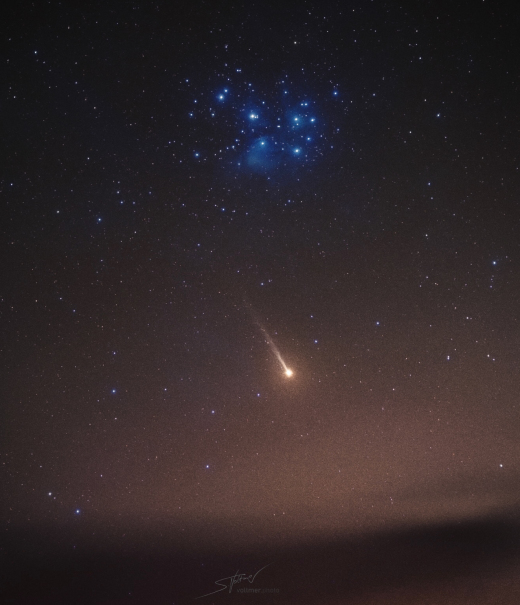
April 29, 2022: Planets aren’t supposed to have tails, but Mercury does. Dr. Sebastian Voltmer just photographed it from La Palma in the Canary Islands:
“This is NOT a comet, not even a meteor, but the planet Mercury, which is currently very close to the Pleiades,” says Voltmer. “How is the tail formed? The solar wind and micro-meteorites eject sodium atoms from Mercury’s surface. This creates a yellow-orange tail of sodium gas that is around 24 million kilometers long.”
People around the world have been watching Mercury climb up the evening sky this month. Some of them are probably wondering “why didn’t I see the tail?”
Answer: A special filter is required. “I used a 589 nanometer filter tuned to the yellow glow of sodium,” says Voltmer. Without this kind of sodium filter, Mercury’s tail would be invisible.
Above: Dr. Sebastian Voltmer observing Mercury from La Palma on April 27, 2022. Inset is the 589 nm sodium filter. [video]
Voltmer says the tail is so bright, he could see it in individual 30 second exposures. “I can see some very small changes in shape of the tail,” he says, “and the brightness is slightly increasing.”
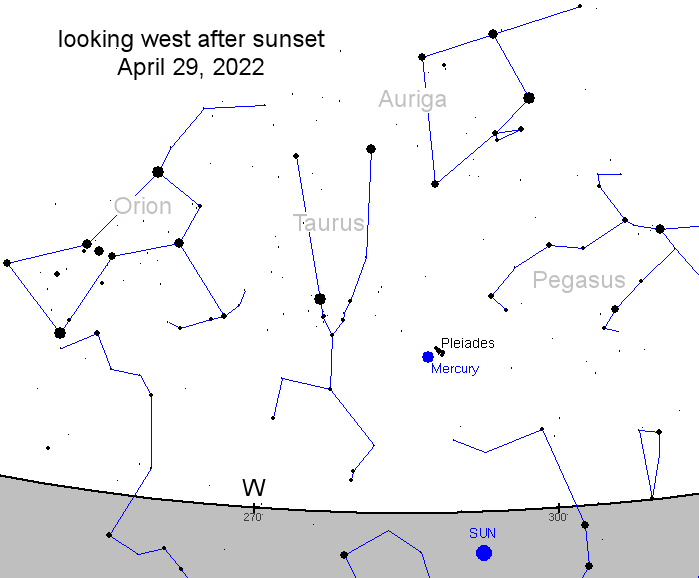
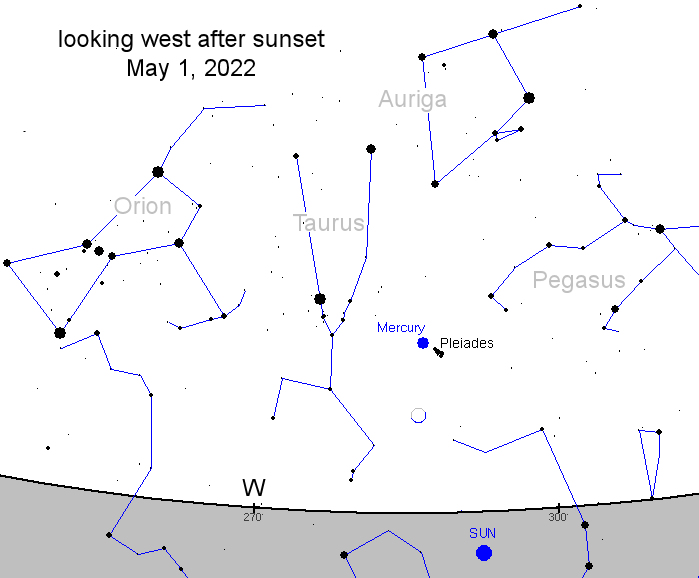
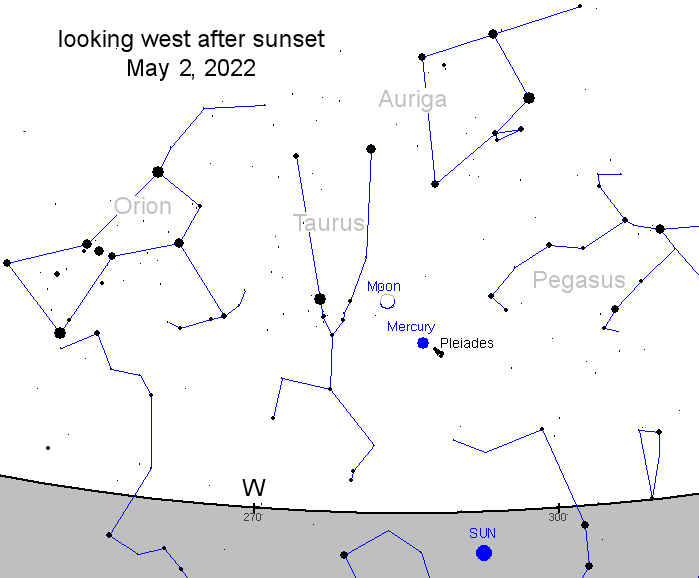
The nights ahead are excellent times to catch this phenomenon. On April 29th and 30th, Mercury will glide past the Pleiades star cluster for a fantastic photo-op. Then, on May 1st and 2nd, the crescent Moon joins the show.
“Currently I’m imaging Mercury day by day just after sunset from the Canary Islands,” says Voltmer. Stay tuned for more sodium.
April 11, 2022: The corpse of old sunspot AR2987 exploded today, April 11, 2022, hurling debris directly toward Earth. NASA’s Solar Dynamics Observatory recorded the eruption:
The S-shaped magnetic filament at the base of the explosion is a classic “sigmoid structure.” Solar magnetic fields often assume this shape just before they explode. One study shows that sigmoid precursors are present in over 50% of CMEs.
Indeed, shortly after the explosion, a full-halo CME emerged from the blast site. Here it is. The CME is expected to reach Earth on April 14th; a new NOAA model pinpoints its arrival time at 1100 UTC. The impact could spark a G2-class geomagnetic storm. Aurora alerts:SMS Text
April 10, 2022: Earth’s magnetic field was supposed to be quiet on April 10th. Instead a strong (G3-class) geomagnetic storm broke out. At the apex of the disturbance, auroras crossed the Canadian border into multiple northern-tier US states. Ron Risman sends this time-lapse movie from Milton, New Hampshire:
“We don’t get to see the aurora all that often in New Hampshire, but this solar cycle so far has been fantastic,” says Risman. Before the show was over, the lights spread west all the way to Washington state.
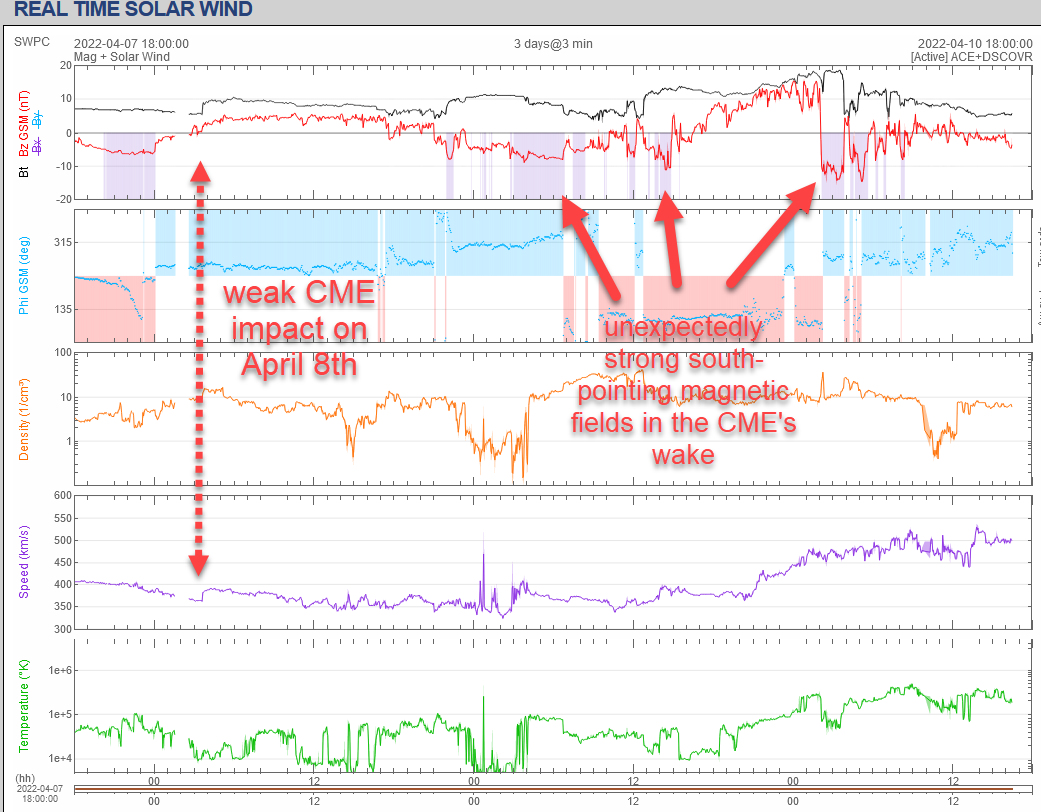
What caused the storm? The prime suspect is a “canyon of fire” CME, which hit Earth’s magnetic field on April 8th. The impact was weak and, at first, it seemed to have little effect. Geomagnetic unrest increased on April 9th as Earth passed into the CME’s strongly magnetized wake. The arrival of an unrelated solar wind stream on April 10th tipped conditions into G3-category storming.
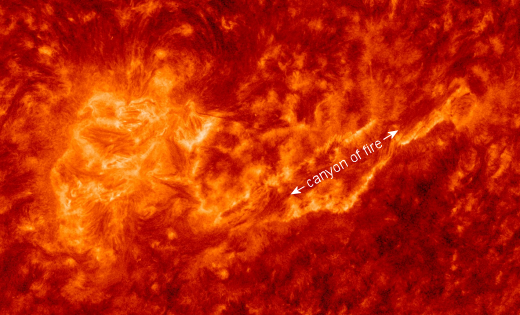
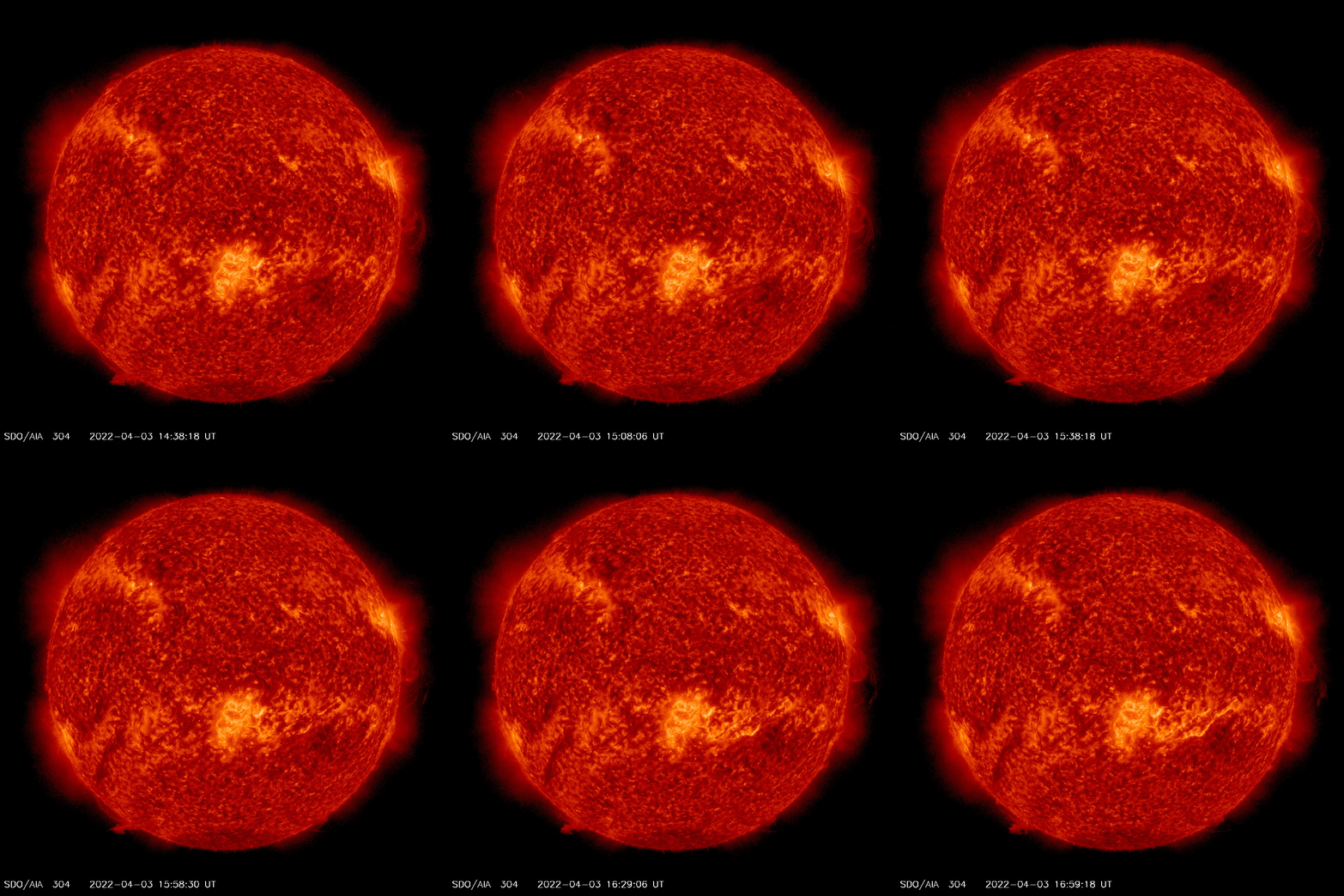
April 3, 2022: A filament of magnetism whipsawed out of the sun’s atmosphere today. On the way out it carved a gigantic canyon of fire. NASA’s Solar Dynamics Observatory recorded the eruption:
The glowing walls of the canyon are at least 20,000 km high and 10 times as long. They trace the channel where the filament (R.I.P.) was previously suspended by magnetic forces inside the sun’s atmosphere.
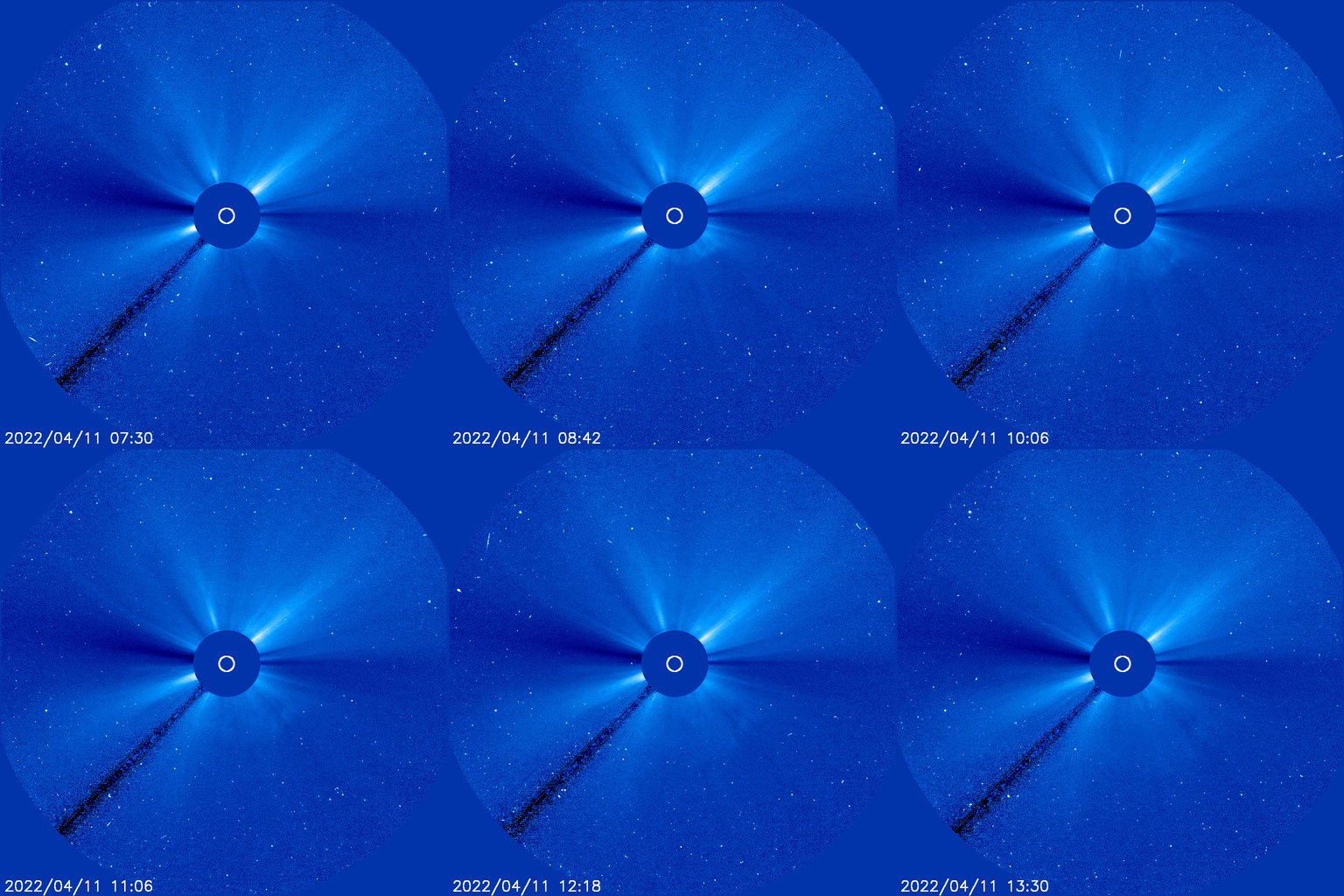
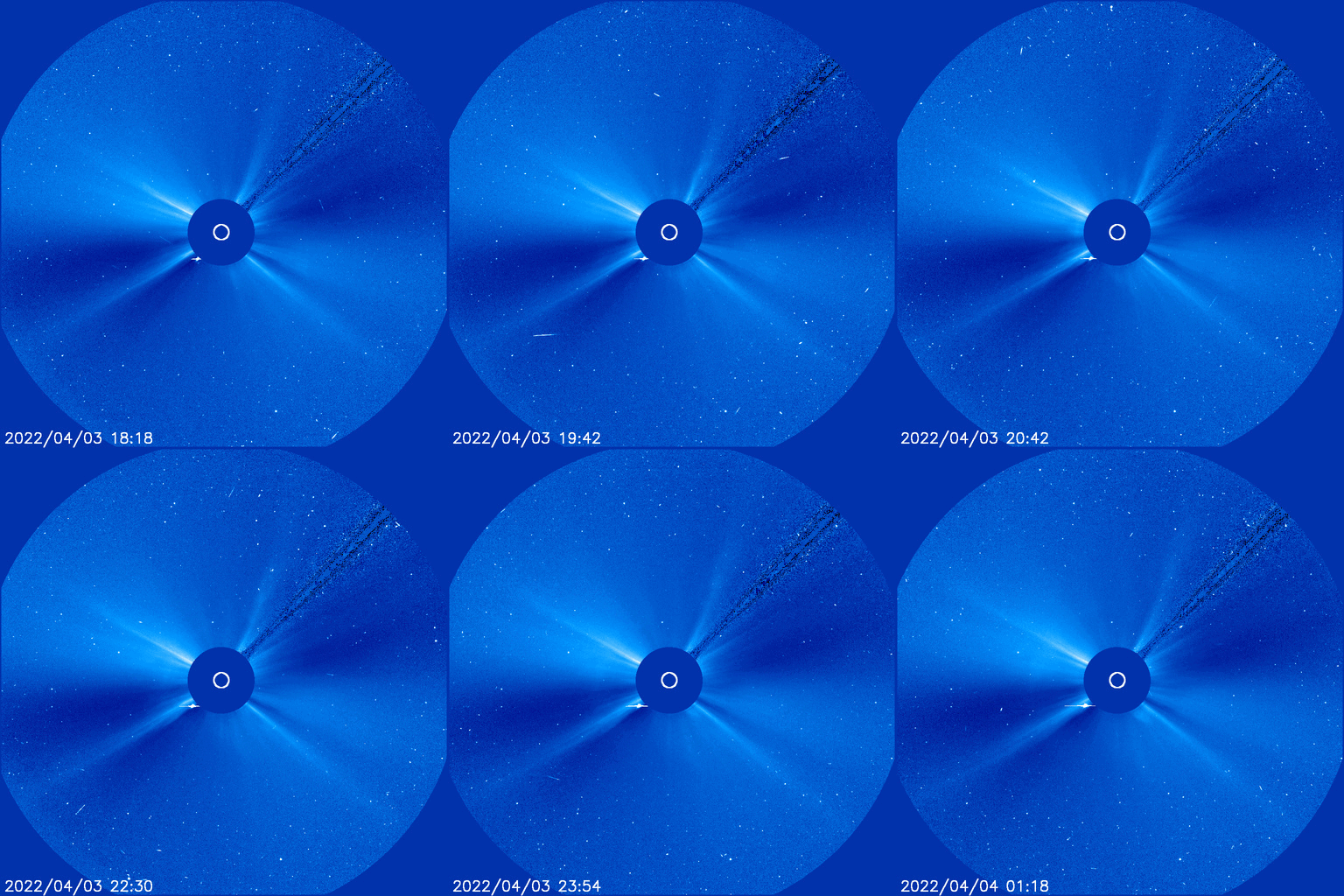
Debris from the explosion formed a slow-moving coronal mass ejection (CME), shown here in a movie from the Solar and Heliospheric Observatory (SOHO):
The CME is not squarely Earth-directed. The bulk of the cloud is expected to miss. However, there is clearly a small Earth-directed component, which could sideswipe our planet’s magnetic field on April 7th. (Update: It arrived on April 8th instead.)
Sunspot counts have now exceeded predictions for 18 straight months. The monthly value at the end of March was more than twice the forecast, and the highest in nearly 7 years.
The “official forecast” comes from the Solar Cycle Prediction Panel, a group of scientists representing NOAA, NASA and International Space Environmental Services (ISES). The Panel predicted that Solar Cycle 25 would peak in July 2025 as a relatively weak cycle, similar in magnitude to its predecessor Solar Cycle 24. Instead, Solar Cycle 25 is shaping up to be stronger.
In March 2022, the sun produced 146 solar flares, including one X-flare and 13 M-flares. Auroras were sighted as far south as Colorado (+38N) and Nebraska (+42N). Multiple shortwave radio blackouts disrupted communications on ships at sea and airplanes flying over the poles. If current trends continue, April will be even busier. Stay tuned. Solar flare alerts:SMS Text
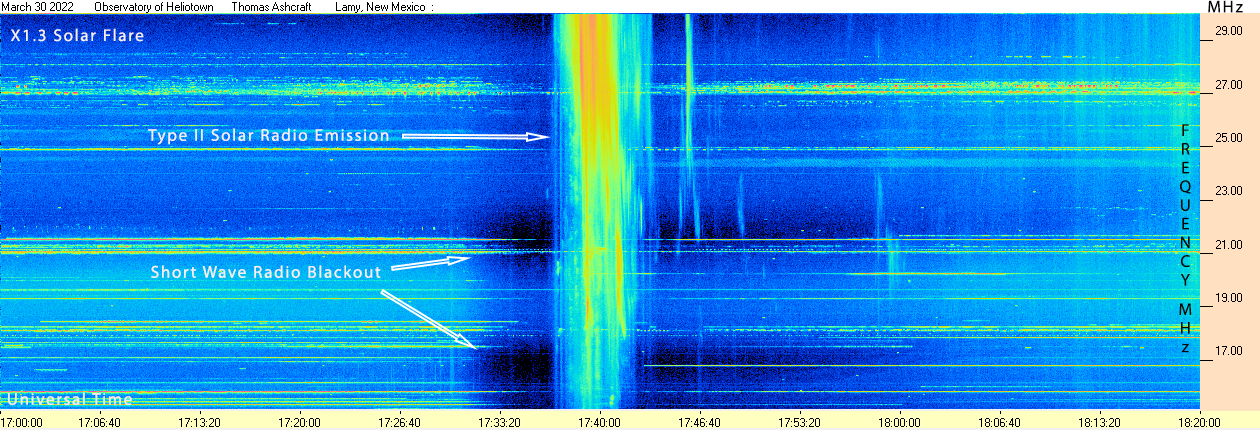
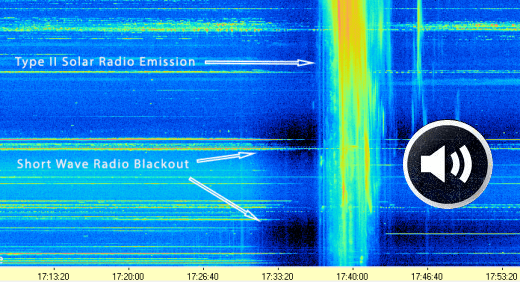
April 2, 2022: On March 30th, the sun did two seemingly contradictory things at once. It produced a loud radio burst and, at the same time, caused a deep radio blackout. Both were side-effects of an X1.3-class solar flare. First, let’s listen to the radio burst:
The gentle roar of static you just heard emerged from the loudspeaker of a shortwave radio receiver in New Mexico. Amateur astronomer Thomas Ashcraft recorded it. “The sun was well positioned in my radio antennas for the X1.3 solar flare,” says Ashcraft. “The left channel of the audio file is 22.2 MHz, the right channel is 21.1 MHz.”
This is a Type II solar radio burst. Shock waves from the flare rippled through the sun’s atmosphere, creating plasma oscillations that emit shortwave static. Briefly, the sun turned itself into a natural radio transmitter.
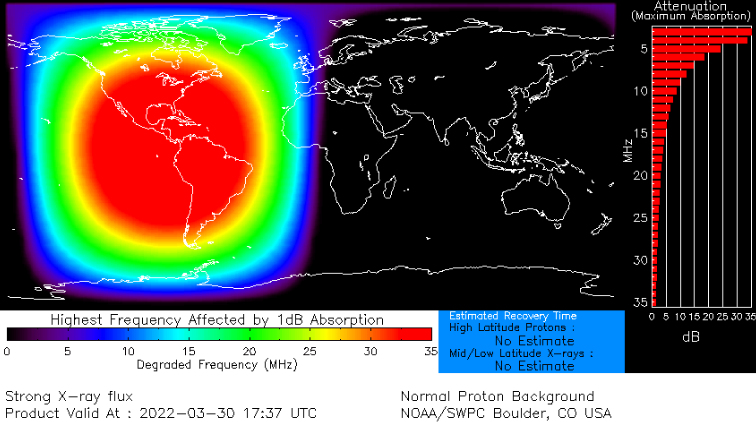
While the sun was busy creating radio waves, it was equally busy wiping them out. Radiation from the flare ionized the top of Earth’s atmosphere, preventing terrestrial radio stations from bouncing their signals over the horizon as usual. This map shows where manmade signals suddenly faded:
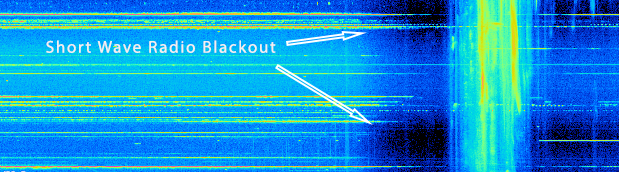
Ashcraft’s observatory in New Mexico is located near the middle of the blackout zone. Take another look at his dynamic spectrum. Horizontal lines are terrestrial radio stations. They vanished for about 10 minutes around the time of the flare. The effect is strongest at frequencies below ~20 MHz.
In Gainesville, Florida, radio astronomer Francisco Reyes recorded the blackout as well. “I used an array of 4 dipoles with an FSX-7 radio spectrograph (Radio JOVE),” he says.
Would you like to record an event like this? NASA’s Radio JOVE program makes it easy. Off-the-shelf radio telescope kits allow even novices to monitor radio outbursts from the sun, which are becoming more frequent as Solar Cycle 25 intensifies. Solar flare alerts:SMS Text
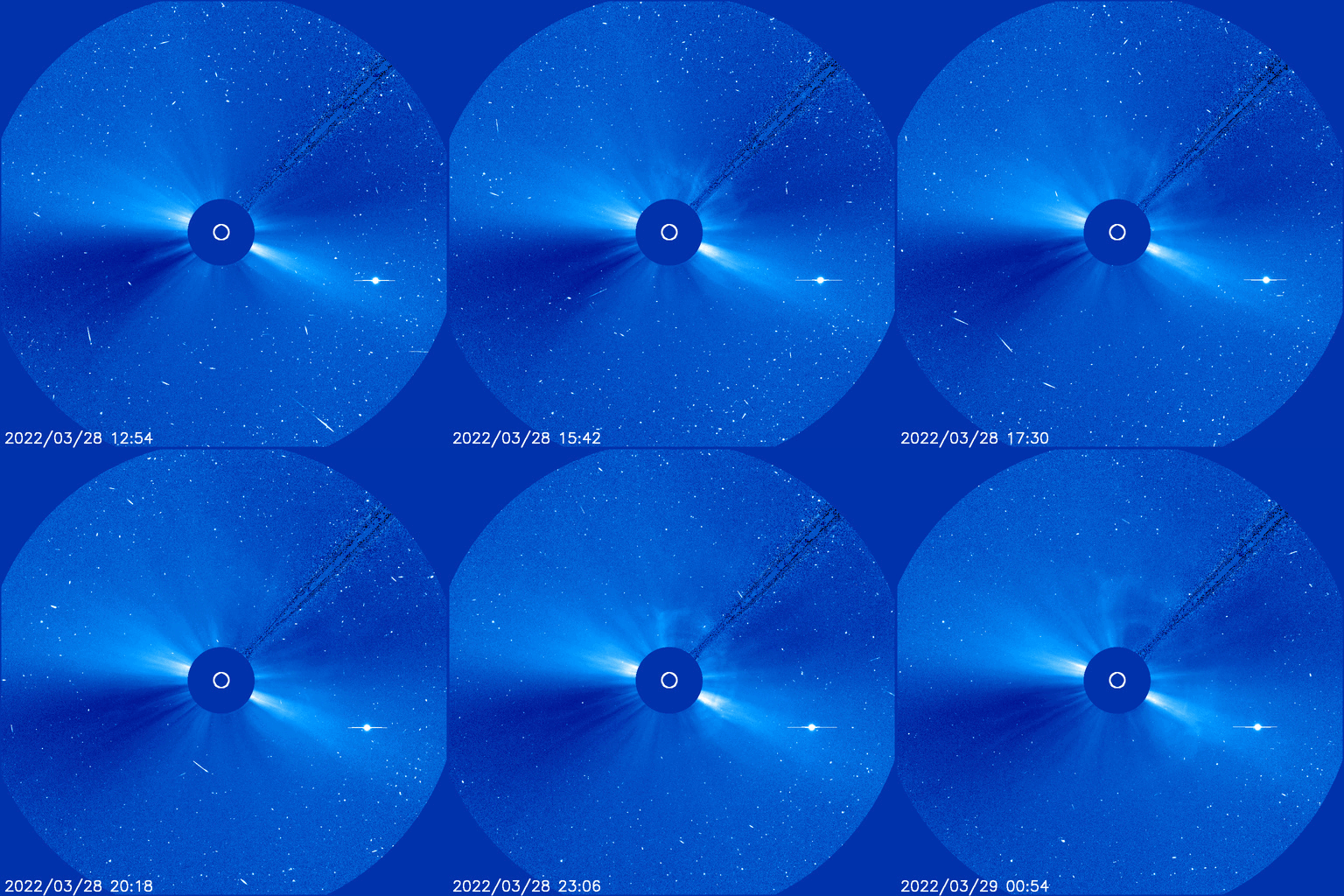
March 29, 2022: On March 28th, sunspot AR2975 unleashed a frenzy of solar flares–more than 17 in all. There were 11 C-class flares and 6 M-flares. At least two full-halo CMEs emerged from the chaos:
Above: A SOHOcoronagraph movie of multiple CMEs on March 28, 2022.
The first CME in this movie was produced by an M4-class flare at 1129 UT. It departed the sun traveling 1259 km/s. The second CME was produced by an M1-class flare at 1923 UT. It departed even faster, traveling ~1700 km/s.
A NOAA computer model suggests that the second CME will overtake the first, merging into a single “Cannibal CME” before striking Earth’s magnetic field around 0300 UT on March 31st.
Cannibal CMEs are fast coronal mass ejections that sweep up slower CMEs in front of them. This NASA movie shows what happens. The mish-mash contains tangled magnetic fields and compressed plasmas that can spark strong geomagnetic storms.
If the NOAA model is correct, the density of solar wind plasma around Earth could increase 10-fold when the CME arrives, while the solar wind speed will top 700 km/s. These events would set the stage for G2– to G3-class geomagnetic storms.
Observing tips: North Americans should be alert for auroras after local nightfall on March 30th. For Europeans, the hours before dawn on March 31st are favored. When chasing auroras, dark skies are essential; go to the countryside. Urban glare can overwhelm auroras even during a strong geomagnetc storm. Aurora alerts:SMS Text.
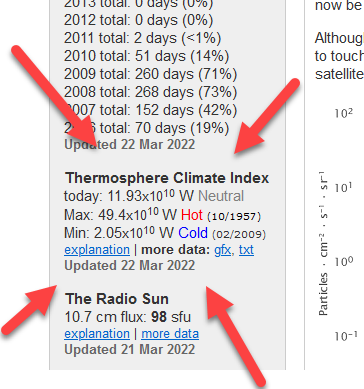
March 23, 2022: Solar Cycle 25 is intensifying–and Earth’s upper atmosphere is responding.
“The Thermosphere Climate Index (TCI) is going up rapidly right now,” reports Linda Hunt of Science Systems and Applications, Inc. “It has nearly tripled in the past year.”
TCI is a number published daily by NASA, which tells us how hot Earth’s upper atmosphere is. The thermosphere, the very highest layer of our atmosphere, literally touches space and is a sort of “first responder” to solar activity. Hunt created this plot showing how TCI has unfolded during the last 7 solar cycles. Solar Cycle 25 (shown in blue) is just getting started:
“So far Solar Cycle 25 is well ahead of the pace of Solar Cycle 24,” notes Hunt. If this trend continues, the thermosphere could soon hit a 20-year high in temperature.
Before we go any farther, a word of caution: This does not mean Earth itself is about to heat up. The thermosphere is hundreds of kilometers above our heads. Here on the planet’s surface we do not feel its heat; summer days are no warmer when TCI is “hot.” As Dr. Marty Mlynczak of NASA notes, “energy driving the climate system near Earth’s surface is hundreds of thousands of times greater than in the thermosphere.” As far as we know, cyclical warming and cooling of the thermosphere by the solar cycle does not affect climate.
Nevertheless, the thermosphere is important. When it heats up, as it is doing now, it also puffs up. Think of a marshmallow held over a campfire. The thermosphere can expand upward so much it actually touches Earth-orbiting satellites. Almost 40 Starlink satellites fell out of the sky earlier this year as a result of aerodynamic drag up there.
Above: Layers of the atmosphere. Credit: NASA
TCI might also have some predictive value. Hunt’s plot shows that the index is on an upward trajectory that most closely mimics Solar Cycle 20, which peaked back in the 1970s. Coincidentally, a new prediction for Solar Cycle 25 based on the arrival of the Termination Event suggests the same thing: It could look a lot like Solar Cycle 20–an above-average cycle with plenty of solar activity.
You can follow the progress of TCI as Solar Cycle 25 unfolds. It is published every day right here on Spaceweather.com.





 Spaceweather.com