First Images of Ultima Thule

Jan. 2, 2019: The first high-resolution images of Ultima Thule have reached Earth following New Horizons’ historic flyby on New Year’s Day. Hot off the presses, the photos reveal a pair of roughly spherical planetestimals stuck together in the middle. The contact binary strangely resembles BB-8:

“This flyby is a historic achievement,” says New Horizons Principal Investigator Alan Stern of the Southwest Research Institute in Boulder, Colorado. “Never before has any spacecraft team tracked down such a small body so far away in the abyss of space. We’re getting our first close-up look at ancient planetesimals.”

Planetestimals are the building blocks of planets. Here in the inner solar system, no pristine examples remain for us to study. They have been swallowed by planets, hammered by asteroids, and scorched by solar radiation. Ultima Thule, however, has been preserved in the deep freeze of the outer solar system for more than 4 billion years. It is truly a relic of the genesis of planets.

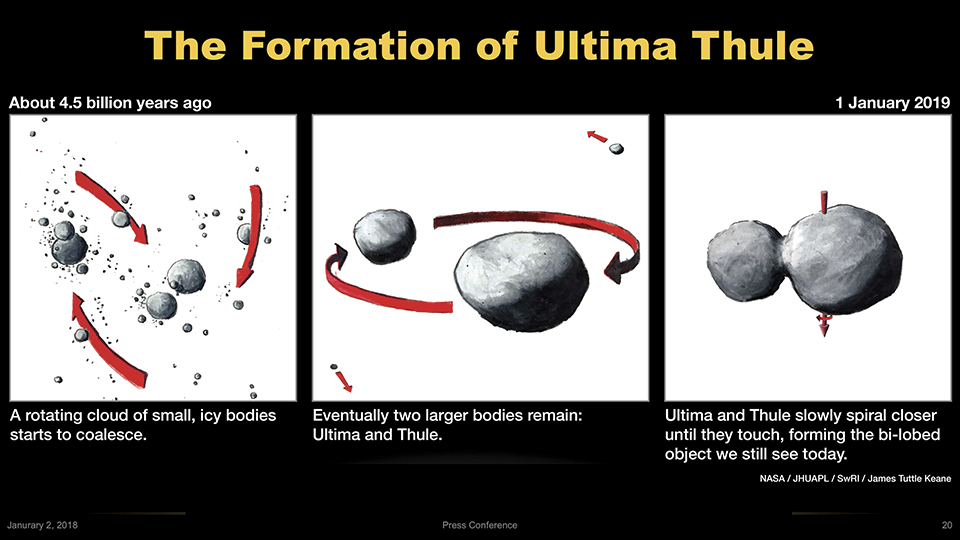
Mission scientists believe that Ultima Thule formed by accretion. A swarm of smaller planetesimals gathered under the pull of their own meagre gravity to form two spherical bodies, medium-sized planetesimals which themselves slowly bumped together and stuck. The result was Ultima Thule.

This is just the beginning of Ultima Thule’s revelations. First images released today have a resolution of about 140 meters per pixel. Images arriving in the days and weeks ahead will be as much as 5 times sharper, possibly revealing craters, hills, landslides, rilles and other unknowns.

New Horizons also scanned the area for tiny moons–the debris of the original swarm that gave birth to this strange object. Detections, if any, will be revealed in future transmissions from the spacecraft.

Browse: Slides from the science briefing and latest images from New Horizons

Rare Video of Clouds in the Stratosphere

Dec. 27, 2018: The habits of a weatherman are hard to break–even on holiday. So it was that Dutch meteorologist Jacob Kuiper found himself outside on Christmas morning, looking up. What he saw amazed him. “The sky was filling with strange clouds,” says Kuiper. “At first I thought they were some form of cirrus, but these clouds were uncommonly wavy with unusual curls. When I saw the telltale flashes of color, I realized they must be polar stratospheric clouds (PSCs).”

Kuiper made a time-lapse video of the display. Note the hypnotic waves and how, at the 25 second mark, ordinary clouds may be seen scudding far below them:

https://player.vimeo.com/video/308454218

Polar stratospheric clouds are not your ordinary Christmas clouds. Indeed, they have little to do with regular weather, floating so high above Earth that even airplanes cannot reach them.

Normally, the stratosphere is free of clouds–completely transparent. It’s very dry up there with a wide separation between molecules of water. When the temperature drops to around -85ºC, however, those sparse molecules begin to reluctantly gather, forming crystals of ice that become PSCs.

“I have been working in the National Meteorological Office in the central part of The Netherlands (KNMI) for 40 years,” says Kuiper. “Only twice have I seen a display of stratospheric clouds this widespread. It was thrilling. I didn’t expect the stratosphere over our country to be cold enough, but one of the stratosphere scientists in our Met. Office confirmed my idea. He also was quite surprised.”


Above: PSCs inside the Arctic Circle in 2017. Photo credit: Mia Stålnacke of Kiruna, Sweden

Tiny ice crystals in PSCs can produce episodes of iridescence so brilliant that they are sometimes mistaken for auroras. The display Kuiper recorded contained only a few brief flashes of those colors–just enough for an identification.

PSCs come in two varieties: Type I contains hydrated droplets of nitric acid and sulphuric acid. These are chemicals that can destroy ozone. Indeed, an ozone hole formed over the UK in Feb. 2016 following an outbreak of Type 1 PSCs. Type II PSCs are icy and colorful, and they do little damage to the ozone layer. The clouds Kuiper witnessed may be a mixture of both.

The display was so rare that researchers in the Met Office conducted an extra round of Christmas radio soundings to probe the stratosphere. They are still processing the data, so stay tuned!

Realtime Space Weather Photo Gallery

A GIFT FROM THE EDGE OF SPACE: The students of Earth to Sky Calculus are about to kick off a new year of cosmic ray balloon launches, continuing a 5-year campaign to monitor increasing levels of radiation in Earth’s atmosphere. You can help. Buy any gift item from the Earth to Sky Store and we’ll give you 10% off to celebrate the New Year.

All items in the Earth to Sky Store have flown to the edge of space onboard cosmic ray balloons. Each one comes with a greeting card showing the item in flight and telling the story of its journey. All sales support the Earth to Sky Calculus cosmic ray ballooning program and hands-on STEM research.

Far Out Gifts: Earth to Sky Store
All sales support hands-on STEM education

Ultima Thule’s First Puzzle

Dec. 23, 2018: NASA’s New Horizons spacecraft is 12 million km from Ultima Thule and closing fast. On New Year’s Day, it will fly by the mysterious Kuiper Belt Object three times closer than it buzzed Pluto in 2015 revealing … no one knows what. In fact, the mysteries have already begun.

Long range images of Ultima Thule reveal that it has no light curve. In other words, its brightness is constant.


Above: An artist’s concept of Ultima Thule, a double-lobed object in the Kuiper Belt

“It’s really a puzzle,” says New Horizons Principal Investigator Alan Stern of the Southwest Research Institute. And here’s why:

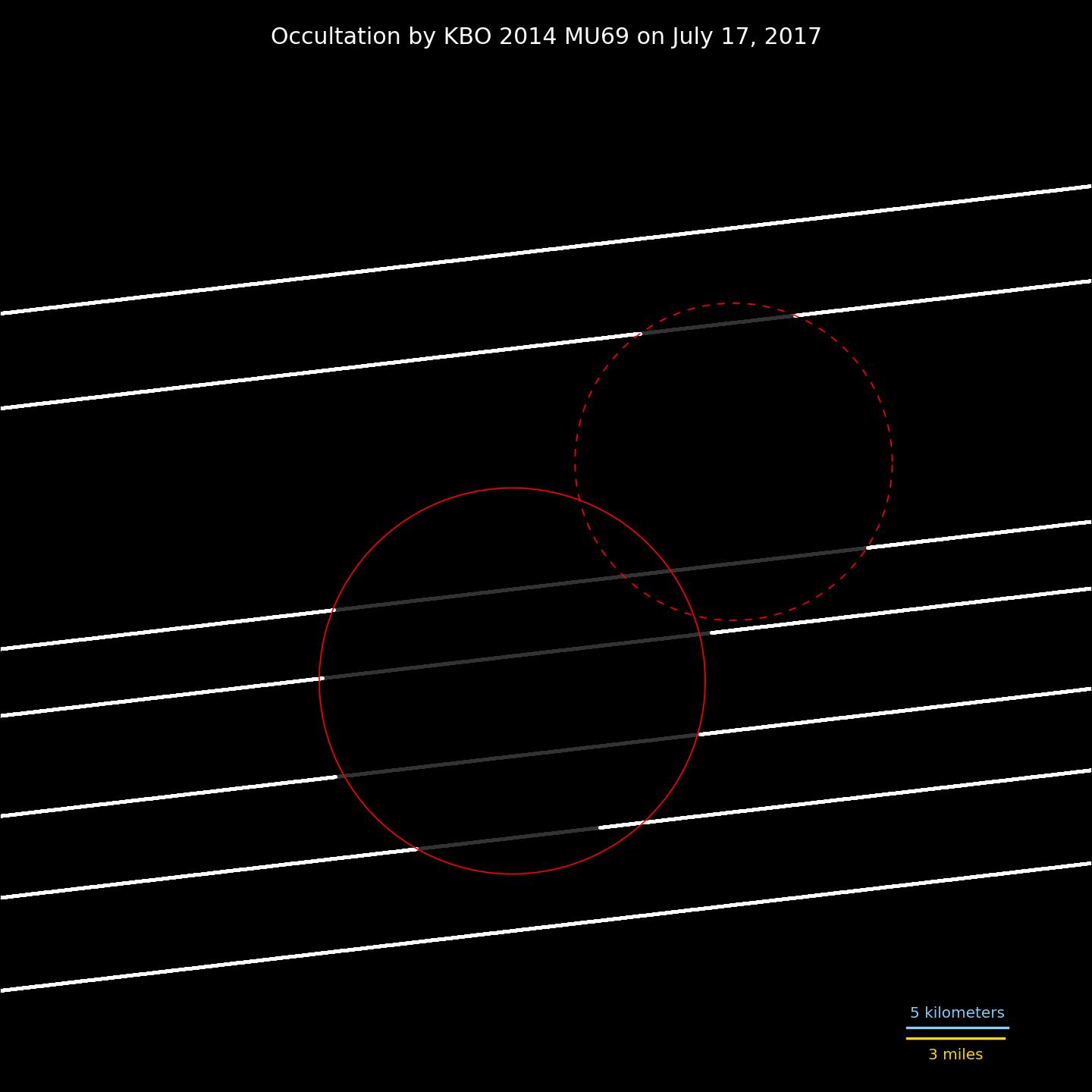
Last year, astronomers watched a distant star pass behind Ultima Thule. Starlight winked in and out in a pattern suggesting an elongated object with two bulbous lobes. Ultima Thule could be a binary system. You would expect the reflected brightness of such an object to vary as it rotates in the sunlight. Yet Ultima Thule does not behave that way.

What’s going on? New Horizons science team members have different ideas. “It’s possible that Ultima’s rotation pole is aimed almost right at the spacecraft,” speculates Marc Buie of the Southwest Research Institute. Such an alignment, however, is unlikely.

“Another explanation,” says the SETI Institute’s Mark Showalter, “is that Ultima may be surrounded by a cloud of dust that obscures its light curve–much the same way that a comet’s coma often overwhelms the light reflected by its central nucleus.”

“A more bizarre scenario is one in which Ultima is surrounded by many tiny tumbling moons,” suggests University of Virginia’s Anne Verbiscer, a New Horizons assistant project scientist. “If each moon has its own light curve, then together they could create a jumbled superposition of light curves that make it look to New Horizons like Ultima has a small light curve.”

“It’s hard to say which of these ideas is right,” Stern says. “We’ll get to the bottom of this puzzle soon – New Horizons will swoop over Ultima and take high-resolution images on Dec. 31 and Jan. 1, and the first of those images will be available on Earth just a day later. When we see those high–resolution images, we’ll know the answer to Ultima’s vexing first puzzle. Stay tuned!”

GIFTS FROM THE EDGE OF SPACE: The students of Earth to Sky Calculus are about to kick off a new year of cosmic ray balloon launches, continuing a 5-year campaign to monitor increasing levels of radiation in Earth’s atmosphere. You can help. Buy any gift item from the Earth to Sky Store and we’ll give you 10% off to celebrate the New Year.

All items in the Earth to Sky Store have flown to the edge of space onboard cosmic ray balloons. Each one comes with a greeting card showing the item in flight and telling the story of its journey. All sales support the Earth to Sky Calculus cosmic ray ballooning program and hands-on STEM research.

Far Out Gifts: Earth to Sky Store
All sales support hands-on STEM education

A Sunspot from the Next Solar Cycle

Nov. 19, 2018: Over the weekend, a small sunspot materialized in the sun’s northern hemisphere, then, hours later, vanished again. Such an occurrence is hardly unusual during solar minimum when sunspots are naturally small and short-lived. However, this ephemeral spot was noteworthy because its magnetic field was reversed–marking it as a member of the next solar cycle.

Shown above is a magnetic map of the sun from NASA’s Solar Dynamics Observatory on Nov. 17th. Two sunspot groups visible at 21:00 UT are inset.

Note sunspot AR2727 just north of the sun’s equator. It is a member of decaying Solar Cycle 24, the cycle that peaked back in 2012-2014. Next, compare its magnetic polarity to that of the other, unnumbered sunspot high above it. They are opposite. According to Hale’s Law, this means the two sunspots belong to different solar cycles. The high latitude sunspot appears to be a harbinger of Solar Cycle 25.

Solar cycles always mix together at their boundaries. Indeed, ephemeral sunspots possibly belonging to Solar Cycle 25 have already been reported on Dec. 20, 2016, and April 8, 2018. Now we can add Nov. 17, 2018, to list. The slow transition between Solar Cycle 24 and Solar Cycle 25 appears to be underway.

What does this mean? First, it suggests that the solar cycle is still operative. This contradicts widespread internet buzz that a Grand Minimum is in the offing, with no new sunspots expected for decades as the solar cycle grinds to a halt. Second, if patterns of previous solar cycles hold, Solar Minimum is not finished. It will probably continue to deepen in the year or so ahead even as new Solar Cycle 25 sunspots occasionally pop up, promising an ultimate end to the lassitude.

The 2018 Leonid Meteor Shower

Nov. 16, 2018: Earth is entering a stream of debris from comet Tempel-Tuttle, source of the annual Leonid meteor shower. Last night, NASA’s network of all-sky meteor cameras detected five Leonid fireballs over the USA, numbers that will grow as we enter the weekend. Forecasters expect the shower to peak on Nov. 17th and 18th with rates as high as 15 meteors per hour.

The Leonids are famous for storming. As often as a few times each century, Earth hits a dense filament of Comet Tempel-Tuttle’s dusty debris, causing thousands of meteors per hour to stream out of the constellation Leo. Such a display in 1833 kickstarted modern meteor astronomy with an outburst of 100,000 Leonids per hour. Many readers still remember the Leonid fireballs of 1998 and the meteor storms of 1999, 2001 and 2002.

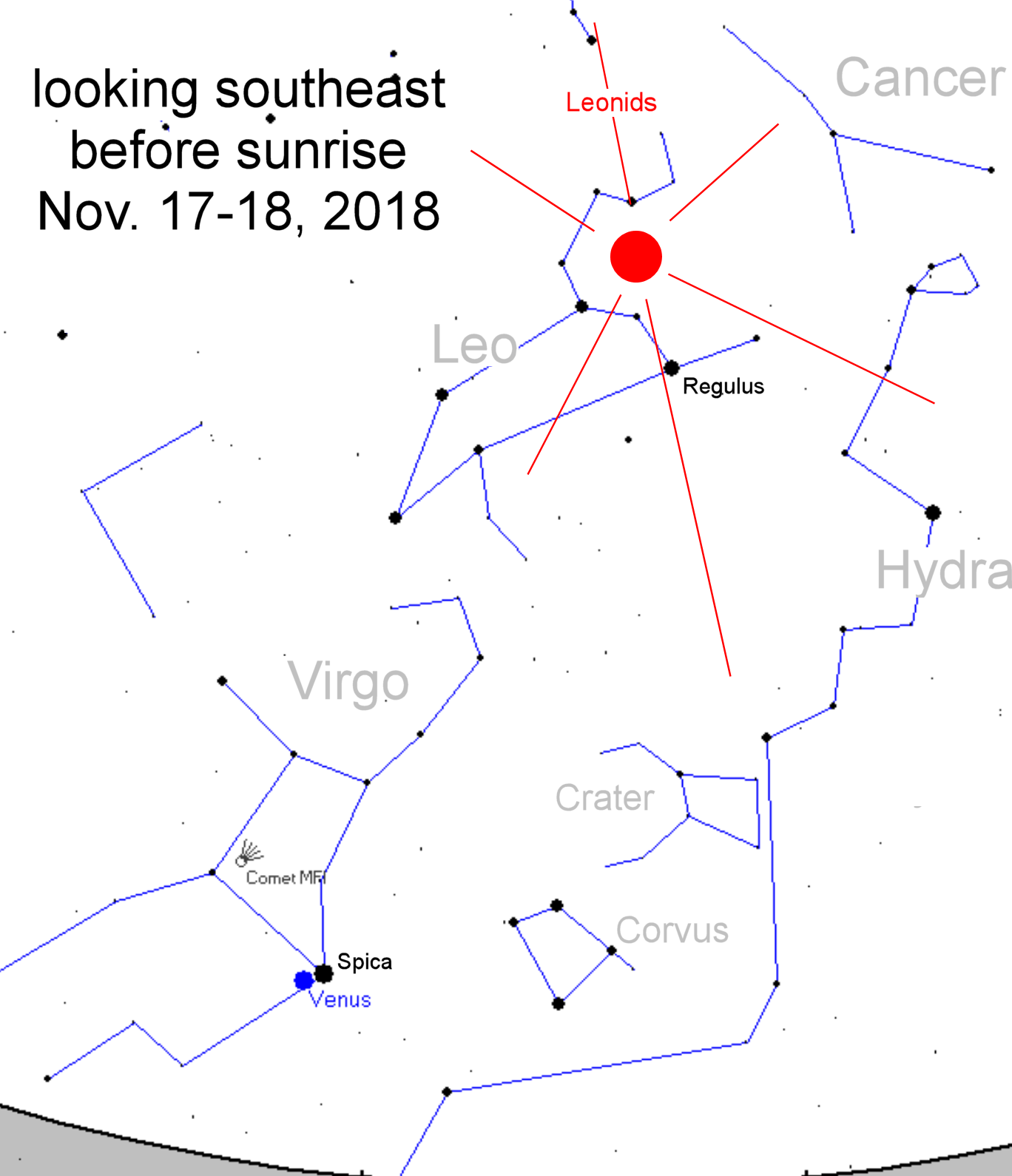
2018 is not a storm year, however. Earth will thread the needle between dense filaments, scooping up a lesser amount of dust. Each speck will hit Earth’s upper atmosphere at ~72 km/s (160,000 mph) producing a swift meteor emerging from the constellation Leo. The best time time to look is during the hours before dawn on Saturday, Nov. 17th, and Sunday, Nov. 18th, when the Lion is high in the southeastern sky.

If you do set your alarm for dawn, there’s more to see besides Leonids. For one thing, amateur astronomers have just discovered a new comet in the constellation Virgo. Comet Machholz-Fujikawa-Iwamoto (C/2018 V1) is an easy target for backyard telescopes, shining like a green fuzzy star of 8th magnitude. Use these orbital elements to point your optics.

Not far from the comet, Venus is having a close encounter with the brightest star in Virgo, Spica. Alan Dyer photographed the pair rising over the plains of Alberta, Canada, yesterday morning:

“Venus and Spica rose together as morning stars in the dawn twilight on Nov. 15th,” says Dyer. “Light clouds added the natural glows and enlarged Venus, so it really does look ‘big’ here!”

Did an Alien Light Sail just Visit the Solar System?

Nov. 6, 2018: It sounds like a tabloid headline, but in this case it could be real. Mainstream researchers from the Harvard Center for Astrophysics have made the case that interstellar asteroid ‘Oumuamua could in fact be an alien light sail. Their original research was posted Oct. 31st on the moderated preprint server arXiv.org.

The story of ‘Oumuamua begins in October 2017 when it was discovered by Robert Weryk using the Pan-STARRS telescope atop Hawaii’s Haleakalā volcano. Astronomers quickly realized that ‘Oumuamua was something special: The object was hurtling through the Solar System on an unbound “hyperbolic” orbit. It came from the stars. Dramatic changes in the object’s brightness suggested that it was tumbling and asymmetric–thin and wide like a cigar or perhaps a pancake.

oumuamua

This artist’s concept shows how ‘Oumuamua is usually depicted: as a cigar shaped asteroid.

On its way out of the Solar System, something unexpected happened. ‘Oumuamua accelerated as if jets of gas were pushing it forward. Astronomers who initially thought ‘Oumuamua was an asteroid now turned their attention to the comet hypothesis. Comets naturally develop jets after close approaches to the sun, and such jets could explain ‘Oumuamua’s behavior.

Just one problem: “Despite its close Solar approach of only 0.25 AU (inside the orbit of Mercury), ‘Oumuamua shows no sign of any cometary activity, no cometary tail, nor gas emission/absorption lines,” point out the Harvard researchers Shmuel Baily and Abraham Loeb. Moreover, “if outgassing was responsible for the acceleration, then the associated torques would have driven a rapid evolution in ‘Oumuamua’s spin, incompatible with observations.”

So if it’s not an asteroid, and it’s not a comet, what could it be? Loeb, who is the chair of the astronomy department at Harvard University and also chairs the advisory board for the Breakthrough Starshot light sail project, realized that the acceleration profile was key. The non-gravitational acceleration of ‘Oumuamua scaled with distance from the sun (r) as r-2 — just like a light sail would behave.

comethypothesis

The comet hypothesis. Credit: NASA/JPL-Caltech

Modeling ‘Oumuamua as a thin object pushed by solar radiation pressure, Baily and Loeb found that it would fit the observations if it were a sheet of material 0.3 mm to 0.9 mm in thickness with a mass surface density of ~0.1 grams per square cm. “Although extremely thin, such an object would survive an interstellar travel over Galactic distances of  about 5 kiloparsecs, withstanding collisions with gas and dust-grains as well as stresses from rotation and tidal forces,” they wrote.

The researchers are now calling for more observations to look for ‘Oumuamua-like visitors to the Solar System. They could be natural objects created by some unknown process in the interstellar medium–or they might be artificial. “A survey for lightsails as technosignatures in the Solar System is warranted, irrespective of whether ‘Oumuamua is one of them,” they conclude.

Although technical, Baily and Loeb’s paper is well written and unusually readable for nonspecialists. Check it out.

Rads on a Plane: New Results

Oct. 3, 2018: Many people think that only astronauts need to worry about cosmic radiation. Not so. Ordinary air travelers are exposed to cosmic rays, too. A recent study from researchers at Harvard found that flight attendants have a higher risk of cancer than members of the general population, and the International Commission on Radiological Protection has classified pilots as occupational radiation workers.

How much radiation do you absorb? SSpaceweather.com and the students of Earth to Sky Calculus have been working to answer this question by taking cosmic ray detectors onboard commercial airplanes. Flying since 2015, we have collected more than 22,000 GPS-tagged radiation measurements over 27 countries, 5 continents, and 2 oceans.

maps

(A) A global overview of our flights. This map shows where we have been. (B) To show the density of our data, we zoom in to the Four Corners region of the USA. There are three major hubs in the map: Phoenix, Las Vegas, and Denver. You can’t see them, however, because they are overwritten by pushpins.

Here is what we have learned so far:

  1. Radiation always increases with altitude, with dose rates doubling every 5000 to 6000 feet. This make sense: The closer you get to space, the more cosmic rays you will absorb.
  2. At typical cruising altitudes, cosmic radiation is 40 to 60 times greater than natural sources at sea level.
  3. Passengers on cross-country flights across the USA typically absorb a whole body dose equal to 1 or 2 dental X-rays.
  4. On international flights, the total dose can increase ~five-fold with passengers racking up 5 to 6 dental X-rays.

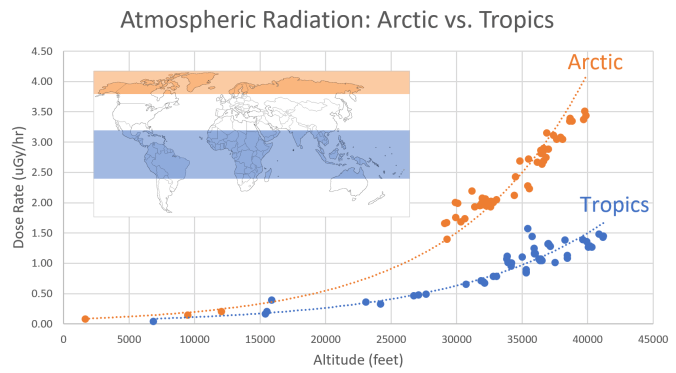
Using our database, we can investigate patterns of radiation around the world. For instance, this plot compares aviation radiation over the tropics vs. the Arctic:
arctic_tropics

We see that the Arctic is a high radiation zone. This comes as no surprise. Researchers have long known that particles from space easily penetrate Earth’s magnetic field near the poles, while the equator offers greater resistance. That’s why auroras are in Sweden instead of Mexico. Generally speaking, passengers flying international routes over the poles absorb 2 to 3 times more radiation than passengers at lower latitudes.

We can also look at individual countries–e.g., Sweden vs. the USA vs. Chile:

countries

As an Arctic country, Sweden has the most radiation–no surprise. The continental USA straddles the middle–again, no surprise. A mid-latitude country can be expected to have middling radiation. Chile, however, is more of a puzzle.

Although Chile does not cross the equator, it has some of the lowest readings in our database. This phenomenon is almost certainly linked to Chile’s location on the verge of the South Atlantic Anomaly–a distortion in Earth’s magnetic field that affects radiation levels. We are actively investigating the situation in Chile with additional flights, and will report results in a future blog.

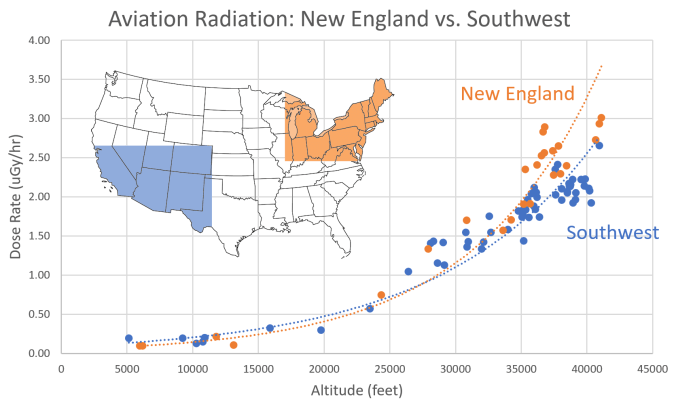
Because our home base is in the USA, we spend a lot of time flying there. The US dataset is so dense, we can investigate regional differences across the country–for example, New England vs. the Southwest:
newengland_southwest

The two curves are indistinguishable below ~30,000 feet, but at higher altitudes they diverge. By the time a plane reaches 40,000 feet, it would experience 30% more radiation over New England than the same plane flying above the desert Southwest. According to our measurements so far, New England is the “hottest” region of the continental USA, radiation-wise, with the Pacific Northwest a close second.

Perhaps the most important outcome of our work so far is E-RAD–a new predictive model of aviation radiation. We can now predict dose rates on flights in areas where we have flown before. Because it is constantly updated with new data, E-RAD naturally keeps up with variables that affect cosmic rays such as the solar cycle and changes in Earth’s magnetic field.

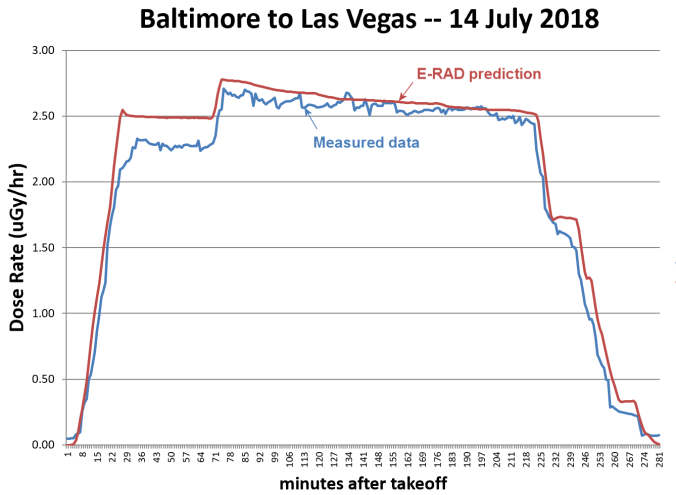
Here is an example of a recent flight we took from Baltimore to Las Vegas, comparing E-RAD’s predictions with actual measurements:
eradvreality

The two agree within 10% for most of the flight. These errors are constantly shrinking as we add new readings to our database.

The results in this report are offered as a preview of what we are learning. Our database is growing almost-daily with new flights to new places, and we will have more results to share in the weeks ahead. We’ve created a website to showcase what we are learning and ultimately to let you, the reader, interact with our databases as well: RadsonaPlane.com.

Visit RadsonaPlane.com


Student-Built Space Weather Satellite Targets Killer Electrons

Sept. 20, 2018: Last Saturday, a Delta II rocket blasted off at dawn from the Vandenberg AFB in California. Soon thereafter NASA reported the successful deployment of the ICESat-2 satellite, designed to make 3D laser images of Earth’s surface.

Here’s what most news stations did not report: A pair of tiny satellites were tucked inside the rocket, and they were successfully deployed as well. Built by students at UCLA, ELFIN-A and ELFIN-B are now orbiting Earth, monitoring the ebb and flow of “killer electrons” around our planet.

“We’ve just received our first downlink of data from ELFIN-A,” reports Ryan Caron, Development Engineer at UCLA’s Department of Earth, Planetary, and Space Sciences. Click to listen:

ELFIN-science-orbit-cutaway_strip

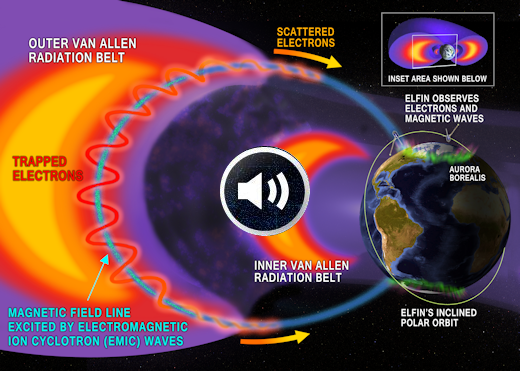
That may sound like ordinary static, but the signal is full of meaning. As mission controllers turn on ELFIN’s science instruments, the static-y waveforms will carry unique information about particles raining down on Earth from the inner Van Allen Radiation Belt.

“Sensors onboard our two cubesats detect electrons in the energy range 50 keV to 4.5 MeV,” says Caron. “These are the so-called ‘killer electrons,’ which can damage spacecraft and cause electrical disruptions on the ground. They also give rise to the majestic aurora borealis.”

“ELFIN is doing something new,” says Vassilis Angelopoulos, a UCLA space physicist who got his doctorate at UCLA and serves as ELFIN’s principal investigator. “No previous mission was able to measure the angle and energy of killer electrons as they rain down on Earth’s atmosphere. ELFIN will help us investigate how disturbances called ‘Electromagnetic Ion Cyclotron waves’ knock these electrons out of the Van Allen Belts and scatter them down toward Earth.”

ELFIN-A and ELFIN-B are cubesats, each weighing about eight pounds and roughly the size of a loaf of bread. They are remarkable not only for their cutting edge sensors, but also for their origin. The two satellites were almost completely designed and built by undergraduate students at UCLA. Working for more than 5 years, a succession of 250 students created the two Electron Losses and Fields Investigation CubeSats –“ELFIN” for short.

“Just seeing all the hundreds of hours of work, the many sleepless nights, the stressing out that you’re not going to make a deadline — just seeing it go up there … I’m probably going to cry,” says Jessica Artinger, an astrophysics major and geophysics and planetary science minor who helped build the satellites and witnessed their launch.

The ELFIN website has interactive tools so the public can track and listen to the spacecraft as it passes overhead twice a day. The CubeSats are expected to remain in space for two years, after which they will gradually fall out of orbit and burn up in the atmosphere like shooting stars.

ELFIN has been supported with funding from the National Science Foundation and NASA, with technical assistance from the Aerospace Corporation among other industry partners and universities.


Earth to Sky Cosmic Ray Sensors

When cosmic rays hit the top of Earth’s atmosphere, they create a spray of secondary radiation that rains down on the planet below. For years, the students of Earth to Sky Calculus have been measuring secondary cosmic rays on airplanes and high-altitude balloons using two types of sensors.

First, are the neutron bubble chambers:

neutronchambers_600

Each bubble pictured above is formed by an energetic neutron (200 keV – 15 MeV) passing through the chamber. Counting bubbles yields the total dose. We use chambers manufactured by Bubble Technology Industries Inc. of Canada.

Second, we monitor X-rays and gamma rays using sensors based on Geiger tubes:

xraygammaray

These are Polimaster 621M dosimeters sensitive to X-rays and gamma-rays. They sample energies between 10 keV and 20 MeV, spanning the range of medical X-ray machines, airport security devices, and “killer electrons” in Earth’s radiation belts.

Cosmic rays are a cocktail of different things: e.g., neutrons, protons, pions, electrons, X-rays, and gamma rays spanning a wide range of energies. Our sensors sample only three ingredients of that cocktail: neutrons, X-rays, gamma-rays. Furthermore, we are sampling only a relatively low range of energies. Many cosmic rays are much more energetic than the 15 MeV to 20 MeV upper limit of our detectors.

This means our data are only the tip of the iceberg.  Flight crews and passengers absorb even more radiation than we can detect.

A New Type of Aurora is Not an Aurora at All

Aug. 20, 2018: A new type of aurora nicknamed “STEVE” may not be an aurora at all, according to a new paper published August 20th in the Geophysical Research Letters. A group of researchers combined satellite data with ground-based imagery of STEVE during a geomagnetic storm to investigate how STEVE is formed. “Our main conclusion is that STEVE is not an aurora,” said Bea Gallardo-Lacourt, a space physicist at the University of Calgary in Canada and lead author of the new study.

steve

STEVE, photographed by Greg Ash of Ely, Minnesota, on May 5, 2018

STEVE is a purple ribbon of light that amateur astronomers in Canada have been photographing for decades, belatedly catching the attention of the scientific community in 2016. It doesn’t look exactly like an aurora, but it often appears alongside auroras during geomagnetic storms. Is it an aurora — or not? That’s what Gallardo-Lacourt’s team wanted to find out.

Auroras appear when energetic particles from space rain down on Earth’s atmosphere during geomagnetic storms. If STEVE is an aurora, they reasoned, it should form in much the same way. On March 28, 2008, STEVE appeared over eastern Canada just as NOAA’s Polar Orbiting Environmental Satellite 17 (POES-17) passed overhead. The satellite, which can measure the rain of charged particles that causes auroras, went directly above the purple ribbon. Gallardo-Lacourt’s team looked carefully at the old data and found … no rain at all.

“Our results verify that this STEVE event is clearly distinct from the aurora borealis since it is characterized by the absence of particle precipitation,” say the researchers. “Interestingly, its skyglow could be generated by a new and fundamentally different mechanism in Earth’s ionosphere.”

Another study has shown that STEVE appears most often in spring and fall. With the next equinox only a month away, new opportunities to study STEVE are just around the corner. Stay tuned and, meanwhile, read the original research here.

Realtime STEVE Photo Gallery