Climate Change at the Edge of Space

by Dr. Tony Phillips (Spaceweather.com)

In the summer of 1885, sky watchers around northern Europe noticed something strange. Sunsets weren’t the same any more.  The red and orange colors they were used to seeing were still there—but those familiar colors were increasingly joined by rippling waves of luminous blue.

At first they chalked it up to Krakatoa, which had erupted just two years earlier. The explosion of the Indonesian super volcano hurled massive plumes of ash and dust into the atmosphere more than 50 miles high, coloring sunsets for years after the blast.

Eventually Krakatoa’s ash settled, yet the rippling waves of luminous blue didn’t go away.  Indeed, more than 100 years later, they are shining brighter than ever.

Ruslan-Merzlyakov-2_1465805905_stripAbove: Noctilucent clouds over Nykøbing Mors, Denmark, on June 13, 2016. Photo credit: Ruslan Merzlyakov

Today we call them, “noctilucent clouds” (NLCs). They appear with regularity in summer months, shining against the starry sky at the edge of twilight. Back in the 19th century you had to go to Arctic latitudes to see them. In recent years, however, they have been sighted from backyards as far south as Colorado and Kansas.

Noctilucent clouds are such a mystery that in 2007 NASA launched a spacecraft to study them. The Aeronomy of Ice in the Mesosphere satellite (AIM) is equipped with sensors specifically designed to study the swarms of ice crystals that make up NLCs.  Researchers call these swarms “polar mesospheric clouds” (PMCs).

A new study published in the Journal of Geophysical Research (doi:10.1002/2015JD024439) confirms what some researchers have long suspected:  PMCs in the northern hemisphere have become more frequent and brighter in recent decades—a development that may be related to climate change.

The story begins long before the launch of AIM.

sbuvicemassThe paper’s lead author Mark Hervig, an AIM scientist with GATS, Inc., explains: “Thanks to decades of data from the Solar Backscatter Ultraviolet (SBUV) instrument on NOAA weather satellites, we know that PMCs have become thicker and more frequent.”

Right: According to data from SBUV, the ice mass of PMCs has increased since 1980.

“The question we’ve been grappling with is why?” says co-author David Siskind of the Naval Research Lab in Washington, DC. “Why did the upper mesosphere (the atmospheric layer where PMCs form) become icier?”

The ingredients for PMCs are simple enough. Ice requires water molecules + freezing temperatures.  However, SBUV could not tell researchers if the mesosphere was getting wetter or colder–or both.

Fortunately, AIM has an instrument onboard named SOFIE that can unravel the water-temperature knot.  Hervig, Siskind, and another co-author, Uwe Berger of the Leibniz-Institute of Atmospheric Physics in Germany, recently interpreted the 36-year SBUV record using data from SOFIE, and this is what they found:

At altitudes where PMCs form, temperatures decreased by 0.5 ±0.2K per decade. At the same time, water vapor increased by 0.07±0.03 ppmv (~1%) per decade.

current_daisyAbove: AIM data taken on June 21, 2016, show noctilucent clouds ringing the north pole.

“These results settle the decades old question of whether or not the observed long-term change in PMCs is an indicator of changing temperature or humidity,” says James Russell, AIM Principal Investigator. “It’s both.”

These results are consistent with a simple model linking PMCs to two greenhouse gases. First, carbon dioxide promotes PMCs by making the mesosphere colder. (While increasing carbon dioxide warms the surface of the Earth, those same molecules refrigerate the upper atmosphere – a yin-yang relationship long known to climate scientists.) Second, methane promotes PMCs by adding moisture to the mesosphere, because rising methane oxidizes into water.

methane_stripAbove: A graphic prepared by Prof. James Russell of Hampton University shows how methane, a greenhouse gas, boosts the abundance of water at the top of Earth’s atmosphere. This water freezes around “meteor smoke” to form icy noctilucent clouds.

However, the simple model may not be enough:

“Our study shows that PMCs may be tied to changes in the temperature of the stratosphere as well,” says Hervig. “This complicates things because the stratosphere is governed by a wide range of phenomena including ozone concentration, greenhouse gases, and volcanic aerosols.

“While we have finally quantified the underlying temperature and water vapor changes related to PMCs,” he adds, “there is still work to be done in understanding the details of what caused these changes.”

Summer is the season for PMCs and noctilucent clouds.  As June turns into July, observers in Europe are already reporting some displays, and they should appear over the northern USA within weeks.

Observing tips: Look west 30 to 60 minutes after sunset when the sun has dipped ~10 degrees below the horizon. If you see blue-white tendrils spreading across the sky, you may have spotted a sign of climate change.  It happens, even at the edge of space.

Solar Eclipse Balloon Network

https://player.vimeo.com/video/179806783

We are actively raising funds for the Solar Balloon Eclipse Network. Scroll down for a list of unique gifts flown to the edge of space.

Experience the Great American Solar Eclipse from the edge of space! Help us create the first-ever 360-degree movie of the Moon’s shadow sweeping across the continental U.S. during a total eclipse of the sun.

Spaceweather.com and the students of Earth to Sky Calculus have developed a balloon payload that can photograph solar eclipses from the stratosphere. This sets the stage for a one-of-a-kind photography experiment: On August 21, 2017, the Moon will pass in front of the sun over the USA, producing a total eclipse visible from coast to coast. We will launch balloons to record the event from multiple points along the path of totality. The pins show our confirmed launch sites so far:

Floating more than 100,000 feet above the clouds, the balloons will have an unobstructed view of the eclipse.  Each payload will be equipped with a 360-degree camera.  This camera will record not only the sun’s ghostly corona in the sky above, but also the Moon’s dark shadow racing across the landscape below. When the eclipse is finished, we will combine the footage to create a unique video portrait of an eclipse sweeping across the American continent. This will be the first time in history a movie of a full eclipse as it moves across the United States is captured from the stratosphere.

Our payload has already traveled to the stratosphere and photographed a partial solar eclipse in Oct. 2014:

matrixTo test the payload under conditions of totality, a team of students and parents from Earth to Sky Calculus visited Indonesia on March 9, 2016.  They were stationed on a beach on the island of Belitung when the Moon’s shadow enveloped them for 3 full minutes. Our spherical eclipse camera and other optics did a great job recording the event.

belitung_stripThere’s more to our mission than photography, however. We are also going to conduct a unique experiment in atmospheric radiation.

For the past three years we have been flying balloons to the stratosphere equipped with neutron, X-ray, and gamma-ray sensors.  As a result of these flights, we’ve discovered that cosmic rays in Earth’s atmosphere are intensifying.  Here is a plot of radiation dose rates over California:

radplot_stripWhat’s happening over the rest of the country? The solar eclipse gives us a chance to find out.  With teams launching balloons and radiation sensors from as many as a dozen sites, we can get a unique snapshot of the cosmic ray environment in the North American atmosphere from ground level to 120,000 feet and from coast to coast.

Readers, would you like to join the Solar Eclipse Balloon Network? There are many ways you can help.

We still need lots of hardware for our payloads–including more radiation sensors, GPS trackers, and cameras. To fund the cost of the launch sites and balloon payloads, we are selling eclipse-related products on our Earth to Sky website. Purchasing these products will allows us to by the crucial items needed for each launch site and to dispatch teams of students across the country to study the Great American Solar Eclipse from the edge of space. With enough funding we can launch multiple balloons from each site, increasing the footage we can take and the number of people who can participate. A limited number of people can even join us in the path of totality!

We are offering a variety of eclipse-related products on our website. If you are interested in participating directly at a launch site and supporting the Solar Eclipse Balloon Network at a higher level, please visit our GoFundMe campaign.

Safe Solar Eclipse Viewing Glasses:

snoopy4_cropGet ready for the Great American Solar Eclipse! These safe solar glasses will allow you to view any phase of the solar eclipse without fear of damage to your eyes. The Family Pack includes 3 pairs of glasses and costs only $29.95.

And there’s a bonus: They have all been to the edge of space! On June 23, 2017, the students of Earth to Sky Calculus flew a payload-full of solar glasses to the stratosphere onboard a high-altitude space weather balloon. The glasses ascended more than 95,000 feet above the Sierra Nevada mountains of central California before parachuting back to Earth.
Each Family Pack of solar eclipse glasses comes with a unique gift card showing the glasses floating at the top of Earth’s atmosphere. The interior of the card tells the story of the flight and confirms that these items have been to the edge of space and back again.
Price: $29.95

Solar Eclipse T-Shirt:

tees_strip600Become an honorary member of the Earth to Sky Solar Eclipse Team! Official club tee-shirts are available in four sizes (S, M, L and XL) and two styles (Male and Female). The shirt was designed by Earth to Sky founding student Ginger Perez. All proceeds support student space weather research and our Solar Eclipse Balloon Network. (Specify the size and style you want in the comments field at checkout.)

Price: $39.95.

Solar Eclipse Pendant:

pendant1_strip2

This solar eclipse-themed pendant flew to the stratosphere on July 2, 2017, attached to the payload of a giant space weather balloon. Floating at an altitude 105,000 feet above Earth’s surface, it made contact with space, experiencing temperatures as low as -63 C and a dose rate of cosmic rays 100x Earth normal. Artwork on the pendant commemorates the upcoming Great American Solar Eclipse on Aug. 21, 2017.
Buy one of these pendents now and for no additional charge we will fly it back to the stratosphere during the total eclipse on Aug. 21, 2017, where it will be enveloped by the shadow of the Moon over our launch site in Oregon. To make this happen, please make a note in the COMMENTS BOX of your shopping cart: “Fly my pendant during the eclipse!”
Each pendant comes with a unique gift card showing the jewelry floating at the top of Earth’s atmosphere. The interior of the card tells the story of the flight and confirms that this gift has been to the edge of space and back again.
Price: $79.95.

stamps_strip

On June 20, 2017, the US Postal Service issued a first-of-its-kind Total Eclipse of the Sun Forever stamp, which commemorates the August 21 eclipse. On July 2nd, we flew them to the edge of space 105,000 feet above central California. You can have a sheet of 16 stamps for the collector’s price of $89.95. They make great Birthday and Christmas gifts.
These rare temperature-sensitive stamps depict the Moon eclipsing the sun. When the stamp gets cold, the Moon darkens, forming a space-black disk. During our balloon flight on July 2nd, the temperature dropped to -63 C. The Moon darkened in the extreme cold of the stratosphere, then lightened again when the payload parachuted back to Earth, landing on the warm foothills of the Sierra Nevada mountains near Big Pine CA. The recovered stamps are perfectly intact and continue to change their appearance as intended when exposed to heat and cold.
The Total Eclipse of the Sun stamp is a Forever stamp, which is always equal in value to the current First-Class Mail 1-ounce price.
Each sheet of 16 stamps comes with a unique gift card showing the stamps floating at the top of Earth’s atmosphere. The interior of the card tells the story of the flight and confirms that this gift has been to the edge of space and back again. You will receive the stamps in a black protective envelope that protects the stamps from UV radiation and preserves them for future gift-giving.
Price: $89.95

Thank you for your support!

Earth’s Magnetic Field is Changing

by Dr. Tony Phillips (Spaceweather.com)

Anyone watching a compass needle point steadily north might suppose that Earth’s magnetic field is a constant. It’s not. Researchers have long known that changes are afoot. The north magnetic pole routinely moves, as much as 40 km/yr, causing compass needles to drift over time. Moreover, the global magnetic field has weakened 10% since the 19th century.

A new study by the European Space Agency’s constellation of Swarm satellites reveals that changes may be happening even faster than previously thought. In this map, blue depicts where Earth’s magnetic field is weak and red shows regions where it is strong:

Data from Swarm, combined with observations from the CHAMP and Ørsted satellites, show clearly that the field has weakened by about 3.5% at high latitudes over North America, while it has strengthened about 2% over Asia. The region where the field is at its weakest – the South Atlantic Anomaly – has moved steadily westward and weakened further by about 2%. These changes have occured over the relatively brief period between 1999 and mid-2016.

Earth’s magnetic field protects us from solar storms and cosmic rays. Less magnetism means more radiation can penetrate our planet’s atmosphere. Indeed, high altitude balloons launched by Spaceweather.com routinely detect increasing levels of cosmic rays over California. Perhaps the ebbing magnetic field over North America contributes to that trend.

As remarkable as these changes sound, they’re mild compared to what Earth’s magnetic field has done in the past. Sometimes the field completely flips, with north and the south poles swapping places. Such reversals, recorded in the magnetism of ancient rocks, are unpredictable. They come at irregular intervals averaging about 300,000 years; the last one was 780,000 years ago. Are we overdue for another? No one knows.

Swarm is a trio of satellites equipped with vector magnetometers capable of sensing Earth’s magnetic field all the way from orbital altitudes down to the edge of our planet’s core. The constellation is expected to continue operations at least until 2017, and possibly beyond, so stay tuned for updates.

Earth’s Inconstant Magnetic Field

by Dr. Tony Phillips (Spaceweather.com)

Every few years, scientist Larry Newitt of the Geological Survey of Canada goes hunting. He grabs his gloves, parka, a fancy compass, hops on a plane and flies out over the Canadian arctic. Not much stirs among the scattered islands and sea ice, but Newitt’s prey is there–always moving, shifting, elusive.

His quarry is Earth’s north magnetic pole.

At the moment it’s located in northern Canada, about 600 km from the nearest town: Resolute Bay, population 300, where a popular T-shirt reads “Resolute Bay isn’t the end of the world, but you can see it from here.” Newitt stops there for snacks and supplies–and refuge when the weather gets bad. “Which is often,” he says.

Scientists have long known that the magnetic pole moves. James Ross located the pole for the first time in 1831 after an exhausting arctic journey during which his ship got stuck in the ice for four years. No one returned until the next century. In 1904, Roald Amundsen found the pole again and discovered that it had moved–at least 50 km since the days of Ross.

The pole kept going during the 20th century, north at an average speed of 10 km per year, lately accelerating “to 40 km per year,” says Newitt. At this rate it will exit North America and reach Siberia in a few decades.

Keeping track of the north magnetic pole is Newitt’s job. “We usually go out and check its location once every few years,” he says. “We’ll have to make more trips now that it is moving so quickly.”

Earth’s magnetic field is changing in other ways, too: Compass needles in Africa, for instance, are drifting about 1 degree per decade. And globally the magnetic field has weakened 10% since the 19th century. When this was mentioned by researchers at a recent meeting of the American Geophysical Union, many newspapers carried the story. A typical headline: “Is Earth’s magnetic field collapsing?”

Probably not. As remarkable as these changes sound, “they’re mild compared to what Earth’s magnetic field has done in the past,” says University of California professor Gary Glatzmaier.

Sometimes the field completely flips. The north and the south poles swap places. Such reversals, recorded in the magnetism of ancient rocks, are unpredictable. They come at irregular intervals averaging about 300,000 years; the last one was 780,000 years ago. Are we overdue for another? No one knows.

see captionLeft: Magnetic stripes around mid-ocean ridges reveal the history of Earth’s magnetic field for millions of years. The study of Earth’s past magnetism is called paleomagnetism. Image credit: USGS. [more]

According to Glatzmaier, the ongoing 10% decline doesn’t mean that a reversal is imminent. “The field is increasing or decreasing all the time,” he says. “We know this from studies of the paleomagnetic record.” Earth’s present-day magnetic field is, in fact, much stronger than normal. The dipole moment, a measure of the intensity of the magnetic field, is now 8 × 10²² amps × m2. That’s twice the million-year average of 4× 10²² amps × m2.

To understand what’s happening, says Glatzmaier, we have to take a trip … to the center of the Earth where the magnetic field is produced.

At the heart of our planet lies a solid iron ball, about as hot as the surface of the sun. Researchers call it “the inner core.” It’s really a world within a world. The inner core is 70% as wide as the moon. It spins at its own rate, as much as 0.2° of longitude per year faster than the Earth above it, and it has its own ocean: a very deep layer of liquid iron known as “the outer core.”

see captionRight: a schematic diagram of Earth’s interior. The outer core is the source of the geomagnetic field.

Earth’s magnetic field comes from this ocean of iron, which is an electrically conducting fluid in constant motion. Sitting atop the hot inner core, the liquid outer core seethes and roils like water in a pan on a hot stove. The outer core also has “hurricanes”–whirlpools powered by the Coriolis forces of Earth’s rotation. These complex motions generate our planet’s magnetism through a process called the dynamo effect.

Using the equations of magnetohydrodynamics, a branch of physics dealing with conducting fluids and magnetic fields, Glatzmaier and colleague Paul Roberts have created a supercomputer model of Earth’s interior. Their software heats the inner core, stirs the metallic ocean above it, then calculates the resulting magnetic field. They run their code for hundreds of thousands of simulated years and watch what happens.

What they see mimics the real Earth: The magnetic field waxes and wanes, poles drift and, occasionally, flip. Change is normal, they’ve learned. And no wonder. The source of the field, the outer core, is itself seething, swirling, turbulent. “It’s chaotic down there,” notes Glatzmaier. The changes we detect on our planet’s surface are a sign of that inner chaos.

They’ve also learned what happens during a magnetic flip. Reversals take a few thousand years to complete, and during that time–contrary to popular belief–the magnetic field does not vanish. “It just gets more complicated,” says Glatzmaier. Magnetic lines of force near Earth’s surface become twisted and tangled, and magnetic poles pop up in unaccustomed places. A south magnetic pole might emerge over Africa, for instance, or a north pole over Tahiti. Weird. But it’s still a planetary magnetic field, and it still protects us from space radiation and solar storms.

And, as a bonus, Tahiti could be a great place to see the Northern Lights. In such a time, Larry Newitt’s job would be different. Instead of shivering in Resolute Bay, he could enjoy the warm South Pacific, hopping from island to island, hunting for magnetic poles while auroras danced overhead.

Sometimes, maybe, a little change can be a good thing.

12-Year Old Invents a New Kind of Space Selfie

by Dr. Tony Phillips (Spaceweather.com)

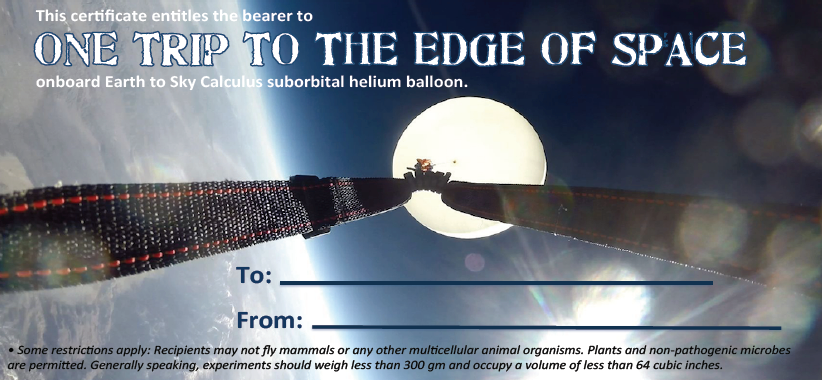
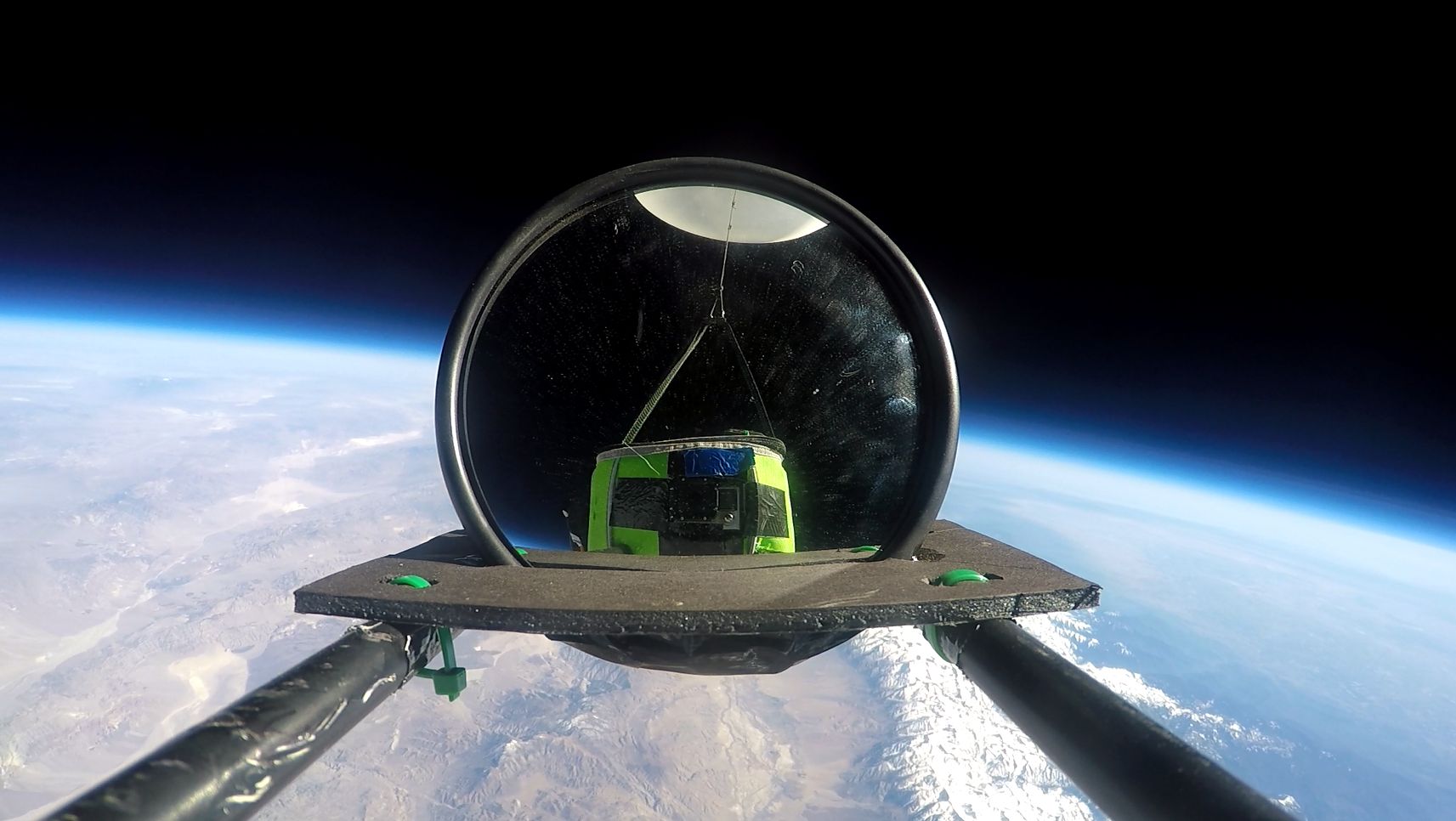
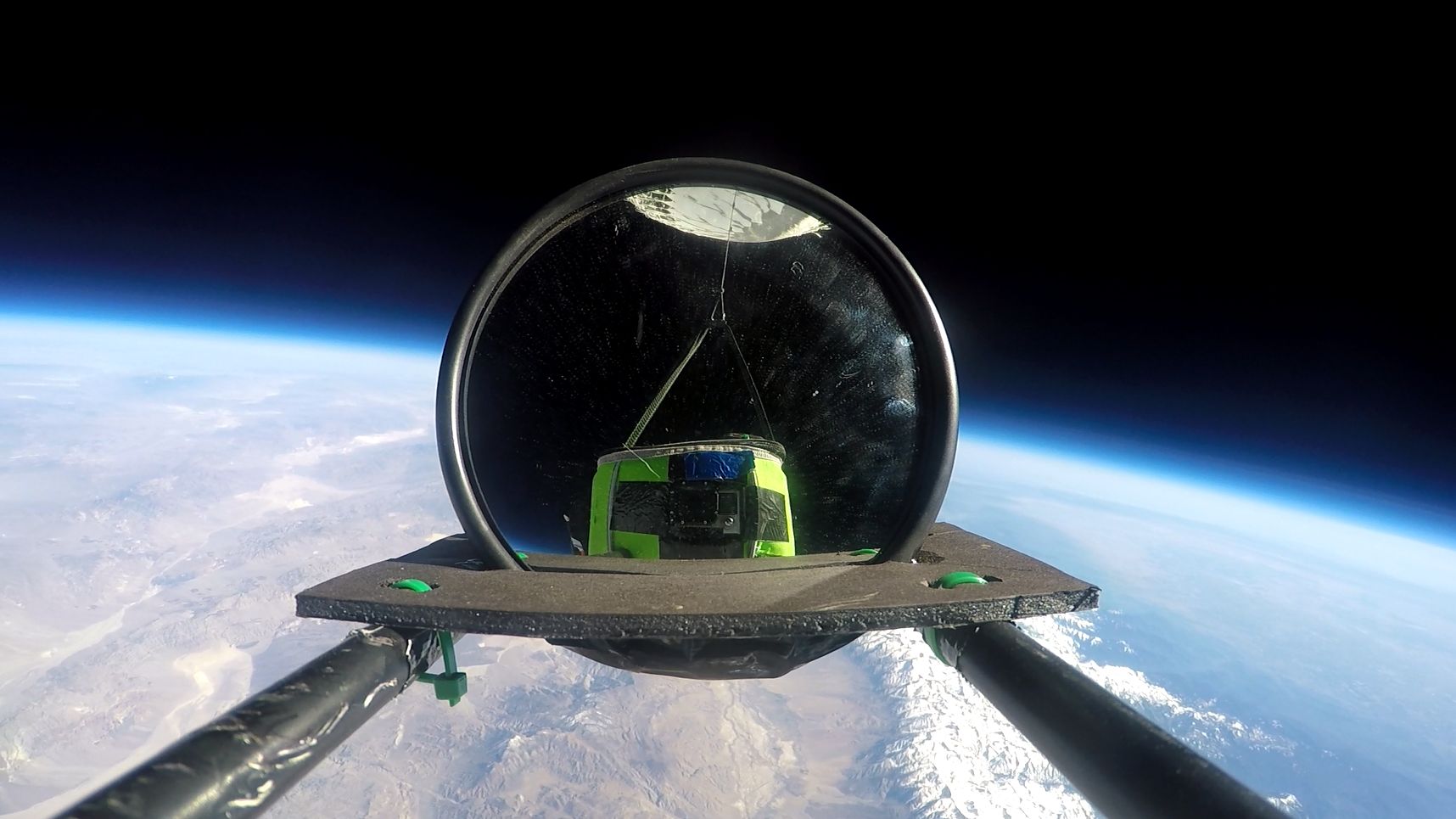
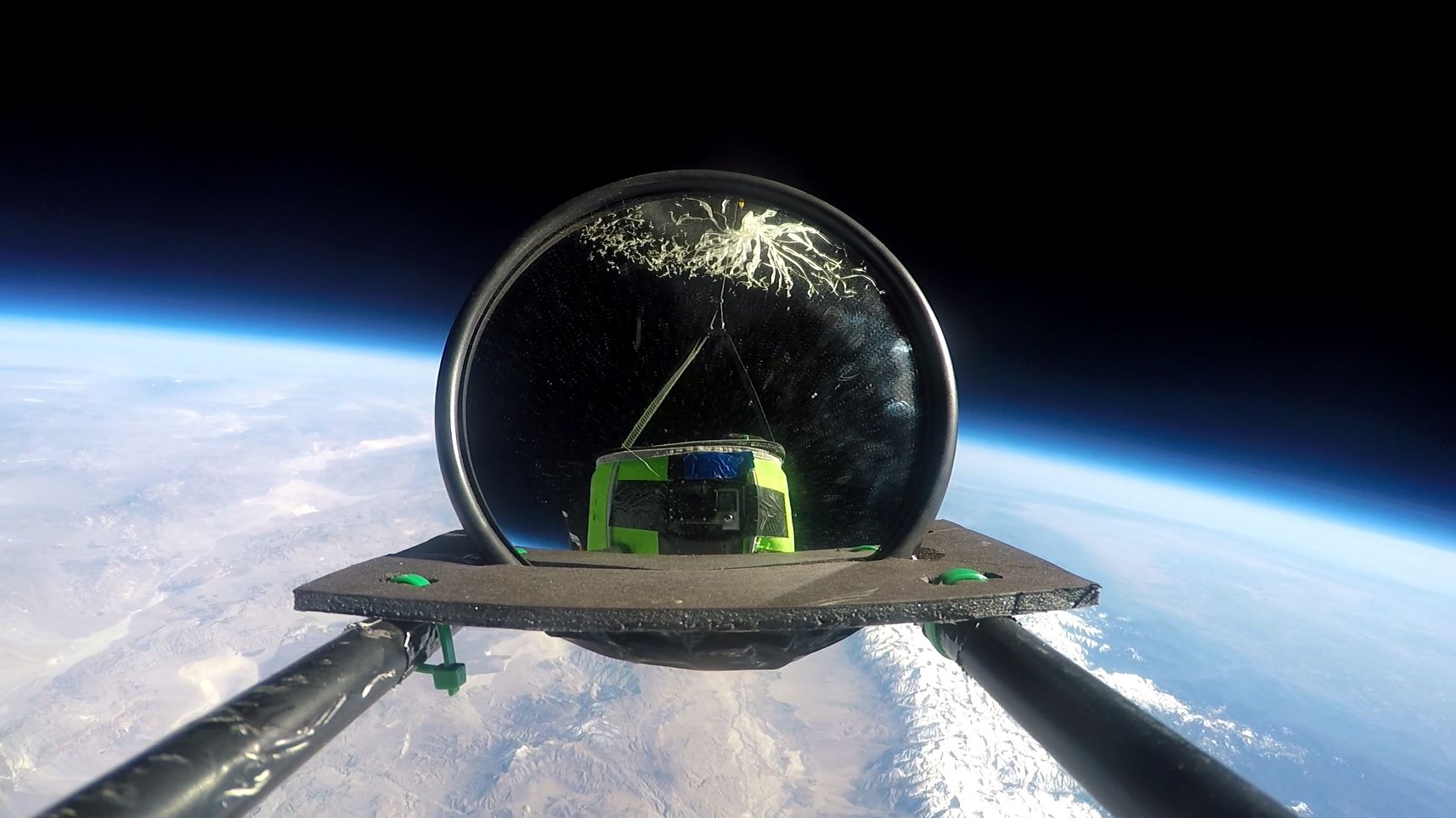
Last December, Joyce and Tad Lhamon of Seattle, Washington, bought their 12-year-old grandson Barrett a far-out Christmas gift–that is, a trip to the edge of space. In exchange for this gift certificate, Barrett could fly any experiment he wanted to the stratosphere onboard an Earth to Sky Calculus helium balloon. He thought about it for months and, after discarding many ideas, Barrett decided to fly a convex mirror. The payload’s cameras could look into the mirror and take a new kind of “space selfie.” Would it work? On April 17th, we flew Barrett’s experiment, and the results were better than anyone dreamed:

.

“Spaceweather.com and the students of Earth to Sky Calculus have flown more than 150 missions to the edge of space monitoring cosmic rays and stress-testing microbes. We’ve never seen our payload quite like this before.

A particularly interesting sequence of images shows the balloon exploding above the payload 117,100 feet above Earth. The following video frames are separated by only 1/30th of a second: #1, #2, #3, #4. Note how the payload remains motionless during the explosion. It takes more than a second for the shock wave from the explosion to propagate down the long cord connecting the payload to the balloon.

Congratulations, Barrett, on a very successful experiment!

The Solar Cycle is Crashing

by Dr. Tony Phillips  of Spaceweather.com

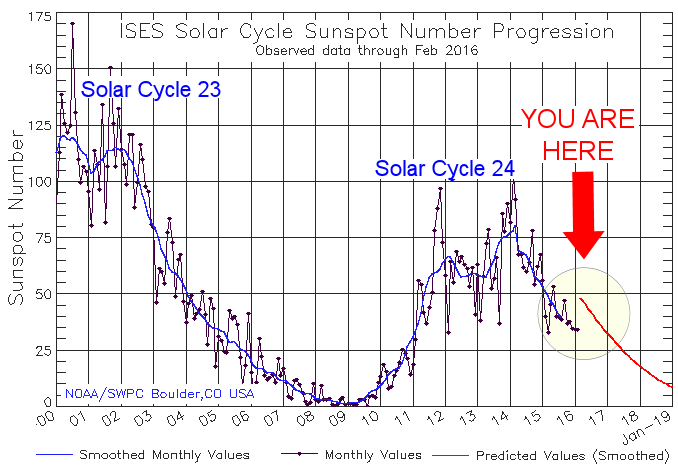
Anyone wondering why the sun has been so quiet lately? The reason may be found in the graph below. The 11-year sunspot cycle is crashing:

For the past two years, the sunspot number has been dropping as the sun transitions from Solar Max to Solar Min. Fewer sunspots means there are fewer solar flares and fewer coronal mass ejections (CMEs). As these explosions subside, we deem the sun “quiet.”

But how quiet is it, really?

A widely-held misconception is that space weather stalls and becomes uninteresting during periods of low sunspot number. In fact, by turning the solar cycle sideways, we see that Solar Minimum brings many interesting changes. For instance, the upper atmosphere of Earth collapses, allowing space junk to accumulate around our planet. The heliosphere shrinks, bringing interstellar space closer to Earth. And galactic cosmic rays penetrate the inner solar system with relative ease. Indeed, a cosmic ray surge is already underway. (Goodbye sunspots, hello deep-space radiation.)

Stay tuned for updates as the sunspot number continues to drop.

SCIENCE FAIR AT THE EDGE OF SPACE

March 31, 2016: Around the USA, science fairs are underway in all 50 states. Middle-school student Sydney R. of Turlock, California, decided to do her experiment at the edge of space. On March 23rd, she flew packets of baker’s yeast to the stratosphere onboard an Earth to Sky Calculus helium balloon. The fungi reached an altitude of 116,181 feet:

At the apex of the flight, the yeast absorbed doses of cosmic radiation more than 100x Earth-normal. Meanwhile, back on Earth, control samples remained in their usual place in the kitchen cupboard. The two samples, flown vs. control, form the basis of Sydney’s experiment.

She plans to do some “space baking.” Sydney has a recipe for brownies that calls for yeast, and she is going to prepare the dessert using both kinds of leavening. Does space yeast make the same delicious brownies as terrestrial yeast? Hungry astronauts would love to know.

Green Comet Approaches Earth

On March 21st, Comet 252P/LINEAR will make a close approach to Earth–only 0.036 AU (5.4 million km) away. This is the fifth closest cometary approach on record and, as a result, the normally dim comet has become an easy target for backyard telescopes. Indeed, it is brightening much faster than expected.

“Comet 252P/LINEAR has surpassed expectations and is now bordering on naked eye visibility for southern observers,” reports Michael Mattiazzo of Swan Hill, Australia. “At the moment it is near magnitude +6,” Observing from Brisbane, Australia, Tom Harradine didn’t even need a telescope to photograph 252P/LINEAR. On March 17th, he caught the green comet (circled) passing by the Tarantula Nebula using just a digital camera:

“This image is a stack of 140 four second exposures I made using a Canon EOS 70D set at f/4.0, ISO 12800, and 200mm,” he says.

The comet is green because its vaporizing nucleus emits diatomic carbon, C2, a gas which glows green in the near-vacuum of space. The verdant color will become more intense in the nights ahead as 252P/LINEAR approaches Earth.

In recent days, astronomers have realized that Comet 252P/LINEAR might have a companion. A smaller and much dimmer comet named “P/2016 BA14” will buzz Earth even closer than 252P/LINEAR on March 22nd. P/2016 BA14 appears to be a fragment of 252P/LINEAR. Unlike its parent, however, P/2016 BA14 is “pitifully faint” and difficult to observe. Sky and Telescope has the full story.

There is a chance that the comet’s approach could cause a minor meteor shower. According to the International Meteor Organization, “[modeling by forecaster] Mikhail Maslov indicates that there might be a weak episode of faint, very slow meteors (15.5 km/s) on March 28–30 from a radiant near the star μ Leporis.” Little is known about meteors from this comet, so estimates of the meteor rate are very uncertain. Maslov’s models suggest no more than 5 to 10 per hour.

This is a southern hemisphere event. At closest approach on March 21st, 252P/LINEAR will speed through the constellations Triangulum Australis and Apus, far south of the celestial equator. Observers can use this ephemeris to point their cameras and telescopes.

Physics of an Exploding Space Weather Balloon

by Dr. Tony Phillips (Spaceweather.com)

On Feb. 27, 2016, the students of Earth to Sky Calculus launched a space weather balloon to measure increasing levels of cosmic rays. At the apex of the flight, the balloon exploded as planned and the radiation sensors parachuted back to Earth. A high-speed camera on top of the payload captured some extraordinary images of the pop:

These images illustrate new findings about the physics of exploding balloons. In Oct. 2015, researchers Sébastien Moulinet and Mokhtar Adda-Bedia of the Ecole Normale Supérieure published a Physical Review Letter entitled “Popping Balloons: A Case Study of Dynamical Fragmentation.” In it, they reported the results of a series of fun yet informative laboratory experiments in which one balloon after another was popped and analyzed.

Basically, there are two ways a balloon can pop: along a single tear (the “opening regime”) or along many tears (the “fragmentation regime”). This video shows the two regimes in action. Which way the balloon decided to pop depends on the stress in the rubber membrane. When the stress is low, it can be relieved with a single tear, but when the stress is high, many tears are required to do the job.

Clearly, space weather balloons explode in the fragmentation regime. This is hardly a surprise. When space weather balloons are launched, they measure no more than 6 to 8 feet in diameter. By the time they reach the stratosphere, they have stretched into a sphere as wide as a house. That’s a lot of tension to release!

More information about this research is available from the American Physical Society.

Spherical Camera at the Edge of Space

On Feb. 27th, Spaceweather.com and the students of Earth to Sky Calculus launched a helium balloon to the stratosphere to monitor increasing levels of cosmic rays. In addition to radiation sensors, the payload carried something special: a spherical camera. Click and drag on the image below to explore California’s Sierra Nevada from an altitude of 115,300 feet–and don’t forget to look up at the balloon!

The camera, a Ricoh Theta S, will probably become a regular part of our cosmic ray payload. Imagery should improve in future flights as the students learn to lower the profile of the camera’s thermal pack–the strange-looking black object in the center of the 3D image. During its flight to the stratosphere, the camera experienced temperatures as low as -65 C. The thermal pack helps keep the camera’s batteries warm in these harsh conditions.

more spherical images: the students preparing to launch the balloon, the balloon ascending through clouds, the balloon exploding in the stratosphere.

Next week, the camera will take another trip–to Indonesia. The students will be using it to record a total eclipse of the sun on March 9th. Stay tuned for that!