Cosmic Rays Continue to Intensify

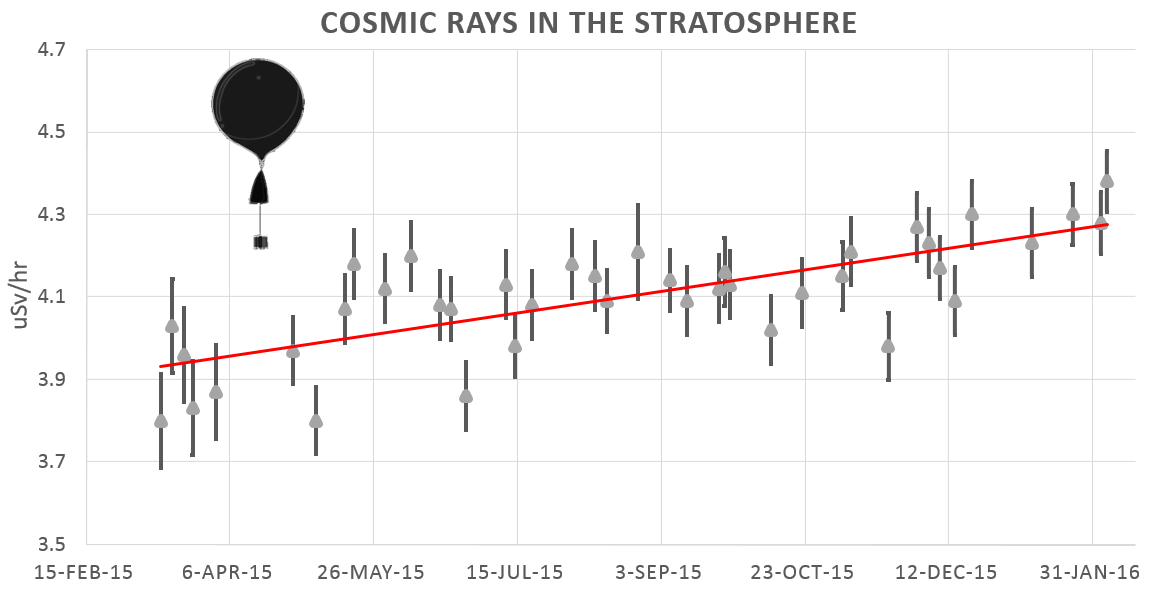
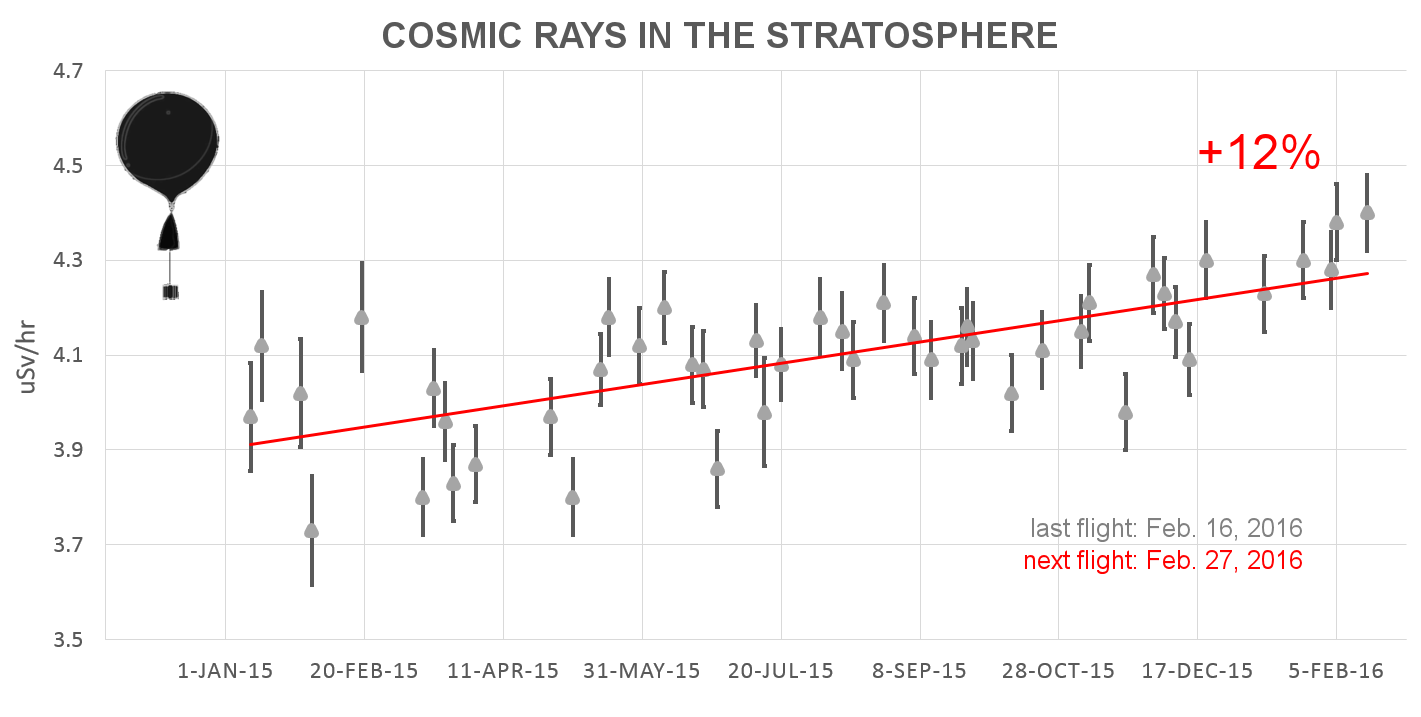
Researchers have long known that solar activity and cosmic rays have a yin-yang relationship. As solar activity declines, cosmic rays intensify. Lately, solar activity has been very low indeed. Are cosmic rays responding? The answer is “yes.” Spaceweather.com and the students of Earth to Sky Calculus have been using helium balloons to monitor cosmic rays in the stratosphere. Their data show that cosmic rays in the mid-latitude stratosphere now are approximately 12% stronger than they were one year ago:


Cosmic rays, which are accelerated toward Earth by distant supernova explosions and other violent events, are an important form of space weather. They can seed clouds, trigger lightning, and penetrate commercial airplanes. Furthermore, there are studies linking cosmic rays with cardiac arrhythmias and sudden cardiac death in the general population. Among patients who have an implanted cardioverter – defibrillator (ICD), the aggregate number of life-saving shocks appears to be correlated with the number of cosmic rays reaching the ground. References: #1, #2, #3, #4.

Why do cosmic rays increase when solar activity is low? Consider the following: To reach Earth, cosmic rays have to penetrate the inner solar system. Solar storms make this more difficult. CMEs and gusts of solar wind tend to sweep aside cosmic rays, lowering the intensity of radiation around our planet. On the other hand, when solar storms subside, cosmic rays encounter less resistance; reaching Earth is a piece of cake.

Forecasters expect solar activity to drop sharply in the years ahead as the 11-year solar cycle swings toward another deep minimum. Cosmic rays are poised to increase accordingly.

Cosmic Rays Continue to Intensify

Last month, we reported that cosmic rays are intensifying. Measurements so far in February indicate that the trend is continuing. In fact, the latest balloon flight over California on Feb. 5th detected the highest value yet:

The data show that cosmic rays in the mid-latitude stratosphere now are approximately 10% stronger than they were one year ago. All of these measurements were collected by Spaceweather.com and the students of Earth to Sky Calculus.

Cosmic rays, which are accelerated toward Earth by distant supernova explosions and other violent events, are an important form of space weather. They can seed clouds, trigger lightning, and penetrate commercial airplanes. Indeed, our measurements show that someone flying back and forth across the continental USA, just once, can absorb as much ionizing cosmic radiation as 2 to 5 dental X-rays. Likewise, cosmic rays can affect mountain climbers, high-altitude drones, and astronauts onboard the International Space Station.

This type of radiation is modulated by solar activity. Solar storms and CMEs tend to sweep aside cosmic rays, making it more difficult for cosmic rays to reach Earth. On the other hand, low solar activity allows an extra dose of cosmic rays to reach our planet. Indeed, the ongoing increase in cosmic ray intensity is probably due to a decline in the solar cycle. Solar Maximum has passed and we are heading toward a new Solar Minimum. Forecasters expect solar activity to drop sharply in the years ahead, and cosmic rays are poised to increase accordingly. Stay tuned for more radiation.

Ozone Hole over the UK

Feb. 5, 2016: For the past week, sky watchers in the UK have witnessed a rare apparition of polar stratospheric clouds (PSCs). Normally restricted to the Arctic Circle, the fantastically colorful clouds have appeared over the British Isles almost every day since Jan. 31st. Colin Fraser photographed the display over Edinburgh, Scotland, on Feb. 2nd:

PSCs form in the lower stratosphere when temperatures drop to a staggeringly-cold -85ºC. High-altitude sunlight shining through tiny ice particles ~10µm wide produce bright iridescent colors by diffraction and interference.

But there is more to PSCs than ice. Some polar stratospheric clouds contain very small droplets of naturally occurring nitric and sulphuric acids. These droplets destroy ozone. Indeed, atmospheric optics expert Les Cowley points out that a temporary ozone hole has formed over Ireland and the UK. It is the blue patch in this Feb. 1st ozone map from NASA’s Arctic Ozone Watch:

“The acid droplets destroy the stratospheric ozone layer that protects us from harmful solar ultra-violet rays,” says Cowley. “They catalyse unreactive forms of man-made chlorine into active free radicals (for example ClO, chlorine monoxide). The radicals destroy many ozone molecules in a series of chain reactions..”

This outbreak of PSCs is truly unusual. “Prior to this outbreak I have seen PSCs over the UK only twice in the last 20 years!” says Cowley. “This episode is exceptional at such low latitudes.  If it goes on any longer my camera will be worn out.”

UPDATE: On Feb. 5th, the outbreak of PSCs has subsided, and so has the UK ozone hole. Click here for updates.

Cosmic Rays are Intensifying

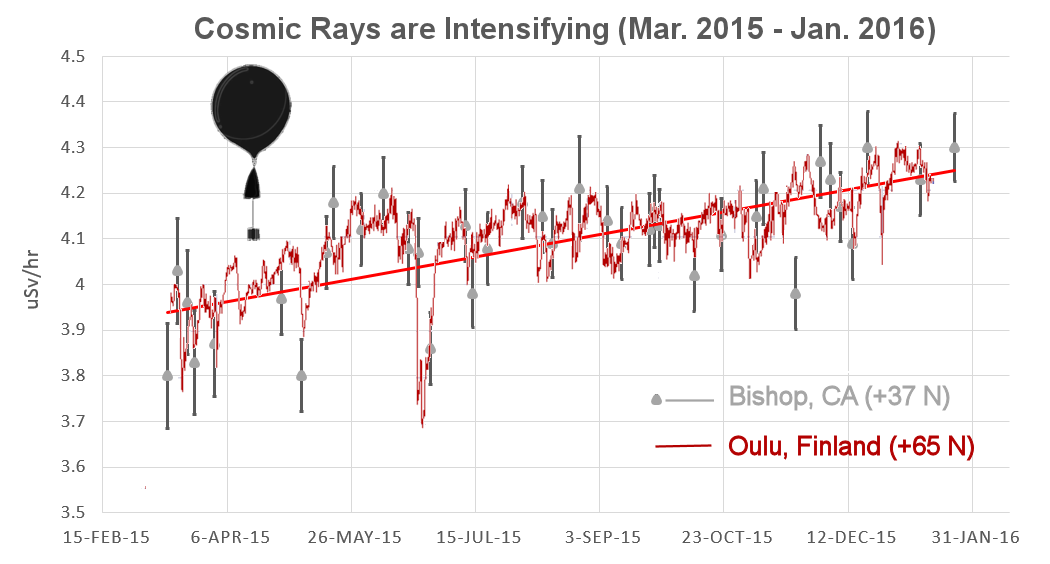
For the past year, neutron monitors around the Arctic Circle have sensed an increasing intensity of cosmic rays. Polar latitudes are a good place to make such measurements, because Earth’s magnetic field funnels and concentrates cosmic radiation there. Turns out, Earth’s poles aren’t the only place cosmic rays are intensifying. Spaceweather.com and the students of Earth to Sky Calculus have been launching helium balloons to the stratosphere to measure radiation, and they find the same trend over California:

In the plot, neutron monitor measurements from the University of Oulu Cosmic Ray Station are traced in red; gamma-ray/X-ray measurements over California are denoted in gray. The agreement between the two curves is remarkable. It means that the intensification of cosmic rays is making itself felt not only over the poles, but also over lower latitudes where Earth’s magnetic field provides a greater degree of protection against deep space radiation.

Cosmic rays, which are accelerated toward Earth by distant supernova explosions and other violent events, are an important form of space weather. They can seed clouds, trigger lightning, and penetrate commercial airplanes. Indeed, our measurements show that someone flying back and forth across the continental USA, just once, can absorb as much ionizing cosmic radiation as 2 to 5 dental X-rays. Likewise, cosmic rays can affect mountain climbers, high-altitude drones, and astronauts onboard the International Space Station.

This type of radiation is modulated by solar activity. Solar storms and CMEs tend to sweep aside cosmic rays, making it more difficult for cosmic rays to reach Earth. On the other hand, low solar activity allows an extra dose of cosmic rays to reach our planet. Indeed, the ongoing increase in cosmic ray intensity is probably due to a decline in the solar cycle. Solar Maximum has passed and we are heading toward a new Solar Minimum. Forecasters expect solar activity to drop sharply in the years ahead, and cosmic rays are poised to increase accordingly. Stay tuned for more radiation.

Meteor Balloon in the Stratosphere

When the Geminid meteor shower peaked on Dec. 14th, a snowstorm was in progress over the mountains of central California. No stars? No problem. Using a helium balloon, the students of Earth to Sky Calculus launched a low-light camera to photograph the shower high above the obscuring clouds. Their experimental payload ascended to 91,000 feet where the night sky looked like this:

The big white object at the top of the frame is the balloon, surrounded by some of the bright stars and planets of the pre-dawn sky. From the lower stratosphere, the freezing camera was able to see stars as dim as 2nd magnitude. This wasn’t as sensitive as the students had hoped, but it was good enough to record several Geminid fireballs. Here are a couple of movies showing Geminids emerging from behind the balloon: fireball #1, fireball #2. In the movies, stars and planets move in a lazy circle around the balloon–a result of the payload’s gentle spin–while Geminids streak in straight lines. The camera also recorded the balloon exploding at the apex of the flight, and the payload parachuting back to Earth.

The students plan to observe more meteor showers in the future with even better results. They believe they can boost the sensitivity of the camera by, e.g., warming the payload bay during the flight and improving the camera’s focus, pre-launch. If their improvements succeed, they could establish ballooning as a practical and fun way to monitor meteor showers in all kinds of weather. Stay tuned for updates.

Thanksgiving Skies

by Dr. Tony Phillips (Spaceweather.com)

Nov 24, 2015: Thanksgiving is the biggest travel holiday of the year in the United States. Millions of people board airplanes and fly long hours to visit friends and family.

Dreading the trip? Think of it as a sky watching opportunity. There are some things you can see only through the window of an airplane. Atmospheric optics expert Les Cowley lists a few of his favorites:

glory_stripAbove: A glory, photographed by air traveler Philip Laven. Copyright 2000, all rights reserved. More

“Both sides of the aircraft have their own sights,” says Cowley. “On the side opposite the sun, the main thing to look for is the glory. Clouds below the aircraft are required. They are the canvas on which the glory is ‘painted.’”

“Look toward the antisolar point, the place in the clouds directly opposite the sun,” he instructs. “There, if the aircraft is low enough, you will find the shadow of the plane. Surrounding the shadow is the glory–a bright white glow surrounded by one or more shimmering rings of color.”

space weather alerts“These rings are formed when light is scattered backwards by individual water droplets in the cloud. The more uniform the size of the droplets, the more rings you will see. They swell and contract as you travel over clouds with smaller or larger droplets.”

No clouds beneath you?

“In that case,” says Cowley, “another optical effect might be visible, especially over arid regions or pine forests. This is the opposition effect, a bright patch of light moving along the ground below you. The brightening, which is always directly opposite the sun, marks the point where the shadows of objects, like trees or soil granules, are hidden beneath the objects themselves. The area consequently looks brighter than its surroundings.” Here is an image of the opposition effect, photographed by Eva Seidenfaden flying over Uzbekstan.

opposition_stripA similar phenomenon has been observed on the Moon.

Turning to the sunward side of the aircraft…

“That is the realm of ice halos,” says Cowley. Ice halos are rings and arcs of light caused by ice crystals in high clouds. “They are often rainbow-colored,” he notes, “but they are not rainbows.”

From the ground you look up to see these halos. From an airplane you look down.

“You might be able to see subhorizon halos invisible from low ground,” says Cowley. “The brightest, sometimes blindingly bright, is the subsun. This is a direct reflection of the sun from millions of flat plate-shaped ice crystals floating in the clouds beneath you and acting together as a giant mirror. As the aircraft moves the subsun drifts along the clouds, sometimes growing, sometimes contracting, sometimes wobbling as crystals with different tilts are sampled. Sometimes a column of light will extend upward from the subsun toward the real sun–this is a lower sun pillar.”

see caption

Above: Subhorizon halos photographed by Don Davis. Copyright 2005, all rights reserved. Click on the image to view labels. More
“Sunrise and sunset from high altitudes are special,” Cowley adds. “The speed of the aircraft can make them faster or slower than usual. Furthermore, the sun is extra-flattened because its light is refracted almost twice the normal amount by its passage into the dense lower atmosphere and then out again to you. On a night flight, you might catch the moonrise; its distortions and flattening are greater for the same reason.”

“And if none of these things are visible on your particular flight, ignore fellow passengers and crane your head to see some of the sky above you. It is dark and a deep violet blue–darker than you will ever see on the ground. A large part of Earth’s atmosphere is beneath and there are far fewer molecules to scatter the sun’s light and turn the sky blue. You are not far from space.”

Happy Thanksgiving!
Yeast Survive and Mutate at the Edge of Space

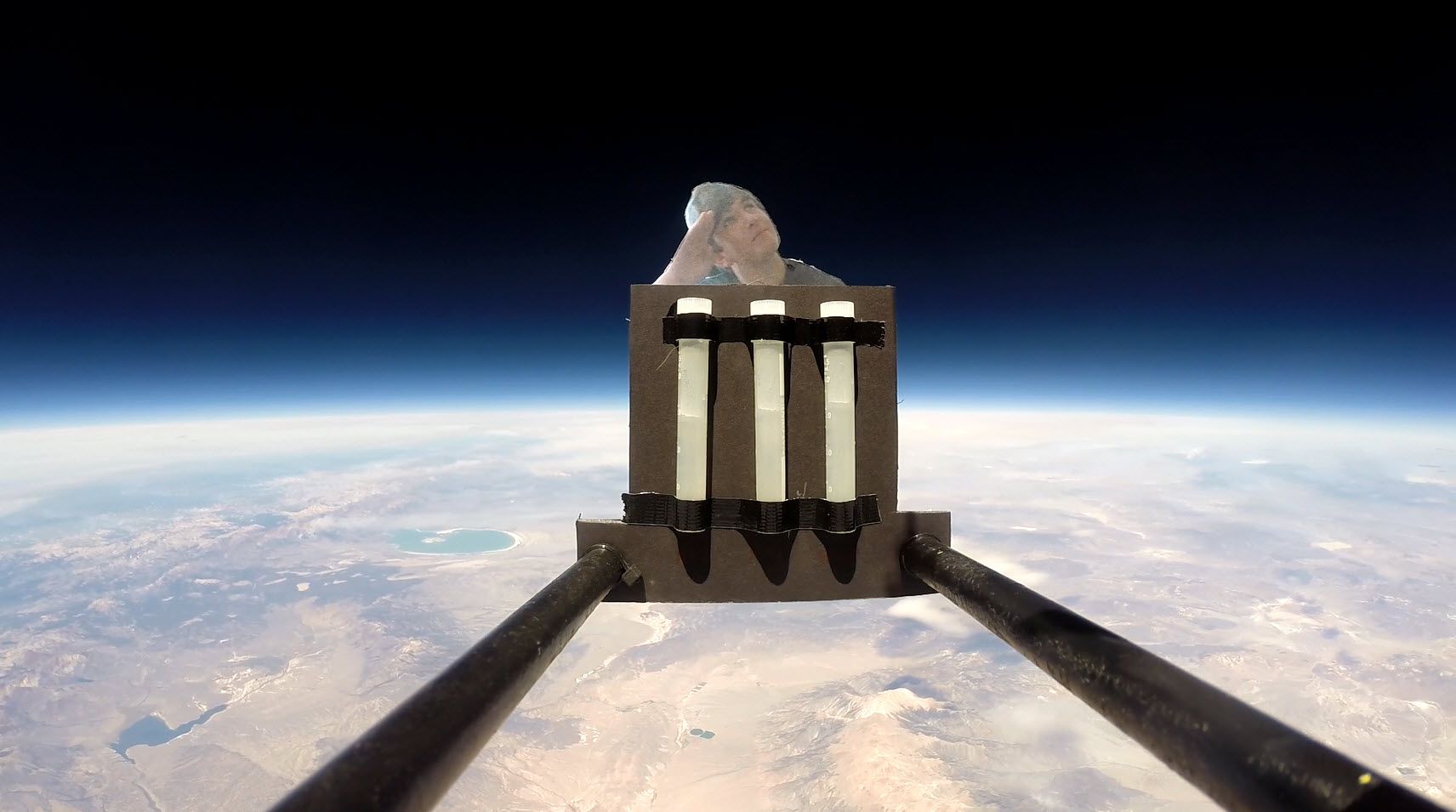
Yeast and people have a lot in common. About 1/3rd of our DNA is the same. Indeed, the DNA of yeast is so similar to that of humans, yeast can actually live with human genes spliced into their genetic code. This is why Spaceweather.com and the students of Earth to Sky Calculus have been flying yeast to the edge of space. Understanding how the microbes respond to cosmic rays could tell us how human cells respond as well. Here are three strains of yeast (one per test tube) flying 113,936 feet above Earth’s surface on August 15th:

The student in the picture is Joey, a high school senior, hitching a ride to the stratosphere along with the yeast. Joey and other members of the student research team are busy measuring growth curves and mutation rates for the space-traveling yeast.

One result is already clear: Yeast are incredibly tough. En route to the stratosphere they were frozen solid at temperatures as low as -63C, and they experienced dose rates of ionizing radiation 100x Earth normal. Survival rates in some of the returning samples were close to 100%.

Photo-micrographs show that yeast mutates in the stratosphere. This image, for instance, shows a colony of white mutants alongside the normal red colonies of Saccharomyces cerevisiae (HA2):

In addition to the white mutation shown above, the students have also observed petite mutants, which are a sign of changes in the cells’ mitochondrial genome. These changes are of interest to space biologists because the DNA repair mechanisms of yeast are remarkably similar to those of human beings. In particular, proteins encoded by yeast RAD genes are closely related to proteins used by human cells to undo radiation damage.

Rare Blue Starter

by Dr. Tony Phillips (this article originally appeared on Spaceweather.com)

We all know what comes out of the bottom of thunderstorms: lightning bolts. But on Oct. 20th, Thomas Ashcraft of New Mexico saw something coming out of the top. “I captured a form of a transient luminous event called a ‘blue starter’ shooting up from the top of a thunderstorm cloud,” he says. “Blue starters are rarely captured from ground level and there are hardly any specimens on the internet.”

Lightning scientist Oscar van der Velde explains this phenomenon: “A blue starter is an electric streamer discharge coming out of the top of a thundercloud, fanning out and reaching up to the stratosphere as high as 26 km altitude. First reported by UAF scientists Wescott and Sentman in 1995/1996, they were found to be different from blue jets, which reach 35-40 km height.”

“Since then, there have been very few reports of blue starters,” continues van der Velde. “It seems that unusual physical circumstances may be required to produce them. Also, geometry can prevent people from seeing blue starters when a cloud is nearby because the underbody of the cloud can block their view. At larger distances the blue/violet light does not make it to the observer due to scattering.”

Blue starters and blue jets are cousins of sprites, another form of exotic lightning that shoots up instead of down. Sprites, however, are more frequently observed. Check them out in the realtime photo gallery:

Realtime Sprite Photo Gallery

Flying at Night Doesn’t Protect You from Cosmic Rays

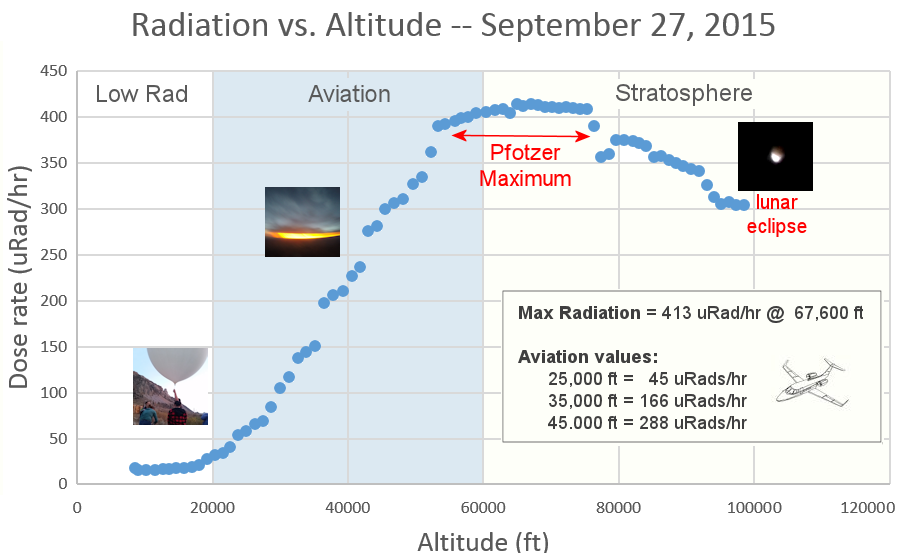
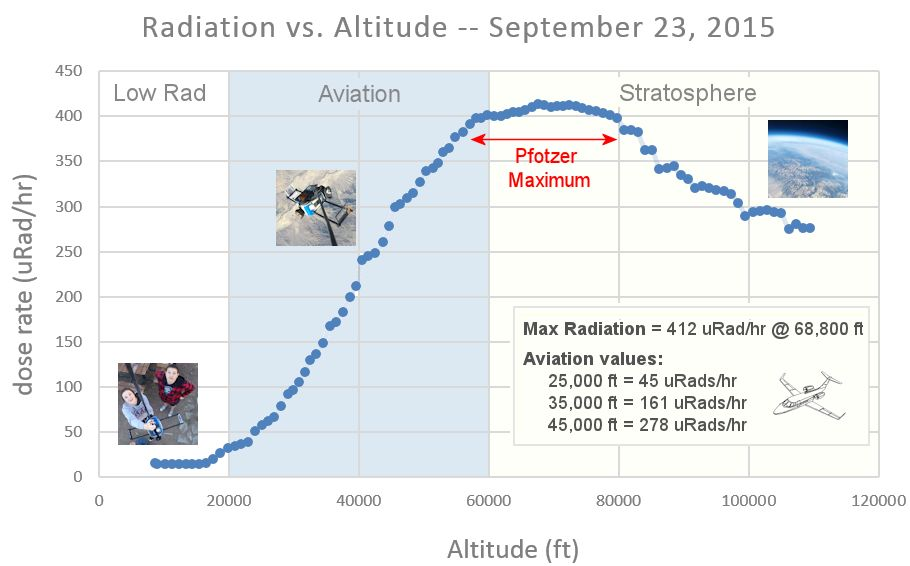
On the evening of Sept. 27th, Spaceweather.com and the students of Earth to Sky Calculus conducted a routine flight of their cosmic ray payload to the stratosphere. Routine, that is, except for one thing: the balloon flew at night during a lunar eclipse. One of the goals of the flight was to compare radiation levels at night to those recorded during the day. Here are the data they recorded:

Compare this plot of radiation vs. altitude to a similar plot recorded in broad daylight only a few days earlier. They are almost identical. Radiation levels in the stratosphere matched at the 1% level. Radiation levels at aviation altitudes (where planes fly) agreed within about 3%. Night and day were the same.

This simple experiment highlights something that is already well known to researchers. Cosmic rays in Earth’s atmosphere come mainly from deep space. They are accelerated toward Earth by supernovas, colliding neutron stars, and other violent events in the Milky Way. Flying at night is no safeguard against these energetic particles because they are ever-present, coming at us from all directions, day and night.

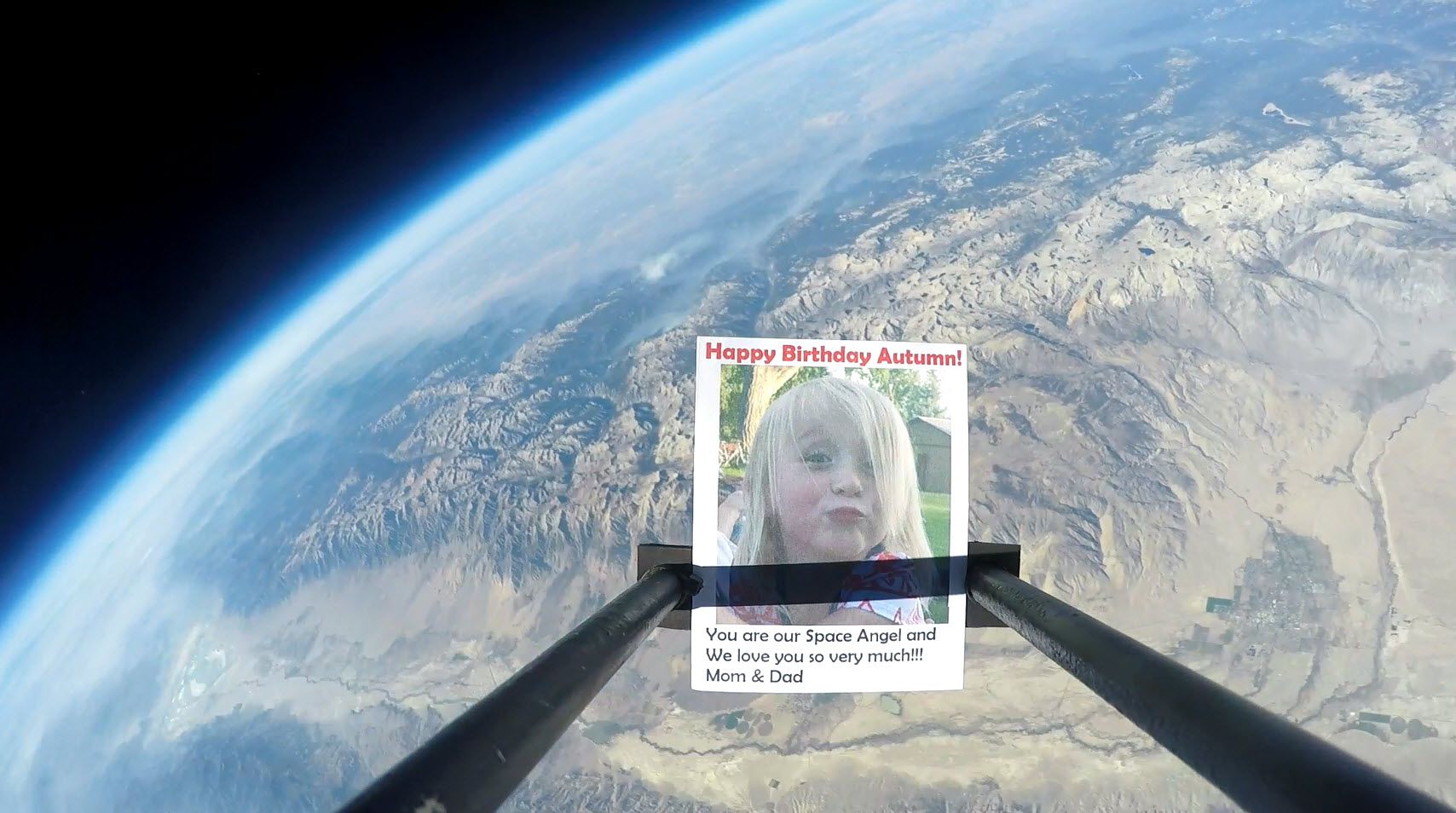
HEY THANKS (and Happy Birthday): The lunar eclipse flight was sponsored by Spaceweather.com reader JR Biggs, whose donation of $500 paid for the supplies neccesary to get the balloon off the ground. To say “thank you” for his contribution, we flew a birthday card for his daughter to the edge of space:

Happy Birthday to Autumn! She enjoyed watching a complete video of the flight when she turned 4 on Oct. 10th.

Readers, if you would like to support a research flight and send your birthday card, business logo, or other photo along for the ride, it only costs $500. Contact Dr. Tony Phillips to make arrangements.

Did Radiation Kill the Martian?

by Dr. Tony Phillips (This article originally appeared on Spaceweather.com)

Spoiler alert: Stop reading now if you haven’t yet seen The Martian.

The #1 movie in theaters right now is The Martian, a film adaptation of Andy Weir’s eponymous book. It tells the heart-pounding story of fictional astronaut Mark Watney, who is stranded on Mars and ultimately rescued by the crewmates who had inadvertently left him behind. To survive long enough to be rescued, Watney has to “science the hell out of” a very tricky situation: he grows food in alien soil, extracts water from rocket fuel, dodges Martian dust storms, and sends signals to NASA using an old Mars rover that had been buried in red sand for some 30 years.

It’s a thrilling adventure told with considerable accuracy—except, perhaps, for one thing. “While Andy Weir does a good job of representing the risks faced by Mark Watney stranded on Mars, he is silent on the threat of radiation, not just to Mark but particularly to the crew of the Hermes as they execute a daring rescue mission that more than doubles their time in deep space,” says Dr. Ron Turner, Distinguished Analyst at ANSER, a public-service research institute in Virginia.

Space radiation comes from two main sources: solar storms and galactic cosmic rays. Solar storms are intense, short-lived, and infrequent. Fortunately for Mark, there weren’t any during his mission. He dodged that bullet. However, he and his crewmates could not have avoided cosmic rays. These are high-energy particles that arise from supernovas, colliding neutron stars, and other violent events happening all the time in the Milky Way. They are ever-present, 24/7, and there is no way to avoid them. So far, NASA has developed no effective shield against these sub-atomic cannon balls from deep space. “Doubling a nominal spacecraft shielding thickness only reduces the GCR [galactic cosmic rays] exposure by a few percent,” notes Turner.

In the movie, Watney is actually safer than the crew of the Hermes. Turner explains: “The radiation exposure is significantly less on the surface of Mars. For one thing, the planet beneath your feet reduces your exposure by half. The atmosphere, while thin, further reduces the dose. The dose rate on Mars, while high, is only about 1/3rd of that on the Hermes.”

The biggest threat from cosmic radiation exposure is the possibility of dying from radiation-induced cancer sometime after a safe return to Earth. NASA’s radiation limits today are set to limit this life-shortening risk to less than three percent. Taking into account many factors, such as the phase of the solar cycle and the number of days the crew spent in deep space and on the surface of Mars, Turner has calculated the total dose of cosmic rays absorbed by Watney (41 cSv) and the crew (72 cSv). “cSV” is a centi-Seivert, a unit of radiation commonly used in discussion of human dose rates.

There is considerable uncertainty in how these doses translate into an increased risk of cancer. Turner estimates the added risk to Watney as somewhere between 0.25% and 3.25%. For members of the crew, the added risk ranges from 0.48% to 7.6%. The high end of these ranges are well outside NASA safety limits. The crew especially could be facing medical problems after their homecoming.

Post-flight cancer is not the only problem, however. “There is some additional concern that sustained radiation exposure could lead to other problems that manifest during the mission, instead of years afterward. Possible examples include heart disease, reduced immune system effectiveness, and neurological effects mimicking the symptoms of Alzheimer disease.”

As far as we can tell, none of these things happened to the crew of the Hermes. It’s just as well. They had enough trouble without cosmic rays. For the complete details of Turner’s analysis CLICK HERE (pdf).