Planets in a Bottle –Lesson Plan

This is a prototype lesson plan for “Planet in a Bottle” yeast experiments .

Objective: The student will measure the viability of yeast samples and explore environmental conditions which affect the health of yeast microbes. The yeast samples may be common store-bought Baker’s yeast, or more exotic forms which have been exposed to extreme environments as part of the Earth to Sky balloon program.

Overview: Students mix yeast with a nutrient broth consisting of warm water and table sugar in a plastic water bottle. A common 9 inch party balloon is used to cap the bottle. As yeast digest the sugar they produce carbon dioxide and inflate the balloon. A healthy 1/4 oz sample of baker’s yeast can inflate a balloon to 12 inch circumference in less than 30 minutes. Simple variations of this experiment may be used to discover environmental factors that inhibit or promote the health of the yeast colony. Students can compare these factors to conditions on other planets. ingredients for a Planet in a Bottle

Materials:

  • 1 cup lukewarm water
  • 3 cubes sugar
  • 1 quarter-oz package of yeast
  • 1 empty half-liter plastic water bottle
  • 1 nine or ten inch party balloon
  • 1 cloth measuring tape
  • 1 small funnel (optional)

Procedure:

  1. Mix water + sugar in water bottle until the cubes are dissolved.
  2. Using the funnel add yeast, the gently swirl the mixture.
  3. Cap the bottle with a balloon.
  4. Use the cloth measuring tape to measure the circumference of the balloon every 15 minutes.

a healthy yeast sample inflates a balloon with carbon dioxide This basic recipe can be considered an “Earth in a Bottle.” It is a warm, healthy environment for yeast with plenty of nutrients. The total amount of CO2 in the balloon when it reaches its greatest volume is proportional to the number of healthy yeast microbes present in the initial sample. For the procedure outlined above, the balloon will achieve its maximum volume less than two hours after the yeast are added to the nutrient mix.

The rate at which the balloon inflates is proportional to the growth rate of the yeast colony. After the yeast are added to the nutrient broth they begin to divide and increase in number. As the colony size increases so does the rate of CO2 production, so long as there is an ample supply of nutrients. If the environment inside the bottle is conducive to yeast growth, the maximum rate of CO2 production will be high. Conversely, if the environment is hostile to yeast, the maximum rate of CO2 production will be low.

Students can begin to explore conditions on other planets with simple variations to the basic recipe. Although we cannot create truly accurate extraterrestrial conditions in a water bottle, there are many simple variations that are representative of conditions on other planets. A few examples are listed below:

Example variations:

  • Mercury — Mercury’s surface is very hot. Mercury in a Bottle: Boil the water before adding sugar and yeast.
  • Venus — Venus is very hot, and has an acidic atmosphere. Venus in a Bottle: Instead of water and sugar, use scalding hot orange juice as a nutrient mix. Citric acid in the juice represents sulfuric acid in Venus’s hot atmosphere. Lemon juice or vinegar can also be used to increase the acidity of the nutrient mix. Venus’s atmosphere also has a high pressure, so that the simulation can be made more realistic by heating the nutrient mix in a pressure cooker.
  • Students monitor yeast growthThe Moon — The moon has no atmosphere, so that yeast on its surface would be exposed to a strong vacuum and solar radiation. Moon in a Bottle: Expose the yeast to a vacuum, using a hand pump bell jar, and to radiation in a microwave oven and/or from a UV lamp.
  • Mars — Mars is cold and has a thin atmosphere which allows much solar UV radiation to penetrate to its surface. Mars in a Bottle: freeze the yeast, then expose the microbes to ultraviolet radiation from a UV lamp before adding yeast to the nutrient mix.  Note:  Flying the yeast to the stratosphere on an Earth to Sky research balloon gives the yeast a very Mars-like experience.
  • Europa — this moon of Jupiter may harbor the largest ocean in the solar system. The icy surface is a combination of pure water ice, Epsom salts, and unknown minerals. Europa in a Bottle: Freeze a briny mixture of water and Epsom salt. Break the ice into chips and mix the salty ice chips with a cold nutrient solution.
  • Callisto — this moon of Jupiter may have a salty ocean beneath its frozen crust. Callisto in a Bottle: Add common table salt or Epsom salts to the nutrient mix to simulate a salty environment.
  • Pluto — Pluto is the most distant planet from the sun and is very cold. Pluto in a Bottle: freeze the yeast in a deep freezer before adding to the nutrient mix.
Growing Peril for Astronauts?

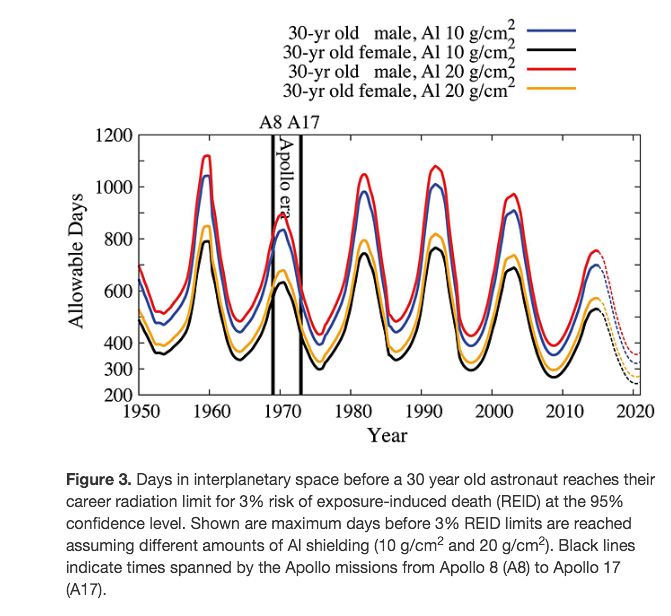
NASA’s successful test flight of Orion on Dec. 5th heralds a renewed capability to send astronauts into deep space. A paper just published in the journal Space Weather, however, points out a growing peril to future deep space explorers: cosmic rays. The title of the article, penned by Nathan Schwadron of the University of New Hampshire and colleagues from seven other institutions, asks the provocative question, “Does the worsening galactic cosmic ray environment preclude manned deep space exploration?” Using data from a cosmic ray telescope onboard NASA’s Lunar Reconnaissance Orbiter, they conclude that while increasing fluxes of cosmic rays “are not a show stopper for long duration missions (e.g., to the Moon, an asteroid, or Mars), galactic cosmic radiation remains a significant and worsening factor that limits mission durations.” This figure from their paper shows the number of days a 30 year old astronaut can spend in interplanetary space before they reach their career limit in radiation exposure:

According to the plot, in the year 2014, a 30 year old male flying in a spaceship with 10 g/cm2 of aluminum shielding could spend approximately 700 days in deep space before they reach their radiation dose limit. The same astronaut in the early 1990s could have spent 1000 days in space.

What’s going on? Cosmic rays are intensifying. Galactic cosmic rays are a mixture of high-energy photons and subatomic particles accelerated to near-light speed by violent events such as supernova explosions. Astronauts are protected from cosmic rays in part by the sun: solar magnetic fields and the solar wind combine to create a porous ‘shield’ that fends off energetic particles from outside the solar system. The problem is, as the authors note, “The sun and its solar wind are currently exhibiting extremely low densities and magnetic field strengths, representing states that have never been observed during the Space Age. As a result of the remarkably weak solar activity, we have also observed the highest fluxes of cosmic rays in the Space Age.”

The shielding action of the sun is strongest during solar maximum and weakest during solar minimum–hence the 11-year rhythm of the mission duration plot. At the moment we are experiencing Solar Max, which should be a good time for astronauts to fly–but it’s not a good time. The solar maximum of 2011-2014 is the weakest in a century, allowing unusual numbers of cosmic rays to penetrate the solar system.

This situation could become even worse if, as some researchers suspect, the sun is entering a long-term phase of the solar cycle characterized by relatively weak maxima and deep, extended minima. In such a future, feeble solar magnetic fields would do an extra-poor job keeping cosmic rays at bay, further reducing the number of days astronauts can travel far from Earth.

To learn more about this interesting research, read the complete article in the online edition of Space Weather.

Solar Eclipse in the Stratosphere

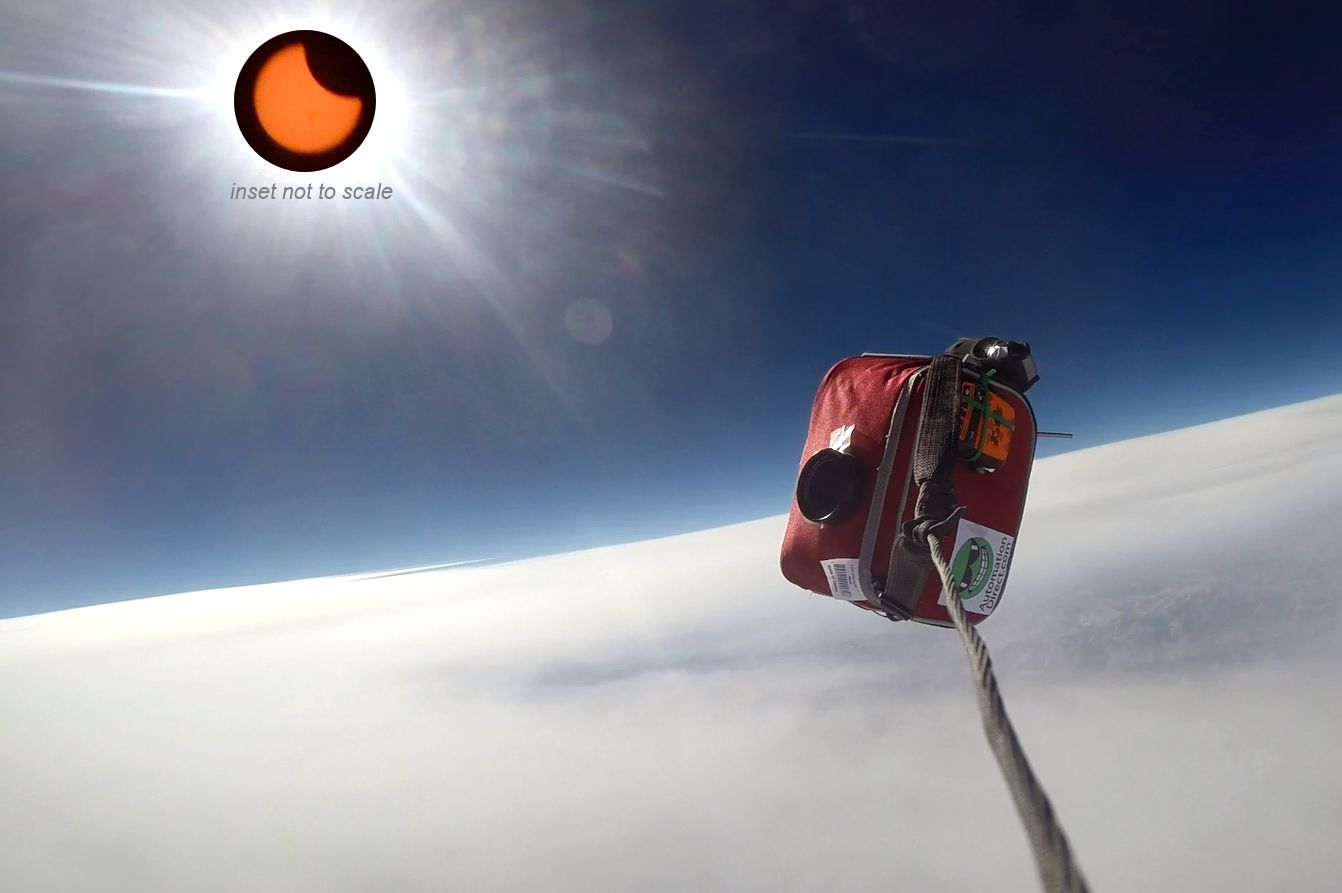
On Oct. 23rd, 2014, just as the New Moon was about to pass in front of the sun, the students of Earth to Sky Calculus launched a helium balloon carrying a Nikon D7000 camera. Their goal: to set the record for high-altitude photography of an eclipse. During a two-hour flight to the edge of space, the camera captured 11 images of the crescent sun. The final picture, taken just a split second before the balloon exploded, was GPS-tagged with an altitude of 108,900 feet:

To put this achievement into context, consider the following: Most people who photographed the eclipse carefully mounted their cameras on a rock-solid tripod, or used the precision clock-drive of a telescope to track the sun. The students, however, managed the same trick from an un-stabilized platform, spinning, buffeted by wind, and racing upward to the heavens at 15 mph. Their photos show that DLSR astrophotography from an suborbital helium balloon is possible, and they will surely refine their techniques for even better photos in the future.

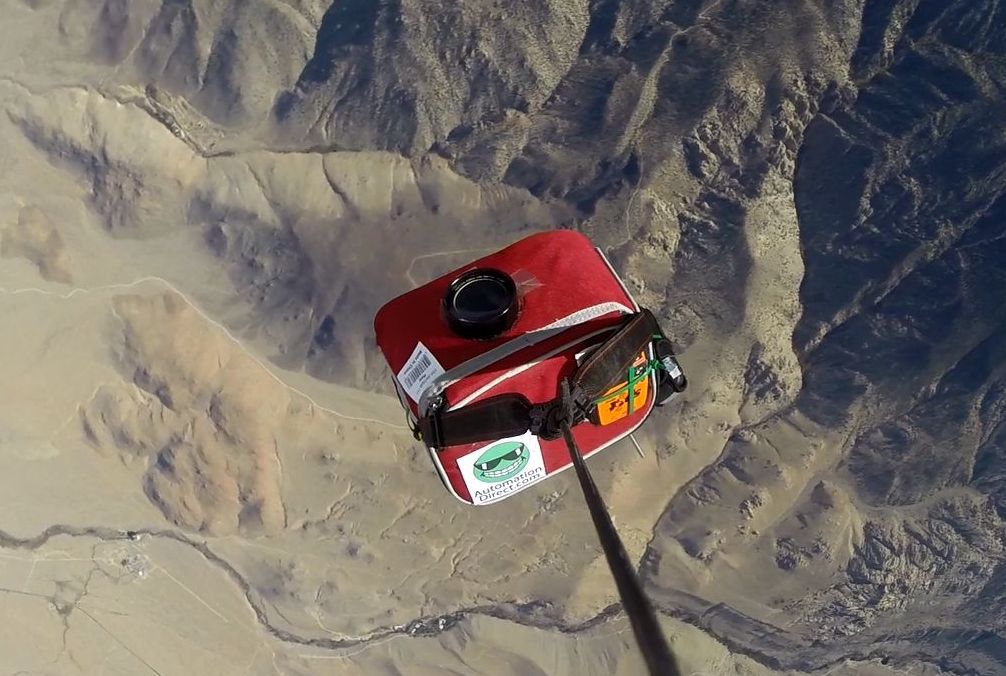
Hey thanks! The students wish to thank AutomationDirect.com for sponsoring this flight. Their $500 contribution paid for the helium and other supplies necessary to get the balloon off the ground. Note the Automation Direct logo in this picture of the payload ascending over the Sierra Nevada mountains of central California:

Another notable picture shows the payload ascending over clouds, which blocked the eclipse at ground level but did not prevent photography from the balloon.

Readers, would you like to sponsor a student research flight and have your logo photographed at the edge of space? Contact Dr. Tony Phillips to get involved.

Electric Hurricanes

by Dr. Tony Phillips (this article originally appeared in Science@NASA)

January 9, 2006: The boom of thunder and crackle of lightning generally mean one thing: a storm is coming. Curiously, though, the biggest storms of all, hurricanes, are notoriously lacking in lightning. Hurricanes blow, they rain, they flood, but seldom do they crackle.

Surprise: During the record-setting hurricane season of 2005 three of the most powerful storms–Rita, Katrina, and Emily–did have lightning, lots of it. And researchers would like to know why.

https://smd-prod.s3.amazonaws.com/science-green/s3fs-public/mnt/medialibrary/2006/01/09/09jan_electrichurricanes_resources/flightpath.jpg
Above:
An infrared GOES 11 satellite image of Hurricane Emily. Yellow + and – symbols mark lightning bolts detected by the North American Lightning Detection Network. The green line traces the path of the ER-2. Click to view electric fields measured by the aircraft during the flight.

Richard Blakeslee of the Global Hydrology and Climate Center (GHCC) in Huntsville, Alabama, was one of a team of scientists who explored Hurricane Emily using NASA’s ER-2 aircraft, a research version of the famous U-2 spy plane. Flying high above the storm, they noted frequent lightning in the cylindrical wall of clouds surrounding the hurricane’s eye. Both cloud-to-cloud and cloud-to-ground lightning were present, “a few flashes per minute,” says Blakeslee.

“Generally there’s not a lot of lightning in the eye-wall region,” he says. “So when people see lightning there, they perk up — they say, okay, something’s happening.”

Indeed, the electric fields above Emily were among the strongest ever measured by the aircraft’s sensors over any storm. “We observed steady fields in excess of 8 kilovolts per meter,” says Blakeslee. “That is huge–comparable to the strongest fields we would expect to find over a large land-based ‘mesoscale’ thunderstorm.”

see caption
Above:
The ER-2 en route to a hurricane. [More]

The flight over Emily was part of a 30-day science data-gathering campaign in July 2005 organized and sponsored by NASA headquarters to improve scientists’ understanding of hurricanes. Blakeslee and others from NASA, NOAA and 10 U.S. universities traveled to Costa Rica for the campaign, which is called “Tropical Cloud Systems and Processes.” From the international airport near San Jose, the capital of Costa Rica, they could fly the ER-2 to storms in both the Caribbean and the eastern Pacific Ocean. They combined ER-2 data with data from satellites and ground-based sensors to get a comprehensive view of each storm.

Rita and Katrina were not part of the campaign. Lightning in those storms was detected by means of long-distance sensors on the ground, not the ER-2, so less is known about their electric fields.

Nevertheless, it is possible to note some similarities: (1) all three storms were powerful: Emily was a Category 4 storm, Rita and Katrina were Category 5; (2) all three were over water when their lightning was detected; and (3) in each case, the lightning was located around the eye-wall.

What does it all mean? The answer could teach scientists something new about the inner workings of hurricanes.

Actually, says Blakeslee, the reason most hurricanes don’t have lightning is understood. “They’re missing a key ingredient: vertical winds.”

Within thunderclouds, vertical winds cause ice crystals and water droplets (called “hydrometeors”) to bump together. This “rubbing” causes the hydrometeors to become charged. Think of rubbing your socked feet across wool carpet–zap! It’s the same principle. For reasons not fully understood, positive electric charge accumulates on smaller particles while negative charge clings to the larger ones. Winds and gravity separate the charged hydrometeors, producing an enormous electric field within the storm. This is the source of lightning.

A hurricane’s winds are mostly horizontal, not vertical. So the vertical churning that leads to lightning doesn’t normally happen.

Lightning has been seen in hurricanes before. During a field campaign in 1998 called CAMEX-3, scientists detected lightning in the eye of hurricane Georges as it plowed over the Caribbean island of Hispaniola. The lightning probably was due to air forced upward — called “orographic forcing” — when the hurricane hit the mountains.

“Hurricanes are most likely to produce lightning when they’re making landfall,” says Blakeslee. But there were no mountains beneath the “electric hurricanes” of 2005—only flat water.

It’s tempting to think that, because Emily, Rita and Katrina were all exceptionally powerful, their sheer violence somehow explains their lightning. But Blakeslee says that this explanation is too simple. “Other storms have been equally intense and did not produce much lightning,” he says. “There must be something else at work.”

It’s too soon to say for certain what that missing factor is. Scientists will need months to digest reams of data gathered in this year’s campaign before they can hope to have an answer.

Says Blakeslee, “We still have a lot to learn about hurricanes.”


Rainbows on Titan

see captionFebruary 25, 2005: When the European Space Agency’s Huygens probe visited Saturn’s moon Titan last month, the probe parachuted through humid clouds. It photographed river channels and beaches and things that look like islands. Finally, descending through swirling fog, Huygens landed in mud.

To make a long story short, Titan is wet.

Right: River channels and a shoreline on Titan. Credit: ESA Huygens probe. [more]

Christian Huygens wouldn’t have been a bit surprised. In 1698, three hundred years before the Huygens probe left Earth, the Dutch astronomer wrote these words:

“Since ’tis certain that Earth and Jupiter have their Water and Clouds, there is no reason why the other Planets should be without them. I can’t say that they are exactly of the same nature with our Water; but that they should be liquid their use requires, as their beauty does that they be clear. This Water of ours, in Jupiter or Saturn, would be frozen up instantly by reason of the vast distance of the Sun. Every Planet therefore must have its own Waters of such a temper not liable to Frost.”

Huygens discovered Titan in 1655, which is why the probe is named after him. In those days, Titan was just a pinprick of light in a telescope. Huygens could not see Titan’s clouds, pregnant with rain, or Titan’s hillsides, sculpted by rushing liquids, but he had a fine imagination.

Titan’s “water” is liquid methane, CH4, better known on Earth as natural gas. Regular Earth-water, H2O, would be frozen solid on Titan where the surface temperature is 290o F below zero. Methane, on the other hand, is a flowing liquid, of “a temper not liable to Frost.

Jonathan Lunine, a professor at the University of Arizona, is a member of the Huygens mission science team. He and his colleagues believe that Huygens landed in the Titan-equivalent of Arizona, a mostly-dry area with brief but intense wet seasons.

“The river channels near the Huygens probe look empty now,” says Lunine, but liquids have been there recently, he believes. Little rocks strewn around the landing site are compelling: they’re smooth and round like river rocks on Earth, and “they sit in little depressions dug, apparently, by rushing fluids.”

The source of all this wetness might be rain. Titan’s atmosphere is “humid,” meaning rich in methane. No one knows how often it rains, “but when it does,” says Lunine, “the amount of vapor in the atmosphere is many times that in Earth’s atmosphere, so you could get very intense showers.”

And maybe rainbows, too. “The ingredients you need for a rainbow are sunlight and raindrops. Titan has both,” says atmospheric optics expert Les Cowley.

see captionLeft: Sunlight + raindrops = rainbows. [more]

On Earth, rainbows form when sunlight bounces in and out of transparent water droplets. Each droplet acts like a prism, spreading light into the familiar spectrum of colors. On Titan, rainbows would form when sunlight bounces in and out of methane droplets, which, like water droplets, are transparent.

Their beauty [requires] that they be clear….”

“A methane rainbow would be larger than a water rainbow,” notes Cowley, “with a primary radius of at least 49o for methane vs 42.5o for water. This is because the index of refraction of liquid methane (1.29) differs from that of water (1.33).” The order of colors, however, would be the same: blue on the inside and red on the outside, with an overall hint of orange caused by Titan’s orange sky.

One problem: Rainbows need direct sunlight, but Titan’s skies are very hazy. “Visible rainbows on Titan might be rare,” says Cowley. On the other hand, infrared rainbows might be common.

Atmospheric scientist Bob West of NASA’s Jet Propulsion Laboratory explains: “Titan’s atmosphere is mostly clear at infrared wavelengths. That’s why the Cassini spacecraft uses an infrared camera to photograph Titan.” Infrared sunbeams would have little trouble penetrating the murky air and making rainbows. The best way to see them: infrared “night vision” goggles.

Below: An infrared rainbow on Earth, photographed by Prof. Robert Greenler. Reference: Science 173,1231 (1971). “A rainbow on Titan might look like this,” notes Les Cowley. “It would be larger than the visible methane ‘bow’ with a radius slightly more than 49-52 degrees.”

see caption

All this talk of rain and rainbows and mud makes liquid methane sound a lot like ordinary water. It’s not. Consider the following:

The density of liquid methane is only about half the density of water. This is something, say, a boat builder on Titan would need to take into account. Boats float when they’re less dense than the liquid beneath them. A Titan-boat would need to be extra lightweight to float in a liquid methane sea. (It’s not as crazy as it sounds. Future explorers will want to visit Titan and boats could be a good way to get around.)

Liquid methane also has low viscosity (or “gooiness”) and low surface tension. See the table below. Surface tension is what gives water its rubbery skin and, on Earth, lets water bugs skitter across ponds. A water bug on Titan would promptly sink into a pond of flimsy methane. On the bright side, Titan’s low gravity, only one-seventh Earth gravity, might allow the creature climb back out again.

Physical Data: Liquid methane vs liquid water

liquid water
liquid methane
methane/water
ref.
density
1 g/cc
0.45 g/cc
0.45
surface tension
70 dyne/cm

17 dyne/cm

0.24

#2

viscosity
1.54 cP
0.184 cP
0.12
index of refraction
1.33
1.286
0.97

Sources: (#1) NIST Chemistry Webbook. Reference temperature: 40o F for water, -290o F for methane. Reference pressure 1.5 atm; (#2) AIChE Journal, Volume 42, No. 5, pp. 1425-1433, May 1996; (#3) Les Cowley.

Back to boats: Propellers turning in methane would need to be extra-wide to “grab” enough of the thin fluid for propulsion. They’d also have to be made of special materials resistant to cracking at cryogenic temperatures.

And watch out for those waves! European scientists John Zarnecki and Nadeem Ghafoor have calculated what methane waves on Titan might be like: seven times taller than typical Earth-waves (mainly because of Titan’s low gravity) and three times slower, “giving surfers a wild ride,” says Ghafoor.

Last but not least, liquid methane is flammable. Titan doesn’t catch fire because the atmosphere contains so little oxygen–a key ingredient for combustion. If explorers visit Titan one day they’ll have to be careful with their oxygen tanks and resist the urge to douse fires with “water.”

Infrared rainbows, towering waves, seas beckoning to sailors. Huygens saw none of these things before it plopped down in the mud. Do they really exist?

“…there is no reason why the other Planets should be without them.”