Rads on a Plane

by Dr. Tony Phillips (This article originally appeared on Spaceweather.com)

05 Nov. 2015: Spaceweather.com and the students of Earth to Sky Calculus regularly fly helium balloons to the stratosphere to measure cosmic rays. For the past six months, May through Oct. 2015, they have been taking their radiation sensors onboard commercial airplanes, too. The chart below summarizes their measurements on 18 different airplanes flying back and forth across the continental United States.

The points on the graph indicate the dose rate of cosmic rays inside the airplanes compared to sea level. For instance, the dose rate for flights that cruised at 40,000+ feet was more than 50 times higher than the dose rate on the ground below. No wonder the International Commission on Radiological Protection (ICRP) classifies pilots as occupational radiation workers.

Cosmic rays come from deep space. They are high energy particles accelerated toward Earth by distant explosions such as supernovas and colliding neutron stars. Astronauts aren’t the only ones who have to think about them; flyers do, too. Cosmic rays penetrate deep inside Earth’s atmosphere where airplanes travel every day.

Our radiation sensors detect X-rays and gamma-rays in the energy range 10 keV to 20 MeV. These energies span the range of medical X-ray machines and airport security scanners.

Cosmic Rays are modulated by solar activity. Solar storms and CMEs tend to sweep aside cosmic rays, making it more difficult for cosmic rays to reach Earth. Low solar activity, on the other hand, allows an extra dose of cosmic rays to reach our planet. This is important because forecasters expect solar activity to drop sharply in the years ahead as we approach a new Solar Minimum. Cosmic rays are poised to increase accordingly.

The plot, above, tells us what is “normal” in 2015. How will it change as the solar cycle wanes? Stay tuned for regular updates.

Space Weather Ballooning — Results from Oct. 11, 2015

by Dr. Tony Phillips (this article originally appeared on Spaceweather.com)

Approximately once a week, Spaceweather.com and the students of Earth to Sky Calculus fly “space weather balloons” to the stratosphere over California. These balloons are equipped with radiation sensors that detect cosmic rays, a surprisingly “down to Earth” form of space weather. Cosmic rays can seed clouds, trigger lightning, and penetrate commercial airplanes. Our measurements show that someone flying back and forth across the continental USA, just once, can absorb as much ionizing radiation as 2 to 5 dental X-rays. Here is the data from our latest flight, Oct. 11th:

Radiation levels peak at the entrance to the stratosphere in a broad region called the “Pfotzer Maximum.” This peak is named after physicist George Pfotzer who discovered it using balloons and Geiger tubes in the 1930s. Radiation levels there are more than 80x sea level.

Note that the bottom of the Pfotzer Maximim is near 55,000 ft. This means that some high-flying aircraft are not far from the zone of maximum radiation. Indeed, according to the Oct 11th measurements, a plane flying at 45,000 feet is exposed to 2.77 uSv/hr. At that rate, a passenger would absorb about one dental X-ray’s worth of radiation in about 5 hours.

The radiation sensors onboard our helium balloons detect X-rays and gamma-rays in the energy range 10 keV to 20 MeV. These energies span the range of medical X-ray machines and airport security scanners.

Oct. 11, 2015, Balloon Flight Photo Gallery

Hey thanks! The cosmic ray research described above is 100% crowd-funded. Our Oct. 11th balloon flight was made possible by a generous donation of $500 from Spaceweather.com reader Vicki Brown. To say thanks, we flew Vicki’s parents, Betty and Earl, to the edge of space:

“I am so happy to help the young scientists, and it is cool to see my folks in the stratosphere!” says Vicki.

Readers, have you ever wanted to send a loved one to the stratosphere? You can make it happen by sponsoring a cosmic ray research flight. Contact Dr. Tony Phillips for details.

Space Weather Ballooning — Results from the Lunar Eclipse

by Dr. Tony Phillips

27 Sept. 2015: Once a week, and sometimes more often, Spaceweather.com and the students of Earth to Sky Calculus fly “space weather balloons” to the stratosphere. These balloons are equipped with radiation sensors that detect cosmic rays, a form of space weather important to people on Earth. Cosmic rays can alter the chemistry of the upper atmosphere, seed clouds, spark exotic forms of lightning, and penetrate commercial airplanes. This last point is of special interest to the traveling public. Our measurements show that someone flying back and forth across the continental USA, just once, can absorb as much ionizing radiation as 2 to 5 dental X-rays.

Here is an example of our data from a typical balloon flight:

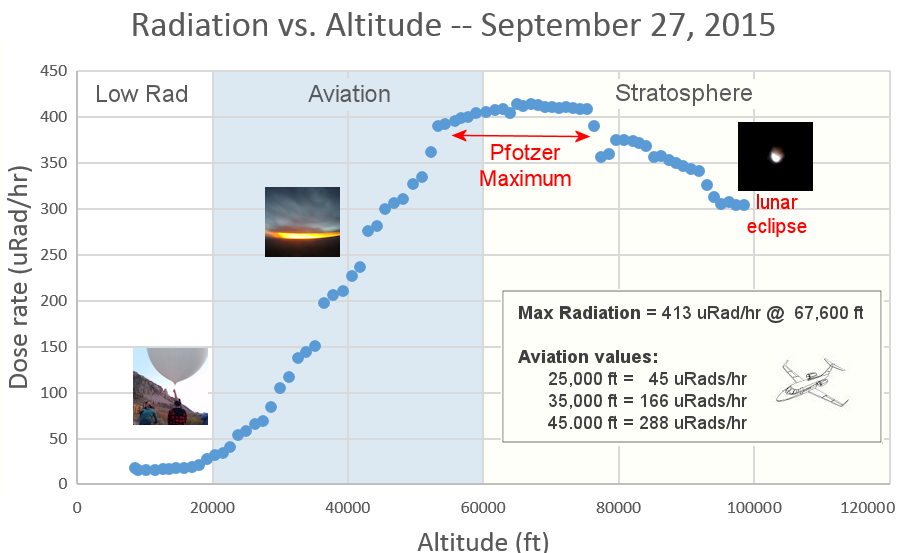
This radiation profile was obtained on the evening of Sept. 27, 2015–incidentally, during a total eclipse of the Moon.  The altitude of the balloon is on the horizontal axis, radiation dose rates are on the vertical axis. Inset photos show scenes from the mission.

Radiation levels peak at the entrance to the stratosphere in a broad region called the “Pfotzer Maximum.” This peak is named after physicist George Pfotzer who discovered it using balloons and Geiger tubes in the 1930s. Radiation levels there are nearly 100x sea level.

Note that the bottom of the Pfotzer Maximim is near 55,000 ft. This means that some high-flying aircraft are not far from the zone of maximum radiation. Indeed, according to the Sept. 27th measurements, a plane flying at 45,000 feet is exposed to 288 uRads/hr. At that rate, a passenger would absorb about one dental X-ray’s worth of radiation in 5 hours.

The radiation sensors onboard our helium balloons detect X-rays and gamma-rays in the energy range 10 keV to 20 MeV. These energies span the range of medical X-ray machines and airport security scanners.

The Richter Scale of Solar Flares

by Dr. Tony Phillips (Spaceweather.com)

A solar flare is an explosion on the Sun that happens when energy stored in twisted magnetic fields (usually above sunspots) is suddenly released. Flares produce a burst of radiation across the electromagnetic spectrum, from radio waves to x-rays and gamma-rays.

Scientists classify solar flares according to their x-ray brightness in the wavelength range 1 to 8 Angstroms. There are 3 categories: X-class flares are big; they are major events that can trigger planet-wide radio blackouts and long-lasting radiation storms. M-class flares are medium-sized; they can cause brief radio blackouts that affect Earth’s polar regions. Minor radiation storms sometimes follow an M-class flare. Compared to X- and M-class events, C-class flares are small with few noticeable consequences here on Earth.

This figure shows a series of solar flares detected by NOAA satellites in July 2000:


Each category for x-ray flares has nine subdivisions ranging from, e.g., C1 to C9, M1 to M9, and X1 to X9. In this figure, the three indicated flares registered (from left to right) X2, M5, and X6. The X6 flare triggered a radiation storm around Earth nicknamed the Bastille Day event.

 Class
Peak (W/m2)between 1 and 8 Angstroms
 B  I < 10-6
 C  10-6 < = I < 10-5
 M  10-5 < = I < 10-4
 X  I > = 10-4

Return to Spaceweather.com

Rads on a Plane: Hot Seats in First Class

by Dr. Tony Phillips (Spaceweather.com)

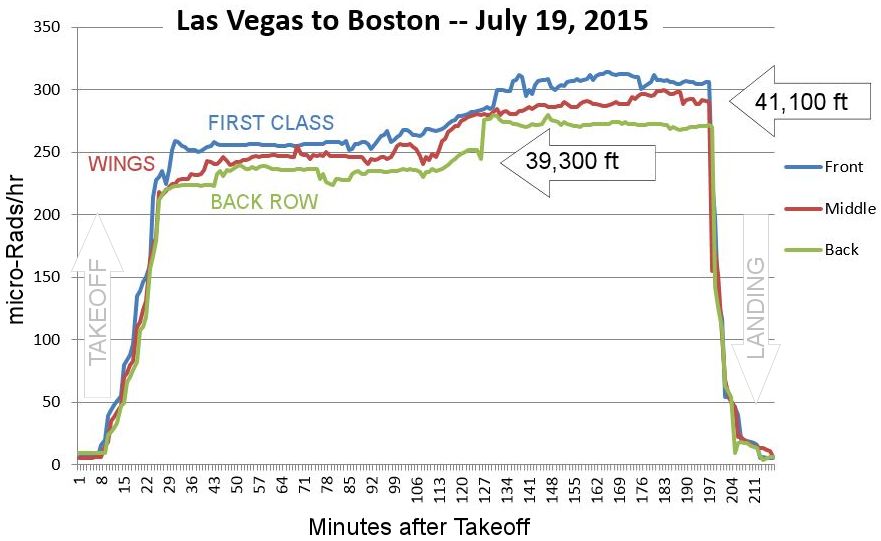
July 30, 2015 — Many people think that only astronauts have to worry about cosmic radiation. Not so. Regular air travelers are exposed to cosmic rays, too. This week, Spaceweather.com’s Dr. Tony Phillips and the students of Earth to Sky Calculus flew across the United States to conduct a transcontinental launch of space weather balloons. They took radiation sensors on board the plane to find out how many cosmic rays they would absorb during the flight. Here are the data they collected flying east:

Radiation levels in the cabin of the Airbus 319 (Spirit Airlines flight 640) tripled within ten minutes after takeoff, and were nearly 30 times ground level by the time the plane reached cruising altitude at 39,300 feet. Summing over the entire flight, the sensors measured about 1 mrem of radiation–similar to a dental x-ray.

There was no solar storm in progress. The extra radiation was just a regular drizzle of cosmic rays reaching down to aviation altitudes. This radiation is ever-present and comes from supernovas, black holes, and other sources across the galaxy.

The Earth to Sky team consisted of five people who sat in three different locations: First Class, over the wings, and in the back row. Would they all absorb the same dose? No. On this particular flight, dose rates were highest in First Class and lowest near the toilets in the rear. The front-to-back ratio was as high as 13%. This gradient is not understood; presumably, it has to do with the way cosmic rays interact with the plane’s fuselage and fuel tanks.

Five days later, following a successful Transcontinental Balloon Launch, the team flew back to the west coast. Once again they flew on an Airbus 319 (Spirit Airlines flight 641), non-stop from Boston to Las Vegas. The results were similar:

As before, the First Class seats registered the highest dose of radiation–as much as 6% higher than the wings and rear of the plane. On this flight we added a second radiation sensor to First Class to confirm the effect. Both sensors agreed: ionizing radiation was slightly higher in the front of the plane.

Because cosmic rays come from space, radiation inside the airplane grows stronger as the airplane ascends. This plot shows how the dose rate changed as a function of altitude throughout the July 23rd flight:

Note how radiation levels remain low at altitudes below ~15,000 ft. Earth’s atmosphere does a good job shielding those altitudes from cosmic rays. Above 15,000 ft, however, dose rates climb rapidly as the plane ascends.

The radiation sensors are the same ones that Earth to Sky Calculus routinely flies onboard helium balloons to measure cosmic rays in the stratosphere. They detect X-rays and gamma-rays in the energy range 10 keV to 20 MeV. These energies span the range of medical X-ray machines and airport security scanners.

Neutron Bubble Chamber in the Stratosphere

June 23, 2015: For nearly two years, Spaceweather.com and the students of Earth to Sky Calculus have been using helium balloons to monitor X-rays and gamma-rays in the stratosphere. Their successful program has detected multiple radiation events in response to solar storms. On June 18th they added something new. For the first time, the group’s Space Weather Payload included a bubble chamber for measuring neutrons. The device flew 109,012 feet above California’s Sierra Nevada mountain range, then parachuted back to Earth, landing near Death Valley National Park. The results: Neutrons were detected.

Circled above are some of the bubbles that formed as neutrons passed through the chamber. By counting the bubbles, it is possible to estimate the total dose of neutron radiation absorbed during the 3 hour flight. The answer is 600 microRads (energy range 200 keV – 15 MeV). Interestingly, this is almost the same dose detected by onboard X-ray and gamma-ray sensors: 620 microRads (energy range 10 keV to 20 MeV). Lesson: if you only count X-rays and gamma-rays, then you are missing at least half of the radiation in the atmosphere. Neutrons matter, too.

Indeed, neutrons are a very important form of cosmic radiation, providing much of the biologically effective radiation dose at altitudes of interest to aviation and space tourism.  Low-energy neutrons also cause single-event upsets in aircraft avionics, especially devices that contain Boron 10. Adding a neutron sensor to the Space Weather Payload allows the students to monitor this type of radiation at altitudes ranging from ground level to 120,000 feet.


Noctilucent Cloud Season Begins (May 2015)

by Dr. Tony Phillips (Spaceweather.com)

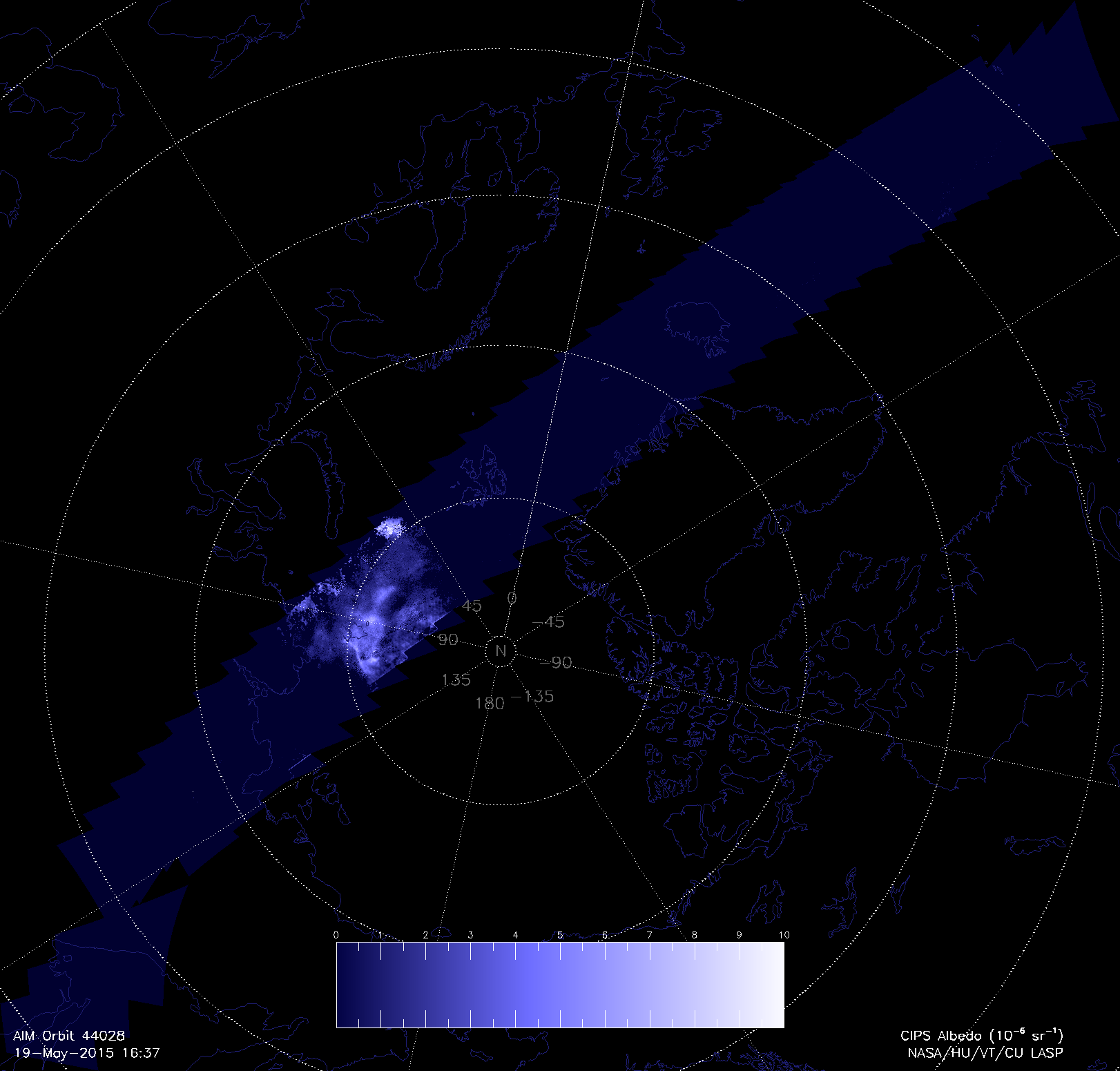
May 23, 2015: NASA’s AIM spacecraft has spotted a luminous patch of electric-blue drifting across the Arctic Circle. The sighting marks the beginning of the 2015 season for noctilucent clouds (NLCs). “The first clouds appeared on May 19th–a bit earlier than usual,” reports Cora Randall, AIM science team member at the University of Colorado. They are located at longitude +90o in this polar image recorded by AIM’s CIPS instrument:


The first northern-hemisphere NLCs of 2015, recorded by AIM/CIPS on May 19th

“It is always good to see the beginning of another season,” says James Russell of Hampton University, principal investigator for the AIM mission. “What surprises will it bring? We will see. The clouds have never disappointed us.”

NLCs are Earth’s highest clouds. Seeded by meteoroids, they float at the edge of space more than 80 km above the planet’s surface. The clouds are very cold and filled with tiny ice crystals. When sunbeams hit those crystals, they glow electric-blue.

Noctilucent clouds first appeared in the 19th century after the eruption of super-volcano Krakatoa. At the time, people thought the clouds were caused by the eruption, but long after Krakatoa’s ash settled, the clouds remained. In those days, NLCs were a polar phenomenon confined mainly to the Arctic. In recent years they have intensified and spread with sightings as far south as Utah and Colorado. This could be a sign of increasing greenhouse gases in Earth’s atmosphere.

Data from AIM have shown that NLCs are like a great “geophysical light bulb.” They turn on every year in late spring, reaching almost full intensity over a period of 5 to 10 days. News flash: The bulb is glowing. Stay tuned for sightings.

Noctilucent Clouds, Behaving Strangely

by Dr. Tony Phillips (Spaceweather.com)

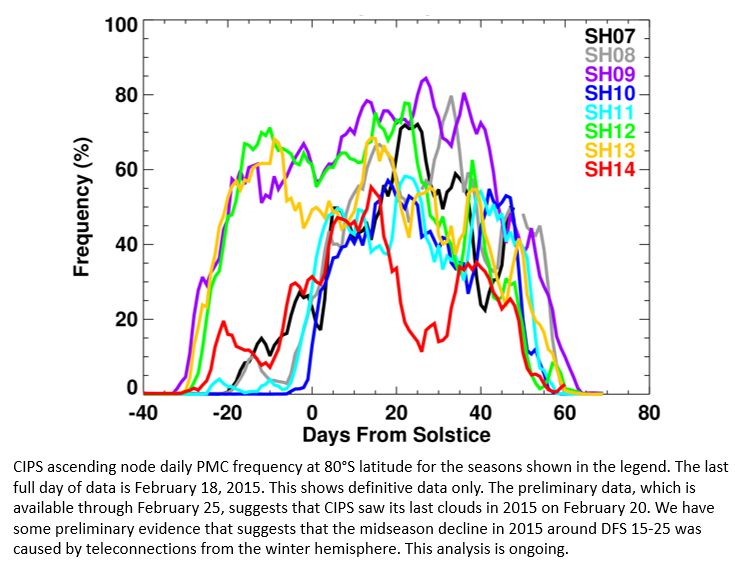
March 2, 2015: The southern season for noctilucent clouds (NLCs) has come to an end. NASA’s AIM spacecraft observed the last wisps of electric-blue over Antarctica on Feb. 20, 2015. The end of the season was no surprise: The polar clouds always subside in late summer. Looking back over the entire season, however, reveals something unexpected. In an 8-year plot of Antarctic noctilucent cloud frequencies, the 2014-2015 season is clearly different from the rest:

These data come from the AIM spacecraft, which was launched in 2007 to monitor NLCs from Earth orbit. The curves show the abundance (“frequency”) of the clouds vs. time for 120 days around every southern summer solstice for the past 8 years.

“This past season was not like the others,” notes Cora Randall, a member of the AIM science team and the chair of the Department of Atmospheric and Oceanic Sciences at the University of Colorado. “The clouds were much more variable, and there was an enormous decrease in cloud frequency 15 to 25 days after the summer solstice. That’s when the clouds are usually most abundant.”

What does this mean? Previous research shows that NLCs are a sensitive indicator of long-range teleconnections in Earth’s atmosphere, which link weather and climate across hemispheres. The strange behavior of noctilucent clouds in 2014-2015 could be a sign of previously unknown linkages. “Preliminary indications are that it is indeed due to inter-hemispheric teleconnections,” says Randall. “We’re still analyzing the data, so stay tuned.”

Now attention turns to the northern hemisphere, where the season for NLCs typically begins in May. Will the northern season ahead be as strangely variable as the southern season, just concluded? Says Randall, “I can’t wait to find out.”

Planets in a Bottle — More About Yeast

Yeast are simple, unicellular fungi. The most common forms of yeast — baker’s and brewer’s yeast — are strains of the species Saccaromyces cerevisiae. Yeast is often taken as a vitamin supplement because it is 50 percent protein and is a rich source of B vitamins, niacin, and folic acid.

Yeast microbes are probably one of the earliest domesticated organisms. People have used yeast for fermentation and baking throughout history. Archaeologists digging in Egyptian ruins found early grinding stones and baking chambers for yeasted bread, as well as drawings of 4,000-year-old bakeries and breweries. Only in the last 150 years, since the experiments of Louis Pasteur, have scientist begun to explore how yeast works. Pasteur first proposed the production of carbon dioxide from yeast as responsible for raising a loaf of bread in 1859.

Yeast Facts:

As little as two pounds of yeast starter can raise 500 pounds of bread dough.

Wild yeast spores are constantly floating in the air and landing on uncovered foods and liquids. These wild varieties contributed some of the earliest kinds of sourdough bread mixes which did not depend on adding starter cultures.

Yeast is also a popular organism for studying genetics. Baker’s yeast is one of only a half-dozen microbes on Earth whose unique gene script has recently been comprehensively deciphered. Notable in the yeast gene is a host of signals that trigger the microbe to protect itself against extremes in cold and heat, called thermal shock proteins. Hopes now run high in the biological community that over the next several years, more than 50 to 100 additional microbes will also provide comprehensive genetic scripts for their lifecycles, including how these organisms might survive under relentless swings in near boiling water, deep ice, or even in the core of an active volcano vent and nuclear reactors.

The yeasts, like most fungi, respire oxygen (aerobic respiration), but in the absence of air they derive energy by fermenting sugars and carbohydrates to produce ethanol and carbon dioxide. When yeast are supplied with both sugar and oxygen, the colonies grow up to 20 times faster through cell division than without oxygen.

The “Stuff of life” as reconstitutable for simple experiments in extreme environments and astrobiology, including freeze-dried nutrient mix (far left, dried skim milk powder) and fast-growing Baker’s yeast (middle, powdered Saccharomyces cerevisiae), and as shown with the key element for life, water, added (right shown in vials from left to right in last panel, with left, metabolic dye to measure growth (chemical called resazurin), middle, reconstituted skim milk with color dye added, and right, yeast.

In 1815, Guy-Lussac understood how yeasts convert the simplest sugar, glucose (C6H12O6) to ethanol:

C6H12O6 (glucose)--->2CO2 (carbon dioxide) + 2C2H5OH (ethanol)

The great medical microbiologist, Louis Pasteur, played a central role in proving this conversion to ethanol required living organisms, rather than a chemical catalyst. Pasteur showed that by bubbling oxygen into the yeast broth, the cells could be made to stop growing, but ferment vigorously–an observation later called the Pasteur Effect.

Many higher animals share this property of oxygen balance with yeasts. When given nutrient (sugar) and oxygen, they will burn fuel quickly like a stoked fire, but when deprived of oxygen, they will reproduce by cell multiplication and division (rather than metabolize). This kind of behavior–burn fuel or divide–is common to many biochemistries and these kinds of organisms are classified as facultative anaerobes; they essentially scrounge a meager living out of whatever particular circumstances are handed to them.

Unlike many kinds of fermenting bacteria (such as yogurt making or lactic acid microbes), yeasts don’t require anything but sugar and water to maintain fermentation and growth. For example, their nutrient broth can be free from other complex molecules such as amino acids, minerals or vitamins, since the yeasts’ history of austere conditions in nature has brought them to a unique state of self-sufficiency, even by microbial standards. The ingeniousness of adaptation makes yeasts one of the most studied and robust microbes.

Suggested Reading 

The Early Days of Yeast Genetics. (1993) edited by Michael N. Hall and Patrick Linder. Cold Spring Harbor Laboratory Press, Cold Spring Harbor, New York.

The Molecular and Cellular Biology of the Yeast Saccharomyces cerevisiae: Gene Expression. (1992) edited by Elizabeth W. Jones, John R. Pringle, and James R. Broach. Cold Spring Harbor Laboratory Press, Cold Spring Harbor, New York.

Mortimer, R.K. and Schold, D. 1985. Genetic map of Saccharomyces cerevisiae, Edition 9. Microbiological Reviews 49: 181-212.

Planets in a Bottle

Mar. 16, 1999: NASA/Marshall’s “Life on the Edge” program is barely a month old but it’s already producing results in some grade school classrooms.

“It was wonderful,” says Mrs. Nancy Walters, whose 3rd grade class recently tried some simple microbiology experiments with yeast. “The kids felt like they were doing real science, and they couldn’t stop talking about it for days.”

Life on the Edge is an educational program that aims to expose grade school students to some of the basic principles of astrobiology and to explore the possibilities for life elsewhere in the Solar System. The program began just over a month ago when 50 lb of yeast and other microbes were delivered to a summit in California’s White Mountains. Conditions there present severe challenges for most forms of life, so it is a good place to test the response of microbes to extreme environments. Some of the microorganisms will remain there for months, and some for longer than a year before they are retreived and distributed to classrooms for experimentation.

“Eventually we’ll be sending thousands of yeast packets to schools around the country,” says Dr. John Horack, director of science communications at the NASA/Marshall Space Sciences Lab. “But even before the microbes are ready to go we have to develop some simple lab protocols that kids can use to measure how their samples were affected by exposure. That’s why we’re going into classrooms now to test some of our ideas.”

One of these ideas, called “Planets in a Bottle,” was field-tested in a 2nd/3rd grade class room in February.

Moon in a Bottle “‘Planets in a Bottle’ is a simple way to test the viability of yeast samples, and a great way to teach young students about conditions on other planets,” explained Dr. Tony Phillips, who is evaluating the concept in classrooms. “The basic ingredients for a planet in a bottle are 1 cup of warm water, 3 sugar cubes, a 1/4 oz. packet of yeast, a half liter plastic water bottle, and a nine inch party balloon. Simply mix the sugar, water, and yeast in the bottle, and cap the bottle with the balloon. A healthy sample of yeast will inflate the balloon to 12 inch circumference in less than an hour.”

What happens is this: In the nutrient broth — warm water containing both dissolved oxygen and sugar — yeast metabolizes the sugar and produces carbon dioxide. The rate of carbon dioxide production at any given instant is proportional to the number of healthy microbes in the bottle. Because the yeast are constantly reproducing through cell division the number of microbes increases exponentially. Likewise, carbon dioxide production increases. The balloon inflates slowly at first, then rapidly accelerates.

a healthy yeast sample inflates a balloon with carbon dioxide In practice the balloon inflates to maximum volume in about 45 minutes. That’s when the yeast have consumed all the available nutrient. At room temperature the cells remain viable for several hours afterward and then begin to die. The maximum volume of CO2 and the time required to produce the gas can be used to estimate the number of healthy microbes in the original sample.

Students monitor yeast growthClick here for a sample “Planets in a Bottle” lesson plan

“Two weeks ago we visited Mrs. Walter’s 3rd grade classroom in Bishop, CA” continued Dr. Phillips. “The class was divided into seven groups, each with the basic ingredients for a Planet in a Bottle. Rather than have every group do the same experiment, we added variations so that each bottle would represent a different planet. For example, the Moon has no atmosphere to protect its surface from solar UV radiation. So, one group exposed their yeast to a UV lamp before adding the microbes to the nutrient mix, creating a “Moon in a Bottle.” Another group used scalding hot orange juice as a nutrient mix for ‘Venus in a Bottle.’ Citric acid in the orange juice served as a substitute for sulfuric acid in Venus’s hot atmosphere.”

Above: Young scientists monitor yeast growth in a bottle labelled “Pluto”. In this case the yeast were frozen for weeks before being added to the nutrient mix.

“Clearly we can’t reproduce true planetary conditions in a simple water bottle, nor did we pretend to, but these excercises have powerful teaching value. Every kid in Mrs. Walter’s class now knows that Venus has acid in its atmosphere thanks to the orange juice experiment, and they also learned that weak acids are not deadly to yeast,” Phillips said.

Students discuss the results in Mrs. Walter's 3rd grade class “My students were really excited when their balloons began to inflate,” recalled Mrs. Walters, “but the best part came at the end when we measured the sizes of the balloons and held a classroom debate about the results. We argued about which planet was most congenial to yeast and what the limitations of our results were. It felt like real science.”

Left: Students in Mrs. Walter’s 3rd grade class debate the question: “Which planet is really best for yeast?”

NASA scientists have a crowded schedule of classroom visits planned in the months to come, even though the Life on the Edge yeast container won’t be retreived for some time. The goal is to develop safe and effective classroom protocols before the yeast packets are distributed nationally.

“We don’t want to spoon feed students with overly-detailed protocols,” says John Horack,” That’s not science. But, we do want to give them a good starting point for their own creative experiments with extremophiles. The only way to do that is by spending lots of time in the classroom now, while the microbes are still in the White Mountains.”

To view a prototype lesson plan for “Planet in a Bottle” yeast experiments click here. Readers are invited to try the experiments (they are lots of fun) and we welcome comments from educators and others to improve our procedures. Please send comments and suggestions to james.a.phillips@earthlink.net.