Severe Geomagnetic Storm: March 23-24, 2023

March 24, 2023: Forecasters did not see this one coming. On March 23-24, auroras spread into the United States as far south as New Mexico (+32.8N) during a severe (category G4) geomagnetic storm–the most intense in nearly 6 years. The cause of the storm is still unclear; it may have been the ripple effect of a near-miss CME on March 23rd.

“Aurora pillars were visible from Shenandoah National Park in Central Virginia,” says Peter Forister, who photographed the light show at latitude +38.7 degrees:
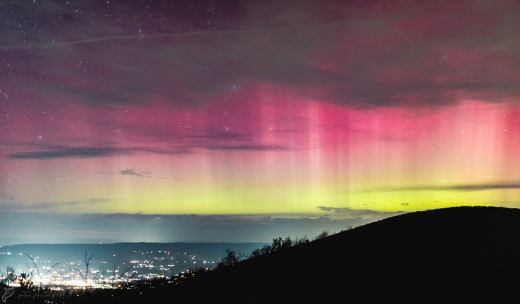
“Beautiful red and green colors were visible to the naked eye around 11 pm local time,” he says. Other notable low-latitude sightings were made in Colorado (+38.7N), Missouri (+40.2N), Colorado again (+38.3N), Nebraska (+41N) and North Carolina (+36.2N). More than half of all US states were in range of the display.

Not every light in the sky was the aurora borealis, however. There was also STEVE:
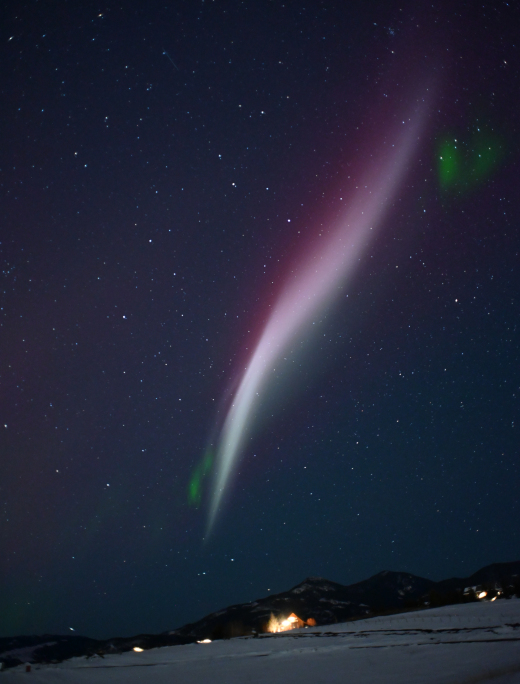
Joseph Shaw photographed the luminous ribbon over Bozeman, Montana. It also appeared over South Dakota, Washington State, Idaho, Montana again, and Scotland.

STEVE (Strong Thermal Emission Velocity Enhancement) looks like an aurora, but it is not. The phenomenon is caused by hot (3000°C) ribbons of gas flowing through Earth’s magnetosphere at speeds exceeding 6 km/s (13,000 mph). These ribbons appear during strong geomagnetic storms, revealing themselves by their soft purple glow.

This remarkable and surprising storm began on March 23rd when magnetic fields in the space around Earth suddenly shifted. In the jargon of space weather forecasting “BsubZ tipped south.” South-pointing magnetic fields can open a crack in Earth’s magnetosphere and, indeed, that’s what happened. Earth’s “shields were down” for almost 24 hours, allowing solar wind to penetrate and the storm to build to category G4.

These developments may have been caused the close passage of an unexpected CME. The storm cloud could have left the sun on March 20-21 when SOHO coronagraph data were unusually sparse. We didn’t know it was coming. For aurora watchers, it was a welcome surprise. Aurora alerts: SMS Text.
A Solar Radio Burst at Night

March 23, 2023:

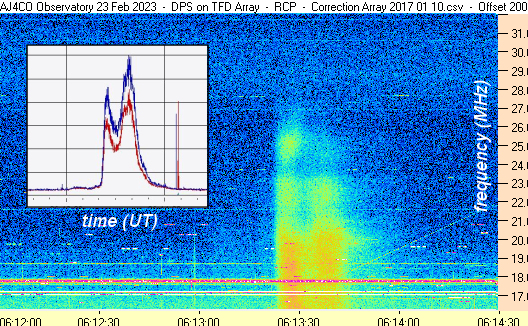
Something rare and strange happened last month. On Feb. 23rd, growing sunspot AR3234 produced an M-class solar flare. It was nearly midnight in Florida when the explosion occurred, so you’d expect no one there to notice. On the contrary, in the community of High Springs, FL, amateur radio astronomer Dave Typinski recorded a strong shortwave radio burst.

“You CAN see the sun at midnight in Florida… sometimes,” says Typinski. This is what his instruments recorded while the flare was underway:

A double wave of static washed over Florida, filling the radio spectrum with noise at all frequencies below 25 MHz. “The Sun was 69° below the horizon when this happened,” he marvels.

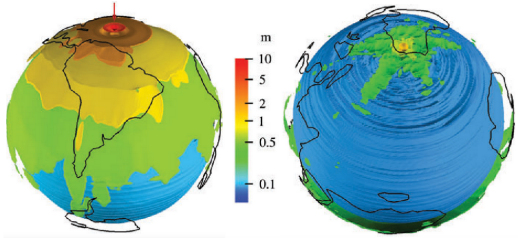
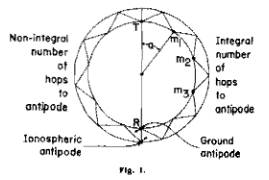
How is this possible? The entire body of our planet was blocking the event from Typinski’s antenna. It’s called “antipodal focusing.” First postulated by Marconi more than 100 years ago, antipodal focusing is a mode of radio propagation in which a signal starts out on one side of the planet, gets trapped between Earth’s surface and the ionosphere, and travels to the opposite hemisphere. Waves converging at the antipode can create a surprisingly strong signal.

Right: This diagram from a declassified US Gov.report shows the basic geometry of antipodal focusing.

“This is the second or maybe third midnight solar radio burst I’ve seen in ten years, but it’s by far the strongest,” says Typinski. “The previous events happened at the height of Solar Cycle 24. They’re quite rare.”

Pause: Yes, solar flares can produce radio signals. Typinski’s midnight burst was a “Type V,” caused by streams of electrons shooting through the sun’s atmosphere in the aftermath of the flare. Plasma waves rippling away from the streams emited intense bursts of natural radio static. The burst was first observed in broad daylight at the Learmonth Solar Observatory in Australia, then it curved around Earth to reach Typinski.


Above: An example of antipodal focusing of seismic waves caused by the Chicxulub asteroid impact. The geometry is the same as for radio waves. [more].

“This propagation mode was used during the Cold War,” notes Typinski. “The U.S. would park a SIGINT ship in the south Pacific to grab signals from the Eastern Bloc. The Soviets probably did the same thing, parking in the southern Indian ocean.”

Turns out, this method of spying works for radio astronomers, too. Would you like to record an event like this? NASA’s Radio JOVE program makes it easy. Off-the-shelf radio telescope kits allow even novices to monitor radio outbursts from the sun, which are becoming more frequent as Solar Cycle 25 intensifies.

This story was brought to you by Spaceweather.com

Extremely Rare CME

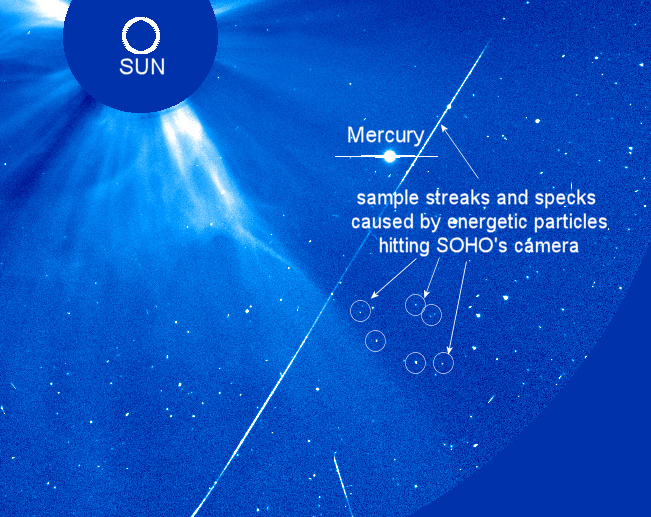
March 13, 2023: Something big just happened on the farside of the sun. During the early hours of March 13th, SOHO coronagraphs recorded a farside halo CME leaving the sun faster than 3000 km/s:

Because of its extreme speed, this CME is classified as “extremely rare,” a fast-mover that occurs only once every decade or so. A NASA model of the event shows the CME heading almost directly away from Earth. Good thing!

Although the CME was not Earth-directed, it has nevertheless touched our planet. See all the snowy dots and streaks in the coronagraph movie above? Those are energetic particles accelerated by shock waves in the CME. They create short-lived luminous speckles when they hit SOHO’s digital camera.

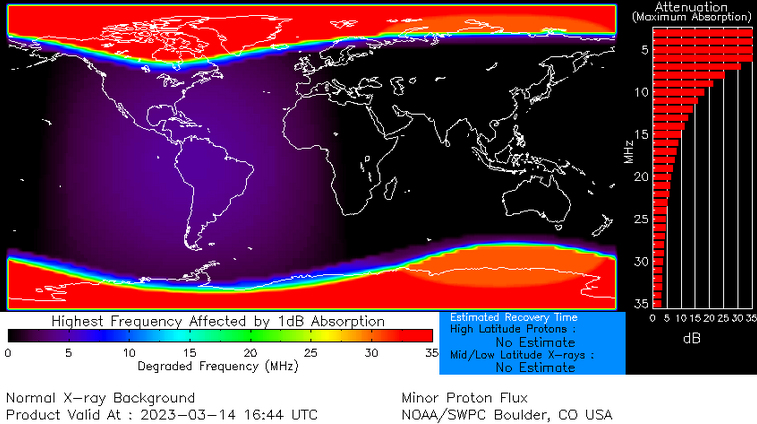
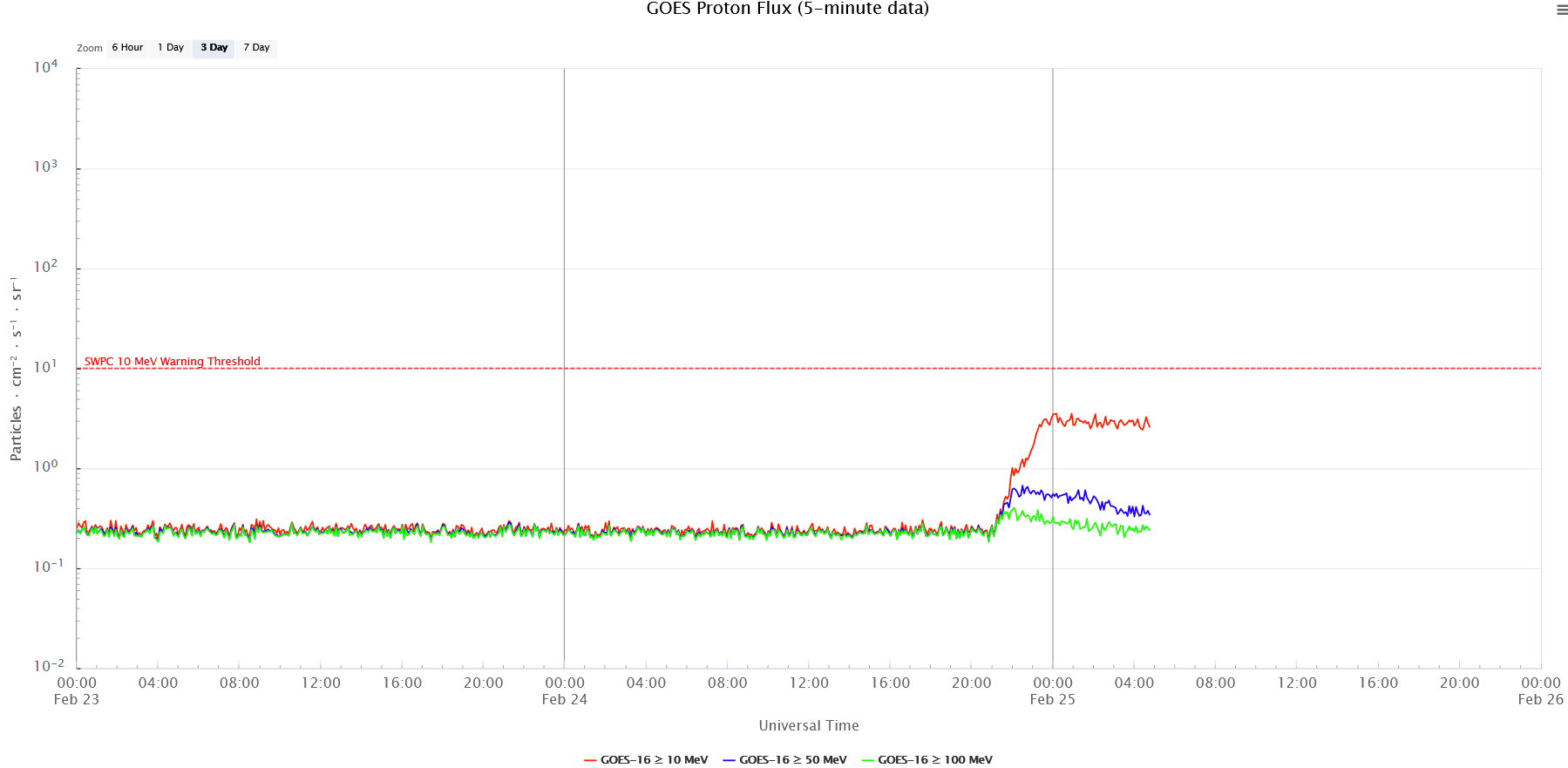
NOAA’s GOES-16 satellite has detected the particles reaching Earth–all from the CME’s backside. Imagine what a frontside blast would have been like. Earth’s magnetic field is funneling the particles toward the poles where a type of radio blackout is underway–a polar cap absorption (PCA) event:

Note the broad red areas. Airplanes flying over these regions may find that their shortwave radios won’t work due to the ionizing effect of infalling protons. This PCA could persist for a day or more. You can monitor its progress here. Solar flare alerts: SMS Text.

A “Chain Reaction” Explosion on the Sun

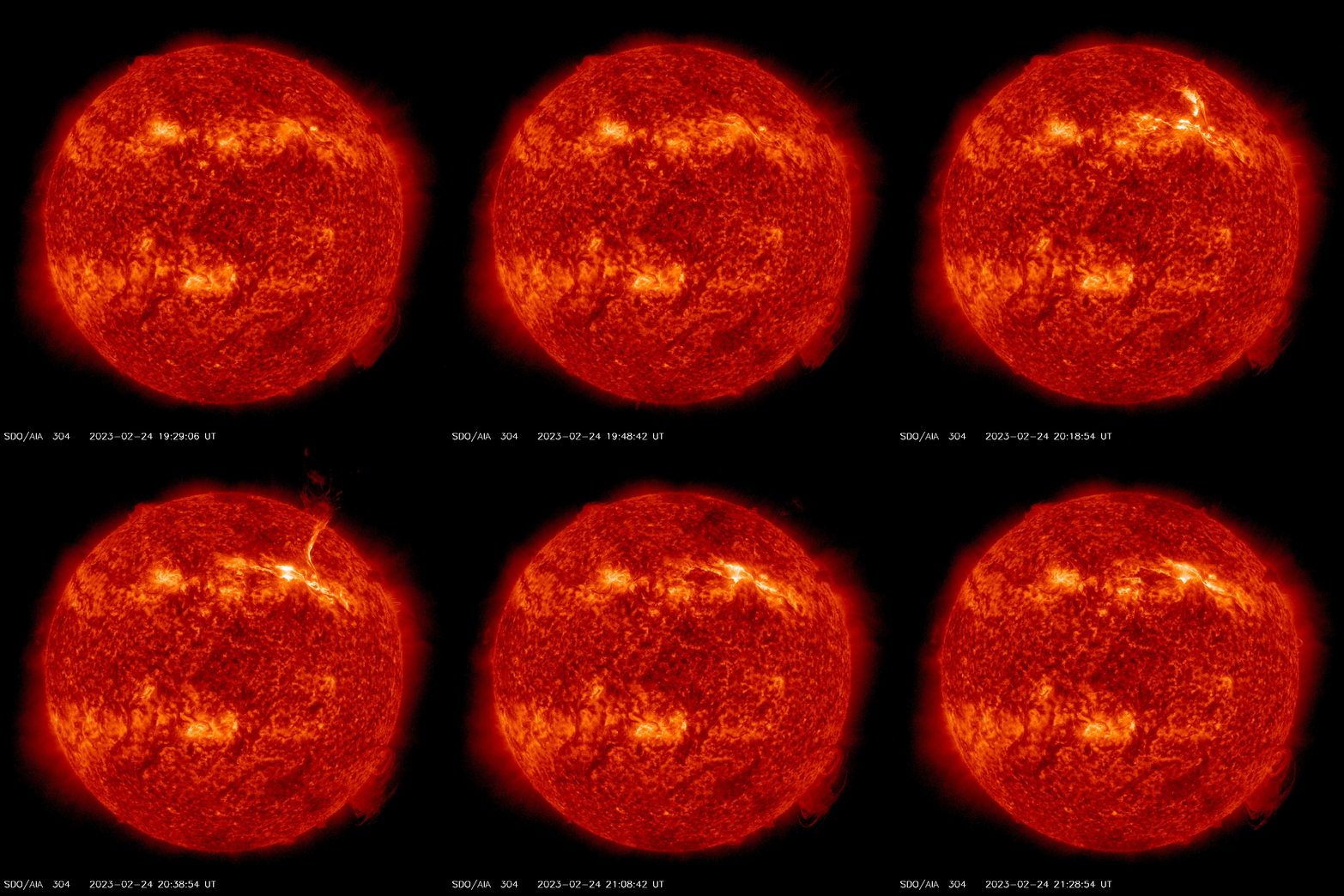
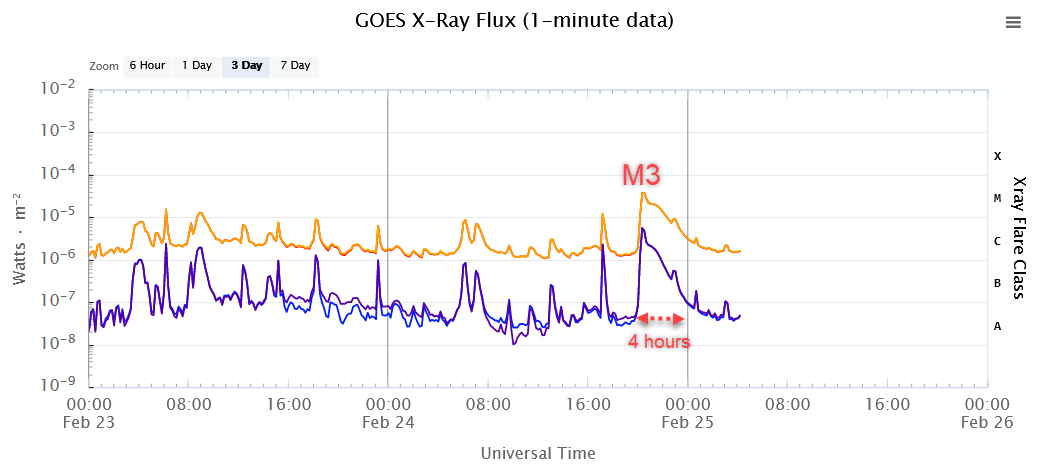
Feb. 25, 2023: A magnetic filament connected to sunspot AR3229 erupted on Feb. 24th, producing a chain reaction of events that could lead to a geomagnetic storm on Earth. The action began at 1949 UTC when the filament rose up and sliced through the sun’s atmosphere:

The violent liftoff destabilized sunspot AR3229, sparking a long duration M3-class solar flare (2030 UTC). Radiation from the flare, in turn, ionized the top of Earth’s atmosphere, blacking out shortwave radio transmissions around the Pacific Ocean: map. Mariners and ham radio operators may have noticed loss of signal at frequencies below 25 MHz for as much as an hour after the explosion.

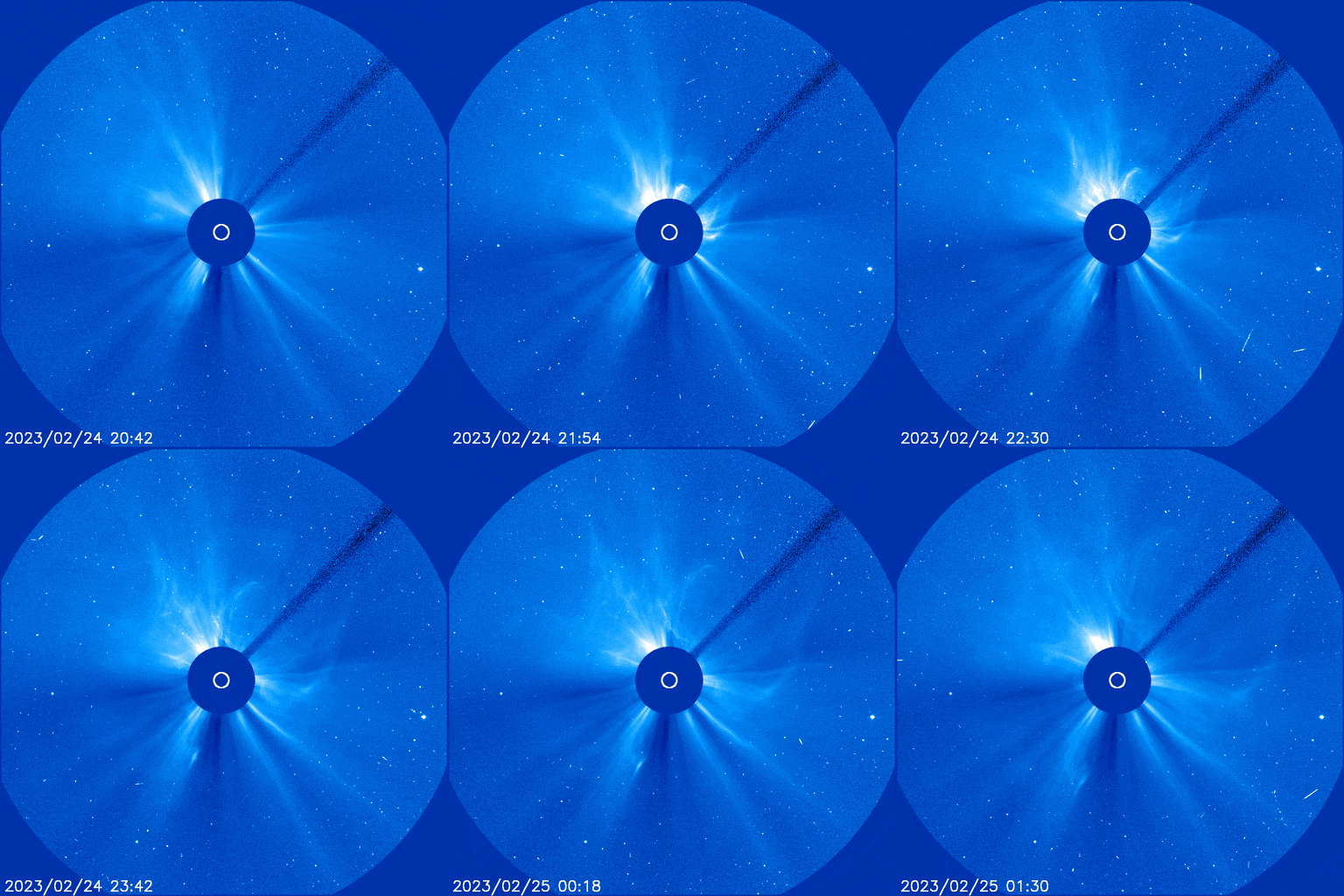
Next, a CME emerged from the blast site. Coronagraph images from SOHO show a lopsided halo with an Earth-directed component:

Type II solar radio emissions from the leading edge of the CME suggest a departure speed of 1200 km/s (2.7 million mph). The flank of the fast-moving cloud could reach Earth on Feb. 27th. NOAA analysts are modeling the CME now, so stay tuned for a refined forecast.

There’s more: Shock waves inside the CME accelerated protons to nearly light speed, and they have already reached Earth. Our planet’s magnetic field is funneling the particles toward the poles where a second type of radio blackout is underway–a polar cap absorption (PCA) event. Airplanes flying over these regions may find that their shortwave radios won’t work due to the ionizing effect of infalling protons: map.

This story was brought to you by Spaceweather.com

Sunspot Counts Hit Their Highest Level in 9 Years

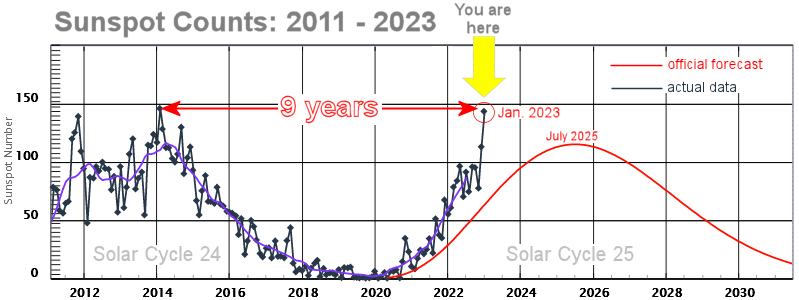
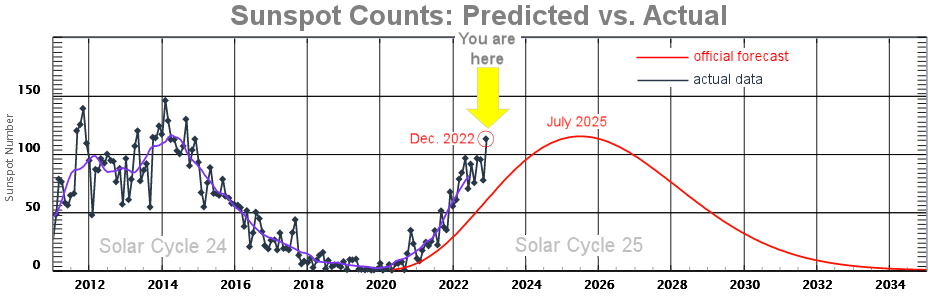
Feb. 1, 2023: In a continued sign of strength for Solar Cycle 25, sunspot counts just hit a 9-year high. This plot from NOAA shows how the monthly sunspot number skyrocketed in January 2023:

The monthly sunspot number of 144 in January 2023 was only percentage points away from topping the previous solar cycle, Solar Cycle 24, which peaked in Feb. 2014 with a monthly value of 146.

Originally, forecasters thought Solar Cycle 25 would be about the same as Solar Cycle 24, one of the weakest solar cycles in a century. Current trends suggest Solar Cycle 25 will surpass that low threshold, at least. Solar Maximum is not expected until 2024 or 2025, so it has plenty of time to strengthen further, perhaps far exceeding Solar Cycle 24. You can follow the progression here.

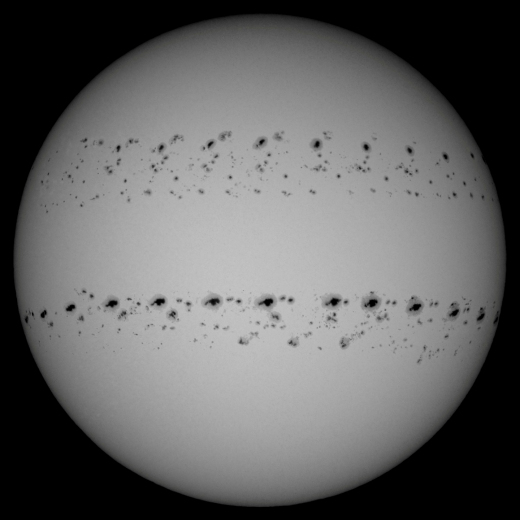
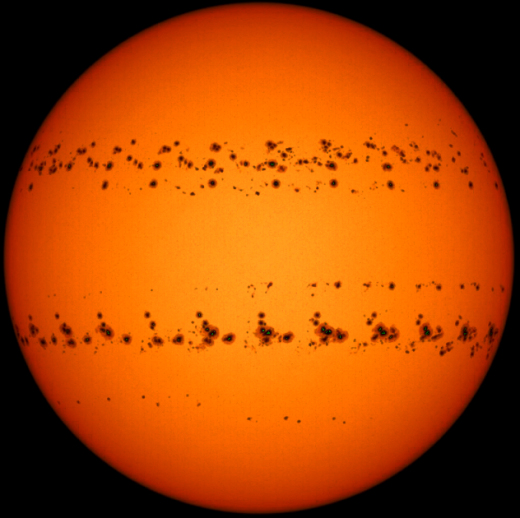
Extra: What made January 2023 so special? This picture says it all:

This is a composite image created by Patricio Leon of Santiago, Chile. Almost every day in January, Leon photographed the sun, and stacked the images to show the march of large sunspots across the solar disk.

This story was brought to you by Spaceweather.com

Significant Farside Explosion

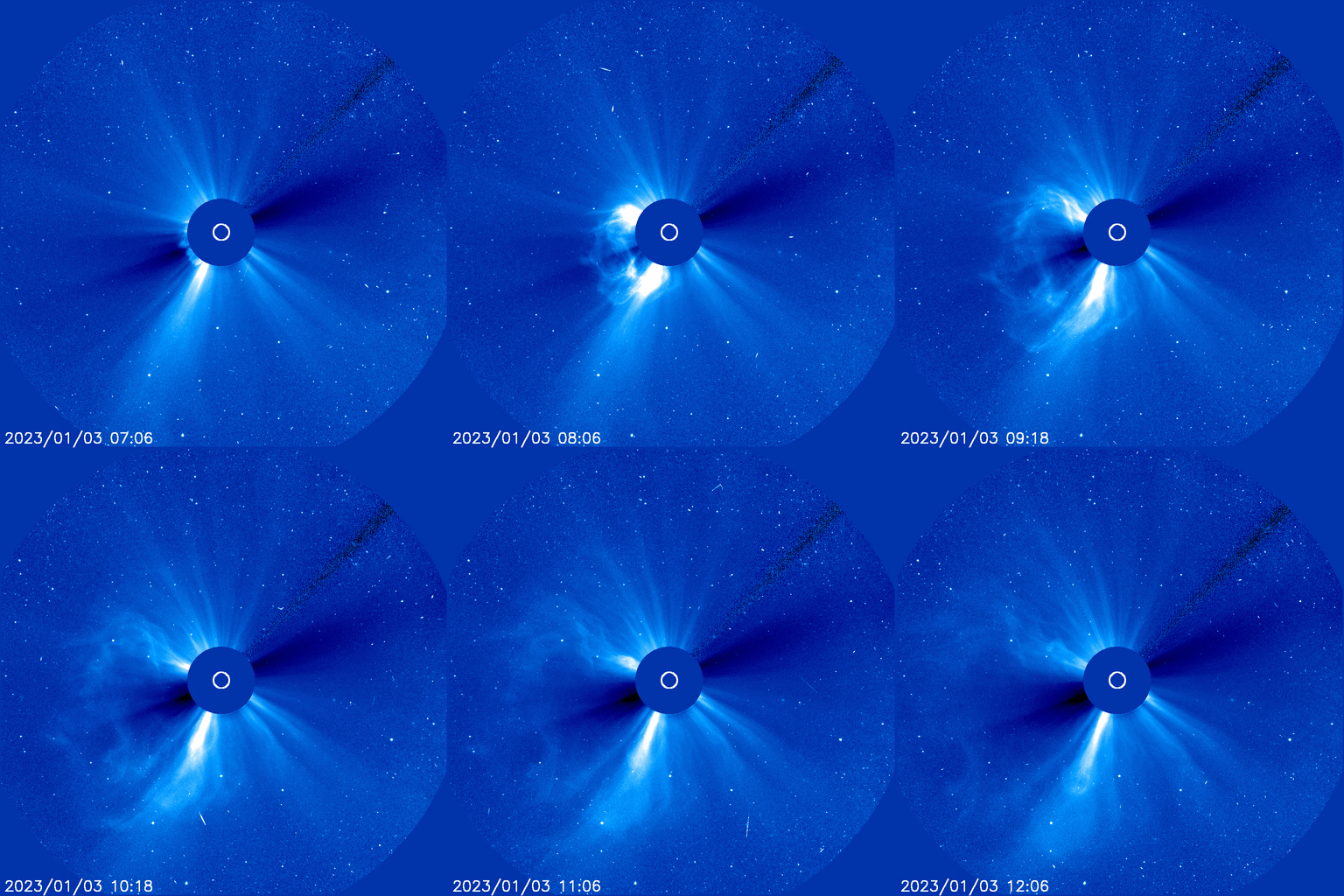
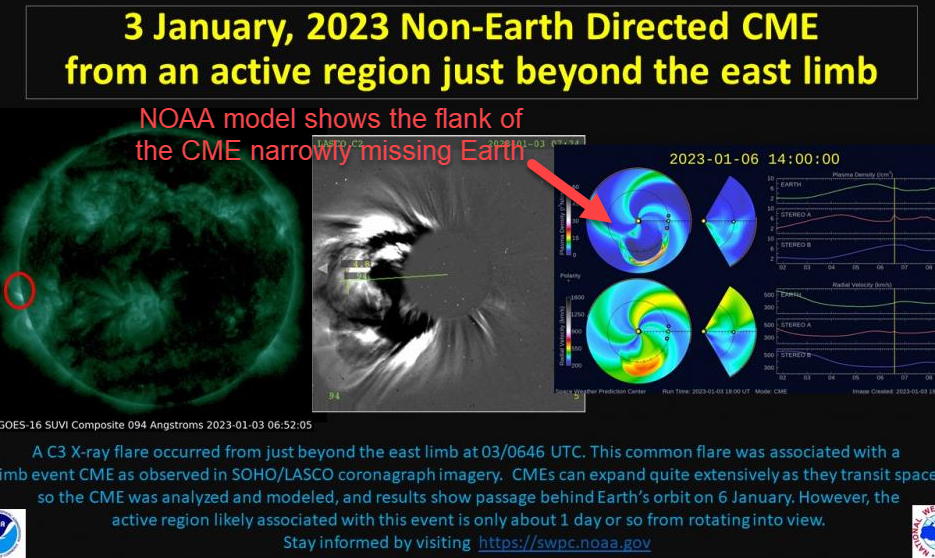
Jan. 4, 2023: Something just exploded on the farside of the sun. SOHO watched the debris–a very bright and fast CME–billow away from the sun’s southeastern limb on Jan. 3rd:

It won’t hit Earth. NOAA analysts have modeled the CME and determined that the edge of the storm cloud will narrowly miss our planet a few days from now.

NASA’s Solar Dynamics Observatory detected shock waves from the blast wrapping around both of the sun’s poles. This suggests a very powerful explosion–possibly an X-flare. Radiation from the flare was eclipsed by the edge of the sun, reducing its intensity by one to two orders of magnitude, so that Earth-orbiting satellites detected only a C4-class event.

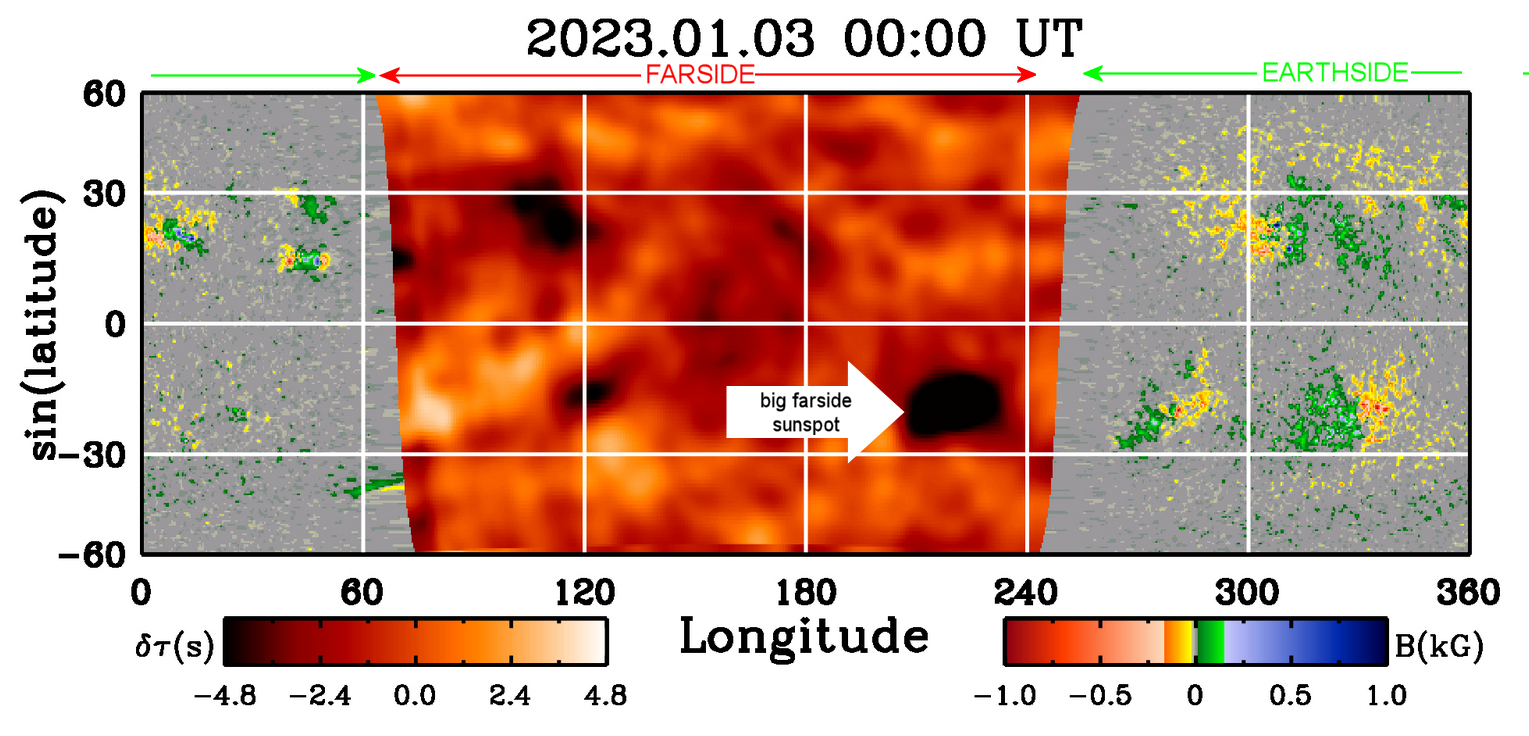
Whatever exploded will soon turn to face Earth. Helioseismic echoes pinpoint its location no more than 2 days behind the sun’s eastern limb:

This might be old sunspot AR3163, which spent the last two weeks transiting the farside of the sun. It was big the last time we saw it in December and may have grown even bigger since. Stay tuned! Solar flare alerts: SMS Text.

This story was brought to you by Spaceweather.com

Sunspot Counts Hit a 7-Year High

Jan. 2, 2022: December was a busy month on the sun. How busy? Senol Sanli of Bursa, Turkey, answered the question by stacking 26 days of sun photos (Dec. 2nd – 27th) from NASA’s Solar Dynamics Observatory:

“There were more than 24 sunspot groups, some of them quite large, congested in two bands on opposite sides of the sun’s equator,” says Sanli.

The congestion of dark cores catapulted the monthly sunspot number to its highest value in 7 years:

This plot from NOAA shows the ascending progression of Solar Cycle 25. It has outperformed the official forecast for 35 months in a row. If the trend continues, Solar Maximum will either happen sooner or be stronger than originally expected–possibly both. Stay tuned for lots more sunspots.

This story was brought to you by Spaceweather.com