Starlink Satellite Flares (Part 1)

May 28, 2019:  SpaceX has an idea: Surround the Earth with 12,000 satellites and provide broadband internet to every corner of the globe. The project is called Starlink–and it’s getting started. The first 60 Starlink satellites were launched on May 23rd, creating a train of bright lights in the night sky. “It was one of the most spectacular things I have every seen,” reports Marco Langbroek of Leiden, the Netherlands, who made this video the night after the launch:
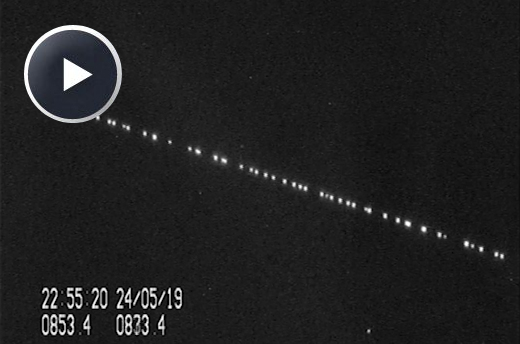
thetrain_strip

“I could see the entire train of satellites with the unaided eye,” he says.

Since then, sky watchers have been catching the “Starlink Train” — often by accident. “I saw it last night around 9:30 pm in Piseco, New York,” reports Christopher Hayes. “I just happened to look up at the right moment. Thanks to Spaceweather.com I knew what it was, but anyone who didn’t know would have been in for quite a surprise. It was such an amazing sight!”

The Train no longer looks as it did on the first night. Individual satellites are fading in brightness as they move out into their operational orbits. A typical urban sighting now consists of only 4 to 6 naked-eye objects interleaved by dozens of fainter satellites best seen through binoculars.

The Train is still worth catching, however, because the satellites are flaring. Sunlight is glinting off flat surfaces on the satellites’ bodies, creating flashes of light that can briefly rival the brightest stars in the sky. Here are two flares photographed on May 26th by Bill Keel, an astronomy professor at the University of Alabama:

“I saw a pass of the Starlink Train about 15 degrees from zenith over Tuscaloosa,” says Keel. “Some of them showed very systematic flaring, flashing brightly at nearly the same location in the sky. The brightest flares reached a magnitude of -2 for about 5 seconds.” For reference, that’s 50% brighter than Sirius, the brightest star in the sky.

On May 27th, George Varros photographed a cluster of 4 flares over Mt. Airy, Maryland. “I could see them despite horrible conditions–clouds, humidity, airplanes everywhere. This was a real treat visually!”

The flares are pretty, but some astronomers are concerned. Will 12,000 artificial stars criss-crossing the night sky, sometimes flaring, make deep-sky observing impossible? It’s an important question. Keel speculates that the regularity of the flares he observed might mean they’re predictable, in which case, big telescopes could learn to avoid them. We’ll find out soon enough as SpaceX plans to launch at least two more trains this year.

Ready to see the Starlink Train with your own eyes? Visit Heavens-Above.com and click on “Starlink (leader)” for local flyby predictions. A dynamic display of the satellites’ current location is also available.

Realtime Space Weather Photo Gallery
Free: Spaceweather.com Newsletter

Close Encounters with the Taurid Swarm

May 24, 2019: In November 2032, Earth will pass through the Taurid Swarm, a cloud of debris from Comet 2P/Encke that makes brilliant fireballs when its gravelly particles occasionally hit Earth’s atmosphere. Previous encounters with the Swarm in 2005 and 2015 produced showers of bright meteors observed around the world; in 1975 the Swarm contacted the Moon, making Apollo seismic sensors ring with evidence of objects hitting the lunar surface. If forecasters are correct, we’re in for similar activity 13 years from now.

Some researchers are beginning to wonder if there might be more to the Taurid Swarm than the pebble-sized particles that make fireballs–something, say, that could level a forest. On June 30, 1908, a forest in Siberia did fall down when a 100-meter object fell out of the sky and exploded just above the Tunguska River. Back-tracking the trajectory of the impactor suggests it may have come from the Taurid Swarm.

tunguska

Above: Trees felled by the Tunguska explosion. Credit: the Leonid Kulik Expedition

Why would the Swarm contain such big rocks? After all, comet debris is normally no bigger than specks of dust. The most popular theory holds that 10 or 20 thousand years ago, a giant 100-km wide comet fragmented in the inner solar system. The breakup produced a mixture of dust and asteroid-sized bodies that are still present today. Comet 2P/Encke itself may be just one of the fragments.

If the Taurid Swarm does indeed contain Tunguska-class impactors, the people of Earth need to know. A team of astronomers from the University of Western Ontario (UWO) suggests that this summer is a great time to find out.

“In June 2019 the Earth will approach within [0.06 AU or 9 million km] of the center of the Taurid swarm, its closest post-perihelion encounter with Earth since 1975,” write UWO astronomers David Clark, Paul Wiegert and Peter Brown in a paper just accepted for publication in the Monthly Notices of the Royal Astronomical Society. “This will be the best viewing geometry to detect and place limits on the number of Near-Earth Objects proposed to reside at the swarm center until the early 2030s.”

To be clear, the team won’t be looking for fireballs disintegrating in Earth’s atmosphere. Instead, they want to point powerful telescopes at the Swarm, peering deep inside it to see if they can find big, dangerous pieces of rock gliding among the pebbles.

“Seeing anything in the Taurid Swarm will be tough,” says Wiegert. “It’s faint, it’s spread across a lot of sky, and it’s moving fast. A fair dash of serendipity will be needed to catch a glimpse of it. But we have to try to strike when the iron is hot, and that’s now.”

“We’ve applied for 10 hours of time on the Canada-France-Hawaii Telescope atop Mauna Kea,” he adds. “And we’re hoping other big telescopes will join the search as well.”

To learn more about this year’s close encounter with the Taurid Swarm, read the original research at https://arxiv.org/pdf/1905.01260.pdf

Noctilucent Cloud Season Begins

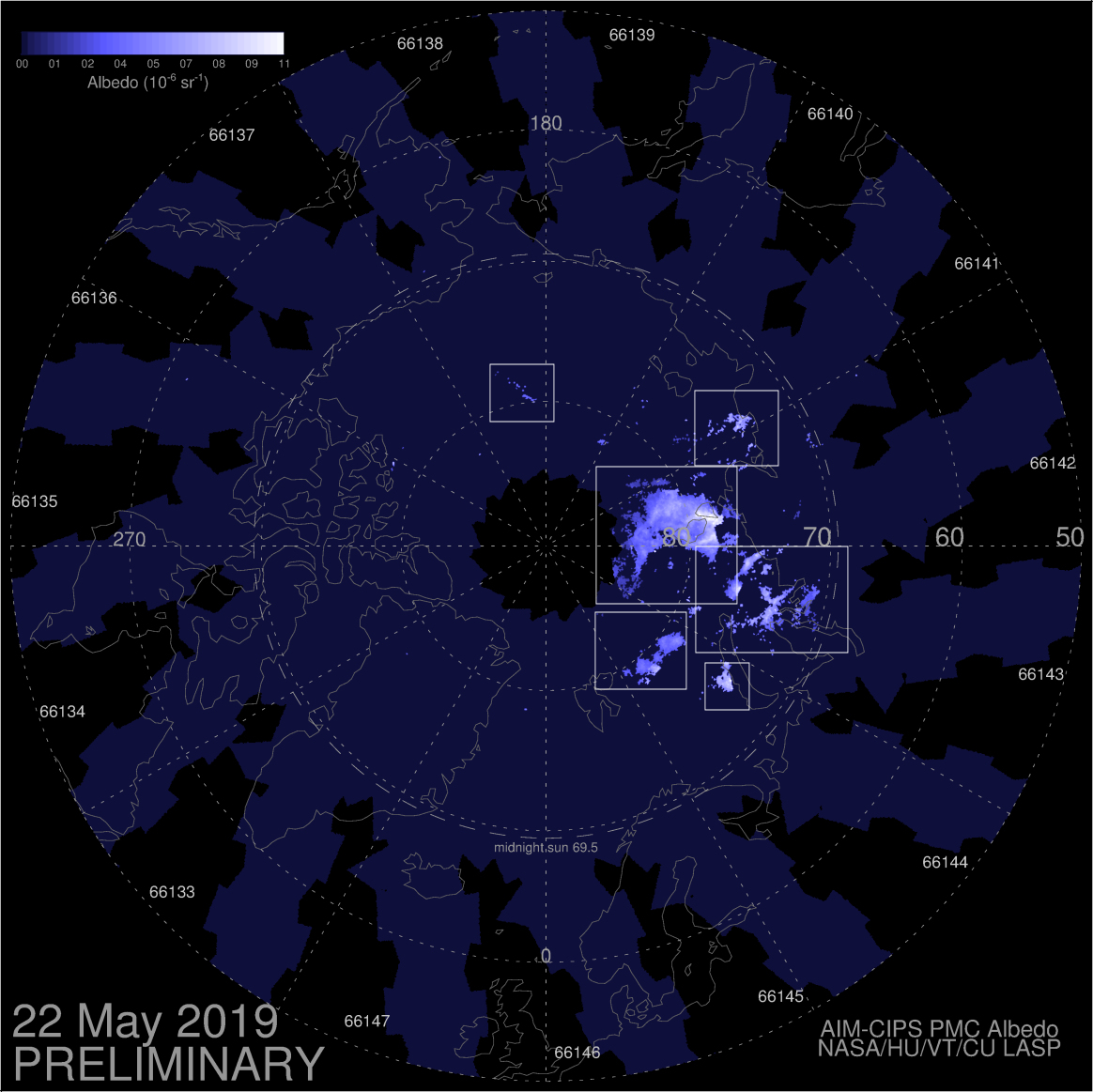
May 24, 2019: NASA’s AIM spacecraft has spotted wispy patches of electric-blue drifting over the Arctic Ocean. This marks the beginning of the 2019 season for noctilucent clouds (NLCs). The clouds are boxed in this polar image recorded by AIM’s CIPS instrument:

These first detections from space are mostly small and faint. They won’t remain faint for long, however. Previous data from AIM have shown that NLCs are like a great “geophysical light bulb.” They turn on every year in late spring, reaching almost full intensity over a period of 10 days. This means observers on the ground should soon begin to see them.

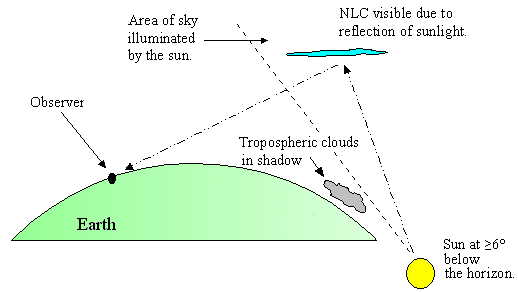
NLCs are Earth’s highest clouds. Seeded by meteoroids, they float at the edge of space more than 80 km above the planet’s surface. The clouds are very cold and filled with tiny ice crystals. When sunbeams hit those crystals, they glow electric-blue.

This is what a fully-realized noctilucent cloud looks like, photographed over the Lille Vildmose Wild Life Park in Denmark by Pernille Fjeldgaard Jensen on July 6, 2018:

Early-season NLCs are always found at high-latitudes–e.g., Canada, the British isles, Siberia and Scandinavia. To people in those areas, we offer the following observing tips: Look west 30 to 60 minutes after sunset when the sun has dipped below the horizon. If you see luminous blue-white tendrils spreading across the sky, you may have spotted a noctilucent cloud.

Realtime Noctilucent Cloud Photo Gallery

Polar Mesospheric Summer Echoes

May 21, 2019: Every summer since the late 1970s, radars probing Earth’s upper atmosphere have detected strong echoes from altitudes between 80 km and 90 km. What’s up there? Noctilucent clouds (NLCs). NASA’s AIM spacecraft is still waiting to spot the first NLCs of the 2019 season, but the echoes have already begun. Rob Stammes of the Polarlightcenter in Lofoten, Norway, detected them on May 19th and 20th:

pmse

“I detected these VHF signals coming from transmitters in Eastern Europe,” he explains. “Before they reached my receiver in Norway, they bounced off something in the mesosphere. The patterns were recognizable and very strong.”

Researchers call them “Polar Mesospheric Summer Echoes” or “PMSEs.” They occur over the Arctic during the months of May through August, and over the Antarctic during the months of November through February. These are the same months that NLCs appear.

The underlying physics of these echoes is still uncertain. A leading theory holds that the ice particles in noctilucent clouds are electrically charged, and this makes them good reflectors of radio waves. However, NLCs are not always visible when the radar echoes are observed and vice versa.

nlcs

Noctilucent clouds observed by Kairo Kiitsak of Simuna, Estonia, on on July 26, 2018.

The echoes Stammes detected suggest that the season for NLCs is about to begin.

“It certainly should be starting soon!” says Cora Randall of the AIM science team at the University of Colorado. “We’ve been looking at MLS temperature and water vapor data. As of last week, the north polar mesopause was colder and wetter than in any other years of the AIM record at this time.” In other words, conditions are ripe for water vapor to crystallize around meteor smoke, forming icy tendrils of electric-blue at the edge of space.

High-latitude sky watchers should be alert for their return. Observing tips: Look west 30 to 60 minutes after sunset when the sun has dipped 6o to 16o below the horizon. If you see luminous blue-white tendrils spreading across the sky, you may have spotted a noctilucent cloud.

Realtime Noctilucent Cloud Photo Gallery


Is the Great Red Spot Unraveling?

May 20, 2019: Around the world, amateur astronomers are monitoring a strange phenomenon on the verge of Jupiter’s Great Red Spot (GRS). The giant storm appears to be unraveling. “I haven’t seen this before in my 17-or-so years of imaging Jupiter,” reports veteran observer Anthony Wesley of Australia, who photographed a streamer of gas detaching itself from the GRS on May 19th:

plume

The plume of gas is enormous, stretching more than 10,000 km from the central storm to a nearby jet stream that appears to be carrying it away. Wesley says that such a streamer is peeling off every week or so.

The Great Red Spot is the biggest storm in the solar system–an anticyclone wider than Earth with winds blowing 350 mph. Astronomers have been observing it for hundreds of years. In recent decades, the Great Red Spot has been shrinking. Once it was wide enough to swallow three Earths; now only one of our planet could fit inside the maelstrom. This has led some researchers to wonder if the GRS could break up or disappear within our lifetimes. Perhaps the streamers are part of this process.

In fact, such unraveling clouds have been seen before. For instance, the Gemini North adaptive optics telescope on Maunakea saw a lesser but similar streamer in May of 2017:

gemini_hook

The leader of those observations, Glenn Orton of NASA’s Jet Propulsion Laboratory, noted “a curious hook-like cloud feature on the Great Red Spot’s western side. Events like this show that there’s still much to learn about Jupiter’s atmosphere,” he said in a press release.

Wesley describes how the streamers are behaving now: “Each streamer appears to disconnect from the Great Red Spot and dissipate. Then, after about a week, a new streamer forms and the process repeats. You have to be lucky to catch it happening. Jupiter spins on its axis every 10 hours and the GRS is not always visible. A joint effort between many amateurs is underway to get clear images of the process.”

Indeed, now is a great time to monitor the action. Jupiter is approaching Earth for a close encounter in June 2019. During the weeks around opposition on June 10th, Jupiter will shine 4 times brighter than Sirius, the brightest star in the sky, and even small telescopes will reveal its storms, moons, and cloud belts.

Stay tuned for more unraveling.

A Series of CMEs Approaches Earth

May 13, 2019: Three and possibly four CMEs are en route to Earth following a series of explosions near sunspot AR2741. The most potent so far occurred on May 12th when a filament of magnetism surrounding the sunspot became unstable and erupted. The blast zone was more than 220,000 km in diameter:

Similar eruptions on May 10th, 11th and 13th combined with this one to produce a train of faint coronal mass ejections (CMEs) heading in our direction. The incoming CMEs are lightweights compared to the bright massive CMEs typically seen during Solar Maximum. However, their combined effect could rattle Earth’s magnetic field.

NOAA forecasters estimate a 55% to 60% chance of G1-class geomagnetic storms on May 15th and 16th. Isolated periods of even stronger G2-class storms are possible as well. Aurora Alerts: SMS Text.

Realtime Aurora Photo Gallery

Rare Blue Auroras over Canada

May 11, 2019: Northern Lights are usually green, sometimes red. Those are the colors we see when oxygen is hit by electrons raining down from space during a geomagnetic storm. On Friday night, however, Harlan Thomas of Calgary, Alberta, witnessed a different color: deep-blue.

“To see these incredible blue pillars was out of this world,” says Thomas.

In auroras, blue is a sign of nitrogen. Energetic particles striking ionized molecular nitrogen (N2+) at very high altitudes can produce a blue glow rarely seen during auroral displays. In this case, it was the afterglow of a CME impact.

The CME left the sun on May 6th, propelled in our direction by an explosion in the magnetic canopy of sunspot AR2740. When it finally arrived on May 10th, the slow-moving storm cloud rattled Earth’s magnetic field, triggering a minor G1-class geomagnetic storm. Auroras were sighted in parts of Canada as well as US States such as Michigan and Minnesota.

“To top it off, STEVE appeared for several minutes as well,” says Thomas, who captured it in this shot:

STEVE is a hot (3000 degrees C) ribbon of ionized gas slicing through Earth’s upper atmosphere some 300 km above the ground. It appears unpredictably during some, but not all, geomagnetic storms. Originally thought to be a form of aurora borealis, new research shows that it is not an aurora at all.

The soft purple color of STEVE may also be caused by emissions from nitrogen, according to a new study just published in the Geophysical Research Letters. Coincidence? STEVE and blue auroras seem to share a connection to the 7th element on the periodic table.

Blue auroras are most often seen during intense geomagnetic storms–yet this was a relatively minor storm. Why nitrogen-blue overtopped the usual hues of oxygen on May 11th is unclear. It just goes to show, auroras still have the capacity to surprise. Aurora Alerts: SMS Text.

Realtime Aurora Photo Gallery

What is a Geomagnetic Jerk?

May 2, 2019: Earth’s magnetic field is notoriously inconstant. The north pole itself has been wandering across the Arctic for centuries. Currently, it is racing from northern Canada toward Siberia on an unpredictable path that has prompted hurried updates to world magnetic models. And then there are the “geomagnetic jerks.” Every 3 to 12 years, Earth’s magnetic field suddenly accelerates in one direction or another, a phenomenon that has puzzled scientists since it was recognized in the late 1970s.


Above: The rate of change in vertical magnetic fields at the Honolulu observatory (blue) and in Earth’s orbit (red). Sudden changes in the slope indicate geomagnetic jerks. [More]

The most recent jerk occurred in 2017 following a rapid-fire sequence of similar disturbances in 2008, 2011, and 2014. There is evidence for jerks going all the way back to 1901. Some are global, felt everywhere, while others are regional, spanning single continents or less. The unpredictability of jerks has complicated efforts to forecast geomagnetism.

A new study may solve the mystery. In a paper published on April 22nd in Nature Geoscience, Julien Aubert (Paris Institute of Earth Physics) and Christopher C. Finlay (Technical University of Denmark), describe how they created a computer model for geomagnetic jerks based on the physics of hydrodynamic waves in Earth’s molten core. According to their model, jerks originate in rising blobs of metal that form deep inside our planet. These slow-moving blobs can take 25 years to rise to the top of the convection zone. As they buoy upwards, the blobs disrupt the normal flow of magnetic field-generating currents and, in turn, cause jerks. The model successfully reproduces the form and timing of recent events.

Above: A computer simulation of molten blobs floating up from Earth’s core. Credit: Aubert and Finlay, Nature Geoscience (2018)

Geomagnetic jerks are just one aspect of Earth’s magnetic variability. Globally, Earth’s magnetic field has weakened by more than 10% since the 19th century with an even faster decline in the 2000s. Satellite data show the changes are uneven. According to CHAMP, Ørsted, and SWARM, the field has recently weakened by about 3.5% at high latitudes over North America, while it has strengthened about 2% over Asia. The region where the field is at its weakest – the South Atlantic Anomaly – has moved steadily westward and weakened further by about 2%.

At present, no one can predict these changes. However, Aubert and Finley’s successful model of jerks suggests that a deeper understanding may be within reach. You can read their original research here.

Note: The name “jerk” was borrowed from dynamics, where it means the rate of change of the acceleration of a body–that is, the third derivative of its position with respect to time. Geomagnetic jerks are therefore the first derivative of magnetic acceleration.

Free: Spaceweather.com Newsletter

Naked Eye Sprite Storms

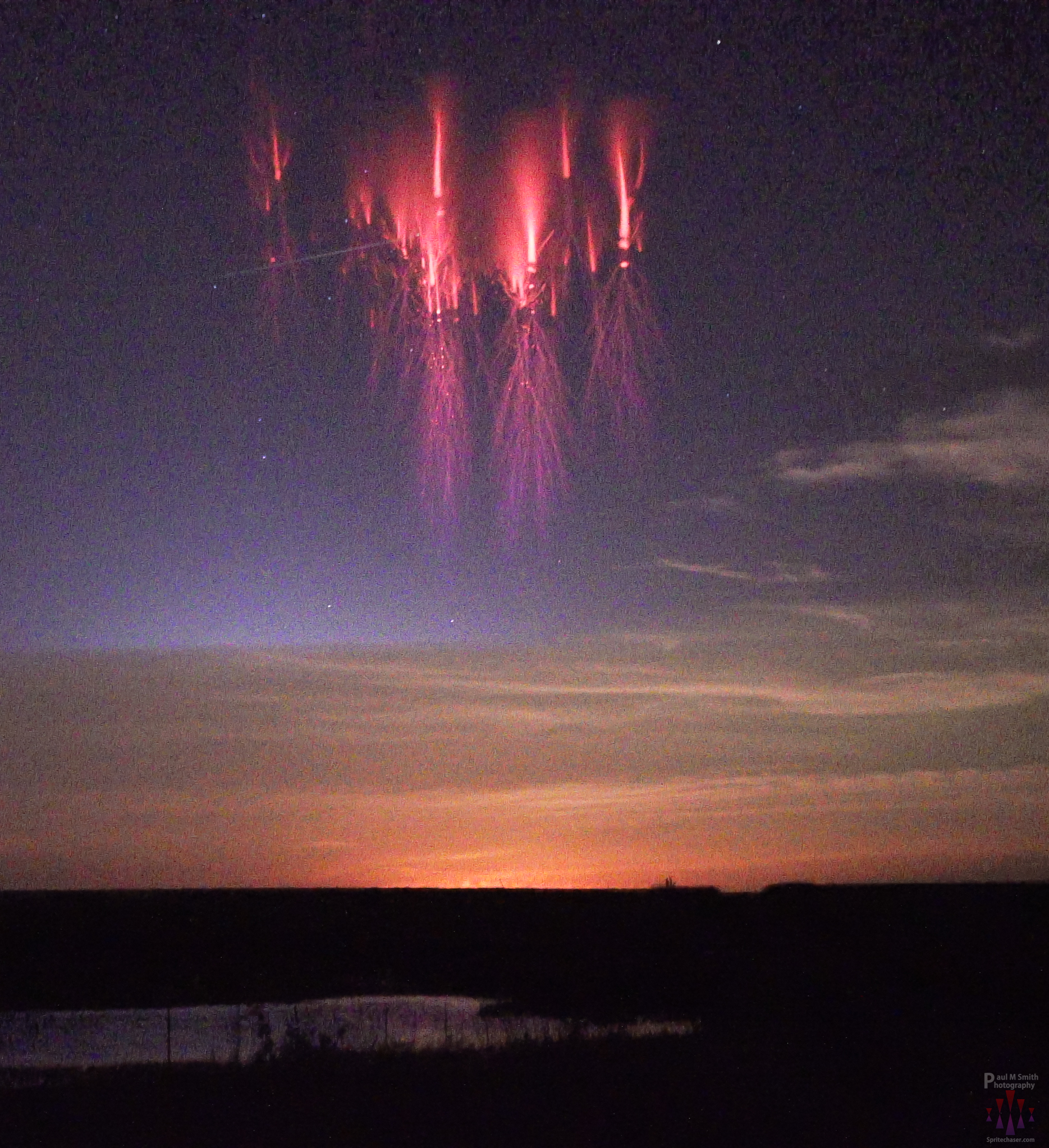
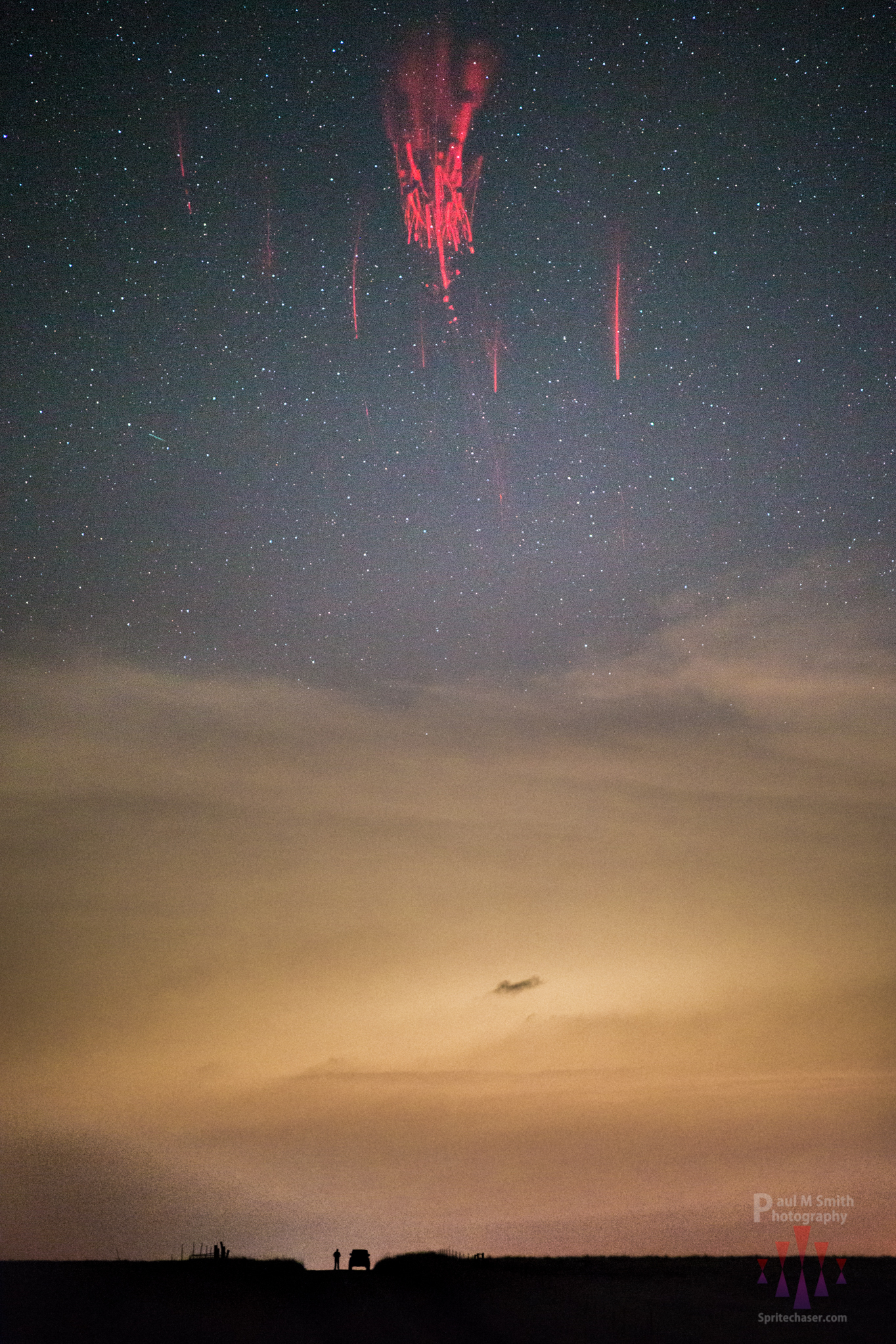
April 30, 2019: Have you ever seen a sprite? Some say it’s impossible. The strange and fleeting forms of red lightning materialize above thunderheads, then disappear again in less time than it takes to blink. Yet this week veteran sprite chaser Paul Smith says he did see them: “I’ve watched a number with my bare eyes over the last two big storms in Kansas.”


Above: Naked-eye sprites over Kansas on April 28th. Credit: Paul Smith.

“It has been an amazing experience that, quite honestly, has left me somewhat emotional,” says Smith. “I am now convinced that before the days of light pollution, these were observed more often than we know.”

Sprites are an exotic form of electricity that leap up from storm clouds instead of down like ordinary lightning. Although sprites have been reported for at least a century, many scientists did not believe they existed until after 1989 when sprites were accidentally photographed by researchers from the University of Minnesota and confirmed by video cameras onboard the space shuttle.

Smith has been chasing and photographing sprites for years in the stormy Great Plains around Oklahoma and Kansas. “This is the first time I have seen them with my unaided eyes,” he says. “I believe that these were unusually bright.” Here are two examples of clusters he caught simultaneously with his eyes and camera.

His eyes registered fewer details than his camera–but he still saw plenty. “The jellyfish shapes I saw had a fiery orange/red color,” he adds. “I didn’t see the bottoms of the tendrils, but I had an impression of the heads and beads. Storm chasers to the west of me were also viewing with their naked eyes.”

The underlying physics of sprites is still not fully understood. Some models hold that cosmic rays help them get started by creating conductive paths in the atmosphere. If cosmic rays do indeed spark sprites, now is a good time to look for them because cosmic rays are nearing a Space Age high.

More examples of naked-eye sprites may be found on Smith’s Facebook page.

A Perfect Storm of Cosmic Rays

April 23, 2019: Ten years ago, NASA reported a “perfect storm of cosmic rays.” During the year 2009, radiation peppering Earth from deep space reached a 50-year high, registering levels never before seen during the Space Age.

It’s about to happen again.

Ground-based neutron monitors and high-altitude cosmic ray balloons are registering a new increase in cosmic rays. The Oulu neutron monitor in Finland, which has been making measurements since 1964, reports levels in April 2019 only percentage points below the Space Age maximum of 2009:

crinfo2

Source: The Sodankyla Geophysical Observatory in Oulu, Finland.

What’s going on? The answer is “Solar Minimum.” During the low phase of the 11-year solar cycle, the sun’s magnetic field and solar wind weaken. Cosmic rays find it easier to penetrate the inner solar system. In 2009, the sun experienced the deepest solar minimum in a century. Cosmic rays reaching Earth naturally surged.

Ten years later, solar minimum is back with renewed weakening of the sun’s magnetic field and the solar wind. Again, it’s a “perfect storm.” A panel of experts led by NOAA and NASA recently predicted that the current minimum would reach a nadir in late 2019 or 2020, likely matching the record-setting minimum of 2009. If they’re right, cosmic rays will continue to increase, with a new record possible in the near future.

neutronsandxrays2

Four years of overlapping data from neutron monitors and cosmic ray balloons agree that atmospheric radiation is increasing again.

Cosmic rays cause “air showers” of secondary particles when they hit Earth’s atmosphere. Indeed, this is what neutron monitors and cosmic ray balloons are measuring–the secondary spray of cosmic rays that rains down on Earth.

This spray is of special interest to air travelers. Secondary cosmic rays penetrate the hulls of commercial aircraft, dosing passengers with the whole body equivalent of a dental X-ray even on ordinary mid-latitude flights across the USA. International travelers receive even greater doses.

The International Commission on Radiological Protection has classified pilots as occupational radiation workers because of accumulated cosmic ray doses they receive while flying. Moreover, a recent study by researchers at the Harvard School of Public Health shows that flight attendants face an elevated risk of cancer compared to members of the general population. They listed cosmic rays as one of several risk factors.

Stay tuned for updates as solar minimum deepens.