159 Years Ago, A Geomagnetic Megastorm

Sept. 2, 2018: Picture this: A billion-ton coronal mass ejection (CME) slams into Earth’s magnetic field. Campers in the Rocky Mountains wake up in the middle of the night, thinking that the glow they see is sunrise. No, it’s the Northern Lights. People in Cuba read their morning paper by the red illumination of aurora borealis. Earth is peppered by particles so energetic, they alter the chemistry of polar ice.

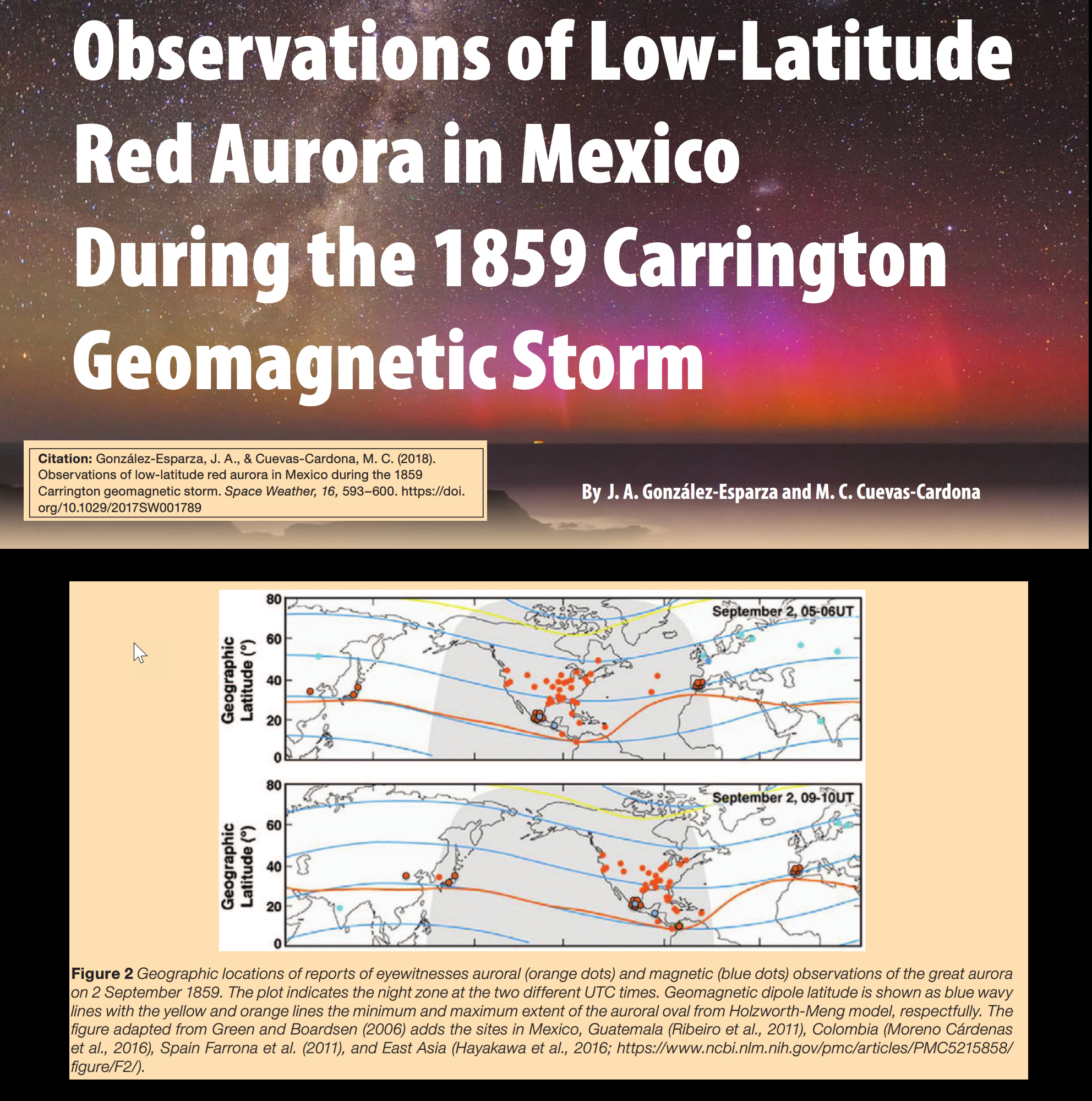
Hard to believe? It really happened 159 years ago. This map shows where auroras were sighted in the early hours of Sept. 2, 1859:

As the day unfolded, the gathering storm electrified telegraph lines, shocking technicians and setting their telegraph papers on fire. The “Victorian Internet” was knocked offline. Magnetometers around the world recorded strong disturbances in the planetary magnetic field for more than a week.

The cause of all this was an extraordinary solar flare witnessed the day before by British astronomer Richard Carrington. His sighting on Sept. 1, 1859, marked the discovery of solar flares and foreshadowed a new field of study: space weather. According to a NASA-funded study by the National Academy of Sciences, if a similar “Carrington Event” occurred today, it could cause substantial damage to society’s high-tech infrastructure and require years for complete recovery.

carrsket

In Sept. 1859, this large sunspot unleashed a record-setting solar flare. Sketch by R. C. Carrington.

Could it happen again? In fact, a similar event did happen only 6 years ago. On July 23, 2012, a powerful explosion on the sun hurled a Carrington-class CME away from the sun. Fortunately, it missed. “If it had hit, we would still be picking up the pieces,” says Prof. Daniel Baker of the University of Colorado, who summarized the event at NOAA’s Space Weather Workshop in 2014.

In a paper published just a few months ago, researchers from the University of Birmingham used Extreme Value Theory to estimate the average time between “Carrington-like flares.” Their best answer: ~100 years, a value which suggests we may be overdue for a really big storm.

Earth to Sky Cosmic Ray Sensors

When cosmic rays hit the top of Earth’s atmosphere, they create a spray of secondary radiation that rains down on the planet below. For years, the students of Earth to Sky Calculus have been measuring secondary cosmic rays on airplanes and high-altitude balloons using two types of sensors.

First, are the neutron bubble chambers:

neutronchambers_600

Each bubble pictured above is formed by an energetic neutron (200 keV – 15 MeV) passing through the chamber. Counting bubbles yields the total dose. We use chambers manufactured by Bubble Technology Industries Inc. of Canada.

Second, we monitor X-rays and gamma rays using sensors based on Geiger tubes:

xraygammaray

These are Polimaster 621M dosimeters sensitive to X-rays and gamma-rays. They sample energies between 10 keV and 20 MeV, spanning the range of medical X-ray machines, airport security devices, and “killer electrons” in Earth’s radiation belts.

Cosmic rays are a cocktail of different things: e.g., neutrons, protons, pions, electrons, X-rays, and gamma rays spanning a wide range of energies. Our sensors sample only three ingredients of that cocktail: neutrons, X-rays, gamma-rays. Furthermore, we are sampling only a relatively low range of energies. Many cosmic rays are much more energetic than the 15 MeV to 20 MeV upper limit of our detectors.

This means our data are only the tip of the iceberg.  Flight crews and passengers absorb even more radiation than we can detect.

Surprise Geomagnetic Storm

Aug. 26, 2018: Last night, a crack opened in Earth’s magnetic field. Solar wind poured in to fuel a strong G3-class geomagnetic storm. John McKinnon photographed the storm’s brilliant green glow from Four Mile Lake in Alberta, Canada:

“At 2 o’clock in the morning, the auroras were so bright I could see them through the glare of the full Moon,” he says.

At the peak of the storm, Northern Lights spilled across the Canadian border into US states such as Michigan, New York, Montana, Wisconsin, and Indiana.  People in Alaska witnessed a fine display as well. At the same time, Southern Lights were photographed from several locations in New Zealand.

Forecasters did not see this coming. The stage was set for the storm when a minor CME arrived with little fanfare about 24 hours ago. First contact with the CME barely registered in solar wind data, and Earth’s magnetic field was unperturbed. The action began only after Earth entered the CME’s wake, where strong south-pointing magnetic fields opened a crack in our planet’s magnetosphere. A surprise geomagnetic storm ensued.

Realtime Aurora Photo Gallery

A New Type of Aurora is Not an Aurora at All

Aug. 20, 2018: A new type of aurora nicknamed “STEVE” may not be an aurora at all, according to a new paper published August 20th in the Geophysical Research Letters. A group of researchers combined satellite data with ground-based imagery of STEVE during a geomagnetic storm to investigate how STEVE is formed. “Our main conclusion is that STEVE is not an aurora,” said Bea Gallardo-Lacourt, a space physicist at the University of Calgary in Canada and lead author of the new study.

steve

STEVE, photographed by Greg Ash of Ely, Minnesota, on May 5, 2018

STEVE is a purple ribbon of light that amateur astronomers in Canada have been photographing for decades, belatedly catching the attention of the scientific community in 2016. It doesn’t look exactly like an aurora, but it often appears alongside auroras during geomagnetic storms. Is it an aurora — or not? That’s what Gallardo-Lacourt’s team wanted to find out.

Auroras appear when energetic particles from space rain down on Earth’s atmosphere during geomagnetic storms. If STEVE is an aurora, they reasoned, it should form in much the same way. On March 28, 2008, STEVE appeared over eastern Canada just as NOAA’s Polar Orbiting Environmental Satellite 17 (POES-17) passed overhead. The satellite, which can measure the rain of charged particles that causes auroras, went directly above the purple ribbon. Gallardo-Lacourt’s team looked carefully at the old data and found … no rain at all.

“Our results verify that this STEVE event is clearly distinct from the aurora borealis since it is characterized by the absence of particle precipitation,” say the researchers. “Interestingly, its skyglow could be generated by a new and fundamentally different mechanism in Earth’s ionosphere.”

Another study has shown that STEVE appears most often in spring and fall. With the next equinox only a month away, new opportunities to study STEVE are just around the corner. Stay tuned and, meanwhile, read the original research here.

Realtime STEVE Photo Gallery

A Mystery in the Mesosphere

August 15, 2018: This summer, something strange has been happening in the mesosphere. The mesosphere is a layer of Earth’s atmosphere so high that it almost touches space. In the rarefied air 83 km above Earth’s surface, summertime wisps of water vapor wrap themselves around speck of meteor smoke. The resulting swarms of ice crystals form noctilucent clouds (NLCs), which can be seen glowing in the night sky at high latitudes.

And, no, that’s not the strange thing.

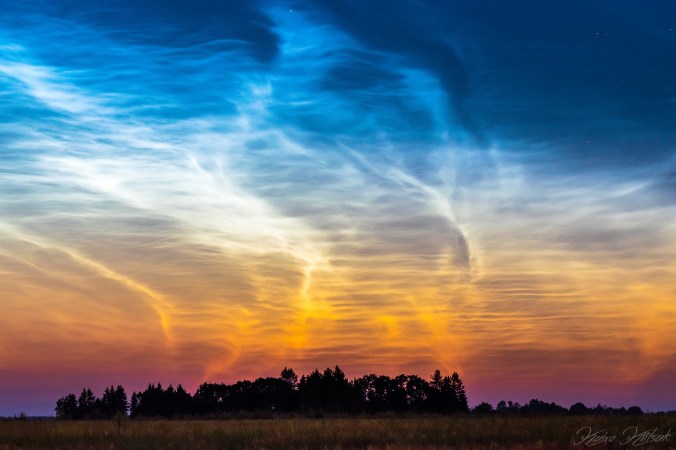
Northern sky watchers have grown accustomed to seeing these clouds every summer in recent years. They form in May, intensify in June, and ultimately fade in July and August. This year, however, something different happened. Instead of fading in late July, the clouds exploded with unusual luminosity. Kairo Kiitsak observed this outburst on July 26th from Simuna, Estonia:

Kairo-Kiitsak-DSC_0943_1532595355

“It was a mind-blowing display,” says Kiitsak. “The clouds were visible for much of the night, with intense ripples for 3 hours.”

Other observers saw similar displays in July and then, in August, the clouds persisted. During the first half of August 2018, reports of NLCs to Spaceweather.com have tripled compared to the same period in 2017. The clouds refuse to go away.

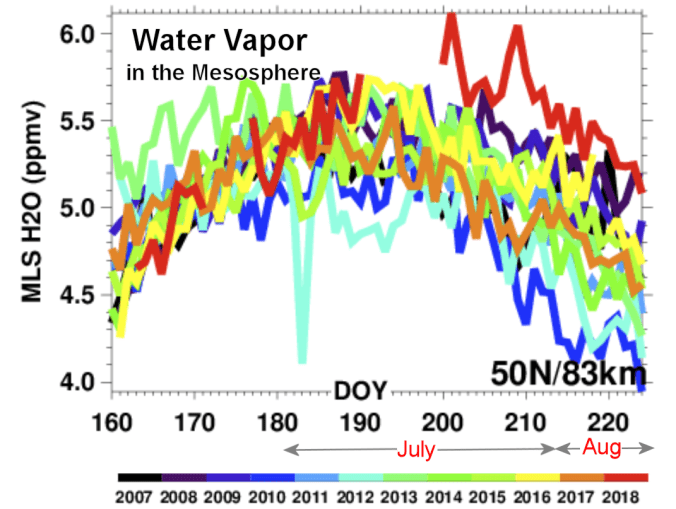
Researchers at the University of Colorado may have figured out why. “There has been an unexpected surge of water vapor in the mesosphere,” says Lynn Harvey of  Colorado’s Laboratory for Atmospheric and Space Physics (LASP).  This plot, which Harvey prepared using data from NASA’s satellite-based Microwave Limb Sounder (MLS) instrument, shows that the days of late July and August 2018 have been the wettest in the mesosphere for the past 11 years:

mls2

The red curve traces water vapor levels in the mesosphere for 2018.

“July went out like a lion!” says Harvey.

In addition to being extra wet, the mesosphere has also been a bit colder than usual, according to MLS data. The combination of wet and cold has created favorable conditions for icy noctilucent clouds.

Harvey and her colleagues are still working to understand how the extra water got up there. One possibility involves planetary wave activity in the southern hemisphere which can, ironically, boost the upwelling of water vapor tens of thousands of miles away in the north. The phenomenon could also be linked to solar minimum, now underway. It is notable that the coldest and wettest years in the mesosphere prior to 2018 were 2008-2009–the previous minimum of the 11-year solar cycle.

Stay tuned for updates and, meanwhile, be alert for NLCs.

Realtime Noctilucent Cloud Photo Gallery


Fun Ways to Observe a Partial Solar Eclipse

August 9, 2018: A partial solar eclipse happens when the Moon passes in front of the sun, off center, turning the solar disk into a fiery crescent. There are usually one or two partial solar eclipses somewhere on Earth every year. They look like this:

Dennis-Put1

Dennis Put photographed this partial solar eclipse over Maasvlakte, The Netherlands, on Jan. 4, 2011.

The first thing to remember about a partial eclipse is don’t stare at it. Even the tiniest sliver of sun left uncovered by the Moon can hurt your eyes. Instead, look at the ground. Beneath a leafy tree, you might be surprised to find hundreds of crescent-shaped sunbeams dappling the grass. Overlapping leaves create a natural array of pinhole cameras, each one casting an image of the crescent-sun onto the ground beneath the canopy.

No trees? Try this trick: Criss-cross your fingers waffle-style and let the sun shine through the matrix of holes. You can cast crescent suns on sidewalks, driveways, friends, cats and dogs—you name it. Hand shadows are fun, too, like the crescent-eyed turkey shown above.

Because partial eclipses typically last for more than an hour, there is plenty of time for shadow play and photography using safely-filtered telescopes and cameras.

Atmospheric Radiation Update: July 2018

July 30, 2018: As the sunspot cycle declines, we expect cosmic rays to increase. Is this actually happening? The answer is “yes.” Spaceweather.com and the students of Earth to Sky Calculus have been monitoring cosmic radiation in the atmosphere with frequent high-altitude balloon flights over California. Here are the latest results, current as of July 2018:

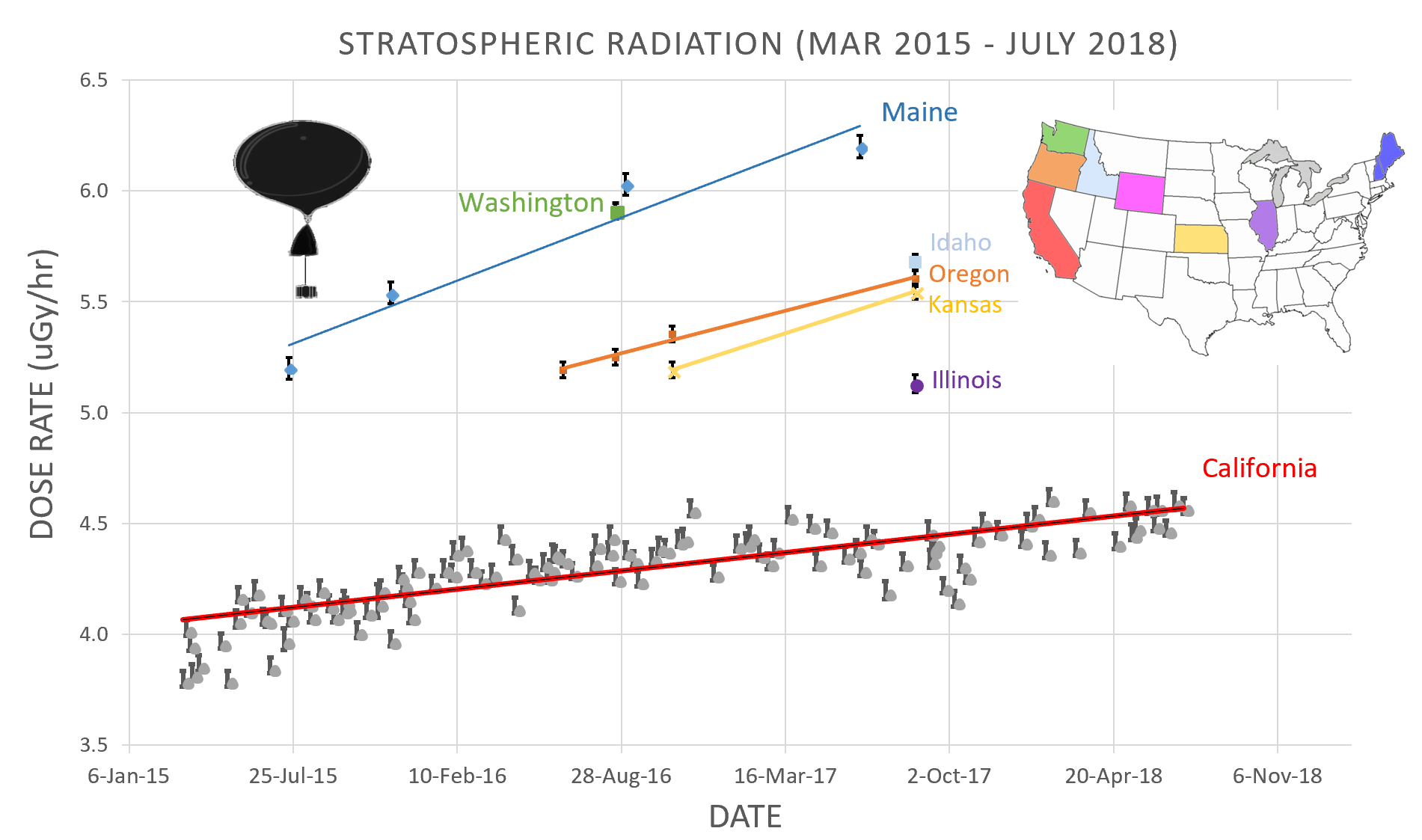
X-ray/gamma-ray dose rates in the stratosphere over California. Energy range: 10 keV – 20 MeV

The data show radiation levels intensifying with an approximately 18% increase in monthly averages since March 2015. This comes as sunspot counts have dipped to a ~10-year low in June and July 2018.

Cosmic rays are the subatomic debris of dying stars, accelerated to nearly light speed by supernova explosions. They travel across the galaxy and approach Earth from all directions, peppering our planet 24/7. When cosmic rays crash into Earth’s atmosphere, they produce a spray of secondary particles and photons that is most intense at the entrance to the stratosphere. This secondary spray is what we measure.


Above: An artist’s rendering of secondary cosmic rays. [more]

Sunspots and cosmic rays have a yin-yang relationship. At the peak of the sunspot cycle, strong solar magnetic fields and solar wind hold many cosmic rays at bay. During solar minimum, however, the sun’s magnetic field weakens and the outward pressure of the solar wind decreases. This allows more cosmic rays from deep space to penetrate the inner solar system and our planet’s atmosphere.

The increase is widespread. Every place in the USA where we have launched multiple balloons exhibits the same pattern. There are upward trends from coast to coast:

The plot, above, shows more than 150 stratospheric radiation measurements we have made using balloons flown over the continental USA. Because California is our home base, it is more densely sampled than other states. Adding additional points outside California remains a key goal of the monitoring program.

How do cosmic rays affect us? Cosmic rays penetrate commercial airlines, dosing passengers and flight crews so much that pilots are classified as occupational radiation workers by the International Commission on Radiological Protection (ICRP). According to a recent study from researchers at the Harvard School of Public Health, flight attendants face an elevated risk of cancer compared to members of the general population. The investigators listed cosmic rays among several risk factors. Weather and climate may also be affected, with some research linking cosmic rays to to the formation of clouds and lightning.

In August-December 2018 we will conduct a new campaign of coordinated balloon launches from the USA (including sites in California, Washington, Kansas, Oregon, and Maine), Chile, and New Zealand to further probe the evolving cosmic ray situation. As solar activity declines we expect to find increasing radiation around the globe. Stay tuned for updates.

Lunar Eclipse and Martian Conjunction

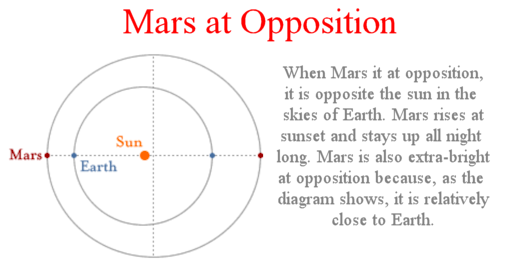
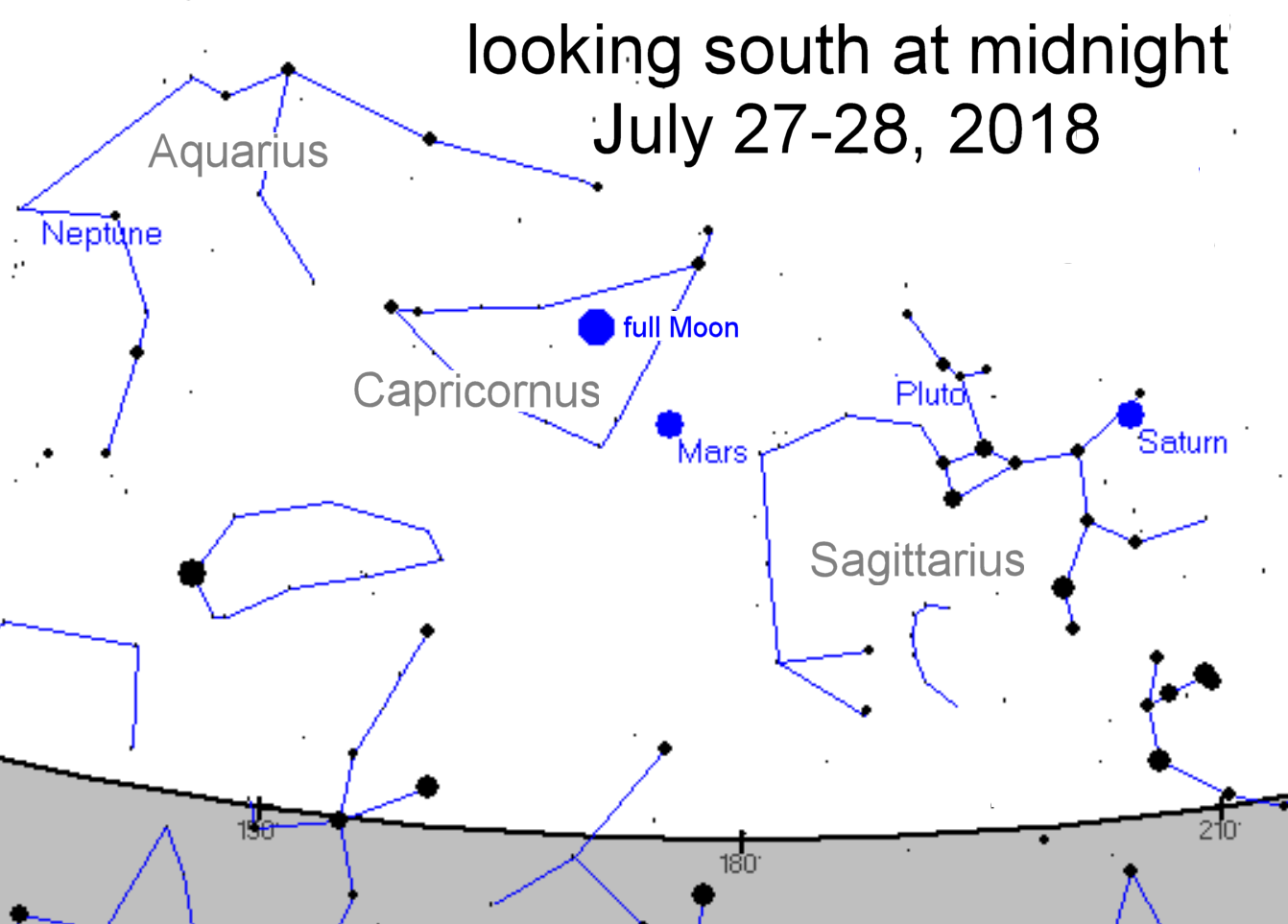
July 25, 2018: Friday, July 27th, is a big night for astronomy. Three reasons: First, Mars will be at opposition–directly opposite the sun and making a 15-year close approach to Earth. Second, Mars and the full Moon will be in conjunction–less than 10 degrees apart. Third, the Moon will pass through the shadow of Earth, producing the longest lunar eclipse in a century.

Graphic artist Larry Koehn of ShadowandSubstance.com created this montage of the eclipse:

eclipsemontage07272018

An animation of the eclipse may be found here.

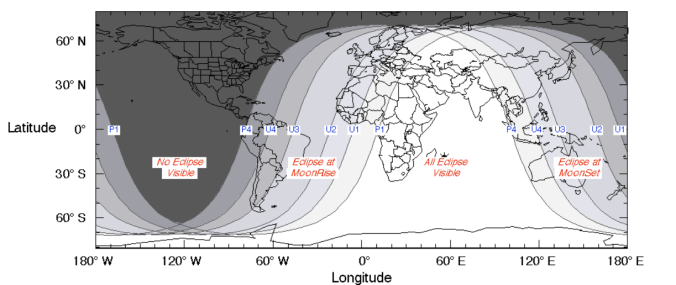
Almost everyone on Earth (except North Americans) can see the eclipse as the sunset-colored shadow of our planet swallows the Moon for almost 2 hours. During totality, the Moon will turn almost the same red color as Mars right beside it–an incredible sight.

Visibility_Lunar_Eclipse_2018-07-27
Because Mars is opposite the sun, it will rise at sunset and stay up all night long.  The best time to look is around midnight when the Moon-Mars pair will be at their highest in the sky. The Red Planet will have no trouble being seen through the glare of the full Moon because Mars itself is so luminous–almost three times brighter than Sirius, the brightest star in the sky.

People in North America will not be able to see the eclipse. The shadow play happens mostly on the opposite side of the world. They can, however, witness the conjunction. Swinging a backyard telescope between the Moon and Mars in quick succession will reveal the dusty-red martian disk alongside lunar mountains and craters. It’s a special night. Enjoy the show!

Spiders and the Global Electrical Circuit

July 20, 2018: Did you know that spiders can fly? Biologists call it “ballooning.” Spiders spin a strand of silk, it juts into the air, and off they go. Airborne arachnids have been found as high as 4 km off the ground. Originally, researchers thought spiders were riding currents of air, but there’s a problem with that idea. Spiders often take flight when the air is calm, and large spiders fly even when air currents are insufficient to support their weight. It’s a mystery.

Scientists from the University of Bristol may have found the solution. In a paper published in the July 5th edition of Current Biology, they proved that spiders can propel themselves using electric fields.

ballooningspider_strip

Just before ballooning, spiders adopt a posture shown here called “tiptoeing.”

“We exposed adult Linyphiid spiders (Erigone) to electric fields similar to those which naturally occur in Earth’s atmosphere,” explains the paper’s lead author, Erica Morley. “Spiders showed a significant increase in ballooning in the presence of electric fields.” A remarkable video of their experiment shows one spider flying when the fields were switched on, then landing when the fields were off again. It appears conclusive.

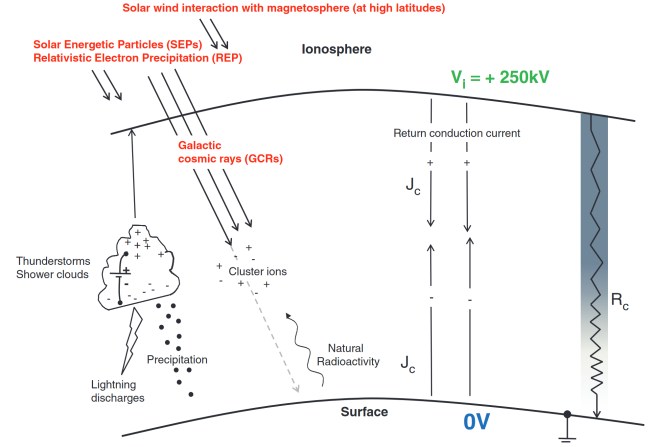
The electric fields spiders use for propulsion are part of Earth’s global atmospheric electric circuit (GEC)–a planet-sized circuit of electricity that researchers have known about since the 1920s. In a nutshell, thunderstorms help build up a charge difference between the ground and the ionosphere 50 km overhead. The voltage drop is a staggering 250,000 volts. This sets up electric fields linking Earth to the edge of space. Cosmic rays ionize Earth’s atmosphere, turning it into a weak conductor that allows currents to flow through the GEC. [Ref]
gec_crop

This diagram, borrowed from K. A. Nicoll’s 2014 review paper “Space Weather influences on Atmospheric Electricity,” illustrates the role of thunderstorms and cosmic rays in creating electric fields.

Spiders evolved inside the global electric circuit, so it’s no surprise that they have learned to tap into it. But how? Peter W. Gorham of the Dept. of Physics and Astronomy at the University of Hawaii notes that “the complex protein structure of spider silk includes charge-bearing amino acids glutamic acid and arginine, which might be generated in a charged state as part of the spinning process. [Alternately, those acids might be able to attract charge] from the local launching surface as strands are spun from the sharp nozzles of the spinneret.” [Ref]

Researchers have long wondered about the role of electricity in spider flight. Charles Darwin may have been the first. He wrote about it during his voyages on the HMS Beagle (1831-1836). One day, the ship was 60 miles off the coast of Argentina when the deck was inundated by ballooning spiders. “The day was hot and apparently quite calm,” he wrote, yet “I repeatedly observed the same kind of small spider, either when placed or having crawled on some little eminence, elevate its abdomen, send forth a thread, and then sail away horizontally, but with a rapidity which was quite unaccountable.” He was particularly struck by spiders using multiple strands of silk that splayed out in fan-like shapes. Instead of tangling as they moved through the air, the strands remained separate. Were they repelled by an electrostatic force? Darwin wondered in his writings. The work of Erica Morley and her collaborator Daniel Robert closes the loop on a train of thought almost 200 years old.
spiderhairs_crop

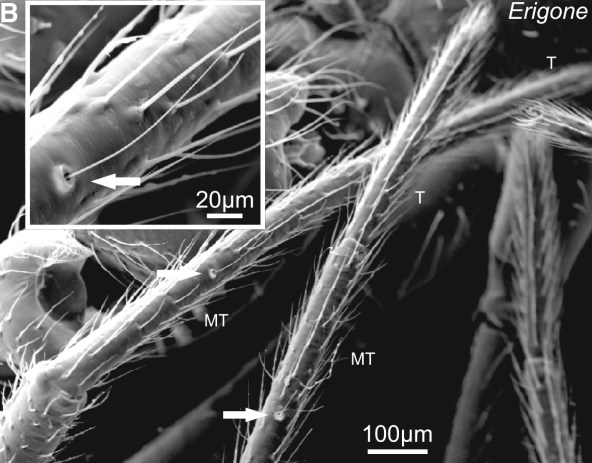
Hairs on the legs of spiders called “trichobothria” twitch when electric fields are present–a signal to the spider that ballooning may commence.

All of this raises the possibility that spiders may be affected by space weather as electric fields are perturbed by cosmic rays and solar activity. Research groups have demonstrated connections between space weather and atmospheric electricity on a variety of time scales.  Days: Coronal mass ejections (CMEs) from the sun can sweep aside cosmic rays as they pass by Earth, causing temporary reductions in atmospheric ionization as large as 30%. Our own Spaceweather.com/Earth to Sky cosmic ray balloons have measured these events. [RefMonths: Measurements at the Reading University Atmospheric Observatory in the UK have shown that voltages can fluctuate +-15% as Earth dips in and out of the heliospheric current sheet (a huge corrugated magnetic structure centered on the sun) every ~27 days. [RefYears: During the 20th century, fair weather atmospheric voltages at sites in Scotland and the UK decreased by factors of ~25% due to a long-term decrease in cosmic rays. [Ref] That slow trend is now reversing itself as cosmic rays intensify again.

Could the migration patterns of ballooning spiders be affected by space weather? “It’s entirely possible, but we simply don’t yet know,” says Morley. “The experiments we have carried out are mostly lab-based, which helps eliminate confounding variables. A next step in the project is to take this all into the field and look for patterns. Factoring in solar activity could be very interesting.”

Stay tuned.
Three Weeks Without Sunspots

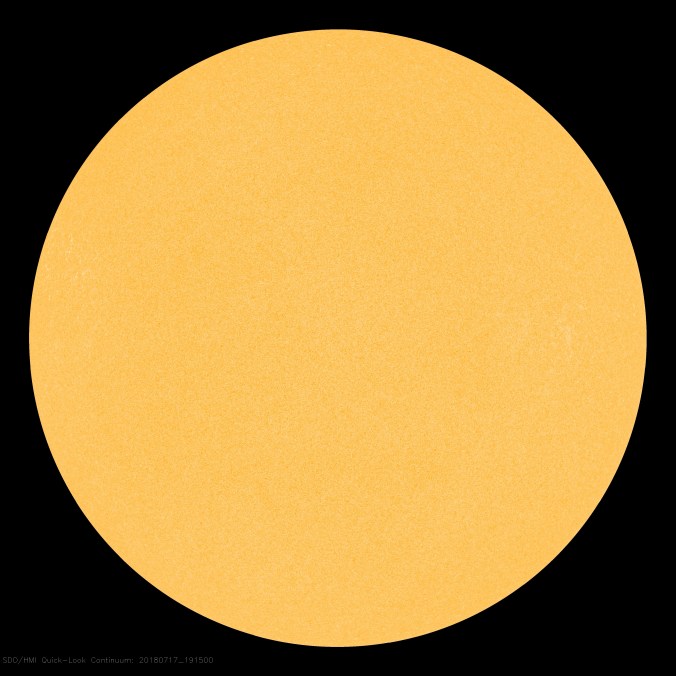
July 17, 2018: As July 17th comes to a close, the sun has been without spots for 21 straight days. To find an equal stretch of spotless suns in the historical record, you have to go back to July-August 2009 when the sun was emerging from a century-class solar minimum. This is a sign that the sun is entering another solar minimum, possibly as deep as the last one.

bigblanksun

Solar minimum is a normal part of the solar cycle. Every 11 years or so, sunspot production sputters. Dark cores that produce solar flares and CMEs vanish from the solar disk, leaving the sun blank for long stretches of time. These quiet spells have been coming with regularity since the sunspot cycle was discovered in 1859.

However, not all solar minima are alike. The last one in 2008-2009 surprised observers with its depth and side-effects. Sunspot counts dropped to a 100-year low; the sun dimmed by 0.1%; Earth’s upper atmosphere collapsed, allowing space junk to accumulate; and the pressure of the solar wind flagged while cosmic rays (normally repelled by solar wind) surged to Space Age highs. These events upended the orthodox picture of solar minimum as “uneventful.”

solarcycle_july2018_strip

Space weather forecasters have been wondering, will the upcoming solar minimum (2018-2020) be as deep as the previous one (2008-2009)? A 21-day stretch of blank suns is not enough to answer that question. During the solar minimum of 2008-2009, the longest unbroken interval of spotlessness was ~52 days, adding to a total of 813 intermittent spotless days observed throughout the multi-year minimum. The corresponding totals now are 21 days and 244 days, respectively. If this solar minimum is like the last one, we still have a long way to go.

How does this affect us on Earth? Contrary to popular belief, auroras do not vanish during solar minimum. Instead, they retreat to polar regions and may change color. Arctic sky watchers can still count on good displays this autumn and winter as streams of solar wind buffet Earth’s magnetic field. The biggest change brought by solar minimum may be cosmic rays. High energy particles from deep space penetrate the inner solar system with greater ease during periods of low solar activity. NASA spacecraft and space weather balloons are already detecting an increase in radiation. Cosmic rays alter the flow of electricity through Earth’s atmosphere, trigger lightning, potentially alter cloud cover, and dose commercial air travelers with extra “rads on a plane.”

At the moment there are no nascent sunspots on the solar disk, so the spotless days counter is likely to keep ticking. Stay tuned for more blank suns and … welcome to solar minimum.