Astronauts Photograph Starlink Satellites from Space

April 20, 2020: For the first time, SpaceX’s controversial Starlink satellites have been photographed by astronauts onboard the International Space Station. Here they are, photo-bombing a display of aurora australis on April 13, 2020:
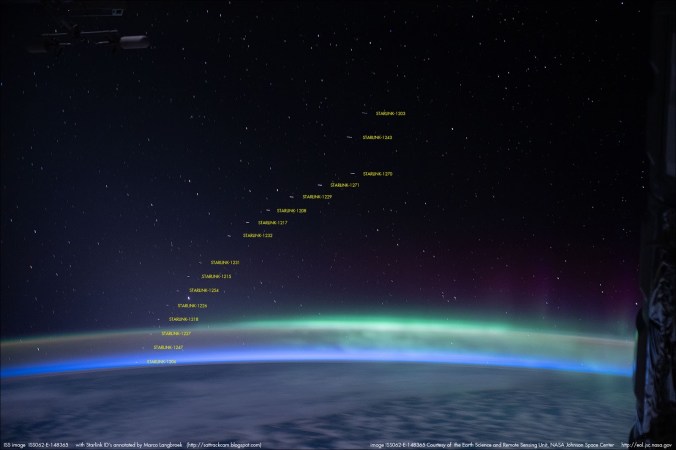
ISS062-E-148365_red_PlusID

The ISS was flying over the southern Indian Ocean when the sighting occurred with cameras pointing generally south toward Antarctica. At the time, a minor stream of solar wind was buffeting Earth’s magnetic field, sparking auroras over the frozen continent. The Starlink train stretches all the way from the twilight-blue horizon to the starry sky high above the aurora layer.

Dutch satellite expert Marco Langbroek identified the Starlink satellites and labeled the original NASA image. “These are all objects from the 17 February 2020 launch— a.k.a. ‘Starlink 4,'” Langbroek wrote in his blog.

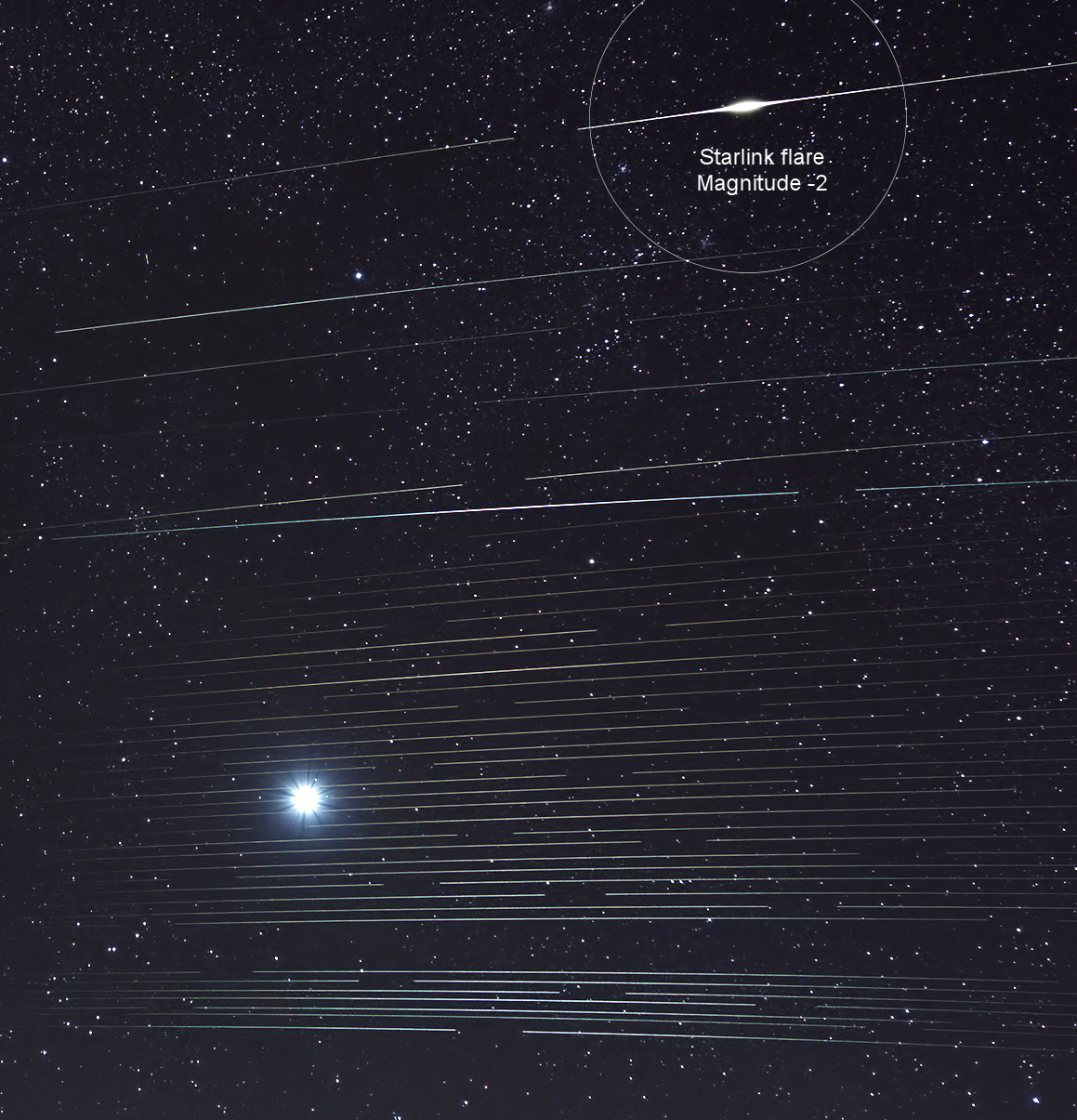
Starlink is a new venture by SpaceX, which aims to surround Earth with satellites and beam affordable internet to remote locations all over the world. It is controversial because of its potential effect on the night sky. Just after launch, Starlink satellites easily can be seen with the unaided eye, swarming across stars and planets familiar to backyard astronomers. Scott Tucker of Tucson, Arizona, was photographing Venus on the evening of April 17th when this happened:

venus_flare

“I watched 41 Starlink satellites from the most recent launch pass by Venus during late twilight,” says Tucker. “One of them even flared like an Iridium satellite! It got to magnitude -2 for a few seconds.”

Newly-launched Starlink satellites eventually dim as they approach operational orbits 550 km above Earth–but even then they can interfere with research astronomy. Big telescopes have no trouble detecting Starlink satellites no matter how high they go. The fact that SpaceX plans to launch at least 12,000 of them has prompted the International Astronomical Union to sound the alarm.

So far, there are 360 Starlinks into Earth orbit, a tiny fraction of the ultimate total, yet still a large number. Accidental sightings have become so common that we now have an entire photo gallery of Starlink sightings. Browse the collection and see what you think.

Realtime Starlink Photo Gallery
Free:
Spaceweather.com Newsletter
Introducing Comet SWAN

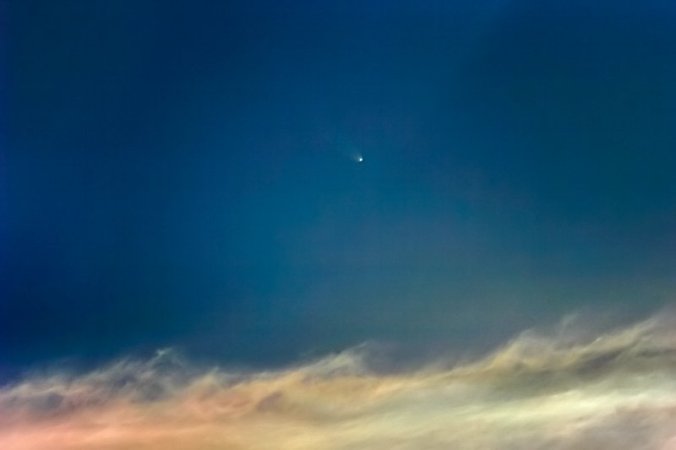
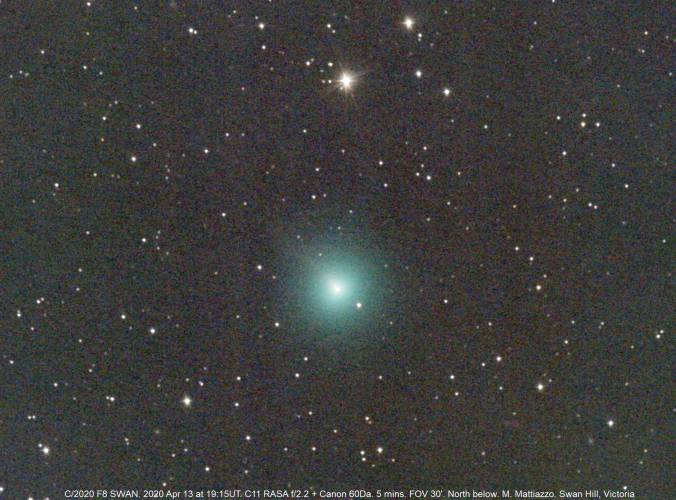
April 15, 2020: Warning: This story may give you a sense of déjà vu. A new comet has been discovered, and in late May it will pass by the sun near the orbit of Mercury. No, it’s not Comet ATLAS (C/2019 Y4), which is currently falling apart on a similar trajectory. Instead, this is Comet SWAN (C/2020 F8):

cometswan_mm

Michael Mattiazzo of Swan Hill, Victoria, Australia, took the picture on April 13th. “This is a 5 minute exposure through my 11-inch Celestron telescope,” says Mattiazzo. “A visual observation using 15x70mm binoculars gave a magnitude of 8.1.”

Mattiazzo discovered the comet two days earlier when he was looking at data from the Solar and Heliospheric Observatory (SOHO). It suddenly appeared in images from SOHO’s SWAN instrument. “This is my 8th discovery credit for SWAN comets since 2004 and I do check the data on most days,” says Mattiazzo.

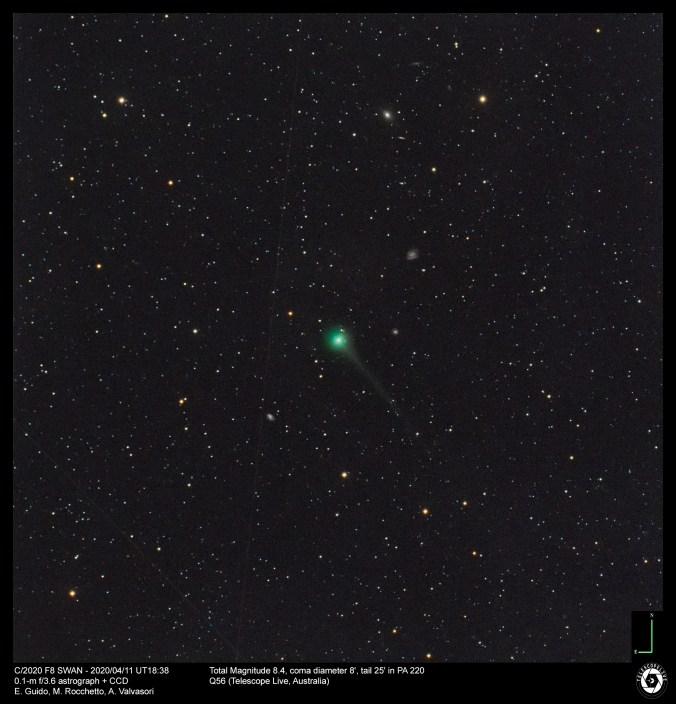
Post-discovery images taken by Italian astronomer Ernest Guido and colleagues confirm that the comet is bright (8th magnitude), green, and has a long tail:

cometswan

“We took this picture on April 11th–the same day Mattiazzo found the comet in SWAN data,” says Guido. “We couldn’t see it from Italy, so we used a remote-controlled 0.1 meter telescope in Australia.”

SOHO’s SWAN instrument was not designed to find comets. Its job is to survey the solar system for hydrogen. When the solar wind blows into a cloud of hydrogen-bearing compounds, the impact produces UV photons that SWAN can photograph.

“For SWAN to see a comet, it means the comet must be producing a fairly significant amount of hydrogen,” explains Karl Battams of the Naval Research Lab in Washington DC. “This is usually in the form of water-ice.”

“It’s extremely likely that Comet SWAN is in ‘outburst’ mode,” he continues. “That is, some major eruption happened to this otherwise small and faint comet, releasing a massive cloud of hydrogen-rich volatiles. SWAN is picking up on this sudden dump of hydrogen into the inner solar system.”

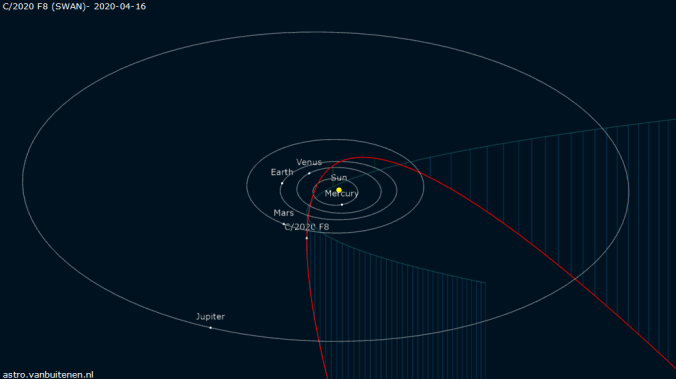
swanorbit

Click to view an interactive preliminary orbit of Comet SWAN. Credit: Gideon van Buitenen

If the outburst continues, Comet SWAN could become visible to the naked eye next month. Preliminary light curves suggest that it could reach 3rd magnitude–dim, but visible without optics. However, Battams, who correctly predicted the demise of Comet ATLAS, is not so sure.

“I doubt that the comet will maintain its current impressive appearance, and will quite possibly fade away soon,” he says. “But we’ve only been viewing it for a couple of days, so no one knows.”

Comet SWAN is currently located in southern skies, best seen by telescopes in Australia, New Zealand, southern Africa and South America. Preliminary orbital elements are available here. Stay tuned for updates.

Fragments of Comet ATLAS

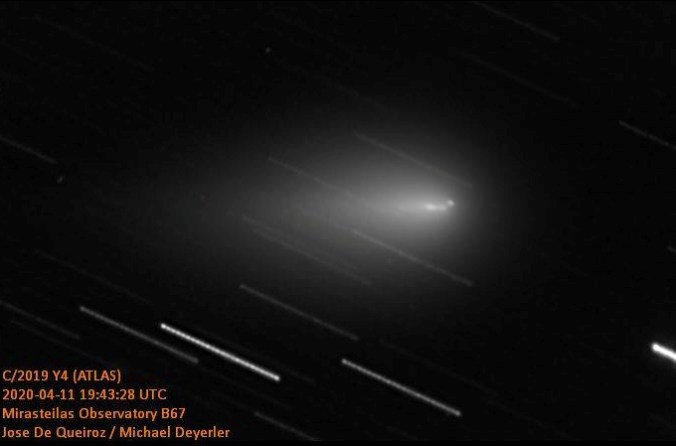
April 13, 2020: There’s no longer any doubt. Comet ATLAS (C/2019 Y4) is falling apart. Around the world, amateur astronomers are beginning to witness the breakup, even imaging individual fragments. Jose de Queiroz photographed 3 pieces on April 11th:

fragmentation_big

“I took the picture using the 90 cm telescope at Observatory Mirasteilas in Falera, Switzerland,” says de Queiroz. “This is a stacked 20×120 sec exposure.”

Confirming images from the Lulin One-meter Telescope in Taiwan have just been reported in an Astronomer’s Telegram. The observing team, led by Zhong-Yi Lin of Taiwan’s National Central University, estimates that the leading fragment is about 3400 km ahead of the trailing pair.

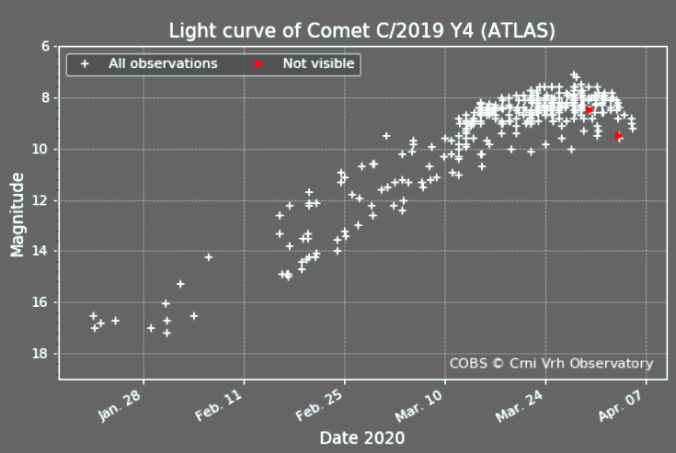
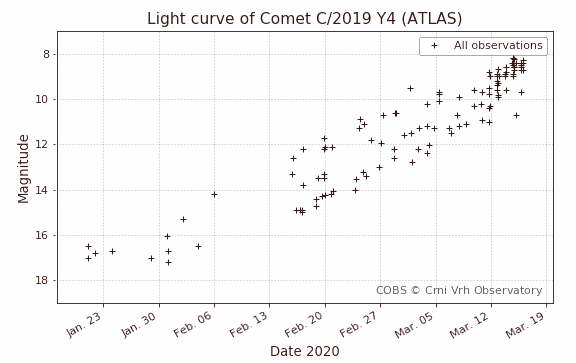
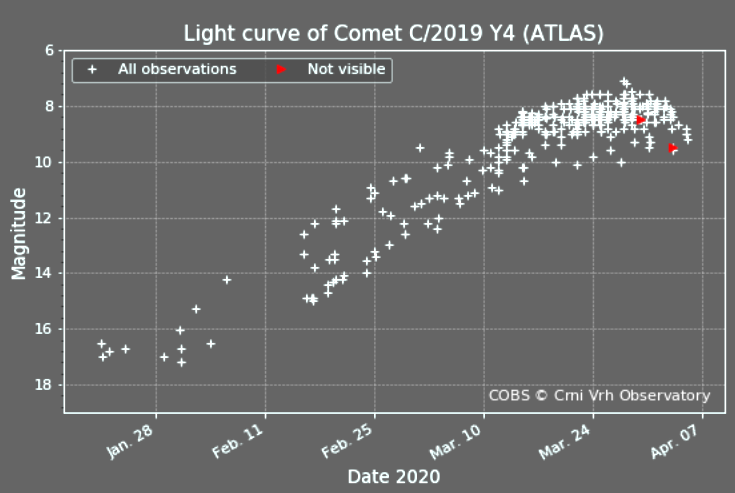
The breakup of Comet ATLAS coincides with a sharp decline in its brightness. The Comet Observation Database shows a drop of two full magnitudes (a factor of more than 6):

lightcurve

These trends suggest that the comet *might* completely dissolve before its close approach to the sun inside the orbit of Mercury at the end of May. “Follow-up observations of C/2019 Y4 (ATLAS), both imaging and spectroscopy, are highly recommended to investigate the cause of this cometary breakup event,” says Lin and colleagues.

Realtime Comet ATLAS Photo Gallery
Free:
Spaceweather.com Newsletter
Where the Power Might Go Out

April 9, 2020: A solar superstorm can make your lights go out. New maps released by the USGS show where the power is most likely to fail: The Denver metropolitan area, the Pacific northwest, the Atlantic seaboard, and a cluster of Midwestern states near the US-Canadian Border. Bright yellow and orange trace the trouble spots across the contiguous USA:

voltagemaps

Power companies have long been wary of the sun. Solar storms can cause strong electric currents to flow through commercial power lines–so strong that the lines can’t handle it. Fuses blow, transformers melt, and circuit breakers trip. The most famous geomagnetic power outage happened during a space storm in March 1989 when six million people in Quebec lost power for 9 hours.

Whether or not *your* power goes out during a solar storm depends on two things: (1) The configuration of power lines in your area and (2) the electrical properties of the ground beneath your feet. In areas of more electrically resistive rock, currents struggle to flow through the ground. Instead, they leap up into overhead power lines – a scenario that played out in Quebec in 1989.

The new maps are possible thanks to Earthscope–a National Science Foundation magnetotelluric survey of the upper 2/3rds of the contiguous USA. Earthscope mapped the electrical properties of deep rock and soil on a continent-spanning grid with points about 70 km apart. USGS researchers led by Greg Lucas and Jeffrey Love combined this information with the layout of modern power lines to estimate peak voltages during a century-class storm.

Electric powerlines

Sprawling power lines act like “solar storm antennas,” picking up currents and spreading the problem over a wide area.

They found a huge variation in hazard across the USA. “The largest estimated once-per-century geoelectric field is 27.2 V/km at a site located in Maine, while the lowest estimated once-per-century geoelectric field is 0.02 V/km at a site located in Idaho. That is more than 3 orders of magnitude difference,” they wrote in their research paper “A 100‐year Geoelectric Hazard Analysis for the U.S. High‐Voltage Power Grid.” Notably, some of the most vulnerable regions are near big cities: Denver, Boston, New York, Philadelphia, Baltimore, and Washington, DC.

To complete the hazard map, the researchers are waiting for a new magnetotelluric survey to cover the rest of the USA. It can’t come soon enough. The last “century-class” geomagnetic storm hit in May 1921 … 99 years ago.

Comet ATLAS is Breaking Up

April 6, 2020: Comet ATLAS (C/2019 Y4), what are you doing? New data from astronomers around the world show that the once-promising comet is beginning to fade. For Karl Battams of the Naval Research Lab in Washington DC, it could be a classic case of “I told you so.”

atlas_crop

Comet ATLAS on March 28th. Credit: Tim Connolly of Plattsburgh, NY. [More images]

“Quoting myself from March 15th,” says Battams, “‘I wouldn’t be surprised to see Comet ATLAS start to fade rapidly and possibly even disintegrate before reaching the sun.’ I very much hope I’m wrong, but Comet Elenin did something similar several years ago, holding lots of promise and then just… fizzling.”

In recent months, Comet ATLAS galvanized astronomers as it fell toward the sun, skyrocketing in brightness like few comets before it. By late May 2020 it promised to rival Venus in the sunset sky. But recent developments belie that possibility.

On April 6th, astronomers Quanzhi Ye of the University of Maryland) and Qicheng Zhang of Caltech reported new images of Comet ATLAS, in which the comet’s core appears to be elongating–“as would be expected from a major disruption of the nucleus,” they wrote in an Astronomical Telegram.

possiblefragmentation

Images from the 0.6-m Ningbo Education Xinjiang Telescope show a possible fragmentation of ATLAS’s core

“It’s possible that this is the beginning of the end,” says Battams.

Recent measurements of the comet’s position also point to trouble. Battams explains: “The comet’s orbit is now being influenced by ‘non-gravitational’ forces. These forces are the result of gases lifting off the comet nucleus and causing the nucleus to move very slightly in the opposite direction–sort of like a jet engine. Most active comets experience this to some degree, but ATLAS’s non-gravitational forces have kicked in very abruptly and are quite strong. This supports a narrative of a small nucleus being pushed very strongly by extreme outgassing, possibly along with fragmentation.”

“Finally, let’s not forget that ATLAS is a fragment of a larger (unidentified) comet also related to the Great Comet of 1844,” says Battams. “Fragmenting is a family trait for these guys.”

lightcurve

Is Comet ATLAS doomed? Not necessarily. “The frustrating thing about comets is we often don’t know exactly what they’re doing or why they’re doing it. There’s still a chance that Comet ATLAS is just ‘taking a breather’ before another outburst,” says Battams. “But I wouldn’t count on it….”

No matter what happens, amateur astronomers are encouraged to monitor developments. Submit your images here.

Noctilucent Clouds over the South Pacific

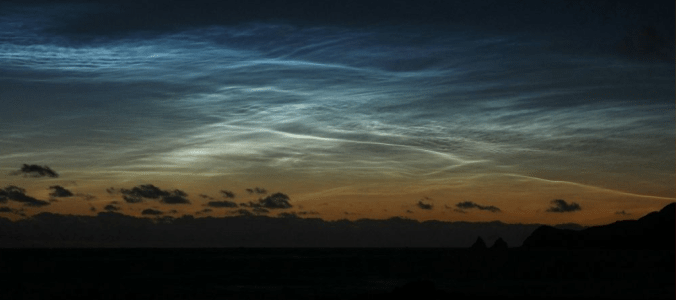
March 26, 2020: You don’t see this everyday–or even in 30 years. “Noctilucent clouds have appeared over the South Pacific,” reports  meteorologist Ashleigh Wilson of the Australian Antarctic Division. “I photographed them from Macquarie Island on Jan. 4th.”

southpacific_nlc_crop

Noctilucent clouds over Macquarie Island on Jan. 4, 2020. Photo credit: Ashleigh Wilson of the Macquarie Island Bureau of Meteorology team, Australian Antarctic Division. [more]

Wilson is just wrapping up a year-long stint on the remote island where the Australian government maintains a research station to study climate change and wildlife. She’s been there, off and on, since the year 2000, and this is the first time she’s ever seen NLCs.

“According to John French of the Australian Antarctic Division Atmospheric Science Program, the only other photographic recording of NLCs on Macquarie Island was in the mid-1990s,” Wilson says.

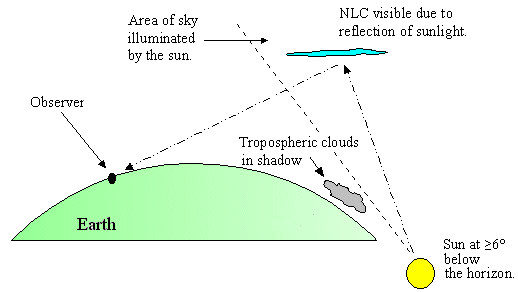
NLCs are Earth’s highest clouds. Seeded by meteoroids, they float at the edge of space more than 80 km above the planet’s surface. NLCs form when summertime wisps of water vapor rise up to the edge of space and crystalize around specks of ‘meteor smoke.’ Prime time for sightings is June-July in the north, December-January in the south.

geometry
“It was a breathtaking moment when I first realized what I was seeing,” recalls Wilson. “I had just finished my shift in the Met office at 11:30 pm and I was walking back to our dorms. Luminous filaments were crisscrossing the sky, blue in color with some wave formations. I spent two hours down by the ocean with a camera and tripod, adjusting ISO and lenses, trying to capture the extraordinary event. The clouds were so bright, I could see their reflection in the water.”

Wilson’s sighting caps a remarkable year for noctilucent clouds. Once confined to Earth’s polar regions, NLCs have recently spread to lower and lower latitudes. In 2019, the clouds appeared over Rome, Italy; Las Vegas, Nevada; Albuquerque, New Mexico; Paris, France; and outside Los Angeles, California. Many of the sightings smashed old records for low-latitude visibility.

nlc_range_2019

The recent spread of noctilucent clouds. The shaded area shows the traditional domain of NLCs. Black circles denote sightings during the northern summers of 2003-2011. Red circles are for June 2019. All data come from Spaceweather.com. The map originally appeared in JGR Atmospheres: article.

In the southern hemisphere, reports of *any* noctilucent clouds are quite rare–in part because there are fewer people on that side of the world; in part because southern NLCs are usually weaker than their northern counterparts. Nevertheless, NLCs were sighted over New Zealand in Dec. 2019 and Macquarie Island in Jan. 2020.

Why are NLCs so revved up? No one knows for sure. It could be a result of climate change and/or the solar cycle. Satellites have recently detected extra moisture in the mesosphere–a key ingredient of NLCs. That moisture may be surviving thanks to low solar activity. Right now a deep Solar Minimum is underway. Ultraviolet radiation that would normally destroy water in the mesosphere is at low ebb.

Get ready for more. The northern hemisphere season for NLCs is about to begin as summertime wisps of water vapor drift up toward the edge of space. The first electric-blue filaments are typically sighted in mid- to late-May. If recent events are any guide, 2020 could be very special indeed.

Stay tuned!


Comet ATLAS is Half as Wide as the Sun

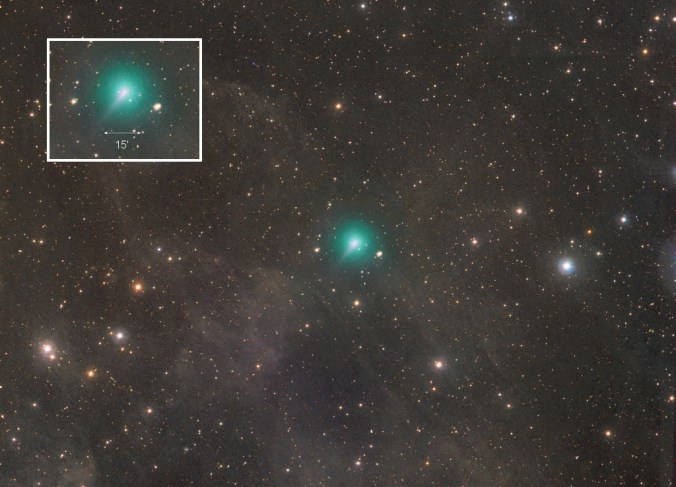
March 24, 2020: No one knows how big the icy core of Comet ATLAS (C/2019 Y4) might be–possibly no wider than a few kilometers. One thing’s for sure, though, the comet’s atmosphere is huge. New images from amateur astronomers around the world show that ATLAS’s gaseous envelope has ballooned in diameter to ~720,000 km–about half as wide as the sun.

cometatlas_inset

“Comet ATLAS’s coma (atmosphere) is approximately 15 arcminutes in diameter,” reports Michael Jäger of Weißenkirchen, Austria, who took the picture, above, on March 18th. “Its newly-formed tail is about the same size.”

Other astronomers are getting similar results. 15 arcminutes = a quarter of a degree. Given Comet ATLAS’s distance of 1.1 AU on March 18th, that angle corresponds to a physical size of 720,000 km.

On the scale of big things in the solar system, Comet ATLAS falls somewhere between the sun (1,392,000 km  diameter) and Jupiter (139,820 km). It’s not unusual for comets to grow so large. While their icy solid cores are typically mere kilometers in diameter, they can spew prodigious amounts of gas and dust into space, filling enormous volumes. In the fall of 2007, Comet 17P/Holmes partially exploded and, for a while, had an atmosphere even larger than the sun. The Great Comet of 1811 also had a sun-sized coma. Whether Comet ATLAS will eventually rival those behemoths of the past remains to be seen.

Right now, Comet ATLAS is certainly the biggest green thing in the Solar System. Its verdant hue comes from diatomic carbon, C2, a molecule commonly found in comets.  Gaseous C2 emits a beautiful green glow in the near-vacuum of space.

skymap_atlas_24mar20

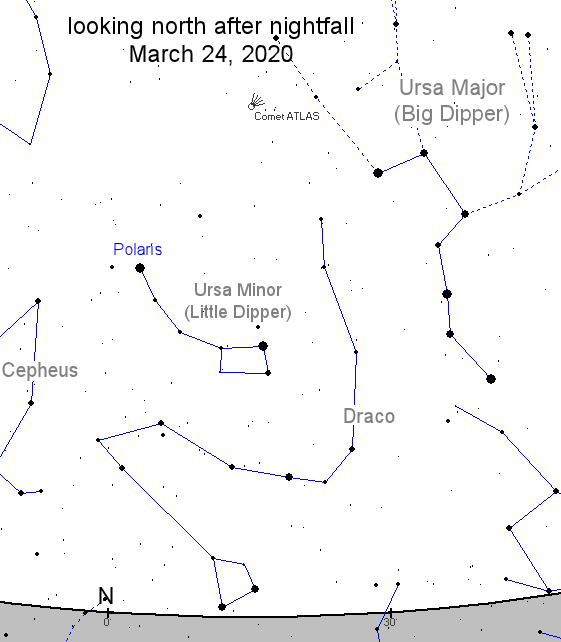
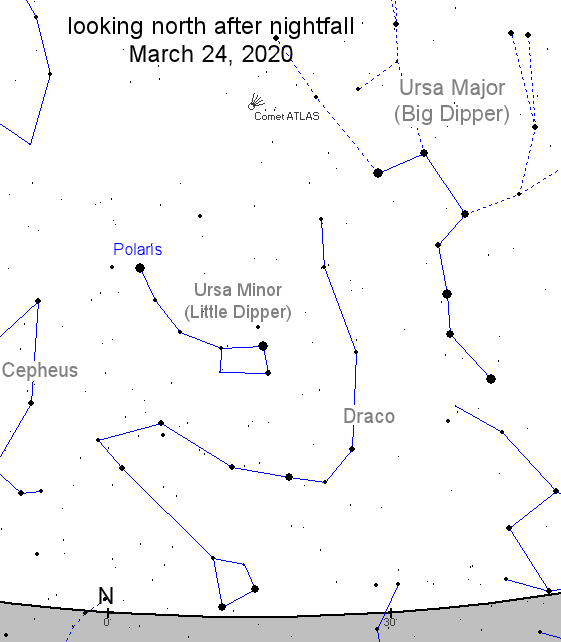
Currently, Comet ATLAS is shining like an 8th magnitude star–invisible to the unaided eye but an easy target for backyard telescopes. The comet is brightening rapidly as it comes closer to Earth and the sun. By late May it could rival Venus in the evening twilight sky. Stay tuned!

Comet ATLAS resources: sky map; 3D orbit; ephemeris, light curve.

Comet ATLAS is Brightening Faster than Expected

March 17, 2020: Get ready for a wild ride. Comet ATLAS (C2019 Y4) is plunging toward the sun, and if it doesn’t fly apart it could soon become one of the brightest comets in years.

“Comet ATLAS continues to brighten much faster than expected,” says Karl Battams of the Naval Research Lab in Washington DC. “Some predictions for its peak brightness now border on the absurd.”

atlas3_crop

Above: Comet ATLAS (C/2019 Y4) photographed on March 6, 2020, by Austrian astrophotographer Michael Jäger. The comet’s diffuse green atmosphere is about twice as wide as the planet Jupiter.

The comet was discovered in December 2019 by the Asteroid Terrestrial-impact Last Alert System (ATLAS) in Hawaii. Astronomers quickly realized it might be special. On May 31, 2020, Comet ATLAS will pass deep inside the orbit of Mercury only 0.25 AU from the sun. If it can survive the blast furnace of solar heating, it could put on a good show.

However, no one expected the show to start this soon. More than 2 months before perihelion (closest approach to the sun), Comet ATLAS is already “heating up.” The worldwide Comet Observation Database shows it jumping from magnitude +17 in early February to +8 in mid-March–a 4000-fold increase in brightness. It could become visible to the naked eye in early April.

“Right now the comet is releasing huge amounts of its frozen volatiles (gases),” says Battams. “That’s why it’s brightening so fast.”

lightcurve

Can ATLAS sustain this crazy pace? If it has a big nucleus with large stores of frozen gas, then yes; we could get a very bright comet. Otherwise, Comet ATLAS might “run out of gas”, crumbling and fading as it approaches the sun.

Current best estimates of the comet’s peak brightness in May range from magnitude +1 to -5. If Comet ATLAS hits the high end of that range, a bit brighter than Venus, it could become visible in broad daylight.

Comet McNaught (C/2006 P1) performed that very trick 13 years ago. On Jan. 13, 2007, it swooped past the sun shining at magnitude -5. The absurdly-bright comet was visible at high noon with its tail jutting across blue sky.

Rosen1

Above: Comet McNaught in broad daylight on Jan. 13, 2007. Photo credit: Peter Rosen
 of Stockholm, Sweden. [More]

Battams is not optimistic, though: “My personal intuition is that Comet ATLAS is over-achieving, and I wouldn’t be surprised to see it start to fade rapidly and possibly even disintegrate before reaching the sun,” he says.

Come to think of it, that would be a good show, too. Solar glare may challenge ground-based observers, but NASA has spacecraft with cameras that specialize in seeing things close to the sun.

“The Heliospheric Imager on NASA’s STEREO spacecraft will get a great view of ATLAS from mid-May through early June,” says Battams. “The camera is very sensitive, so we might be able to observe ATLAS’s tail interacting with the solar wind and outflows–as well as any potential breakup events.”

Stay tuned!

Cosmic Rays are Increasing at Aviation Altitudes

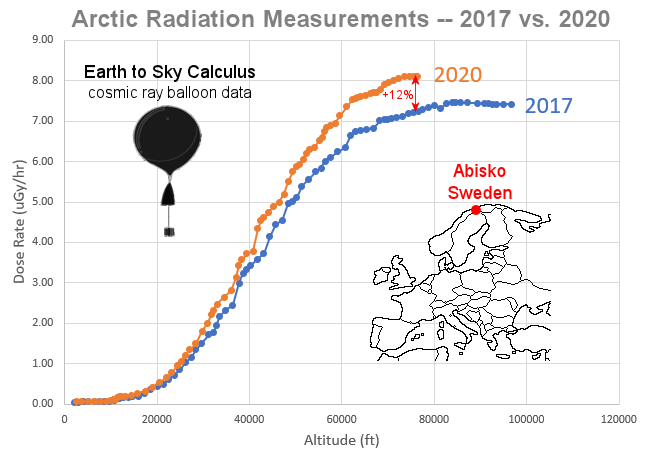
March 13, 2020: We’re back from the Arctic, and we have some new results to share. In January 2020, the students of Earth to Sky Calculus and Spaceweather.com traveled to Abisko, Sweden, to launch a pair of cosmic ray balloons. We’d been there before, launching three identical balloons in March 2017. Putting all the data together, 2017+2020, we find that radiation has increased +12% in the past 3 years:

arctic_2020c

The graph shows radiation dose rate (uGy/hr) vs. altitude (feet) all the way from ground level to the stratosphere. Radiation appears to be increasing at nearly all altitudes–even in the range 25,000 ft to 40,000 ft where airplanes fly. Polar flight crews and passengers are therefore absorbing ~12% more cosmic radiation than they did only a few years ago.

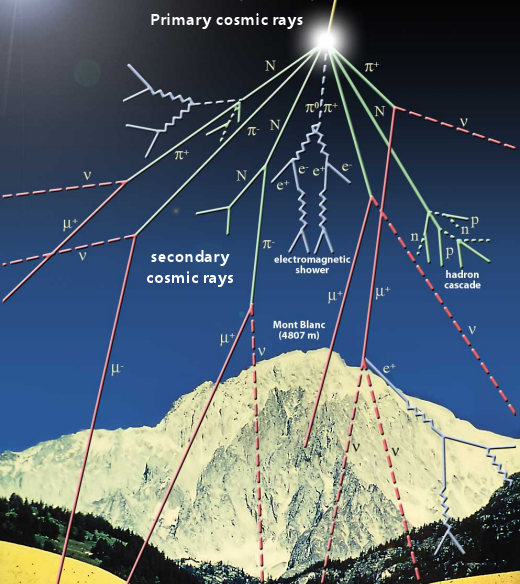
What’s causing the increase? Solar Minimum. At the moment, the sun is near the bottom of the 11-year solar cycle. During Solar Minimum, the sun’s magnetic field weakens, allowing extra cosmic rays from deep space to penetrate the solar system. These cosmic rays are hitting Earth’s atmosphere, creating a spray of secondary cosmic rays that shower toward the ground below.

Secondary cosmic rays are what we measure. Radiation sensors onboard our helium balloons detect X-rays and gamma-rays in the energy range 10 keV to 20 MeV, similar to what you get from medical X-ray machines and airport security scanners.


Above: Schematic diagram of a cosmic ray air shower. Learn more from CERN.

We’ve been launching radiation sensors almost weekly for 5 years–mainly from California, the “home base” of Spaceweather.com. Cosmic rays in the stratosphere have been increasing the entire time, a sign of deepening Solar Minimum.

The new data from Abisko, Sweden, show the increase is not limited to the stratosphere. It is also happening at aviation altitudes with a 3-year increase of ~12% even below 40,000 ft. We’re planning another ballooning trip to Sweden in August 2020 to confirm these results. Stay tuned.

A “Radio-Active” Sunspot from the Next Solar Cycle

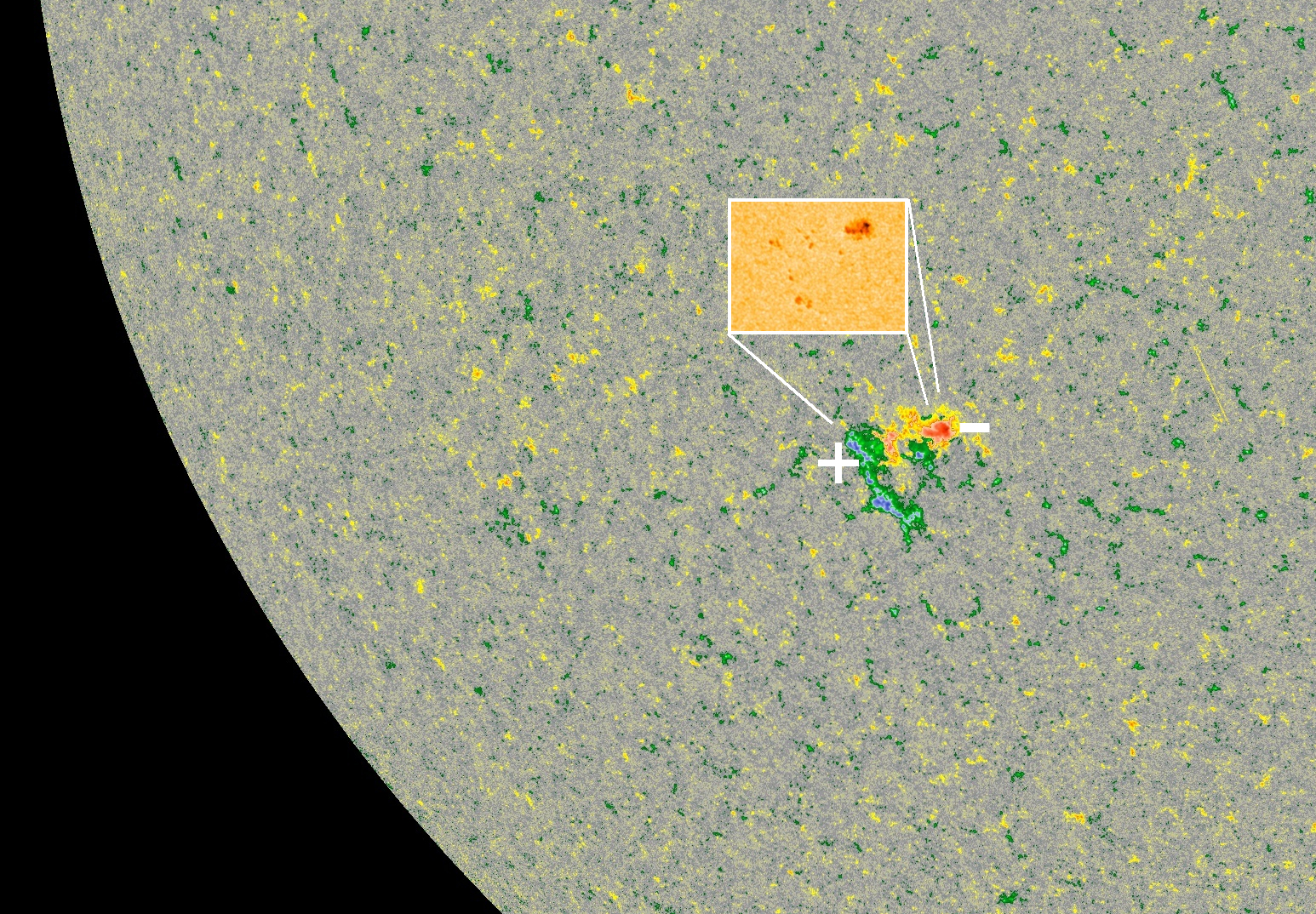
March 8, 2020: A new sunspot is emerging in the sun’s southern hemisphere, and it looks like a member of new Solar Cycle 25. Numbered “AR2758,” the sunspot is inset in this magnetic map of the sun’s surface from NASA’s Solar Dynamics Observatory:

How do we know this sunspot belongs to Solar Cycle 25? Its magnetic polarity tells us so. Southern sunspots from old Solar Cycle 24 have a -/+ polarity. This sunspot is the opposite: +/-. According to Hale’s Law, sunspots switch polarities from one solar cycle to the next. AR2744 is therefore a member of Solar Cycle 25.

AR2758 continues a trend of increasing Solar Cycle 25 activity. So far this year, there have been 4 numbered sunspots. Three of them (75%) have been from Solar Cycle 25. This compares to only 17% in 2019 and 0% in 2018. Solar Cycle 25 is still weak, but it is coming.

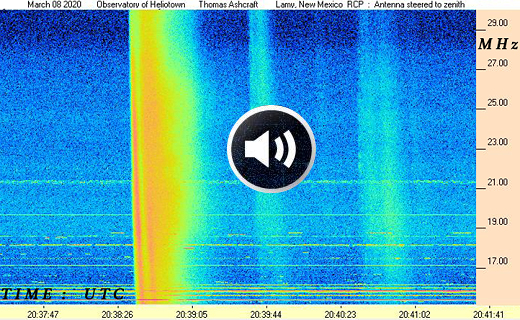
Sunspot AR2758 has produced one of the first solar radio bursts of Solar Cycle 25. “I was surprised to see distinct solar radio bursts on my spectrograph this morning,” reports Thomas Ashcraft. Click to play the slow-rolling roar of static that emerged from the loudspeakers of his amateur radio telescope in New Mexico:

These radio sounds are caused by beams of electrons–in this case, accelerated by unrest in the sunspot’s fast-changing magnetic canopy. As the electrons slice through the sun’s atmosphere, they generate a ripple of plasma waves and radio emissions detectable on Earth 93 million miles away. Astronomers classify solar radio bursts into five types; Ashcraft’s recording captured a mixture of Type III and Type V.

“Even in the height of solar maximum, this would be considered a strong solar burst,” says Ashcraft, who has been listening to solar radio many years. “I am hoping for more!”

Extra: There is growing evidence that solar radio bursts can disorient the navigation of grey whales, causing them to strand on beaches. According to the radical-pair hypothesis of magnetoreception, shortwave bursts such as the one Ashcraft recorded may be especially effective at sending them off course.